




Abstract
In this article, we explore the extent to which applying embodied, ‘skin in the game’ methods used in infrastructure activism (a contemporary art practice) can help expand the toolkit of methods applied in action research on infrastructures, interactions between humans and more-than-humans and urban socio-environmental processes in planning. In particular, we focus on two cases of infrastructure activism: the Amsterdam Zuidoost Food Forest (VBAZO), in Amsterdam's South East, and the KRATER project in Ljubljana's city centre. In our discussion of these projects, we explore the embodied research practices that infrastructure activists have developed to change not only urban green infrastructures but also researcher-actors’ own perspectives.
Keywords
Introduction: Borrowed methods – skin in the game and embodied methods in artistic research
In this article, we explore the extent to which applying embodied, ‘skin-in-the-game’ methods used in infrastructure activism 1 can help expand the toolkit of methods in participatory action research on infrastructures, interactions between humans and other-than-humans and urban socio-environmental processes (Loftus, 2009: 329). To that end, we explore embodied research practices that infrastructure activists have developed to change not only urban green infrastructures but also their own perspectives. In particular, we focus on two cases of infrastructure activism: the Amsterdam Zuidoost Food Forest (henceforth VBAZO) in Amsterdam’s South East and the KRATER project in Ljubljana’s city centre.
These projects showcase embodied research practices for researching infrastructures, human/other-than-human interactions and socio-environmental processes more broadly. We argue that these practices can become an effective approach to conducting fieldwork, premised on participants having ‘skin in the game’ that is the production of urban green spaces. Our claim is that this approach has the potential to change the power relations and set of actors involved in making such spaces.
Our notion of skin-in-the game embodied research refers here to the sustained practices of intense physical and emotional labour that aim to create better conditions for mitigating the local effects of the climate crisis. Skin-in-the-game praxis involves making ‘hands-on’ interventions with the aim of crafting the ‘ideal local material and social conditions’ for improving the health and biodiversity of urban green infrastructures. By the latter, we mean urban soil microbiomes and the animals, insects, microbes and fungi that inhabit them, as well as pocket woodlands, meadows and ‘leftover’ green spaces in cities – what Gandy (2016: 437) calls the Brachen. In addition to other-than-human actors, skin-in-the-game research draws other citizens into the ‘game’. These include political actors who can support, institutionalise and thus sustain into the future the new practices and forms of caring for urban green infrastructures that arise through such research.
Our effort to expand participatory action research methods responds to recent calls in the social sciences for embodied research and critical engagement with the more-than-human (Doshi, 2017: 126–127; Gandy, 2022: 22; Kaika et al., 2023: 4; Tzaninis et al., 2020: 7). We engage with the skin-in-the game methods developed in the area of artistic practice and research referring to infrastructure activism. The value of infrastructure activism, we claim, lies in its potential not only to reveal facts but also to imaginatively explore and prefigure new ways of producing, managing and engaging with (in this case) urban (green) infrastructures amongst both humans and other-than-humans alike. As scholars argue, art (and artistic research) is therefore just as much a mode of inquiry as mathematics or the empirical sciences (Borgdorff, 2011: 54; Johnson, 2011: 142; Scrivener, 2011: 259). The principal difference is that artistic research focuses more intently on certain qualitative dimensions of lived urban experience that are often overlooked. These include the look and feel of the process of democratising natures, as well as the new ways of doing things that will produce them (Borgdorff, 2008: 96).
Embodied research
Embodied research in the arts connects the researcher’s lived (embodied) experience with the politics of the object of research while fostering solidarity with that object. The researcher’s physical body is both an affective lens through which research is produced and one that is impacted by conducting the research (Borgdorff, 2011: 51, 61, 93; Sullivan, 2011: 117), with which sympathies and entanglements within the socio-natural field of inquiry develop. Through these entanglements, the field of inquiry is something that the researcher wishes to change. According to Thanem and Knights (2019: 461), embodied research formats allow sympathies to model the researcher’s reflection and analysis, ultimately creating political solidarities. Research ‘bias’ in this context can be embraced as a process to be studied in its own right. In short, embodied research requires total immersion in the field. Embodied researchers become entangled, acknowledge all of the privileges and biases that this involves and explore all of the consequences that they entail. As Maanen (2010: 219) puts it: If one cannot do lengthy and sustained fieldwork among others who are often initially recalcitrant and suspicious of those who come uninvited into their lives, one has no business doing ethnography.
This position has far-reaching consequences that implicate even the readers of the research results. Critical literature on embodied research points to responsibilities extending beyond the researcher’s world and into the reader, through embodied writing that ought to stimulate the reader’s imagination in ways that intend to precipitate a change in the reader’s practice.
Such embodied research practices commonly draw from queer and feminist lineages and put forth calls for environmental–political action (Gibson-Graham, 2006: 6; Santos, 2022: 91).
Scholars of that tradition (Gibson-Graham and Roelvink, 2009) take up an experimental researcher’s stance to bring new realities into being in the context of the climate crisis and the political ‘stalemate’ (324), giving rise to hybrid research collectives that centre on transformative change. Drawing from the sociology of science, embodied research practices represent an activist plea to academics to participate in hybrid research collectives that are already busy with world-changing and with developing reciprocal and ethical practices of ‘more-than-human’ economy (Gibson-Graham and Roelvink, 2009: 322). This collective activism trope has inspired new generations of researchers to band together for instance in the Community Economies network, 2 a platform where practitioners share research, tools, teaching materials and discuss action. This network has produced work like McLean's (2022) decolonial, feminist and queer research on the possible pitfalls, as well as the exciting potential, of arts-driven approaches, or Do Thi and Dombroski's (2022: 28) more-than-human analysis of climate change adaptation through the entanglement of Vietnamese farmers and other-than-human entities, which advocates not only investigation but also action in response to embodied knowing (35).
Recent neoliberal calls in the Netherlands and elsewhere for the professionalisation of arts-education have favoured traditional methods training and research akin to the social sciences. Against the backdrop of the marketisation of university education, a strong debate has emerged over the legitimacy of artistic research methods in comparison to more ‘scientific’ and hence supposedly more valid research methods in the social sciences (Cramer and Terpsma, 2021; Vienna Declaration on Artistic Research 2020). Borgdorff (2011: 44), amongst others, has strongly defended the efficacy of embodied methods. He reiterates how, over two decades, a wide range of qualitative methods from the social sciences have become fully embedded, taught and used in curricula on art, design and architecture. These include action research, grounded theory, participant observation, performance ethnography, field study, autobiographical narrative and thick description (KUNCI Study Forum and Collective, 2023). The appearance of the longitudinal embeddedness of qualitative methods in such contexts also means that artistic research methods are embedded in the social sciences. Specifically discussing science and technology research, Borgdorff states that the ‘boundary between applied research in the arts and artistic research is thin and rather artificial, just as the dividing line between artistic research and performance studies or ethnography may also seem contrived’ (2012: 157). A section in Borgdorff’s book Conflict of the Faculties (2012: 157, 173–4) is devoted to methodological overlaps between the social sciences, science and technology studies, with artistic research. Ultimately, he suggests that borrowing qualitative academic methods strengthens artistic research methods (Borgdorff, 2011: 50–1). In this article, we take this argument a step further. We contend that embodied research methods developed in arts practices can and should cross-fertilise social sciences disciplines too. In this way, we mean to answer the calls to grapple with the more-than-human in the social sciences, specifically in urban political ecology. We argue that embodied research methods such as those used by infrastructure activists are especially suited to researching interrelations and entanglements between humans and other-than-humans.
What embodied research in infrastructure activism can offer the social sciences
The social sciences have been experimenting with embodied research methods for several decades. Examples include Gandy’s documentary filmmaking of interstitial urban natures and edge landscapes (2017); Velicu’s interviews and ‘imaginary-making’ work with citizen groups around participatory political processes (Velicu and Kaika, 2017: 305–6); and Kaika’s refugee community theatre, in addition to her making art and theatre with mortgage holders in Greece and Spain (García-Lamarca and Kaika, 2016; Tsavdaroglou and Kaika, 2021). In these works, though, embodied research methods remain supplemental or secondary to standard, fully validated social science research methods. Bookchin et al. (2013: 4) advocates militant research praxis on the grounds that it is ‘the place where academia and activism meet’ and can foster ‘new ways of acting that lead to new ways of thinking’. Native American activist Andrea Smith quotes her mentor Judy Vaughn to this effect: ‘You don’t think your way into a different way of acting; you act your way into a different way of thinking’ (quoted in Bookchin et al., 2013: 3). The practice of researchers involved in radical forms of eco-activism (e.g., water and forest protectors, Indigenous land protectors) also falls into the category of embodied research methods (Tsavdaroglou, 2019: 220). Militant research, which aims to produce ‘politically applicable knowledge from within movements, for movements’, is also embodied research (Apofis, 2016: 5; Bookchin et al., 2013; Colectivo Situaciones, 2003; all cited in Tsavdaroglou, 2019: 200).
Recently, however, there have been several calls to increase the prominence of embodied research methods in the social sciences, especially given the capacity of certain types of embodied art-making to create platforms for social–political or material change (Beyes and Steyaert, 2011: 111–112; Loftus, 2009; Uitermark, 2009: 349). According to those advocating this shift, the value of artistic research lies in how it reveals the significance of experiences (Borgdorff, 2011: 93; Johnson, 2011: 149; Sullivan, 2011: 115) and imaginatively explores how the world is and might become (Borgdorff, 2011: 61; Loftus, 2009: 329). According to these accounts then, action research in art can be a way of inquiring into possibilities: a form of small-scale prefigurative politics (Johnson, 2011: 149). Indeed, Loftus underlines urban artistic interventions’ radical potential to effect change, in particular by revealing new imaginaries of what a more democratic culture might be like (Loftus, 2009: 327–9). In sum, artistic research practices prompt audiences to query what is taken for granted; offer new experiences of the everyday; and create new imaginaries for the future.
One clear way in which action and artistic research methodologically overlap with the social sciences lies in its potential to influence field sites (Beyes, 2010: 237–8; Beyes and Steyaert, 2011: 112). In this sense, the time is ripe for the social sciences in general, and infrastructure research in particular, to enter a dialogue with infrastructure activists with the aim of practising new forms of academic activism as research. In fact, this dialogue has already begun, though it is by no means systematic. Utrecht's 2019–20 Basis voor Actuele Kunst programme, for example, forged a collaboration with infrastructure activist Jeanne van Heeswijk titled ‘Trainings for the Not-Yet’. This involved workshops bringing together social science theorists, action researchers and infrastructure activist artists primarily from the EU, United Kingdom and United States (Heeswijk, 2019).
In artistic research, the way of thinking and doing that creates the previously unimaginable is known as (radical) contingency (Borgdorff, 2008: 95, 2012: 71). As a form of art-making and ‘field creation’, radical contingency goes beyond knowing ‘what’ or ‘how’. Instead, it is driven by the curiosity to explore what has not yet been done and what remains unknown (Borgdorff, 2011, 2012; Johnson, 2011; Scrivener, 2011). For examples of artist research projects that sketch out possible futures (see Table 1). They include the Freehouse Collective, initiated by the Afrikaanderwijk Co-op in Rotterdam in the Netherlands. Since 2008, Freehouse has transformed the district’s outdoor market, from its practices and products to its approach to public engagement. This involved supplying the market with design products produced by neighbourhood businesses (ranging from fashion, through motor scooters, to restaurant experiences); starkly boosting the market’s assortment; upgrading the neighbourhood; and keeping profits within the community’s co-operative (Heeswijk and Otterloo, 2008).
A table of the artworks mentioned in the article, their adopted methods and what these methods affect (in order of appearance).
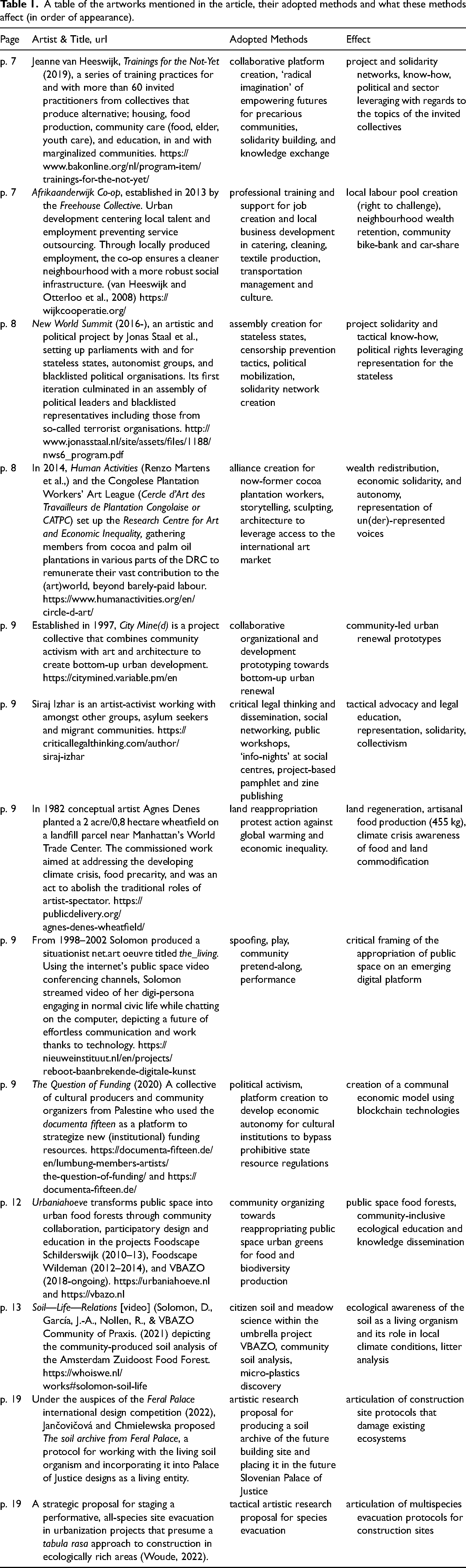
Looking at interventions beyond the neighbourhood scale, there is the New World Summit, an artistic and political project that involves setting up parliaments with and for stateless states, autonomist groups, and blacklisted political organisations. Its first iteration culminated in an assembly of political leaders and blacklisted representatives from the so-called terrorist organisations such as the PKK (Staal, 2016). Another international example is the work of Human Activities and the Congolese Plantation Workers’ Art League (Cercle d’Art des Travailleurs de Plantation Congolaise or CATPC). They commissioned the design and construction of a ‘white cube’ exhibition space on a former Unilever palm oil plantation in Lusanga in the Democratic Republic of Congo, designed by starchitects at the Office for Metropolitan Architecture. The work reverses the mechanisms through which plantations subsidise the art-world elite. The CATPC is now highly visible and attracts capital, which helps the group create ideas for a ‘post-plantation’ ecological and economic future (Martens, Human Activities and CATPC, 2014-ongoing).
Relational Aesthetics – a theory of contemporary art-making practices concerned with ‘the interhuman sphere’s relationships and social networks first introduced at the end of the 1990s (Bourriaud, 1998/2002) has since advanced with politically pre-figuring characteristics. Recent large-scale exhibitions such as the Venice Biennials of Art and/or Architecture attest to this, taking up post-humanist positions questioning How will we live together? (2021), and pavilions exposing artists whose oeuvres unpack proposals to these curatorial questions (Who is We? 2021, Planet B; Bourriaud, 2022, Strangers Everywhere! 2024).
In infrastructure activism, the establishment of new practices can also replace the object of research and research field with a newly produced reality. (Staal, 2020: 63) Depending on the project, the latter might refer to a parliament for stateless people, a decolonising project providing reparations to former plantation workers, or a new neighbourhood economy that alleviates precarity through collaborative production. In these examples, infrastructure activism creates possibilities for (political) life based upon the concerns of those researched. In this sense, infrastructure activism also critically engages with the future, which it approaches as a research field (Johnson, 2011: 107). According to Demos, ‘in the subfield of infrastructure activism, artists research subjects through a “field production” which yields more questions than the answers it provides. Not knowing is an essential aspect that drives the work’ (2016: 59–60). Loftus (2009: 329) refers to similar practices as ‘interventionist art’, especially in relation to the work of City Mine(d) and Siraj Izhar. 3 Interventionist artists work in a lineage that stems from Surrealism and the Situationists and continues through Wiener Aktionism through Fluxus to land art (such as Agnes Denes’ famous Wheatfield), to early public space situationist net.art (Solomon, 1998 ‘the_living’). There is a political engagement and interventionist legacy amongst these artists who apply traditions in political tactics (see documenta fifteen, The Question of Funding 2020). In their book Second Nature Urban Agriculture, Bohn & Viljoen architects present a timeline and inventory of infrastructure activism as it developed in the context of urban agriculture practices in the EU in the early 2000s. Artists eagerly took to such activism as part of their efforts to build communities, engage in critical spatial planning and food production at a small, local scale (Berg, 2013; Viljoen and Bohn, 2014: 259).
We argue here for the need to bring these types of practices squarely into the research and training methods of the social sciences, particularly in the areas of infrastructure research, urban political ecology and more-than-human geographies, which resonate strongly with embodied research methods. In the following sections, we present two case studies to illustrate the embodied research practices developed by infrastructure activists to produce infrastructural alternatives to existing institutional structures. Their practice shows that situated and embodied research practices can transform socio-ecological and socio-political interrelationships, as well as precipitate the emergence of new and more inclusive ways of producing urban green infrastructures. Indeed, the latter is the ultimate aim of any social science researcher in these fields.
The Amsterdam Zuidoost food forest: Turning modernist lawns into places for other-than-human encounters
In 2018, the manager of the district council area Amsterdam Bijlmer commissioned a project from Urbaniahoeve, an artist collective producing urban food forests with locals since 2010 as a form of infrastructure activism. As the Bijlmer’s spacious urban greens do not provide well-being for all residents equally (Lewartowska et al., 2024: 315), the commission’s aim was to collaborate with residents and officials in transforming the lawns between modernist high-rise buildings into a public space food forest. Since the 1990s, two waves of revitalisation projects (Aalbers, 2010: 1719) have aimed at increasing integration and alleviating territorial stigmatisation (Pinkster et al., 2020: 539; Veer and Kornatowski, 2021: 268), characterising the area's policy and projects. Burdened with high maintenance costs, and low levels of use, there are additional administrative blind spots concerning fostering biodiversity and mitigating the local effects of climate crisis in a way that is appropriate for a broader group of residents (Hoyle et al., 2017, 2019). The motivation for commissioning a food forest project in the area therefore, concerned an attempt to democratise public space for a wider group of residents, compared to those already engaged in the collective gardens.
Artist involvement in recent explorations into the city as food production landscape is well-documented (Rooden, 2012: 36–7; Viljoen and Bohn, 2014: 28). Yet this group of skilled and self-directed professionals is known to belong to a precariat class (Bain and McLean, 2013: 97) of researchers and producers. So too in this project, in which the project‘s managers were commissioned to carry out the works within an 18-month timeline. Two managers were paid half-time for what would become an initial pilot project period. The managers were paid to recruit participants from a representative group of locals, develop and organise their educational programme and implement the food forest's planting. The representative group of participating residents received as compensation for their participatory labour in the planting activities and the food forest's future stewardship, an education in urban food forest design and maintenance based upon Urbaniahoeve's year course on urban food forest design and maintenance. Participants who later engaged in organisational activities were compensated with a municipal ‘volunteer’ allowance. Based on the Urbaniahoeve artist-project managers’ experience in earlier projects, an 18-month schedule was sufficient to implement this phase of project if no procedural obstructions delayed the seasonally sensitive work. The budget did not allow for any procedural obstructions that caused delays to carrying out activities at the seasonally appropriate time. This is however, what happened when procedural issues concerning who would grant the commissioned project's planting permission, significantly altered the project's timeline, planning and budgeting (108). The budget for paying the artist-project managers, hardware, plants and the socio-educational activities, was stretched with additional work in the form of project (re-)design, and meetings with officials, and educating subsequent groups of participants. The food forest project has since been funded via diverse municipal funding programmes for urban greening involving residents, with the project-managers producing the funding applications uncompensated.
This urban food forest project – titled VBAZO to represent the Dutch acronym Amsterdam Zuidoost Voedselbos, now comprises a footprint of 56 hectares between iconic high-rise modernist social housing units. As of 2021, these spaces had become dotted with small orchards, connecting the area to Amsterdam’s broader peri-urban ecological framework through urban wildflower meadows. But when the project began, the green spaces between the high-rise flats were unusable (exotic plant) shrubbery and manicured turfgrass lawns. What is more, these lawns were cut to just four centimetres in height and mowed with heavy machinery no less than 22 times annually. This management regime had not been changed or questioned since the area’s landscape architecture was installed in the 1970s and renovated in the 1990s.
Since its foundation in 2010, Urbaniahoeve has focused its projects on collaborating with locals to transform public space urban greens into spaces of inter-species care. This mitigates the local effects of the climate crisis, fosters higher levels of biodiversity and provides more nutrition for both humans and other-than-humans (Kennedy, 2022: 8–9; Solomon and Nevejan, 2019: 621) (See Table 1: Urbaniahoeve). Along with participants in VBAZO’s ‘Community of Practice’, Urbaniahoeve identified four types of urban greens in which this food forest pilot project could meaningfully intervene: pocket woodlands, turfgrass lawns, waterscapes and much-used public spaces. As a first step, the VBAZO's project managers recruited their Community of Practice from local residents, who participated in exchange for the aforementioned educational programme the project provided. As part of this, its members were invited to choose small sites (parcels) at which they would intervene in the landscape. They did so strategically, taking two key factors into account: proximity to their own home and the parcel’s potential to connect with other small ecological spaces. In this way, it was hoped that in time the project’s biodiversity impact could become much greater than that of its 56 hectares (Beninde et al., 2015) (see Figure 1).
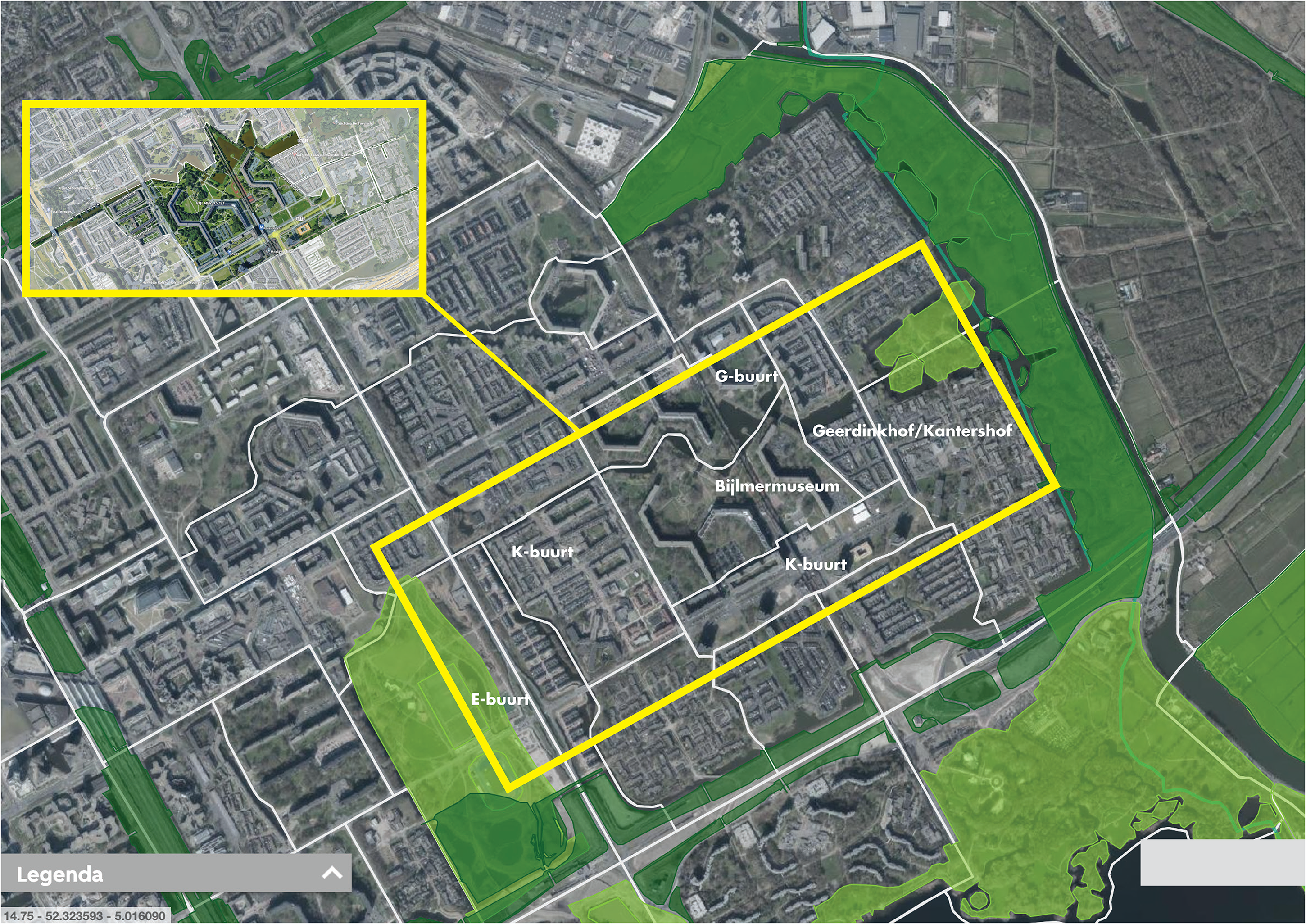
Amsterdam's ‘ecological passages and green structures’ (highlighted green), in relation to the VBAZO project ecological footprint (outlined yellow).
In parallel and in support of these efforts, the VBAZO managers’ educational programme instructed project participants on the principles and practices of designing and maintaining urban food forests, as well as basic plant and insect dynamics, local soil analysis and food foraging. In the VBAZO’s first years, these weekly educational workshops took the form of embodied research with the Community of Practice, with members taking informal walks, holding discussions and trying out planting techniques. These first embodied ways of engaging the Community of Practice were deliberately designed as an educational and planting intervention programme. The latter was to favour ‘charismatic’ and easily recognisable plant species that have a high ecological impact (e.g., birds, wild bees, butterflies and other pollinator species). The first workshops focused on identifying and learning how the project could cater for these species’ food and habitat requirements. An engagement with less ‘charismatic’ species (e.g., thistles, nettles, ‘native’ groundcovers and the soil microbiome) was equally central to the project.
Municipal management services and participating residents rarely appreciated collaboration with these often invisible, yet essential, species and locations (i.e., the soil). Hence, there was a deliberate decision to engage with these species communities and particularly the soil microbiome in the first instance. In this way, the project sought to combat a form of ‘surface chauvinism’ (Lyons, 2020: 42; Wolfe, 2001) in which practitioners focus on providing resources for only ‘charismatic’ local animal, insect and plant species in order to maintain the local community’s engagement and policymakers’ interest. Indeed, a few months into the project, the local Community of Practice was monitoring and documenting subsoil and other-than-human species communities at the parcel level on a weekly basis. For this, they analysed soil across the project’s footprint (see Table 1, Solomon, García, Nollen et al.). The VBAZO also worked with a conservation ecologist to design a system of meadow management in accordance with both the project’s ecological ambitions and community members’ wish to transform lawns into meadows (see Figure 2).
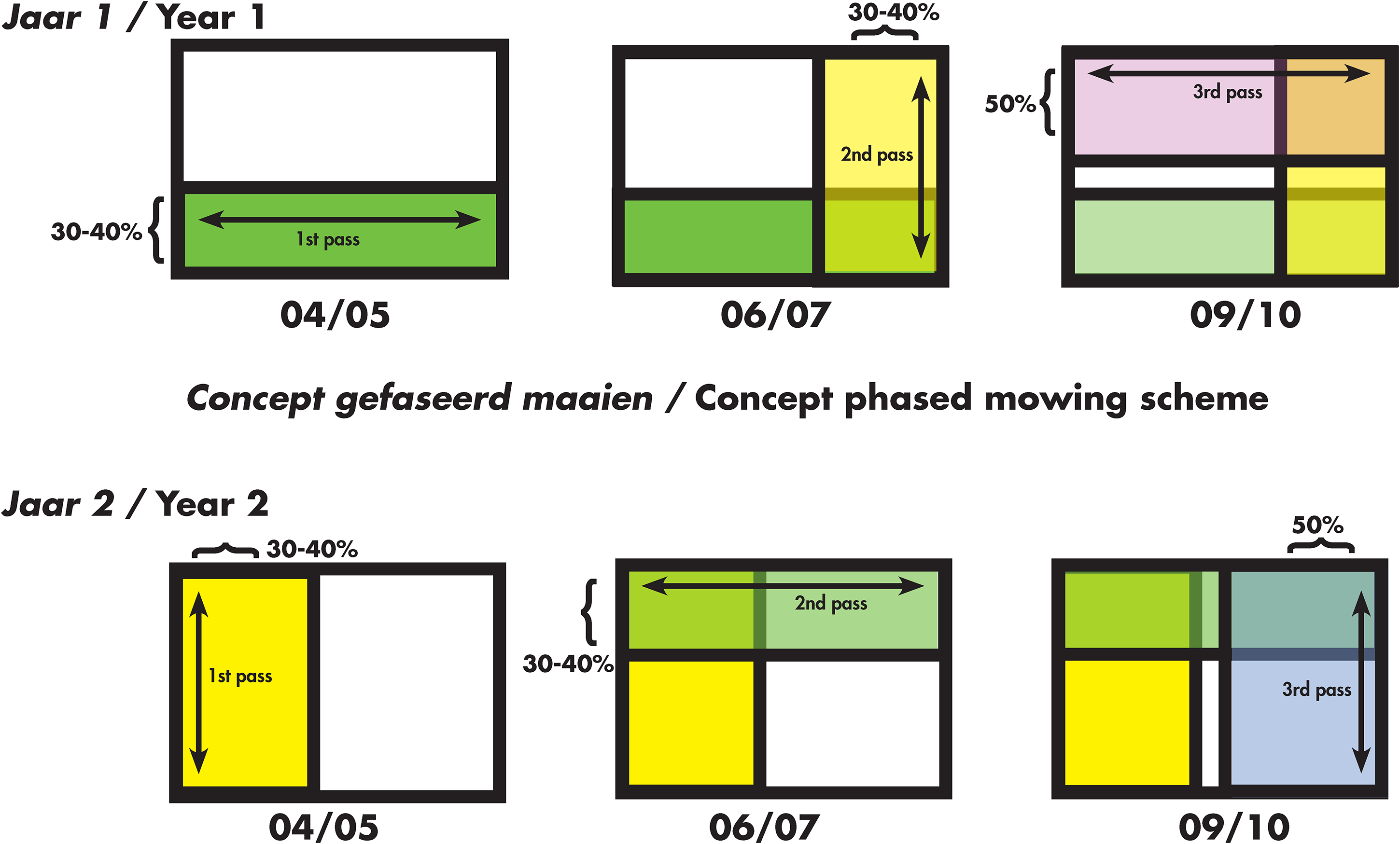
VBAZO phased mowing concept diagram.
To enable the planting and maintenance of the new spaces, the project recommended a new management regime for the whole area’s green spaces. This included a ‘phased mowing’ plan that would replace the 22 mowing passes each year and allow the VBAZO’s 56 hectares to host their ‘maximum’ potential biodiversity (Beninde et al., 2015; Gagné et al., 2015). The new management regime prioritises the food and habitat requirements of local and threatened populations of birds and insects over the modernist aesthetics of manicured lawns. The project’s key hurdle proved to be replacing the local authorities’ management regimes with the new phased mowing plans, thereby accommodating new places in which to generate food, nectar and meaningful encounters between humans and other-than-humans. Between 2020 and 2022, VBAZO managers worked intensely with a manager-led municipal stakeholder group to embed the VBAZO’s new maintenance requirements into the Department of Public Works’ (Stadswerken) existing maintenance regime. This was no small ask. It demanded changing the ways in which the municipality communicated, mapped and maintained things, as well as its working culture and the formats of its external labour contracts.
From 2020 onwards, protections for the VBAZO’s green parcels were established through the Ambitions and Conditions document (VBAZO Ambities en Voorwaarden Amsterdam, 2020), which was collaboratively authored with the stakeholder group governing the VBAZO. The agreement replaced the contracts stipulating 22 mowing passes annually on the area’s turfgrass lawns with a new mowing regime of only three mowing passes annually (see Figure 2). In addition to the mowing, the mowed material needed to be removed to avoid increasing the soil’s fertility, which would negatively affect plant biodiversity. The new management regime, combined with the planting of additional native meadow species, quickly transformed turfgrass lawns into wildflower meadows, encouraged nectar foraging and produced both a year-round habitat for pollinators and requisite habitat for the pollinators’ predators. Implementing this phased mowing and maintenance regime at both parcel and organisational levels was key for the project to achieve its ecological ambitions.
However, mowing the area less frequently raised a new conflict and set of concerns (Hoyle et al., 2017: 1111). This time the conflict concerned the timing of the mowing passes and the type of technology used to avoid compacting the newly forming meadow soils. For two full years, the community’s planting efforts failed to deliver the desired outcomes. This was because the contracted mower did not appropriately apply the phased mowing plan. This, in turn, resulted in thistle-dominated patches in the meadows, which dismayed some in the Community of Practice. Some residents now perceived the VBAZO as a negative and chaotic programme, which had introduced weed and thistle to the public urban greens in front of their homes.
This was directly linked to the public’s wider perception of thistle as a weed and an unwanted species. In an exasperated email sent to a social worker and forwarded to the VBAZO managers, one resident wrote that ‘It’s becoming a shaggy mess!’ (July 2023). For the VBAZO’s managers, though, thistles were welcome; they are the primary food source of European Goldfinches (Carduelis carduelis), whose populations had been decreasing in Amsterdam due to the near eradication of thistles in local green landscaping (but see IUCN). Thankfully, the positive effect of thistle patches in the VBAZO was soon observable: from June 2021 onwards, goldfinch flocks were feasting on the thistle seed and had started populating the site. To safeguard the protected bird species and get the mowing right (the project’s raison d’être), the project managers developed a plan to communicate the benefit of thistles in developing biodiversity to the VBAZO’s municipally contracted mowers, residents and visitors. As one local resident said in an informal conversation with a VBAZO manager, ‘What an amazing amount of (European) goldfinches! They’re a protected species? We have a conservation park in our front yard’ (June 2022).
The VBAZO is still ongoing in 2024. To continue embedding the project in the local community, its managers are developing a citizen communication plan through a web platform (now in development) that includes a set of responses to any complaints about the meadow parcels that citizens might make using the municipal contact line. Through the phone line or follow-up emails, civil servants can then offer citizens scripted responses to their queries. The scripts contain images and short texts that provide insight into the relationships between observable plant, animal, insect and fungal species, as well as the planned maintenance of the meadows. The aim of this ongoing exercise is to create alliances amongst residents, civil servants and the project. The more-than-human rhythms visualiser web application enables civil servants trained in using the application, to respond to complaints about ecosystem ‘shaggyness’ with information about the seasonal ecological processes occurring on the site around the year (even when the landscape looks less than perfectly maintained). In response to comments that the landscape featured too many dead stalks, civil servants could soon respond that the remaining stinging nettle stalks (Urtica dioica) are in fact the habitats in which the larvae of the butterfly species Vanessa atalanta lay their eggs. The emerging larvae are harvested by adult European Goldfinches to feed their hatchlings. Each goldfinch nest requires around 9000 larvae if the hatchlings are to mature to the point of being able to forage thistle seeds independently. European Goldfinches are a protected species in the Netherlands (Wyles et al., 2019; Figure 1) (see Figure 2). The emerging larvae are harvested by adult European Goldfinches to feed their hatchlings. Each goldfinch nest requires around 9000 larvae if the hatchlings are to mature to the point of being able to forage thistle seeds independently.
The embodied practices that the VBAZO established include regular monitoring and methodologies of observation to create awareness of the number of species present in the area, seasonal variations and conditions and interventions in planting and maintenance regimes that take species’ presence and habitats into account. Even before the meadows were established new types of embodied practices set in. They included foraging, which went beyond the simple extraction of food, to become an act of eco-spatially favouring ‘beneficial’ edible species such as dandelions, wild rocket, winter purslane, deadnettle, chicory, mugwort, wild burdock and especially wild garlic. These embodied practices did more than document what was there. They facilitated the instigation of new, site-specific forms of care and management. In turn, these produced not only new types of urban ecological infrastructures and new power relations between the local community and policy officials but also new dynamics and hierarchies between human and other-than-human actors within urban green infrastructures.
KRATER, Ljubljana: Feral infrastructures vs limitless planning shrinking feral possibilities
Ljubljana’s Trajna Collective is a group made up of designers, ecologists, biologists, permaculturists and architects, all deeply concerned with the continued urbanisation of the city. In 2020, the Trajna Collective entered a disused, gravel quarry in the centre of Ljubljana and began caring for the location’s biodiversity. In parallel with this, it started a campaign to increase local interest in its ecological conditions through regenerative design projects. 4 The Slovenian Ministry of Justice permitted the Trajna Collective to research the 1.8 hectare site on the basis of a contract that has to be renewed annually. The collective named the location KRATER, which means ‘crater’, on account of the holes that had once been produced by gravel excavation there. Between 2020 and 2023, the founders (a group of artists, designers and curators) launched an educational, hands-on, permaculture design, public programme at KRATER, aiming to reimagine and transform the site into a platform for human–plant companionship (Osole and Sretenović, 2020). Engaging with and nurturing the site’s (plant) species and mineral resources, KRATER’s programme includes non-extractive forms of paper-making, native ceramics, woodworking and myco-design labs, as well as in-situ innovations in the use of materials (including a semi-permanent tea pavilion made of ‘rammed earth’, pounded and polished local clays and gravel). The project focused on enhancing the regenerative capacities of the site’s ‘pioneering species’, such as mugwort, malva and echium varieties. As part of this, the collective cared for patches of Japanese knotweed (Reynoutria japonica). According to EU ecological guidelines and prevailing assumptions in urban green maintenance more generally, this species is commonly understood as invasive and is the subject of an ongoing, world-wide debate (Mediamatic, 2023). The Trajna Collective decided to steward the species in situ by making and eating a savoury pastry named ‘NOT-Weed burek’ and producing ‘NOT-Weed’ papers. In this way, they emphasise that Japanese knotweed is ‘not a weed’, thus questioning the official policy of eradication (and its associated budgets).
In 2021, however, the national government decided to use the KRATER site to build the new Court of Justice to conjoin the local district, labour and social courts and launched a national architectural competition for a new Palace of Justice on the KRATER site. Competition guidelines neglected to mention the site’s value for the local ecosystem, giving the impression that the location was a tabula rasa (Sretenović and Meznarić-Osole, 2022) (see Figure 3). The winning architectural studio, Bevk Perović Arhitektidesign demanded a complete site excavation, which would obliterate not only the special biodiversity habitat that KRATER had created but also biodiversity in the broader area. 5 Having been first left alone and later ‘nurtured’ by the Krater Collective, KRATER had visibly and palpably become a biodiversity hub within Ljubljana: a cool and moist bullseye in a city centre suffering seasonally from the urban heat island effect, drought and flooding.
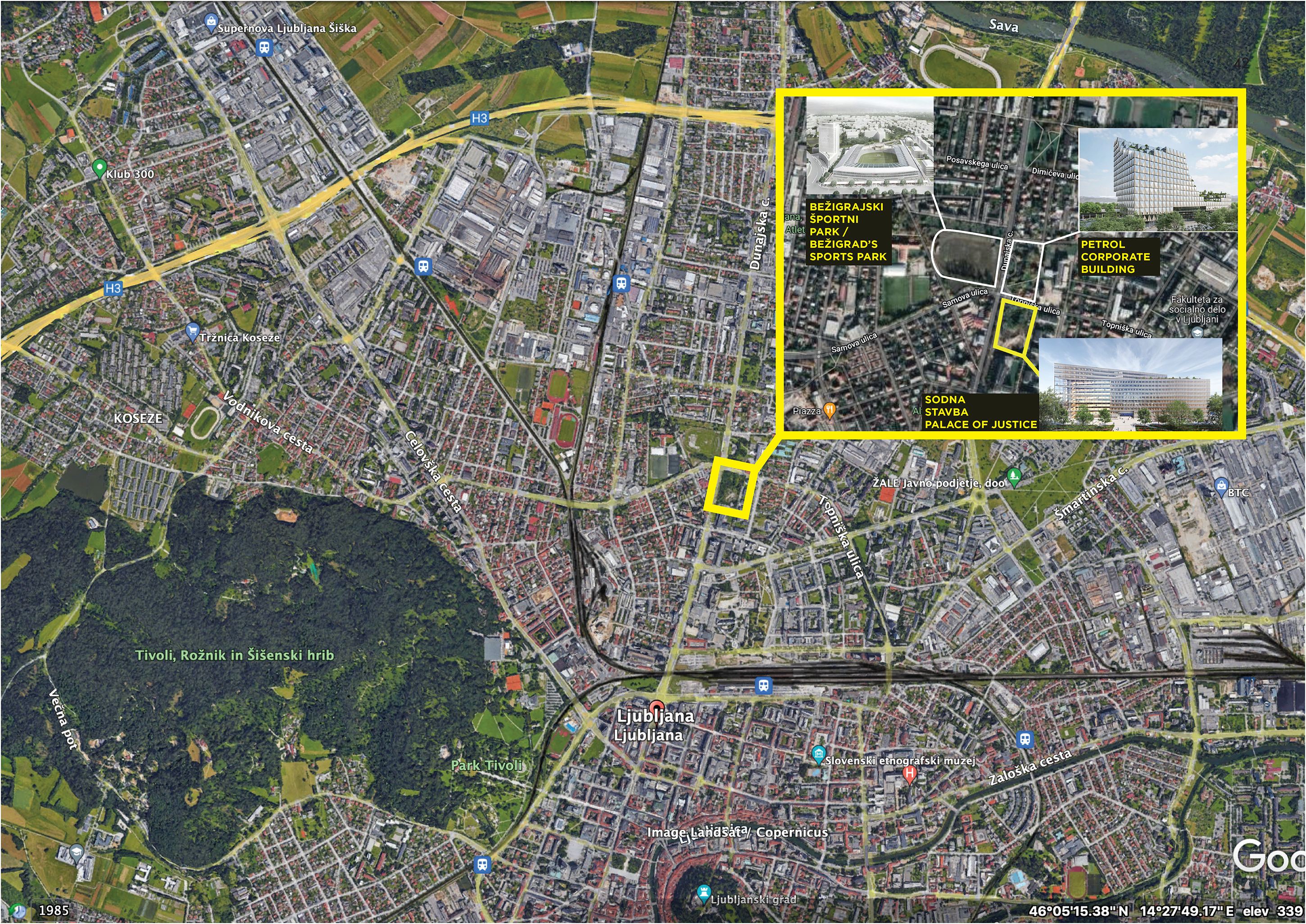
The KRATER location (outlined yellow) in relation to Ljubljana's surrounding green structures.
To avoid Krater’s destruction by the new Palace of Justice project, Mežnarić Osole and Sretenović launched an alternative international architecture competition and conference for a palace of feral justice. The Feral Palace project references the reparative quality that pioneer ecosystems have in landscapes and the need to provide justice to ecosystems. An international jury was appointed, comprising Rok Kranjc (a social–ecological transformations researcher at the Institute for Ecology and founder of Futurescraft, a research and design studio, Klaas Kuitenbrouwer (a researcher at Het Nieuwe Instituut (Rotterdam) and initiator of the Zoöp project), and a third member (anonymised for reviewing process). The idea was to show that by putting ‘skin in the soil’ there was a different way of doing things; that it was possible to design a new Feral Palace that would accommodate both the site’s biodiversity needs and the human need for a new Palace of Justice building. The jury chose eight international, cross-disciplinary teams consisting of lawyers, ecologists, landscape architects, designers, curators and sociologists, and invited them to develop a Feral Palace through mentored group sessions over a four-month period. During the sessions, the group discussed architectural and building design protocols that do not harm vital ecosystems on construction sites, not least by mitigating the builders’ contact with the ecosystem and soil microbiome in situ. The chosen design groups developed, amongst other things, the soil archive from Feral Palace, a protocol for working with the living soil organism (Jančovičová and Chmielewska, 2022) and incorporating it into Palace of Justice designs as a living entity. One proposal presented a worst-case-scenario strategy to stage a performative, all-species site evacuation should the original competition’s designs (presuming a tabula rasa) ever be implemented (Woude, 2022). The four months of workshops culminated in a three-day international conference held to exhibit the alternative competition’s results, with the pre-conference dinner and discussion hosted by the Dutch ambassador to Slovenia.
Trajna’s well-attended alter-festival and the Feral Palace of Justice conference exhibited how architects can use embodied research to produce socially relevant work under conditions of climate crisis. The embodied research practices that the Krater Collective developed on-site included; monitoring the site regularly (i.e., walking around the area and observing seasonal conditions and species); inventorying resources and habitats; facilitating plant, animal and fungal species through (trans)planting and favouring ‘beneficial’ species by variously harvesting and stewarding materials, plants and fungi; gathering clay and soil for ceramics and terrazzo; harvesting Japanese knotweed to make paper and as human food; metabolising ‘waste’ materials from diverse processes of manufacture so as to produce artisanal packaging for the ceramic objects. Public advocacy for the site was generated through numerous interviews and roundtable discussions, which sought to enhance Krater’s degraded public image, as well as an educational, curatorial and public programme held on the site.
These were all practices of embodied research. These practices, disseminated through regular public workshops, focused attention on site-specific relations between humans and other-than-humans. Thanks to the international media attention garnered by these events, as well as ‘shifting priorities’ vis-à-vis the Palace of Justice’s location, in May 2023 the Ljubljana commissioning body decided that the Krater Collective could remain in place, stewarding and hosting programming at the KRATER site until December 2024.
Discussion
The VBAZO and KRATER projects illustrate how infrastructure activists can create new roles and forms of agency for humans and other-than-humans, whether by creating new and embedding themselves in existing more-than-human relations or critical spatial practice. In both cases, embodied research practices created material and spatial resources and governance instruments that helped sustain local, threatened species as well as prioritised biodiversity and more-than-human visibility and agency. These practices included monitoring physical sites, inventorying species and the resources they require, stewarding ecosystems and using local plants and materials, in addition to a broad range of in situ dissemination activities. Carried out by infrastructure activists from diverse arts disciplines, the forms of embodied research undertaken as part of the VBAZO and KRATER recognised, facilitated and leveraged the alter-labour of an area-specific, multi-species whole. In these projects, then, embodied research into site-specific, species-wide engagement leads to ‘every-body biodiversity’.
The two projects share four key characteristics. First, their aim is to mitigate the local effects of climate change by producing new infrastructural roles for urban greens and humans.
Second, these new infrastructural configurations are produced through collective processes and require both human and other-than-human participation. Third, their spatial practices combine artistic intervention with infrastructure activism; their work with and on urban metabolic processes are a form of cultural production (Beyes and Steyaert, 2011: 110). Fourth, their embodied practices establish new stewardship and management regimes. These not only increase levels of urban biodiversity by expanding urban greens’ plant and soil surfaces but they also engage, enlarge and diversify the socio-political footprint of the participating actors and collectivised processes, something we propose to describe as an increase in the projects’ relational surface area. As areas are expanded through additive planting (in the case of the VBAZO) or additive location programming (in that of KRATER), the number of inter-species relations that can thrive in and on these areas also expands. Additionally, the governance of these newly generated relations creates new entanglements and assemblages. A phased mowing regime and redefinition of a quarry as an ecological haven and space for cultural practice both increase interspecies use and thus relational surface area, as well as multiply governance formats and expand the legal imaginary.
Both KRATER and the VBAZO engaged a diverse, more-than-human network of actors, expanded the interrelations between them and devised new ways of connecting plant, animal, insect and fungal species through reconfigured municipal monitoring and management regimes. In the case of the VBAZO, disused, monocultural, turfgrass lawns were transformed into lively, biodiverse meadows through community care and planting, as well as through altered mowing practices. In the case of KRATER, embodied research methods lay bare socio-ecological assemblages and politics that had previously been unseen and unknown. This initiative shows how a new Palace of Justice could be built in ways that avoid eradicating the site’s existing biodiversity.
In effect, both projects can be seen as instantiating a form of critical statecraft. Accommodating the new socio-environmental relations and practices created by the projects entailed new management arrangements and contracts, as well as building and planning trajectories. And all of this, in turn, required that local and national departments access new forms of knowledge and adhere to different working cultures and priorities (Inventarisatie Groen, Amsterdam, 2020). The new management constellations that resulted intervene in how state organisations function in order to facilitate biodiversity and engage other-than-humans in projects of city-making (Beyes and Steyaert, 2011: 110; Ernstson, 2021) (see Table 1).5 These two cases of infrastructure activism intervened in urban landscapes, revealing the ways in which embodied research can change the relations between humans and other-than-humans as well as the agency exerted by these entangled actors.
Our two case studies show how infrastructure activists’ embodied spatial practices overlap with aims and questions posed in the social sciences. This goes especially in political ecology, some of which focuses on the politics of urban metabolisms and aims to unveil injustices and foster forms of empowerment and participation. In many ways, infrastructure activists do what much social science research advocates: they engage directly with local human and other-than-human actors in creating new local climate crisis mitigation processes and infrastructures. They transform green infrastructures, human social networks, socio-natural networks and governance formats in the pursuit of a fairer (re)distribution of resources for humans and other-than-humans alike.
It is important, however, that we also acknowledge the emergent challenges when applying these embodied, skin-in-the-game research methods in the social sciences. One limiting factor is research time and funding. Although social scientists sometimes address longitudinal case studies, the way that social science research is currently funded and conducted challenges the sustained, longitudinal action research and analysis entailed in infrastructure activism. The long periods of ‘field-creation and field-work’ necessary for embodied research practices to create new infrastructures are costly and time-consuming for the often precarious infrastructure activists involved. This model of research, which is often what Boudreau and Kaika call a ‘labour of love’ (2013: 5), is therefore difficult to import into the standard neoliberal formats of academic research funding and publication timelines. In the notable exceptions of work engaging in longitudinal analysis, this is done through historical and archival work rather than lived research and practice. Mitchell's (2012) longitudinal study of California migrant farmworkers from 1996 to 2009, for example, both goes back through historical archives and delves into the bracero period in the history of Californian agricultural labour with which Mitchell was personally engaged.
The second issue is that infrastructure activism’s skin-in-the-game approach raises demanding ethical considerations vis-à-vis the communities involved. The nature of initiating projects and engagement outside of common municipal mandates can potentially make precarious the involvement of human and other-than-human actors involved. This has been the case in both the KRATER and VBAZO projects. It cannot be said for certain that the Krater Collective’s work will continue indefinitely given that the collective’s use of the site is precarious, with access having to be renewed annually. If the Slovenian Ministry of Justice revokes or fails to renew the contract legitimising their use of the land, the human and other-than-human labour put into KRATER will have been wasted despite the fact that the site now attracts biodiversity and local citizen participation. In the case of the VBAZO, the Community of Practice comprised of local citizens was dissolved and reconstituted four times within four years due to a lack of initial administrative support for the project and the subsequent pandemic lockdowns. Again, the precarity of this project, which questions official mandates for institutional management, means that the fruits of any labour that human and other-than-human actors invest in the VBAZO can be easily negated.
The VBAZO’s work on the landscape, which has starkly increased biodiversity, goes on under precarious conditions in which management and policy depend on individual civil servants working under short-term contracts. All of the project’s ecological ‘gains’ on the ground might be lost should a crucial management dossier fall into the lap of one unsympathetic civil servant (indeed, this transpired in May 2023).
In addition, the conditions under which infrastructure activists’ work are precarious. Despite project completion and delivery being subject to many unforeseen factors, the funding instruments through which infrastructure activists work do not allow for delays in delivery. This means that their labour is underpaid in cases of there being lengthy negotiations to extend timelines. What is more, such extensions might cause work to be undone and redone.
A third challenge to the broader adoption of embodied research methods in social science research is the presumption that researchers should keep an emotional distance from the object of inquiry. This supposedly rational approach is thought to avoid bias. Daily practices and practices of care offer a foil to this, most notably in studies on ways of caring for soils (Krzywoszynska, 2019: 664; Puig de la Bellacasa, 2013: 14). Recently, Green New Deal proposals include care of the environment as forms of care that should transition into remunerated work (Barca, 2020, 2022). One research practice that refutes the researcher’s presumed emotional distance is that undertaken by Kaika and García-Lamarca and Siatitsa. In their work, participant art-making (specifically theatrical performance and diary writing) generates data for research on mortgage defaults in Spain and Greece. In this way, community theatre draws out informants’ experiences by offering a format for (self)care (García-Lamarca and Kaika, 2016).
A fourth challenge relates to questions that arise from the scaling up of research practices (Druijff and Kaika, 2021: 2204). The case studies and other works of artistic infrastructure activism presented here (listed in Table 1) are confined to specific areas (1.8 hectares in the case of KRATER, 56 hectares in that of the VBAZO). Yet despite their relatively small spatial scale, as well as the fact that they originated in a niche sector, they were envisioned as more than temporary gestures and as having broad sectoral reach. From the outset of these projects, those involved in them aimed to transform the broader legal and/or formal arrangements within which they unfolded. What is more, the projects were initiated with the intention that they would be scaled up in the future. Some post-human theorists discuss how scaling up can potentially become a modernist trap. Tsing (2015) for instance suggests that scaling up evokes deterministic myths of unidirectional growth. However, the KRATER and VBAZO projects specifically target ecosystem de-fragmentation, their primary aim being not to scale up their own projects, but area biodiversity. In this case, scale strongly impacts biodiversity because spatial factors such as ‘patch area and corridors have the strongest positive effects’ on it (Beninde et al., 2015: 589; Lepczyk, 2017: 805). Scaling here is akin to ecological succession, involving cycling through pioneer landscapes towards multilayered edge landscapes.
Therefore, metaphorically speaking, applying the biophysical dynamics of the edge-landscapes that are the focus of these projects, become their modus – growing and enriching the socio-political networks they intend to emerge in support of ecological ones. This is indeed not too dissimilar to Tsing's (2015: 50) ‘indeterminacies of encounter’ where divergent assemblages of human and non-human actors come together to co-create community organisations and economies.
Conclusion
In this article, we have highlighted infrastructure activism’s capacity to encourage changes in conventional knowledge and practice, as well as instigated new ways of understanding and taking action (Lippard, 2021: 47). We have explored the potential of methods developed in infrastructure activism to expand the methodological toolkit of action research in political ecology, infrastructure studies and interactions between humans and other-than-humans. We have analysed the extent to which these methods can be applied more broadly in the social sciences than they previously have.
Through interactions with the labouring humans and other-than-humans endemic to particular sites, infrastructure activists alter the regimes through which those sites are managed and governed. What is more, they devise new ways of being, planting, maintaining and governing relationships between humans and other-than-humans; urban greens; infrastructures; winter habitats; and nectar resources for feral foraging bees and pollinators.
In this way, embodied research produces embodied answers to questions such as ‘for whom?’ and ‘who benefits and who loses?’ with regards to such projects. Infrastructure activism requires rethinking current understandings of what knowledge production comprises. It does so by advocating a ‘process-oriented’ way of arriving at knowledge that involves the body as both its maker and researcher (Alaimo, 2008: 248; Barad, 2003: 826; Johnson, 2011: 145).
The two cases we have presented here – KRATER in Ljubljana and the VBAZO in Amsterdam – represent two interventions in different landscapes. Through lived experiences in the social, ecological and governance realms, they produce new subjectivities and new interactions between humans and other-than-humans. Through the hands-on, skin-in-the-game material production, as well as collective labour that affects everyday livelihoods, alternative futures are imagined. These processes then became the objects of research. Loftus draws attention to the types of urban landscape interventions that can offer a starting point in ‘a struggle for “a new culture” and “a new civilization”’ when connected to everyday lives (Gramsci, 1985: 98). Embodied research produces entry points through which its practitioners might change long-established regimes and create new participatory practices in the making of urban infrastructures (Cramer and Terpsma, 2021: 4; Loftus, 2009: 329). This attests to the methodological potential of social scientists engaging more broadly with infrastructure activists’ research.
Highlights
Infrastructure activism reshapes knowledge and practice, fostering novel ways of understanding and action.
Methods from infrastructure activism expand action research in political ecology, infrastructure studies and human–nature interactions.
Activists transform site management and relationships between humans and more-than-humans, generating embodied research and answers.
Embodied research offers entry points for altering established regimes and fostering participatory practices in urban infrastructure creation.
Footnotes
Acknowledgement
The authors wish to thank the reviewers for their constructive feedback, which significantly enhanced the quality of this article. We also extend our gratitude to Dr. Yannis Tzaninis for his invaluable insights and unwavering support throughout the revision process.
Declaration of conflicting interests
The author(s) declared no potential conflicts of interest with respect to the research, authorship, and/or publication of this article.
Funding
The author(s) received no financial support for the research, authorship, and/or publication of this article.
