




Abstract
In Sweden, Indigenous Sámi reindeer pastoralists must find effective ways to improve ecological conditions conducive to natural pasture-based reindeer pastoralism in a rapidly changing environment. In particular, they must challenge the conventional climate policy agenda of the dominant economic and political actors. This paper seeks to contribute to the emergence of a social movement that can push for reforms towards such improvements. Theoretically, we combine a theory of hegemony and counter-hegemonic politics, and the contentious politics approach to social movement theory, to discuss how meaningful reforms could be achieved by assembling a broad social coalition. Empirically, we examine 10 years of data from a public media outlet that reports on Sámi issues to show what demands are being made, who is making them, and the reforms and changes in social relations that they imply. The analysis identifies current coalitions and demand clusters. We discuss potential opportunities for a new reform agenda and actor constellations, with a focus on rural and Indigenous cultures and livelihoods, in relation to a broader environmental movement.
Introduction
An emerging political economic program is set to transform the energy-intensive, natural resource-based industry of Northern Sweden. Investments in renewable energy-based mineral and battery production are increasing demand for land for mining, wind farms, intensive forestry, and associated infrastructure (Hildingsson et al., 2018; see also Beland Lindahl et al., 2017). These initiatives find support in conventional approaches to climate policy under contemporary Western capitalism, which see technological innovation as the way to address environmental problems. 1 Such approaches have been characterised as, for example, ecological modernisation theory (Mol and Jänicke, 2009), eco-modernism (Asafu-Adjaye et al., 2015), and green growth (Hickel and Kallis, 2020), and have been subject to much critique. But how, in practice, can these political economic programs be challenged?
The question is directly relevant for reindeer pastoralists among the Indigenous Sámi people in Northern Sweden, as further encroachments on their pastoral landscapes threatens their cultural and livelihood practices. Sámi reindeer pastoralism is based on semi-domesticated reindeer that range mostly freely across highly variable, multi-purpose landscapes that include areas suitable for calving and migration pathways with resting pastures, and, ideally, continuous pasturelands that provide forage resources for each of the eight pastoral seasons (Holand et al., 2022). However, many pastoralists struggle to maintain such practices during periods of snow cover, due to the cumulative effects of encroachments from industrial land use, predator pressure, and changing snow conditions due to climate change. Increasingly, they must rely on artificial feeding and mechanised transport to cope with poor grazing conditions (Horstkotte et al., 2022; see also Harnesk and Jakobsen, 2023). In addition to decades of statements from reindeer pastoralist organisations (Lantto and Mörkenstam, 2015), research on the various environmental problems that reindeer pastoralists face includes impact assessments that critique the trajectory of the status quo (Åhman et al., 2022; Horstkotte et al., 2022; Stoessel et al., 2022), and assessments that show how land-based production regimes can, at best, deliver that very same trajectory (Fjellborg et al., 2022; Österlin and Raitio, 2020). Yet, the state's position remains that land use ‘co-existence’ is possible through dialogue and participation within and between current institutions (Löf et al., 2022).
In practice, those who seek to change the status quo are aware that conceptual critique is insufficient. We argue that critique must be mobilised by an agent and operationalised in a strategy for social change that includes proposals for concrete reforms that address the problem. By reforms, we mean any of a range of governmental actions that would address the demands of reindeer pastoralists. This could include changes to property rights, changes to decision-making procedures, the legal recognition of rights, changes in the content of plans and programs, changes to taxation and spending, and so on. Any of these could have the desired effect of changing how the environment is managed, who gets to decide, what is prioritised, and so forth.
However, prospects for radical policy change remain poor. Despite continuous, forceful challenges from reindeer pastoralist organisations and the broader Sámi movement, control over the land, water and natural resources remains largely with the state, which has strong ties to corporations (Lantto and Mörkenstam, 2008a). To be clear, Sweden is a nation state with over 10 million citizens in which there are 51 reindeer herding communities (RHCs) with over 1000 full-time, active pastoralists and around 4600 individuals who own reindeer; groups that together have grazing rights over about half of Sweden's land area (Sámi Parliament, 2023). As we see it, addressing the grievances of reindeer pastoralists requires changes to the social institutions that govern land-based production, which, in turn, requires an agent of change capable of achieving this aim. Elsewhere, we have argued that this feature requires collective actors such as social movements, rather than individuals or incumbents (Boda et al., 2021; Harnesk and Isgren, 2021; Isgren et al., 2019; O’Byrne, 2020). By social movements, we mean collective actors with a common purpose that originates in civil society (i.e. outside institutionalised politics) that undertake political action in interaction with the state and usually make demands on the government to change economic, political or cultural practices (Tarrow, 2011), notably, with respect to their environmental impact. For any movement to advance, it must not only articulate demands that can address grievances, but also maintain a coalition of support that is strong enough to force through reform.
In this paper, we seek to contribute to the emergence of a social movement that can push for reforms that will improve the ecological conditions for natural pasture-based reindeer pastoralism, specified in The historical landscape of contention. Our specific goal is to help develop strategies that can achieve meaningful reforms by assembling a broad social coalition. To achieve this, we examine 10 years of data from a public media outlet that reports on Sámi issues. We focus on the interests of reindeer pastoralists, and answer the following research questions:
What demands are being made? Who is making them? What kind of reforms do these demands imply? What changes in social relations do these reforms imply?
We discuss our findings in relation to the current alignment of social and economic interests around land-based production and policy (i.e. the land-based production regime), and opportunities and constraints for coalition building in this context, focusing on rural and Indigenous cultures and livelihoods, in relation to a broader environmental movement.
Our study is relevant to ongoing discussions in critical environmental scholarship that investigate the agents and strategies able to tackle urgent sustainability challenges, such as climate and biodiversity crises (e.g. Barlow et al., 2022; Huber, 2022). More specifically, it contributes to a growing body of work on this particular case that studies contemporary political dynamics using social movement theory, with a focus on the grievances and strategies of the Sámi movement (Harnesk, 2023; Harnesk and Jakobsen, 2023; Lantto and Mörkenstam, 2015), and the political opportunity structures available to mining-sceptical movements (Fjellborg et al., 2022; Zachrisson and Beland Lindahl, 2023, 2019).
The paper is structured as follows. We start by presenting our theoretical framework. Then, we present our method and materials. We outline the historical landscape of contention, building on previous research on Sámi mobilisation. Next, we present our case study analysis at two levels: the strategic actions of the emerging movement and the underlying social–structural relations (see Figure 1). We end by drawing some conclusions and discuss the wider implications of our work.
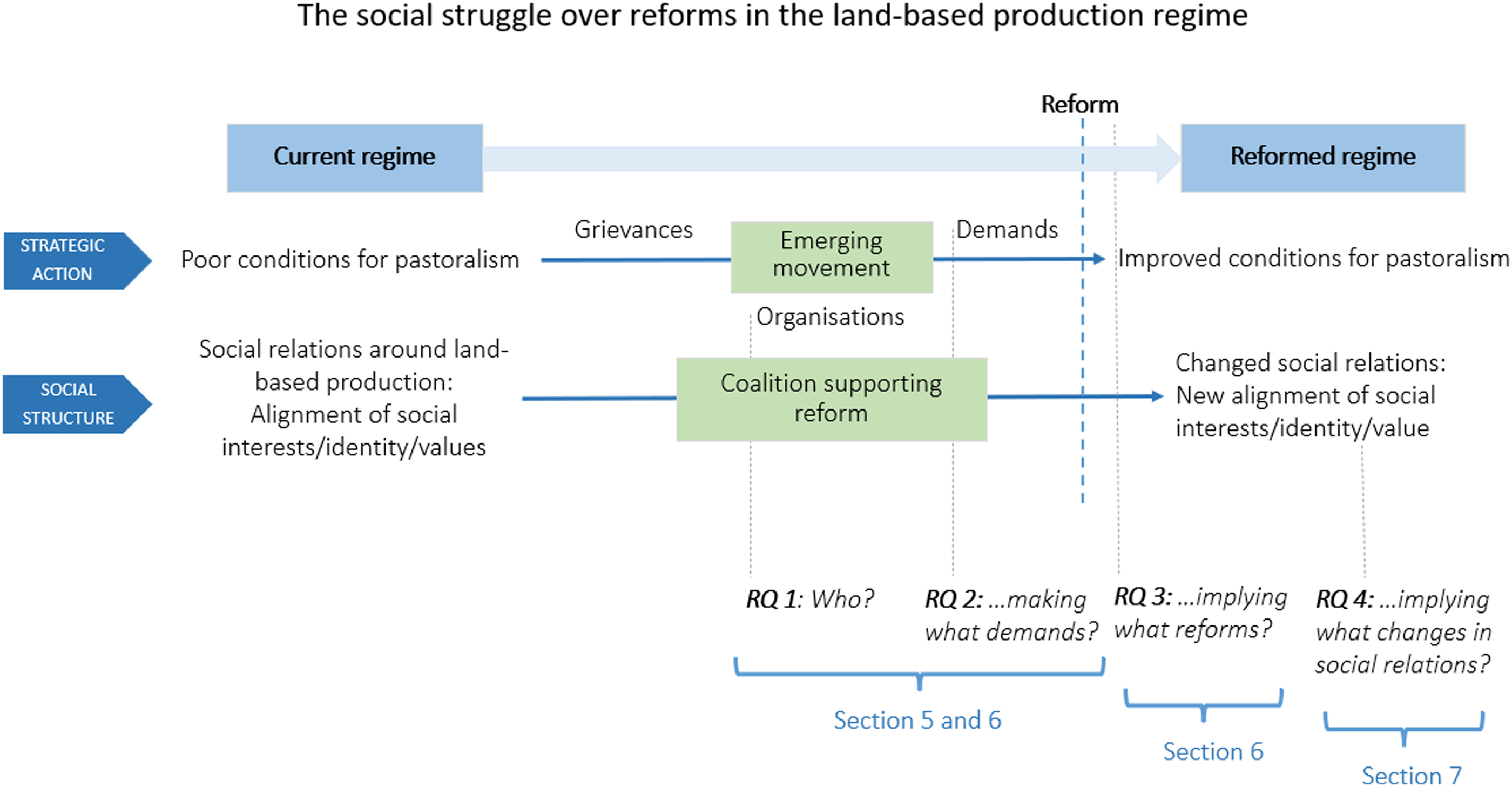
Theoretical framework showing the pathway for reforms of the land-based production regime. The first level shows how current conditions for pastoralism give rise to grievances. The latter contributed to the emergence of the movement, which demands change from the government, and which, in turn, might lead to changed conditions for pastoralism. The second level shows how social relations, and their changes, underlie this process. Our research questions, and where they are addressed in this paper, are indicated at the bottom of the figure.
Theoretical framework
We conceptualise this case in terms of an emerging social movement that is pushing for reforms, i.e. policy or legislative changes, as described above. Building on the ideas of Marxist scholars (Burkett, 1996; Luxemburg, 1970), two things are important from the point of view of the movement that demands reform. The first is relatively straightforward: the reform should address the problem and, if there is a cost to be borne, it should be borne by a sector of capital, rather than a worse-off social group. In the present case, this would mean improving ecological conditions for natural pasture-based reindeer pastoralism. The second, which we think is often neglected, is that the reform should not prevent, and ideally should contribute to, future progressive change. The best way to do this is to ensure that the reform strengthens the position of the broader environmental movement. In this way, reforms like those proposed here can contribute to a broader process of social transformation, driven by the environmental movement and its allies.
There are several ways in which the movement could be strengthened. Luxemburg describes how reforms can be used to develop both ‘political forms’ and ‘awareness’ that give the movement a foundation for more effective political action (Luxemburg, 1970, Part 2, Chapter VIII). In contemporary language, this corresponds to expanding the movement's organisational network (for example, by developing coalitions with other organisations or movements), developing its intellectual resources, raising its morale, and so on. Although this conceptualisation may seem similar to the concept of ‘non-reformist reforms’ (Gorz, 1967), here, we highlight that it is not the content of the policy proposal that determines a reform's ‘non-reformism’, but its impact on the development of the movement. And this can only be determined through an analysis of particular concrete circumstances. This conceptualisation also contrasts with other, prevalent approaches that focus on reducing aggregate growth or material throughput, and pay less attention to the social dynamics that lie behind such indicators (Alisa and Kallis, 2020; Huber, 2022; van den Bergh, 2011).
Here, we argue that Indigenous Sámi reindeer pastoralists engage in two distinct, but related modes of social struggle for reform. First, as pastoralists, they have non-sedentary relations to the land through their livelihood and maintain cultural practices that require multi-purpose, continuous landscapes; in societies organised around sedentary and capitalist social relations that facilitate privatisation and encroachments (see e.g. Postigo, 2021). Second, as Indigenous, they have a ‘permanent attachment […] to a fixed area of land in a way that marks them as culturally distinct’ (Li, 2010: 385); in societies where colonial social relations have facilitated their dispossession prior to, and throughout capitalist development (see e.g. Coulthard, 2014). Although neither mode reflects trends in the capitalist economic system, this does not mean that Sámi people are necessarily anti-capitalist. Social constructions such as Indigeneity, are ‘without guarantees’ (Hall, 1986a), as they can be articulated as identities by different political subjects to legitimise their specific claims (Li, 2004). Therefore, to understand concrete political dynamics, research must be historically specific (see The historical landscape of contention).
Our research conceptualises the social struggle to improve conditions for natural pasture-based reindeer pastoralism in the context of two, related processes (see Figure 1). The goal is to understand how proposed policy changes might affect the interests of different social groups, and the implications for gaining their support. Firstly, we discuss the social structural level. Here, we examine the relationship between the desired changes in land-based production, and what this would mean in terms of changed social relations. In simple terms, we look at which groups are likely to benefit or suffer losses due to the change, and the character of these gains and losses. We understand this process using theory of hegemony and counter-hegemonic politics (see Gramsci, 1971; Hall, 1986b). Secondly, we examine the social struggle at the level of strategic action taken by an emerging movement, which we understand using the contentious politics approach to social movement theory proposed by Charles Tilly, Sydney Tarrow and Doug McAdam (see Tarrow, 2011). Here, we clarify the relationship between reforms and coalition building using the social theory of collective actors proposed by Erik Olin Wright (Wright, 2019). In methodological terms, we examine the ongoing strategic action of the emerging movement; here, the task is to gain insight into what it implies for social structural change. It should be noted that the movement's strategic action, and the process of social change, are not independent phenomena. The social movement is both the political mechanism that drives social structural change, and an expression of the grievances and deeper social tensions that give rise to its strategic action.
Our research questions allow us to examine the activity of the emerging movement in terms of its implications for potential social structural change and, thereby, coalition building. By examining who is making demands, what demands are being made, what reforms these demands imply, and what changes in social relations the proposed reforms imply, we can reflect on the implicit strategy deployed by actors in the social change movement. We can then reflect on whether these strategies can assemble the kind of coalition necessary to push through the required land-based production reform. We develop this argument in more detail below.
The social structural level
From the perspective of the theory of hegemony (see Gramsci, 1971; Hall, 1986b), the social struggle for reform of the land-based production regime is driven by a clash of interests, primarily between reindeer pastoralists and large landowners, much of which is state-owned (see Harnesk, 2022). This clash of interests is a result of the organisation and management of land-based production. Though we argue that this social tension is currently reproduced by economic production, we acknowledge that historically it has been produced by colonial power relations that entail some extra-economic relations, and that it is reinforced by extra-economic factors, such as contemporary neo-colonial ideology. Furthermore, while we argue for a change in the organisation of land-based production, we acknowledge that this could hypothetically be achieved by various kinds of reforms – from changes to management approaches, to changes in property rights, and changes in sovereignty over land.
Consider the relationship between forestry and reindeer pastoralism – two, overlapping land uses. Earlier work has shown that in many Sámi pastoral landscapes, maintaining the ecological conditions needed for natural pasture-based reindeer pastoralism in boreal forests requires two changes. First, to forest management and planning practices 2 (Harnesk, 2022; Horstkotte and Djupström, 2021) and, second, to the decision-making balance of power to allow reindeer pastoralists to affect land use management and planning decisions, including the ability to say no to encroachments from activities such as logging and the establishment of mines and wind farms (Österlin and Raitio, 2020). It has also been shown that since reindeer pastoralism spans multiple political geographies 3 , planning regimes need to be implemented at scales that incorporate the pastoral landscape perspective 4 (Harnesk, 2022). These observations point to the need to change the land-based production regime in ways that reduce economic pressure on land-based resources – at least those required to support natural pasture-based reindeer pastoralism.
Achieving the required changes could be accomplished in several ways. For example, the state could introduce regulations that compel landowners in pastoral landscapes to change forest management practices both at the scale of forest stands (e.g. increased rotation time, reduced soil disturbance, preserving larger groups of trees, consideration of efficient dispersal distances, more vigorous early thinning, lichen transplantation) and the landscape scale (e.g. preserving large, continuous old-growth forests and increasing connectivity and not-for-harvest areas) (see Harnesk, 2022). Another approach involves the wholesale transfer of land ownership to RHCs that practice pastoralism, or the Sámi people more generally. The latter could then decide how it should be managed, notably the option to say no to the establishment of mines and wind farms. All else being equal, these examples will, at a minimum, advance the interests of reindeer pastoralists, while going against the interests of those who profit from the current forestry regime. In other words, it requires a ‘certain degree of infringement on the land use rights of primarily large forest property owners’ (Harnesk, 2022: 2519), be they private capital or state-owned companies.
Depending on what changes are enacted, a range of other interests will be affected, beyond pastoralists and landowners. For example, while an immediate limit on production could mean fewer jobs in wood-based value chains related to the sawmill industry, the pulp and paper industry, or the bioenergy industry, it may benefit other groups and businesses. Similarly, reforms to transfer land ownership to the Sámi people would affect the interests of the Sámi people generally, not just pastoralists, but other groups and businesses located in the area.
While reforms that are likely to advance the interests of pastoralists may go against the interests of landowners and industries, different policy options imply different realignments of social relations both with respect to these two central actor constellations, and beyond. Furthermore, the chosen measures may go beyond minimal changes to the land-based production regime and address the interests of other affected social groups. This could include programs to ensure that workers in land-based sectors will still have access to meaningful jobs in communities and environments they value, and ensure that the principles of ecological integrity are respected. Here, we would like to underline that these issues, and any tensions that emerge, must be considered in order to build a coalition that supports concrete reform.
The level of strategic action
At the level of strategic action, an emerging movement consists of a network of formal and informal actors (see Tarrow, 2011), in the present case centred on RHCs. These organisations demand the state to enact a variety of changes to the land-based production regime. They frame certain issues to gain support, undermine their opponents, motivate participation, and so on (see Benford and Snow, 2000). Moreover, they use, benefit from, and seek to expand a network of organisations and individuals through which they can mobilise, among others, human, financial and intellectual resources to achieve their goals (McAdam et al., 1996). But any movement that finds itself in this situation will have to mount a successful counter-hegemonic campaign. Notably, it will have to assemble a coalition of support that has the social power to push back against the economic interests of industry and large landowners (O’Byrne, 2020).
Movements can successfully push for social change if they are able to assemble a coalition that amounts to a strong collective actor. A critical element is to propose reforms that gain support from sufficiently influential social groups that see the reform as in their interests (O’Byrne, 2020). Hence, depending on the target policy, the coalition might include different social groups. So far, for the sake of simplicity, we have only discussed interests, but three social bases drive people to join coalitions: identities, interests and values (Wright, 2019).
Identities refers to ‘how people classify themselves and others in terms of things that are salient in their lives’ (Wright, 2019: 125). They are complex and fluid intersections of categories that people cultivate freely, and those that are imposed on them by others (ibid.). They are also closely linked to social relations and power, since they are, in significant ways, forged through people's lived experience within social structures (ibid.).
Interests refers to ‘things that would make a person's life go better along some dimension important to that person’ (Wright, 2019: 129). They are rooted in solutions to problems that people face in their everyday lives; thus, some interests are closely tied to identities (ibid.). They are chiefly associated with material practices, which are tightly intertwined with their immaterial counterparts (ibid.). 5
Values refers to ‘the belief people hold about what is good, both in terms of how people should behave in the world and how our social institutions should function’ (Wright, 2019: 131). The meanings of actions are closely connected to people's values (ibid.). People may engage in collective action not because the goals are in their own interests, but rather because their participation is driven by a moral commitment (ibid.). But the relationship of values to interests is fraught, since broadly shared values may be invoked by people simply as a cover for self-interest (ibid.).
Building on the theory described above regarding the social bases for why people might join coalitions, we conceptualise that reforms affect the three overlapping dimensions in different ways. Interests have a strong and direct connection to reforms, as they may change material conditions and alter social relations to address problems that are salient for particular social groups. The same is true for identity, as a particular reform may advance the identity-based interests of a social group at the expense of others. We see values more as a source of motivation, and while they often become a source of identity, they have a less direct connection to reforms. Thus, a major challenge to coalition building is competing sources of identity, and how the latter relate to interests regarding the reform agenda.
The historical landscape of contention
Sámi society is diverse – illustrated by the wide variety of material (e.g. reindeer pastoralism, hunting, fishing, handicrafts, building traditions), and immaterial practices (e.g. languages, oral traditions, worldviews), and political visions (Lantto, 2018). Therefore, this section does not seek to provide an exhaustive reading of histories of the Sámi people; instead, the aim is to show how the demands and mobilising structures in the present Swedish context have emerged from past social and political mobilisation.
Historical research focusing on state-Sámi relations in Sweden has convincingly argued that the experiences of the Sámi people, including reindeer pastoralists, are profoundly shaped by a long colonisation process that intensified in the 1800s (Holand et al., 2022; Lantto, 2000; Päiviö, 2011). Intensification dates back to the mid-1600 s, at least, when the state encouraged people to settle in the north of the country and work in agriculture, for example, by exempting them from taxes and military services (Päiviö, 2011).
The late 1800s saw the intensification of the state's Sámi institutions, notably in the form of three, overarching ideological positions: (a) Sámi were culturally inferior reindeer pastoralists that should be segregated from the majority of society, only remaining as an ethnographic motif; (b) all other Sámi should be assimilated into the superior Swedish culture, cease to exist as Sámi, and instead become ethnic Swedes; and (c) reindeer pastoralists could be allowed to use pasturelands that could not be used by other commercial enterprises, given the marginal benefits to the political economy (Lantto, 2000). These Social Darwinist, paternalistic and economic utilitarian ideological positions underpinned various harmful and oppressive institutions that targeted Sámi, notably forced resettlement programs, cultural segregation and assimilation politics, and race biological institutes (Lantto and Mörkenstam, 2016).
At that time, the state gradually changed its institutions in ways that greatly reduced the decision-making power of reindeer pastoralists over land, water and natural resources – not least via the Reindeer Grazing Acts and the Lapp Administration (Lantto, 2018). These institutions created a divide amongst the Sámi people, as only reindeer pastoralists were institutionalised as holders of limited grazing, hunting, fishing and resource rights, through the formalisation of RHCs as organisational units (Beach, 2007; Mörkenstam, 1999). By the 1900s, an agrarian-colonial discourse shifted into an industrial-colonial one, wherein the state, under social democratic hegemony, used the commons to justify further dispossessions of the Sámi people, and encroachments into their landscapes (Össbo and Lantto, 2011).
On the emergence and development of the Sámi movement in Sweden
In the early 1900s, a Sámi movement emerged in Sweden as a response to the state's Reindeer Grazing Acts of 1886 and 1898 that drastically reduced Sámi rights to land, and divided the Sámi people (Lantto, 1997; Lantto and Mörkenstam, 2008b). Mobilisation focused on the grievances of reindeer pastoralists and actions included protests and pamphlets that demanded Sámi ownership of land, and the first attempts to establish Sámi organisations and newspapers (Lantto and Mörkenstam, 2016). The movement benefited from its members’ prior engagement in the free church awakening movement, the temperance movement and the women's movement (Lantto, 1997, 2000, 2015). However, poor strategic choices and limited economic resources halted momentum, and it took until 1918 for the first national meeting to be held in Sweden (Lantto, 2000). This meeting resulted in two, formative agreements: that developing organisational capacity was important; and, to not side with any political parties (ibid.). The newspaper The Sámi People (est. 1918) was created around this time and remains an important forum for political debates to this day (Lantto, 2018).
The following decades saw the development of the Sámi movement's mobilising structures and changes to its leadership and strategies. By the 1930s, conflicts with local and regional authorities had shifted the focus from developing organisational capacity to building solidarity and direct action (Lantto, 2000; see also Lantto and Mörkenstam, 2015; Svensson, 1976). Although the grievances of reindeer pastoralists remained a core issue, it was at this time that the movement started to actively challenge the state's Sámi policies, notably those that restricted building solidarity, and allowed the state to challenge the legitimacy of the movement's claims (Lantto and Mörkenstam, 2015). The need for national organisations, however, had re-emerged by the end of the 1940s, as it was ‘not viable to call a national Sámi meeting every time issues of importance arose and needed to be addressed’ (ibid.: 143).
By the 1950s, the movement's dream of national-level organisations had been realised. The Sámi People newspaper and the Sámi Folk High School (est. 1942) were important spaces for Sámi political discourse (Lantto, 2003). The same is true for the Sámi-based organisations The National Association of Swedish Sámi (SSR) (est. 1950) and The National Organisation Same Ätnam (est. 1945) (RSÄ) (Lantto, 2000). The SSR brought together RHCs and Sámi associations (Lantto, 2000). It established itself as a central actor within the polity, with a mandate to make claims against the state on behalf of its Sámi-based constituency (Lantto and Mörkenstam, 2015). The RSÄ, on the other hand, focused on organising for Sámi culture more broadly, and together with Sámi organisations in Finland and Norway, created the first international pan-Sámi organisation, the Nordic Sámi Council (est. 1953) (hereafter the Sámi Council) (Lantto, 2000).
The period after the 1960s was particularly formative, as this was when the Sámi movement was able expand its solidarity and to effectively leverage the courts to promote change (Lantto and Mörkenstam, 2015). At this time, it expanded in two directions: (a) nationally, towards a more inclusive Sámi identity and (b) internationally, allying itself with the Indigenous Peoples movement.
At the national scale, Sámi organisations took steps to address the divide between pastoralist and non-pastoralist Sámi, which had been caused by the state's Sámi policies (Lantto and Mörkenstam, 2015). Non-pastoralist Sámi thought that the SSR, despite being a central actor within the polity, did not sufficiently represent the interests of all Sámi people (Lantto, 2003; Lantto and Mörkenstam, 2015). To build solidarity, the SSR's leadership started to reframe the Reindeer Grazing Acts. The organisation promoted the idea that the Acts had separated Sámi groups who belonged together, and put forward a more inclusive social construction of Sámi wherein ‘culture and not occupation should be the determining factor for entitlement to the rights of the Sámi’ (Lantto and Mörkenstam, 2015: 144). But the SSR continued to prioritise the interests of reindeer pastoralists, which incentivised the formation of new Sámi organisations (ibid.). This was, for example, when the youth organisation Sáminuorra (est. 1973) broke away from the SSR (ibid.). Over time, the ‘strong collective identity was thus no longer expressed as solidarity with one organisation, SSR, but with the Sámi people’ (ibid.: 146).
At the international scale, the Sámi Council brought together multiple Sámi organisations in Fennoscandia. The Council developed a frame wherein the Sámi were ‘a single people divided by the borders of four nation-states’ (Lantto and Mörkenstam, 2015: 144). Minde (2003) refers to this pan-Sámi strengthening as part of an internationalisation process, and argues that it reflected a new generation of university-educated Sámi intellectuals who ‘were inspired by ideas of equality and the right of self-determination, such as those set down in declarations of human rights and conventions, and those expressed in the conflicts in the Third and the Fourth World (by First Nation peoples)’ (p. 80). The Sámi Council organised conferences in the 1970s, and the movement framed the Sámi people not as an ethnic minority, but instead as an Indigenous People, and expressed its solidarity with the experiences of the Indigenous Peoples elsewhere (ibid.). Although this development generated much political debate among the Sámi, the Council's activities led to the movement being accepted into the World Council of Indigenous Peoples in 1976 (ibid.).
At this time, the Sámi movement's main adversary had become the state, notably its unrightful control over land, water and natural resources, and Sámi struggles over territory ‘were situated in the context of an Indigenous People's struggle against a colonising state’ (Lantto and Mörkenstam, 2015: 147). International solidarity meant that the Sámi now held a new position, ‘no longer “from below”, which made it easier to challenge the state and to put forward demands and rights claims’ (ibid.: 147). International politics further strengthened the rights-based framing of Sámi organisations via Indigenous and human rights conventions, and furthered the use of litigation, with Sámi making claims that they had older, customary rights to the land than the Swedish state (Lantto and Mörkenstam, 2008b; Össbo and Lantto, 2011).
In terms of outcomes, the movement impacted Sámi policies in Sweden in several ways. Lantto and Mörkenstam (2015) highlight the following: (a) the dismantling of the paternalistic Lapp Administration through the Reindeer Farming Act (1971); (b) the recognition of Sámi as an Indigenous People and a minority (1976/1977); (c) the appointment of a Sámi Rights Commission to consider efforts to protect and develop the Sámi languages, and the need for a new representative body of the Sámi people (1982/1989); and (d) the establishment of a Sámi Parliament with the mandate to act as a state-controlled administrative authority, and as a popularly elected assembly representing the Sámi people (1993).
The institutional design of the Sámi Parliament (est. 1993) is both controversial and contradictory. On the one hand, it acts as an administrative authority that is controlled by the state. On the other hand, it is a popularly elected assembly representing the Sámi people. It has no independent source of income, no rights to participate in decision-making, and no veto over the use of land, water and natural resources (see Lawrence and Mörkenstam, 2016). Despite the evident risk of state co-optation, the popularly elected assembly is a mobilising structure in the Sámi movement. It operates alongside the formal organisations mentioned above (see Lantto and Mörkenstam, 2015), and informal networks that have been observed elsewhere (Fjellborg et al., 2022; Zachrisson and Beland Lindahl, 2023, 2019).
On current demands and political debates in the Sámi movement
Lantto and Mörkenstam (2008b) argue that the demands of the contemporary Sámi movement tend to focus on: (a) the ratification of ILO convention No. 169 that recognises Indigenous People's right to self-determination within a nation state; (b) the demand for free prior and informed consent in planning processes; (c) the expansion of the powers of the Sámi Parliament, and (d) the addition of a veto for Sámi concerning questions of rights to land, water and natural resources. We would argue that many of these demands are tightly connected to prevailing liberal and rights-based institutions at national and international levels.
In contrast, Sámi political scientist Ragnhild Nilsson (2021) argues that the institutionalised meaning of Indigenous self-determination is founded on a rights-based and individualistic perspective, which conflicts with the relational and responsibility-based conceptualisations that govern territorial configurations of Sámi people and their landscapes. Nilsson (ibid.) argues that the rights-based approach is reaching its conceptual limits in relation to Sámi politics, and that the Sámi struggle: “… is not about territorial sovereignty from rights-based arguments, but instead is more about [maintaining] the relations of common responsibility that over time has emerged between the landscape and people, and the norms that govern this relation” (p. 213, own translation). “Well-functioning and long-term sustainable reindeer pastoralism […] requires suitable calving areas, functioning migration pathways with resting pastures as well as core and continuous seasonal pasturelands for each season. It also requires grazing peace, especially during calving season and the reindeer's growing period. The access to safe winter pasturelands is an absolute necessity for the survival of the livelihood.” (own translation).
Method and materials
The present study is part of a longer, action-oriented research process conducted by the first author that start started in 2020 and that aims to develop theory and practice in relation to social movement emergence. The approach is part of a collective ambition to develop a paradigm within the field of sustainability science that views social movements as the primary agent of social change in sustainability transformations (Boda et al., 2021; Harnesk and Isgren, 2021; Isgren et al., 2019; O’Byrne, 2020). The general features entail a critical realist position that draws on immanent critique to ground its normative position on what constitutes environmental problems and desirable solutions (see Harnesk and Isgren, 2021), and that in the present research process adopts the extended case method as its methodological approach, with participant observation as one important method (see Burawoy, 2009). The first author is positioned within the Sámi movement and has engagements with pastoralists, activists and organisers in different fora. The analysis presented herein is an analysis of the authors that was in part prompted from these ‘interventions’ (see ibid.). The second author has studied social movements in rural communities elsewhere and is a sympathetic observer of the Sámi movement.
The first author of this paper constructed a database of articles related to claims reflecting the interests of Sámi reindeer pastoralists. These articles were published by the Sámi public media outlet Sveriges Radio Ođđasat. This dataset was chosen for its journalistic focus on Sámi issues in Sweden (see Skogerbø et al., 2019). The first author used the software Retriever, using the search line ‘(ren* OR sameb*)’ to identify articles on ‘reindeer’ and/or ‘reindeer herding communities’. The selected time period was from 11 January 2012 (the date of the first article) to 11 February 2022. The first author then identified articles that reported claims-making instances related to the interests of reindeer pastoralism, following the three steps listed below.
The first step was to identify if the article was related to the interests of reindeer pastoralists. The starting point was a previously published literature review of the ecological conditions of reindeer pastoralism (Harnesk, 2022). It was also informed by our reading of the history of the Sámi movement, complemented by insights from other analyses of the same database (Harnesk, 2023; Harnesk and Jakobsen, 2023), and ongoing participant observations with organisations within the Sámi movement. From this, the first author constructed a set of ‘issues’ and ‘land uses’ that were identified as relevant (see Table 1).
Categories of issues and sub-categories of encroachments identified by the analysis.
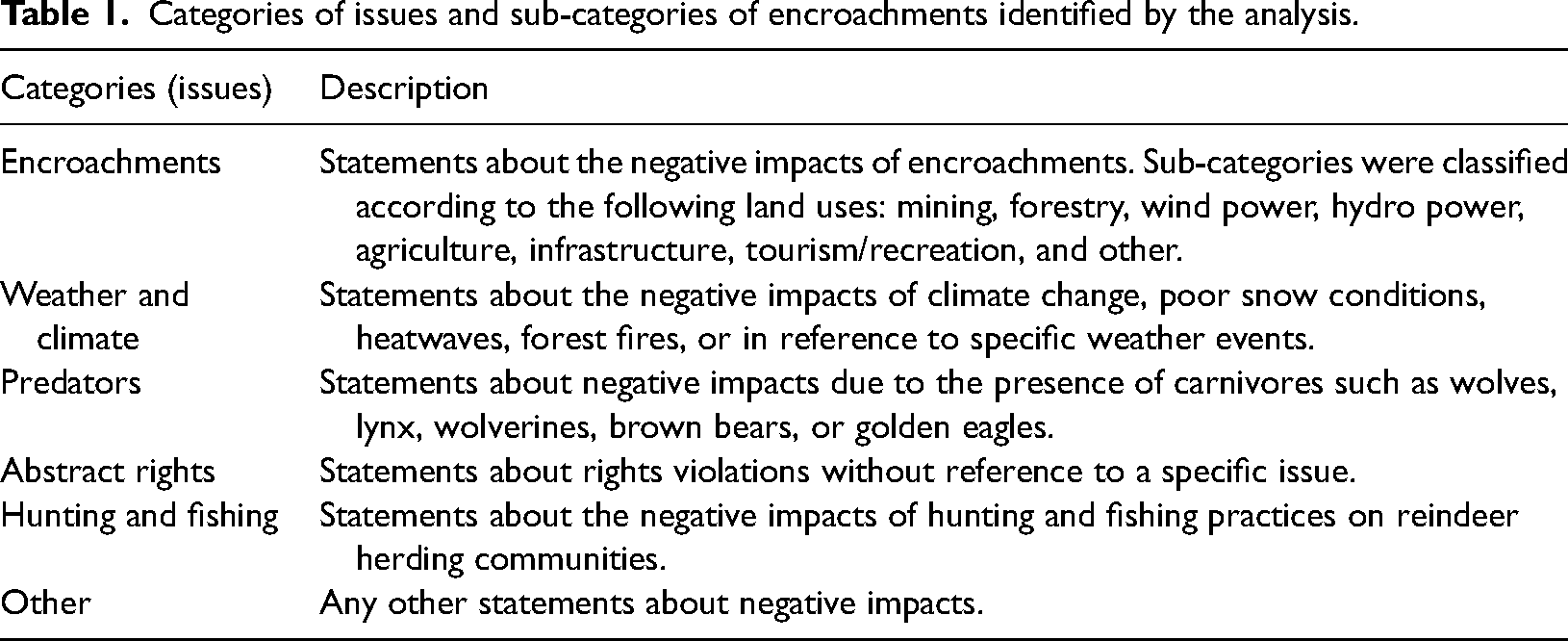
The second step was to identify articles that discussed claims-making in line with the interests of reindeer pastoralists. In this context, ‘political claims-making entails both the formulation of a political demand with a specific content (the claim) and the public staging of this demand (claims-making), giving the term a degree of semantic overlap with social movement core concepts such as framing, collective action, and action repertoires’ (Lindekilde, 2013: 1). Building on Koopmans (2002), instances were identified using the following semantic sequence: subject(who), action(how), addressee (at whom), what (issue), object actor (for/against whom) and frame(why). In other words, we sought to identify articles where ‘an actor, the subject, undertakes some sort of action in the public sphere to get another actor, the addressee, to do or leave something affecting the interests of a third actor, the object, and provides a justification for why this should be done’ (ibid.: p. 3). The first author also formulated categories for different actor groups (many of which are rough approximations), and different forms of claims-making, and revised these iteratively throughout the research process.
The third step was to identify demand clusters. Demand clusters are understood as claims with demands with similar content that were made in the public sphere. Some articles listed specific demands, while others referred to specific documents, all of which were accessed through online search engines. Both these articles and additional documents were examined to inductively identify demand clusters. Building on an actor-mapping exercise, we used our theoretical framework to interpret what reforms these demand clusters implied, in terms of coalition building, and discuss their wider implications for changing social relations.
The dataset has three main limitations. First, media bias results in some phenomena being reported more frequently than others, which skews the quantitative representation of which issues are considered important. Second, we omitted both claims-making instances in the internal Sámi political debate (predominately plenary debates in the Sámi parliament), and transboundary conflicts around the Swedish–Norwegian border. Third, the material does not capture internal debates within and between RHCs on various issues. Our results, therefore, cannot offer a nuanced understanding of the depth of Sámi politics, most notably divergent views on the use of contentious politics, the views of non-pastoral groups in relation to the land, water and natural resource rights available to RHCs, internal discussions of strategies and risks and opportunities related to coalition building (that have been observed as important debates during ‘interventions’ in the first author's longer, action-oriented research process).
Coalition building and cycles of contention
In this section, we characterise coalition building efforts, and cycles of contention during the study period. A total of 6269 articles were identified between 11 January 2012 and 11 February 2022. Of these, 504 articles described instances of claims-making in line with the interests of reindeer pastoralists, and these were analysed in detail. Issues were categorised as follows: encroachments (57%), predators (15%), abstract rights (12%), hunting and fishing (9%), and other issues (9%). Regarding encroachments, two periods stand out as heightened periods of conflict: from January 2012 to January 2015, and from July 2020 onwards (see Figure 2). Overall, we identify three periods: Cycle 1, the Development Phase and Cycle 2. Over 300 actors were named as making claims in line with the interests of reindeer pastoralists (see Figure 3).
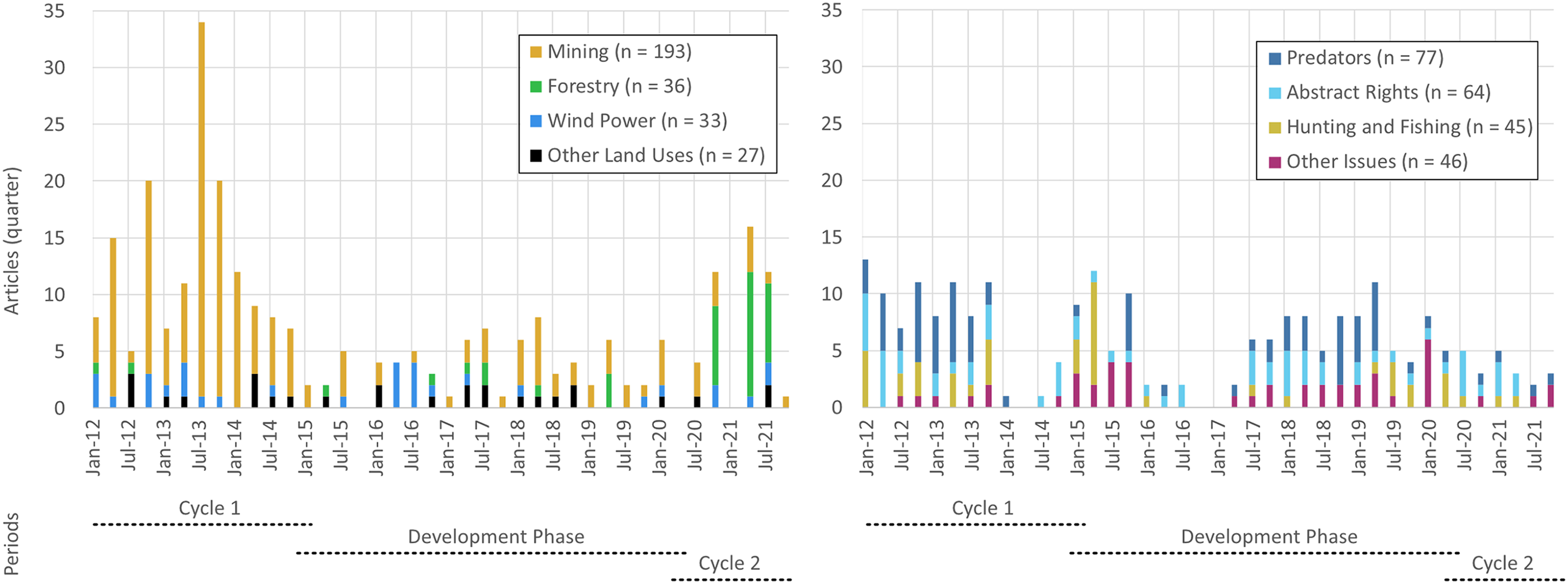
Categorisation of reports on claims-making instances in line with the interests of reindeer pastoralism in Sweden in articles published by the Sámi public news service between 2012 and 2022 (n = 504). Left: issues categorised as encroachments. Right: issues not categorised as encroachments.
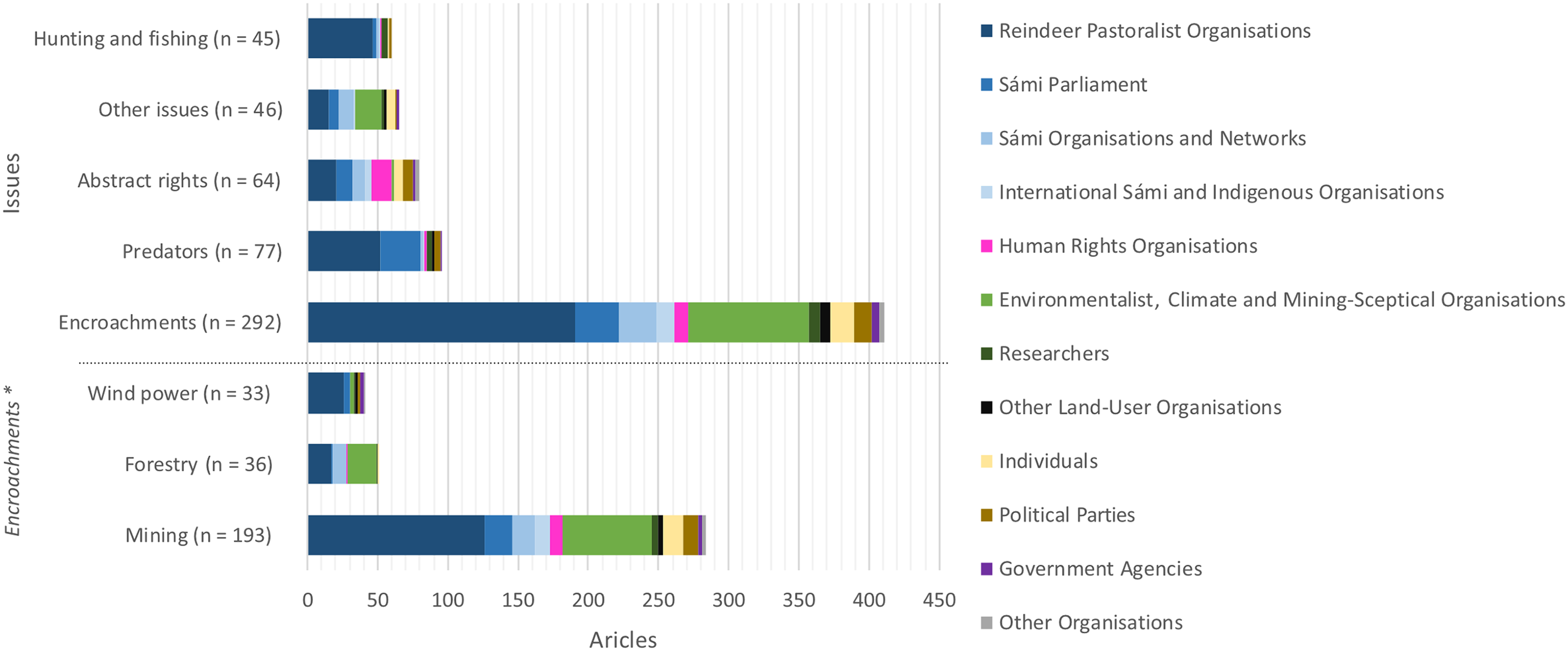
Categorisation of actor groups represented in claims-making instances in line with the interests of reindeer pastoralism in Sweden, identified in articles published by the Sámi public news service between 2012 and 2022 (n = 504). For each article, each named actor was counted as a unique entry. *Only the three most common sub-categories for encroachments are shown.
Cycle 1 – predators and mining (January 2012–January 2015)
This period included 244 instances of claims-making, over 1127 days.
Predator pressure was the focus of 37 instances – particularly in the southernmost pasturelands. Demands concerned licenses to hunt predators, changes to animal conservation policies, policies regarding the hunting of carnivores, and a tolerance-level policy on how many reindeer carnivores can kill. Here, our material highlights two salient dynamics between reforms and coalition building.
First, it is clear that the mobilisation around predator pressure of reindeer pastoralist organisations is rooted in their interests. Most claims were made by individual RHCs, coalitions of RHCs and the SSR. Although most were made by organisations in the southernmost pasturelands, some also came from nationwide coalitions: the SSR, the Sámi Parliament and other Sámi organisations connected to reindeer pastoralism in general, or the southernmost pasturelands in particular. These actors either had a direct interest in the issues at hand, or expressed solidarity in relation to the shared threat of predator pressure.
Second, there is a clear lack of non-Sámi allies regarding the issue of predator pressure, as only two claims include such actor categories. One was an individual researcher, who co-signed an open letter that was launched by the heads of 51 RHCs, SSR, a civil servant at the Sámi Parliament, and the head of the concession RHCs’ interest organisation. The other was a municipal commissioner from the Social Democrats and the head of the local government in the southernmost pasturelands; likely prompted after documented dialogues with the local RHCs. The researcher may have been motivated by values and identities related to their work, and the municipal actor advocated that Sámi culture and business are an important part of the municipality's identity, commerce and attractiveness.
Mining was the focus of 130 instances of claims-making – particularly in areas where mining companies were active. Two conflicts were reported most frequently: Gállok and Rönnbäck. Demands concerned stopping these projects; 21 instances were appeals within formal processes, while other demands focused on reforms to strengthen Sámi rights, policy reform and changes to mining legislation. Here, our material highlights four dynamics between reforms and coalition building.
First, reindeer pastoralist organisations mobilised to protect their interests, notably RHCs located in areas of mining activity. The SSR made claims at the national scale and supported the RHCs’ claims-making at more local scales.
Second, the mining-sceptical cause mobilised a larger coalition, which, at times, could be said to have taken on the repertoire of a social movement proper, with well-attended protests (public assemblies, marches, demonstrations) and confrontational actions (blockades, occupations). Coalitions with non-Sámi actors were observed: examples include local mining-sceptical networks, (youth) environmentalist organisations, human rights organisations, tourism organisations and religious organisations. Some actors can be considered more value-based (e.g. environmentalist organisations, human rights organisations), whereas others have a more direct connection (e.g. local mining-sceptical networks and tourism organisations).
Third, some instances were mobilised at the international scale, with coalitions ranging from local RHCs, to national and international Sámi organisations (the SSR, the Sámi Parliament, the Sámi Council), to United Nations-related human rights organisations. These claims systematically drew on human and Indigenous rights framings, arguing that either the state or mining companies should take measures to ensure that Indigenous rights were respected.
Fourth, mining became an issue for contentious politics at the national scale. During this time, reindeer pastoralist organisations and Sámi youth organisations communicated with political parties, mainly the Leftist Party and the Green Party. There were 24 parliamentary motions connected to mining policies, and the Leftist Party launched plenary debates on the ratification of ILO 169, arguing that government representatives had taken insufficient action. Here, the social struggle against mining proved to be a political opportunity for political parties to politicise these issues in relation to their own agenda.
The analysis identified 18 instances of demands related to hunting and fishing rights. These were mainly connected to the Girjas court case, launched by the Girjas RHC and the SSR, with support from the Sámi Council. The case focused on hunting and fishing rights in the Girjas RHC and would evolve, with profound impacts for the rights-based political strategy, which we discuss in the context of the next phase: the Development Phase (2015–2020).
The development phase (February 2015–June 2020)
This period covered 1977 days, and included 207 instances of claims-making.
The court case brought by the Girjas RHC continued during this period, with 19 instances of claims-making. It eventually reached its conclusion in January 2020. The Supreme Court concluded that the Girjas RHC retained the sole right to grant hunting and fishing rights, based on possession of the area since time immemorial. This, in turn, triggered the state to launch a reform of the Reindeer Husbandry Acts, around which another instance of claims-making unfolded. Here, our material highlights two dynamics of reform and coalition building: first, mobilisation surrounding the court case only included Sámi actors, researchers on Sámi issues and human rights organisations; and second, the case sparked wider political debate.
Issues regarding predator pressure and mining also continued, with 36 and 42 instances of claims-making, respectively. With respect to predator pressure, a new development emerged. Specifically, several new actors made claims that were in line with the interests of reindeer pastoralist organisations, following delays in the implementation of tolerance-level policies. These actors included right-wing political parties, municipal commissioners (the Centre party), individual politicians at national and international levels (Liberals, Moderates), and interest-based organisations such as the Federation of Swedish Farmers and a local hunting association. Their demands specifically concerned greater protection for the hunting of wolves, and their demands were connected to their constituencies. With respect to mining, further support emerged at the international scale, namely in the form of the Association of World Reindeer Herders.
During this period, forestry emerged as a salient issue. There were seven instances of claims-making. Some were centrally coordinated by the SSR and researchers focused on the national scale, and some were local initiatives from RHCs, sometimes in collaboration with environmental organisations. At the national scale, demands concerned a review of the management and planning practices of the state-owned landowner and forestry company Sveaskog, a zero-tolerance policy regarding planting of a foreign tree species the ‘lodgepole pine’ on reindeer pasturelands, and reforms of the forestry acts. At the local scale, initiatives focused on preventing logging, preserving old-growth forests, and improving transparency from forestry companies through co-planning sessions within the FSC certification system.
This period saw the emergence of climate politics 6 , with 13 instances of claims-making. These initiatives were mainly organised by Sámi activist networks and youth organisations, but at times included coalitions with environmental organisations. The youth organisation Sáminuorra launched a court case, together with a youth climate movement organisation and an international environmental organisation, and later invited Greta Thunberg and the Fridays for Future movement to join them in demonstrations in Jokkmokk. Other activists mobilised around international climate politics, for example, at COP-related events. Their demands were general; they called for action around climate change mitigation and framed Indigenous rights as connected to climate justice. This development, in particular, would come to influence action in the next cycle of contention, focused on forestry and mining.
Cycle 2 – forestry, mining and conventional climate policy (July 2020–)
During this period there were 73 instances of claims-making, over 608 days.
The Girjas court case prompted four new dynamics, observed in seven instances of claims-making. First, the victory led other RHCs to demand the sole right to grant hunting and fishing rights in their landscapes. Second, the government formed a committee tasked with reviewing and suggesting reforms to the Reindeer Husbandry Act, and analysing the Sámi hunting and fishing rights regime, including its implications for Sámi who were not RHC members. This prompted criticism from the SSR and the Sámi Parliament, who claimed that the process gave political influence to non-Sámi actors over Sámi rights. As with previous claims focused on abstract rights, claims-making predominately involved Sámi actors, at times with support from human rights organisations. Third, a research project that focused on the municipal level was launched. The goal was to design collaborative arrangements to ensure that the Supreme Court's decision could be implemented in ways that gained broad local support. Fourth, the SSR started to draw on the Court's decision in claims-making on other issues. Examples include its comments on forestry policies, notably its observation that the Court's decision has implications on forest-related property rights as well.
Contention surrounding the intensive forestry regime increased during this period, and our analysis of 24 instances of claims-making highlights three salient dynamics. First, environmental and climate movement organisations collaborated with Sámi activists in two new ways. One was through confrontational protests: human blockades were used to stop individual logging practices, and protestors occupied the head office of the state-owned forestry company Sveaskog. Another was the application of biodiversity mapping; activists focused on politicising reindeer pasturelands areas with high biodiversity. Second, social media campaigns launched by reindeer pastoralists quickly gained support from environmental and climate movement organisations. Third, non-Sámi actors in the coalition used the negative impacts of forestry on reindeer pastoralism in a broader campaign against the intensive forestry regime, and connected these demands to aspirations for a more radical climate change mitigation policy in line with the Paris Agreement.
Mining re-emerged as a focus in 29 instances of claims-making. After several years of postponement, and shortly after the Green Party left the left-wing coalition government, the one-party Social Democratic government that followed approved a mining company's application for an exploitation permit in Gállok. This triggered a new wave of claims-making instances from reindeer pastoralist organisations and Sámi organisations alike. A new dynamic, however, came from the involvement of the Fridays for Future movement. The latter made new demands related to the climate change mitigation framing of the mine (which was by now connected to the renewable energy-based mineral production agenda, also framed in terms of national and European geopolitical interests) presented in the decision made by the Social Democratic government. The claims made against the new wave of encroachments now included frames that criticised the conventional climate policy position in relation to the struggles of the Sámi in Sweden.
Finally, although wind power remained contested for the entire 10-year period, it never gave rise to an increased frequency of claims-making equivalent to that seen around mining and forestry. Most instances were legal appeals that sought to prevent encroachments, including supporting statements from researchers. The only outlier was a highly publicised conflict over large-scale wind power farms located in Jämtland and Västernorrland. The RHC mobilised at the international scale, appealing to the OECD, with support from the Sámi Council, human rights organisations, and the Sámi Parliament. They demanded the reversal of government decisions to approve wind farms, based on violations of human rights. Frames were critical of conventional climate policy, and noted that reindeer pastoralists should at least have decision-making power around wind farm deployment.
Demands and changes in social relations
In this section, we look at the demands that were made, who made them, and their implications for changes in social relations. Our material shows that formal/ institutionalised/ umbrella organisations within the polity, such as the SSR, the Sámi Parliament or the Sámi Council dominate in the context of demands that relate to specific reforms at the social structural level, although coalitions of RHCs also stand out. These demand clusters where such actors dominated the material have been marked with an asterisk (*) in the following. The surrounding mobilising structure that engaged in claims-making, for the most part, rallied to stop encroachments, or amplified demands along the lines of established frames – Indigenous rights, human rights and, more recently, climate justice. Only in some instances did they make specific demands. However, it should be noted that such instances were sometimes referred to in the more specific demands made by formal/ institutional/ umbrella organisations, in particular, critiques of the status quo by international policy actors at the UN level.
In the following, we categorise eight demand clusters, two of which we consider overarching and connected to the others.
7
These are presented first.
I. Implement policies that incorporate Sámi rights to self-determination*. This refers to: (a) the practical implementation of Sámi rights to land, water and natural resources (that the legal system has formally recognised); and (b) redistributing decision-making power to RHCs (and other Sámi) within institutions, including the power to say no to encroachments. II. Implements policies that incorporate the Sámi pastoral landscape scale*. This refers to: (a) how land-based production and policy must incorporate the pastoral landscape scale in decision-making, and include factors relevant to reindeer pastoralism in such decision-making; and (b) incorporating reindeer pastoralists’ knowledge of their pastoral landscapes into decision-making processes, including the power to say no to encroachments. III. Stop encroachments. This refers to: (a) stopping individual encroachments; (b) giving RHCs (and other Sámi) veto rights; and (c) implementing a moratorium until Sámi rights to self-determination have been implemented. IV. Change land-based production and policy*. This refers to: (a) specific changes to forest management practices, and other forms of land-based production; and (b) redistributing decision-making power to RHCs with respect to the management and planning of forestry and other land-based production. V. Improve assessments of land-based production and policy*. This refers to: (a) cumulative impact assessments, at the pastoral landscape scale, of land-based production and policy that affects reindeer pastoralism; (b) redistributing decision-making power to RHCs in assessments of land-based production and policy that affect them; and (c) knowledge requirements for people involved in land-based production, and developing policy that affects pastoral landscapes. VI. Change conservation policies*. This refers to: (a) significant changes to carnivore population policies within reindeer pasturelands; (b) allowing specific practices related to reindeer pastoralism to be used within conservation areas, such as nature reserves; and (c) the redistribution of decision-making power to RHCs in the management and planning of conservation areas, such as nature reserves. VII. Ownership changes. This refers to: (a) ending the privatisation and corporatisation of state-owned land and companies on reindeer pasturelands; (b) changes to required rates of return in the ownership directives of state landowners and state-owned companies on reindeer pasturelands; (c) local and Sámi ownership of land and land-based production; and (d) some form of economic redistribution of profits to benefit Sámi and other local communities. VIII. Financial compensation. This refers to financial compensation to cover costs associated with: (a) animal deaths caused by predators; (b) participation in decision-making; (c) poor winter grazing conditions; (d) forest fires; and (e) COVID-19.
The six remaining demand clusters, that we see as connected to the overarching two, were:
While individually, these demands can be explored in great detail, when taken together, we argue that they imply two changes to the balance of social forces, with benefits for natural pasture-based reindeer pastoralism.
The demand clusters described above seek to: (a) advance the position of Sámi reindeer pastoralism and (b) push back capital. The effects are seen both in terms of changes to decision-making power, and in terms of changes to ownership and property relations. For RHCs, they represent reforms that would force (primarily large) landowners and companies to adapt their practices, and improve ecological conditions for natural pasture-based reindeer pastoralism at the pastoral landscape scale. Examples include incorporating ecological functions such as core and continuous pasturelands for each season, and including calving areas and migration pathways with resting pastures in policies. For (again, primarily large) landowners and companies, these reforms would reduce profits derived from land use. Examples include a block on encroachments, increased production costs due to the need to support natural pasture-based reindeer pastoralism, reduced output and profit redistribution. Therefore, such reforms are bound to face significant resistance from the hegemonic bloc that adheres to the conventional climate policy agenda and seeks to increase industrial land use rather than reduce it – bringing us to coalition building efforts.
Concluding discussion
Here, we proceed to our goal to help develop strategies that can achieve meaningful reforms, by assembling a broad social coalition in support of natural pasture-based reindeer pastoralism. In theoretical terms, we consider this as a consciousness-building effort, ‘drawing-out and building on fragmentary insight’ (Eyerman, 1981), and as an opportunity for reflection by both movement activists and researchers working with activists. Here, our position is that whether or not our communication efforts inform practical decision-making among movement activists and organisers is their decisions to make.
The conventional climate policy approach to sustainability that is promoted by Swedish governments relies on land, water and natural resources located in its Northern regions. It can be thought of as one way to resolve the tension between addressing environmental problems, here, climate change, while promoting social well-being. Intensive forestry, wind power, and mining are all part of an industrial agenda that claims to reduce greenhouse gas emissions, while at the same time providing employment, contributing to tax revenue for social spending, delivering economic growth and protecting geopolitical interests. However, this solution comes at a cost. Of particular concern for us, it will degrade the ecological conditions needed for natural pasture-based reindeer pastoralism and lead to the loss of a valued way of life. At the same time, the climate change mitigation frame is likely to be internally inconsistent. An exclusive focus on supply-side mitigation strategies, such as intensive forestry and mineral production, may not be the best way to reduce greenhouse emissions.
The practical struggle of reindeer pastoralists corresponds, therefore, to a scientific problem: is there an alternative approach to sustainability that can provide a better solution to this problem? In other words, is there a way to improve ecological conditions and social well-being, while capital, as opposed to reindeer pastoralists, bears the cost? We believe that achieving such an alternative against the interest of capital will require a strong social movement. In the following, we do not present a pre-made, comprehensive plan that is ready to be implemented as soon as a strong social movement gains the upper hand. But we do maintain that the task of developing an alternative for Northern Sweden, and assembling a strong coalition in support of it, are one and the same; in order for the reforms proposed by the movement to be accepted by a broad spectrum of social groups, reforms must address the interests, identities and values of those social groups. This will also ensure that social well-being is maintained, even if profits suffer.
In the current conjuncture, we think that there are two potential alliances that could contribute to building a coalition in support of the emergent movement for natural pasture-based reindeer pastoralism. The most immediately relevant is currently represented by a tension that exists even within some Sámi communities. It is between Sámi reindeer pastoralists, and rural local communities in Northern Sweden. The continuation, and potential expansion of industrial forestry, mining, and other elements of the conventional climate policy agenda may have material and symbolic benefits for many rural dwellers. Advantages include employment and taxes (even if limited, and unequally distributed), which may support rural life and even contribute to the environment, by reducing greenhouse gas emissions. The challenge for the movement is to understand what alternative economic arrangement would guarantee, at a minimum, the same material and symbolic benefits currently gained from the status quo. In other words, how can quality of life be maintained, while also preserving the ecological conditions needed for Sámi reindeer pastoralism, and, on a broader scale, ecological integrity, including greenhouse gas emissions. For example, what alternative forms of employment and/or sources of social support and spending can be included in the suggested reforms? How can greenhouse gas emission reductions be achieved if one accepts that some encroachments must be stopped? The problem for strategic actors is to present this alternative in a way that garners the support of organisations, social groups or individual voters in these rural communities.
The other potential (or deepened) alliance would be with the broader environmental movement. This alliance would need to make claims that address both the ecological conditions of natural pasture-based reindeer pastoralism, and improved social well-being in rural communities. This implies, as we have seen, pushing back capital. But our analysis highlights that the demands made by the environmental movement during cycles of contention related to reindeer pastoralism are limited to abstract notions of rights and justice, and resistance to (possibly greenhouse-emission-intensive) encroachments. This alliance could be strengthened if the broader environmental movement supported the more specific demands of reindeer pastoralists, and committed resources to demonstrating their social and economic viability (e.g. in relation to rural communities). Furthering these demands must not, however, transform the framing of the ecological conditions conducive to natural pasture-based reindeer pastoralism. This is not motivated by loyalty to reindeer pastoralist organisations, but because the current framing can be demonstrated to be more in line with general ecological integrity in nature-society relations (see Harnesk, 2022).
The overwhelming focus of the environmental movement's demands to stop further encroachments creates tensions that are comparable to those discussed in relation to rural communities. The challenge is to articulate a reform that can address the social problems that will result from the loss of jobs, income and taxes from these industries. The current lack of attention to these issues may reflect the general reluctance of the environmental movement to support demands for jobs and employment, because of their association with economic growth. Even if reduced production in certain sectors will be necessary to meet environmental targets, we maintain that if the movement is to build broad social coalitions that can challenge the hegemonic bloc, the immediate strategy must directly address people's interests, values and identity. The abstract argument that reduced GDP can be compatible with better social well-being may be correct, but will not gain the support of social groups who see themselves as negatively affected by a reduction in industrial production.
The conventional climate policy approach to sustainability claims to benefit both the environment and people, where the former is understood narrowly in relation to greenhouse emissions, and the latter in relation to profits and economic growth. This is problematic when it damages both the environment more broadly (e.g. the ecological conditions conducive to natural pasture-based reindeer pastoralism) and social well-being (e.g. the Sámi pastoral way of life). We argue that to effectively challenge the dominant political economic program, the proposed reform must maintain ecological integrity in general, while also delivering real social benefits to reindeer pastoralists, rural communities and other social groups. Such a reform must align the interests of a broad coalition of social groups with sufficient capacity to challenge the powerful political and economic interests that seek to maintain the status quo.
Highlights
Indigenous Sámi reindeer pastoralists must build coalitions to effectively challenge conventional climate policy that threatens their livelihood and cultural practices.
Reforms that engage both rural communities and the broader environmental movement must be developed to challenge the hegemonic bloc.
Reforms that would change the current balance of social forces can only be formulated through an analysis of particular, concrete circumstances.
The analytical approach to reforms and coalition building that is developed feeds into debates on agency, in the context of tackling urgent sustainability challenges.
Footnotes
Acknowledgements
David Harnesk would like to acknowledge financial support from the Swedish Research Council, Grant No. 2019-06354 (Sámi social movements—indigenous mobilisation around the ecological conditions of reindeer husbandry under climate emergency). We would also like to thank the two anonymous reviewers for helping us improve the manuscript.
Funding
The authors disclosed receipt of the following financial support for the research, authorship, and/or publication of this article: This work was supported by the Vetenskapsrådet, Grant No. 2019-06354 (Sámi social movements—indigenous mobilisation around the ecological conditions of reindeer husbandry under climate emergency).
