




Abstract
This paper draws on the concept of ‘attachment’ to examine pro-coal sentiment in Whitehaven – an English town at the centre of global political controversy because of a plan to open a coal mine in the area. Drawing on fieldwork data, I show that pro-mine persuasions among some residents are underpinned by a process of ‘re-attaching’ to coal. I argue that the case of the Whitehaven mine is a warning about how fossil fuels might re-emerge as promissory objects in other parts of the world, even when a transition away from fossil fuels has been completed. Paradoxically, the very disorientations and deepening traumas that climate change is causing threaten to spur on the rise of fossil fuel (re-)attachments. The paper also examines how pro-coal discourses linked to wider vested interests are received in a context where coal exists as ‘afterlife’. Consequently, local actors construct narratives that legitimise new coal extraction by (re)articulating discourses of delay. My findings are thus a reminder of the need to guard against over-valorising ‘the grassroots’, arguably a risk in environmental justice scholarship. I conclude by calling for further empirical research on the way attachments to high-carbon objects are (re/de)composed, an urgent task given the need for rapid societal decarbonisation – one which has received very little attention to date.
Introduction
In 2015, the United Kingdom (UK) and 195 other countries signed the Paris Agreement on Climate Change. This committed to limiting global temperature increases to reduce the risk of dangerous climate change (United Nations, 2015). To achieve this objective, the global economy must rapidly reduce its dependence on fossil fuels. In practice this means halting new sites of fossil fuel extraction and keeping half of all fossil fuel reserves already granted extractive permission in the ground (SEI et al., 2021). Whilst this rationale applies to oil and gas, it is especially important for coal, the most carbon-intensive fossil fuel (SEI et al., 2021).
Despite this, fossil fuel extraction continues apace. Governments continue to grant permission for new oil and gas wells across the world, with demand for oil and gas expected to continue to increase until 2030 (IEA, 2023a). Meanwhile, global coal supply has continued to rise (IEA, 2023b). In recent years, China and India have opened hundreds of new coal mines (IEA, 2023b), whilst other countries like Russia and Australia have continued to give approval for new coal extraction (Statista Research Department, 2023; The Australia Institute, 2023). Given how difficult it is proving to reduce fossil fuel dependency to avert dangerous climate change, institutions and governmental authorities across the world have rung alarm bells by proclaiming that we are experiencing a ‘Climate Emergency’ (e.g., Hamilton et al., 2023).
One country which appeared to have transitioned away from new coal extraction is the UK. Coal mining declined in the country throughout the twentieth century and largely came to a halt in the 1980s, following then Prime Minister Margaret Thatcher's dramatic defeat of the mining unions (e.g., Bright, 2012). However, in 2017 it was revealed that an Australian mining company had applied for permission to open a new coal mine in the northern English town of Whitehaven (Willis, 2024). This set in motion a prolonged political and legal battle over whether the mine should be granted approval or turned down, culminating in the UK Government giving it the green light in December 2022. With a new mine potentially on the verge of opening, new coal could once more become part of the UK's domestic industry landscape.
In this context, critical researchers have turned to examining the political dynamics of the Whitehaven mine. Rebecca Willis (2024) has examined governance issues related to the plans, whilst Petra Tjitske Kalshoven's (2022a) ethnographic work recognises that, despite condemnation by national and international actors, plans for a new mine are popular with Whitehaven residents. In this paper, I add a new dimension to this literature by arguing that pro-mine persuasions in the town are underpinned by a process of ‘re-attaching’ to coal – a peculiar process which defies linear time to bring the past back into the future. However, my focus is not on Whitehaven per se. Rather, I ask what challenges the unexpected re-emergence of pro-coal politics in Whitehaven might portend for attempts to build a world without fossil fuel dependency. As I outline in the implications section of this paper, my argument is that the case of the Whitehaven mine signals a warning for the way high-carbon attachments can re-surface many decades after fossil fuel extraction has ceased. The paper is thus a cautionary tale about the ‘afterlife’ of fossil fuels and how this might disturb efforts to build net zero futures – not only in England, but across the world.
To begin to understand this dynamic of re-emergence, we must consider Whitehaven's history. Like other post-industrial areas in the UK, mining activity in Whitehaven came to an end in the 1980s. But in contrast to other parts of the country, the end of pit activity in Whitehaven did not lead to widespread or lasting social deprivation because mine closures dovetailed the arrival of a new major employer to the area, the nuclear industry (Davies, 2012). The industry came to pay a generous wage to the many thousands of people it now employs, making the area unusually wealthy given its location in the north of England (Oxford Economics, 2017). As I will elaborate and has been suggested by others (cf. Davies, 2012; Kalshoven, 2022b), nuclear came to be a better employer than working down the pits ever was. It is the fact that the area seems to be well served by the nuclear industry that makes affective attachments to the new coal mine intriguing. These cannot be explained by pointing to socio-economic factors of deprivation alone. A more careful analysis is needed which attends to the area's material and cultural history, and how this lends itself to the generation of intensified pro-coal persuasions under certain political economic conditions.
The significance of the transition from coal to nuclear for locals crystallised for me whilst I was walking along Whitehaven harbour with one of my informants, Sheila. Sheila is a young project manager who until recently had worked for the nuclear industry. We were discussing Margaret Thatcher's legacy for ex-coal communities. I remember as a child, and my grandma still says it now, don't mention that name in our house…See, I think it was probably the large-scale impact [her actions were] having. But it's a hard one because even though we've got really deep mining roots, they do seem quite different to the likes of County Durham [another ex-mining community]. We seem to kind of – not be forgetting about it, but slightly moving on.
This tension animates the pages that follow. To answer these questions, I structure the paper as follows. In the next section (section 2), I introduce my use of recent conceptual work on attachment, together with an analysis of its political economic dimensions as it relates to fossil fuels. I then detail my case study and research methods, before showing how reattaching occurs in Whitehaven (sections 3, 4 & 5). The paper ends by examining the implications of my findings (sections 6 & 7). In this section, I call for further empirical research on the way attachments to high-carbon objects are (re/de)composed – an urgent task given the need for rapid societal decarbonisation which has received very little attention to date. In addition, I ask what the Whitehaven case means for commitments to democratise research practice in critical environmental analysis. If, as Eva Lövbrand and others put it, we are to 'devise research agendas … that allow local knowledge holders to rename, reclaim and redefine environmental research' (2015: 215–216), how do we respond to the challenges posed by grassroots spaces where there is mostly desire for fossil fuel futures? I now turn to outlining my conceptual framework.
Conceptual framework
The political economy of fossil fuels
As extensive research has shown, societies are ‘locked into’ fossil fuel dependent trajectories (Urry, 2014), partly as a result of the infrastructures that have been set up to service the exploitation, dissemination, and consumption of fossil fuels. These physically structure the material layout of societies. However, the durability of these infrastructures is fortified by the vested interests of fossil fuel constituencies. These have exerted themselves into political decision-making processes to argue for the maintenance, rather than the replacement, of infrastructures dependent on extractive industries (Stoddard et al., 2021).
The contemporary proliferation of discourses which attempt to legitimate new coal, oil, and gas extraction – despite warnings from scientists about the perils of doing so – should be understood within this context. For decades, fossil fuel companies built alliances with political leaders, the media, and think-tanks to sow doubt about the science of human-induced climate change (Dunlap and McCright, 2011). In recent years, as the science of climate change has become more difficult to challenge, denial discourses have given way to ‘discourses of delay’ (Lamb et al., 2020). Rather than denying that burning fossil fuels causes climate change, delay discourses advocate that carbon mitigation should be deferred. This serves to protect incumbent interests instead of enabling rapid decarbonisation pathways (Franta, 2022). While actors who benefit from continued fossil fuel dependency often spur these arguments, they gain social currency when articulated by other groups – including influential media outlets (Wright et al., 2021) and groups of citizens who appropriate these in ways that are either advantageous to or ‘make sense’ from the position they occupy (Ayling, 2017). Thus, ideologies which legitimate more fossil fuel extraction continue to circulate.
Yet, efforts to justify new extraction cannot be reduced to material-economic considerations alone. It is important to consider the ways people's lives are affectively bound up with the workings of fossil fuel industries, including the way place-based, cultural-emotional considerations can inform support for new extraction.
Coal as emotion and affect
Energy social scientists have shown how support for new extraction is often high in communities with intimate experiences of extractive industry (e.g., Della Bosca and Gillespie, 2018; Herrero and Lemkow, 2015; Svobodova et al., 2021). In their study of a small mining community in Australia, Hannah Della Bosca and Josephine Gillespie (2018) document how plans to expand an existing coal mine is supported by residents for the way coal is folded into the town's sense of self-identity, one shaped by many decades of coal extraction. The value of coal is ‘more-than-economic’ (2018: 738), they write, and is integral to ‘the emotionality of people-place connection’ (2018: 738). Note here parallels with Rebecca Scott and Elizabeth Bennett's work (2015) and wider rural sociological literature (Jacquet et al., 2021) exploring fossil fuel support among extractive communities. Scott and Bennett draw attention to ‘the “complex personhood” of residents of extractive communities’ (2015: 279). This conception acknowledges that even whilst communities desire better working conditions within industry, there is strong community ‘identif[ication] with the history and landscape of extraction’ (2015: 279) which buttresses support for new extractive activities. An additional similar study is Amaranta Herrero and Louis Lemkow's (2015) analysis of resistance to mine closures in Spain. In their case study, they reveal a gendered dynamic, one where the ‘figure of the miner as a working class, hypermasculine “tough guy”’ (2015: 230) informs desires to keep coal mines open.
The multiple ethnographies of affect in post-mining communities in the United Kingdom has undertaken comparable research (Bright, 2012; Rohse et al., 2020; Walker, 2020; Walkerdine, 2010). In these studies, the concept of ‘affect’ is preferred over ‘emotion’ for the way it attends to feelings which are embodied and interpersonal – rather than being cognitively and individually felt. Studies like Geoffrey Bright's (2012) show that even though mining is no longer operational in their communities of study, coal retains affective value for the way it continues to shape gendered and classed identities, and people's sense of self and place. In these contexts, coal exists as ‘afterlife’ and has a strange present-absent dynamic – it shapes people's dispositions and outlooks whilst the source of these affects (extractive activity) no longer exists. Coal affects are described as haunting the communities they circulate among; they are ‘ghosts’ (2012: 319) which linger from a lost past.
Linked to discussion of mining afterlives, it is worth considering the role of ‘nostalgia’. Scholars studying North American communities like Eric Kojola, show how nostalgia ‘evokes longing for an idealized past’ (Kojola, 2023: 117). Romantic renderings of the past serve to relegate or erase negative aspects of past experiences, including the experiences of workers labouring in hazardous conditions underground. What is important to stress is the performance involved in acts of nostalgic remembrance. They project a particular image of the past which glosses over that which is too uncomfortable or inconvenient to factor into contemporary depictions.
Coal as attachment
I would like to suggest reading these empirical studies by drawing on cultural geographer Ben Anderson's (2022) recent work on ‘attachment’. Anderson's interest in attachment emerges in conversation with the relational turn in the social sciences. Inspired by the work of cultural theorist Lauren Berlant, he is interested in certain types of subject-object relations, namely those where objects ‘come to feel necessary to a way of life’ (2022: 1). As opposed to other types of relations (i.e., connections, associations, entanglements), attachments are defined by the way the thing that the subject becomes attached to is felt as ‘a promissory object’ (2022: 1), one ‘that … opens a valued future – whether of continuity from the present, or return to a lost past, or of something better’ (2022: 9). In doing so, they give people an affective orientation to continue moving through disorienting worlds. Appreciated as such, ‘attachments’ differ from their use in evolutionary psychology, where they relate specifically to parent-child relationships and are seen as more straightforwardly nurturing. From a relational perspective, people can and in practice do become attached to a myriad of things: to ‘Gods, Brexit, lost hopes, how another person laughs…land, whiteness, nation, a phrase’ (2022: 2). Further, attachments are not necessarily straightforwardly positive but can ‘simultaneously sustain and harm … [unsettling] the line between sustaining/flourishing and harming/damaging’ (2022: 3).
Reading the above case studies through this conceptual lens, coal is foregrounded as a promissory object in each study. Herrero and Lemkow's (2015) miners rise to defend the mines when the government threatens to close them because of the affective ties coal provides for constructions of masculinity. Coal allows identities to continue to exist, even whilst mining is dangerous – for the threat it poses to workers who labour in hazardous conditions in pits. Geoffrey Bright's (2012) communities appear to be attached to coal because it harks back to a time when the mines organised a way of life around them. Despite the timespan between mine closures and the present, coal still ‘feels necessary’ to contemporary life. These attachments are not just sustaining. They are also disorienting, for the object of attachment no longer exists. 1 Note that in each of these examples coal signals a valued future, albeit in different ways. In Della Bosca and Gillespie's (2018), and Herrero and Lemkow's (2015), coal means continuity from the present; in Bright's (2012) it signals the promise of return to a lost past.
It is worth underscoring the temporal nature of these attachments. Like all attachments, they are not fixed but, rather, are subject to change. In Herrero and Lemkow's (2015) case study, when the object in question is threatened, attachments to it expand and intensify, igniting impassioned feelings which translate into confrontational forms of political action. In Bright's ethnography, coal attachments are of a different nature: They are more subdued, latent, and appear to be gradually diminishing over time. Casting these studies in this light draws attention to how attachments can ebb and flow, flare up, or lose their strength. Further, just as attachments can wane over time, such that processes of detaching unfold, processes of re-attaching can occur when an object which appeared to no longer be important re-appears as something which once more signals a valued future. In this scenario, re-attaching can corral fresh political energy around the object of promise, especially when it appears to be at risk of being withdrawn. Understood in this light, attachments scramble otherwise comforting notions of linear time, moving in sometimes unpredictable, erratic ways. As I will go on to show, this has important implications for the net zero transition – even if we successfully transition away from carbon-intensive energy sources, they may yet come back to haunt us in the future.
Drawing on attachment as a concept to read these cases provides a complementary (not an alternative) frame to the use of ‘emotion’ and ‘affect’. It foregrounds the object which works affectively on the people in each case study, underscoring the way it constitutes a type of relation which is ‘hard to end or exit’ (Anderson, 2022: 5). In addition, reading these cases as attachments to coal is helpful for analytic purposes. As I will show, it opens a path for understanding how the cultural-affective scale connects with the multi-scalar political economic dynamics analysed earlier – in particular, how fossil fuel delay discourses are drawn down to make sense of re-attaching to coal in a Climate Emergency. In this context, the act of re-attaching seems to provide a propelling force for the (re)circulation of pro-fossil fuel discourses. With this appreciation in mind, I now detail my case study.
Case study and research method
Whitehaven, northern England
Whitehaven is a small, remote town with 23,000 residents in the west of the county of Cumbria (City Population, 2023). It is poorly served by transport connections, with the closest major road and train line forty miles away from the town. Although it is close to the edge of the Lake District national park, it is in cultural terms very different from the ‘Lakes’ (Davies, 2012). The Lake District is a place composed of tranquil waters, rolling hills, and was once home to the English romantic poets. The landscape in Whitehaven and the wider west Cumbria area, by contrast, tells a story of a history of heavy industry and subsequent deindustrialisation (Chapman, 1993; Davies, 2012). Visit the area and you will see the relics of chimneys, plants, and pits overlooking the Irish Sea. A handful of industrial complexes are still in operation and continue to belch smoke into the sky.
From the seventeenth to the twentieth century, various industries including mining shaped the contours of local economic activity (Whitehaven Town Council, 2023). Deposits of coal and iron ore and sea access made the region both nationally and internationally important. Its harbours exported resources across the world, including to Ireland – a country which once relied on Whitehaven's harbour for seventy-five percent of its coal imports 2 . Industry attracted migration to the area – villages in the area expanded; the town of Whitehaven grew. The mines and other industry came to organise social life around them and shaped gendered and classed relations. Further, mining and industry moulded people's sense of local identity. The area proudly saw itself as a home to abundant ‘black gold’, a resource which promised work to those who laboured underground in hazardous conditions. But work in the mines and other industry was never secure. Industrial activity experienced booms and busts, like in the aftermath of the Great Depression of the 1930s which inflicted widespread hardship on the area (Apperley, 2020). As the century progressed, coal-based industry slowly and steadily declined, with the last of the mines closing in 1986 (Whitehaven Town Council, 2023).
Yet, as mentioned already, Whitehaven is unusual for a UK post-industrial area in that it bucked an otherwise widespread trend, where closure of coal industries in the 1980s resulted in widespread underemployment and deprivation. The arrival of the nuclear industry in west Cumbria in the 1950s and its growth over the following decades meant that many workers who lost work in the steadily declining coal industry were able to transition to work in nuclear (Davies, 2012). By the turn of the twenty-first century, almost all industry other than nuclear had disappeared. Nuclear had become the sole major employer. The nuclear operator is now called Sellafield, employing more than 10,000 people and thousands more through its supply chain (Oxford Economics, 2017).
Whilst Sellafield provides a handsome wage to many, it has its drawbacks. It is the only major employer with well-paid, secure jobs in the area. Some argue that there is a sense of ‘dependency’ on nuclear (Wynne and Waterton, 2007; see Kalshoven, 2022b for a critique of Wynne and Waterton's use of ‘dependency’). Sellafield has recently entered full decommissioning, causing some anxiety about future work prospects in the area, although the extensive work involved in decommissioning the plant means it will generate employment for many decades to come (Subramanian, 2022).
Research method
Whilst in the field, I was animated by a desire to probe the nuances of people-coal relations. To employ a term used in affect research (Ingraham, 2023), I wanted to understand how people ‘thought-felt’ coal as an object given its ambivalent status. On the one hand, coal is imbued with emotional weight given its historic importance. On the other hand, its allure has dimmed in recent decades, even whilst it never occupied the romanticised status it is sometimes portrayed as having had, both due to the social traumas inflicted by the demise of industry, and because of widespread public recognition that coal has played a very significant role in causing climate change.
I used interview and ethnographic methods, allowing myself to be oriented by these questions as animating issues. Many of those I chose for interview were actively involved in local debate about the mine. This included local politicians and a handful of residents who had become involved in campaigning for the mine. I used a purposive sample so that interviewees were broadly demographically representative of the area by gender and age (see appendix 1), to avoid disproportionately interviewing some groups. 3 Ethnographic observation was recorded in a diary and spontaneous conversations with people were noted down after the encounter.
I held thirty-nine long conversations in total, the majority over the course of five weeks in October and November 2022. Twenty-four residents were interviewed, and fifteen substantive conversations were held through ethnographic encounters. I recorded the interviews and anonymised the names of participants following ethics protocols. Five were carried out as walking interviews, a method used to create a fluid and open encounter between interviewer and interviewee which can be helpful when discussing controversial issues (Ross et al., 2009).
All quotes in the findings section are from interviews. Demographic information of interviewees is provided, including occupation. As many of those interviewed were Sellafield workers, I specify whether Sellafield interviewees work on the ‘shopfloor’ as manual labourers or in ‘administration’, which refers to office-based roles. Given there is a relatively low number of political representatives in the area, I do not specify when someone I interviewed is a politician to protect sensitive opinions expressed to me.
Re-attaching to coal
Coal as afterlife
Even though four decades have passed since the last of Whitehaven's mines closed, coal continues to shape Whitehaven's milieu – in two ways. The first is in the material make-up of the town. Whitehaven harbour, once a hub of bustling industrial activity, has been regenerated into a site for leisure purposes, mainly as a place to moor sailing boats. It looks and feels very different to its prior incarnation as a dirty, polluted industrial space. However, vestiges of mining are visible around the harbour. This includes a large ventilation shaft and memorials to pit workers which recount evocative stories about the area's coal past. Texts accompanying statues of pit workers speak of ‘the end of an era’ and describe past times as a period when ‘there w[ere] … mines, steelworks, nobody had any problems with jobs, they just hadn’t’ (Figure 1). The museum by the harbour dedicates almost half of its exhibition space to the historic importance of coal to Whitehaven. Note here the way pit worker statues perform an idyllic imagined past with nostalgic elements (Kojola, 2023). They present past social worlds as largely problem-free (‘nobody had any problems with jobs, they just hadn’t’).
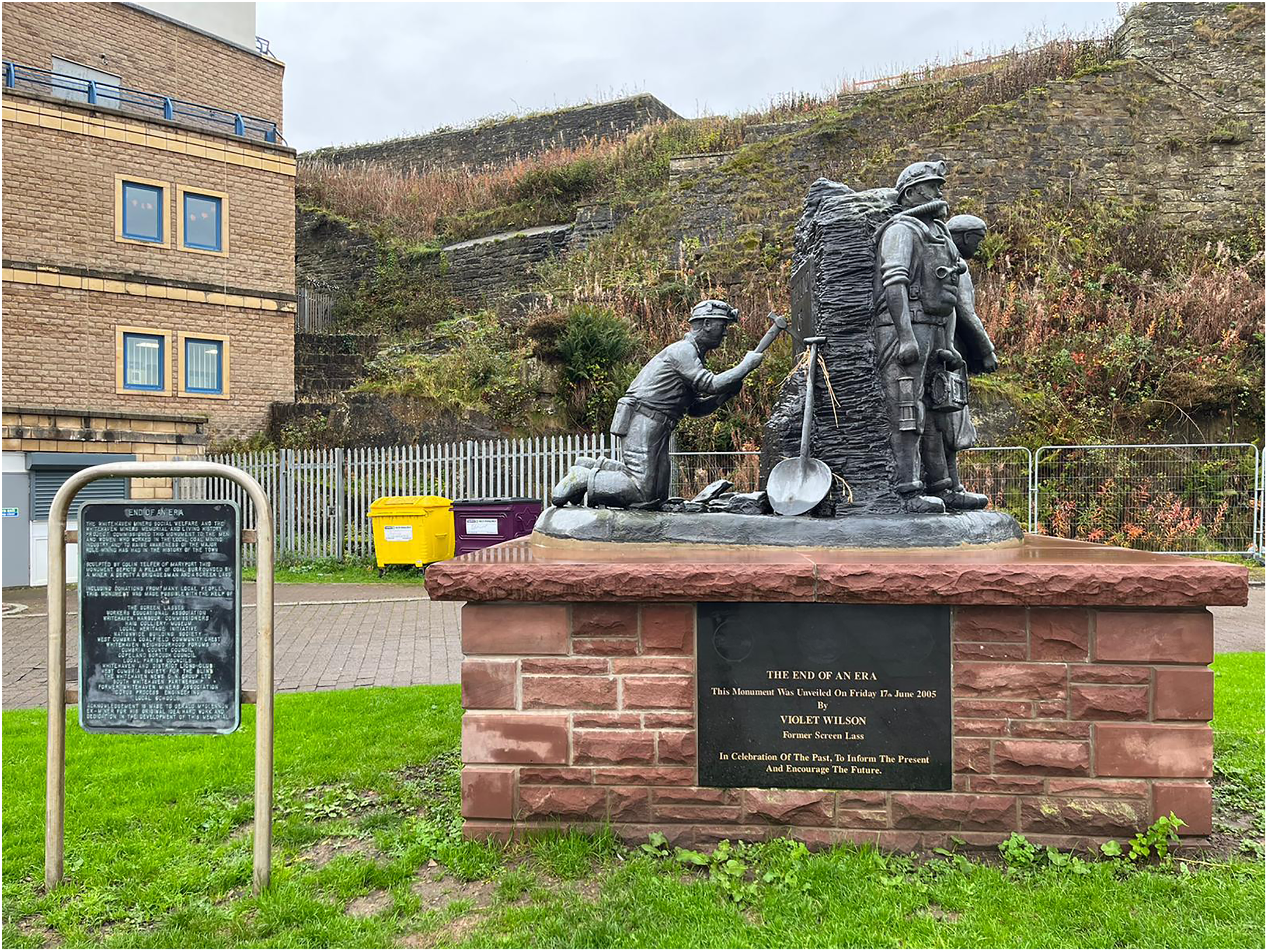
Statue to miners.
Dotted elsewhere are numerous other mining relics, the largest of which is Hague Pit, an impressive red-brick building with an enormous mining wheel attached to it (Figure 2). The area's landscape and the narrating of history through official channels underscores a sense that Whitehaven is indebted to coal; without coal, the town would never have come to exist in the way it does today.
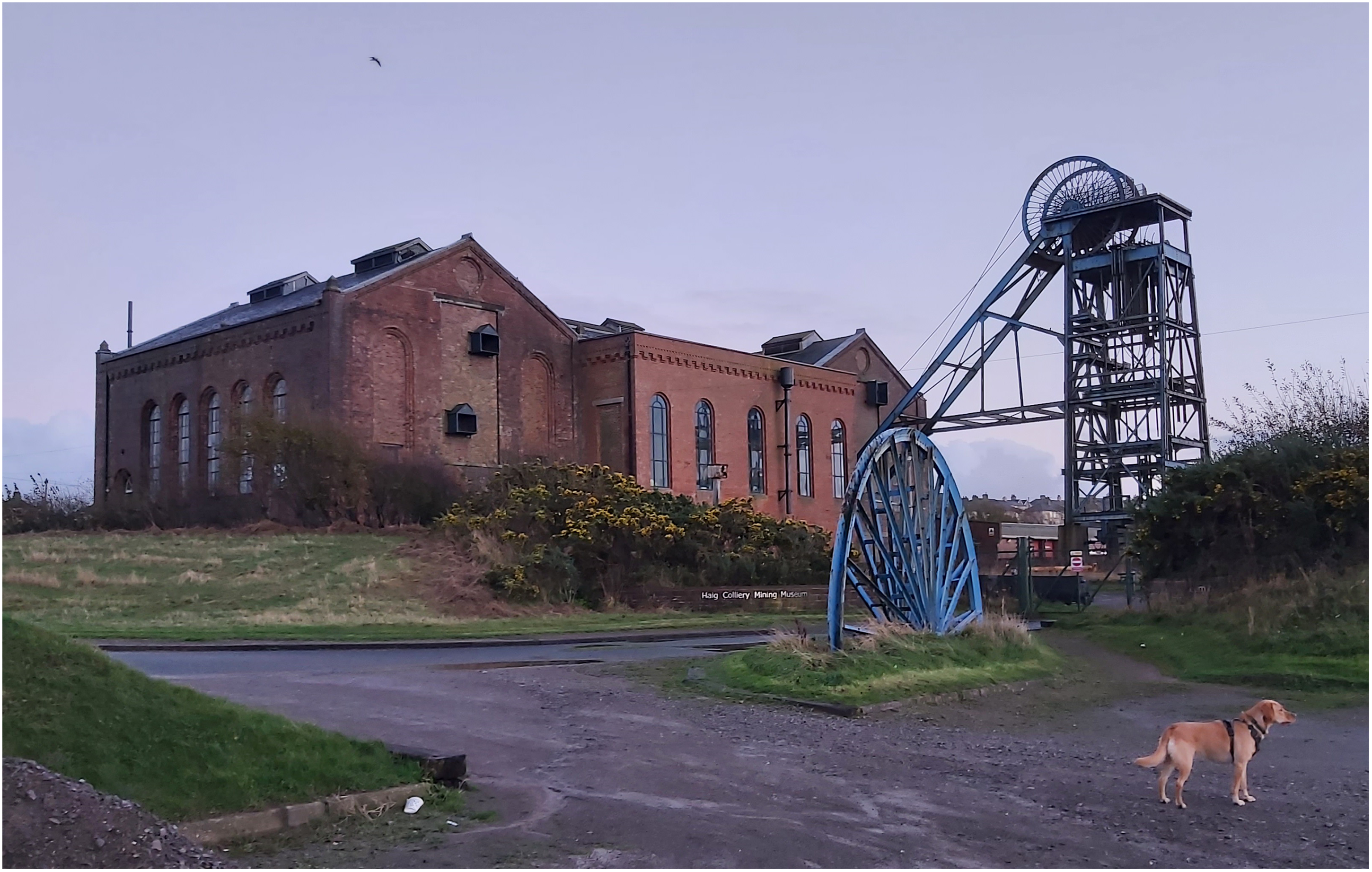
Haig Pit.
The second way coal continues to shape Whitehaven's milieu is in the way it informs contemporary constructions of community identity. This is most pronounced among older generations who have a personal memory of mining. In their accounts, coal interweaves with kinship relations, evoking memories of intimate relations bound up with industrial activity. My dad, he worked in [one of the biggest local pits]. He were down the mine for 30, 39 years, something like that…Obviously coal mining is a big thing around here. We’ve got history in coal. (male, 60 s, ex-nuclear union official)
I think that's the history of the coal mines as well. … Everybody is in one community. (male, 40 s, ex-nuclear worker)
The meaning of prior coal activity for younger people who do not have a personal memory of mining is less clear. The young people I spoke to see coal as an important part of the area's heritage, but not closely tied to their personal identity. 4
Detaching from coal
Mining activity thus exists as material and relational afterlife in Whitehaven. However, an afterlife is more akin to residue than an object of future-oriented promise. My informants agreed that prior to plans for the new colliery being made public it was widely assumed that mining activity was unlikely to return to the area. When I came out of the coal mines, I was convinced, like everybody else, that coal was a thing of the past, that they didn’t need it anymore. (male, 70 s, ex-miner) It was strange when it first presented again. I was like: Coal mine? What? I thought it was in the past. (female, 40 s, health professional)
[The] nuclear industry has probably taken over from where coal and mining had been previously. So, in the same principle that you grew up as a mining community, you grow up as a nuclear community and work in the same industry. (female, 40 s, public relations professional)
Many came to see Sellafield as a source of optimism, in particular because of its generous pay packages. In an area that is inexpensive, a good monthly wage provides ample opportunity for Sellafield employees to access different material goods. It also offered rewarding careers for those able to access them. The wages up in West Cumbria are pretty good in the nuclear sector, but the housing prices have remained really cheap…It's always been a good place to live…you see young 20-year-olds driving around in BMWs and Mercedes. (male, 60 s, Sellafield administration) Plenty of young people went on to be apprentices there, got a good trade, moved throughout the world, had some success. It's been a great – eventually – a great employer. (male, 70 s, ex-factory worker)
In these descriptions, we see the emergence of objects of attachment (flashy cars, homeownership, a career) which the promise of working in Sellafield clusters around. What is noticeable is the absence of coal as an aspirational object. It has been relegated to occupying a backdrop which no longer seems to be affectively potent in signalling a valued future. Yet, as discussed earlier, attachments should be understood as subject to flux, not immutable. Even when subjects appear to detach, affective ties can linger in a way which is not visible to the naked eye. ‘Afterlife’ should thus be read as a descriptor indicating a process of distancing such that the affective potency of the object loses much of its strength, rather than as indicating full detachment, which would imply closure. Afterlives could be understood, then, as containers which carry within them an object with the potential for reignition, such that that object might then transmorph into something that signals a promise.
Re-attaching to coal
Indeed, when plans for the mine became public, some people (although certainly not everyone) began a curious process of reattaching to coal. When I asked my informants to explain why many people in the area support the mine, they invariably stressed the employment that the mine promises to deliver (Kalshoven, 2022a). Pressed on the details of what is valuable about jobs in the mine, most did not feel the need to elaborate on the value of new employment – they implied that the provision of more jobs for the area had self-evident value (cf. parallels with Kalshoven, 2022a, who speaks of a ‘jobs incantation’ in the area). Some pointed to the high wages that have been promised. Others stressed a sense of cultural familiarity with the types of jobs the mine is expected to provide. The mine was imagined as mirroring certain aspects of work in Sellafield that are valued, including the job security, the predictable nature of employment routines, and the industrial nature of the work.
At the same time, many people argued that anxieties about Sellafield underpinned local support for the mine. A theme that came up very frequently in my conversations was a feeling that the local population relies too much on Sellafield for work. I think we’re over reliant on nuclear. We’re far too reliant on it. We’re so over reliant on it that people are getting desperate for a coal mine. (male, 30 s, Sellafield administration)
We lose our brightest brains…people will go elsewhere, to find a decent, you know, a good job. Well, my own son's gone. He said he wouldn’t come back here to live. (male, 60 s, ex-teacher)
Worries about dependency relate to existential concerns. Last year the plant entered full decommissioning. Although this will take more than a hundred years (Subramanian, 2022), some are concerned that nuclear jobs will be lost in the years to come and that, without other industry to replace nuclear, there will be little left to support people in the area (cf. parallels with Wynne and Waterton's (2007) study).
I do worry that there won’t be anything to fill the gap when Sellafield eventually closes. We don’t want it to be left as a ghost town. [If] there was no alternative employment, people would have to leave the area. (female, 20 s, Sellafield administration)
Further, some interviewees expressed concern about the local inequality that Sellafield produces. Indeed, statistical data shows that some of those who are locked out of employment opportunities in nuclear face economic hardship (Department for Communities and Local Government, 2019). [Some neighbourhoods are] high up on the areas of deprivation in the country…So you’ve got the haves and the have nots. We don’t have that diversification of industry, for, everybody to be working. … So having coal here, that's great. (male, 60 s, Sellafield administration)
In these conversations, the coal mine evoked feelings of hope given concerns about Sellafield. It seemed to exert a gravitational pull in promising to address multiple problems caused by overreliance on Sellafield.
In some conversations the mine appeared to hold up an additional promise. Some of my interviewees spoke about pride in the area given Whitehaven's history as a hub of diverse industrial activity. In one conversation, the face of a widow of a miner lit up as she listed the range of industries which once existed in the area – a large chemical plant; a pram factory; a high duty alloys plant; a tannery; a hat factory; a chocolate factory; an oats factory; a rope factory; several steel plants. One interviewee painted vivid pictures of a vibrant Whitehaven which was once, many years ago, a centre of global innovation. [Whitehaven] was the Silicon Valley of the day. [We had] cutting edge technology…that was driving the industrial revolution. So, advances in steam locally were right at the edge of technology. (male, 60 s, Sellafield administration)
A small number of interviewees explicitly juxtaposed the town's past grandeurs with the way the town exists in the present. We were one of the biggest ports in the world … now no-one knows us … we’re just a little old town that people pass through to get to [other places] … there's nothing here to call us a town. (male, 18–19 youth worker) It's quite tragic…all the shops are shutting down, we’re turning into a ghost town. No-one knows where Whitehaven is…we used to be one of the biggest spots and now it's just dead. (female, 18–19, youth worker)

Example of a boarded up shop.
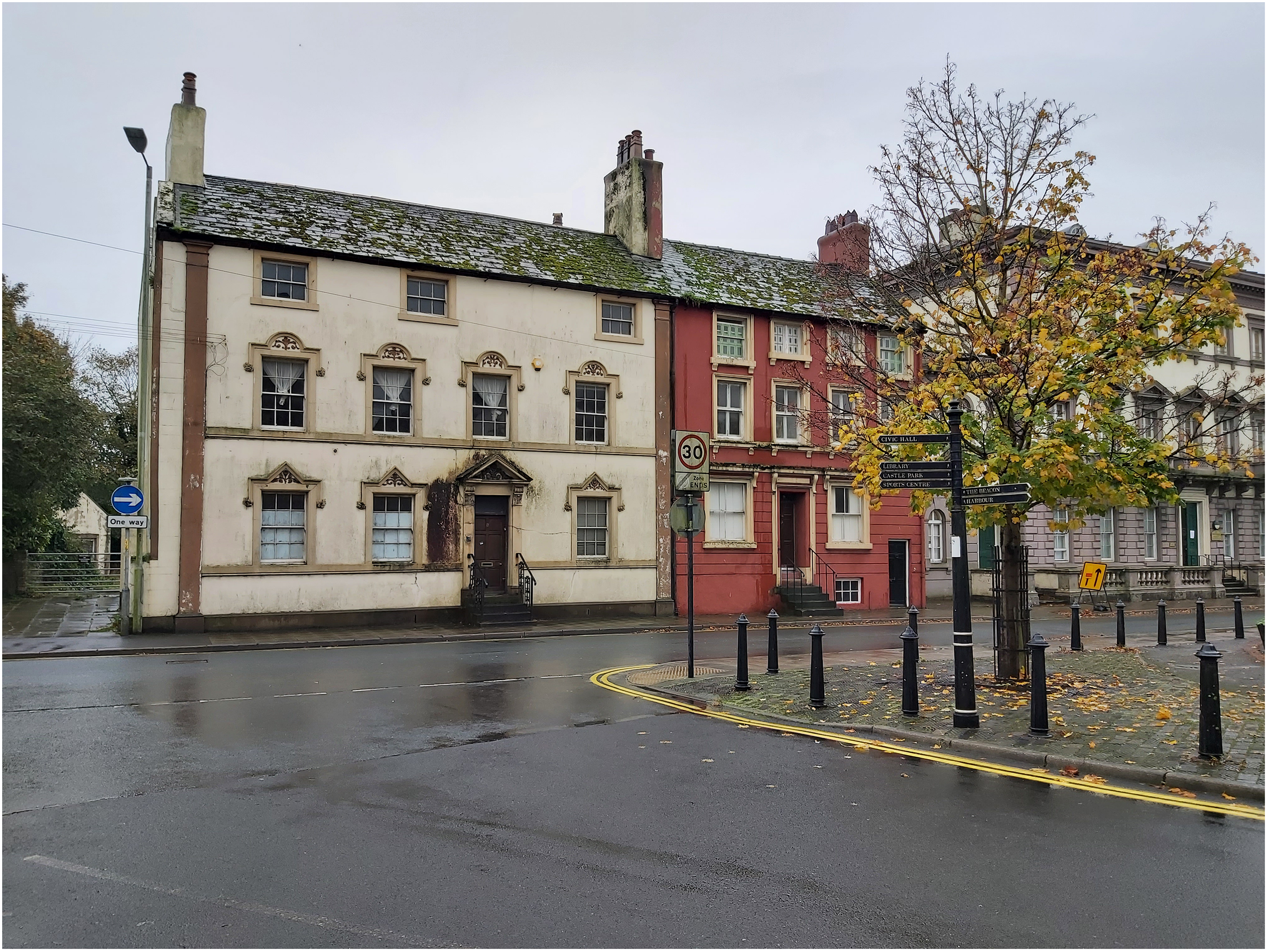
Example of a building left in disrepair.
One interviewee commented on the loss of industrial diversity as follows: We’ve lost such big things…Mining was a big thing and there was a massive chemical plant … [Things were] more industrious. … It's rich, the history. I’m a big supporter of the mine. (male, 60 s, ex-nuclear union organiser)
6
Coal mines and stuff are like the only things to really kick us back up and make us a known spot. (female, 18–19, youth worker)
Once we get a coal mine that means more money coming into town which means more shops, which means more people wanna move in and start growing their businesses. At least then there's hope. (male, 18–19, youth worker)
What is intriguing about the descriptions I quote immediately above is the following. On the one hand, they were hopeful about the possibilities afforded by the mine. On the other, they were acutely aware of the environmental damage that opening a new coal mine would contribute to. They drew on apocalyptic imagery to describe imminent threats which they saw the mine as hastening including ‘water rising because of ice melting’ and the different ways climate change is “ruining us faster and faster’. One of them described his fears of climate change as a spectral future which haunts the present: It's like a ghost. Nobody gives it attention until it destroys stuff that we love…I’ve read that the Maldives could be submerged within the next ten years, if we keep on doing what we’re doing. Which is weird because the whole island might be submerged completely underground. It's horrible. (male, 18–19 youth worker)
For these young people, then, attaching to the coal mine generated hope and profound concern. But they were not alone in communicating climate change anxieties. All my informants, including those who were passionately pro-mine, accepted that human-induced climate change was real and expressed varying degrees of concern about what climate instability might inflict upon the planet. Given this, how then could so many of them rationalise supporting a mine which would, if opened, pump an extra 8.4 million tonnes of carbon emissions a year (Moss et al., 2020)? What explains this disconnect?
New coal in a climate emergency
As argued in section two, discourses of delay (which state that carbon mitigation should be deferred) have in recent years largely replaced denial arguments (which reject or question scientific consensus on climate change). In Whitehaven, it was clear that pro-coal delay discourses found circulation. These centred on the notion that it ‘made sense’ to open a new mine in the area, despite the climatic consequences of burning coal. Anti-mine arguments were, by contrast, depicted as ‘idealistic’ and ‘out of touch’.
One argument that gained social currency was the view that the transition to a low-carbon energy mix could not be achieved without coking coal. Some residents argued that metallurgical coal is needed for the steel industry to produce steel for low-carbon technologies, like wind turbines and electric vehicles. How are you going to get the steel if you don’t have coal? I looked at the new processes that were coming in, hydrogen and things like that…I realised it was in its infancy and they could only do it in small amounts at present. (male, 70 s, ex-miner)
Steelmaking in the UK uses coking coal which we import from Australia…the fact that we’re no longer importing and using locally is a positive for me. (female, 20 s, Sellafield administration)
An additional argument suggested that local coal was ‘clean’, in contrast to coal from abroad which is ‘dirty’. This coal, it's quite clean coal apparently. … They say it's going to create very little carbon dioxide, it's a different type of coal apparently. (male, 60 s, ex-teacher)
West Cumbria Mining (WCM), the company behind the plans, played a role in injecting these delay discourses into local arenas. They ran community engagement events where they presented these and similar arguments. In her ethnography, anthropologist Petra Tjitske Kalshoven describes visiting one of these events, where she was greeted by young, enthusiastic staff who showed her around an exhibition space the company had set up. ‘Large graphic panels [were displayed] depicting hi-tech remote operations’, she writes, which ‘looked very different from the grimy photographs of coal mining and its disasters in the old days’ (2022a: 10). These depictions appear to have been intended to portray the new mine as safer than prior mining operations. However, they may also have been an attempt to instil the feeling that the proposed mine would be ‘futuristic’ and with more stringent environmental conditions attached to it. This tactic has been advanced elsewhere by WCM. On their website they explicitly make the argument that the mine will provide coking coal for ‘world leading “net zero” steelmaking’ in the UK (West Cumbria Mining, 2024) – even whilst this flies in the face of the scientific evidence.
WCM built an alliance with local politicians who in turn rehearsed pro-coal discourses in resident meetings, in the local media, and on social media platforms (Jenkinson, 2022). Delay discourses – including the argument that it is ‘greener’ to extract coal locally than import it from other countries – found repeated circulation in wider regional, national, and international arenas (Willis, 2024), in arguments made by national politicians and media sources on television channels like Sky News (Sky News, 2022) and newspapers like The Daily Mail (White, 2023), all of which are media sources that Whitehaven residents would likely have encountered.
Yet, I suggest that these arguments did not gain traction in Whitehaven arenas only because of the actions of powerful actors. Rather, it seems they found resonance in part because of the material, historic, and cultural context within which they were received. As shown earlier, coal persists as material and relational afterlife, acting as a reminder of Whitehaven's historic indebtedness to coal. Discourses about the legitimacy of a new coal mine appeared to connect with the way coal is folded into the area's sense of memory and time. This message was explicitly articulated to me by one of my informants. You’ve got that history and heritage as well … Coal powered the country didn’t it? Everything we needed, whether we needed steel or we needed electricity … I think we’ve got a massive opportunity … if we open this mine as well it gives us more opportunity for jobs. It gives us an opportunity for the coke, we don’t have to then ship it from Australia to fetch it out. (male, 60 s, ex-nuclear union organiser)
Implications
Re-attaching to fossil fuels
What are we to make of some people re-attaching to coal in Whitehaven, and deploying pro-coal discourse to legitimise their position? I suggest there are two core implications. The first is about the dangers of social groups re-attaching to fossil fuels. As we have seen, empirical studies have shown that communities with intimate experiences of extractive industries can feel a sense of cultural-emotional connection with fossil fuels (e.g., Bright, 2012; Della Bosca and Gillespie, 2018; Rohse et al., 2020). What is unique about the case of the Whitehaven mine is the way it shows how attachments to coal which had previously been loosened can be brought back to life many decades later. It is worth dwelling on the significance of this process of unforeseen reattaching and what it could portend for developments elsewhere. To help me do this, we can turn to cultural theorist Lauren Berlant.
Perhaps more perspicaciously than any other theorist, Berlant (2011) explores the affective consequences of the wearing down of people's agency under neoliberal conditions. They 8 write about how the promise of the ‘good life’ as a guiding orientation for Euro-American political programmes in the post-war years has been undermined in recent decades. This in turn has eroded the modest social democratic gains achieved during those decades. Berlant suggests that a strange thing has occurred. Even whilst the conditions required to socially enact the promises of liberal democratic meritocracy have diminished, attachments to meritocratic narratives have persisted. For Berlant, this is a form of ‘cruel optimism’, the act of desiring something that is ‘actually an obstacle to your flourishing’ (2011: 1) – for, in continuing to desire meritocratic fantasies, individuals make themselves responsible for a failure to enact them, rather than construing alternative narratives which challenge the premise of liberal narratives (Berlant, 2019). Further, Berlant seems to suggest that conditions of precarity and trauma provide the very fuel for the persistence of these damaging attachments (Berlant, 2011).
This suggests that at times of uncertainty subjects will reach out to objects of attachment to help counteract the disorienting effects of insecurity, even whilst those attachments may generate a deepening sense of dislocation. Berlant's observation could portend a troubling warning for the future of climate politics. Given that climate instability and extreme weather events are likely to lead to deeper and more profound traumas, it is not unforeseeable that fossil fuels – the very things which cause climate change – could increasingly become the very objects which some reach out to as a means of gaining orientation in a disorienting world. Perhaps, then, it would not be surprising if we see the resurrection of attachments which rebind people to high-carbon forms of living in the years to come – renewed support for extractive industries, heightened attachment to high-carbon transport, etc. This might occur even whilst progress is made in forging attachments to objects which enable more sustainable ways of living (e.g., reduced energy consumption patterns, an increase in renewable forms of energy, etc).
Researchers have pointed to contexts where similar processes may already be occurring. Political scientist Cara Daggett's (2018) work on ‘petromasculinities’ examines how affective ties to fossil fuels are bound up with constructions of toxic masculinity in reactionary political movements, in the USA and elsewhere. Her work shows how, under conditions of uncertainty about the future, petromasculinities provide a guiding orientation to groups attracted to authoritarian politics. Similarly, governance researcher James Patterson (2023) focuses on public backlash to climate policy. He identifies instances of ‘abrupt and forceful negative reaction by a significant number of actors within a political community … [involving] a volatile and largely unexpected pushback’ (2023: 69, emphasis added), pointing to examples like protests against infrastructure siting. Whilst these do not necessarily signal a process of reattaching insofar as they heighten already existing attachments, both Patterson's and Daggett's research warns about the way these objects which emerge in unexpected circumstances can undermine attempts to turn away from fossil fuels towards alternative energy sources.
In this light, the challenge is to assemble a politics of promise which channels people's need for attachments towards ends which are compatible with stabilising climatic conditions. The focus should in part be about helping people detach from fossil fuels and other objects which lock society into high-carbon trajectories. Yet, as I have suggested, the challenge is also to pre-empt preemergent high-carbon attachments. I suggest, then, that this is a pertinent and fertile area for future research, which I expand on in my conclusion.
Caution against over-valorising the local
A second implication of this case study concerns the way the value of ‘the local’ is imagined in the energy social sciences and humanities. In environmental justice (EJ) and related fields, it is common to advocate for the imperative of attending to locally situated, culturally diverse voices through empirical research. This sensibility is shaped by political-ethical considerations, which underscore that foregrounding marginal voices is important because these have been historically ignored or victimised (Holifield et al., 2018). There are also instrumental reasons for doing so. Sidelined voices can articulate novel critiques vis-à-vis fossil fuel hegemony (Brown and Spiegel, 2019; Lohmann, 2008; Lövbrand et al., 2015; Schlosberg, 2004).
Some voices within EJ have nuanced these arguments. Eva Lövbrand and others (2015) argue for democratising environmental research agendas and simultaneously acknowledge that doing so is ‘a challenging task that does not promise better or more complete understandings of environmental change…[for] the vision of the less powerful by no means is innocent’ (2015: 216). Despite this, I suggest there remains a tendency in EJ scholarship to advocate for the value of attending to community voices without always acknowledging the way that ‘the local’ can be constituted by, and be reproductive of, high-carbon trajectories. It remains common to centre empirical studies on the grassroots for the way it is thought of as a site where resistance to extractive industries emerges (Brown and Spiegel, 2019; Chatterton et al., 2013; Chomsky and Striffler, 2014). Even whilst scholars complicate romanticised depictions of the local by recognising elements of ‘residual support for coal’ (Brown and Spiegel, 2019: 159), emphasis tends to be on the way ‘social mobilizations against coal set the stage for competing visions of the future’ (2019: 155) and help achieve ‘the realization of a just transition’ (2019: 151). I suggest that these arguments are sometimes made without sufficient consideration about how some communities might desire futures which perpetuate high carbon lock-in.
Another common position is to advocate for attending to locally situated voices for the way they foreground people's lived experience in otherwise abstract, expert-oriented discourse about climate change (e.g., Lohmann, 2008). The argument is that doing so provides more open, inclusive ways of mapping environmental futures and that taking such an approach will help pave the way for more desirable socio-environmental outcomes (e.g., Lohmann, 2008). Attending to local voices in some places may undoubtedly achieve such an objective. This includes recognising how indigenous voices challenge logics of capital accumulation which structure globalised economic activity. Yet, here too, I suggest that there is sometimes not enough recognition of the way the grassroots can become a site of the entrenchment of high-carbon political sentiment. It would be beneficial to take stock of Eva Lövbrand and her colleagues’ (2015) call to guard against the risk of over-valorising the local. The case of the Whitehaven mine serves as one such reminder, together with many other studies cited in this paper (e.g., Della Bosca and Gillespie, 2018; Herrero and Lemkow, 2015; Svobodova et al., 2021).
Conclusion
How do we assemble low-carbon attachments and simultaneously pre-empt re-emergent attachments to high-carbon objects? These questions have received very little explicit attention. In part this is because the concept of attachment has only recently been elaborated for the purposes of empirical study in geography and other social sciences (Anderson, 2022). 9 Where attachment has been used to describe human-carbon relations, the term surfaces fleetingly without conceptual elaboration (e.g., Daggett, 2018; Furnaro, 2021).
There are different ways researchers can explore the questions I pose above. One approach is to build on work by Harriet Bulkeley, Matthew Paterson and Johannes Stripple (2016), which examines devices, desires, and dissent – ‘the materialities, subjectivities and resistances through which power and everyday life are organized’ (2016: 9) – and their role in enabling net zero social arrangements. Researchers might pay attention to attachments in different spheres of social life most relevant to the net zero transition, such as home heating (Lovell, 2016), travel (Bartling, 2016), and consumption practices (Rice, 2016). In so doing, considerations should be given to the reasons why, and the mechanisms by which, certain devices come to be experienced as promissory over others, and how the act of composing attachments is always responsive to a set of wider political economic dynamics.
However, it is important to draw attention to the way that cultivating attachments to net zero practices faces profound challenges. One problem is that enacting a net zero transition means bucking a historical trend that has been in place since the start of the industrial revolution. When new energy sources have been discovered in the past, they have rarely replaced older energy sources (York and Bell, 2019). Rather, they have been added to the existing energy mix to meet increasing demand. The discovery of oil, for example, did not lead to the substitution of coal. Instead, it meant more energy (coal and oil) was available for higher production and consumption. There is a need, then, not just to continue to scale sustainable forms of energy, but also to find ways of actively removing high-carbon energy sources. Moreover, it is unlikely that this is feasible without reversing historic trends of ever-increasing energy supplies.
But it is difficult to overstate the sheer transformation in people-energy relations that such an objective requires. What is needed is a re-configuration of the hegemonic imaginaries which have powered social and economic change for centuries (Garrigou, 2016). In place of the promise of an infinitely expanding pool of energy – which arguably lies at the heart of the project of modernity – a radical new promise which runs against the tide of modern history needs to be sown. This needs to recast energy not as boundless, but as something to be used with moderation. In practice, this requires placing certain social practices out of bounds, at least in the short to medium term. A range of activities might be mentioned, but an obvious example is regular flying. Whilst most humans have never been on a flight, a small but sizeable number of people are more than accustomed to jumping on a plane to achieve the objective of traveling hundreds or thousands of miles within hours. The politics of cultivating detachment from regular flying is littered with hurdles, not least stiff resistance from wealthy and powerful social groups who have come to take frequent flying as a taken-for-granted activity – or from the aviation industry itself which profits from these attachments and will fight hard to protect those (Brown, 2016).
A separate challenge concerns the issue this paper has centred on – the risk that high carbon attachments might return or intensify. As suggested, it is possible to imagine that in future years we might see the rekindling of attachments to high carbon objects, even in contexts where progress has been made in binding people to sustainable ways of living. One might imagine a scenario where there has been global progress in significantly scaling up low-carbon technologies and rapidly scaling-down fossil fuel extraction, such that real cuts in global carbon emissions are being achieved. In this scenario it might only take a few unfortunate events for that consensus to unravel, and for a successful counter-hegemonic project wedded to petromasculinities and fossil fuel expansion to re-emerge. To use the typology employed by theorists Geoffrey Mann and Joel Wainwright, this would represent a resurgence of a ‘Climate Behemoth’, a politics ‘animated by a chauvinistic capitalist and nationalist politics that denies – until it can only denounce – the threat climate change poses’ to national polities (Mann and Wainwright, 2019: 1).
We can turn to this year's US presidential elections to think of a real-world scenario which illustrates this point – although the analogy is imperfect, given that real global emissions cuts are not yet being achieved. At the time of writing, it looks all but certain that Donald Trump will be the Republican party's presidential nominee. In recent months, his politics has grown more ethnonationalist and fossil fuel friendly. If he wins, Trump has promised that he will reverse the limited but significant progress that has been achieved by the Biden Administration through the passing of the Inflation Reduction Act (Milman, 2024). He boasts that he will ‘drill, baby, drill’ for new fossil fuel extraction. Even if he loses, this does not mean the end of this form of politics. It will find articulation in the USA and other countries for years to come. The scenarios I paint above are admittedly nightmarish. However, it is precisely their dystopian nature which makes the task of attending to the (de/re)composition of attachments in the net zero transition so important.
At the beginning of the paper, I described walking along Whitehaven harbour with one of my informants, Sheila. She implied it was strange that the mine had become such a prominent political issue, because it otherwise very much looked like the community had ‘moved on’ from its coal days. I agreed with her – it felt strange. And despite the time I have now spent thinking about the case of the Whitehaven mine, the unexpected reemergence of pro-coal politics in Cumbria continues to feel strange to me. As I have argued, it is the peculiar nature of fossil fuel re-attaching which makes examining cases like the Whitehaven mine important and, moreover, makes carrying out pre-emptive work to prevent the re-kindling of high-carbon attachments all the more crucial. If we are to avert dangerous climate change, in future detaching from coal and other fossil fuels must entail gaining sufficient distance such that the allure of high-carbon objects no longer retain their shine. Or, to put it in terms that Sheila might: In future ‘moving on’ from fossil fuels must also mean not moving back. The stakes could barely be higher.
Highlights
This paper draws on the concept of ‘attachment’ to understand people-coal relations.
Pro-coal discourses promoted by vested interests are (re)articulated by local actors in a context where coal exists as afterlife.
The case study I examine is a warning about how fossil fuels can unexpectedly re-emerge as promissory objects.
The findings are a reminder of the need to guard against over-valorising ‘the local’ in environmental research.
More research about how attachments to high-carbon objects are (re/de)composed is needed, given the urgent task of societal decarbonisation.
Footnotes
Acknowledgements
I thank my supervisors Nigel Clark, Rebecca Willis, and Jacob Ainscough for their detailed and constructive feedback on drafts of this paper, and the wider Climate Citizens team at Lancaster University for stimulating conversations. I am grateful to all those who took part in this research as informants, for their time and generosity in sharing their perspectives with me. I also want to thank the paper's three anonymous reviewers for their insightful comments. These were very helpful for the final version of the paper.
Declaration of conflicting interests
The author(s) declared no potential conflicts of interest with respect to the research, authorship, and/or publication of this article.
Funding
The author(s) disclosed receipt of the following financial support for the research, authorship, and/or publication of this article: This research was funded by Economic and Social Research Council (ESRC) funding ES/P000665/1.
