




Abstract
Though urban scholars have drawn our attention to the multiple water infrastructures serving urbanites in the global South, studies rarely explored the practice through which prices are produced and governed within the heterogeneous infrastructures that supply water beyond the utility. Drawing perspectives from everyday pricing practices and heterogeneous water infrastructures, we contribute to the scientific discourse on heterogeneous infrastructures, everyday practices and infrastructure governance by showing how multiple infrastructural systems beyond the utility network, such as hydro-mobile and private network water providers produced prices to mediate water collection. Prices were established based on the cost of electricity, fuel, repairs and maintenance, location and/or distance, nature of road connectivity to clients’ residences, and providers’ expected profit margins. Water providers’ discretions and learning by doing enabled the continuity of pricing practices. The conventional practice of non-collective negotiation and bargaining produced specific prices between water providers and end-users. The novelty of the paper emanates from the ways in which prices are produced and governed. In contrast to conventional tariff systems, reflectivity, creativity, practical knowledge and experiences acquired by non-state actors over time works to produce prices. The involved non-state actors exercised regulatory power over prices of water produced and supplied beyond the utility. When prices were established, they remained subject to modification. We argue that the focus on pricing sheds light on an important aspect of heterogeneous infrastructure provision and governance: where varied prices are established outside formal regulation, they reflect, shape and exacerbate fine-grained socio-spatial differences between individuals within single neighbourhood.
Introduction
Dar es Salaam, like many Sub-Saharan African cities is characterized by uneven coverage of networked water. This has been attributed to low water production capacity, leakages, and uncontrolled spatial expansion of the city (Monstadt and Schramm, 2017; Bender, 2021). Consequently, urban and peri-urban residents collect and store water from varied water infrastructures often beyond the utility network (tube wells, boreholes fitted with hand pumps, tankers, pushcarts etc.) for domestic use (Dakyaga et al., 2018a, 2023; Grönwall, 2016). In many Sub-Saharan African cities, these water infrastructures often serve diverse urbanites: residents located beyond the network; residents by-passed by the network due to inability to afford the cost of utility connection; and residents connected to the utility networked but experience an erratic and uneven flow of water (Allen et al., 2017; Mapunda et al., 2018; Nganyanyuka et al., 2015; Peloso and Morinville, 2014). Water collection beyond the utility manifests in an interactional manner, where residents by-passed by the utility purchase water via out-of-pocket payments or “cash payments” for a given quantity of water (Alba and Bruns, 2021; Sarkar, 2020a; Simone, 2015; Tutu and Stoler, 2016).
Moreover, studies considering the socio-economic inequalities and the unequal negotiation and bargaining powers of urbanites, especially in Southern cities advocate for the need to pay attention to the varied ways in which water is priced, distributed and collected (Adams, 2018; Dakyaga et al., 2022; Dapaah and Harris, 2017; Pihljak et al., 2019; Sesan et al., 2021). This is imperative because though prices can regulate water use and limit wastage of water, they may also foster the exploitation and exclusion of marginalized residents (Alba et al., 2019; Alfonso et al., 2022; Bakker, 2003; Meehan, 2014). Prices may facilitate access and manage water availability, but may also restrict and (re)produce unequal access in heterogeneous socio-economic settings (Fuente 2019; Zetland, 2021). Critical urban scholars further show how spatial diversity and endowments shape water access in heterogeneous ways (Dapaah and Harris, 2017), often allowing residents located in the inner city and who can afford the cost of networked gain better connectivity (Alba et al., 2020; Dakyaga, 2022; Smiley, 2020), while peripheral dwellers and low-income residents by-passed by the utility network or unable to afford utility bills remain dependent on manifold water supply infrastructures beyond the utility network (Dapaah and Harris, 2017). This study uses the term water supply beyond the utility to refer to the multiple off-the-utility-grid water systems that are indirectly connected to the utility network but produce and/or distribute water (Dakyaga, 2023). While we acknowledge the aforementioned observations, that water pricing is a strategy capable of fostering inequality and exclusion in the daily water collection chain, our own aim is not to analyze how pricing produces inequalities, but to understand the practice of pricing itself, and how pricing practices beyond the utility network are governed. This is imperative because urban scholars barely explored the ways in which water prices are produced, especially the mechanisms that determine the setting of water prices and how they are regulated also by non-state actors towards improving urban water supply. A nuanced understanding of such mechanisms can provide initial insight for further research into how water pricing beyond the utility network produces inequality and exclusion in everyday water access.
Even though water collection beyond the utility network is a common phenomenon in urban Sub-Saharan Africa, research on urban water pricing is yet at an infant stage (see Alba et al., 2019, 2020). The few existing studies have been more focused on the sustainability of the utility's water tariffs and subsidies, and the everyday practice of setting prices through utility-community collaborations (e.g., Pihljak et al., 2019). Within these areas, scholars reveal the distributive inequity that characterizes the network water distribution in Southern cities, where tariffs are formally set (Favre and Montginoul, 2018; Fuente, 2019; Mercadier and Brenner, 2020). Similarly, in Dar es Salaam, research has showcased the proliferation of, and reliance on, varied water supply infrastructures beyond the utility network (Allen et al., 2017; Dakyaga et al., 2022; Nganyanyuka et al., 2015). Some urbanites leverage their owned resources to co-produce water for self-supply, while others rely on water systems owned by neighbours to cope and adapt to water access complexities (Andreasen and Møller-Jensen, 2016; Dakyaga et al., 2018b; Dapaah and Harris, 2017). In this study, we attempt to question perspectives on urban residents as passive actors in urban development issues (Schramm and Wright-Contreras, 2017; Wamuchiru, 2017), by demonstrating how urbanites influence price setting to supply water. Therefore, by engaging literature on infrastructure heterogeneity (Lawhon et al., 2018, 2023), and everyday practices of pricing water (Alba et al., 2019; Pihljak et al., 2019), our study contributes to the growing debate on urban infrastructure governance, especially the governance of heterogeneous urban water supply infrastructures beyond the utility network in the global South (e.g., Dakyaga et al., 2023). We offer an overview of the varied actors, prices and the ordinary ways in which water prices are produced and how they mediate water collection for domestic use.
In our exploration of everyday water pricing, we bring to light the various ways in which urbanites in Dar es Salaam engage with water providers beyond the utility network, structure water distribution, and determine the monetary value of water. We first situate our exploration of water pricing practices within the perspective of heterogeneous water infrastructure and everyday practices of pricing water to demonstrate the ways in which water pricing manifests in practice. We unravel (i) the prices, paying and water distribution practices; (ii) the mechanisms through which water prices are produced, and (iii) how they are regulated. The paper is organized as follows; Section 2, draws review from heterogeneous water infrastructure beyond the utility network in the global South cities. Section 3, presents our framework for analyzing everyday practice of pricing water. Section 4, explains the research methods. Section 4, presents the results and discussions. In section 6, we conclude by demonstrating the implications of the ways in which water is priced and regulated for improving urban water supply.
Heterogeneous water infrastructure beyond the utility network in the global South cities
In nearly half a decade, literature in urban studies has grown tremendously on urban water infrastructure heterogeneity (Alba and Bruns, 2021; Lawhon et al., 2018; Smiley, 2020; Truelove, 2019a, 2019b). This growing body of knowledge demonstrates how the waterscape of cities in the global South is characterized by an assemblage of diverse actors, technologies that coexist distributing water beyond the utility water network (Graham and Marvin, 2022; Monstadt and Schramm, 2017; Schramm and Wright-Contreras, 2017). Even when a utility connection exists, it tends to bypass some residents, producing the need for alternative water infrastructures. Such bypass, or the inability of some residents to gain networked water connection, often produces two or more co-existing urban waterscapes within cities: One where high-income residents receive regular water via the utility networked water infrastructure; another, where high-income residents receive regular utility water flow, but ought out for self-supply or co-produce water by drilling groundwater due to unreliable supply (Furlong and Kooy, 2017; Healy, 2019; Uitermark and Tieleman, 2021). The third urban waterscape is where marginalized residents, are excluded from utility networks and lack the ability to self-supply, thus remaining subservient to manifold water solutions and providers (Alba and Bruns, 2021; Grönwall, 2016). This failure of utilities in terms of even coverage, and regular flow of water contributes to the insurgence of domestic boreholes in global South cities (Dakyaga et al., 2021, 2023; Schramm et al., 2023; Truelove, 2019a) These water infrastructures beyond the utility network augment water collection, and simultaneously provide economic benefits to their owners (independent self-help and market-oriented actors) through the sale of the water (Dakyaga et al., 2022; Healy, 2019).
Some scholars (e.g., Adams, 2018; Dill, 2010), broaden our understanding as they reveal how historical intra-inequalities in Sub-Saharan African cities produce uneven distribution of networked water. They show how (post)colonial neglect and restriction in the distribution of utility networked water to suburbs of the colonial officials instigated the proliferation of water supply infrastructures beyond the utility network (Furlong and Kooy, 2017; Truelove, 2019a, 2019b). These produce socio-spatial differentiation in access to networked water (Healy, 2019; Smiley, 2020; Truelove, 2019a, 2019b; Wamuchiru, 2017). In urban environments where water is produced and distributed beyond the utility network, urbanites collect water daily from varied water systems navigating socioeconomically complex situations (Alba and Bruns, 2021; Burt and Ray, 2014; Wutich et al., 2016). The collection of water beyond the utility networked is mediated by diverse actors, whose ingenuities are more or less informed by varied motives, transcending “profit-making, political legitimacy, patronage and petty corruption including solidarity, religious beliefs and pragmatic choices” (Alba et al., 2020: 1; Rusca and Cleaver, 2022).
Understanding heterogeneous infrastructures, especially the practices associated with the ways in which water is collected can enables us to imagine, associate with, and place ourselves in the position of (un)served urban residents whose daily water collection experiences circle around varied infrastructures of which none is perhaps adequate to provide reliant water supply (Alba and Bruns, 2021). Such diverse infrastructures and urban service provision models coexist in peripheral areas, co-produced by urbanites due to utility network failure (Schramm and Wright-Contreras, 2017; Sesan et al., 2021). Truelove (2019a, 2019b) uses the term “gray zone” to describe the continuum of formal and informal water supply in Delhi, and reveals how such a continuum accounts for the heterogeneity of water infrastructure shaping daily water collection of urbanites. Within heterogeneous waterscapes, urban residents oscillate between sharing water with neighbours, buying water from vendors and sometimes drawing on utility networked water from owners’ plots (Alba and Bruns, 2021; Dakyaga, 2023; Wutich et al., 2018). This also involves relying on multiple water infrastructures beyond the utility network such as domestic boreholes, private and public water kiosks, tanker trucks, pushcarts, and private taps, in addition to utility water kiosks (Dakyaga et al., 2022; Hofmann, 2020; Sarkar, 2020a; Wutich et al., 2016). Through a perspective on the multi-modality of water systems in Dar es Salaam Dakyaga et al. (2018a, 2018b), reveal how “dual and multiple” purchasing and storing of water in varied material artefacts enables household to fulfil domestic water demands at the fringes. Residents may hold connectivity to both utility networks as well as drill mechanized water system, often by collecting and storing water differently, for drinking and sanitary purposes (Dakyaga et al., 2022; Grönwall, 2016). In heterogeneous water infrastructure systems, water access is often mediated by the locations of residents, and the available water systems at the time of oscillation (Dakyaga et al., 2022; Tiwale et al., 2018). Oscillation may be shaped by residents’ defined water uses, and also by the income required to purchase water (Alba et al., 2020; Dakyaga et al., 2018b; Truelove, 2020).
Moreover, studies referring to cities of the global South argue that the fragmentation or heterogeneity of infrastructure does not represent failure, but a possibility for advancing water infrastructure delivery (McFarlane et al., 2017; Monstadt and Schramm, 2017; Smiley, 2020). This suggest the need to reflect on ways to improve water supply beyond the utility. Additionally, they reveal how the co-existence of technologies, skills, knowledge and operational capacities of the actors serve as incentives for facilitating and improving water supply beyond the utility network (Lawhon et al., 2018; Truelove, 2020). Water collection beyond the utility network is essential for shaping the confines of the completely private (high cost) and utility water supply (Bakker, 2003; Dakyaga et al., 2018b). While multiple water systems may contribute to innovatively delivering water to urban residents, they may also offer water at high and unequal cost (Tiwale et al., 2018). The unequal cost of collecting water from such water infrastructures may occur due to varied technological artefacts used by the actors, material costs and electricity (Schramm and Wright-Contreras, 2017). These variation in cost discriminate residents in terms of access within cities (Dakyaga et al., 2018a, 2018b; Sarkar, 2020b).
Our paper contributes to this evolving scholarly discussion by exploring the practice of pricing, questioning how water prices are set and governed in a context where water is supplied beyond the utility network. Through these water infrastructures, (in)formal transactions may manifest to enable water collection for domestic use (Caprotti et al., 2022; Healy, 2019). In some cases, water may be sourced from the utility network for resale, but unknown to the utility (Alba et al., 2020; Smiley, 2020). Situating our exploration within water infrastructure heterogeneity enables us to associate and extend our deliberation beyond the actors engaged in the practices, community ownership, private ownership, and the (in)formal domain, towards how prices are produced and regulated (Dapaah and Harris, 2017). These together offer a holistic understanding of everyday urban life (McFarlane et al., 2017).
Analytical perspective: Everyday practice of pricing water beyond the utility network
Within conventional water infrastructures, tariff systems mediate water pricing towards equitable, cost sensitive and affordable supply between end-users and the utility (Fuente, 2019; Pihljak et al., 2019). How prices of water are set in urban geographies where water is supplied beyond the utility network by varied actors, remains a lacuna in urban studies. Therefore, furthering our understanding of pricing mechanisms concerning multiple water systems that are indirectly connected to the utility network is imperative, especially where uneven coverage of the utility network is prevalent. Over the years, scholars have employed the everyday practices as an alternative lens for situating and analyzing how residents relate with water infrastructure (Kundu and Chatterjee, 2020; Peloso and Morinville, 2014; Sarkar, 2020a; Velzeboer et al., 2017). Some scholars draw an everyday practice lens to analyze the ordinary ways in which urban residents engage with infrastructure, provide and access water and sanitation services (Amankwaa and Gough, 2021; Iossifova, 2015; Pihljak et al., 2019), or how non-state actors develop and sustain water infrastructures beyond the utility (Dakyaga et al., 2021). These scholars show how a focus on “everyday practice” in connection with practice theory is useful for studying and analyzing water infrastructure access in cities of the global South (Kuusaana et al., 2023). The usefulness of a focus on everyday practices has also been highlighted for decentering Northern theories from the South (Velzeboer et al., 2017). Such a focus offers the possibility to unravel and critique socio-economic inequalities and differentiated power relations that prevail in, and reproduce, the chain to water access (Harris, 2021; Nakyagaba et al., 2023). Parnell (2012) see the relevance of everyday practices for urban studies in its suitability for diagnosing and comprehending the connection between global processes and place-specific situations. Their perspective advances the everyday practice as a universally applicable lens for urban studies beyond the global South. But while urban studies have flourished on the everyday practice, studies analyzing water pricing beyond the utility network as an everyday practice barely exist. This concerns specifically the ways in which prices of water are produced and governed. We contribute to this evolving discourse by exploring pricing practices of water supply infrastructures beyond the utility network such as boreholes, protected wells, tanker trucks and carts. We intend to demonstrate how such practice may represent alternative ways of understanding water access inequalities or segregation in urban areas.
Studies furthering practice theory analyze the practices associated with the production of water, and electricity (Kuusaana et al., 2023; Neves Alves, 2019). These studies reveal how urban residents develop, experience and sustain water and sanitation infrastructure beyond the state utility (Iossifova, 2015). They also reveal the socio-material artefacts and ordinary social relations that facilitate the production and distribution of water beyond the utility network (Alda-Vidal et al., 2018; Dakyaga et al., 2021; Peloso and Morinville, 2014). In the context of this study, everyday pricing practice entails the ordinary, diverse, trivial, and discrete acts through which actors – producers, consumers or both – establish and institute prices to warrant payments for the distribution or collection of water. Price setting may manifest through long-term strategies, and revolving within more or less complex transactional processes, shaped by (non)monetary costs and commitments (Nganyanyuka et al., 2015). However, prices of water may vary among the actors or water providers who perceive water supply as a business and a service. Alba et al. (2019), note that water prices are relatively higher among providers who regard the act of supplying water beyond the utility network as a business compared to their counterparts who regard such as “a service”. While these motives are essential in shaping pricing decisions, they are equally influential in (re)producing prices (Dakyaga, 2023; Strengers, 2010). Through ordinary practices, the actors involved in such water provision may create, sustain, transform and (re)produce prices (Dakyaga, 2023). The act of setting prices may manifest through repetitive actions shaped by water technologies and materialities (Peloso and Morinville, 2014). While prices may be ordinarily determined, they may be guided by defined rules or verbally expressed principles and instructions (Strengers, 2010).
Practices reflect the act or manner of “doing” influenced by historical, sociocultural interactions, powers, practical knowledge or know-how, and everyday experiences of actors shaped by discursive knowledge (Strengers, 2010). The interactions among actors work to produce common social understandings at a given location. In relation to water access and pricing, they may be mediated by material infrastructures and/or configurations of technologies, that produce and distribute water to residents (Strengers, 2010). Moreover, actors may hold tacit knowledge in terms of what water prices existed in the past and how they were determined (Dakyaga et al., 2021). These then inform how much a unit of water should cost (Strengers, 2010). End-users may negotiate or (re)produce prices towards their institutionalization (Velzeboer et al., 2017). The conduct of these practices tends to facilitate relations, shaped by how water is delivered beyond the utility network, particularly, the material infrastructures (buckets, barrels, poly-tank, in-house pipes) that facilitate the distribution of water beyond the utility. Prices may vary across cities’ spaces shaped by diverse arrangements, sources of water, quality and location factors. Studies on the routine operations of hydro-mobile infrastructures reveal how water prices of tankers are often shape by travel distance, waiting time to haul water from the utility source, costs of fuel and labour (Alba et al., 2019; Dakyaga et al., 2023).
Research methods
Study areas
The confluence of Dar es Salaam's rate of urbanization (5.6%) and suburban sprawl challenges utility-networked water supply. As a result, many residents live beyond the utility network (Andreasen and Møller-Jensen, 2016). Besides, water supply by the utility, the Dar es Salaam Water and Sewerage Authority (DAWSA), is intermittent due to insufficient production capacity to meet the demand of the city's rising population. Water production capacity is challenged by power outages and low voltage especially at the utility pumping station (EWURA, 2020). Consequently, utility water flows at an average of 14 h per day, woefully below the benchmark of 24 h (EWURA, 2020). The extension of networked water is demand-driven; residents pay for the estimated cost of the utility's network extension. The cost of utility network extension varies based on locations, and is relatively costly to people living at the urban edge (Hofmann, 2022). Like most cities in the global South (e.g., Fuente, 2019; Pihljak et al., 2019), the volumetric tariff system mediates the price per unit of water of DAWASA towards equitable, cost-reflective and affordable supply.
The Energy and Water Utility Regulatory Authority (EWURA) sets and regulates prices per unit of water of the utility network. This is aimed at protecting the interests of residents, as well as ensuring the availability of regulated services to all residents especially for low-income residents and disadvantaged groups (EWURA, 2020). Moreover, due to uneven coverage and low production capacity, residents in the peripheral and in the intermediary zones of the city live without direct utility network connection. These residents secure water beyond the utility, from the varied water supply infrastructures that more or less co-exist with utility water services (McGranahan et al., 2016). These comprise private tanker trucks water distribution, protected wells, water delivery with pushcarts, mechanized boreholes, self-supplied water networks and community-managed water systems (Dakyaga et al., 2023). Although these water infrastructures complement the utility (Mapunda et al., 2018), price determination and governance mediating water distribution beyond the utility has been barely explored. See Table 1 and Figure 1.
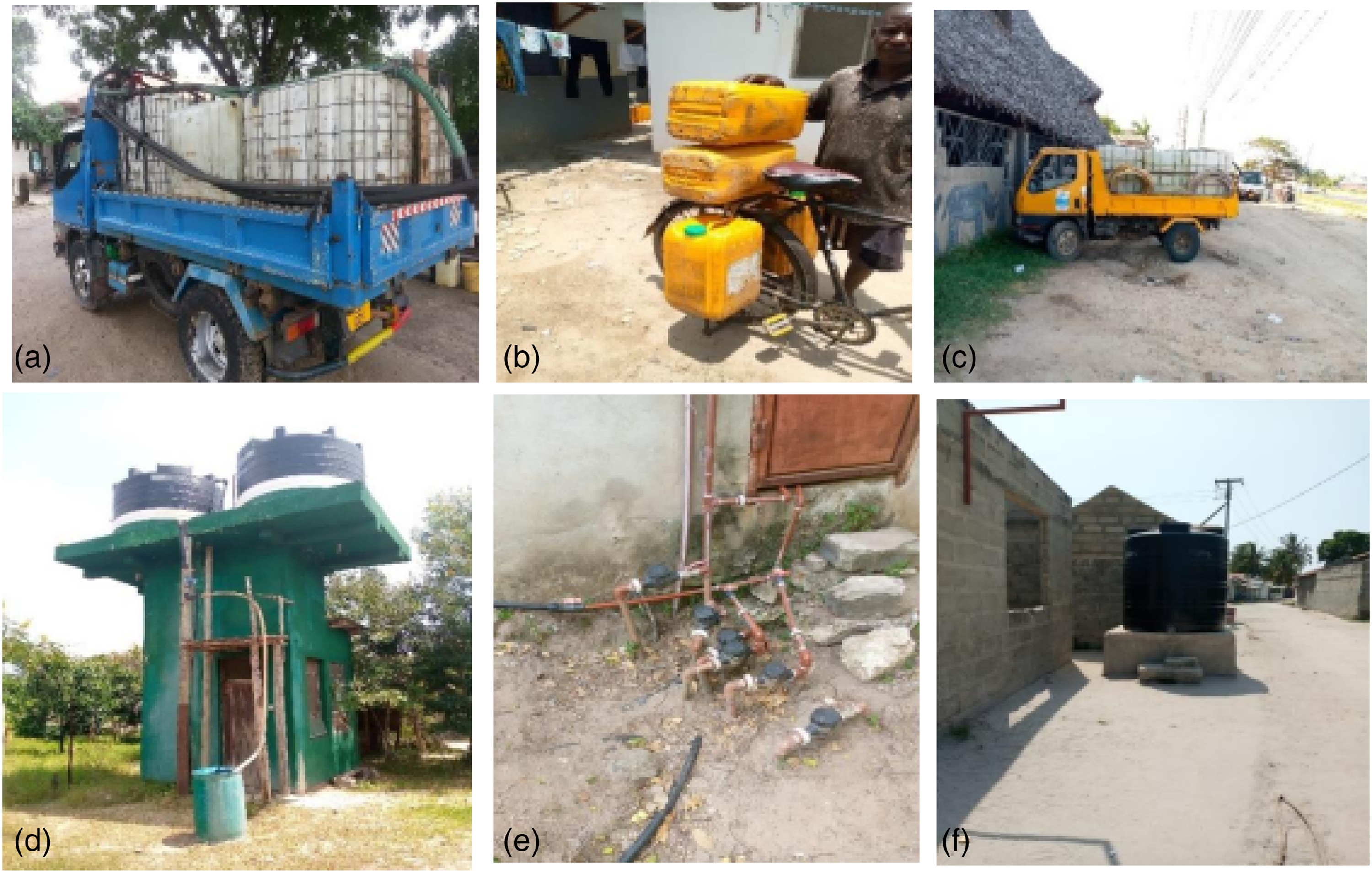
Water supply infrastructures beyond the utility network; (a) non-registered private tanker trucks, (b) bicycle utility water reseller, (c) utility registered tanker, (d) privately mechanized boreholes for in-house/pipe water connections, (e) pipelines and meters of private boreholes networked, (f) standalone reseller of utility's water to neighbours.
Basic descriptions of the selected case study settlements.
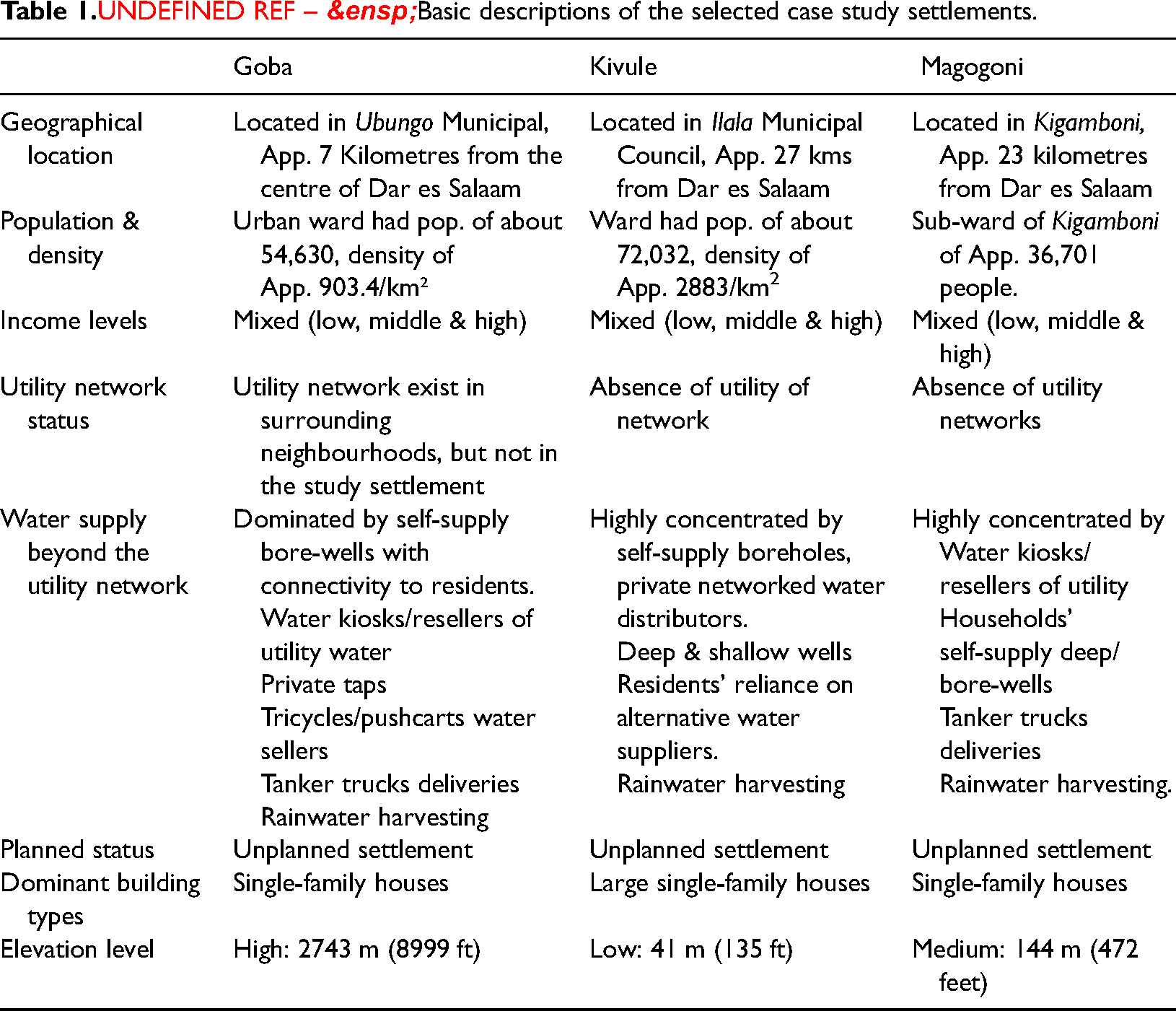
Drawing on a qualitative case study research method, we asked how prices wereproduced and governed beyond the utility network in Dar es Salaam. In so doing, we focused on the heterogeneous water supply infrastructures beyond the utility network. These comprised of private tanker trucks water distribution, protected wells, pushcarts water delivery, mechanized boreholes for commercial use and self-supply water and community-managed water systems. These water infrastructures are not all fixed in terms of location but produce and transport water to varied suburbs within the city. In order to gain a nuance understanding of how these water infrastructure providers set and govern prices beyond the utility network in Dar es Salaam, we targeted the utility's officials and experts, Ward (Mtaa) leaders, hydro-mobile infrastructure providers such as tanker truck drivers and pushcart operators. Additionally, we targeted water kiosks operators, mechanized borehole water providers, self-supply households, protected wells, private tap operators, Community-shared water systems in three settlements (Goba, Kivule and Magogoni). These settlements outside Dar es Salaam's urban core were selected from three Municipalities (Ilala, Ubungo and Kigamboni), see Table 1.
Data collection and analysis
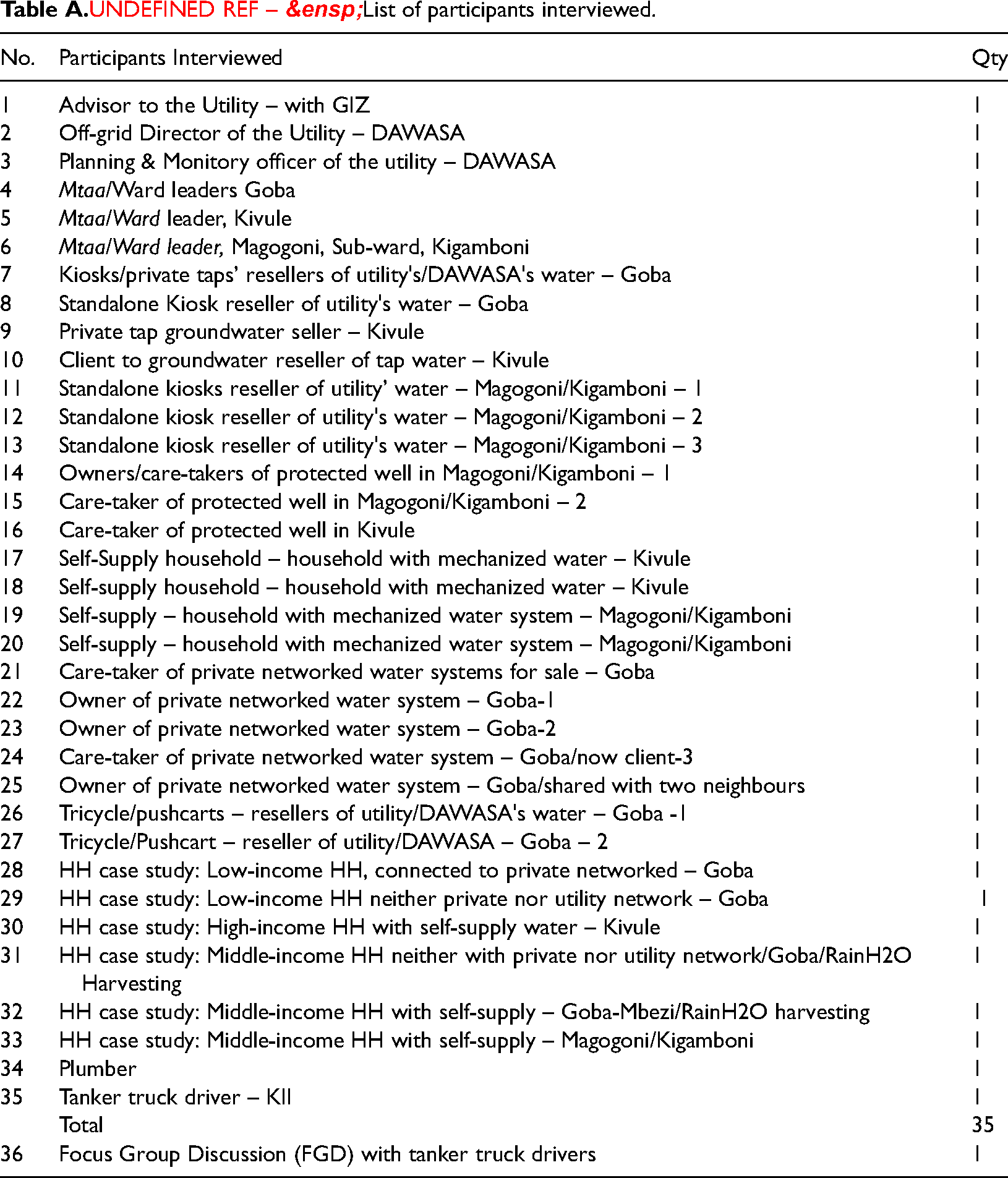
We used a qualitative case study research method to gather data from city officials, experts, and (non)utility officials to unravel how prices were produced and regulated in the context of water supply infrastructures beyond the utility network. Data were collected from March 2021 to July 2022. Snowballing and maximum variation purposive sampling techniques were used to select participants within the city. We asked about the practice of pricing water beyond the utility network and regulating these prices. We conducted face-to-face interviews with thirty-five (35) interviewees comprising expert interviews, key informant interviews (KIIs), and end-users at the household level (see Appendix A). Expert interviews were conducted with water resource managers in Dar es Salaam, the advisor to DAWASA and two DAWASA officials. The first officer was purposefully selected based on in-depth knowledge of water supply in the city, while subsequent participants were selected through referral by the first expert interviewed. Through semi-structured interviews, data were collected on how prices of water were set and regulated, the cost per unit of water, factors that determined pricing per unit of water, payments modalities, and actors with power to determine and regulate prices of water supply beyond the utility network. The probing technique was used for further clarifications and elaboration. This enables the study to capture a wide variety of perspectives concerning water pricing practices beyond the utility.
To deepen our empirical understanding of water price production and governance outside the utility network in Dar es Salaam, three (3) peri-urban settlements; Kivule, Magogoni and Goba were purposely selected as information-rich cases. These settlements were selected due to the limited or lack of utility connections. In these settlements, face-to-face in-depth interviews were conducted with three (3) Ward (Mtaa) leaders, who acted as intermediaries between the local government officials, the utility (DAWASA), residents and alternative water providers. Through interviews data were gathered from the various non-state water operators, either the care-takers or the owners. Data were collected on how prices were determined, regulated and how payments were made for water collection. Also, six (6) household case studies were conducted. These comprised low- middle-income and high-income households in the periphery of Dar es Salaam. The high-income households had self-supply water infrastructure. Some shared networked connections with neighbours. Some middle-income households had mechanized boreholes for self-supply water. The selected low-income households lived in smaller un-gated houses and routinely collected water from tanker truck drivers and pushcarts. One low-income household was connected to a private network, but routinely bought water from pushcarts to complement. The household case study also included three middle-income households without utility connection. These households had installed rainwater harvesting technologies, but also relied on tanker truck drivers registered with the utility for water delivery in the dry season. These households were purposely selected. The goal was to ascertain the ways in which households secured water from actors who produce and distribute water beyond the utility network. See Appendix A, for details.
Key informant interviews (KIIs) alongside observations and photographs were conducted with purposely selected water providers in the selected settlements. These comprised of water kiosk owners, or resellers of utility water (6); caretakers of protected wells (3); tricycle/carts operators (2) and private mechanized in-house water providers (4), See Figure 1. KIIs were also conducted with plumbers/pump technicians to ascertain the technologies and materials that facilitated water supply and how that influenced pricing. The goal was to understand the arrangements that facilitate water supply and price determination. Lastly, the first author conducted transect walks and took photos around the various water infrastructural systems.
During the transect walks, we asked questions about how prices per unit of water were set, payments made, and the key actors and factors shaping prices of water, particularly the roles of the utility in water price determination. We also collected data on the various ways in which water was sourced or produced and distributed to end-users. Throughout the interviews, consent was sought from the participants and the conversation was recorded. The interviews were also validated through the conduct of a Focus Group Discussion (FGD) with private tanker trucks registered with the utility. Interviews were conducted in Swahili and English. Thematic analysis was conducted on the text of the transcribed audios. This involved editing and cross-validating transcribed text alongside a replay of the audio. Through the use of MAXQDA 2022, the transcribed text was grouped and codes generated/constructed. Themes were defined alongside the objectives of the study, such as the prices and water distribution, paying for water, the practice of producing water prices, the actors, powers and water price regulations. A constructed narrative in a chronological sequence was developed along the themes such as prices, water distribution and paying for water, the practice of producing water prices, and water price regulations – actors, powers and water price regulations. The aforementioned themes were substantiated using field evidence.
The everyday production and regulation of prices beyond the utility network
Pricing, distributing and paying for water beyond the utility network
In urban areas of Dar es Salaam without or with limited access to the utility network, water was varyingly priced, paid for, and collected from, community-owned water systems, hydro-mobile systems and private mechanized in-house water networks. Hydro-mobile infrastructures such as carts and tankers truck drivers served as intermediaries distributing water to residents (Wutich et al., 2016). Through these infrastructures, water was (in)directly distributed, and represented the most preferred source of water by some residents unserved by the utility. As observed in several global South cities (e.g., Alba et al., 2019; Truelove, 2019a, 2019b; Wutich et al., 2016), hydro-mobile water infrastructures such as tanker trucks, tricycles and pushcarts collected water from the utility, supplied to residents by-passed by the utility network, or those connected to the utility but challenged by frequent interruption of water flows (e.g., Mapunda et al., 2018; Nganyanyuka et al., 2015). Private mechanized in-house water network owners provided direct pipe water to residents. Similar to those with utility networks, socioeconomic power, such as the ability to pay for an estimated cost of water connection enabled interested residents to gain connectivity to the private mechanized in-house water connection (Andreasen and Møller-Jensen, 2016; Truelove, 2019a, 2019b). Waters from intermediaries such as tanker truck drivers, pushcart or tricycle operators and standalone water kiosks were distributed indirectly via self-collection and transportation by residents for domestic use. This was mediated by artefacts such as containers, barrels, buckets, jerry-cans and pipelines (Dakyaga et al., 2018a).
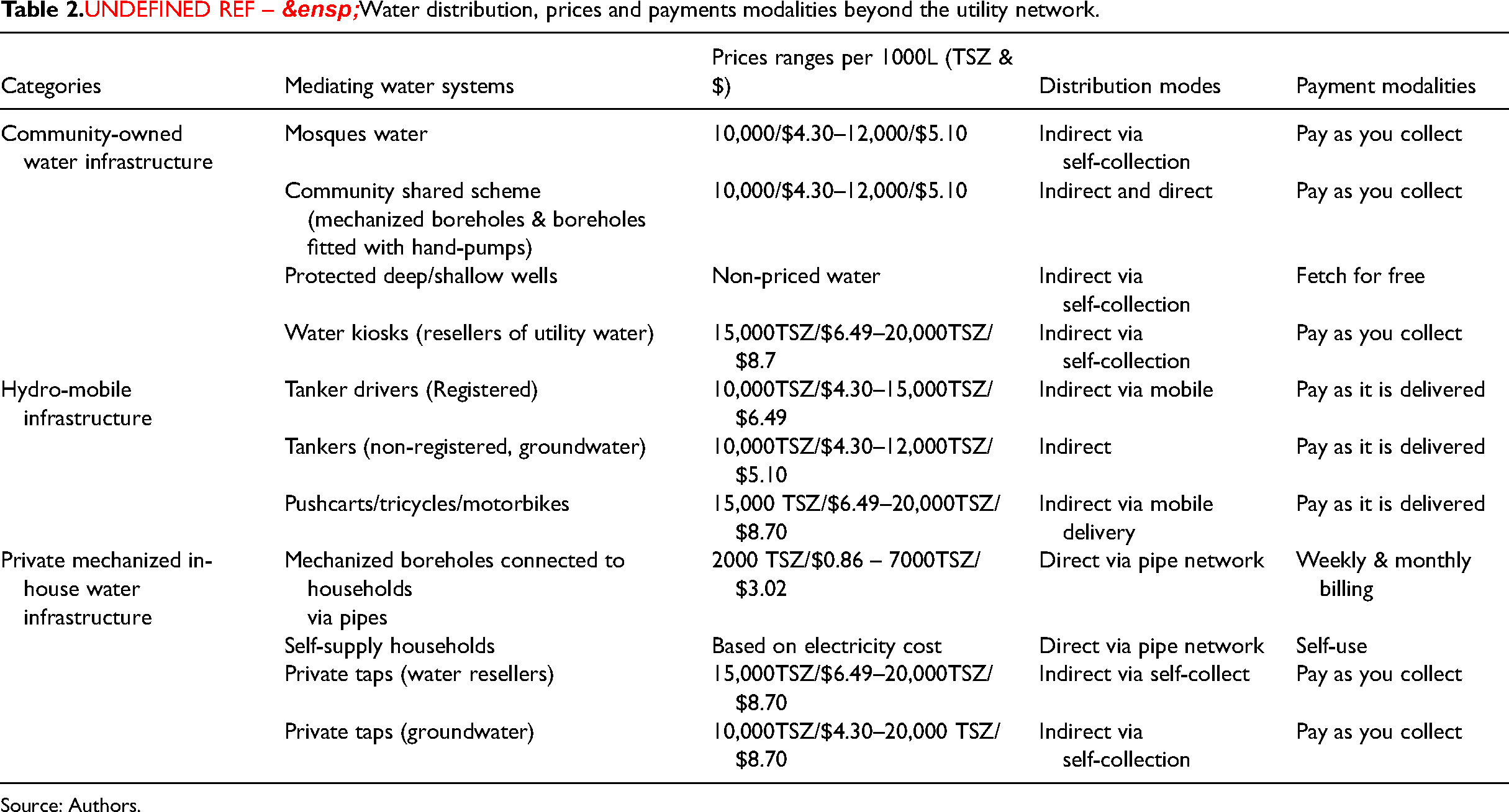
As observed in most African cities (Cain, 2018; Zozmann et al., 2022), varied modalities mediated payments for water supply beyond the utility. Payment modalities comprised “pay as you collect” – commonly associated with stand-alone kiosk and standpipes. “Pay as delivered” – associated with hydro-mobile infrastructures such as tankers, pushcarts/tricycles, and weekly or monthly payments—characterized water supply arrangements of private mechanized in-house water networks, such as mechanized boreholes with pipe networked connections. As observed elsewhere, “Pay as you collect” via cash and carry was found as the dominant mode of payment (Sarkar, 2020a; Simone, 2015; Tutu and Stoler, 2016). The price per unit of water varied among resellers or intermediaries of the utility such as pushcarts, tankers, standalone water kiosks, motorbike/bicycle water distributors and across the neighborhoods. These varied prices were shaped by varied conditions such as locations and sources from which intermediaries collected water for onward distribution (see also Alba et al., 2019). Prices per unit of water were rather stable over the past decades but differed across water providers beyond the utility network. As revealed; I have been here for more than ten (10) years, and my price per unit of water has been the normal 3000TZS/$1.30, so we all know how much a tank of water should be sold for [No. 22]. However, in the same location, some private mechanized in-house water providers charged 5000TSZ/$2.16 per unit of water. As revealed by a resident during the household case studies, … someone here has also drilled groundwater and is supplying us, 5000TSZ per unit of water (1000L), and every month we pay for the cost of the water supply. The water provider comes to read the meter, and give us the bill based on the quantity of water I have consumed … [No. 28]. This produced unequal cost of accessing private in-house water connection across neigbourhoods in the same settlement (Tiwale et al., 2018). Residents connected to private mechanized in-house water networks at the cost of 5000TSZ/$2.16 would prefer the alternative private connection at the cost of 3000TSZ/$1.30 per unit of water. However, they were unable to gain connectivity due to their location beyond 500 meters to the source of the less costly private water network providers in the same settlement. Due to price variations within and across suburbs and among providers, common social knowledge (Strengers, 2010) or, what residents perceived as the right or wrong price, guided the bargaining processes for water. As indicated by tanker truck drivers: … the customers know the price ranges in their areas. They know it is between 10,000TZS/$4.30–15,000TZS/$5.10, per unit of water. They also know the water which is salty is sold between 300TZS/ $ 0.17 −400TZS/$ 0.17 per 20L and 500TZS/$ 0.22–600 TZS/0.26 per 20L of utility water [No. 35]. Prices of utility water resellers and redistributors such as registered tankers, kiosks and pushcarts were relatively higher compared with groundwater distributors. These operators considered water distribution as a business for profit making (Alba et al., 2019).
As indicated, tanker truck drivers supplied 1000L of utility's water at the cost of 10,000TSZ/$ 4.30 and 15,000 TSZ/$6.49. This price range was found as the commonly known price per unit of water of tanker trucks drivers formally registered with the utility (See Table 2).
Water distribution, prices and payments modalities beyond the utility network.
Source: Authors.
Moreover, our interlocutors preferred tanker truck water services. This is because tanker truck drivers registered with the utility were believed to collect improved water from the utility's source. As disclosed by a resident: … I purchase water from the tanker truck drivers registered with DAWASA. It is better to buy water from these tanker drivers registered with DAWASA than the salt water, because it has multiple purposes, you can drink, you can wash your clothes and other things … [No. 29]. Residents connected to private mechanized boreholes bought water from pushcart and tricycles and stored alternatively for drinking (Dakyaga et al., 2018a). As revealed: I am connected to private owner pipeline, so I just buy little of DAWASA water, I just go to the tricycle operators purchase two gallons of water to use when I want water from DAWASA, getting water from the tankers, is not also easy … [No. 28]. In this context, residents beyond the utility network practice the “dual and multiple” purchasing and storing water arrangements (Dakyaga et al., 2018b). The price per cubic meter charged by registered tanker truck drivers was established as 10,000 TZS/$4.30, as the lowest, determined by a short distance and 15,000 TZS/$ 6.49 as the highest cost for water delivering in farther distance of travel. These prices per unit of tanker truck water were formally established between registered tanker truck drivers and the utility. Concerning tanker truck drivers, the existing price ranges were not fully addressing inequity and inequality in access to water especially among residents beyond the utility network. Although the price range of 10,000TZS//$4.30–15,000 TZS/$ 6.49 was established, no standard distance in terms of kilometers of travel was defined as short or far to warrant a particular price, for example of 10,000TZS/$4.30 or 15,000 TZS/$ 6.49. In this context, drivers determined proximity of locations based on their own discretions, and that warranted a given price per unit of water charged. As disclosed by a tanker truck driver: “… each driver decides the price unit of water based on how far he travels to deliver water, even the customers do not know where and how far we are coming to their places …” [No. 39].
However, gaining water from water providers outside the utility involved diverse piecemeal arrangements and practices. These included self-searching for water providers, contacting neighbours and gaining referral from relatives. This connects with previous observations in Accra, (see Peloso and Morinville, 2014) where residents chased, bought and transported water for self-use. In this process, the act of building rapport with water providers such as tanker truck drivers and pushcart water resellers enabled residents to gain access to improved water resellers. While residents may develop rapport with water providers, “preparing the providers” – thus notifying tanker truck drivers, pushcarts operators, and privately mechanized in-house water network operators in advance were key practices for gaining timely supply of water. Residents gained contacts with water providers often via neighbours’ recommendations of water suppliers. As revealed by a middle-income household head: I know a permanent water provider, who knows me and I trust him, there is no way he can bring me contaminated water. No, no, I got him from the street, from the other neighbour who is getting water from him also. So, I asked around and got his number. I pay him after delivery, […] because we have a good relationship, I could be at the job and when the water is finished, I call him to supply me whilst I pay him afterwards because we know each other. [No. 31]. However, these practices through which water was distributed were less applied to standalone kiosks reselling utility water.
Practice of water price production beyond the utility network
Prices per unit of water were ordinarily produced through non-unionized and non-collaborative arrangements, but via negotiation and bargaining between provider and end-user (Truelove, 2019a, 2019b). Heterogeneous factors influenced pricing of water beyond the utility; (i) the source of water (utility water or groundwater); (ii) the mode of delivery (direct or indirect) to end-users, (iv) the kind of relations or social ties that existed between a given water provider and end-user (short to long-term provider-end-user relationships, relations as family or friendship), and (iii) the purchasing power (the quantity of litres a user can purchase at a given time, especially from hydro-mobile infrastructure). These factors produced varied prices outside formal regulation, they shaped and exacerbated fine-grained socio-spatial differences between residents within a single neighbourhood. A case study of six households in Goba (low- and middle-income households interviewed) revealed variations in prices per unit cost of tanker truck water purchased and private mechanized in-house water connection. Though five of the case study households in the same neighbourhood, sought the services of tanker truck drivers for utility water, they paid different prices per unit of water in the past months. Four of the households revealed to have paid 15000TSZ/$ 6.49, while one paid 12,000 TSZ/$ 5.10 per unit of water. Though the case study households were served water by different tanker truck drivers, they revealed that purchasing powers accounted for the disparities (Tiwale et al., 2018). As revealed: “… I bargain sometimes for the price's reduction, with tanker truck drivers registered with the utility, they said, they can give me one-unit of water [1000L] for 10,000TSZ/$4.30 if I can buy 10,000 units of water. But I usually buy 3000 units of water at the cost of 15000TSZ $6.49 per unit of water, because my water storage tank can only store 7000 units of water. Even if I can purchase the 10,000 units of water at a reduced price, I cannot store it. …” [No. 32]. However, from the experiences of a low-income household, price negotiation and bargaining with tanker truck drivers has been impossible. As revealed; “… when they [tanker truck drivers] set the price of water, there is no negotiation, it is 15,000TZS/$6.49, you agree and they bring you the water or not …” [No. 29]. The confluence of higher purchasing power and storage capacity work to enable some residents beyond the utility to collect larger amount of water at a reduced cost per unit of water (Alba et al., 2019). Besides that, the ordinary market arrangement of demand and supply shaped price variations (Wutich et al., 2016). As revealed: … so what I will say is like market-driven, so they look at the willingness and ability of the people to pay, then they charge … [No. 3]. The aforementioned factors shaped prices loosely, ultimately not binding by the various providers. In these arrangements, common social understandings of the price expected by residents and distributors enabled water supply (Dakyaga et al., 2021; Strengers, 2010). A resident explained the existing social understanding as follows: Yes, you know here (Dar es Salaam), we have different prices for the different water, the water which is salty is cheaper than the utility water. In my area, they are supplying salty water, but I don’t buy salty water, I have not connected, there is a private company that is supplying the water, not the government. Everyone knows the prices, the private operator in the area supplies residents with the salty water …” [No. 31]. He continued: – There was a time I wanted the operator to connect me to the salty water, but the water is expensive. People quarrel with him, the other day he saw me and said he is sorry, ‘I want to connect you to the water’ then I said no, I don’t want to be connected to your water system [No. 31]. These common social understanding (Strengers, 2010), of the prices of different waters and providers [utility and groundwater], and their respective distributors enabled residents, water distributors and producers to collectively reach consensus of the price per unit of water distributed. This also implies that peri-urban residents located farther away from the utility water kiosks, gained access to utility water via tanker truck drivers, but at a higher cost of about 15,000 TSZ/$6.49 (Pihljak et al., 2019). Residents incurred higher expenses on water in February and March, not due to rise in price per unit of water, but due to an increase in demand for water at household levels. People bath two-three times per day because of high temperature.
Moreover, some mechanisms were found more specific to certain water supply infrastructures beyond the utility network and providers. For example, the price per unit of water of hydro-mobile infrastructures such as tanker trucks was shaped by distance, cost of fuel, repairs and maintenance of vehicles and the nature of the road network to clients’ residences. A 20L of water (gallon) was priced 500 TZS/$ 2.17 by pushcarts operators based on the distance to water source and expected profit margins of the operators. As revealed: It depends on the place you go, if you do not go farther place, the price is low, but if you go farther places the price is high. For another; It is the distance, and the fuel (…), so we charge based on the fuel, now one-litre of petrol is about 2400–2500 TZS/$1.04–1.08, which is too high. Each driver decides the price based on how far he travels to deliver water, even the customers do not know where and how far we are coming to their residence … [No. 36]. As a practice, new drivers and cart operators acquainted themselves with pricing practices, by learning from experienced operators (Strengers, 2010). These served as logics and meanings in which consensus can be reached and water collected by residents beyond the utility network (Rusca and Cleaver, 2022).
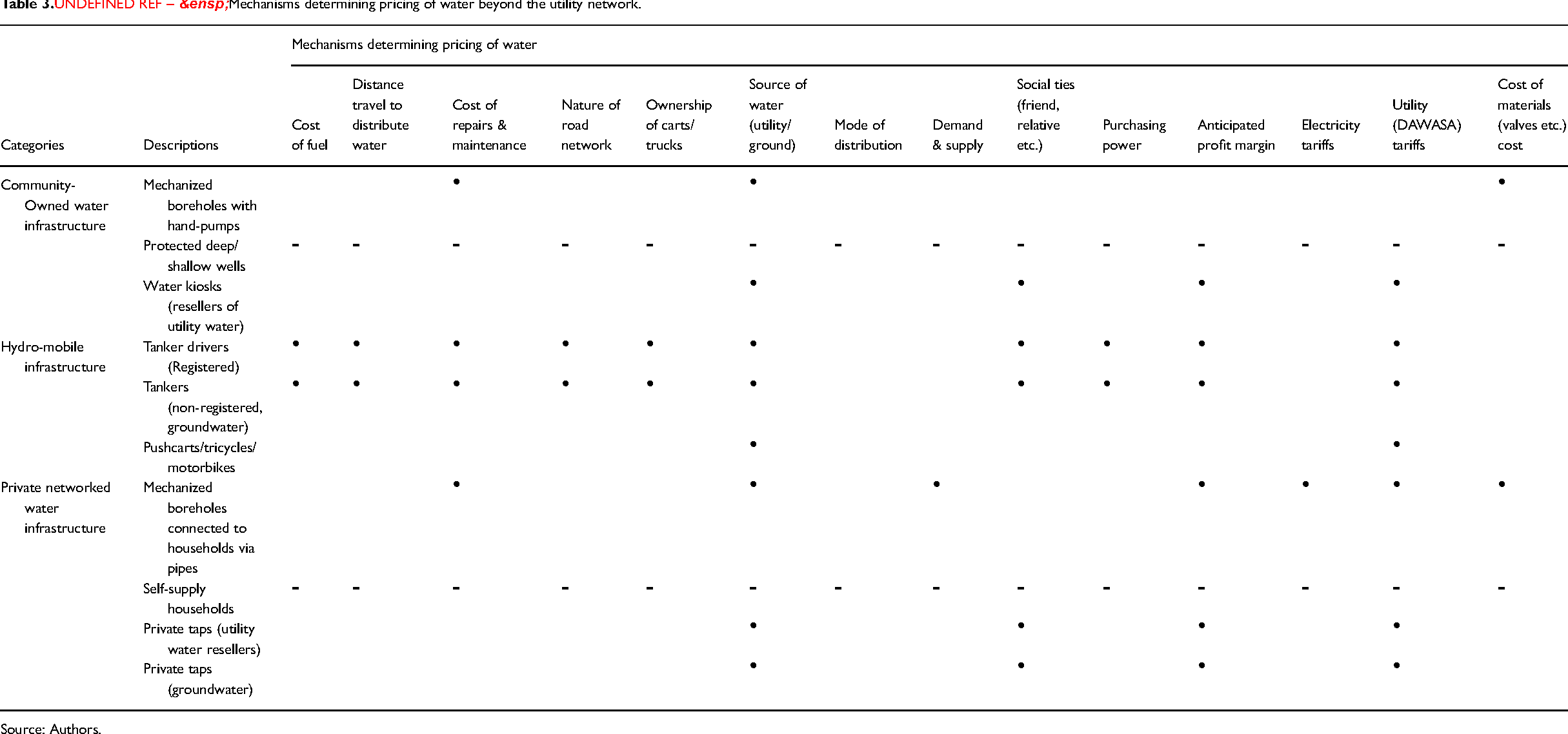
Moreover, ownership of the means (truck/carts) for water distribution affected pricing. Care-takers such as drivers of tanker trucks were obliged to meet the daily monetary targets of 60,000TSZ/$25.95 or of their respective truck owners. As revealed: When it is not up to 60,000TZS/$25.95 our bosses [owners of the trucks] sometimes ask us today you are giving this amount how is the business now? [No. 36]. See Table 3.
Mechanisms determining pricing of water beyond the utility network.
Source: Authors.
While prices may be established based on common knowledge, the practice of bargaining and negotiation can be used by both end-users and operators to (re)set prices of water especially with tanker trucks. As disclosed: … they [clients] bargain, some will call you and say in my area, they bring water to me at this price, they want it at this and that price, if it is good, we agree on the price before we deliver. If you go and they don’t agree you send it to a different person [No. 36]. In these processes, drivers yet had the power to influence prices to reflect their daily targets and profits. Truck owners monitored, and set targets through the daily records [in books] of water distribution trips of drivers as observed in Accra (Alba et al., 2019). Also, competition among water providers (re)produced price per unit of water, between an end-user, a tanker driver, and a pushcart. However, prices of water of Community-based water infrastructures and private networked water infrastructures were stable and less subjected to negotiation and bargaining processes. For tanker trucks water, potential customers suggested prices per unit of water of interest, and tanker truck drivers choose to accept or not. It is through this process, that price per unit of water was negotiated and bargained between tanker truck drivers and clients.
Moreover, among private mechanized in-house water networks and communal shared water systems, prices per unit of water were determined by owners based on the recurrent cost of electricity, technologies such as pipelines, valves, pump machines, repairs and maintenance, bills for plumbers, care-takers of the facility and less by competition. Cost of electricity was the dominant factor shaping the price per unit of water provided via a private mechanized in-house water network. This implies that utility's actions such as increase or decrease of electricity influence the price per unit of water supply beyond the utility. As revealed: … the cost of power/electricity, maintenance cost, emergency cost, when you sometime get problem with the distribution, you should have money to address it, this cost should not affect the anticipated profit of 700,000–800,000 TZS/$302.76–346.02, per month from the sale of the water … [No. 24]. Varied prices were found per unit of water within neighbourhoods due to the non-collective ways in which prices were produced. As revealed: It is my own decision about the cost of the unit of water, I could make it 1000TSZ/$0.43 per unit, but what I think is the cost of the electricity. Also, the repairs and maintenance of the pumps, pumps can break down at any time and we need to call for repairs [No. 22]. Also, the motive or perception of the water providers shaped prices in varied ways. Private mechanized water providers who perceived in-house water distribution as a “service to the community” charge lower prices per cubic meter, compared with producers who regarded such as a “business for profit making” (Alba et al., 2019). Nonetheless, in order to gain connectivity, potential clients must be able to pay for the estimated cost of materials required for private networked water connectivity.
For standalone kiosks’ water resellers who purchased bulk water from registered tankers, the distance travelled by tankers, and the cost of fuel indirectly shaped the price per 20L/gallon of water. Prices were determined by water resellers of utility's water such as standalone kiosks and private taps. Price ranged from 400 – 500TZS/$ 0.17–0.22 per bucket of water (20L). For some standalone kiosk water resellers, prices were determined by the tanker truck drivers from which they collected water for onward distribution. As disclosed; Those [drivers] who sell water to me, are the ones who determine price for me to buy and to sell out [No. 11]. For others, the practice of self-calculating how much a bulk quantity of water was purchased vis a vis the anticipated profit margins justified the price per bucket/gallon of water within neighbourhoods. The calculative strategy represented a practice of determining the quantity of water purchased from tanker trucks drivers and the amount to be sold per 20L of water to attain the total amount invested and profit. In so doing, water resellers divided the bulk quantity of water purchased by 20L (1000L divided by 20L equivalent to gallon or buckets), and multiplied by 500TSZ/$0.22, the anticipated price per bucket of water. Through these processes, prices by 20L of water were either adjusted to suit the anticipated profit margins of the resellers. Additionally, new resellers of utility water, such as standalone water kiosks determined prices based on price information provided by tankers from whom utility water was collected for resale.
Regulation of water prices beyond the utility network
In Dar es Salaam, water prices beyond the utility network were (in)directly regulated by state and non-state actors. The state actors included the Energy and Water Utilities Regulatory Authority (EWURA), the Dar es Salaam Water Supply and Sanitation Authority (DAWASA), and the Tanzania Electricity Supply Company Limited (TANESCO). Non-state actors comprised consumers, caretakers and owners of water systems, distributors such as tanker drivers, owners of tanker trucks, pushcarts/tricycle operators, standalone water kiosks, religious bodies (Allen et al., 2017). Through the (in)direct actions of the aforementioned actors’ prices per unit of water were structured in manifold ways. EWURA exercised the legal mandate to regulate utility services in Tanzania such as water, electricity and petroleum. EWURA directly regulated the prices and services of DAWASA and TANESCO (Dakyaga et al., 2023; Mcgranahan et al., 2016). The regulatory role of EWURA directly influenced the service and prices of formal utilities and indirectly shaped the prices and service of water provided by intermediaries such as private tankers registered with the utility, and kiosk resellers of utility water. State agencies by legal mandate are expected to regulate the prices of intermediaries, especially non-state actors engaged in water and electricity service provision. The interview revealed that DAWASA did exercise a legal mandate to directly regulate prices of water providers beyond the utility network. However, it was unable to directly regulate prices per unit of water produced and distributed beyond its networks due to the informal arrangements that characterized such water supply (Cain, 2018; Dapaah and Harris, 2017). As disclosed: “… The capacity of DAWASA to enforce regulation is very limited if at all …” [No. 1]. From another interlocutor; “Regulating the other operators has been difficult, we tried registering them but they resisted for fear that they may be asked to pay taxes …” [No. 2]. Therefore, the utility navigated these challenges by equally playing a role as an indirect regulator of the prices of water produced and distributed beyond the utility (Dakyaga, 2022). For example, DAWASA engaged, and built partnerships with, private water tanker drivers to collaboratively establish price ranges per unit of water (Cain, 2018).
As recounted by an experienced tanker truck driver: Some years ago, we had a water shortage in Dar es salaam, we struggled a lot to collect water, clean water was very expensive, it cost 25000TZS/$10.81 per 1000 liters, the drivers together with DAWASA then DAWASCO agreed to set the minimum standard that it should start from 10,000TZS/$4.33 per 1000 litres, but distributing water to various areas it depends on the distance, fuel used, hills and roughness of the road. So, if you travel a long distance to supply water the price will increase from 10,000TZS/$4.33, to 12,000TZS/$5.19, 13,000TZS/$ 5.62, 14,000TZS/$ 6.06 up to 15,000TZS/$ 6.49 depending on the factors mentioned [No. 36]. Drivers justified their mediatory roles and the powers of vehicle owners as follows; So, we have two bosses, DAWASA and the owners of the vehicles, but for the case of DAWASA not so necessary. It is the owner of the cars that is very important because when you burst the tyre; it is the boss/owner you have to call immediately [No. 36].
Additionally, the utility acquired and introduced hydro-mobile infrastructures such as tanker trucks that collected water from the utility for onward distribution, at the cost of 1663 TZS/$0.72 per unit of water (Dakyaga, 2022). This served as an alternative to residents located beyond the network to either collect water from utility tanker trucks or the private owned tanker trucks registered by the utility. This represented an indirect way in which the utility regulated the prices per unit of water of hydro-mobile infrastructures such as tanker trucks water delivery. As lamented: … Mmmh, basically those water operators do not have formal tariffs (…) but of course, they compare with the tariffs of those that are regulated by DAWASA, somehow, they charge more, they charge more because, when for example our tariffs are 1663TZS/$0.72 a unit price per cubic meter (1000L), private tankers may sell at 10,000TSH or more than … [No. 3]. Though this price range existed, known by residents, the study realized that enforcement of the regulation has been problematic (Dakyaga et al., 2023). As the utility officials revealed: “… but we don’t have any formal means of saying we are setting prices for the others …” [No. 2].
Due to lack of formal regulation, (un)registered water providers exercised greater power over price determination and regulation. Prices were regulated by individual water providers outside the utility. As revealed: DAWASA has nothing to do with me, once I receive water in my tanker truck, I am the one who controls everything.” [No. 35]. Registration of private tanker truck drivers with the utility for water distribution did not necessarily contribute to affordable water supply. While bargaining and negotiation could influence prices, it was fluid. Residents could not determine the respective utility kiosks from which tanker truck drivers collected water for onward distribution. This limited the ability of residents to determine the distance traveled by drivers for the appropriate price per unit of water. In this case, drivers’ profit motives, and the cost of a litre of fuel served as mechanisms mediating how much customers paid per unit of water (Alba et al., 2020: 1; Rusca and Cleaver, 2022). This suggests that the (in)direct actions of EWURA, TANESCO and DAWASA, changes in petrol prices, and unit of water of the utility in turn influence the prices per unit of water sold by water providers beyond the utility in the city. The interviews revealed that residents used the price per unit of the utility's water as the terms of reference when bargaining or negotiating prices per cubic meter of water outside the utility network. As disclosed by a middle-income household's head. … I have ordered for water from the tankers today, and am waiting for them. I bargain sometimes for price's reduction from tanker truck drivers registered with the utility, they said, they can give me 1 unit of water for 10,000TZS/$4.30 if I can buy 10,000 units of water …” [No. 32]. This implies that urban spaces where water infrastructures beyond the utility network co-exist, inequality in terms of access to water may be (re)produced. This has the tendency of widening the gap in terms of who gets what water, when, how and from whom (Rusca and Cleaver, 2022). For example, private tanker trucks’ drivers registered with the utility constituted the major distributors of water beyond the utility. However, these water distributors were mainly monitored to pay fees for water collected from the utility's kiosks for onward distribution. see Figure 2.
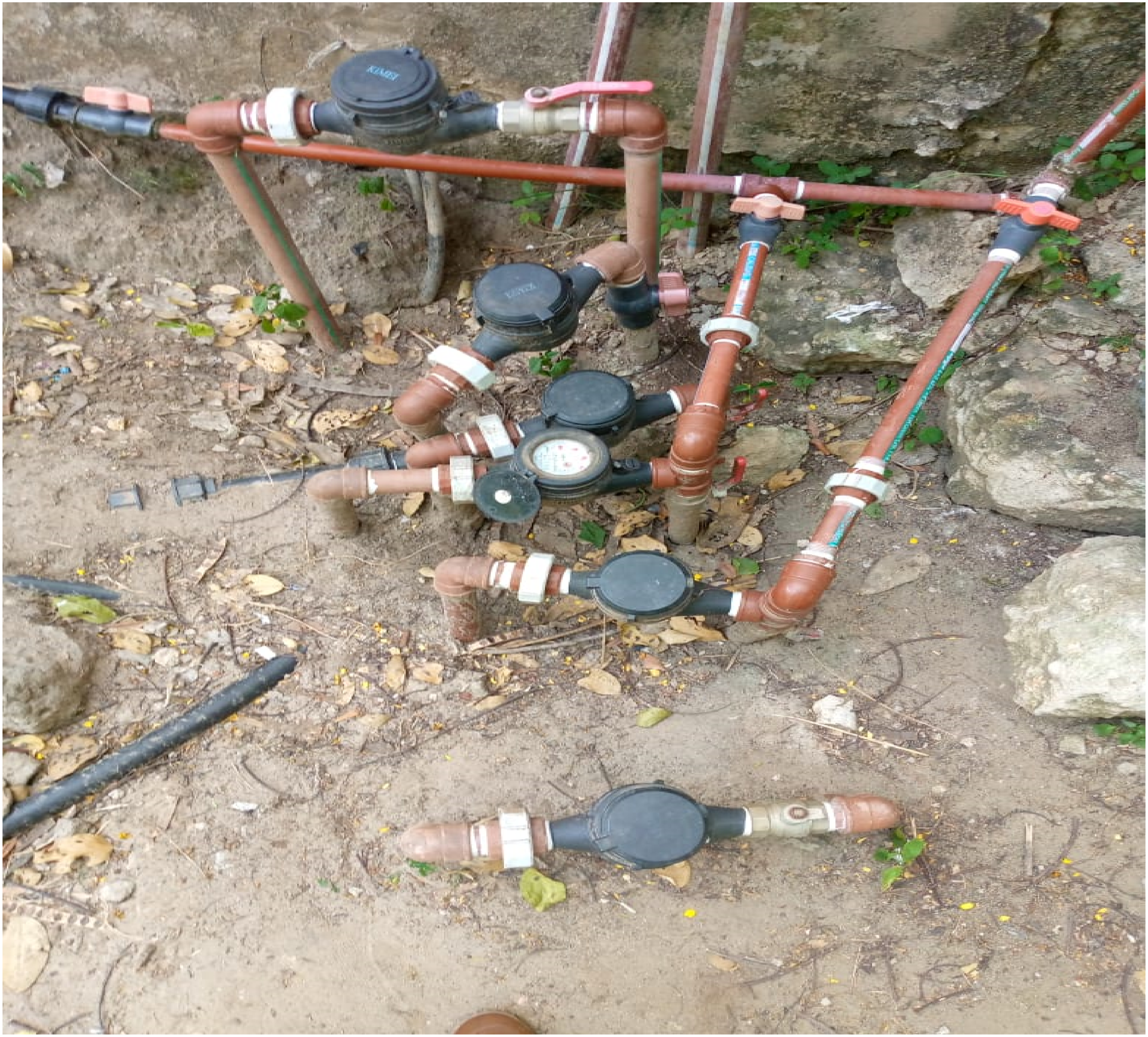
Water meters as material artefacts mediating prices of water.
Also, prices of private networked in-house water systems and water intermediaries such as resellers of utility water (standalone kiosks), pushcarts/tricycle vendors, mosque water vendors and community-based water vendors (Cain, 2018), were neither determined nor regulated by the utility, but more directly regulated by the owners and care-takers. Except for private mechanized in-house water network systems that provided connectivity, water intermediaries had neither formal registration, permits nor a license for water distribution. This connotes to observations of previous studies in most global South cities (Alba et al., 2019; Bakker, 2003; Kundu and Chatterjee, 2020; Truelove, 2019a, 2019b), where water supply beyond the utility network remained unregulated in terms of operations and water prices. However, in a situation where direct regulations are lacking, possession or ownership of water infrastructure signified power (Rusca and Cleaver, 2022), especially in areas bypassed by the utility. As revealed: When you have water, it is the people who come to you. The need and demand for water drives people to you so you become the lord “governor” because you have water [Private networked water provider, No. 22]. As observed in Dar es Salaam (e.g., Dakyaga et al., 2022), the household case studies revealed how owners of in-house water systems were accorded the power of lordship or “water governors” in enclaves beyond the utility network. As revealed: My house has no connectivity to DAWASA water, there is a private operator here who supplies water to other households not connected to the utility. There was a time I wanted the operator to connect me to the salty water, but the connector is too greedy, he talks badly, and charged me 400,000TZS/$173.01 as the cost of the connectivity to the network. it is expensive, I told him to reduce some money for me because my storage system is about 2,400Liters capacity, and even the tankers charge 15,000TZS/$6.49 per unit of water supplied … [No. 32]. In this context, the owner of the infrastructure held the power to either reduce or maintain the cost of connectivity based on his discretion.
Though the utility ordinarily established 5000TZS/$2.16 as the maximum standard price per cubic meter of water for private mechanized in-house water connections, interviews revealed that some private mechanized in-house water providers charged more than the standard price. Whilst this represented a peculiar water urbanism with water supply beyond the utility network, uneven coverage of networked challenged utility's efforts in regulating non-state actors in the water supply landscape towards equitable and affordable water distribution. Indirect regulation of the water providers instigated uneven prices of water supplied beyond the utility network (Rusca and Cleaver, 2022). This was found common especially among standalone kiosks and pushcarts/tricycles’ operators reselling utility's water (Kjellen, 2007). However, for private mechanized in-house water networks, the price per unit of water was indirectly regulated by the utility. Pipelines mediated the flow and the distribution of water to end-users. Water meters did not only regulate water flow but also acted as intermediaries by preventing conflicting discourses and building transparency between water providers and end-users, justifying cost to warrant payment. As revealed by private mechanized in-house water network owner: … At any time, they come to ask me, how much do I owe you? Then I read the meter, and tell them the quantity they have consumed, and then they pay me. I have meters installed that regulate the consumption of the water [No. 22]. This demonstrates the role, of pipelines, water pump machines, robes, water meters and storage systems. These material actors indirectly determined the quantity of water consumed through which payment was warranted and user fees collected by the providers.
Conclusion and implications for improving urban water supply beyond the utility
In many cities of the global South, studies demonstrate the heterogeneous ways in which water is produced and distributed beyond the utility network (Alba and Bruns, 2021; Lawhon et al., 2018; Truelove, 2019a, 2019b). This growing body of knowledge shows how diverse infrastructural arrangements and technologies co-exist and serve residents in cities of the global South. Critical urban scholars (e.g., Adams, 2018; Dakyaga et al., 2023; Truelove, 2019a, 2019b), considering the socio-economic inequalities in cities of the global South alongside the multiple ways in which people produce, distribute and access water beyond the utility network have argued for the need to pay attention to the ways in which prices are produced and regulated beyond utility networks. However, studies have to date rarely explored the ways in which prices are established and governed in such uneven waterscapes and the implications for improving urban water supply. Drawing from literature on everyday pricing practices and urban water infrastructure heterogeneity (e.g., Dakyaga et al., 2023; Lawhon et al., 2018; Pihljak et al., 2019; Smiley, 2020), we contribute to urban water governance scholarship especially in the global South about the ways in which water prices are produced and governed, in urban geographies characterized by uneven utility networked coverage.
Through a qualitative case study in Dar es Salaam, we contribute to the aforementioned studies, by showing that multiple infrastructural systems such as hydro-mobile infrastructures (pushcarts/tricycles, mechanized boreholes, (non)utility tankers) together produced prices and mediated water collection beyond the utility. Prices ranged from 2000TZS/$0.86 to 20,000TZS/$8.70 per unit of water and varied across the actors engaged in water supply beyond the utility. Price ranges were influenced by the varied water sources from which non-state actors collected water for sale, the mode of delivery (direct and indirect), the relations between water providers and end-users (friends, family relations or long-termed customer), and lastly the purchasing powers of water consumers. Competition among water providers (re)produced price per unit of water. However, prices of water of Community-based water infrastructures and private networked water infrastructures were stable and less subjected to negotiation and bargaining processes. For tanker trucks water, potential customers suggested prices per unit of water of interest, and tanker truck drivers choose to accept or not. It was through these processes, that prices per unit of water were negotiated and bargained for water collection across the non-state actors distributing water beyond the utility network. These represented a configuration where people, material artefacts and relationships worked to produce water prices and mediated collection beyond the utility (Lawhon et al., 2018; Nakyagaba et al., 2023). Additionally, these arrangements worked to establish prices in a place-specific way, less through pre-determined tariffs, unionized or collaborative arrangements, but rather through everyday learning by doing of the actors (Alba et al., 2019; Strengers, 2010). The involved non-state actors used self-discretion, reflectivity, creativity, practical knowledge and experiences ordinarily acquired overtime to determine and exercise regulatory power over water supply (Dapaah and Harris, 2017). Varied parameters including cost of electricity, fuel, repairs and maintenance, location and distance, nature of the road network to clients’ residences, as well as providers’ expected profit margins guided price determination. Hydro-mobile water distributors determined the price per unit of water based on distance, cost of fuel and repairs and maintenances. In terms of community-owned water infrastructure, cost of materials, source of water, repairs and maintenance shaped the price per unit of water.
These everyday practices have diverse implications for improving urban water supply beyond the utility network. While they enabled water access via the mediating roles of diverse actors, skills, technologies and creativities (McFarlane et al., 2017; Monstadt and Schramm, 2017), such practices also hold the possibility for widening water access inequities (Schramm and Wright-Contreras, 2017). This can be attributed to limited regulation of the varied actors engaged in water production and distribution beyond the utility network. With the exception of registered tanker truck drivers, prices per unit of water of the other water providers were determined by their owners. Again, conventional practice such as using spatial distance to establish prices for water collection in the case of tanker truck water distribution, are processes fostering exclusion and inclusion in the waterscape. Tanker truck drivers decided which distance was short or long to merit a lower or higher price per unit of water to clients. The institution of a defined kilometric distance for a given price may enable tanker truck drivers to equitably price utility water. Also, bargaining and negotiation were spaces where socio-economic powers were exercised, as well as where relational powers, such as one's ability to gain bulk quantities of water based on storage abilities was made visible. Our study concludes that prices of water supply beyond the utility network are often produced and governed through the interplay and relationships of people, material artefacts and legal stipulations. We show that focusing on the varied ways in which pricing is determined sheds light on an important aspect of heterogeneous infrastructure provision especially in urban spaces: where varied prices are established beyond formal regulation, they reflect, shape and exacerbate fine-grained socio-spatial differences between individuals within a single neighbourhood. We suggest that further studies pay attention to how water pricing practices beyond the utility produces inequality and exclusion.
Highlights
Urban waterscape of cities in the global South is characterised by heterogeneous water infrastructure.
Such water infrastructures are largely beyond the utility network but serves urbanites (un)served by the utility.
Prices mediate the production and distribution of water to end-users through these infrastructures
Within the context of socio-economic inequality, the study demonstrates how prices are produced and governed beyond the utility network
Prices were established in place-specific way, less by pre-determined tariffs, but based on mundane negotiation, learning by doing
Footnotes
Declaration of conflicting interests
The author(s) declared no potential conflicts of interest with respect to the research, authorship, and/or publication of this article.
Funding
The author(s) disclosed receipt of the following financial support for the research, authorship, and/or publication of this article: This work was supported by the Deutscher Akademischer Austauschdienst (grant number 91592283).

Appendix A
List of participants interviewed.
| No. | Participants Interviewed | Qty |
|---|---|---|
| 1 | Advisor to the Utility – with GIZ | 1 |
| 2 | Off-grid Director of the Utility – DAWASA | 1 |
| 3 | Planning & Monitory officer of the utility – DAWASA | 1 |
| 4 | Mtaa/Ward leaders Goba | 1 |
| 5 | Mtaa/Ward leader, Kivule | 1 |
| 6 | Mtaa/Ward leader, Magogoni, Sub-ward, Kigamboni | 1 |
| 7 | Kiosks/private taps’ resellers of utility's/DAWASA's water – Goba | 1 |
| 8 | Standalone Kiosk reseller of utility's water – Goba | 1 |
| 9 | Private tap groundwater seller – Kivule | 1 |
| 10 | Client to groundwater reseller of tap water – Kivule | 1 |
| 11 | Standalone kiosks reseller of utility’ water – Magogoni/Kigamboni – 1 | 1 |
| 12 | Standalone kiosk reseller of utility's water – Magogoni/Kigamboni – 2 | 1 |
| 13 | Standalone kiosk reseller of utility's water – Magogoni/Kigamboni – 3 | 1 |
| 14 | Owners/care-takers of protected well in Magogoni/Kigamboni – 1 | 1 |
| 15 | Care-taker of protected well in Magogoni/Kigamboni – 2 | 1 |
| 16 | Care-taker of protected well in Kivule | 1 |
| 17 | Self-Supply household – household with mechanized water – Kivule | 1 |
| 18 | Self-supply household – household with mechanized water – Kivule | 1 |
| 19 | Self-supply – household with mechanized water system – Magogoni/Kigamboni | 1 |
| 20 | Self-supply – household with mechanized water system – Magogoni/Kigamboni | 1 |
| 21 | Care-taker of private networked water systems for sale – Goba | 1 |
| 22 | Owner of private networked water system – Goba-1 | 1 |
| 23 | Owner of private networked water system – Goba-2 | 1 |
| 24 | Care-taker of private networked water system – Goba/now client-3 | 1 |
| 25 | Owner of private networked water system – Goba/shared with two neighbours | 1 |
| 26 | Tricycle/pushcarts – resellers of utility/DAWASA's water – Goba -1 | 1 |
| 27 | Tricycle/Pushcart – reseller of utility/DAWASA – Goba – 2 | 1 |
| 28 | HH case study: Low-income HH, connected to private networked – Goba | 1 |
| 29 | HH case study: Low-income HH neither private nor utility network – Goba | 1 |
| 30 | HH case study: High-income HH with self-supply water – Kivule | 1 |
| 31 | HH case study: Middle-income HH neither with private nor utility network/Goba/RainH2O Harvesting | 1 |
| 32 | HH case study: Middle-income HH with self-supply – Goba-Mbezi/RainH2O harvesting | 1 |
| 33 | HH case study: Middle-income HH with self-supply – Magogoni/Kigamboni | 1 |
| 34 | Plumber | 1 |
| 35 | Tanker truck driver – KII | 1 |
| Total | 35 | |
| 36 | Focus Group Discussion (FGD) with tanker truck drivers | 1 |