




Abstract
Muizenberg East, in Cape Town, South Africa, is a peri-urban landscape that encompasses sewage works, tourist beaches, a nature reserve, a waste dump, a Ramsar site for the protection of migrating birds, shack settlements, and a corporate office park. The complex and contradictory uses of this land demonstrate the limitations of social-ecological analysis and ecosystem service approaches to environmental governance. Mapping contemporary struggles over food, housing, aquifer contamination, air pollution, conservation space, safety, and farmland, the study proposes that a new materialist approach combining emerging transdisciplinary fields that focus on material flows and metabolism offers a big-picture science for landscape diagnostics and repair. It is argued that the Earth processes such as metabolism, thermodynamics, and flow offer an integrative basis for environmental governance based on partnerships with Earth processes. Such a constitutional shift in approaches to local governance offers the possibility of amplifying habitability without inserting new modes of profit-taking into the web of life.
In the past decade, scholarly efforts to develop new transdisciplinary knowledges that attend to material flows have yielded multiple integrative research fields. These include the biogeosciences (Richter et al., 2018); industrial ecology (Ayres and Ayres, 2002); critical zone sciences (Banwart et al., 2019; Latour and Weibel, 2020); circular economics (Arruda et al., 2021); public health engineering (Gelting et al., 2019); medical geology (Skinner, 2007; Dissanayake and Chandrajith, 2009); technosphere studies (Haff, 2013); urban ecology (Ernstson and Sorlin, 2019); the porous city (Enright and Olmstead, 2023; Bremner et al., 2022); the food-water-energy nexus (Aboelnga et al., 2018); environmental chemistry (Ali and Khan, 2017); Anthropocene stratigraphy (Zalasiewicz et al., 2011; Steffen et al., 2016); and the hydrosocial sciences (Linton and Budds, 2014; Boelens et al., 2017). Variously, these link life sciences, the Earth and chemical sciences, engineering, and economics, and reach for the hope of bridging the modernist divide between natural and social sciences via empirical studies of materials flows and metabolism.
A materials-flow approach has also emerged in qualitative social science studies of contamination as central to environmental justice (Nixon, 2011); in energy humanities (Szeman and Boyer, 2017); multi-species social sciences (Kirksey, 2014); indigenous studies (Liboiron, 2021); feminist phenomenology of water (Neimanis, 2017); new materialism (Whatmore, 2006; Fox and Alldred, 2016); ecological economics (Spash, 2017); and in biosocial health studies such as the developmental origins of health and disease (DOHaD) (Gluckman et al., 2016; Marya and Patel, 2021) and the OneHealth approach (Min et al., 2013; Destoumieux-Garzón et al., 2018). All these approaches have in common that they explore flows, processes, and interactions as an alternative to the monetary-based analytics pursued in ecosystem services approaches (Dunlap and Sullivan, 2020). The difference between the financialized ecosystem services approaches and materials-flow approaches could be simplified as the difference between tracking currents and translating to currencies. There is, of course, overlap between the two approaches. However, the commonality across the range of new transdisciplinarities signals an emerging consensus: the importance of attention to modes of thought that conceptualize Earthly processes, interactions, and relations, suggesting the increasing awareness that Earth systems do not run on dollar values. Following matter and materiality through bios, geos, bodies, and histories offers an alternative suite of insights to those that arise by following nature translated to finance.
That similar approaches are emerging in new transdisciplinarities on both sides of the nature–society divide, in basic and applied sciences as well as social sciences, is significant for higher educationists and researchers, for the widespread lack of engagement between these fields has much to do with the inadmissibility in the social sciences of key concepts that tend to be unquestioned in environmental governance sciences. Three of the most important conceptual hindrances to social science inclusion in transdisciplinarity, are these:
Society as a system: For many environmental governance scientists, social systems are structures, like local government, community-based organizations, and social networks. Social science, however, observes that action is not predicted by rules and that dissent holds transformational capacity in the face of inequity. Given its poor capacity to characterize everyday life, “the social system” is rarely an analytic used in peer-reviewed social science journals, where it is associated with the outdated theory of structure-functionalism (Wellstead et al., 2017; Stojanovic et al., 2016), which fails to characterize empirical realities. Economics as mediator of nature and society: The financialized bridge between society and nature proposed by ecosystem services approaches is criticized by leading social scientists, as dollar-based valuations of ecosystem services advance relations of commodification (Sullivan, 2010; Metzger, 2018). The translation of ecological processes into accounting frameworks may undermine local value regimens that previously protected local ecologies—unwittingly encouraging new regimes of financialized natural resource exploitation. Theories of personhood: The idea that all people are motivated by financial gain and therefore may have their choices changed by financial incentives is criticized as “Homo economicus” in social science literature for misrecognizing its advancement of inequality and for misrecognizing the multiplicity of human values, commitments, motivations, and attachments.
The above discrepancies reduce the ecological presence of the human to matters of mind and financial exchange. They are unresolvable in the bifurcations of modernist thought such as mind and body; society and nature, and subjects and objects, all of which are empirically challenged in fields at the forefront of scientific innovation, including epigenetics, neurosciences, and the emerging transdisciplinarities that study material movements and transformations through bodies, histories, policies, economies, emotions, and geologies. The focus on material flows in emerging transdisciplinarities offers the possibility of a unifying “big picture” scholarship that offers an empirically grounded approach. The question therefore arises: How might the various emergent transdisciplinarities merge into a metadiscipline that is robust and integrative and able to advance the repair of habitability?
Focusing on the profoundly damaged landscape known as Muizenberg East on the southern edge of Cape Town, South Africa, this study describes the chaotic and destructive material flows that characterize landscapes that have been planned and governed via hard boundaries between water bodies and land (Mathur and Da Cunha, 2020) and between nature and society (Latour, 2004). It proposes a “meta-transdisciplinary” approach that operationalizes the study of mobility, metabolism, and interactions in the in-between and mobile states of matter such as mud, slime, mist, dust, smoke, and flame to bring to scholarly attention to the metabolic, kinetic, thermodynamic, and catalytic relations and processes that occur in them. Theorizing how to attend to mobile, interacting matter, the study suggests, will make it possible to describe in scholarly terms the conditions of uninhabitability that are experienced on the Anthropocene's many peri-urban frontiers.
In what follows, part one attends to building a meta-transdisciplinary approach for describing and understanding harms to Earth processes. Part two summarizes the conceptual changes necessary for a shift to a politics of Earth process partnerships.
Toward a method for describing damaged landscapes: A case study of Muizenberg East
In southern Cape Town, South Africa, the low-lying, low-income area known as the Cape Flats meets the Indian Ocean along the shoreline of False Bay. It exemplifies the disruptive chaos of peri-urban engineering based on the inheritance of the nature-society divide as it intersected, in colonial and Apartheid thought, with race-based segregation. Dune wetlands were drained by civil engineers, and to these dusty, sandy, and seasonally waterlogged spaces, South Africans of color were forcibly moved by the Apartheid state.
The section known as Muizenberg East, between Muizenberg Beach and Strandfontein, is home to the largest of the city's sewage works, and is licensed to treat 161ML/day of Cape Town's waste water (City of Cape Town, 2018:38). A team of water scholars noted in 2013: urban planners totally ignored the Cape Flats aquifer when developing the Cape Flats region, and constructed a solid waste disposal site and waste-water treatment works directly above the most productive part of the aquifer. Two waste disposal sites and sewage works were identified … as three major sources of groundwater pollution in the Cape Flats. (Aza-Gnandji et al., 2013)
The lake known as Zeekoevlei was declared a Ramsar site in 2015 and is protected for international migrations of wetland birds that migrate here annually across the African continent to and from Siberia, Norway, and the United Kingdom, among others. However, the traveling birds overwhelmingly prefer the neighboring waste water treatment works as “high nutrient levels in the maturation ponds encourage the growth of plankton, making them an excellent feeding ground for birds” (City of Cape Town, 2010:43). In vernacular English, this reads somewhat differently: nutrients from urine and poop foster algal blooms, and the birds have no awareness of the level of contaminants in the water, which has frequently failed effluent quality guidelines. Together, the waste dump, the sewage works, and the two major lakes of Rondevlei and Zeekoevlei form the curiously named False Bay Ecology Park. On its edges are a shack settlement, a green business park, and Lavender Hill low-cost housing. The rivers flowing into FBEP from across the Cape Flats are characterized by poor solid waste collection and cross-contamination of stormwater and sewage.
Little makes sense in this damaged space, and available disciplinary approaches are unable to contain the contradictions, harms, and extreme inequalities that characterize this surreal space in which hippos and fish eagles, otters and flamingos, amphibians and reptiles defy extinctions in the shadow of a waste dump and the shallows of sewage settlement ponds; where the infrastructures of the area harm health and poison the air, aquifer, soil, ocean sediments, and marine life; and where climate refugees from droughts elsewhere on this continent make a precarious living in a wetland whose waters they cannot drink (Figure 1).
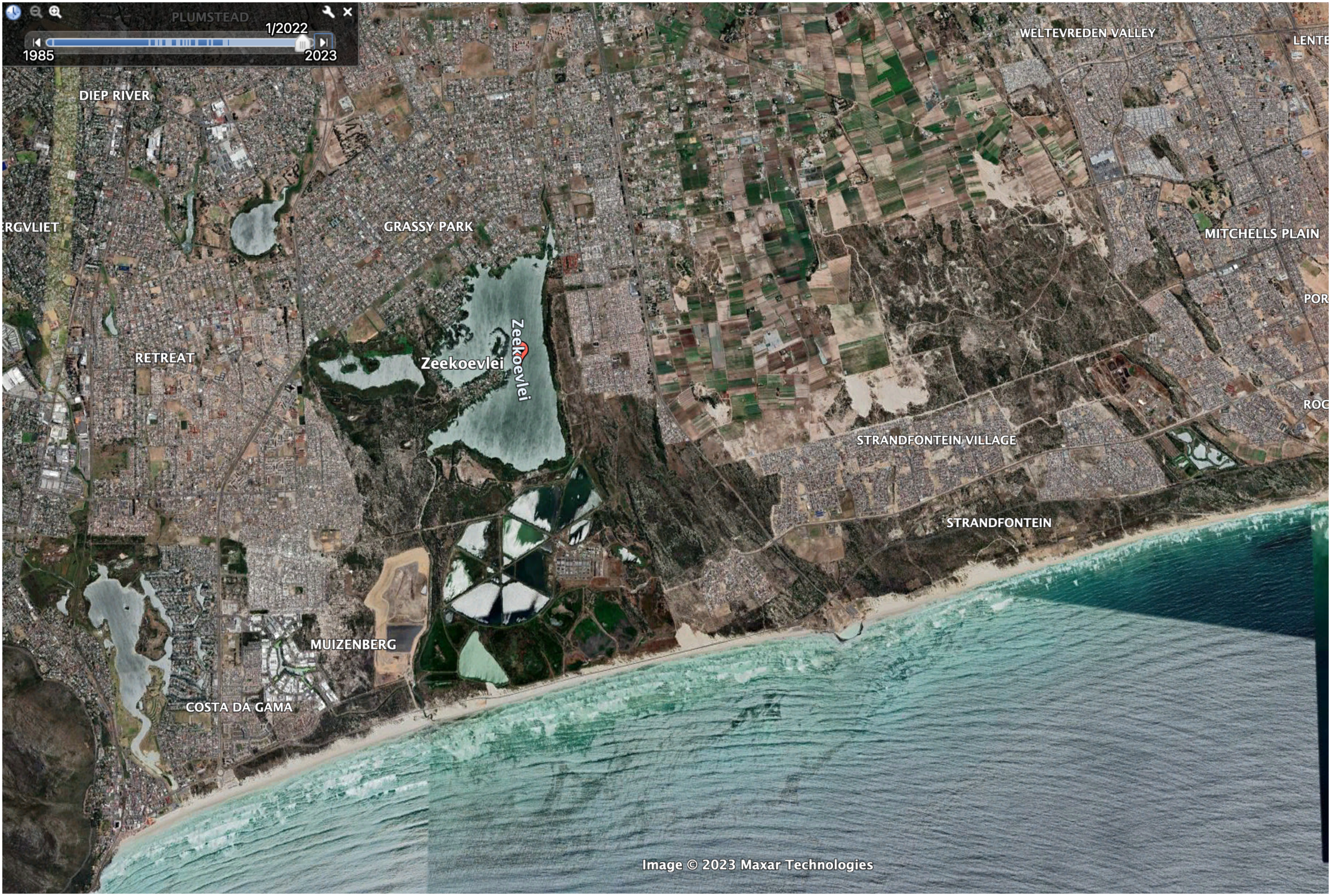
Muizenberg East, from Muizenberg Beach (lower left) to Mitchell's Plain (far right), as at January 2022. Source: Google Earth/Maxar Technologies.
The gaps, errors, and lacunae of urban and peri-urban planning based on modernist modes of thought are evidenced here: the falsehood of the nature-society divide; the idea of matter set in time and space; the belief in a hard boundary between City contaminants and the ocean edge; the error of imagining that environments can be governed by property law and concrete edges; the folly of hoping that private development will serve the greater good. Mud, dust, sunlight, water, temperatures, sewage, stormwater, pollutants, algal blooms, seeds, and pollens all move through the area and the bodies of those who live in it, regardless of class or race or the classifications imposed on the sources and spaces of their co-mingling.
The Great Derangement is the title given by Ghosh (2016) to his collection of essays on the climate crisis, in which available frames of rationality and reason find inevident the evidentiaries that are obvious to those who live in such spaces (see also Stengers, 2023). Thus, a first step in a methodology for integrating Earth processes with social sciences would be to begin with an inventory of the struggles, contradictions, absurdities, and distresses that emerge in activist dialogues on this landscape, precisely because those run counter to the conventional wisdoms through which this landscape has been known, designed, and governed. Learning to think in ways that can undo the harms produced by inherited categories requires learning to see differently: that is, being open to what does not make sense, rather than limiting research to what is pre-determined to be real. For without doubt, landscapes of waste are “surreal,” for the presence of unassimilated waste evidences the absence of Earth processes from versions of reality advocated in town halls and shopping malls.
Flows of “matter out of place” reflect disrupted Earth processes and/or conceptual apparatuses that no longer fit, if they ever did.
In Muizenberg East, municipal records show that in the 1940s to 1970s, the sands of the Cape Flats were allocated to glass and cement manufacturers that built the city, and water was drained from the wetlands to house people designated for removal from “White Areas” by Apartheid race scientists who classified them “Colored,” “Indian,” or “Malay.” Most were moved into ghettos of apartment buildings that were described by the then-City Engineer JG Brand (1999) as “drab three- and four-storeyed rental flat ghettos set in crime-ridden wildernesses.” Brand set about designing a solution: a suburban area in which “Colored” people would be allocated to “a vastly better environment capable of sustaining a balanced community. The package included schools, libraries, parks, play grounds, swimming baths … sports stadiums, civic halls, a town centre and suburban shops, a railway link with three stations, a wastewater treatment works, paved streets and footways” (Brand, 1999:30). For his application of Apartheid “Bantustan” principles to the creation of an urban “Coloredstan,” he was awarded the Order of Merit by the French government in 1985.
Among the blind spots in Brand's urban design was that Apartheid used racialized areas to turn off access to finance, industry, jobs, education, and land. In the absence of access to land, decision-making, and resources, Cape Flats residents could neither move away to better environs nor act to amplify local wellbeing and habitability. The devastated dune wetland ecology that is now under housing is wet and cold in winter and dusty in summer, contributing to very high tuberculosis figures (Pentecost and Cousins, 2017) and rendering the area ecologically inhospitable. Poorly linked to the regional economy, many in the area turn to gangs for access to financial flows. In the most recent crime statistics available, the area was listed by the South African Police Services as the most violent policing district in the Western Cape, with the fourth highest crime rate in the country. For sexual assault crimes, the Mitchells Plain area on the Cape Flats was at number one (South African Police Services, 2022).
No spaces were allocated to Black citizens—the so-called “Bantu” groups—in the Cape Flats Joint Planning Scheme adopted by local municipalities in February 1969 (Joint Planning Committee, 1969). Those came later, in the 1980s. The crime statistics of Cape Town's urban Bantustans—townships like Nyanga, Khayelitsha, Gugulethu—also occupy top spots in national crime statistics.
Sand dune mining and forced removals accelerated the risks of losing plant species associated with Cape Flats Dune Strandveld and Cape Flats Sand Fynbos. The current very high extinction risks to unique plant species and the very high homelessness rates in the area share the same history. Were it to be acknowledged that extinction risks and expulsions share the same history, conservationists and urban housing movements might find they have common ground and could build an environmentalism for a habitable urban ecology that repairs the ruins of racism and the ruins made possible by the separation of nature and society. South Africa's wealth of nature reserves, so crucial to preservation of species of all kinds, have had the unintended consequence of being used to justify ecological devastation elsewhere. Like the Bantustan, the Naturestan was severed from “society.” Both social outcasts, competition for resources has arisen between them. A Black urban environmentalism for habitability could relieve pressure on both.
According to urban researchers Turok et al. (2021), Cape Town remains the most segregated city in South Africa—in the country that World Bank researchers found to be the most unequal on Earth in 2022 (Sulla et al., 2022).
The 70 ha Capricorn waste dump began as an informal dump in the sand dunes when they were still considered wasteland rather than a unique and precious part of the fynbos biome. Arguing that the dunes were already degraded, post-Apartheid engineers leveled the area in 2002 and suggested the waste dump fall within the nature reserve. The official City promotional document for FBEP justifies this with the argument that waste is part of urban metabolism—ergo it provides environmental services; ergo it is compatible with conservation. Countering that argument, urban planning scholar Jonathan Metzger (2018:15) notes “Ecosystem services approaches generate calculative infrastructures that provide affordances for simplification and unwarranted reductionism, which then paves the way for unthoughtful action underpinned by illusions of commensurability, substitutability and tradability where this simply is not.” This is particularly dangerous, he continues, “because of its projected veneer of scientificality, universality and comprehensiveness—but without any regard for how a wider application of an ecosystem services approach, without a humility in the face of wicked ecological complexity, will in all probability lead to a series of successful operations leading to the eventual death of the patient” (Metzger, 2018:15).
In the 1970s, while Mitchells Plain was being built for those classified “Coloured,” the fresh water lakes at the adjoining Marina da Gama were engineered for those that Apartheid designated as “White.” Middle class and upmarket homes were built on the water's edge by Anglo American (Morant and Grindley, 1982). Its reservation for Whites is evident in its naming after the Portuguese explorer Vasco da Gama, who is regarded as the first European to have set foot on these shores. For people of color, however, its memorialization of Da Gama is bitter, for the nearby lake known as Princess Vlei is so named for the tears of a Khoi princess who, it is said, had been raped by Portuguese sailors. Across the road from Marina da Gama—about 100 m away—lie the shacklands of Vrygrond, home to a significant population of migrants who have fled drought elsewhere in sub-Saharan Africa and who maintain a precarious existence amid flare-ups of xenophobia. More recently, a new suburb named Costa da Gama was built between the waste dump and the sea.
A few dozen meters from the Vrygrond entrance, where local commerce happens atop blankets on the greying sands, are the gates of Capricorn, a so-called “green” business park that is landscaped with carefully nourished indigenous plants and is home to multinational corporates and their warehouses. It is entirely possible that this square kilometer of Cape Town, where Capricorn meets Vrygrond, is among the most unequal anywhere. Gaza-style gates on the business park testify to the consequences of social arrangements that break the limits of bearability: they seem designed to withstand tanks. Entry to its greenery and lake is denied to all without proof of employment or a vehicle license and driver's license, which are scanned by guards under the unblinking stare of 24/7 surveillance.
Understanding the struggles on this landscape begins with observing and listening for clues as to the slow violences of materials that flow out of place and compromise health and habitability alike (Nixon, 2011; Davies, 2022). Listening to how these issues manifest and tagging them on a map or a satellite image is a fourth step to understanding urban ecology and how it might be remediated. Conversations, observations, and extant published research across multiple disciplines evidence ongoing forms of slow violence affecting the health and wellbeing of all, regardless of race or class or land-use area. Among the problems that have become evident in conversation and observation are:
In late summer, when the ground is dry, In winter, Not a few
The practical problems surfaced by the methods of driving, observing, listening, and desktop digging for archives and data here readily demonstrate the flaws in the urban planning system that was designed via a mindset of property—in French, the word is “l'immobiliers,” or the immovable—rather than flows. What all thirteen of the above concerns have in common is that they arise in movement: flows of water, dust, contaminants “in the wrong places.” It is not difficult to identify empirical evidence of the flaws in a paradigm of infrastructure design that has imagined nature as immobilized by private property, humans as separate from nature (and one another), and urban metabolism as separate from Earthly processes. The question arises: With what concepts and analytics might these relations in a place like Muizenberg East be described, understood, and remediated?
Rethinking personhood
The break between politics and the Earth is evident in every one of the dozen environmental governance faultlines above. This is the first and most important concept to resolve: that nature and society are one; that people and place are interrelated with one another. The Earth and body do not meet at the skin of the human. They intermingle with every breath; every ingestion; every excretion. Bios and geos mingle.
Bodies are part of landscapes before they are part of the economy. Household economies and ecologies were tied together in the word “ecos” (which means household) long before financialized economics became a global conceptual currency. To rethink the human in relation to the Earth is to reconceive Homo economicus as Homo sedimenta, the human whose tracks, actions, and extractions leave geological traces. Bruno Latour, after Danowski and De Castro (2016), uses the concept of a Terran, and proposes a Terran politics as the defining politics of the twenty-first century, displacing both the politics of the right (broadly: nation and nationalism) and the politics of the left (broadly: human rights and globalization). The politics of the moment, he writes in Down To Earth (2018), is the question of how we rethink politics via a return of personhood to planet, and how we are to care for the planet via the landscapes in which we live. The attempt to bridge social and natural sciences via economics has failed. While it has empowered global consultancies to take up new-found capacities as a shadow-state (Ylönen and Kuusela, 2019), this has also advanced oligarchies, i.e., the privatization of governance for profit, and has not reduced corruption risks (Williams, 2022). Moreover, financializing people's relations with ecology has erased deep practices of care and advanced the commodification of species and resources. It may well be that in rolling out commodification of everything, environmental governance sciences have unwittingly advanced the loss of forest cover and extinctions.
The hope for habitability may well be a far more powerful and effective grounding for collective Earth care than an environmental governance based on an alliance of science with the violence of the state exercised via “crimes and fines” policing. There is place for environmental law and punishment, certainly. However, if the relation between environmental science and publics is via guns, fines, and handcuffs, science will be hated. And distrusted. The question is critical: What is the place of science in the social contract? If scientists are not to advise environmental governance via an authoritarianism wielded via the guns of the state, what are the alternatives?
To rethink science is to rethink the disciplines and the disciplining relation of science within the social contract. It yields an invitation to rethink environmental politics not as nature vs. people, but as a partnership with Earthly processes for habitability, in which financialized economics are replaced with Earth-process relations. What follows builds on the proposals for ecological economics based on principles of Earth processes, such as the focus on entropy in the work of Georgescu-Roegen (2011) and metabolism in the work of Martínez-Alier (2003).
Metabolic flows: BioGea as the basis of habitability
In times past, Cape Flats soils would have been fed by the annual migrations of wading birds visiting the plentiful wetlands, feeding on fish and frogs and insects, and leaving behind a season's worth of guano to nourish the sands. For this reason, Cape Flats farmlands (item k) have long been recognized as exceptionally good for horticulture. Yet without access to farmlands, affordable nutrients, and mulch to keep the sands cool in summer, food gardens are not productive enough to stave off poverty. Instead, nutrients are sedimenting “out of place,” metabolizing in rivers or oceans as algae and contributing to the methane produced in the waste dump. This suite of problems speaks to the misalignment of regional nutrient flows with a basic Earth process: metabolism. This is widely recognized in literatures on urban metabolism that date back to the young Karl Marx, who recognized as long ago as the 1840s that capitalism is unsustainable, as metabolic relations that feed soils are broken by monoculture, requiring ever more financial input, that would make land and food unaffordable (Foster, 2000).
Points a (hunger), d (contaminated wetlands), f (desalination difficulties), and h (energy poverty) relate to key nutrients and biomass being out of place. There is hunger without access to land or nutrients with which to grow crops. Wetland algal blooms attest to soil nutrients (nitrogens and phosphates) being out of place, as did the fouling of desalination plant filtration systems. Energy poverty pervades the area even though methane (a carbon) from the waste dump is available—but is sold elsewhere. The application of sewage sludge to farmlands is prohibited (although practiced), because it carries all manner of toxins and chemicals of emerging concern (CECs).
A program to create pockets of urban food growing could begin with a redirection of organic waste flows. Planting fruit trees in these lots, where they will be tended when young and fragile, will provide food and shade for many seasons to come. An urban movement for food security, sustained by thoughtful investment in the movement of nutrients that are currently going to the wrong places, can build more hopeful, healthy, and habitable futures.
Community-led urban farming programs would reduce hunger, build zones of care for waterways and riparian zones, and improve security along them (point m). Allowing people to graze livestock along river edges or farm the open tracts of land along the M5 could initiate nutrient cycles that will feed soils and create opportunities for decent work, reduced hunger, better health, and increased safety.
A short-term solution to hunger, for example, is to generate massive composting programs that can distribute garden waste and the coffee grounds and vegetable matter discarded by juice-bars and restaurants.
A longer-term solution is to recognize that contemporary sewage sludge contains so many toxins that by law (though not always in practice) it is carted to landfill not to farms—and that cost-effective ways to break down the molecular structures of persistent organic pollutants is a crucial area of investment in order to build a circulating commons of nutrients, promoting affordable habitability.
Both of these interventions point to a first principle for a regenerative Earth politics: to partner with Earth processes, starting with gravity, metabolism and thermodynamics.
The key is to understand municipal structures as protecting these processes as a commons, rather than enabling them to be extracted for profit. The extraction of methane from the waste dump, for example, affords “Environmental, Social, Governance” (ESG) labeling to the shares of the company doing the extraction, on the grounds that their intervention supports sustainable industry. Given the toxins associated with waste dump smoke, however, flaring the waste dump gas at low level (Scottish Environmental Protection Agency (SEPA), 2002) potentially compromises the air quality and health of those who live and work in the immediate vicinity.
Ensuring that the circulation of matter supports life and habitability rather than hunger, disease, and dying is the basis of a politics of habitability. Critical Zone scholars speak of this in terms that address the building blocks of life—nitrogen, oxygen, phosphorous, carbon, potassium, and water. While Critical Zone research has tended to focus on the flows of nutrients, carbon, and water in pristine landscapes (Latour and Weibel, 2020), its principles for protecting the conditions of habitability can be readily extended to encompass contaminant studies, environmental chemistry, and urban metabolism (Banwart et al., 2019).
Earth moves: there is no nowhere
The design of the waste dump, the sewage works, and the chemicals and pharmaceuticals that they contain, testifies to the presumption of an extra-terrestrialism: that there is a “nowhere” to which human waste goes when it leaves the end of a pipe or arrives at the end of a road. This is evident in items b (metals), c (contaminated aquifer), d (contaminated wetlands), and f (desalination difficulties).
In this paradigm, the sewage system goes nowhere of any consequence, even though it settles into the major recharge zone of the Cape Flats Aquifer, and that aquifer discharges directly into the Indian Ocean, and from there moves into long-range planetary circulations via evaporants and ocean currents. The unlined CFWWTW settlement ponds on the dunes close to the shoreline discharge into groundwater and the aquifer system (Riemann, 2022), and from there into the bay (Pfaff et al., 2019). Once in the ocean, the chemical compounds these waters contain circulate into the food chain, into the global ocean system, and into the global weather system as evaporants subject to long-range transport. Because of these long-range transport vectors, municipalities have an out-size responsibility to planetary health. It is at the municipal level that CECs present themselves, and it is at this level that they are either broken down or released into the environment. Even if they are dumped at a dump site, they are not out of planetary circulation. There is no “end of pipe” solution.
The water crisis of 2018 highlighted how flawed “end-of-pipe” thinking is: in the lengthy downtime of the False Bay desalination plants that were unable to function, and in the heavy metals identified in the Cape Flats Aquifer system once it became clear that the city would have to rely on it in the droughts that are to come (Riemann, 2022). Another example: the cycling of cadmium between the sewage works and the waste dump that was identified by Mason-Jones (2009). This likely relates heavily to the end-of-life of nickel cadmium batteries that powered consumer electronics in the 1990s and 2000s, which, along with other e-waste, has not been separated. Circular ecologies for e-waste have been under discussion with engineers for a long time. The coming wave of lithium batteries to the waste dump, after rapid shifts to battery storage amid South Africa's increasingly erratic electricity supply, requires planning to prevent an equivalent lithium toxicity.
States of matter are not the only matters of state
Misrecognized in the formulation of environmental governance via the imagined hard borders between people and nature and the separation of solids, liquids, and gases are dust, mist, leachate, sediment, and compost, all of which traverse fences and borders on vertical as well as horizontal planes (cf. Szerszynski (2021)—in colloids, smoke, and thermals; in mud and aquifers (Cunha, 2019; Bremner et al., 2022).
How might rivers be reconceived, not solely as ribbons of liquid traversing solids, but as colloids and sediments and evaporants; as mud that turns to dust and enters the air commons? This requires thinking on the vertical, not only the horizontal.
Only solids and liquids appear to have been factored into the design. Rethinking the water cycle via hydrosocial science, and the soil cycle via urban metabolics, and contamination as a biogeosocial problem requires rethinking approaches to environmental governance that attend primarily to solids, liquids, and gases. To put it succinctly: the approach conflates matters of state with states of matter. In contrast, an ethnography of mud, mist, dust, flows, and metabolism—as is emerging in the biogeosciences; industrial ecology; critical zone sciences; circular economics; public health engineering; medical geology; technosphere studies; urban ecology; the porous city; anthropocene stratigraphy; and the hydrosocial sciences—renders Anthropocene harms evident precisely because these approaches flow around disciplinary boundaries, in much the same way as mud and mist flow around concrete walls. Where local knowledge is able to speak to motion and interaction rather than being required to present data points, local experience begins to (re)define the big picture that is currently dominated by governance rationalities primarily attuned to property and profit. The focus should be on currents more than currencies.
Habitability arises in vertical relations
In environmental governance sciences, a dominant orientation is cartographic—the governance of the horizontal surface, in terms of legal relations framed by property allocations to private owners or organs of government. It is no accident that the word “property” (“l’ immobiliers”) focuses scholarly attention on that which is immobile, immobilized or immovable. Yet pollutants here operate from aquifer to cloud, on the vertical, regardless of the allocations of surfaces to specific legal protocols. Hardened surfaces prevent ground mists from forming and foment flooding when rainwaters find no soil ingress. Changed surface relations between bedrock and plant-top alter risks and habitability. For it is in the vertical flows—gravitational and thermodynamic—that the critical zone emerges as viable or non-viable. These relations are in basic Earth processes: gravitational sedimenting, seepage, and hydrogeology downwards, and thermodynamic flows of particulate matter, evaporants, and gases upwards. Vertical movements apply as much to the mountain streams and flows into the aquifer as they do to the wastewater treatment facility and the Capricorn waste dump.
Rainfall that ingresses to soils on the mountains to the west of Muizenberg East may seep in turn into the underlying sandstone formations. It will continue downward until it reaches the impermeable layer of granite, and it will then flow very slowly into the aquifer system on the Cape Flats, traveling some 100 m per year until, 30 years later, it reaches the Zeekoevlei, Rondevlei, and Princess Vlei wetlands. Rainwater that fell from the same cloud on the same day may reach a stream and land in a stormwater pipe, cause flooding until it reaches the stormwater system and thence to the ocean. Much as stars in the sky appear contemporaneous but arrive in wildly differing histories, water in the wetlands of the Cape Flats arises from very different time horizons. As water in the sandstone aquifer moves at approximately 100 m per year, a flood two decades back, for example, may form a pulse in groundwater that will determine whether heavy rains flood a specific neighborhood. The implications for the aquifer are significant, as pollution events and new contaminants may persist in groundwater far longer than a single rain season, and may appear at unexpected moments in wetlands. Just as the presence of heavy metals and new agricultural toxins cannot be measured from a single sample of borehole water, so too, compounds metabolize in different timeframes. Water bodies represent an agglomeration of timeframes and events and materials. What are the futures of the aquifer if they are recharged with poorly treated waste water that does not adequately remove CECs?
On calm summer days when the air is hot and humid, stare into the sky long enough and chances are that a dozen or so pelicans will appear as specks in the sky, whirling and turning on a thermal gyre. Winter days are different. When the seasonal northwester is quiet, the Indian Ocean current off False Bay warms the air at ground level, but colder layers of air higher up trap the warmth, creating a thermal inversion that warms the city between the succession of harsh cold fronts that gave the region the name “Cape of Storms.” But like all Earthly processes, an ignored thermal inversion can bring trouble. When the cold hits and fuel for fire is nowhere to be found, the poorest of the poor burn plastics. Between the nitrous oxides of vehicle exhaust fumes and the dioxins, furans, mercury, and polychlorinated biphenyls from burning plastics, the polluted thermal inversion wields multiple health risks, far and wide. At those moments, air quality across Cape Town becomes an index of inequality, responding overwhelmingly to Apartheid spatial planning and adding to inflammatory conditions and respiratory ailments.
The thermal inversion may turn particularly nasty because of the waste dump at Capricorn. A study elsewhere in South Africa indicates that air pollutants associated with waste dumps include furans, dioxins, volatile organic compounds, sulfides, benzenes, and hydrocarbons. While the dump at Capricorn is managed to harvest methane, gaining reputational credit for the fossil fuel company that won the contract, contrary to international best practice the company practices flaring, putting toxins into the air rather than containing them. And with such widespread energy poverty—which could be offset by methane-harvesting from the waste dump and sewage works—those with no other option, burn plastics. In financial terms, the health costs to the commons of burning plastics likely outweigh the fiscal contribution of for-profit methane harvesting.
In summer when the wind blows and the dump is dry, plumes of dust pour over Vrygrond and Lavender Hill. For those who live downwind of the dump, breathing in dust is linked to multiple systemic inflammatory conditions (Njoku et al., 2019). So too for those who eke a living from the dump, seeking recyclables, but who are chased off the dump by security guards tasked with protecting a new recycling contract signed by the City with a for-profit company. The most precarious of the most precarious lose their livelihoods to the rollout of corporate green. Violent scuffles with security turn in to teargas and then toxic smoke as waste-pickers set fire to the dump in protest. Fires can last for weeks when methane ignites deep in the belly of the beast. While it is commendable that the City has invested in recycling, it must be asked why the move to a circular economy is reproducing social relations of inequality, and whether there is an alternative relation possible between sustainability and the reproduction of inequality. To borrow the question of African environmentalist Nnimmo Bassey, we must ask of every implementation of the SDGs: “Sustainability of what, and development for whom?”
Future scenarios underscore how crucial it is to think on the vertical. Modeling of the Cape Flats under sea level rise and storm surges by 2100 indicates that much of Muizenberg East would likely be under water then. Cape Town has no mangroves to protect it from ocean surges, but its sand dunes, which emerged as sea levels dropped at the start of the Holocene, are capable of protecting the Cape Flats from sea level rise and storm surges. With so much of these sand dunes already stripped, the continued mining of sand dunes at Macassar, near Khayelitsha, is nonsensical. The policy allowing sand dune mining appears impervious to material futures.
Energy, land, health, safety, and resource poverty
Hunger; air pollution; aquifer contamination; wetland contamination; inappropriate water management devices; desalination difficulties; energy poverty; land/conservation struggles; protest fires; court struggles to protect farmland—all relate to resource poverty arising from what some call the “Food Water Energy” nexus.
On the Cape Flats, Apartheid planning produced a brutal alteration of land surfaces. Sand dunes were excavated and extracted for glass (silicates) and cement (limestone), then drained by canals. Hard-surfaced and denuded of dunes, the land is less able to absorb heavy winter rain runoff, more vulnerable to foot-burning levels of heat in midsummer, and therefore also more prone to incubating tuberculosis bacteria. Recreational spaces are few. The presence of Australian Port Jackson willows and hackea bushes, brought in by the Apartheid state to stabilize shifting sands, provides a monotonous necro-ecology that kills the smaller fynbos and its associated insects, birds, small fauna, and medicinal plants. An unloved landscape that is used for illegal dumping, the bushland is dangerous, as under its cover, rapes and murders are many. Safety and security are rare.
The resources for shifting this dysfunctional food–water–energy–safety nexus are readily available, however. Cape Flats farmland is potentially very fertile, with ready access to groundwater. Moreover, much of South Africa—including the Western Cape—has some of the best solar radiation in the world. Cape Town also has regular winds, with average windspeeds ranging between 16 and 23 km/hour across winter and summer. Supporting small-scale farming to shorten supply chains makes food more affordable and more climate-friendly. Locating solar and wind energy production in households would democratize energy production and shorten distribution chains. It has the potential to shift energy poverty and both mobilize and empower the collective. The capacity to earn currency from current by enabling low-income suburbs to supply the grid from rooftop solar would alter landscapes of urban poverty. Another urban metabolism is possible.
The multiple temporalities of place
Material processes on landscapes occur in vastly differing timeframes. Cancer-causing chemicals or Parkinson-inducing contaminants may take decades to reveal themselves in bodies. Bureaucratic processes to replace broken infrastructure may be out of kilter with the harms caused by sewage spills. When governance is limited to an annual financial cycle or a five-year electoral cycle, the multiple temporal implications of planning decisions are rarely factored in. The timeframes of materials such as cement or plastic, in pipes or pharmaceuticals, may be incompatible with the timeframes of law and policy. Consider the lifespan of cement: the permanence of contaminants that the cement is expected to contain are not the same. Cement has a lifespan of perhaps 50 years before it disintegrates and can no longer prevent leakages. The contaminants it is supposed to contain may be harmful for tens of thousands of years. As suggested above, aquifer time is different to the timeframes of stream flows and stormwater or sewage spills. These different movements are unmappable in conventional cartography or geographical information systems – hence the proposals of Ait-Touati et al. (2021) for mapping the vertical relations that generate the conditions of habitability or its opposite.
While memory is almost wholly absented from frames of reference in environmental governance, knowledge of the temporalities of landscapes is, however, a powerful resource for reclaiming awe for the Earth and its relational history.
Memory is in the beach sands of the Cape Flats from about 21,000 to 11,700 years ago, when sea levels were higher. It is in the chalky calcrete rocks bearing the bones of animals from the late Pleistocene. It is in the back-stacks of museums in Cape Town and elsewhere, where evidence of material culture on the coastline in nearby Stilbaai may go back 100,000 years (Jacobs et al., 2020). Marine isotopes indicate that the area was host to early fynbos of the Cape Floristic Region dating back to extinct Pleistocene ecosystems, with an abundant nutritious grassland, numerous wetlands, broad rivers, and a rich habitat (Marean et al., 2020).
Memory is also in surviving botanical knowledge taught by intergenerational knowledge keepers, who withstood Apartheid forced removals, and whose knowledge of the landscape testifies to enduring Khoi presence and the memory of the Cape Flats as a vast expanse of plants used for food and medicine (Bam, 2021). Memory is in the weather that calls to mind years of drought and flood, and in the memory of elders of Grassy Park who say that when they were tiny tots their parents and grandparents would go by boat to Plumstead and Diep River in years when winter rains were heavy. Memory is in the time before cement canals, when one could fish in the river. Memory is the price of land being so cheap when Pa was a boy, compared to prices now that render people homeless. Memory is in the sense that the Ancestors dwell on mountains, where a sense of the sacred resides. It is in the name of the Princess Vlei, which honors the tears of a young Khoi princess raped by Portuguese sailors. That memory protected the Princess when corporate developers wanted to build a mall on its shores and a Cape Flats environmental movement resisted (Ernstson, n.d.). Of these fragments, a Black environmentalism is delicately and deftly emerging (items (i) and (k)).
Memory is in the archives of Council papers, where the citizens of Cape Town yielded to the Apartheid State and denuded the vegetation, turned the dunes into concrete, and forced people of color here. Memory is in the ongoing presence of the Cape Flats Distress Association (CAFDA) formed to provide help and healing to those who suffered guns, whips, boots, and bulldozers—and still do, when they are homeless in the post-Apartheid Cape.
Memory yields both rage and healing. Memories yield stories of why people and ecologies alike here are now poor and often sick. Memory is in the Google Earth images that go back to 1985, and the aerial photos from the 1920s, and the maps in the archives from 1615, 1725, 1790, 1815, 1850, 1925, and 1969. The movements they trace yield sparks of hope that activate the imagination that things could be different; that life does not need to be lived in alienation from the Earth, or from land long dispossessed.
In these histories and stories are the possibilities for a different ecological politics that is not stuck in the imaginary “perpetual present” of bureaucratic maps and does not set the homeless against the conservationists. “We are nature protecting itself” is the motto of the local environmental movement that sprang up to protect Princess Vlei. Might it be possible to build an Earthly politics in partnership with a new generation of officials whose urban-ecological knowledge is capable of unmaking Apartheid segregations and Anthropocene bifurcations? Is it possible to install new environmental officials with fresh mindsets in offices run by hawkish officialdom that perpetuates authoritarian sciences and presumes public ignorance? Could a flows-based transdisciplinarity initiate an empowering environmental governance politics based on Earth-process partnerships?
The rationality of calculative tools (and the death of the patient)
The struggle for the future of Muizenberg East has long been financialized—in its relegation to wasteland in the 1960s; in the removal of the dunes for cement and glass; the forced moves of the 1970s; in the argument to build a science park (now corporate offices and warehousing) and a waste dump in the nature reserve; in the current struggle over proposals for the agricultural area to be built over. Metzger (2018), cited earlier, notes that these calculative tools set in motion successful operations that risk the death of the proverbial patient. His work calls for “a new sensibility underpinning planning practice, as well as the development of practices, tools and institutional arrangements that can function to introduce and stabilize such a sensibility within the processes of planning.”
The overview of the emerging transdisciplinarities with which this study opens suggests that the scholarly framework for environmental governance in terms other than authoritarianism, social-ecological systems, and ecosystem service assessments is already advanced, and that their convergence is in their empirical orientation to material flows and metabolic relations. Following these equips researchers to replace the politics of Earth mastery based on property relations, with a politics of partnership with Earthly processes. Methodologically, partnerships with those who live in local landscapes and experience their flows and relations will fill in what is currently inevident in the dominant epistemic practices of officialdom.
Advancing new metadisciplines for Earth partnership would be the outcome of concerted efforts across the new transdisciplinary fields to design analytical methods and approaches that articulate an ethic of Earth-process partnership. The word “Terrans” is proposed by Danowski and De Castro (2016) to characterize those who choose to live in partnership with Earthly processes. Drawing on their concept and Bruno Latour's use of it in Down To Earth (2018), a “Terranology” as proposed here is an explicitly political science for extending the social contract to an Earth contract (Serres, 1995) and to generate such metadisciplinary spaces of teaching and dialogue on what it means to be an Earthly citizen. The name of such a field, however, is of less importance than the approach that introduces new practices of making landscapes sensible to officialdom.
With that goal in mind, this study closes with the outline of an approach to integrative Earthly politics based on the Muizenberg East site.
Toward a terranology: an integrative science of Earth partnership
Synthesizing emerging material process disciplines into a politics of Earth partnership invites a fresh conceptual framework.
First, a theory of the Earth.
Second, a theory of Earthly Personhood.
Third,
Fourth, a revised theory of environmental governance.
Finally,
Footnotes
Acknowledgments
This article was developed at Leeds University's School of Earth and Environment where I am deeply grateful to Steve Banwart for guidance in linking these ideas to Critical Zone sciences. Archival research support from the University of Cape Town's Engineering and Built Environment Library staff was exceptionally helpful. I am grateful to Vanessa Farr, Nikiwe Solomon, Isabelle Stengers and the HKW Anthropocene Curriculum project for engaging these ideas as they took form, and to Dalton Gibbs for insights on local hydrogeology. Oversights and errors remain my own.
Funding
The author disclosed receipt of the following financial support for the research, authorship, and/or publication of this article: The Peter and Liz Cheney Visiting Fellowship to Leeds University, which made the development of this work possible. This research was funded in part by Science for Africa Foundation to the Developing Excellence in Leadership, Training and Science in Africa (DELTAS Africa) programme (Del-22-010) with support from Wellcome Trust and the UK Foreign, Commonwealth & Development Office and is part of the EDCPT2 programme supported by the European Union.
