




Abstract
Water has been formulated as a resource or a hazard within water resources geography. We propose that reframing of water as hydro-heritage opens up richer analytical possibilities for examining the pluriverses and multiple ontologies that animate gendered experience of water. We are concerned with how hydro-heritage has or could have contributed to healing in the post-conflict Swat valley of Pakistan. We highlight how the Taliban insurgency and the reconstruction following its military defeat displaced people's worlds of meaning in Swat. We find that the pre-conflict mountain springs were a site for an enchanted affective encounter between humans and non-humans, where a multifaceted gendered experience of water was enacted. The developmental imaginaries of the Pakistan state in the post-conflict reconstruction phase and the accompanying social changes deracinated water and springs from their pluriversal moorings towards ‘modern water’ with damaging material and emotional consequences for the people of Swat. This was particularly pronounced in terms of gendered access to water, health and mobility. We suggest that water as hydro-heritage has the potential to heal, provided people's worlds of meaning and experience of water are recentred in developmental imaginaries.
Introduction: Beyond water access to experience
Water has predominantly been analytically engaged with as a ‘resource’ within Anglo-American geography. Be it as a basis of life, livelihood, culture, society or ecology or its incarnation as a hazard, water has mostly been thought of and written about in terms of its material utility or hazardousness (e.g. see Gaile & Wilmott, 2004; Sultana & Loftus, 2020). Others, however, have pointed to the cultural meaning (Linton, 2010), emotional and affective aspects (Mustafa & Halvorson, 2020) and the experience (Wescoat, 2021) of water. Our concern in this paper is to understand how water bodies, such as springs, when engaged with through an affectual heritage lens, open up avenues for exploring sense of place, geographical scale from local to national, and gender roles in the post-conflict environment of Swat valley in Northern Pakistan. We argue that heritage is relationally produced and does not exist in itself. It exists in relation to the material and discursive power structures that in turn produce the affective and emotional geographies, wherein some places are designated heritage, and others not. The process is in a continuous state of flux, and this is the tale of water springs as sites of affective practices associated with heritage sites and communities’ own needs, imaginaries, aspirations and projects (De Nardi, 2019a, b). Importantly, heritage is not recognized, experienced or even physically accessed equally across gender, class, ethnicity and age lines (Voss, 2008). Heritage politics is fraught, characterized by disagreement on the nature and agency of heritage assets (Logan and Reeves, 2009). The consensus on the worth and prescribed interpretation of remnants of the past have been at the centre of debate for decades (Lowenthal, 2003; Macdonald, 1997; Meskell, 2002; Smith and Campbell, 2011; Waterton, 2015). Our emphasis is on the gender aspect of water in its many forms and perceptions, which inevitably also accounts for the intersectional nature of the gendered interactions with and experience of, what we call hydro-heritage after Mukherjee (2022).
Swat became one of the epicentres of the Global War on Terror (GWOT), when it was practically taken over by Taliban from 2007 to 2009 (Khan, 2023). The intense military operation undertaken by the Pakistan Army in 2009 led to the displacement of more than 3 million people. As the army operation reached somewhat of a successful conclusion in 2010 after dislodging the Taliban, the internally displaced people made their way back to the valley (Caron and Khan, 2022). The Pakistani military led an ambitious reconstruction and de-Talibanization programme to re-establish the writ of the Pakistani state in the troubled valley (Khan, 2019; Marsden and Hopkins, 2013; Shah et al., 2020). We will elaborate upon the features of that programme directed towards ‘modernization’ and upgradation of the infrastructure in the valley as a pathway to healing a traumatized population. But the developmental imaginary illustrated by that reconstruction turned a previously rural valley into a largely urbanized and peri-urbanized society, much more strongly integrated into the larger economy of Pakistan than was the case earlier. Mountain springs, which were exemplars and locus of local cosmologies, also underwent a process of dis-enchantment and often physical degradation. The post trauma healing qualities of water bodies and infrastructure and their role in reinforcing and solidifying local social and cultural capital have been documented in the literature (Mustafa & Qazi, 2007; Wescoat, 2007). We explore the tension between modernizing reconstruction led by the Pakistani military and urbanization, and emergent production of a national-scale mode of being, whilst undermining the local-scale cosmologies, and subjectivities.
Springs perform multiple practical, ideological and mythical functions including healing, recreation, sites of romance, mythologies, providing for household needs, offering water for drinking, bathing and ablutions (in Islamic societies). These multiple functions of springs highlight entanglements of water in sometimes intertwined, and at other times conflicting, emotional and even ontological registers. To explore the emotional and affective dimensions of springs in the Swat valley of Pakistan, we heed Wescoat (2021: 238–239) who regards ‘experience as a continuous process of inquiring, feeling, acting, and understanding. Some types of experiences are problem-driven while other occur through an openness to spontaneous wonder’ (pp. 238–39). We are particularly interested in the experiential accounts of local community members. Experience of encounter with water entails a succession of both stable and transitory emotions (Wescoat, 2021: 246). We therefore maintain that experiential processes of cultural habitus, which ultimately shape cultural identities, are dominant in shaping emotional encounters (Dallman et al., 2013).
As the gendered emotional and affective geography of springs in the Swat valley is shaped by embodied human encounters with and around water, we treat water as vibrant matter, as productive potentiality rather than fixed substance (Bennett, 2010). Against this backdrop, we ask, What is the gendered experience of water in Swat? How does the evolving ontological configuration of springs change gendered affective encounters with, and around water? What implications do neoliberal developments, and their twin sibling of increasingly conservative Islamic influence (Caron and Khan 2022), have for the ontology, and therefore affective atmosphere of springs? And hence how are they spatially contributive towards healing or not? More broadly, what can we learn from engaging with water as a lively matter framed as hydro-heritage and not just a resource to be managed?
Hydro-heritage in post-conflict landscapes
Water has had a settled ontological identity as a compound with two hydrogen and one oxygen atom (H2O), in modernist imagination and practice. However, Linton (2010) rightly destabilizes this modernist certainty by explaining how throughout history and contemporaneously, human societies have interacted with water through such varied material, cultural, spiritual and aesthetic valences to render the notion of a unitary meaning of water meaningless. In fact, pure water as H2O can barely exist outside of the rarefied confines of a laboratory. Still, in the modernist imagination, predominantly water has been engaged scholastically and practically as a ‘resource’. That register is predicated upon an ontological sleight of hand similar to (and related to) focusing only on an objectified chemical identity for water, one with little real material or social relevance. As water is imbricated in the social and ecological fabric of life, a relational understanding of it must go beyond its molecular structure to understand it in relation to its socio-ecological interactions with humans and non-humans (Mustafa et al., 2021; Walsh, 2018).
The waterscape concept by Swyngedouw (1999) provides us with a politicized framing for understanding water's myriad socio-political valences. While the waterscape literature has been attentive to the political economic, and technological relations actuated through water (e.g. see Karpouzoglou and Vij, 2017; Loftus and Lumsden, 2008; Mustafa et al., 2021), Acharya (2015) goes a step further, and describes waterscapes as assemblages of practices, technologies, emotions and world views – a veritable repository of symbolic and material practices, a mode of being in which water is a vital part. The attention to the emotional and symbolic aspect of waterscapes inevitably invites us back to contemplate the symbols, and also affects and other presubjective, pre-cognitive knowledges, enacted through water. After all, what is a symbol without affect? Mustafa et al. (2021) document the affective and symbolic meaning of Indigenous waterscapes among the Indigenous Diné and Musahar people in the United States and Nepal, respectively, premised upon non-Western ontologies of person and environment. Gladfelter (2022) on the other hand describe how irrigation development in Nepal leads to the marginalization of local people's worlds of meaning/being in the Tarai region of Nepal. In a non-Western context of Swat, Pakistan too, we argue symbols, affects and practices are not necessarily embedded in the naturalistic ontology of a singular world, knowable through objectification. In fact, during the post-conflict reconstruction and development, the local mountain springs have become a locus for the experience of an ontological dissonance between a national- and international-scale modernity and local-scale place-based imaginaries.
The modern naturalist ontology posits the existence of a singular world out there that is knowable. The conceit of this ontology Blaser and de la Cadena (2018) call extractivism: the accelerated extraction of global resources in the name of economic growth. They argue for revisiting and recentring of ontological pluralism of indigenous and local people which reorients the ‘course of one-world world’ and, following the Zapatista people in Mexico's declaration, allows for the practice of a world of many worlds, or what we call pluriverse: heterogenous worlding coming together as a political ecology of practices, negotiating their difficult being together in heterogeneity. (p. 4)
A brief note on affect is order here; it is more than emotion. Following Laszczkowski and Reeves (2018, pp. 4–5) we understand that: While emotion describes the subjective experiences of an individual, affect is an intersubjective (or, as some say, presubjective) intensity…a domain of feeling that comes before or beyond its narration as an emotion.
The importance of the encounter with heritage and its role in post-conflict reconstruction has been increasingly at the centre of heated debate, as new conflicts intersect old ones in creating landscapes of precarity and fragile balances of reconstruction and reconciliation (see Matthews et al., 2020). More broadly, heritage research had already been interrogating the wellbeing potential held by people's engagement with heritage, historical and archaeological assets. This research has increasingly explored the societal and cultural implications of the embeddedness of heritage into the everyday or leisure time of communities. Specifically, scholars have started debating on the positive impacts of active involvement in archaeology and heritage on key wellbeing indicators (see, for instance, Pennington et al., 2019; Sayer, 2015). What is most of interest here is the link of heritage and natural resources that also embody deeply held cultural meanings and ways of being, and the impact of change in these things upon the communities and individuals they help constitute. For instance, De Nardi's research (2014) identified profound emotional and healing experiences through engagement with heritage landscapes. This research explored the cultural and personal growth potential of living near, or amidst, longue durée historical landscapes that were held as meaningful even without a detailed knowledge of the ‘data’ that makes them strictly ‘historical’, heritage-worthy, or of scholarly interest.
The nature of water lends itself to even more significant lore-making social and cultural processes. Since prehistory, more than human value has been endowed to bodies of water: from the liminality of rivers and water's ontological paradoxes between life and death in the Roman empire of antiquity (e.g. Bradley, 1990; Kamash, 2008), to identity derived through water (Ruru, 2012), to the generative nature of springs, human societies have perceived a higher (or deeper) relationship between water and cosmological contexts. Wescoat (2021) argues that there is a continuity between aesthetic and environmental experience, and following him, we posit that the aesthetic or affective experience of water itself has important political–ecological implications. Heritage after all is steeped in affective politics of what and where, of geographies that may or may not, be considered relevant to the history and identity, and hence social practices of communities at and across spatial scales. Accordingly, we posit ‘hydro-heritage’ as a formative concept for engaging with the politics of reconstruction and development in the context of Swat.
The Taliban occupation of Swat between 2007 and 2009 was characterized by extreme spectacular violence, directed towards constricting spaces for plurality, worldliness and public togetherness (Mustafa & Brown, 2010). The Taliban's wrath was in particular focused on women's mobility, as in their world view women were ‘imperfectible’. Women's ‘essence’ as an embodied root source of fitna (psycho–social–political disorder among believers) made them unfit for the public sphere; therefore, their proper place was in the cloistered depths of the private sphere (Mustafa et al., 2013). More generally, the society overall underwent extreme trauma as a consequence of Taliban violence, which aimed at creating both ideational and material rupture with past modes of being (Caron and Khan 2022). The way this mode of violence fundamentally transformed humans’ place in the material experienced environment, is illustrated by the quote below (M is the code for male research participant): In Mingora I witnessed two dead bodies lying in mullah baba stream and streets dogs were eating their flesh. Whole bazar was looking like a jungle. dera ziyata khamoshi ba wa, sirf spee ba paki wu, insaan ba paki nao [there was complete silence in Mingora, only dogs were roaming in bazars]. The dogs were chasing people to eat because they had eaten many dead bodies. They [dogs] were also starving – they were looking wild. Thank God, that time passed, and peace came again. There was an elder person who was telling us, har makham pasi sahar razi, hark hazan pasi bahar razi [a bright day comes after every dark evening, and spring comes after every autumn]. (M22, 13/7/2021)
The reconstruction process following the end of the violent conflict was largely led by the military, which has gone on to establish a permanent presence in the valley (Figure 1) where previously it had none. The reconstruction efforts were informed by the twin logics of creating patriotic ‘Pakistani’ subjects of the Swat population, who presumably were not Pakistani enough to avoid being led astray by the Taliban, and undertaking ‘development’ to integrate them into the Pakistani polity. The affective ‘Pakistaniat’ part (Jabbar, 2019) – that is, fostering attachment to the claimant of sovereignty, the Pakistani state – meant deploying a whole set of affective messaging strategies like requiring prominent displays of the Pakistani flags everywhere (Figure 2), military sponsorship of patriotic music festivals, and a propaganda offensive through print, electronic and social media. In addition, the ongoing policy of promoting and encouraging establishment of Islamic madrassas continued apace, to not only provide foot soldiers for the Pakistani supported insurgency in Kashmir but also align the population to the officially sanctioned Islamic identity of the Pakistani state (Ahmed, 2008).
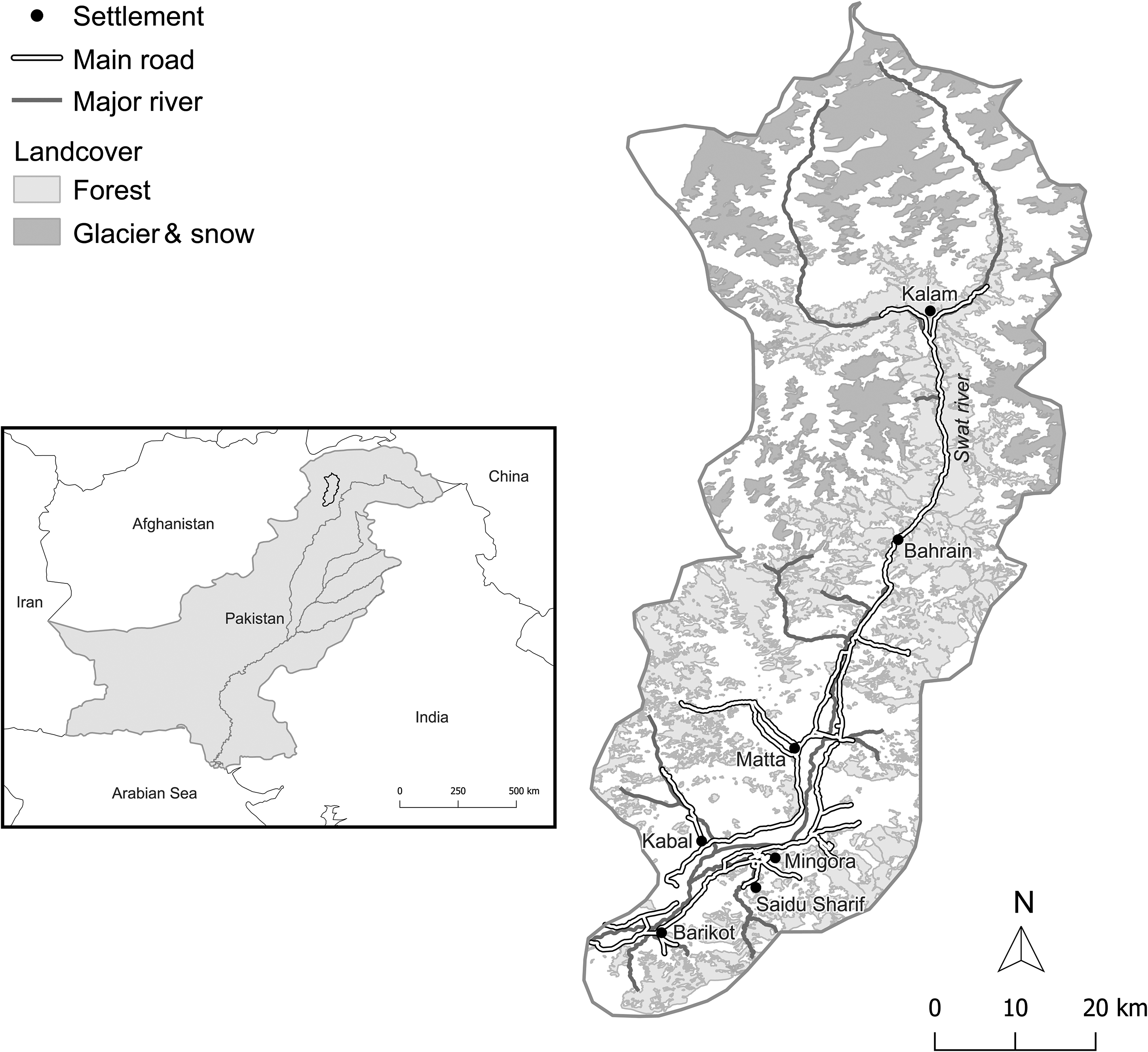
General map of Swat district/valley within Pakistan (cartography by Aiden Byrne).
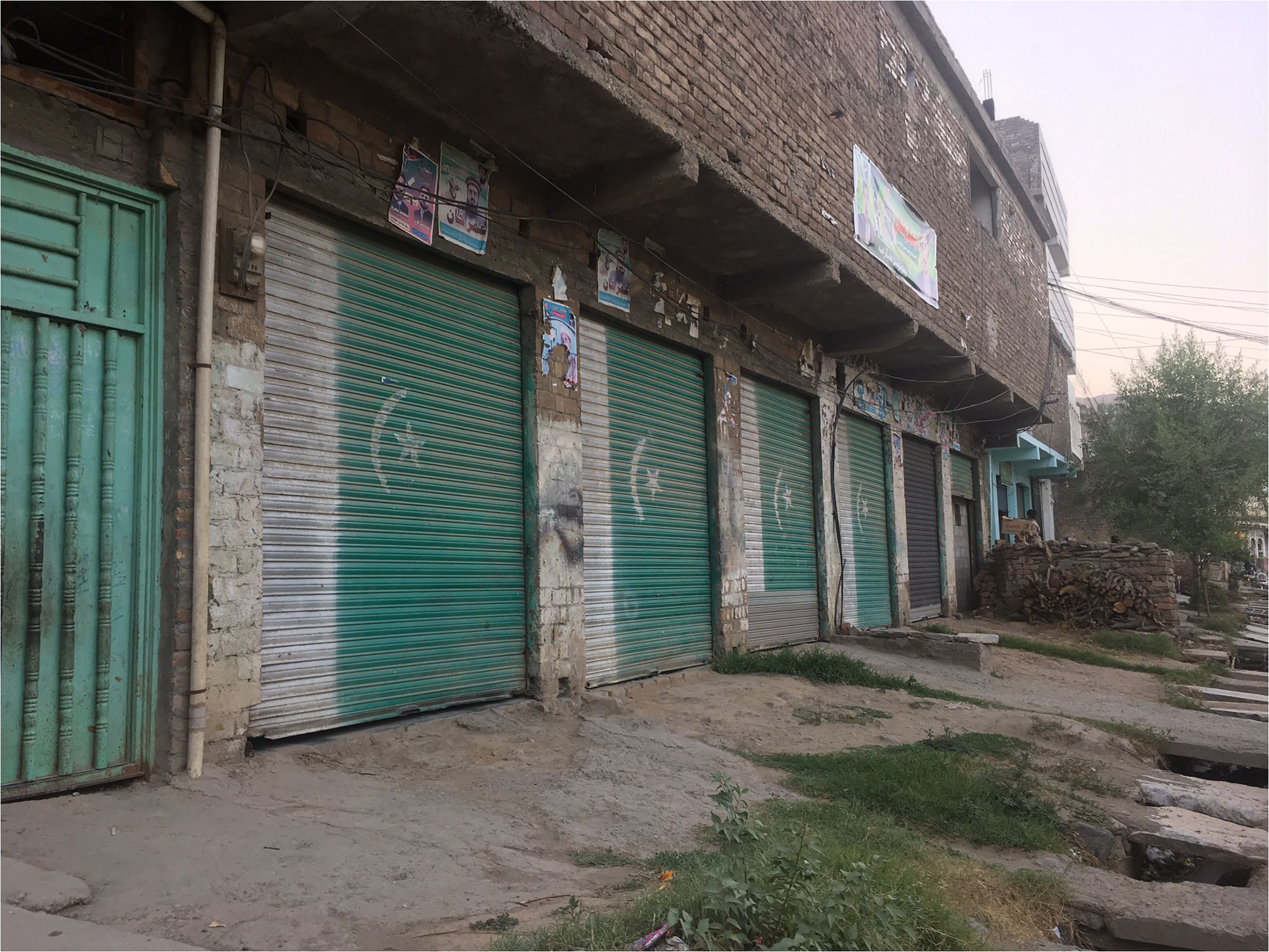
A series of shop shutters painted in the Pakistan flag in Kabal, Swat (photo courtesy: James Caron).
The ‘development’ part translated into building of roads, water supply schemes, schools, bus stops (with no government buses) and even a golf course. The golf course particularly became a source of resentment by the local population as it appropriated a considerable amount of arable land, in a mountainous environment where arable land is scarce. The golf course also has only six members from the entire region (The Golf Course Administrator, personal communication, 21/08/2021). The military led infrastructure-based development also converged with the greater rural to urban migration, especially in the aftermath of the war, and greater influx of remittances to the Swat valley, mostly from the Persian Gulf countries. The consequences of two have been peri-urbanization and population diversification of previously rural communities and greater inroads of high to medium end retail and recreational opportunities in the valley. The water supply schemes and peri-urbanization are the core concern for us, insofar as they have changed not only the geography of access to water but also the affective geographies around springs conceptualized as hydro-heritage.
Methodology
We empirically engage with the everyday experiences of men and women of Swat and their encounters with and around water. We map spatial, material, social and political reconfiguration of springs to understand their emotional and affective geography in Swat. We empirically explore this through analyzing 79 semi-structured interviews conducted with men (n = 45) and women (n = 34) of Swat, informal conversations and photographic evidence generated during our fieldwork. Swat valley has thousands of springs (locally called cheena) of various size and types; for this paper, we selected four sites: Nagoha Cheena, Saidu Baba Cheena, Gulligram and its surrounding springs and Shumbailay Cheena that represent geographic diversity, social complexity and material and spatial reconfiguration. It should be noted here that Swat is an ethnically mixed society with many caste and class-based cleavages, e.g. Swat is home to various Pashtun tribes like Yusufzai, Shinwari, Akhund Khel, and Tarkalani in addition to non-Pashtuns like Torwali, Gujjars, Kohistanis, and Mullahs. The ethnic, class and caste-based interactions are relevant to how gendered access and affective environment of the springs changed in the aftermath of the Swat conflict, as we shall discuss later. Springs have a distinct recent gendered history in the context of human and non-human affective encounters, which is unlike other gendered spaces in the Swat valley which focus primarily on inter-human encounters. Unlike archaeological sites that are predominantly men's spaces (Khan & De Nardi, 2022) and women's markets, that are expanding with increasing women's mobility (Khan, 2023), springs are evolving from culturally accepted space for women's activities to a restricted space with decreased women's mobility and decreased ties to the non-human environment as a result. We map the affective geography of water with a focus on springs within this historic, cultural, geographic and spatial context.
The field research informing this manuscript was conducted intermittently between October 2020 and March 2022, because of COVID-19-related lockdowns and restrictions. The bulk of the fieldwork was undertaken by post-graduate researchers (man and woman) based at the partner institution of the University of Malakand. They were native to the neighbouring districts of Swat and largely hailed from lower middle-class backgrounds. Three of the co-authors who participated in field interviews and focus groups are natives of Swat valley, while the another had worked as an archaeologist in Swat valley from 2010 to 2017. The other two co-authors, one of them a native of Pakistan, visited episodically but were mostly involved in data analysis, strategic direction and textual analysis. Field researchers were trained in social science field methods and were made aware of questions of differential power and positionality from the very outset to allow for ethical, free and open exchange of ideas. Throughout the conduct of the fieldwork, the researchers were debriefed and provided feedback on conducting ethical research as per the guidelines of the Research Ethics Office at King's College, London.
Intersubjective encounters and the affective relationality of springs were not incorporated in our interview guide at an early stage (Fox and Alldred, 2022). Affectivity of springs, embodied and gendered encounters of humans with them, and social experiences within which springs are embedded were thematically developed from the accounts of our interviewees. Initially, we were interested in springs as local heritage and their role in the post-conflict healing. However, a distinct (from other spaces) history of gendered spatial reconfiguration of springs, their affective, mythical, political and developmental imaginaries along with embodied experiential, practical and affective encounters at the quotidian level, forced us to think about the vital materiality of springs in the post-conflict Swat.
Springs as affective sites of enchantment
Cheenas (springs) were intimately tied with what Wescoat (2021) called the experience of water in Swat. The experience of water that he spoke of was in the spatial context of Nagaur Fort complex in Rajasthan, India, a sprawling example of what he calls India's Islamicate architectural and landscaping sensibilities. Mountain springs in Swat although deemed to be natural are however also deeply human-modified waterworks in far less monumental but no less aesthetically and functionally rich cultural contexts (Figure 3).
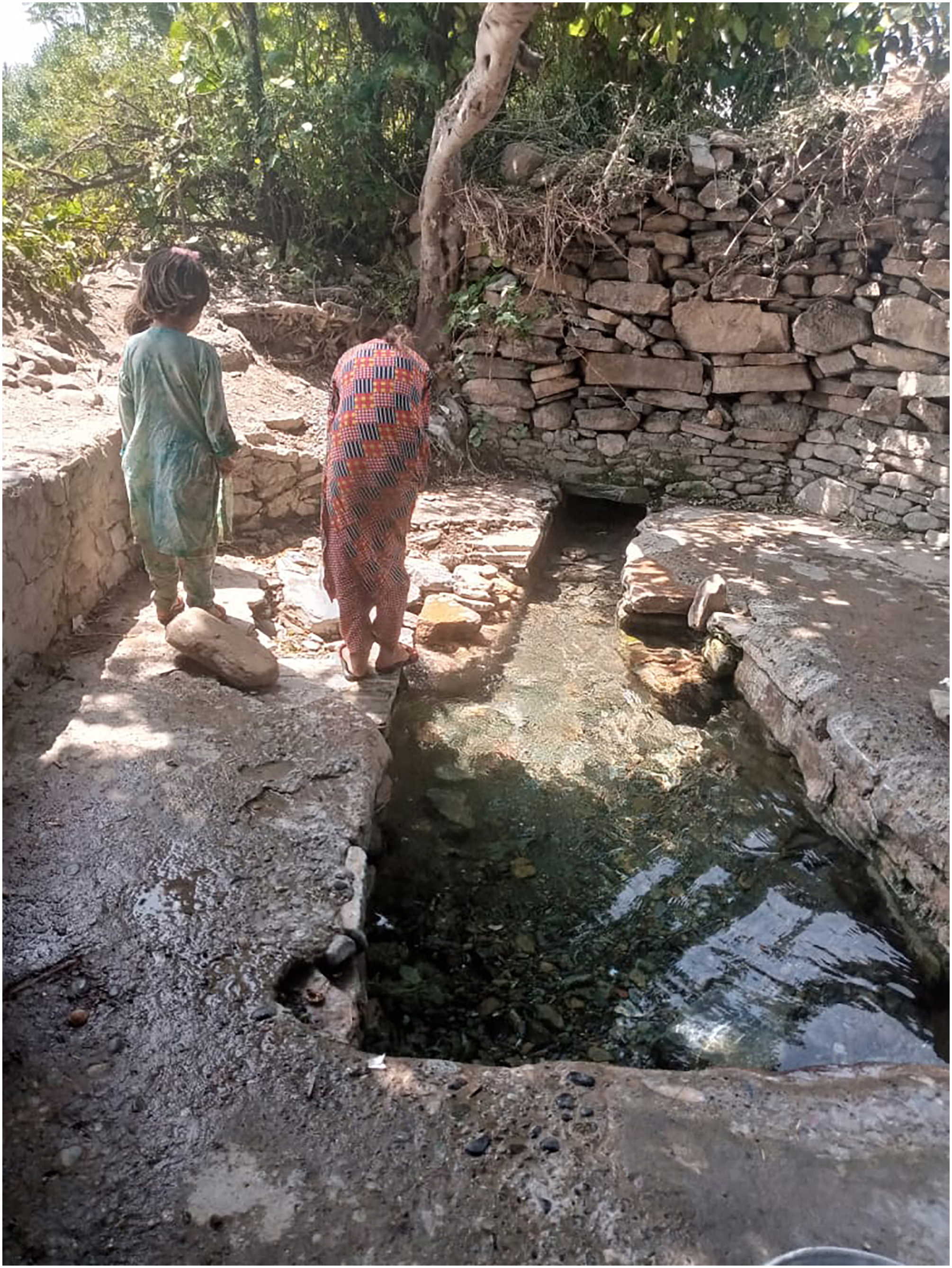
Randa Cheena, near Nagoha, Swat Valley, Pakistan, illustrating the engineering traditionally undertaken to improve springs (photo courtesy: Izhar Khan).
All cheenas in Swat, like most mountain springs, have deeply human and spiritual creation myths. Those myths almost invariably centred around a holy person or a patron saint of the local village hitting the ground with their walking sticks in times immemorial, leading to the water flowing from the ground to quench the thirst of spiritual votaries of those saints to whom most communities (certainly the ones claiming elite or indigenous status) trace their spiritual or ethnic genealogy, e.g. as a local man described the creation myth of Kokrai Cheena (spring): Peer Baba said, it's time for prayer. His companion responded, sir, there is no water. Mian Hassan Baba, hit the ground with his stick and water came out of the ground. So, they were awalya kiram [spiritual people], now people are sinners. Have you heard people often say, that I tried to dig a well but no water came out? It's all about faith and beliefs. (M9, 12/7/2021) Previously there were no wells and tap water; everyone was taking water from the spring, so people were healthy. Now it's wells and tap water, and everyone is sick. (W18, 13/8, 2021) This [spring] is a sacred place and the water is sacred. Once a person from Mingora [Swat valley's main city] who had acute skin problems came wearing just a lungi [Punjabi loin cloth that people of this area never wear]. Because of his acute skin disease he couldn’t wear proper clothes. But he visited the cheena three times and he was healed. His illness was completely cured by Allah through this water. (M7, 12/7/2021) In the old days in my childhood women were washing clothes in the spring, they were bringing cans and lit fires to warm the water for washing clothes. We played in the streams. Some women washed utensils, while others were fetching water. There was a ‘Taal’ [swing] in an old tree which we played on [for hours]. Mother would send for us to come home, but we would not. My mother used to say taso da qayamat pori na loyeagai [you are not growing up even by the end of the world]. (W17, 11/8/2021) NO! [I don’t go to the spring anymore.] When I go there, I regret the loss of the past. I say, (alas!) afsos da dey, if it was the past, you [young men] would not have played tambals here [in the surrounding of spring]. (M36, 26/7/2021)
If love and romance has the potential to deterritorialize a subject such that in an amorous, joyful state it can transform and connect to other humans and non-humans, then romance has to be the most enchanting of affects (Pyyry & Aiava, 2020). Cheena then has been a site where solidarity and attachment to the human and the non-human usher in new possibilities and connection. Afterall, within human geography ‘enchantment has been most obviously accentuated by the bringing together of materiality and affect’ (Woodyer & Geoghegan, 2012, p. 203). The materiality of the cheena with its water and stones becomes interwoven with romance, including the idea of female exuberance, in the local musical genre of tappa (poem), e.g. as per the tappas narrated by a local person:
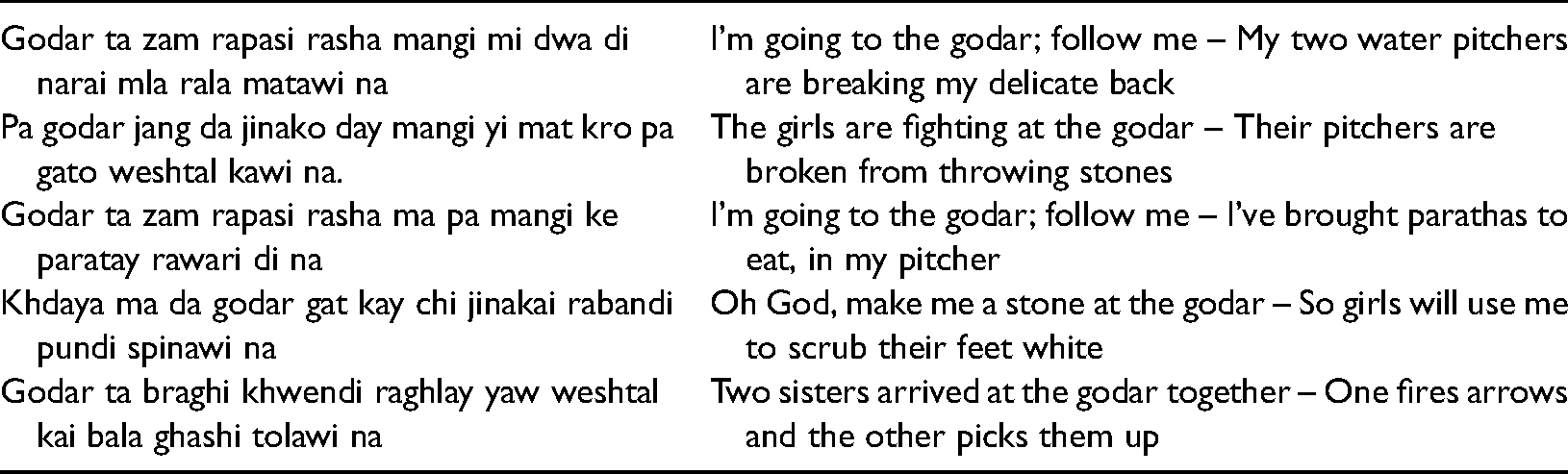
A tappa is a composition of two verses with unequal metres. It lives primarily in the oral tradition and is often improvizational, although many individual tappas have gained widespread circulation if they speak to wide enough sensibilities. Among these sensibilities, the tappa has emerged as a genre specifically known for what some describe as social subversion, critique or resistance (Imran et al. 2020; Griswold 2014), stereotypically among women. However, it would be more precise to say that it expresses counter-normative affects of anti-structural desires, as numerous scholars have noted (Layiq, 1984; Majrouh, 2003; Nichols, 2000), and tappas are created and circulated by men as well. In effect, both tappas and springs are places where virtues counter to normative patriarchal regulation can have a home, for women and men alike; the affective significance of springs and tappas have reinforced each other in their deterritorial possibilities and their openness to multivariate modes of connection. The above series of tappas about the godar, which is essentially a place for gathering drinking-water, are both from a woman and man's perspective. The first one links sensual physicality and the godar, while the second and third ones speak of a playful fight between girls and their invitation to their presumed amors to share paratha (buttered bread), thereby pointing to godar as a site both of women's sociability and of romantic trysts. The fourth and fifth tappas speak from a man's perspective, with the former desiring physical communion with the women as a stone in the godar and the second one evoking cupid's arrows.
The overall poetic mood of spring tappas is obviously of a sensual sociability, where the non-human godar and its stones become allegorically the mediums through which desires are both explored and consummated. In fact, the themes of the tappas were repeated as truth by many of the local women and men, for example: Yes, girls [coming to the spring] were involved with boys, but they were keeping the affairs secret and not telling anyone. (W18, 11/8/2021) This [Sairai cheena] was a very scary place. There were trees and people were fearful of it. We’ve seen many people collapsing from fear. Aksar ba pe ghuta rala, ao chaghy ba westy [people were going into trances, and crying out]. De peryanu asarat ham wu kana [That was the effect of djinns, you see]…a djinn possessed anyone who visited the spring. And then a local mullah had to do a dum [exorcism] on them. Now the population has increased, trees have been cut (there are no maple or olive trees anymore), and the djinns are gone too. (M23, 13/8/2021)
Modern water in post-conflict reconstruction
The causes for the Taliban insurgency have been attributed to many factors by scholars, chief amongst them being failures of governance, especially in delivery of justice, and less so to any developmental lags or poverty relative to the rest of Pakistan (Rabia, 2011; Khan et al., 2020). The Pakistani state, while recognizing the governance failure as a cause of the conflict, laid out a three-pronged strategy of dialogue, development and deterrence for post-conflict stabilization of Swat (Avis, 2016). Of the three pillars, the dialogue part has manifested itself primarily in dialogue with the Taliban and the religious right and not the ordinary people or their elected representatives. The deterrence part, in addition to the military-run de-radicalization programmes (Azam & Fatima, 2017), has manifested itself in military presence, security checkposts, patrolling, occupation of public and private buildings, the building of a cantonment, and – quite painfully for the people – the cutting of roadside trees and orchards and limits to the growing of maize, for example, which may provide hiding places for militants (Rome, 2011). Development manifested itself in reconstruction of destroyed infrastructure but greatly expanded upon it with wider roads, bypasses to major urban areas, and water supply schemes. Our interviews show that the destruction and degradation of a familiar landscape permeated with living non-human heritage, especially hydro-heritage, have been a major source of unexamined trauma and a barrier to healing in post-conflict Swat.
The large-scale displacement of people during the Swat conflict meant that many ended up settling where they had been displaced because their homes and communities had been destroyed by the war from 2007 to 2009. The mixing of people from different ethnicities, classes and caste affiliations changed the level of trust and camaraderie within communities to the detriment of women's mobility, especially to springs and water bodies: They [women] used to go [to the springs] for socialising. My daughters also used to go with friends. But now the environment has changed. There are some people who associate girls [visiting springs] with a bad reputation. I don’t want anyone to discuss my daughters in bad language. (W16, 2/7/2021) We used to go to the spring even five or six years back but since the crisis, when people of Upper Swat migrated to our village and settled here, we stopped going there because now different people of different background are living here. (W5, 15/6/2021) I felt as if my heart had opened when I would see my friends there [at the spring]. It made me happy…I really wish I could go now but my husband says ‘You will not go to the spring’. (W6, 2/7/2021)
As mentioned above, springs for women were not just a place to draw water but also a space of leisure and sociability. For women, building mosques and madrassas on top of springs is particularly rankling: Before the construction of this madrassa, women use to go there for enjoyment. In summer you know we have load shedding and the power supply remain suspended for hours. So, women and children would go to this spring for bathing. But now you see there is a mosque and a house constructed for the mualim (religious teacher) so we don’t have space to sit there…It is good they have constructed a madrassa, so people can gain religious knowledge. However, they should have been constructed it at some other place than the spring. That spring was a picnic spot for people. (W4, 15 June 2021) A mosque built right next to Sairai cheena (photo courtesy: Izhar Khan). After the Swat halaat [a local word to refer to the Taliban-military conflict] men's numbers have increased, but the women's numbers have decreased. Women rarely go to the spring unless they have some skin related problem [the local cheena being known for its therapeutic water]…Now everyone has their own water pump. Look how many pipes you can see. After the water motors the godar concept changed. (M7, 12 July 2021) In this area you could find springs and streams everywhere. But now the streams are polluted, there is sewerage contamination and people throw garbage in them. In the past it was very clean. We cleaned our houses and threw garbage at designated place – deran…Nowadays even at my age [82 years] as a woman I can’t go out to the deran. The society has changed, and people don’t respect each other. (W15, 7 August 2021)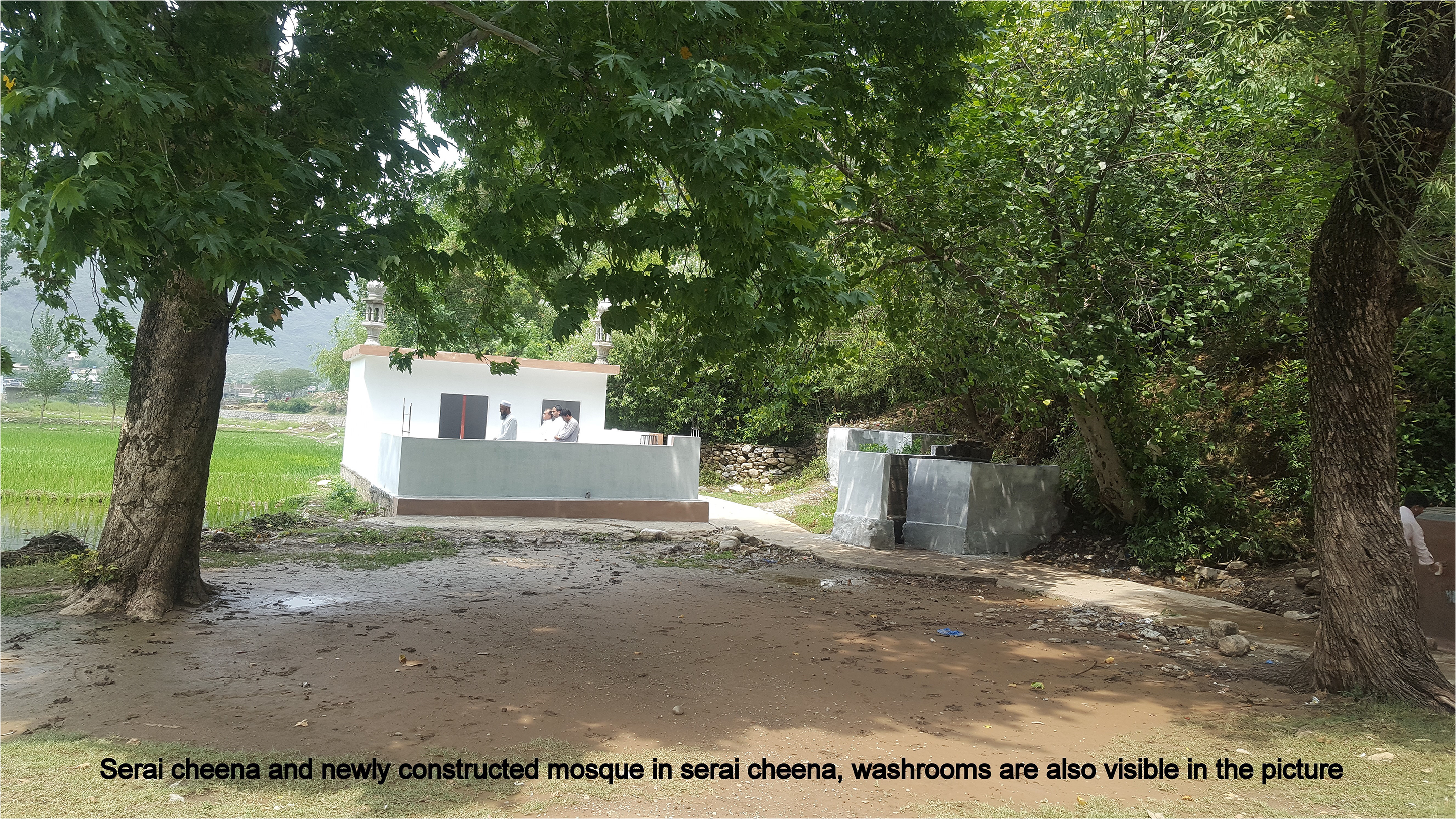
Conclusion
The global water justice movement declares water to be the common heritage of humans and other species. It calls for water to be treated as a public trust, not appropriated for personal profit or denied to anyone for inability to pay (Sultana & Loftus, 2012). To the above, we will add that water as public trust may not be appropriated for profit, monetary or spiritual, or denied to anyone based upon class and/or gender. Extant debates on water around concepts of a ‘right to water’ may be steeped in conservative economic and political individualism (Bakker, 2012). Other tropes such as waterscapes or hydro-social cycles may very rightly call for a politicized view of water where intra-human and inter-species justice and power relations take centre stage (Linton, 2012; Linton & Jessica, 2014). Our hydro-heritage lens, consistent with Walsh's (2018) plea in the context of bath houses and mineral springs in Mexico, however, explicitly distances water from any liberal individualism or modern extractivism, while expanding and deepening the meaning of water in a politicized sense, towards intersectional diversity of experience, affect, culture, memory and human–non-human solidarity.
The springs of Swat, as we have shown, were a site for human and non-human encounters, sociability, and affect, all producing gender processes very different from those prescribed by either the military-developmental state or right-wing petite bourgeoisie. Their continuity as hydro-heritage could have been a conduit for healing in a traumatized society. Their alienation and degradation have had the opposite effect of accentuating social fragmentation, resentment and the festering of trauma from conflict. The cheena/godar of Swat has become a locus of affective politics around replacement of local-scale, place-based cosmologies and experiences by national-scale developmental technologies, imaginaries and practices, as well as transnational-scale politics of piety, all of them with deleterious consequences for women's mobility and wellbeing. Healing, it appears, will have to await another time and a different, yet familiar, zeitgeist.
In conclusion, we are reminded of a passage from Rajmohan Gandhi's (1999) passage as cited by Wescoat (2007: 53): Delhi's djinns, its great load of unrepented cruelty and unshared sorrow…Can Delhi's accumulated offences be washed away? Can some atonement or penance – or some God-sent blessing or grace – expiate the guilt of centuries, and generate a breeze of forgiveness that blows away the smells of torture and revenge? Every tree planted, or cubic foot of water conserved is a celebration of life, a proclamation of the worth of the future, and a garden or a river may calm sad or angry hearts. Every caring act of fellowship, considerateness, nursing, apology, forgiveness, greening, or flowering – perhaps heals something of Delhi's torment, maybe calms one of its djinns, and a healing process in Delhi might speak to all of South Asia (410).
Highlights
Viewing water through a hydro-heritage lens opens up analytical possibilities for examining the multiple ontologies associated with it.
Heritage, especially hydro-heritage, can be a conduit for healing in post-conflict situations.
In the context of mountain springs, Pakistani state's developmental imaginaries have replaced the enchanted experience of water with modern water.
Hydro-heritage as a lived heritage has important gendered dimensions which are subverted by modern water.
Women's limited access to springs has limited their opportunities for sociability, romance and leisure around them.
Footnotes
Acknowledgements
We gratefully acknowledge the help and assistance provided by Ms Farzana, Mr Izhar Khan and Mr Fazl-e-Rabi Rahi, in the conduct of the research and data analysis. The authors take full responsibility for any inadvertent omissions or shortcomings of this manuscript.
Declaration of conflicting interests
The authors declared no potential conflicts of interest with respect to the research, authorship and/or publication of this article.
Funding
The authors disclosed receipt of the following financial support for the research, authorship, and/or publication of this article: This work was supported by the British Academy (grant number HDV190288).