




Abstract
The blue economy represents a new development paradigm, being promoted through multilateral institutions. I examine its emerging nature in the context of the Western Indian Ocean region of Africa. I situate the blue economy within the global sustainable development discourse and argue that it represents a form of global governmentality. I note its utopian nature and argue that discourses of utopian thought and risk act to ‘responsibilise’ States to collaborate in regional sea management in pursuit of human and environmental security goals – which I call a ‘collaborative blue economy governmentality’. I draw attention to multiple sites of resistance (‘counter conducts’) to this governmentality. These counter conducts are diverse, encompassing community resistance to development priorities, insufficient technical capacities and resources, and the material character of ocean and coastal ecosystems. I therefore characterise the blue economy as an immature governmentality, necessitating State and multilateral intervention to put in place or strengthen the governmental capacities needed to enact it. I conclude that the BE governmentality is largely of a neoliberal character, but with hints of an emergent post-neoliberal regime.
Introduction
‘What is the Blue Economy?’ is a question that even now fails to elicit a single answer. Multiple interpretations, ease of co-option, and the evolution of new approaches to implementation in vastly different socio-economic and institutional contexts are just some of the challenges to pinning the blue economy (hereafter, BE) down to a clear definition. In this paper, I examine the evolution of the BE concept in Africa and how it is being enacted in the Western Indian Ocean (WIO) region. I start with a review of the origins of the BE in a wider sustainable development discourse, before focusing in on the WIO region. Taking a spatialised governmentality perspective, I argue that a form of global governmentality is evident. I construct my argument in three steps. First, that the BE represents a new development pathway for Africa in which utopian thought is deployed to enrol states in a global rationality for sustainable ocean development – a form of global governmentality. Two, that this governmental rationality is deployed to encourage states to work together to manage the WIO as a shared resource, which I call a ‘collaborative BE governmentality’. Three, that it is an immature governmentality – insufficient capacities, and spatio-material barriers representing ‘counter-conducts’ – necessitating adaptation and governmental and multilateral intervention. I evidence this argument through a discourse analysis of regional policy documents and interview texts. The paper is structured as follows: I first introduce the WIO region and the origins of the BE as a development paradigm. I next introduce the conceptual perspectives which I draw upon and my analytical approach. In the discussion section, I describe the discourse and present my analysis, followed by concluding statements.
Western Indian Ocean region
The WIO is a regional sea off the east coast of Africa. It encompasses 10 states in total: on the African mainland from Somalia to South Africa via Kenya, Tanzania and Mozambique, and the island states of Commoros, Madagascar, Mauritius, Seychelles, and Reunion and Mayotte as overseas territories of France. The WIO contains important habitats (coral reefs, mangrove forest, seagrass beds) and commercial fisheries of global importance, especially various tuna species. Ocean currents and upwellings support this biota. Some countries have created large marine protected areas (MPAs) in their exclusive economic zones (EEZs), and cross-border management initiatives are emerging. The region is closely connected with the ‘birth’ of the BE as a concept, comprising a number of the small island states and least developed coastal countries that championed its development. The WIO region has longstanding partnerships, for example in the Nairobi Convention (one of a number of UN regional sea Conventions), the Indian Ocean Commission and the Indian Ocean Tuna Commission amongst others. Recent strengthening of Regional Economic Commissions (RECs) in Africa bring a new dimension. Central to some economies (e.g. Seychelles and Mauritius) but overlooked in the past by others (e.g. Kenya), the oceans have become an object of countries growth aspirations as land-based pressures of population growth and urbanisation drive environmental degradation and threaten livelihood and food security.
Origins
The BE represents an evolution of the global sustainable development discourse, which has its roots in the publication in 1972 of the report ‘Limits to Growth’ by the Club of Rome (Meadows et al., 1972). In the following paragraphs, I briefly summarise BE origins and relevant critiques, as it is pertinent to my later arguments. Limits to Growth identified a goal for humanity of establishing ‘a condition of ecological and economic stability that is sustainable far into the future’. In 1983, the UN General Assembly established an independent commission, the World Commission on Environment and Development, to formulate a ‘global agenda for change’ in response to threats to humanity from a degrading global environment, resulting in the publication of ‘Our Common Future’, widely known as the Bruntland Report. In setting out an agenda for sustainable development, the Commission drew on two key concepts, that of human development needs (drawing on the 1972 Stockholm Declaration 1 ) and the limitations imposed on the environment to meet those needs in the future due to the state of technology and social organisation at the time. This report set in train a series of UN Conferences on Environment and Development through which global approaches to sustainable development are negotiated.
Green economy and blue economy
By the mid-2000's, the term sustainable development was losing traction as a policy tool, especially at a political level (Jacobs, 2012). The ‘Green Economy’ was presented as a new approach to sustainable development (Rio+20 conference, 2012), recognising the importance of ‘getting the economy right’ and overturning the structural factors that favour the ‘brown [fossil fuel] economy’. A transition to a green economy was invoked to improve social equity and reduce economic risks, requiring specific enabling conditions of national regulations, policies, subsidies and incentives, and international market and legal infrastructure and trade and aid protocols (UNEP, 2017). In short, a new development paradigm. At the same time, unhappy with the potential implications of a green economy focus, Island states with small ‘green’ and large ‘blue’ territories called for a parallel focus on ‘blue’ economies. ‘Green Economy in a Blue World’ (UNEP et al., 2012) made the case that the oceans needed to be included in the remit of the green economy. This discourse of ocean development followed through into the UN sustainable development goals (SDGs), agreed in 2015. Goal 14 of the SDGs, ‘life below water’ has a target on economy 2 , which highlights the needs of small island developing states (SIDS) and least developed countries, many of which lie in the WIO. The World Bank clearly sees the BE development paradigm as a, perhaps the, approach to meet Goal 14: ‘In addition to target 14.7, the activities undertaken as part of the various sectors of the BE are linked to the achievement of other SDG14 targets’ (World Bank, 2017: 28).
Given the related origins of the green and BE concepts, it is instructive to understand critiques of the green economy discourse, to help to arrive at an informed analysis of that relating to the BE. The term ‘green economy’ has been around for some time (e.g. Pearce et al., 1989. Jacobs, 1991), but it is only more recently that it has entered the global political discourse, most significantly (in the years prior to the UN Conference on Sustainable Development, 2012) in ‘Towards a Green Economy’ (UNEP, 2017). The term BE also arose at that time, in a related move (e.g. Silver et al., 2015). The rise to prominence of ‘green economy’ after the 2008 financial crisis is ascribed to the need for a more salient political discourse to advance sustainable development, which was losing momentum as a concept in part because of its imprecise definition and the ‘incapacity of sustainable development to reconcile conflicting global economic, development, and ecological imperatives’ (Ferguson, 2015: 17). The terms ‘Green Economy’ and ‘Green Growth’ have the advantage of confronting the issues of environment and economic development head on (Jacobs, 2012), aiding clarity. Further, the green economy discourse avoids an explicit anti-growth’ or ‘limits to growth’ position and hence has greater transformative potential (Ferguson, 2015) than green growth. Weak and strong sustainability discourses 3 (e.g. Jacobs, 2012, in relation to green growth; Pelenc et al., 2015), respectively, emphasise efficient use of resources and consideration of environmental risks such as pollution and natural disasters, or additionally stress the sustainability of the natural resource base for human well-being. Jacobs nevertheless points out that there is common ground between them, namely ‘a level of environmental protection which is not being met by current or “business as usual” patterns of growth’ (Jacobs, 2012: 5) and contends that it is this characteristic which gives the concept its political traction. Ferguson (2015), taking an ecological modernisation perspective, recognises a third, intermediate stage, transformational green economy. The green economy's transformative potential stems from its ‘reflexivity’ – an ability of the modernisation process to transform not only itself but also the underlying norms of industrial society (Paterson et al., 2006). It is this process by which modern societies radically renegotiate their relationship with nature, one consequence of which is an emphasis on distribution of risk and a shift in the focus of security from State to people, communities and ecosystems (Ferguson, 2015).
As well as harbouring multiple interpretations, the green economy discourse masks some inherent conflicts and contradictions. Drawing on Polanyi and Gramsci, Wanner (2015: 23) interpreted the green economy as ‘a strategy of “passive revolution” based on obfuscating contradictions between economic and ecological sustainability’. His argument is that the green economy and green growth, rather than providing a path to social and international justice, is deeply embedded in neoliberal capitalism and is simply an extension of the hegemonic sustainable development discourse which is itself ‘ultimately about the sustainability (or “sustainable development”) of neoliberal capitalism’ (Wanner, 2015: 24). The discourse is legitimated by the conceptual device of absolute decoupling of economic growth from natural resource use and environmental deterioration (see UNEP, 2017: xi), thereby protecting neoliberal free market economies by denying the existence of trade-offs between environment and economic growth and ‘diverting the counter-hegemonic challenge of environmentalism’ (Wanner, 2015: 27). Notwithstanding such moves, existing capitalist structures are adept at co-opting discourses to their own ends. Buseth (2017) for example, describes an agricultural investment initiative in Tanzania embracing the green economy discourse but with little observed change in practice. Midlen (2021), reviewing published analyses of BE cases, reveals the BE in practice as a ‘complex spatialised governmentality’, frequently privileging economic growth before environmental protection. Other authors have identified competing BE discourses (Silver et al. 2015; Voyer et al., 2018), raising questions as to what should be ‘in’ or ‘out’ of the BE (Voyer & van Leeuwen, 2019), and calls continue for a more environmentally sustainable and socially equitable BE (e.g. Golden et al., 2017; Bennet et al., 2019; Midlen, 2021). Responding to differing interpretations of the BE, WWF (an environmental INGO) proposed a definition for a ‘sustainable blue economy’ and a set of guiding principles (WWF, 2016) reflecting the social and environmental priorities of the SDGs. These were followed in 2018 by Sustainable Blue Economy Finance Principles (European Commission, 2018), defining a sustainable BE as one that ‘provides social and economic benefits for current and future generations; restores, protects and maintains diverse, productive and resilient ecosystems; and is based on clean technologies, renewable energy and circular material flows’ (UNEPFI, 2022) 4 . Ertor and Hadjimichael (2020), introducing a special Journal issue on BE and degrowth 5 , draw attention to emerging critiques of the BE which call into question the fundamental thesis upon which the BE rests – ‘sustainable growth’. This significant body of scholarship highlights numerous cases of social injustices attributable to BE policy. Bennet et al. (2021) identify 10 risks for social justice in relation to blue growth policies, and Germond-Duret et al. (2022) call for a greater emphasis on the place of environmental protection and people within BE analyses. Schreiber et al. (2022) discuss the concept of blue justice in relation to BE and small-scale fisheries.
Conceptual perspectives
The BE, then, represents a particular rationality of government – a sustainable future is to be attained by following a growth-based development paradigm incorporating practices in which environmental degradation is positioned as a source of economic and social risk. To analyse the nature of the BE in the WIO region I draw on the work of Foucault, in particular his analysis of governmental rationalities (‘governmentalities’), of neoliberalism and risk, and related work regarding utopian thought. I outline these conceptual perspectives in the following sections.
Spatialised governmentality
As an analytic lens, I take a ‘governmentalities’ approach, following the work of French historian and philosopher Michel Foucault. Foucault showed in his genealogy of government (Foucault, 2007, 2008), how states in Europe developed technologies that allowed them to govern at a distance, rather than exerting direct power through the rule of law, which became an inefficient form of government as populations increased and states began to govern to manage their well-being rather than by maintaining order alone. This change to a pastoral form of government required new technologies which enabled the state to exert power through the ‘conduct of conduct’ – that is, to indirectly control how people and institutions conduct themselves. Foucault recognised such shifts in the ‘governmentalisation of states’ as ‘biopolitics’ or ‘biopower’ – a shift from sovereign, juridical forms of power (law, legislation and violence) to power enacted through concern with the security and welfare of populations. Foucault refers to this ‘conduct of conduct’ as ‘governmentality’, which embodies the ‘“the ensemble” of institutions, procedures, analyses and reflections, calculations, and tactics that allow the exercise of this … power that has the population as its target, political economy as its major form of knowledge, and apparatuses of security [especially statistics] as its essential technical instrument’ (Foucault, 2007: 108). In this way, the state is displaced as the centre of power in favour of multiple technologies of power operating within an economy of power that is constituted by the ‘interplay of freedom and security’ (Foucault, 2008: 65; see also 63, 64, 66, 67; 2007: 44–48, 353, 354), security being the ‘cost’ in this economy of ‘manufacturing’ freedom. Foucault identifies multiple governmentalities: initially sovereign, discipline, and advanced liberal government, the latter evolving a ‘neoliberal’ governmentality which deploys a variety of devices, for example technologies of risk, agency (e.g. contracts), performance (e.g. benchmarks) and visibility (e.g. graphs – see Rose, 1996; Dean, 2010: Ch 8 and 9) to promote freedom (as exercise of choice) in return for competitive and responsible conduct. It associates risk with individual responsibility (see Defert, 1991; Ewald, 1991; O'Malley, 1996). Scholars have since used the concept of governmentalities to both analyse and explain governmental practices in many fields, including environment: for example, environmentalities (Agrawal, 2005; Fletcher and Cortes-Vazquez, 2020); green governmentalities (Luke, 1999; Rutherford, 2007); multiple environmental governmentalities (Fletcher, 2010, 2017). That governmentalities have spatial dimensions is a recognised (see Crampton and Elden, 2007) but relatively under-developed aspect of governmentality studies. Midlen (2021) introduces a place-space-times framework alongside Dean's (1999) governmentality analytic framework to better understand the spatialities of governmentalities in the oceans.
Risk and responsibilisation
Foucault regards risk as a core rationality of neoliberal government, one that enables government despite the uncertainties of the future. According to Foucault, neoliberalism locates responsibility for managing risk in subjects rather than in government, the governmental role being to make a range of calculative methodologies available for risk management (see O’Malley 2004; Baerg, 2014). Today, society is asked to respond to risks from climate change, risks from biodiversity loss and environmental degradation, and risks from demographic spatial (e.g. migration) and temporal (e.g. population growth) change. These risks give rise to a variety of concerns which threaten human security – traditional security concerns such as crime, terrorism and war, and more recently recognised (‘non-traditional’) concerns for human security such as public health, availability of food, etc. (Caballero-Anthony, 2016). A risk-based global governmentality has developed in response. Through international institutions the nature of threats are institutionalised, their magnitude calculated, and measures designed to mitigate them. Hardy and Maguire (2016) describe a dominant discourse of risk – that is, one in which texts and practices draw on one another in well-established ways to construct convergent and widely used descriptions and explanations of phenomena (Phillips et al., 2004) bringing ‘risk’ as an object of knowledge into existence in a particular form(s). This in turn rules in certain ways of talking and acting in relation to a topic and rules out others (Phillips et al., 2004) ‘thereby institutionalising practices and reproducing behaviour’ (Hardy and Maguire, 2010: 1367) such that a particular view of ‘reality’ becomes reified and taken-for-granted (Maguire and Hardy, 2009). Dean (1998), comparing Beck's (1992) ‘risk society’ with a Foucaultian understanding of risk, understands Beck's framing as part of a narrative of phases of modernity (i.e. that society has entered into a risk phase) and points out that as such it does not shed much light on the act of governing itself. Rather, Dean (1998: 25) sees risk as ‘a set of different ways of ordering reality, of rendering it into a calculable form’. This in turn renders events ‘governable in particular ways, with particular techniques, and for particular goals’. As such it represents a form of calculative rationality for governing the conduct of individuals, collectivities and populations. The dominant discourse establishes power relations which enables certain actors to construct what constitutes a risk, and to decide how to avoid or manage it by calculating the nature, extent and likelihood of possible hazards under different scenarios (Dean, 1998; Lupton, 2013). By ‘determining the “real” probability of an adverse event multiplied by the true magnitude and severity of consequences’, risk becomes ‘identifiable through scientific measurement and calculation, and [can] be controlled using such knowledge’ (Gephart et al., 2009: 143). The dominant discourse of risk is both an instrument and effect of power, one which thus revolves around normalising risk – rendering unpredictable and uncontrollable hazards into knowable and manageable risks through a web of power relations that enables and constrains all actors, albeit unequally and in different ways (Hardy and Maguire, 2016).
This risk discourse is evident in global policy, with principles of human security and collective security being enshrined within the institutions of the United Nations. This perspective on risk transcends traditional security concerns (inter- or intra-state violence, terrorism, and transnational crime etc.) to include threats from infectious diseases, poverty and environmental degradation. Thus ‘Any event or process that leads to large-scale death or lessening of life chances and undermines States as the basic unit of the international system is a threat to international security’ (United Nations, 2004: 23). By this rationality, the UN seeks to provide security for the world as a population (rather than a world of states). It enacts this concern through the concepts of human security and collective security (and accompanying risks), enacted through technologies of agency (contractualism), performance (benchmarking) and networks (Jaeger, 2010). Thus, the UN is ‘a project of managing and regulating the global population through a variety of governmental rationalities and techniques’, and represents a ‘biopolitical “reprogramming” of sovereignty and global governance whose political finality is the vitality, security, and productivity of the global population’ (Jaeger, 2010: 53). Here, a positive facet of the risk discourse is revealed – the benefit of avoiding or mitigating risks. In this sense it is utopian.
Utopian thought
The global sustainable development discourse, mediated through the institutions of the United Nations, is infused with utopian thought (Hedrén and Linnér, 2009). The SDGs, for example, are presented as ‘a shared blueprint for peace and prosperity for people and the planet, now and into the future’ 6 . Whilst Foucault engages very little with the idea of utopias directly (except in connection with heterotopias. Foucault (1984)), the concept of a goal or objective is central to any governmentality (Dean, 2010). ‘Utopia’ is derived from the Greek outopia and eutopia, it being simultaneously ‘other place’ and ‘no place’, respectively (Hedrén 2009). Hedrén and Linnér (2009) remind us, therefore, that ‘utopias should never be regarded as blueprints for general transformation, but rather as sources of inspiration and driving forces for reflections on how to design politics for a better future society’. A utopia is a narrative representing what is considered to be a best society (Kumar, 1999). Utopian places described are ‘harmonious and fair’ and demonstrate how contemporary conflicts and contradictions can be overcome (Hedrén and Linnér, 2009). Utopian narratives embody a specific morality and values, having a clear sense of what is right or wrong for society. Utopian thought, in contrast, encompasses a wide range of visionary expressions (including the dystopian) normally using contemporary social conditions as their initial frame of reference and inspired by their conflicts and contradictions (Hedrén and Linnér, 2009). The dystopian elements of such discourses, such as risk and insecurity, function mainly as rhetoric to ‘spur action or inaction, to avoid either economic catastrophe by acting too fast or ecological catastrophe by not acting fast enough.’ (Hedrén and Linnér, 2009: 200). In Utopian thinking, when society is in a perceived state of decline, a future utopia can only be envisaged through radical break with the present (Levitas, 1982). A transition to a BE for example, in which environmental degradation is reversed and human needs met, necessitates such a radical break. Utopian discourse can effect this change by elaborating the opportunities presented and risks avoided by pursuing it.
I have now set the scene for my analysis, situating the BE within the global sustainable development discourse. I have shown how this has evolved into green and BE discourses, through the UN conferences on sustainable development. I have noted its utopian nature and explored risk as a dystopian device. I have linked this to concern in the UN with human security and the responsibility of states to mitigate insecurities in order to secure the well-being of their populations. In the next section, I introduce my analytical approach and describe the methodology applied to this study.
Methods
This paper is based on a discourse analysis of texts (policy reports and statements, interview transcriptions and notes, field observation notes) relating to the BE in the WIO region. Interviews were conducted online and, in Kenya and Seychelles, in person.
Discourse analysis
Foucault recognised the importance of discourse as a technology of power and knowledge in the governance of populations (Foucault, 1998. See also Feindt and Oels, 2005; Springer, 2012). For Foucault, a discourse is constitutive of ‘reality’ in that it physically shapes or produces it. Feindt and Oels (2005) identify a number of strengths regarding the use of discourse analysis in environmental policy analysis, including an awareness of the role of language and knowledge in constituting policies, polities and politics and as exerting power effects, and how practices of government are constitutive of power relations and knowledge systems. Put simply, discourse analysis acknowledges that language and knowledge frame problems of government and in doing so privilege certain solutions over others, and those solutions give rise to practices and knowledges that themselves exert power over subjects. Further, Foucault recognised power as distributed, located in a multiplicity of nodes (e.g. institutions) or locales. As such, State power can be resisted, through ‘counter conducts’, establishing a dialectic between government and its subjects (e.g. Death, 2010).
Data sources and analysis
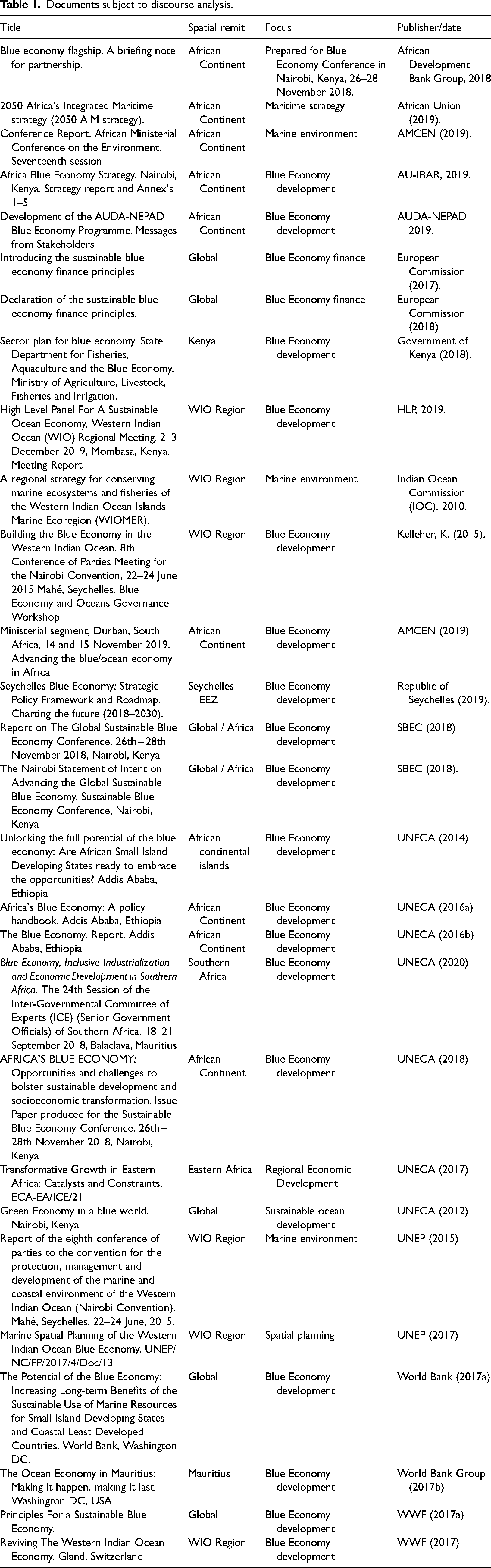
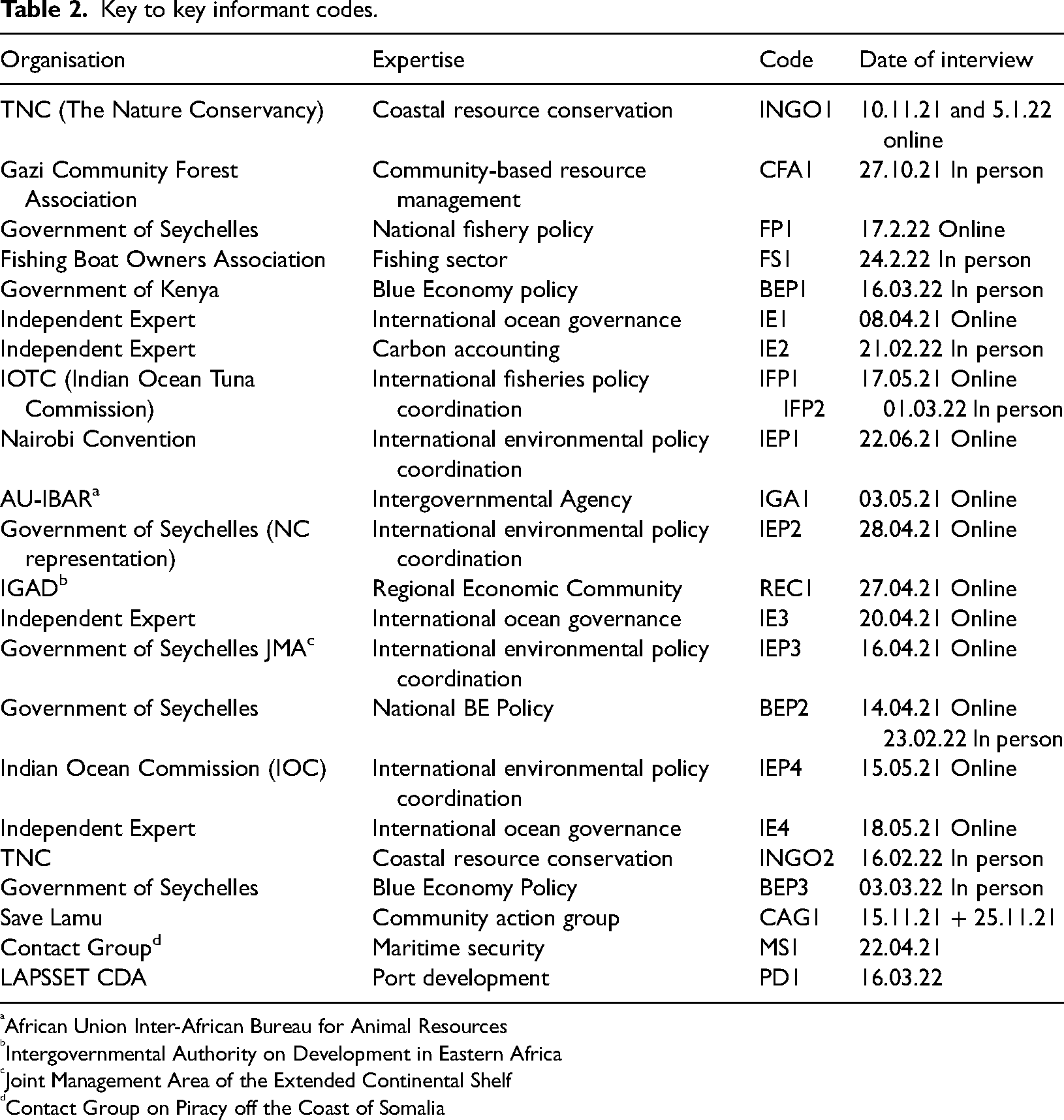
This discourse analysis is based primarily on policy documents issued by the African Union (AU) and its agencies, by international and multilateral institutions in the WIO Region, and by regional States, notably Kenya and Seychelles (Table 1). Documents were identified through web searches for BE policy relevant to the region, and by identifying BE-relevant policy of key organisations (e.g. African Union; Nairobi Convention). Recognising that policy as written does not always turn into practice as intended, these data were triangulated with online semi-structured interviews with representatives of organisations responsible for producing many of the documents analysed (in March–July 2021), and with semi-structured interviews in the field (sometimes including field observation) with government officials and local practitioners and stakeholders in Seychelles and Kenya (Oct 2021 to March 2022) (see Table 2). These latter interviews and visits were selected through web searches for relevant organisations and initiatives and by recommendation from key informants. Covid-19 travel restrictions delayed in person interviews and field observations for some months.
Documents subject to discourse analysis.
Documents subject to discourse analysis.
Key to key informant codes.
African Union Inter-African Bureau for Animal Resources
Intergovernmental Authority on Development in Eastern Africa
Joint Management Area of the Extended Continental Shelf
Contact Group on Piracy off the Coast of Somalia
Policy texts were analysed using NVivo 12. Coding followed a spatialised governmentality framework developed by the author and described in Midlen (2021). This follows Deans’ (1999) analytic of government (simplified, after Russel and Frame, 2013), based on Foucault's governmentality concept, but augmented with a complementary framework based on place-space-time theories (after Malpas, 2012) to aid in drawing out place-based factors. Dean's framework for analysis of governance consists of three analytical categories – problematisations, utopias, regimes. Malpas, in contrast, is concerned with place and space rather than institutions. He considers space to be subordinate to place and place to comprise of bounded space-times. Place is underpinned, therefore, Malpas argues, by three fundamental elements: boundedness, openness and emergence. In my interpretation, boundedness denotes the physical and is therefore spatial; openness encompasses access and opportunity, and their converse – exclusion and risk; emergence represents time, becoming and movement (see Midlen, 2021, for a fuller elaboration). These place-based elements of the analytic framework complement Dean's and enable fuller consideration in governmentality analysis of the material (which is spatial) and the spatial delimitation of institutions for governance, of opportunity and potential, and of trajectories and outcomes resulting from governance regimes. These are aspects of discourse and environment which are not explicitly revealed in a governmentality analysis alone and which are important in understanding the influence of place in governance and governmentality. The coding framework is detailed in Table 3.
Depicting the coding framework used in this study for discourse analysis.
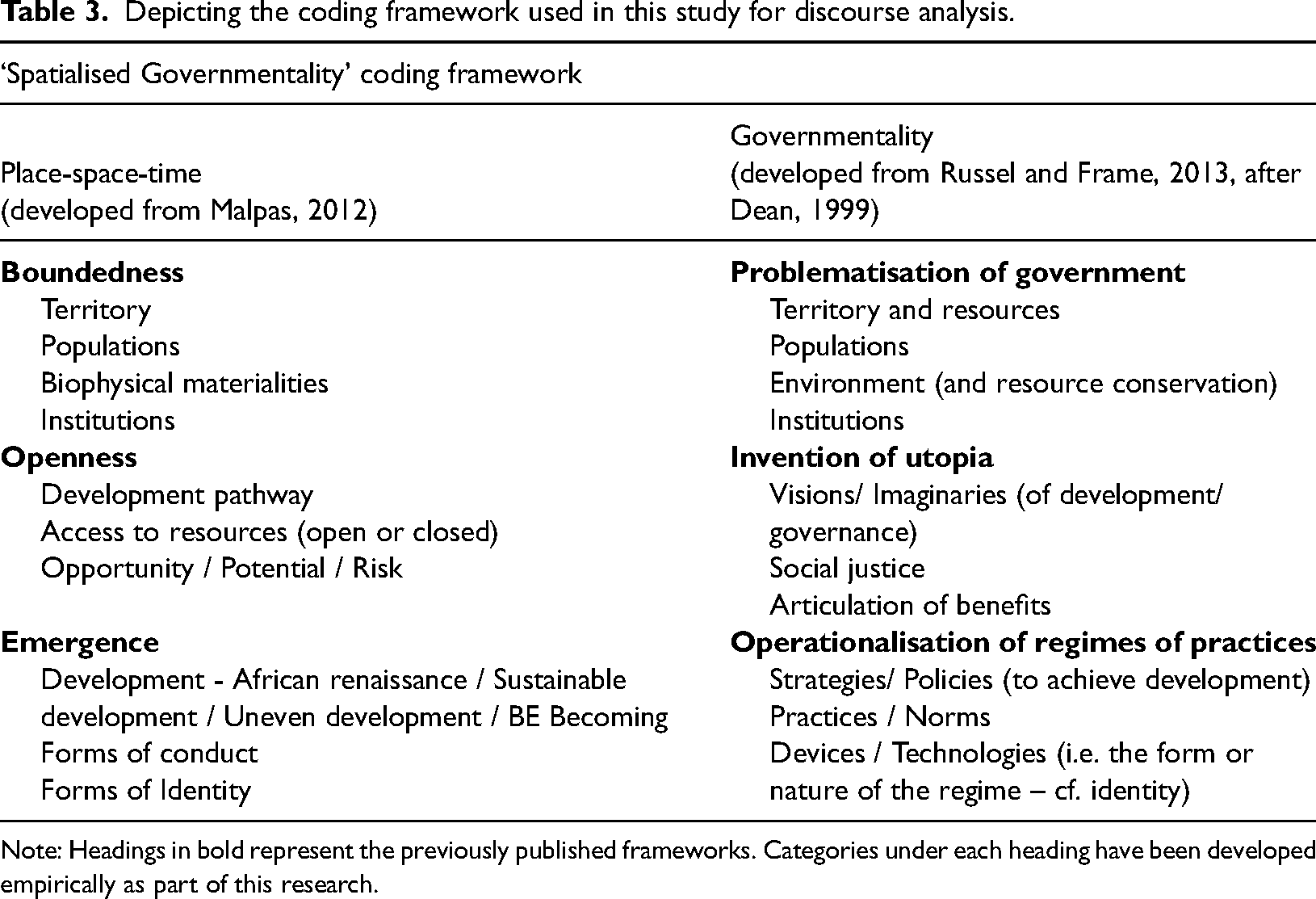
Note: Headings in bold represent the previously published frameworks. Categories under each heading have been developed empirically as part of this research.
Interview texts were coded inductively to provide more robust triangulation, allowing themes to emerge from interviewees' experiences, opinions and priorities. Coded text was transferred in summary form to a digital mind map (SimpleMind Pro), providing a visual representation of coding themes, and a platform on which to easily manipulate coding interrelationships in a further level of analysis. This enabled cross-linking of topics and re-ordering and synthesis of the governmentality and place-space-time coding so as to better represent the complex interrelations of spatialised governance that are characteristic of ocean environments and the BE. A narrative summary was produced for each of the resulting thematic clusters. (Appendix 1)
Findings and discussion
My argument is constructed in three steps. First, that the BE represents a new development pathway for Africa in which utopian thought is deployed to enrol states in a global rationality for sustainable ocean development – a form of global governmentality. Two, that this governmental rationality is deployed to encourage states to work together to manage the WIO as a shared resource – I call this a ‘collaborative BE governmentality’. Three, that it is an immature governmentality – insufficient capacities, and spatio-material barriers representing ‘counter-conducts’ – necessitating adaptation and governmental and multilateral intervention. I evidence this argument in the following sections, dealing with each step in turn.
A utopian vision runs persistently through the regional discourse of the BE as a new and valuable development pathway for Africa and the WIO region: ‘…there is an emerging opportunity to develop an African Blue Economy narrative that better reflects the kinds of development goals, partnerships, and forms of social reciprocity that African societies need as they move further into the 21st century’ (UNECA, 2016a: 15), and one that reverses unsustainable resource use, ‘…the balance can be tipped away from illegal harvesting, degradation, and depletion to a sustainable Blue development paradigm, serving Africa today and tomorrow’ and ‘If fully exploited and well managed, Africa's Blue Economy can constitute a major source of wealth and catapult the continent's fortunes.’ (UNECA, 2016a: x). This discourse presents the BE as a new development paradigm for Africa and the WIO, embodying the twin BE goals of environmental protection and economic development. The scale of the oceans and the opportunity they represent is frequently highlighted, the BE drawing upon a ‘vast network of aquatic resources’ (AMCEN, 2019: 1) and ‘vast ocean territories’ (African Union, 2019: iii). The UN Economic Commission for Africa notes that the EEZs 7 and territorial waters of African States are ‘extensive, measuring some 13 million km2, and their continental shelves extend over a total area of some 6.5 million km2’ (UNECA, 2016a: x). This extensive resource is ‘part of Africa's rich geographical, social, and cultural canvas’ (UNECA, 2016a: x), and represents a ‘New Frontier of African Renaissance’ and a ‘major contributor to continental transformation and growth’ (AMCEN, 2019: 3). The BE is seen not as a new sector ‘but rather a pathway to climate-smart, sustainable development’ (Republic of Seychelles, 2019: 9). Thus, the BE is problematised as a response to human development needs and the unsustainable exploitation of natural resources upon which future wealth can be built. This problematisation has been adopted by African States collectively through continental institutions. Whilst at State level the pace of BE development is variable, nevertheless there is a clear sense of a continental initiative underway: the BE holds a ‘flagship’ position in the African Union development vision, Agenda 63; key Conventions between the continental States support BE development, such as the Africa Integrated Maritime Strategy, the Lomé Charter 8 , etc. These initiatives are reinforced by guidance and strategy produced by associated bodies; AMCEN, the African Ministerial Conference of Environment, receives briefings on BE progress and the emerging policy framework (AMCEN, 2019); the UN Economic Commission for Africa (UNECA) has produced BE guidance; AU-IBAR produced the Africa BE strategy which is now being regionalised through the RECs; the World Bank announced a ‘Blue Economy for a Resilient Africa 9 ’ programme at COP27 in 2022.
Both opportunities and threats are to be encountered on this development pathway. Opportunities presented by the BE are elaborated with regard to the richness of the natural resource and its social value, and the opportunity to grow economies on the basis of aquatic resources and in so doing meet human development needs, mitigate climate change and transition economies to more sustainable patterns. Thus, ‘If African countries invest and develop the Blue Economy in a sustainable manner, this can lead to the generation of jobs and economic growth for the continent’ (UNECA, 2018a: 15). Recognising that many people in Africa live in poverty and suffer insecure livelihoods and access to food, addressing these challenges against a trend of a rapidly growing population is a high priority. For example, fisheries reform is seen as essential to meeting future food security needs as Africa's population rapidly grows and is a central theme of the Blue Economy Flagship arm of the AU's Africa 2063 strategy. The large and growing population of young people is a prominent concern: ‘the continent has the largest number of young people of any continent, currently estimated at 200 million, and young people will influence the economic revival of the continent over the next 15 years’, (AMCEN, 2019: 3). The opportunities afforded the youth of Africa by employment in the BE will enable them to ‘gain more access and control over the basic conditions that determine their well-being’ (AU-IBAR, 2019: 13).
However, this valuable resource is under threat. ‘Despite the potential benefits and opportunities …. the resources of the oceans and inland waters are under serious threats due largely to governance and capacity issues as well as climate change and extreme weather events’ (African Union, 2019: iii). Change is necessary: ‘Given the complexities associated with governance of these water bodies and wetlands, a paradigm shift from the business-as-usual … approach is needed to be able to fully amass the associated benefits ….’ (African Union, 2019: x). Threats to and vulnerabilities of people, institutions and assets comprise risks to socio-economic well-being and the health of ecosystems, from poor practices and missed opportunities, and global environmental change,‘…the unsustainable use of resources threatens livelihoods, human well-being, biodiversity, [and] the goods and services provided by the ecosystems of the WIO’ (UNEP, 2017: 6). Threats encompass unsustainable use, deriving from a variety of pressures including population growth, global demand for commodities, extractive industries etc. ‘The WIO region is under threat. … from … the rapidly growing population resulting in increased demand for goods and services, rapid urbanization, industrialization and associated problems of solid waste and effluent discharge in urban centres’. (HLP, 2019: 9). Vulnerabilities reinforce this narrative but also feature a failure to adapt governance to these challenges or to capture and distribute equitably the benefits of resource wealth, ‘…despite significant endowments in Blue Economy resources, Eastern Africa has failed to achieve growth with sustainable and inclusive development and poverty is still prevalent in the region’ (UNECA, 2016b: 25). The message is clear – in order to realise the potential offered by the BE to address human needs, action is needed to reverse unsustainable trends and practices.
A global governmentality
In recent years Foucault's concepts of biopower and governmentality have been taken up by international relations scholars (e.g. Neumann and Sending, 2007; Joseph, 2010; Jaeger, 2010; Dean, 2010) to explain various features of ‘the international’ as a political realm. Neuman and Sending (2007), comparing theories of the international, suggest that governmentality provides a particularly useful account of today's global governance, in which non-state as well as state polities have agency. Joseph (2010) provides an empirical example of such a global governmentality in action, World Bank Poverty Reduction Strategies emphasise ‘evolving responsibility and establishing governance from a distance through the responsibilisation of the development partner, encouraging countries to take ownership of the project and develop their own poverty reduction strategies’, in effect subjectifying themselves. International organisations avoid direct coercion, but utilise continual monitoring and evaluation, peer review and benchmarking as governmental practices to exert control.
Foucault locates this form of governmentality through self-subjectification in the evolution of ethics. In ancient Greece, ethics was concerned with the customs and practices of living life in certain ways. Olssen (2019) recounts the evolution of Foucault's thinking on ethics and its relation to governmentality. Foucault saw ethics as being not so much a moral code but a way of living, of assimilating practices that help individuals to navigate social rules by ‘developing relationships with the self, for self-reflection, self-knowledge, self-examination….’ (Foucault, 1985: 29) to produce ‘a set of practices by which one can acquire, assimilate, and transform truths into a permanent principle of action’ (Foucault, 1997: 239). A study of ethics and of governmentality constitutes a form of analysis where ‘power relations, governmentality, the government of the self and of others, and the relationship of the self to self constitute a chain’ (Foucault, 2005: 252). In the context of the UN, states agree international rules to which they must themselves comply. In relation to international development, these rules originate from the principle of collective security, a cornerstone of UN policy (Jaeger, 2010), in which traditional and non-traditional security threats (famine, poverty etc.) are addressed through global action. In devising and adopting such rules, States subjectify themselves, as ‘responsible’ states willing to act on behalf of their populations on the basis of commonly agreed problematisations of global development, and committing to certain modes of action. The SDGs (UN, 2015), and especially Goal 14 on ‘life below water’, represent such a framework of problematisations and action of central importance to the BE paradigm. At the regional level too, WIO states agree collective goals and modes of action in order to problematise and respond to prevalent environment and development needs (cf. Nairobi Convention and Indian Ocean Commission – both platforms for such action. Pertinent examples are described later in this paper).
The utopian discourse (i.e. comprising both utopian and dystopian elements) regarding the WIO BE, represents a particular problematisation of ocean development and acts as a mechanism to ‘responsibilise’ States (through self-subjectification) to contribute to regional BE development. This, I argue, is a form of global governmentality. That is, the BE discourse represents a particular governmentality that operates at an international level to influence State's ocean development policies – in Foucaultian terms to ‘conduct their conduct’ – in pursuit of a utopian future in which human development needs are met and environmental degradation reversed. In the WIO region, States are encouraged through this discourse of opportunity and threat (playing to the fear of missing out – a powerful emotional lever. Karkare et al., 2020) and associated capacity building programmes to collectively adopt BE development policies. Thus, States are in effect subjectified and responsibilised through a neoliberal 10 discourse of development to act for the welfare of their populations (i.e. food and livelihood security). Development is considered to be ‘the indispensable foundation for a collective security system’, implicating development as an insurance against a multitude of risks to human security (and consequent uneven development), or conversely ‘as a preventative strategy in the service of collective security’ (Jaeger 2010: 67, 72). In this way, continental BE policy is enacted.
What types of action should the responsible BE State take? Considering the key challenges of developing a BE for small island and least developed coastal states the World Bank notes that a significant issue is ‘the realization that the sustainable management of ocean resources requires collaboration across nation-states and across the public-private sectors, and on a scale that has not been previously achieved’ (World Bank, 2017: vi). The Sustainable Blue Economy Conference, staged in Kenya in 2018, noted in its conference report the fundamental role of collaboration in BE development, calling for ‘genuine collaboration on policy, science and markets’, through ‘a collaborative framework’ and ‘Building collaboration between policy makers, researchers, communities and business sector[s]’ (SBEC 2018: 13, 14). The High Level Panel 11 at its meeting in Mombasa in 2019 noted that African governments ‘need to be sensitized, encouraged and supported to internalize and embrace regional collaboration and planning approaches for a healthy ocean’ (HLP, 2019: 3). The role of the ‘region’ is important – the purpose of collaboration is the management of a shared space by neighbouring States. Such collaboration, in a BE context, aims to produce, I argue, a development space of uniform opportunity and risk, governable and ready for investment and development.
This collaborative rationality extends to sub-national levels. Co-management (between regulators and users) is promoted as good practice in recognition of the importance of natural resources to local communities, of historic use rights, and international obligations to involve indigenous communities in management decisions. The Kenya Constitution, for example, makes provision for co-management of natural resources, such as mangrove forest and marine areas. Community Associations (forest or marine) must be established, to negotiate with the relevant ministry a set of permitted activities within a bounded area and associated monitoring protocols (INGO1). Thus, responsibility for management is shared with communities. Whilst the Government is still the law enforcement body, communities do share this responsibility, for example by establishing their own security mechanisms to protect the resource access rights they have been granted: e.g. in the Mikoko Pamoja mangrove restoration project in Kenya the community has built a surveillance watchtower to deter unauthorised use of mangrove in a way which addresses their lack of policing powers, ‘Even if you are not seen, you feel uncomfortable because someone may be watching you!’ (CFA1). In Seychelles, a co-management approach is central to both marine spatial planning practices and inshore fisheries reform: ‘the focus was to move the key artisan fisheries into management … through co-management, to improve the stakeholder participation in decision making and so on, and then to build the structures around that such as the policy and legislation, and communication and awareness’. (FP1). The Seychelles ‘Blue Bond’ financing mechanism for the BE is supporting this transition through a community grant programme established to ‘empower local communities to access finance to develop their ideas for coastal management … [allowing] broader national scale planning of fisheries but still allowing community-based solutions to emerge through this grant financing’. (FP1). However, the quid pro quo of co-management is the registering of fishers and their vessels, and evidence-based management using catch and effort data, ‘We need to quantify real efforts and make proper management decisions. I’m pushing our members to come forward with information and participate in co-management…..100% management [of the EEZ] would help protect fishers rights’ (FS1). In Kenya, Government has promoted co-management in fisheries from 2007 through the formation of Beach Management Units (BMUs). The 2007 Regulation is now under review as BMUs ‘have not performed as we had thought. A lot of capacity is still required’, (BEP1) illustrating some of the challenges of collaboration in a multi-level governance approach.
I refer to this collaborative rationality of government as a ‘collaborative BE governmentality’ borrowing from network governance literatures (Larsson, 2019. See also Peters et al., 2022 on collaborative governance). In doing so, I argue that the BE represents a set of governmental practices aligned to a rationality of the sea as a shared space, and as a valuable resource to support economic development to overcome a variety of socio-economic insecurities. The BE paradigm is elaborated in continental and regional policy documents, guides and formal agreements between States (e.g. AU Agenda 2063). These texts create a discourse in alignment with the broader sustainable development policy discourse (SDGs, 2015; Convention of Biological Diversity; Paris Agreement, 2015). Regional States discuss threats, risks and barriers (e.g. pollution, over exploitation, technical capacities) to the BE in regional forums (e.g. NC 12 , IOC 13 ) and identify priorities for joint action (e.g. maritime security; MPAs). These form the basis of programmes funded by multilateral organisations or directly by donor nations (e.g. SAPPHIRE 14 funded by GEF 15 ; MASE 16 funded by European Union), having the effect of producing BE subjects (as described earlier) – States, practitioners, communities, businesses gain the capacities to respond to aforementioned calls for collaborative action and to support BE development through training and awareness (‘sensitisation’) programmes, and forms of contractualism under which BE priorities and practices are agreed and formally adopted. Research programmes (e.g. WIOMSA 17 /NC science policy platform) and scientific reports create BE knowledges, informing policy and action. Programmes reterritorialize the ocean and other spaces as BE spaces (e.g. Mascarene Plateau joint management area; RMIFC 18 General Area of Interest; Seychelles Blue Bond in capital market spaces; mangrove carbon credits in carbon market spaces).
Counter conducts and limited capacities
However, this collaborative BE governmentality is immature. As noted above, States have insufficient capacities to undertake the transformations needed to achieve the objectives of a sustainable BE, necessitating donor support if international objectives are to be met. Further, fragmentation of governance (environment / economy) leads to calls for new institutions for regional coordination and collaboration for more holistic policy making (IE1), bringing RECs and environmental platforms (NC, IOC) into productive dialogue. Mechanisms to benchmark and monitor progress are in their infancy, but efforts are underway to develop and align reporting frameworks with international systems, such as the NDCs (blue carbon, Seychelles - IE2). The spatialities of the ocean present some important barriers to this governmentalisation of the BE, requiring new tools (e.g. MSP Seychelles; resource allocation mechanisms for tuna. IFP1 & 2; platforms for policy coordination between RECs and environmental institutions. IEP1) and capacities (understanding of the BE; regional policy alignment; national capabilities for implementation). Political spatialities lead to significant although localised resistance often involving disputes over access to natural resources (e.g. LAPSSET 19 corridor/indigenous land rights; Kenya/Somalia maritime border dispute 20 ) which influence BE development.
This immaturity was evident from many stakeholder interviews, informants consistently raising issues of capacity as a significant constraint to the implementation of the BE in the WIO Region. AU-IBAR, a technical office of the AU, responsible for preparing a continental BE Strategy and its implementation plan, recognises the practical constraints on institutions at all levels to deliver a sustainable BE, ‘BE is still a relatively new concept on the continent’ and ‘States and economic communities don't know how to effectively harness BE resources’ which are ‘vast but there is a need for cooperation, regionally and interagency, and to collaborate for effective exploitation and utilization of these resources’ (IGA1). In the WIO Region, States share expertise to strengthen capacities, through the regional collaboration structures such as NC and IOC. ‘Seychelles.... is looked at as a leader …. and has been one of the [training] facilitators to provide examples, to provide information on what we are doing and how we are doing in terms of marine special planning’ (IEP2). A fundamental issue is the understanding of what the BE actually is, ‘We need to focus on the concept, what is the understanding of the different countries, the member states on blue economy issues’ (REC1). ‘BE implementation is not easy. It's complex and multisectoral. Not every stakeholder understands it, or they see it from their own perspective’ (BEP2). There is a clear sense of a continental and regional BE project being developed, ‘Once the policy gaps are identified we need to do some capacity building works to raise the concept of blue economy in each member State to bring [States up to] a parallel level’, (REC1). The hope is that the BE paradigm can foster better policy coordination within and between states in the region, that ‘it will get much more cooperation in those much more powerful ministries and sectors ….. and to realise that management has to happen together rather than separately’ (IE3). Support is provided by international organisations towards regionally agreed goals. The SAPPHIRE 21 project, for example, funded by GEF and implemented through the NC, includes ‘a capacity building programme to support the process towards improved ocean governance’ (IEP1). Some of the challenges of regional coordination and collaboration for the BE are evident in the Joint Management Area arrangements for the Mascarene Plateau between Seychelles and Mauritius, ‘the two countries do not have the same governance structure. So what we have to do in Seychelles does not work in Mauritius or what Mauritius has to do does not work in Seychelles, ……..we have to make sure that [legislation and policy] sort of marry each other so that when we implement them they are the same in both countries’, (IEP3).
Implementation challenges go beyond regional policy coordination. Lack of capacity is acute at national and sub-national levels, ‘This is one of the major challenges right now – lack of resources – we do not have all the skills required’ (BEP2). The IOC and NC in particular have given capacity building a high priority, but it is important for others too, like the IOTC (IFP2), and IGAD (REC1). Thus, regional initiatives aim to address the critical issues for BE implementation, including ‘building consensus, fostering collaboration, working towards appropriate national and regional standards, legislation, and policy, collating and disseminating relevant information and analyses, and, most importantly, implementing on-the-ground action’ (IOC, 2010: 37). National capacities must be strengthened to enable these regional programmes to achieve their goals ‘…this agreement is not only meant for the regional processes to be undertaken but also for the national processes and national capabilities to be developed’. (IEP4). However, results can be patchy, ‘they come up with very good instruments and so on but then as you know implementation is always at the national level, so if some countries are doing their bits and others are not then it doesn't go very far’ (IE4). ‘At national level there are multidisciplinary committees in some countries, but how effective are they? If this national structure doesn't work it will be very difficult for us to move on with the regional structures’ (IEP4). States are often open about the capacity challenges they face and their needs for external support: ‘We are afraid the over exploitation of our marine and coastal resources will continue unabated because of the lack of capacity for effective control and surveillance’, (Somalia delegate, Nairobi Convention CoP. UNEP, 2015: 69.). In Seychelles EEZ, having originally agreed to use existing powers the government now recognises that a new legal framework is needed to enable coordinated implementation (INGO2; BEP3).
Spatio-material factors also ‘resist’ the dominant BE discourse, rendering collaboration especially hard and requiring new tools and technologies to territorialise and inscribe the oceans as a governable space. The migratory patterns of tuna and their intersection with state territories and oceanic systems (e.g. the Somali upwelling, a rich feeding area that attracts migrating tuna shoals) create uneven opportunities for harvesting, leading to conflict over how catch opportunities are allocated, ‘going back ten years or so when Seychelles was the one that first introduced a proposal for quota allocation….. it recognised historical catch by zone rather than by Flag 22 to say “well if you caught it in our waters regardless of whether you fly our Flag or not it's our historical catch”’. This proved to be an attractive argument for coastal states so ‘the coastal states [have remained] fairly unified against the distant water fleets in that position’ (FP1). Regulation of fishing vessels by flag state (typically not located in the WIO region) introduces additional complexities to the gathering of statistics and monitoring of stocks, and the enforcement of fishing restrictions (IFP1 & 2). The fluid nature of the ocean, its huge scale and its inaccessibility to scientific study renders it an uncertain space, beset with conflicting knowledges that are appropriated to sectoral aims. Terrestrial spatialities also offer resistance to BE development – the LAPSSET corridor involves the construction of a new port in Lamu, Kenya and associated transcontinental transport corridors (road, rail, hydrocarbons) linking Kenya, South Sudan and Ethiopia, and eventually planned to extend to Uganda, Congo and the west African coast. It is one of Kenya's flagship development programmes, bringing new opportunities and growth to the long-neglected northern Counties (Kenya Vision 2030) facilitated by maritime trade. However, the construction of the first berths has damaged fishing grounds in the Lamu archipelago, resulting in a successful legal action by ‘Save Lamu’, a coalition of community associations representing indigenous peoples (CAG1). Construction on and allocation of land for development has been dogged by illegal appropriation of property, property speculation and legal battles by indigenous groups to assert their land rights, sparking ethnic conflict and terrorism (High Court of Kenya, 2012; Anon, 2016; Nyagah et al., 2017). Community resistance has reset relations with government and its agencies: the LAPSSET Corridor Development Authority finds itself liaising more with communities, and negotiating between them and government (PD1); communities better understand their rights and make more effective representations to government (CAG1). Illegal activity at sea (IUU fishing, illegal trade, piracy) represents a threat to development of the BE in the region (‘you have to guarantee maritime security so … particular investors can come in and invest [in the BE]’, IEP4). This ‘resistance’ to the international regime (i.e. UNCLOS 23 Midlen, in press) has necessitated new, collaborative maritime security infrastructures (see ) involving joint surveillance and operations between States in the region (e.g. the international ‘Contact Group’ on piracy off the coast of Somalia. MS1).
These capacity and material constraints can be understood as ‘counter conducts’. Counter conducts are an inseparable component of Foucault's understanding of governance as governmentalities. Power is relational, rather than being possessed or located, and so ‘where there is power, there is resistance’ (Foucault, 1998: 95). Counter conducts – ‘the will not to be governed thusly, like that, by these people, at this price’. (Foucault, 2007. Cited in Death, 2010: 236) – represent a resistance to (rather than a revolutionary rejection of) the regime of truth through which the governed are engaged as objects and subjects of government (Cadman, 2010; Death, 2010). Through acts of resistance and moments of protest, such counter conducts bring new identities, subjectivities and collectivities into being (Cadman, 2010), potentially destabilising power relations through, for example, introducing alternative, subaltern or marginalised forms of knowledge which challenge the prevailing norms. The ‘Save Lamu’ movement, challenging the State's rationality for a major port development (contesting degree of environmental and social impact; challenging land ownership; asserting indigenous use rights) could be said to be a classic counter conduct. The device of a ‘Biocultural Community Protocol’ (Anon, 2016), documenting traditional use rights, is used to challenge conceptions of the land as ‘unused’, ‘empty’ and developable, forcing government to register community land rights, provide compensation, and consult more thoroughly on development proposals. More subtle forms of resistance to the emerging BE governmentality are also evident. Thus, capacity constraints (knowledges, skills, financial and human resources etc.) resist the prevailing global BE governmentality rendering it only imperfectly formed in practice, and necessitating new forms of international intervention (training; skills development; infrastructure provision etc.). Similarly, spatial and material factors present insurmountable barriers to the governmental rationality that seeks to economise ocean space: commercially important tuna migrate through the region confounding attempts to allocate catch shares between states; coastal hydrodynamic systems respond to port construction and channel dredging in ways that damage artisanal fisheries, threatening livelihoods; illegal trade endangers human and non-human populations and forces new governmental relations (surveillance technologies; collaboration agreements etc.) to secure a vast and largely remote BE space. Joseph (2010) questions the reach of global governmentalities, citing States that do not follow the western, neoliberal governmental model and the consequent limitations of the governmental apparatus to be subjectified through a governmentality. In contrast, I argue that in the case of the BE in the WIO the international community is acting to build governmental structures and capacities, directly and through regional States, to enable a BE governmentality to be enacted. Given the scale of this task and the resources being directed to it (e.g. US$100m for Kenya fisheries reform), I consider this BE governmentality to be immature, not yet fully formed and significantly constrained by systemic counter conducts.
Conclusion
I have characterised the BE as a dominant discourse and as a form of global governmentality, one having a strong emphasis on collaboration. I call this a ‘collaborative blue economy governmentality’. It is characterised by a rationality that sees the oceans as a valuable shared space, rich in resources but under threat from unsustainable use and environmental degradation. The discourse proffers the BE as a new development pathway for Africa and the WIO region to solve social ills such as food and livelihood security whilst preserving environmental resources, but for which States must collaborate to align policy and to reverse environmental degradation. I demonstrate how the BE discourse produces this collaborative rationality, through policy texts, regional platforms for policy coordination, and donor-funded capacity building programmes. I highlight the utopian nature of this discourse, and point to sites of resistance, or counter conducts, as signs of its immaturity. The spatial heterogeneity of the oceans, their scale, and physical and biotic complexity resist governmentalisation and demand new tools and capacities for governance of their use.
The governmental practices deployed in the name of the BE lead to a broad characterisation of this collaborative rationality as a neoliberal governmentality, which deploys statistical and inscription devices to quantify the environment, delimit users and zones of use, and devolve responsibility (to States and their populations), and which creates BE subjects through capacity building programmes and contractualism. However, examples of community-based co-management, especially where forms of territorial use rights (e.g. Kenya, Community Forest management agreements) protect resources from exploitation by private capital, hint at the emergence of a post-neoliberal regime in natural resource management. Could the climate and biodiversity crises be opening a space for the development of more socially liberal approaches to governance (collective governance, socially just transitions, strong community resource rights), similar to Gibson-Graham's (2008) ‘diverse economies’ or Fletcher's (2020) ‘communal’ or ‘liberatory’ governmentality?
Highlights
I argue that the Blue Economy discourse represents a form of global governmentality, underpinned by a utopian discourse of opportunity and risk. In the WIO region, I argue that a ‘collaborative Blue Economy governmentality’ is evident. This collaborative Blue Economy governmentality is beset by various ‘counter conducts’, or resistances. I argue that it is an immature governmentality, requiring multilateral support to build and strengthen capacities before it can effectively be enacted.
Footnotes
Acknowledgements
This research was undertaken with financial support from Templeton Education and Charity Trust (Green Templeton College, University of Oxford, UK), School of Geography and Environment, University of Oxford, and Cornwall Oxford Alumni Society. The author is grateful for ongoing advice and guidance of his doctoral supervisor, Dr Ariell Ahearn, and also gratefully acknowledges the anonymous referees for their valuable remarks and suggestions that contributed to improve the quality of this paper.
Declaration of conflicting of interests
The author(s) declared no potential conflicts of interest with respect to the research, authorship, and/or publication of this article.
Funding
The author disclosed receipt of the following financial support for the research, authorship, and/or publication of this article: This work was supported by the School of Geography and Environment, University of Oxford, Templeton Education and Charity Trust (grant number Departmental Travel Grant, Doctoral scholarship), and Cornwall Oxford Alumni Society.
