




Abstract
Modern slavery and deforestation in Brazil are interconnected issues but have been approached by researchers and policy interventions separately. However, an emerging slavery-environment nexus is demonstrating the urgent necessity of engaging with slavery and deforestation holistically, to aid effective action. Accordingly, the research aimed to investigate the slavery-environment nexus in the Brazilian Amazon, by engaging with three core components: vulnerability to enslavement, slavery-deforestation links, and assessing labour and environmental inspections. Mixed qualitative methods revealed that proximate determinants of vulnerability (poverty, lack of access to land, lack of education and social isolation) are multifaceted and produced by underlying determinants (unequal land distribution, racial discrimination, economic globalisation and policies undermining distribution). Furthermore, slavery and deforestation were found to be organised by criminal networks in geographically isolated spaces, specifically among interconnected sectors at the bottom of the supply chain. These characteristics facilitate slavery and deforestation by lessening the risk of detection and punishment, which was compounded by the Bolsonaro government demobilising labour and environmental inspections. Alleviating vulnerability through redistributing land prevailed as a practical recommendation, however there is also need for research to engage further with the underlying determinants of vulnerability and slavery-deforestation links. Only then can slavery and deforestation be tackled holistically.
Setting the scene
Modern slavery is regarded as one of the most brutal and widespread human rights abuses persisting today (Kara, 2017), and thus stands at the forefront of researchers and policy makers to understand and tackle (Bales, 2012). Modern slavery has been approached as an isolated human rights issue, but this notion has recently been challenged by an emerging slavery-environment nexus, recognising that slavery is intimately tied to environmentally harmful processes (Sparks et al., 2021). Bales and Sovacool's (2021) quantification of modern slavery's impact on climate change highlights the magnitude of this unfolding relationship; they found that if slavery was a country it would be one of the poorest in the world, but the third-largest emitter, with emissions dominated by agriculture and land use. The situation in Brazil reaffirms these concerns, as evolving evidence shows that a large proportion of people in slavery are connected to deforestation processes in the Brazilian Amazon (Brown et al., 2019). Accordingly, slavery that is utilised within deforestation in the Brazilian Amazon exemplifies the intersection between human rights abuses and environmental issues inherent within the slavery-environment nexus, which urgently needs to be understood to inform approaches that tackle slavery (Bales, 2016).
In Brazil 369,000 individuals are estimated to be living in conditions of modern slavery, representing the highest slave population in Latin America (GSI, 2018). Despite efforts, tackling slavery has been undermined by two downfalls: an inadequate understanding of vulnerability to enslavement and treating slavery typically as an isolated issue. In Brazil, 40% of individuals freed from slavery by authorities have been re-enslaved and released again, indicating a predisposition to enslavement (Bales, 2016). Ongoing vulnerability is regarded as the most important factor pushing a person into slavery (Bales, 2012; Francelino-Goncalves-Dias, 2013). Yet proximate and underlying determinants of vulnerability are not understood with sufficient depth, appreciation for unequal power relations and contextuality (Baptista et al., 2018; Larsen and Durgana, 2017; Molinari, 2017; Natarajan et al., 2021; Zimmerman and Ligia, 2017).
Furthermore, conceptualising slavery as an isolated issue has created an artificial divide between slavery and wider environmental problems (Bales and Sovacool, 2021; Jackson et al., 2020b), as reflected in Brazil's policies to combat slavery and deforestation. The Grupo Especial de Fiscalização Móvel (GEFM) and Instituto Brasileiro do Meio Ambiente e dos Recursos Naturais Renováveis (IBAMA) work separately to conduct surprise inspections on labour and environmental abuses (Carvalho et al., 2019; McGrath, 2010), despite a prevailing connection between both crimes. Progressing synergetic action is impeded by an underdeveloped knowledge of slavery-deforestation links (Bales, 2016; Bales and Sovacool, 2021; Cameron et al., 2021; Jackson and Sparks, 2020). Accordingly, to holistically understand the slavery-environment nexus and inform effective action, this article aims to investigate the slavery-environment nexus in the Brazilian Amazon. The papers’ objectives are to (i) identify proximate and underlying determinants of vulnerability to slavery; (ii) distinguish links between modern slavery and deforestation; (iii) assess successes and challenges of GEFM and IBAMA's inspections.
In what follows, relevant academic literature is critically reviewed, focussing on determinants of vulnerability, the slavery-environment nexus and GEFM and IBAMA's inspections under Jair Bolsonaro's presidency, to develop a conceptual framework that guides the remaining research. Then, the research's methodology is described, including approach, methods, sampling and analysis. Results are then presented in relation to the research objectives. The findings’ contribution to the conceptual framework and current state of knowledge is outlined, leading to an analytical discussion of findings, comparisons to the wider literature and limitations. Finally, the article is summarised, and recommendations are made.
Current state of knowledge
Conceptualising modern slavery
Defining modern slavery is important, as it determines who is included and excluded in discussions and policy responses (Baptista et al., 2018; LeBaron, 2018). Modern slavery is an umbrella term encompassing many forms of coerced exploitation that have been established in international law, including debt bondage, domestic servitude, sexual exploitation and forced labour (Bales, 2012; Jackson et al., 2020b). Yet no universally adopted definition exists (Cameron et al., 2021; Kara, 2017).
Brazil did not recognise modern slavery's existence until 1995 (Francelino-Goncalves-Dias, 2013), but has since been praised for its legal definition, which incorporates four components, but only one needs to be present to be considered slavery (Baptista et al., 2018). The definition translates to: ‘Reducing someone to a condition analogous to that of a slave, either by subjecting him/her to forced labour or exhausting workdays, by subjecting him/her to degrading work conditions, or by restricting, by any means, his/her mobility because of a debt contracted with an employer or his/her agent’. (Issa, 2017a: 101)
Brazil's definition moves beyond only including the worst forms of slavery and violence (LeBaron, 2018), to encompassing undignified conditions and non-violent coercion (Baptista et al., 2018), which reflects the reality of people enslaved in the Brazilian Amazon. The research paper is set in a single-country context and relies on practitioners working on the ground for data, therefore to maintain coherence modern slavery is defined by Brazil's Penal Code.
Importance of vulnerability
Old and modern slavery systems share similarities, including subordination of one person over another, poor working conditions and inflicted violence (Kara, 2017; Ribeiro and Leao, 2020), but beyond these factors important differences prevail. Aside from ownership no longer being legally bound (Kara, 2017; McGrath, 2010), a crucial change is found in who is suitable for enslavement. Bales (2012) argues that race was the factor determining slave status, whereas today vulnerability to enslavement is the key determinant. However, a shift from race to vulnerability must not be misinterpreted as race no longer holding importance, as racism still contributes to enslavement but through socially produced vulnerability (Baptista et al., 2018). Vulnerability to slavery is a social condition, attributed to its production through social, cultural, political and economic systems, signifying that vulnerability is not inherent or apolitical, but is a product of unequal social relations (Liberto, 2014; Mackenzie et al., 2014; Mitra and Biller-Andorno, 2013). Accordingly, vulnerability can be understood as situational and relational, meaning that a person's unequal socioeconomic circumstances heighten vulnerability to exploitation comparative to others (Cameron et al., 2021; Lerche, 2007; Liberto, 2014; Mackenzie et al., 2014; Mitra and Biller-Andorno, 2013).
Whilst not explicitly separated in the literature, explaining how vulnerability is produced can be split into two interacting categories: proximate and underlying determinants. Proximate determinants have the greatest presence among academic research, referring to immediate variables contributing to enslavement that manifest at the individual level (Alcock and Sherman, 1994; Blaikie et al., 2003). Proximate determinants entail poverty, lack of education, limited employment opportunities, inadequate access to services and social isolation (Bales, 2016; Baptista et al., 2018; Cameron et al., 2021; Crane, 2013; Francelino-Goncalves-Dias, 2013; Jackson and Sparks, 2020; Kara, 2017; Larsen and Durgana, 2017; Philips and Sakamoto, 2012). Academics have described proximate determinants as necessary characteristics of vulnerability and thus exploitation (Baptista et al., 2018; Crane, 2013; Larsen and Durgana, 2017). However, this position has been criticised for being essentialist, by assuming that proximate determinants must be present for enslavement to occur (Mitra and Biller-Andorno, 2013). Taking poverty for example, not all enslaved individuals documented by Kara (2017) were living in poverty, and not all people experiencing poverty are enslaved. Proximate determinants can therefore be regarded as dynamic layers of intersecting inequalities that produce vulnerability which can lead to exploitation (Luna, 2009; Mitra and Biller-Andorno, 2013).
Proximate determinants of vulnerability result from underlying determinants operating at larger scales (Blaikie et al., 2003; Kissinger et al., 2012), by which structural systems embedded in the fabric of society explain how and why vulnerability is experienced at the individual level. Underlying determinants of vulnerability have significantly less presence in the literature, therefore a nuanced understanding remains rudimentary (Baptista et al., 2018; Larsen and Durgana, 2017; Molinari, 2017; Natarajan et al., 2021; Zimmerman and Ligia, 2017), inhibiting the ability to tackle slavery from the root (Cameron et al., 2021; Mackenzie et al., 2014). Nevertheless, underlying determinants include racial discrimination, social marginalisation, policy that reinforces inequality, and economic globalisation (Baptista et al., 2018; Francelino-Goncalves-Dias, 2013; Jackson and Sparks, 2020; Larsen and Durgana, 2017; LeBaron et al., 2018; McGrath, 2010; Natarajan et al., 2021; Philips and Sakamoto, 2012).
Economic globalisation is the most cited by academics and is connected to Brazil's capitalist system that is characterised by capital accumulation, asset ownership and competitive markets (Meade, 1978). Inclusion in the global economy has been argued to alleviate poverty and reduce inequalities (Jenicek, 2012; Neutel and Heshmati, 2006), resulting in lower slavery prevalence. Critical scholars have disputed this orthodox view for ignoring power-laden inequalities inherent within economic globalisation. They argue that environmental goods disproportionally flow to, and are consumed by, the global North (Giljum and Eisenmenger, 2004), whereby the value of labour is not captured by workers but by powerful actors within global production networks (Francelino-Goncalves-Dias, 2013; LeBaron et al., 2018; McGrath, 2010; Philips and Sakamoto, 2012). Consequently, economic globalisation reproduces conditions of vulnerability by excluding workers from environmental goods and their value, therefore modern slavery cannot be detached from the global economy of which it is embedded.
Slavery-environment nexus in Brazil
Slavery's form and conditions vary between contexts (Lerche, 2007), but in Brazil the standard person in slavery's profile, recruitment process and sectors employing slavery have been identified through The Comissão Pastoral da Terra's (CPT) and GEFM's systematic documentation of slavery cases from 1995 to present-day (CPT, 2021; SmartLab, 2020). Debt bondage, characterised by using monetary repayments to maintain exploitation, is the most common slavery form in Brazil today (Francelino-Goncalves-Dias, 2013). Debt bondage victims are typically young, poorly educated, or illiterate men (McGrath, 2010; Ribeiro and Leao, 2020; SmartLab, 2020), who are primarily approached by a gato (recruiter) offering employment (Campbell, 2008; Fearnside, 2008). The gato transfers their victims to a remote work location, socially isolating them and obstructing prospects of leaving (Philips and Sakamoto, 2012). Upon arrival, victims are instructed that they are now indebted for travel expenses and must purchase food and tools from the gato at inflated prices with interest (Bales, 2016; Fearnside, 2008; Issa, 2017a). A growing debt, combined with low wages, means the balance can never be paid (Kara, 2017), but those exploited have a strong sense that they must honour and uphold their verbal contract with the gato (Bales, 2012). Accordingly, the gato harnesses debt, alongside violent and non-violent coercion, to lock a victim into debt bondage (Issa, 2017a).
Debt bondage and deforestation have typically been approached as separate issues (Bales and Sovacool, 2021), but new studies are uncovering an indisputable link. Figure 1 exemplifies that slavery's geographical locations correlate with areas experiencing deforestation (InfoAmazonia, 2021) – the arc of deforestation and remote Amazon. Within these locations slavery is overwhelmingly found in deforestation related sectors, including cattle ranching, agriculture, logging and charcoal production (Bales, 2016; Baptista et al., 2018; Campbell, 2008; Francelino-Goncalves-Dias, 2013; Issa, 2017b; Jackson et al., 2020b; Philips and Sakamoto, 2012). However, research on slavery within these sectors remains compartmentalised, because they have been approached in isolation (Brown et al., 2019), overlooking realities of interconnected industries and thus limiting a holistic understanding.
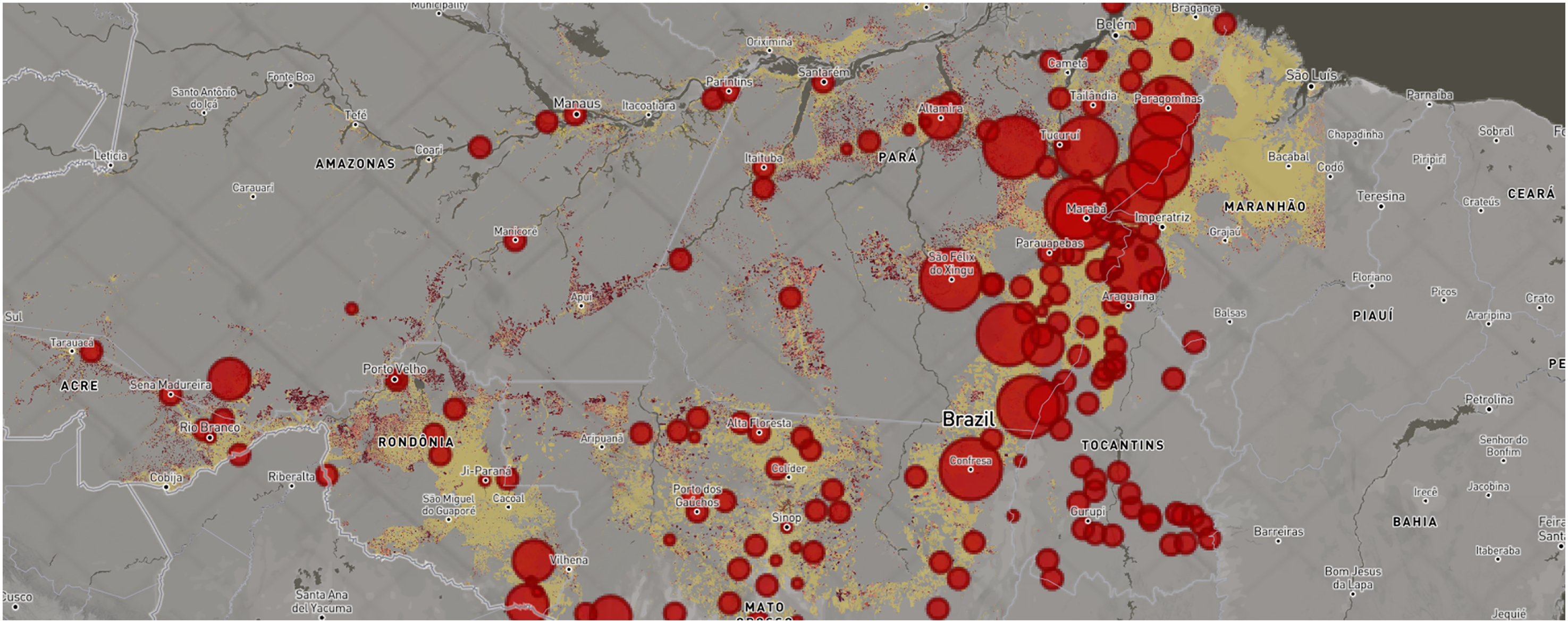
A map illustrating documented deforestation and modern slavery in the Amazon. The yellow corresponds to deforestation between 1988 and 2019, whilst the red shows workers rescued from slavery between 2003 and 2012 (InfoAmazonia, 2021).
Deforestation has been studied exhaustively and academics have separated its proximate and underlying determinants (Armenteras et al., 2017). The proximate determinants of deforestation are cattle ranching, agricultural expansion, logging, infrastructure building and land grabbing (Araujo et al., 2009; Armenteras et al., 2017; Betts et al., 2008; Bos et al., 2020; Fearnside, 2008; Geist and Lambin, 2002; Kaimowitz and Angelsen, 1998; Kissinger et al., 2012; Plata-Rocha et al., 2021). Whilst underlying determinants entail market growth, economic globalisation, poor governance and pro-deforestation policy (Araujo et al., 2009; Armenteras et al., 2017; Geist and Lambin, 2002; Kaimowitz and Angelsen, 1998; Kissinger et al., 2012; Plata-Rocha et al., 2021). It is noteworthy that these proximate determinants of deforestation overlap with the sectors associated with slavery, further evidencing a slavery-deforestation nexus in Brazil.
Parallel to the underlying determinants of vulnerability, economic globalisation is the leading explanation of deforestation. Scholars argue that economic globalisation facilitates an increasing demand for agricultural and forestry goods (Armenteras et al., 2017; Geist and Lambin, 2002; Kissinger et al., 2012), which presents an opportunity to attain market growth by meeting this ever-increasing demand. Pro-deforestation policy, legitimised by the premise of market growth (Ferrante and Fearnside, 2019), materialises as credit and tax policies that encourage land grabs and converting forest to ‘productive’ land (Fearnside, 2008; Araujo et al., 2009). Consequently, Brazil's political history that is shaped by economic globalisation has contributed to an estimated 94% of deforestation in the Amazon being illegal (Valdiones et al., 2021), of which up to 50% is estimated to be reliant on slave labour (Brown et al., 2019). This indicates that economic globalisation is a driver for the demand for deforestation and associated slave labour within the Brazilian Amazon.
Conceptual framework and policy responses
The current state of knowledge is summarised by the conceptual framework in Figure 2. Underlying and proximate determinants of deforestation are well established in the literature (Armenteras et al., 2017), however considerably less evidence is found among underlying determinants of vulnerability to slavery (Molinari, 2017). Moreover, despite an unfolding slavery-environment nexus, slavery-deforestation links in the Brazilian Amazon, and the interconnected sectors within it, are largely unexplored (Bales, 2016). The current literature therefore lacks a holistic understanding of the slavery-environment nexus, according to an underdeveloped understanding of underlying determinants of vulnerability and links between slavery and wider environmental problems. Subsequently, academics have called for further research within these areas, to ultimately inform effective and holistic action (Brown et al., 2019; Philips and Sakamoto, 2012; Zimmerman and Ligia, 2017).
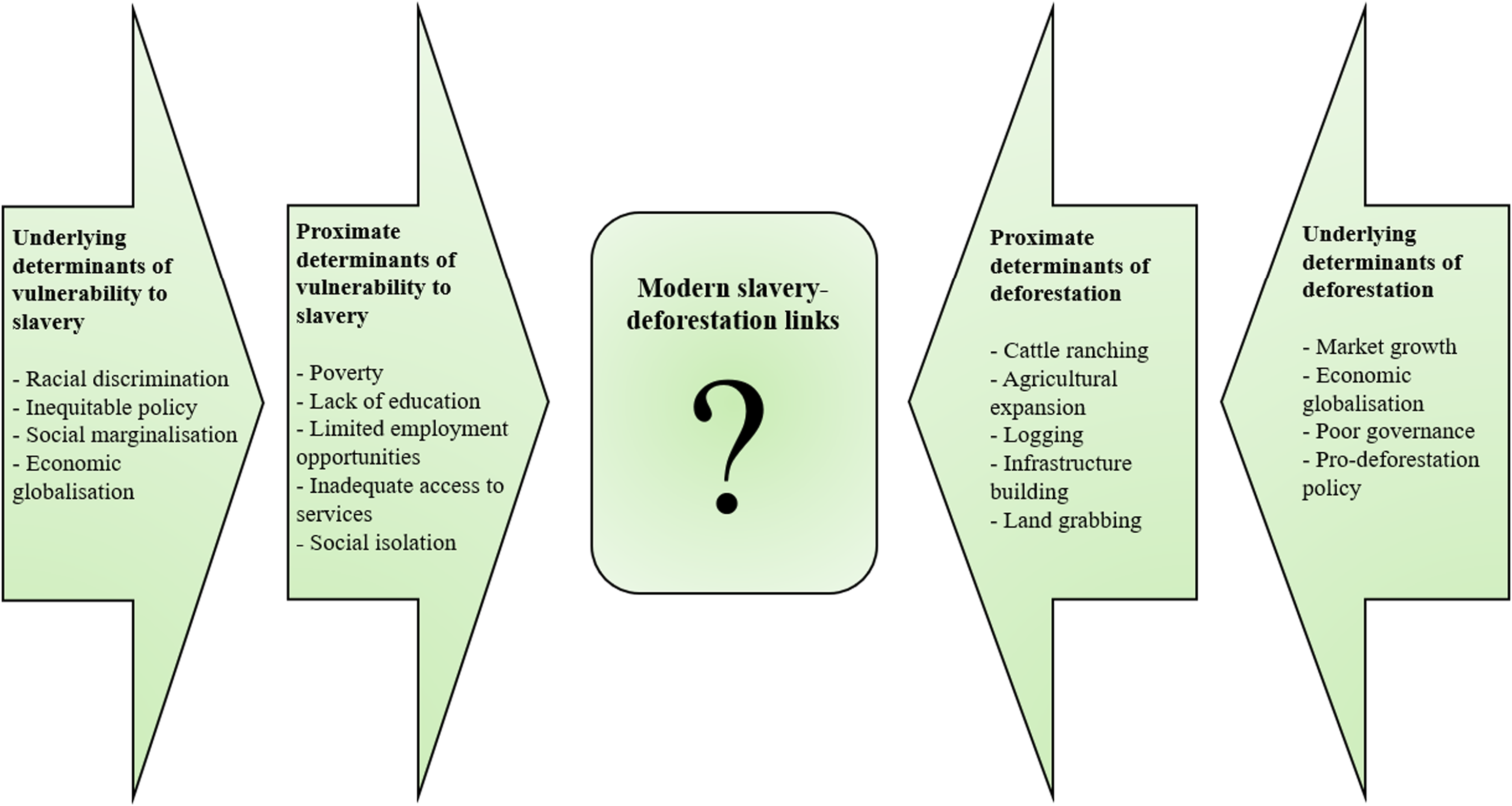
A conceptual framework based on wider academic literature, illustrating underlying and proximate determinants of slavery and deforestation, alongside the unexplored link between them.
Brazil has two long standing institutions that address modern slavery and deforestation independently. GEFM and IBAMA's work in combating slave labour and environmental crime have been praised for their innovative and successful actions (Bales, 2016; Hochstetler, 2017). When modern slavery's presence was recognised in Brazil in 1995, GEFM was created to conduct anti-slavery operations through surprise inspections (Francelino-Goncalves-Dias, 2013; McGrath, 2010). Partnering with mobile courts enables GEFM to free victims and force their perpetrators to immediately pay workers compensation (Bales, 2016; McGrath, 2010; Philips and Sakamoto, 2012), which has released 56,021 individuals since its establishment (GOV.BR, 2021).
IBAMA was formed in 1989, to monitor, conserve and implement environmental law (Feeney, 1992; Rylands and Brandon, 2005). Alike GEFM, IBAMA detects environmental crime by conducting inspections, where they issue fines, stop operations and seize illegally extracted materials (Bales, 2016; Feeney, 1992; Rylands and Brandon, 2005). For example, in March 2021 IBAMA confiscated 1,630 m³ of wood illegally harvested from indigenous lands (IBAMA, 2021). Despite IBAMA being a renowned institution (Hochstetler, 2017), their performance under the Bolsonaro presidency was the lowest since their establishment, with devastating consequences for deforestation in the Amazon (Ferrante and Fearnside, 2019). As poor regulation for deforestation and policy for slavery are underlying determinants established in the conceptual framework (Figure 2), assessing their successes and challenges, alongside their implications in relation to the conceptual framework is paramount to build upon for future tactics (Cairney, 2013).
Methodology
Methodological approach
The Brazilian Amazon was chosen as a single case study because evidence shows that debt bondage and deforestation are major issues there, which presents an opportunity to investigate the understudied slavery-environment nexus in its real-life context and build a conceptual framework (Crowe et al., 2011). A critical realist approach was embraced, owing to its compatibility with case study research and emphasis on gaining an in-depth understanding of a phenomenon (Bryman, 2016). Mixed qualitative methods entailing document analysis of 10 reports and 20 semi-structured interviews were conducted to fulfil the research objectives.
Document analysis
Document analysis was the primary method employed, which treated documents as a source, according to details and actions they can reveal about the material world (Moe and Karppinen, 2012; Prior, 2008). The 10 documents analysed focused on three components: modern slavery, deforestation and IBAMA or GEFM evaluations (see Appendix 1 for the list of documents analysed). Analysing secondary documents raises concerns of inadequate detail and focus (Bowen, 2009; Bryman, 2016), however purposive sampling was applied to obtain reports from credible organisations that sufficiently covered the research objectives (Kohlbacher, 2006; McDonagh et al., 2013; Sharma, 2017). These documents provided a preliminary base of evidence that was assessed to explore links between them.
For analysis, an exploratory abductive approach was adopted, because not only does critical realism favour abduction (Vincent and O’Mahoney, 2018), but the current gap in the literature necessitates investigation through an iterative process between current theory (see Figure 2) and data collection (Porta, 2008; Swedberg, 2020). The documents were analysed through NVivo, where a two-stage process of semantic and latent thematic analysis was applied – the former extracts explicit statements (King et al., 2019; Terry et al., 2014), followed by the latter uncovering implicit meaning among the data (Terry et al., 2014; Willig, 2014). For initial guidance the research objectives were split into five topics: proximate determinants of vulnerability, underlying determinants of vulnerability, slavery-deforestation links, IBAMA inspections and GEFM inspections. Coding was deductively guided by the conceptual framework but remained open for new themes to inductively materialise (Bryman, 2016; King et al., 2019; Laws et al., 2003; Rapley, 2018). Thereafter, connections between codes under each topic were drawn and attributed to a theme (Berg and Lune, 2013; Lichtman, 2014), which ultimately provided a primary analysis and direction for the interview guide.
Semi-structured interviews
Following document analysis, 20 semi-structured interviews were conducted via an online platform with diverse stakeholders, including academics (6), NGOs (4), journalists (4) and civil servants (6). Civil servants included labour and environmental inspectors, prosecutors, and government officials. Interviews with diverse stakeholders were sought to enable interviewees to express their unique experiences (Bryman, 2016), and accumulate a well-rounded body of evidence from different perspectives (Kohlbacher, 2006). Accordingly, triangulation among interviewees reduced bias by not weighting the data towards one viewpoint (Denzin, 2017; Flyvbjerg, 2006; Mabry, 2008). Information orientated and snowball sampling were used to identify participants. The former sought interviewees based upon their breadth of knowledge on the research objectives (Flyvbjerg, 2006), by searching for contributions from academics, NGOs and journalists on modern slavery and deforestation. Snowball sampling following interviews that had been secured facilitated access to hard-to-reach interviewees, such as civil servants (Bryman, 2016; Laws et al., 2003; Sharma, 2017).
The interviews established rapport through a collaborative interview style that asked open-ended questions (Rapley, 2004), which resulted in planned and spontaneous questions differing among interviews. Participants had flexibility in choosing what they felt was important to discuss (DeJonckheere and Vaughn, 2019), aiding the exploratory approach adopted. Language difference was the greatest barrier for conducting interviews (Laws et al., 2003; Squires, 2009); to overcome this a translator was hired to translate 5 interviews in real time. Concerns with translation have been raised regarding concepts not being directly translated or meanings diluted (Berman and Tyyska, 2011), therefore meetings prior to interviews were organised to ensure conceptual equivalence could be achieved (Laws et al., 2003; Squires, 2009).
Interviews were recorded, transcribed and analysed on NVivo. The exploratory abductive approach for the interviews mimicked document analysis – semantic and thematic analysis were applied, including inductive and deductive coding according to the five topics, conceptual framework (see Figure 2), and themes derived from document analysis. The document and interview findings were triangulated to strengthen validity and rigour (Denzin, 2017; Kohlbacher, 2006), retaining themes with reiterative supporting data, whilst disregarding themes that lacked evidence (Lichtman, 2014). Following this, axial coding was employed to classify relationships, similarities and disparities within and between themes (Berg and Lune, 2013; Lichtman, 2014) (see Appendix 2 for a map of the coding process).
Ethical considerations
Document analysis possesses no significant ethical issues, due to its non-intrusive nature and being situated in the public domain (Bowen, 2009; Moe and Karppinen, 2012; Rapley, 2018). Interviews are likewise non-intrusive when conducted on an online platform, however, they do impede on participants’ time (Bryman, 2016). To reduce disruption, they aimed to be 30 min in duration. Ongoing informed consent was adopted (Miller and Bell, 2012), which could have been withdrawn at any point during and after the research. As actors tackling slavery and deforestation are subjected to severe violence in Brazil (Bales, 2016), confidentiality and anonymity were maintained thoroughly. These ethical procedures extended to the translator (Berman and Tyyska, 2011).
Whilst interviewing people who had experienced enslavement would have undoubtedly added valuable new insight, they were not included, according to accessibility and ethical issues (Miller and Bell, 2012). For participants who were interviewed, the topic may have been distressing, therefore the interview guide was perceptive, and empathetic communication was upheld (Lee, 1993). Furthermore, a Northern researcher representing a non-Western context raises concerns of imposing a Northern discourse on the data, and in turn misrepresenting findings (Laws et al., 2003; Willig, 2014). To reduce potential distortion the researcher reflected on their prejudices, assumptions and positionality throughout the research process (Laws et al., 2003; Mortari, 2015), to strive for legitimate interpretation through participants’ eyes that was justified by robust evidence.
Research findings
In accordance with the research aim and objectives, semantic and thematic analysis established proximate and underlying determinants of vulnerability, slavery-deforestation links, and assessed GEFM and IBAMA's inspections under Bolsonaro's presidency. These components are presented sequentially, synthesising similarities, differences, and connections within and among each section.
Proximate determinants of vulnerability
Documents and interviews showed that proximate determinants of vulnerability are multi-faceted, whereby several determinants were identified to be consistently applicable to individuals subjected to slavery in the Brazilian Amazon. The most significant determinants prevailed as poverty, lack of access to land, lack of education and social isolation. Poverty was depicted as the most important determinant of vulnerability by documents 1, 3, 4, 5, 6, 9 and all participants. Income-related poverty from limited work opportunities results in an inability to obtain necessities. However, for all participants, but only documents 3 and 5, income deprivation was not a lone explanation of poverty; rather absence of wealth due to a lack of access to land was deemed a core cause of poverty. The consequence of an inability to subsistence farm or produce agricultural goods to sell was concisely summarised by participant A: ‘No jobs and no land means people haven’t got any options in rural areas’.
Lack of education was regarded by documents 3, 4, 5, 6, 7 and most interviewees as an additional layer of deprivation leading to vulnerability. A nuanced explanation of the relationship between education and poverty was offered by academics. Academics identified a reinforcing relationship – an individual living in poverty withdraws from education early to gain income through the only occupation available to them. Their incomplete education means that they do not acquire qualifications and skills, limiting their employment prospects to unskilled labour and rendering them more vulnerable to slavery. Participant B gave a contextualised account of the relationship between poverty and education that produces vulnerability over time: ‘There’s high rates of people who leave school early, especially in areas where there's a lot of agriculture, because there's not enough incentive to stay in school, […] so they will start working as a child and because they've never had another opportunity this will lead them to the kind of situation where they fall into slave labour’.
Interactions between poverty, lack of access to land and lack of education were found to not be consistent throughout Brazil, but are concentrated in the North and Northeast states – Maranhão, Piauí and Tocantins. Participants explained that these states are providing a supply of slaves due to geographical inequalities of insufficient work and education opportunities, poor public services and inadequate infrastructure. The deprivation experienced in the North and Northeast states generates relative vulnerability, fuelling outward migration in pursuit of work. Social isolation caused by migration was not as prominent as the earlier proximate determinants disclosed. Nevertheless, documents 1, 3, 4, and interviewees from multiple expertise, emphasised migration's significance in contributing another layer to ongoing vulnerability. Migration dismantles social ties, networks and support, resulting in social isolation, which is reproduced by the gatos facilitating debt bondage in the Amazon to maintain their victims’ vulnerable position and continue exploitation. Accordingly, proximate determinants entail an interacting process before and during exploitation, characterised by having no reasonable alternative of survival that corresponds to an individual's socioeconomic circumstances.
Underlying determinants of vulnerability
Underlying determinants that draw a causal line to proximate determinants are also multifaceted, and include unequal land distribution, racial discrimination, policies undermining distribution, and economic globalisation. There was a strong consensus among documents 1, 3, 4, 5, 7, and academics, journalists, and NGOs, that land ownership is concentrated in a few powerful hands, leaving many landless. This has considerable impact on vulnerability, because the North and Northeast states economy is heavily weighted towards farming, therefore participation in the market depends on owning land to farm crops and livestock. The landless majority are unable to grow their own food or sell goods, forcing them into a position where they must sell their labour to survive. In a context of limited opportunities and inadequate access to public services, the potentiality of exploitation is heightened.
Racial discrimination was acknowledged by documents 3, 4, 7, and half the interviewees as being intimately linked to vulnerability, disclosing that black and biracial individuals are overrepresented in slavery, attributed to their disproportionate experiences of poverty and lack of education. However, only document 4, academics and journalists confronted that racialised ideology has been harnessed to legitimise excluding the black and biracial population from equal opportunities throughout history, with the most crucial opportunity being land accumulation. Legacies of unequal land distribution continue to block access to land today, creating deprivations described by the proximate determinants of vulnerability. Participant C offered a visualisation of the impact racial discrimination has on vulnerability and slavery: ‘If you go [to the Amazon] to see the workers, they’re darker skinned and come from the states of Northeast Brazil to work, but they didn't have the same opportunities as the landowners, so the whole area was built in inequalities, which you can see in the operations of slave labour. […] They have dark skin, are poor and don't have their own land, so they have to work for these landowners’.
Legacies of unequal land distribution and accumulation were criticised for being sustained by Bolsonaro's political agenda and subsequent economic policies. Academics indicated that Bolsonaro had an agenda to occupy and convert the Amazon into economically productive land, which is underpinned by the desire to participate in the global economy. Document 4 and most interviewees recognised that Bolsonaro's agenda represented powerful landowners and agribusinesses interests, because they are the actors gaining and economically benefiting from land accumulation, not the black or poor population. Bolsonaro disparately benefiting those with relative advantage was stated by participant D, and his objective in practice is explained by participant E: ‘In the political context of Brazil, the government is one that does not care for the interests of the environment, or the poor workers that could be exploited. It’s much more catering towards the big landowners and exactly the people who are using slavery’.
‘Now what we tend to find is the state facilitating [landowners and agribusinesses] with tax breaks, subsidies and very lax laws’.
Academics furthered that Bolsonaro's agenda was tightly connected to economic globalisation and the production of vulnerability. Bolsonaro's national level policies reduced production costs, in turn increasing agribusinesses competitiveness and facilitating participation in the global economy. This participation enabled agribusinesses to gain more wealth and power; thus, concentrated land assets, in conjunction with biased economic policies, acted as a trajectory that reproduced and exacerbated inequalities.
Modern slavery-deforestation links
Slavery-deforestation links were found to have a reinforcing relationship – drivers of deforestation create a demand for slave labour, whilst the supply of slaves are used within deforestation associated sectors. Important characteristics, including interconnected sectors, stage of production, criminal networks, impunity and geographical isolation, offered crucial insight into the relationship's mechanics. There was strong agreement among interviewees that slave labour is not solely utilised in direct deforestation, but is present among an ongoing chain of interconnected sectors. From logging, to land clearing, to cattle ranching, to agricultural plantations. Within these sectors tasks performed by people in slavery varied according to the industries’ requirements, however, slave labour being concentrated at the bottom of the supply chain was a commonality among all sectors.
Slave labour can be present in legal deforestation, however documents 1, 2, 3, 8, 7 and 10 emphasised that slavery and deforestation manifest in illegal contexts. Illegality is facilitated by criminal networks connected to powerful landowners, state officials and militias, who organise multiple associated crimes and human rights abuses. Academics and civil servants further disclosed that criminal networks can continue illegal deforestation and slavery owing to the Amazon's geographical isolation reducing the probability of being caught. Geographical isolation's prominence in inhibiting informants and inspections that can lead to detecting criminal activities is exemplified by participant F: ‘It’s important to understand that a lot of these places are very difficult to access, so the geography of the place makes it easier to use slavery, because once people are there, they’re unable to leave. Also, because of the difficult access it's more expensive and difficult to have inspections’.
Individuals experiencing slavery are deterred from leaving and seeking help, because they are segregated from cities by vast forests and thus cannot inform authorities of their exploitation. Geographical isolation's importance was exemplified by participants disclosing that inspections are dependent upon informants, because the Amazon's remoteness results in an inability to frequently monitor the area. Two academics challenged this notion, revealing that slavery is not always unreachable distances from communities, claiming that if a person in slavery does reach a town and inform local authorities, the landowner's status and identity means that they are likely to have political influence there. Consequently, lower socioeconomic status and less political leverage means that their claims will be disregarded. Despite contrasting opinions, there was consensus that geographical isolation reduces the probability of being caught.
Environmental inspectors and academics with expertise in deforestation identified satellite imagery as a revolutionary method that makes evading detection harder for perpetrators. Though satellite imagery increases the likelihood of detection, academics with expertise in slavery noted that shorter enslavement periods counteract progress in exposure. Illegal land clearing and logging necessitate fast paced work in a small timeframe, shortening the window of opportunity for inspectors to react and catch illegal activities. In addition to a low probability of being caught, documents 1, 3, 4, 5, 7, 8, 10, alongside all participants, recognised that a culture of impunity contributes to ongoing illegal deforestation and slavery. When slave labour or deforestation are detected punishments rarely result in prison sentences, because the judicial system works in favour of landowners and agribusinesses, by commonly reducing sentences to fines that are too small or not paid. Consequently, the ability and willingness to engage in slavery and surrounding illegal activities continues. The magnitude of impunity is highlighted by document 3 and validated by participant G's example: ‘Impunity has proved to be one of the main obstacles in the fight against slave labour in Brazil. Despite the sanctions provided […] against individuals who practice slave labour, the number of landowners punished for this crime is still low’.
‘I did some data analysis of fines issued by IBAMA and corrected the amount following inflation over the years. I found that R$59.3 billion, the equivalent of US$ 11.5billion, has not been paid, because you can dispute and challenge and so on’.
Labour and environmental inspections
Documents and interviews revealed that GEFM and IBAMA's inspections can be effective means to combat slave labour and environmental crime, yet they experienced a lack of funding and recruitment under Bolsonaro's presidency. Documents 1, 3, 4, 5 and 10 praised GEFM and IBAMA for implementing anti-slavery and environmental laws. Civil servants added that GEFM and IBAMA partner with other actors, such as NGOs and local authorities, enhancing their capacity to organise successful operations through a collective effort. Civil servants and journalists stated that GEFM and IBAMA operate at the same stage (inspection), and the illegal activities are closely related. Despite these similarities, collaboration between institutions was limited to notifying where slave labour may be occurring, and vice versa.
The document's tone changed from praising GEFM and IBAMA's operations, to condemning the state's blatant demobilisation tactics – a trend first recognised by document 10 under Dilma Rousseff's presidency and continued under the Bolsonaro government. Documents 4, 7 and 8 concurred with interviewees that GEFM and IBAMA experienced a lack of state support, markedly through halting recruitment and cutting funding, undermining their capacity to carry out inspections. Recruitment had strategically ceased in both institutions. As a result, inadequate human resources means that operations could not investigate all new intelligence, forcing some inspections to be done at others expense. Relatedly, cuts to funding reduced available resources necessary for inspections, such as transport, fuel, GPS and accommodation. Academics and journalists added that this decelerates processes of gathering information, planning and travelling to sites, which is important in deforestation contexts, as activities are organised in short timeframes by criminal networks to elude detection. Hence, successful inspection is dependent upon reaching the area quickly. Participant H emphasised that a lack of funding and personnel has greater adverse impacts in rural contexts: ‘It’s quite problematic, the labour inspector’s department don’t have a lot of financial or human resources, […] so they have to choose which rescue to do, affecting how to tackle modern slavery. Especially in difficult areas like the Amazon region, because you need a lot of money, a lot of equipment and a big team to go inside the forest and do the rescue’.
Two civil servants challenged the impact of cuts to funding, revealing that NGOs have provided financial support to continue inspections, reemphasising their ability to succeed when collaborating with other actors. Nevertheless, documents 4, 7, 8, and all participants criticised Bolsonaro's agenda, arguing that landowners and agribusinesses leveraged their power to stimulate Bolsonaro's demobilisation tactics that favours their interests. The prominence of unequal power in manipulating the political context was expressed by participant I: ‘Farmers are very rich and politically influential, […] they don’t only have economic power, but they also have political power and are represented in international congress. They have so much power that they have approved many laws recently that weaken labour and environmental inspections, so they are politically and economically very strong’.
Academics further attributed agribusinesses’ capacity to influence the demobilisation of GEFM and IBAMA to economic globalisation. Agribusinesses participation in the global economy amplifies their economic and socio-political power through generating huge profits. Subsequently, agribusinesses can successfully push agendas that reduce production costs and risks of being caught, in turn enabling illegal deforestation and modern slavery.
Discussion
To interpret the research's significance, contributions to the current state of knowledge and conceptual framework are outlined. Followed by applying a social exclusion lens to understand proximate and underlying determinants of vulnerability, alongside discussing why the risk of detection explains slavery and deforestation's continuation. Finally, research limitations in reference to methodology, transferability and generalised vulnerability are considered.
Contributions to the current state of knowledge
Case studies have typically analysed the use of slavery within environmentally harmful activities through a lens of criminality (Brown et al., 2019), which packages these issues as one of crime and lawlessness (Nurse, 2017). Utilising a lens of criminality as a conceptual tool when framing deforestation and slavery impacts the conclusions and recommendations of a study (Martin, 2019). The conceptual framework outlined in Figure 3 contributes a novel approach by combining a vulnerability and criminality lens to investigate vulnerability to slavery, slavery-deforestation links, and efforts to tackle both issues. Combining two lenses brings multiple perspectives and therefore takes a holistic view necessary to research complexities among slavery and deforestation.
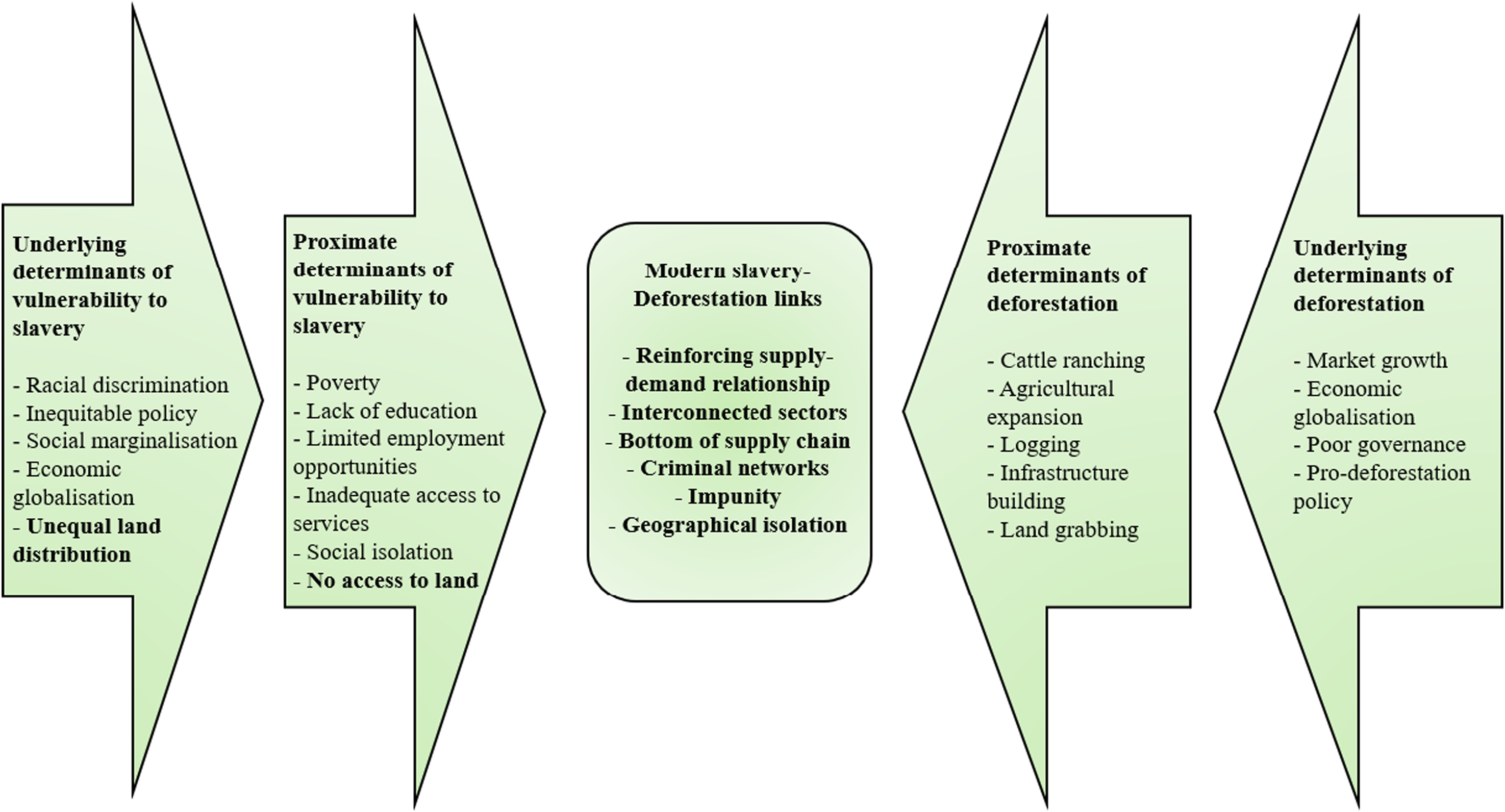
A conceptual framework of the proximate and underlying determinants of vulnerability, alongside slavery-deforestation links. Words in bold represent findings that have contributed to the current state of knowledge.
The results confirmed the significance of all proximate determinants of vulnerability, and distinguished lack of access to land as an additional interacting layer of vulnerability. For underlying determinants, racial discrimination, economic globalisation and policy that undermines distribution concurred with the literature, whilst unequal land distribution added another important determinant. Mapping proximate and underlying determinants treats vulnerability to enslavement as relational and systemic, but the current literature has failed to distinguish between these intersecting determinants (see Hummell and Emrich, 2016; Issa, 2017b; Jackson and Sparks, 2020; Kara, 2017; Larsen and Durgana, 2017). Accordingly, the research has mapped multidimensional and multi-layered relations within and between proximate and underlying determinants, which contributes a conceptually clear understanding of how vulnerability experienced at the individual level is produced by wider structural processes.
Modern slavery and deforestation have been studied as independent phenomena within academic literature (Bales and Sovacool, 2021), impeding the ability to exhaustively understand their relationship and inform effective action (Sparks et al., 2021). The artificial divide has been bridged by the findings explaining how and why they are linked. Several slavery-deforestation connections were contributed, including a mutually reinforcing slavery-deforestation relationship occurring among interconnected sectors at the bottom of the supply chain, which is facilitated by criminal networks experiencing impunity and harnessing the Amazon's geographical isolation to continue labour and environmental exploitation. Furthermore, the research provided an assessment of GEFM and IBAMA's foundations for success, but Bolsonaro's demobilisation tactics that reduced the probability of perpetrators being caught undermined their effectiveness. The research has therefore generated contextualised slavery-deforestation insight under Bolsonaro's presidency in the Brazilian Amazon. This ultimately contributes empirical evidence to support the emerging slavery-environment nexus.
Lens of social exclusion
Proximate determinants of vulnerability – poverty, lack of education, social isolation and lack of access to land – are all forms of deprivation. Meaning they are mechanisms placing an individual at a social, political, or economic disadvantage (Dean, 2016; Devicienti and Poggi, 2011; Mitra and Biller-Andorno, 2013). Deprivation is not an inherent or natural state (Mosse, 2010); rather social exclusion is drawn upon as a power-laden process denying certain people access to social, political, or economic resources, whilst simultaneously including others, thus creating inequalities (Dean, 2016; Devicienti and Poggi, 2011; Haan, 2009; Santiago and Akkari, 2020). Social exclusion explains relative deprivation – structural mechanisms that exclude a group increase disadvantage and therefore vulnerability (Burchardt et al., 2002a; Kahn, 2012; Mario and Woolcock, 2008). Accordingly, underlying determinants of vulnerability explain the social exclusion process, as proximate determinants (deprivations) are generated by underlying determinants (social exclusions) (Blaikie et al., 2003).
The proximate determinants and thus deprivations established generate vulnerability by placing a person at a relative disadvantage, where they can be exploited by individuals with greater social, political, and economic power (Dean, 2016; Haan, 2009; Kerner, 2017). Types of deprivation do not act individually; they intersect to produce disadvantages and unequal socioeconomic positions (Beato, 2004; LeBaron et al., 2018; Li, 2015; Philips and Sakamoto, 2012). Taking poverty and lack of education for example, Mario and Woolcock (2008) state that in Brazil less years in education yields lower income returns, reinforcing income inequality. The connections observed in the results, concurs with Mario and Woolcock's (2008) findings, adding that lack of access to land, in addition to poverty, explains lower education levels and exacerbates poverty. Social exclusion processes in the form of underlying determinants were found to be unequal land distribution, racial discrimination, policies undermining distribution, and economic globalisation. Contrary to economic globalisations significant presence in the literature (see literature review), only academics stated its importance in producing vulnerability, by driving unequal land accumulation with the purpose of participating in the global economy. The dominant discourse frames economic globalisation as an inevitable, naturalised process outside the state's control (Flinders and Buller, 2006; Horsfield, 2002). Subsequently, economic globalisation is a taken for granted assumption of how society operates and therefore is not immediately obvious (Blaikie et al., 2003; Horsfield, 2002), which may explain its limited presence among the results. The wider literature that identifies economic globalisation applies a political economy lens, politicising economic relations by exposing power inequalities over spatial and temporal scales (LeBaron et al., 2018; McGrath, 2010). The political economy goes a step further to reveal what determines social exclusions – a process not investigated in the research here, but is nevertheless advantageous in adding a politicised account of social exclusion.
The political economy places importance on power throughout history (McGrath, 2010), whereby social exclusion does not occur instantaneously, but is an artefact of the past (Devicienti and Poggi, 2011; Kerner, 2017). Connecting historical events to the present is essential in contextualising underlying determinants of vulnerability to promote a critical politicised understanding (Diptee, 2017; Kerner, 2017; O’Connell et al., 2021). Racial discrimination can be traced back prior to capitalism's development, to colonisation, where racism had ideological prevalence legitimising slavery (Araujo, 2016; Klein and Luna, 2010). Afro-descendants were viewed as uncivilised and inferior, ascribing them a lower status that justified their exploitation and deprivation from social, economic, and political capital (Ridgeway, 2014; Shaw, 2005; Shecaira, 2002). Slavery is tied to capitalism's development in Brazil, as slave labour had a critical role in producing sugar and coffee that was sold to the UK and US, leading to Brazil's ability to enter the world economy as an exporter (Araujo, 2016; Meade, 1978). This permitted Brazil to develop a capitalism characterised by capital accumulation, asset ownership and competitive markets (Meade, 1978), which is enshrined with racist legacies, exclusion and inequality.
Relations between racism and Brazil's economic system can explain why Brazil has one of the most unequal land distributions in the world, with a 0.73 land Gini-coefficient (WCMC, 2020). Scholars have emphasised that the 1850 Lei de Terras law has contributed to Brazil's land distribution issues and persistent inequality (Albertus et al., 2018; Damasceno et al., 2017; Oliveira, 2013; Silva, 2015; Wilkinson et al., 2012). As slavery came closer to abolition, landowners lobbied for the Lei de Terras law, where land ownership could now be gained through purchase, rather than occupancy (Albertus et al., 2018; Damasceno et al., 2017). Implementing land regulation was a deliberate strategy to keep people previously enslaved asset and income poor, making them dependent on landowners for survival, and maintaining conditions suitable for exploitation (Albertus et al., 2018; Meszaros, 2013). Land exclusion legacies have persisted throughout Brazil's history, whereby capital accumulation through land has been offered to agribusinesses and non-Afro-descendants from the South and Southeast (Figueira and Esterci, 2017; Reydon et al., 2015), not the poor black population from the North and Northeast. Or land has been taken illegally by those who have resources to do so (Oliveira, 2013), concentrating land gains among individuals who already possess relative advantage. Consequently, race-class intersections justify a cycle of unequal power relations, whereby individuals who embody higher socioeconomic positions have the capacity to maintain or enhance their interests (Kahn, 2012). This becomes visible through academics consistently reporting that Afro-descendants are poorer, less educated and have lower political representation (Baptista et al., 2018; Beato, 2004; Kara, 2017; Li, 2015; Salata, 2020; Santiago and Akkari, 2020). Demonstrating that social mobility is structurally inhibited by racial-class discrimination and unequal land distribution, perpetrating inequality throughout generations (Hunter and Sugiyama, 2009; Li, 2015; Mario and Woolcock, 2008; Salata, 2020).
The academic literature and research findings agree that over time elite interests have been maintained, according to structural inequalities determining whose voice is heard and acted upon (Li, 2015; Mosse, 2010). The elite experience economic inclusion, which gives them social and political power to influence decisions and drive forward their objectives (Albertus et al., 2018; Ferrante and Fearnside, 2019; Hunter and Sugiyama, 2009; Kahn, 2012; Reydon et al., 2015). This reality highlights the multidimensional nature of economic globalisation in influencing both the determinants of vulnerability and the ability to influence political decisions in the Brazilian context. The agenda to participate in the global economy drives unequal land accumulation, which increases inequality and thus vulnerability (Philips and Sakamoto, 2012); whilst simultaneously granting agribusinesses further economic power to influence political decisions, such as GEFM and IBAMA's demobilisation. Subsequently, economic globalisation intersects across multiple components within the slavery-environment nexus.
Whilst elites are undoubtedly enhancing their interests, social exclusion is a social, not individualistic process, therefore ideology's role in decision making beyond economic globalisation is important to highlight (Sikkink, 1991; Silva, 2020). The Bolsonaro government was criticised by documents, interviewees and academics for attacking environmental and labour protection (Ferrante and Fearnside, 2019; Silva, 2020; Taddei et al., 2020; Webber, 2020). Bolsonaro's overt beliefs correlate with extremist far-right ideology, involving racist, sexist, xenophobic, homophobic, anti-environmental and pro-economy sentiments (Fagundes, 2020; Webber, 2020). Far-right ideology justifies and naturalises inequalities, translating into Bolsonaro's policies increasing vulnerability to enslavement and destroying the environment. Not only did Bolsonaro cut funding and recruitment for inspections, which has promoted further land accumulation among the elite (Carrero et al., 2020), he also financially assaulted social assistance programs, cut education budgets and lifted gun controls (Hennigan, 2020; Philips, 2019; Santiago and Akkari, 2020; Taddei et al., 2020). In this regard, the Bolsonaro government exacerbated determinants of vulnerability, by socially excluding individuals with lower socioeconomic status through policy, whilst simultaneously biassing large-scale business interests that worsen deprivation and inequality.
Diminishing risk of detection
The close relationship uncovered between modern slavery and deforestation that is characterised by interrelated sectors at the bottom of the supply chain, geographical isolation, criminal networks and impunity, persists according to low risks of being caught and penalised. This is worsened by GEFM and IBAMA's demobilisation, which began during Dilma Rousseff's presidency in 2011 (Hochstetler, 2017), but continued to be aggravated by Bolsonaro. Some scholars have argued that criminal endeavours are responsive to higher detection and punishment risks (Becker, 1968; Bun et al., 2020; Nagin, 2013), whereas others claim that understanding crime through risk is too simplistic, because wider socioeconomic influences can override deterrents (Ashish, 2014; Lee, 2017). For example, Francelino-Goncalves-Dias (2013) claims that cattle ranchers exploit slavery in Brazil because of pressure to reduce costs from powerful international companies higher in the supply chain. Whereas Philips and Mieres (2014) contend that inadequate regulation at the bottom of supply chains lowers risk of detection, which permits exploitation. In practice, criminal activity is likely to continue because of a mix of socioeconomic pressures and associated risks (Ashish, 2014), however the slavery-deforestation links found here affiliate more with detection and punishment risks.
Within cattle ranching, agriculture, logging and charcoal production, the research found that slavery is concentrated in initial stages of production that correspond with unskilled manual labour (Crane, 2013; Gold and Trautrims, 2015; Phung, 2018). Economic globalisation has resulted in domestic and global supply chains having multiplex structures, geographies and governance characteristics, impacting how they operate and are regulated (Crane et al., 2017). Complex production networks result in slavery being connected with innumerable goods throughout the world (Bales, 2000; Gold and Trautrims, 2015). This reality is attributed to difficulties in regulating supply chains, because the more fragmented a supply chain is, the less transparent suppliers become beyond the direct contractor, which increases difficulty in assuring a suppliers’ legitimacy (Bitran et al., 2007; Crane et al., 2017; Phung, 2018). For instance, Kim and Davis (2016) provide evidence demonstrating that greater diversification among supply chains results in companies being less able to verify their sources. Accordingly, the distance between legitimate companies selling goods on the market and the products origin, increases invisibility and reduces transparency (Gold and Trautrims, 2015). Poor transparency is further strengthened when illegitimate activities are involved, because of criminality's hidden nature, alongside regulators’ inability to monitor these hidden segments (Crane, 2013; Gold and Trautrims, 2015). Hence an inability to regulate criminal activities at the bottom of the supply chain decreases the risk of detecting slavery and illegal deforestation.
Characteristics beyond distant supply chains that further diminish risk can be found among slavery and deforestation's geographical isolation. Crane (2013) argued that geographical isolation is a necessary component for criminal networks to elude regulation and continue exploitation – a trend observed in cattle ranching in Brazil (Philips and Sakamoto, 2012), fishing boats in Thailand (Marschke and Vandergeest, 2016) and shrimp farming in Bangladesh (Jackson et al., 2020a). Geographical isolation prevailed as an important slavery-deforestation link, owing to difficulties in gaining intelligence and infiltrating criminal activities, providing evidence of slavery's invisibility and regulatory challenges in the Brazilian Amazon. An additional intersection can be uncovered between slavery-deforestation links and vulnerability, as geographical isolation is not only harnessed to reduce risks, but it is also a tactic to maintain an individual's vulnerability through social isolation (Baptista et al., 2018; Crane, 2013; Kara, 2017; Phung, 2018). Debt bondage in the Brazilian Amazon is tied to outward migration from the North and Northeast (Bales, 2016; Fearnside, 2008; Philips and Sakamoto, 2012), which depletes social networks and therefore increases vulnerability (Crane, 2013). Subsequently, understanding geographical isolation within the slavery-deforestation nexus appears two-fold: it reduces risks of illegal activities being detected, whilst contributing to the ongoing vulnerability characterised by the individuals being exploited.
The Brazilian state has a responsibility to defend its citizens’ human rights and uphold environmental protection (Bales and Sovacool, 2021; Webb and Garciandia, 2019), however, Bolsonaro demobilised GEFM and IBAMA, which reduced the risk of detecting criminal networks and enhanced impunity. For instance, it is uncoincidental that the start of Bolsonaro's presidency in January 2019 corresponds with a 47% increase in deforestation from 2018 to 2020 (Junior et al., 2021); or that during the same time-period freed slavery victims by GEFM in the Amazon dropped by 23% (CPT, 2021). Similarities can be drawn among GEFM and IBAMA – they focus on interconnected issues and are experiencing similar demobilisation tactics that constrain their resources. Yet collaboration is lacking between them. Research has shown that multi-agency coordination to tackle crime can be an effective strategy to overcome a single intervention's challenges (Broad and Turnbull, 2019; Nurse, 2017). In particular, synergetic action can scale down resources needed to achieve a goal (Pedercini et al., 2019), and thus can withstand resource constraints. However, slavery and environmental harms have been typically treated as separate issues among research that inform policy interventions (Bales and Sovacool, 2021; Jackson et al., 2020b). Accordingly, the importance of a holistic approach that reframes modern slavery and deforestation as interwoven issues has potential to strengthen efforts to tackle them simultaneously through collaborative policies.
Research limitations
The research's most significant limitations can be identified as Northern document bias, difficulty in transferring findings to other contexts and generalised vulnerability. Firstly, a translator was hired to overcome language barriers and ensure diverse interviewee expertise were incorporated into the research (Denzin, 2017; Mabry, 2008). Due to resource constraints the same could not be applied to documents (Squires, 2009), therefore only English written documents from Northern NGOs were included. Incorporating reports from Brazilian NGOs would have been beneficial in triangulating additional perspectives, because Brazilian NGOs are situated in different contexts and thus embody different cultures, values and norms, influencing a report's research process, interpretation and narrative (Hall et al., 2004; Lee et al., 2007). A document's content reflects an authors or institutions’ positionality (Bryman, 2016), which would have transferred to the results. However, documents were triangulated with interviewees situated in the Brazilian context, therefore Northern bias's impact is likely to be insignificant.
Secondly, the research findings’ applicability across contexts is restricted to three parameters: the Brazilian Amazon, deforestation associated sectors and debt bondage. Different countries have heterogeneous environments, histories, political landscapes, and socio-cultural values that govern slavery and deforestation processes within a society (Bales, 2016; Lerche, 2007; Molinari, 2017). As the research employed a methodological approach bound to case study research that strives to appreciate contextuality and complexity (Flyvbjerg, 2006; Mabry, 2008), the findings cannot be generalised elsewhere. Moreover, different sectors and slavery forms – in this case debt bondage in cattle ranching, agriculture, logging and charcoal production – embody distinctive characteristics that pose specific challenges for combating labour and environmental issues (Bales, 2012; Crane et al., 2017; Philips and Mieres, 2014). To illustrate, geographical isolation prevailed as an important factor in reducing risk, enabling crime and increasing vulnerability through social isolation, whereas in the UK modern slavery is found in nail salons and car washes that are in close proximity with citizens (Williams et al., 2017). Subsequently, the findings cannot be automatically transferred beyond the three parameters without further empirical evidence.
Finally, the case study approach has generated politicised context specific evidence on social exclusion processes and subsequent deprivation, but the findings have only recognised general features of disadvantage that principally apply to people in slavery (Gordon, 2020). People in slavery are not homogenous, because individuals embody dynamic and unique identities beyond race and class, such as ethnicity, gender and age (Kaijser and Kronsell, 2013; Kerner, 2017; Mosse, 2010; Sundberg, 2017), which produce distinctive experiences of vulnerability (Baptista et al., 2018). Consequently, the research does not grasp individual deprivations and inequalities among local social groups or communities (Gordon, 2020). Further bottom-up research that includes participants who have been involved in slavery would provide a means to grasp these nuanced deprivations and inequalities.
Research summary and recommendations
Utilising mixed qualitative methods the research investigated the slavery-environment nexus in the Brazilian Amazon and produced a conceptual framework (see Figure 3) for understanding this phenomenon. The slavery-environment nexus was holistically explored, revealing intersections between vulnerability to enslavement, slavery-deforestation links and the successes and challenges of GFEM and IBAMA's inspections under Bolsonaro's presidency.
Vulnerability is a core mechanism enabling slavery's continuation, which is governed by proximate and underlying determinants. Proximate determinants experienced at the individual level included poverty, lack of access to land, lack of education and social isolation, which are forms of deprivation. Underlying determinants at the structural level entailed unequal land distribution, racial discrimination, economic globalisation and inequitable policies – exemplifying processes of social exclusion. Forms of social exclusion dynamically produce and maintain layers of deprivation, contributing to vulnerability to enslavement. Accordingly, vulnerability is produced by inequalities manifesting within unequal social, economic and political power relations in Brazil.
Slavery-deforestation links revealed a reinforcing relationship between the demand and supply of slave labour within deforestation associated sectors that operate at the bottom of the supply chain in geographically isolated spaces. These characteristics enable slavery's continuation in illegal deforestation processes, by reducing risks of detection through increasing invisibility, decreasing supply chain transparency and thus obstructing effective regulation. Criminal networks that coordinate slavery and deforestation therefore enjoy low risks of detection and impunity, which was emboldened by the Bolsonaro government. Bolsonaro's far-right ideology facilitated labour and environmental exploitation, whilst his actions to demobilise GEFM and IBAMA's inspections through cutting funding and halting recruitment further reduced risks of detection and punishment. Accordingly, the Bolsonaro state was complicit in enabling environmental and human rights abuse to continue in the Brazilian Amazon. However, in 2022 left-leaning Lula da Silva triumphed Bolsonaro in the elections, and has vowed to fight climate change by eliminating deforestation by 2030 (Greenfield and Harvey, 2022; Oppermann, 2022). The presidential change signals strong support for IBAMA, but the breadth of this support for GEFM remains unclear.
Geographical isolation and economic globalisation prevailed multifaceted influences across vulnerability processes and slavery-deforestation links. Geographical isolation is two-fold in reinforcing vulnerability and diminishing the risk of detection – social isolation is tactically applied by gatos to continue exploitation, prevent people in slavery from escaping, and keep perpetrators hidden from regulation. Correspondingly economic globalisation increases vulnerability by encouraging unequal land accumulation, and empowering elites to maintain their interests according to their economic power, whilst simultaneously decreasing the risk of detection through complex supply chain networks. These connections highlight the slavery-environment nexus’ complexity and importance in a holistic approach.
As a practical action to tackle slavery, the research supports redistributing social, political and economic power to alleviate vulnerability, especially towards the North and Northeast populations. As unequal land distribution prevailed as the most important underlying determinant of vulnerability, land reform could be a means to redistribute power, by preventing elite land accumulation, whilst promoting attaining land for the landless. Lula has pledged to alleviate inequalities, notably poverty, for Brazil's historically disadvantaged groups (Oppermann, 2022). A positive change in tackling vulernability to enslavement aligns with Lula's agenda, however the extent to which contentious underlying determinants will be tackled will unfold throughout his presidency.
Further calls to action and synergies between policies are inhibited by an underdeveloped slavery-environment nexus understanding. Accordingly, future research should approach slavery and deforestation in Brazil as intimately tied issues, with an appreciation for contextuality and complexity. Factors that contribute to slavery and deforestations continuation, how, and why, is one area warranting further investigation. Vulnerability at the individual and structural level also necessitates further research. Firstly, perspectives of people who have experienced slavery should be incorporated to move beyond generalised accounts of vulnerability and understand how vulnerability changes according to diverse identities. Secondly, underlying determinants of vulnerability and the dynamics within these processes, alongside relationships between proximate and underlying determinants of vulnerability should be identified and evaluated. Developing these areas through further research would assist in informing synergetic action between GEFM and IBAMA to combat slavery and deforestation.
Highlights
Vulnerability, slavery-deforestation links, and policy interventions are multidimensional, interconnected and necessary components in understanding the slavery-environment nexus holistically.
Underlying determinants of vulnerability are forms of social exclusions shaped by historical legacies, race-class discrimination, and unequal power relations.
Underlying determinants of vulnerability produce multifaceted proximate determinants of vulnerability, which manifest as forms of relative deprivation.
A low risk of detection and punishment facilitated by the operational characteristics of slavery and deforestation support their continuation.
Bolsonaro was complicit in enabling human rights and environmental abuse through his economic agenda and demobilisation of GEFM and IBAMA.
Footnotes
Abbreviations
Declaration of conflicting interests
The author declared no potential conflicts of interest with respect to the research, authorship and/or publication of this article.
Funding
The author received no financial support for the research, authorship and/or publication of this article.

Appendix 1
A summary of the 10 documents analysed, including a brief description of their content and justification, alongside the research objectives each document contributed to.
Appendix 2
An example of the coding process, which attributes codes to a theme, and themes to a topic. Followed by mapping similarities, disparities and relationships within and between themes and topics.