




Abstract
This article is positioned within the Chocó borderlands of Ecuador and Colombia. I delve into the historical and contemporary everyday struggles of two communities within the Santiago-Cayapas Watershed—the Afro-descendant community of La Chiquita and the Awá Indigenous community of Guadualito. Yet, I also discuss the methodological aspects of “us-formation”: the multi-dimensional trials and tribulations of a collective quest for justice. The goal: to situate their largely invisibilized 20+ years of legal struggles against two oil palm companies ‘on the map' and demand reparations. The oil palm companies violate Human Rights and Nature's Rights by contaminating rivers and destroying the sustenance of ancestral communities’ lives. Through honing into the entanglements of collaboratively activating five dimensions of Geographies of Hope-in-Praxis—place, alliances, the (un)thinkable, perseverance/resilience, and the (im)possible—the paper traverses a multi-dimensional journey-destination of interdependent processes: 1) (De)CO 2 loniality: decolonizing research, “official” versions of history, and now, “climate change mitigation development”, that attempt to silence and choke out Indigenous and ancestral peoples and territories; and 2) H 2 Ope: carving out new relational spaces bound together by establishing networks to revindicate human/ancestral rights to water and the rights of La Chiquita River. Geographizing hope reveals that the route toward hope-with-justice is a nonlinear, constantly shifting, unpredictable pluriverse of possibilities ripe for action.
We must come together to fight back. We must join in the struggle because there are many problems here. We, ancestral peoples from this zone—our territory that we love and cherish—must fight to defend her. We defend Nature because it is important to defend Nature.
-Aquilino Erazo, Afro-Ecuadorian community leader and forest protector from San Lorenzo
This is neither an ethnographic paper about “them” nor an autobiographical reflection about me. It is a methodological paper where hope is a journey-destination that unfolds through us-formation. This article emphasizes how long-term, multi-scalar, and multi-dimensional methodologies can transform the purpose of community-based research. Moving from extractive documentation to collaborative action, it becomes possible to bridge distinct cultural approaches and re-orient landscapes of hope towards justice.
In the quote above, Erazo refers to ongoing intercultural solidarity to defend Nature against encroaching oil palm plantations in the Ecuadorian Chocó borderlands—a place resting along the Pacific Ocean and Ecuador's Northern border with Colombia. Since the turn of the millennium, the Afro-Ecuadorian community of La Chiquita, the Indigenous Awá community of Guadualito, and residents of the city of San Lorenzo (Esmeraldas Province) have come together in the hope of clean water (Figure 1). Researchers, activists, and filmmakers throughout Ecuador and the world have since joined them as allies in their struggles. I am another who embarked on this collective excursion through rugged landscapes of hope.
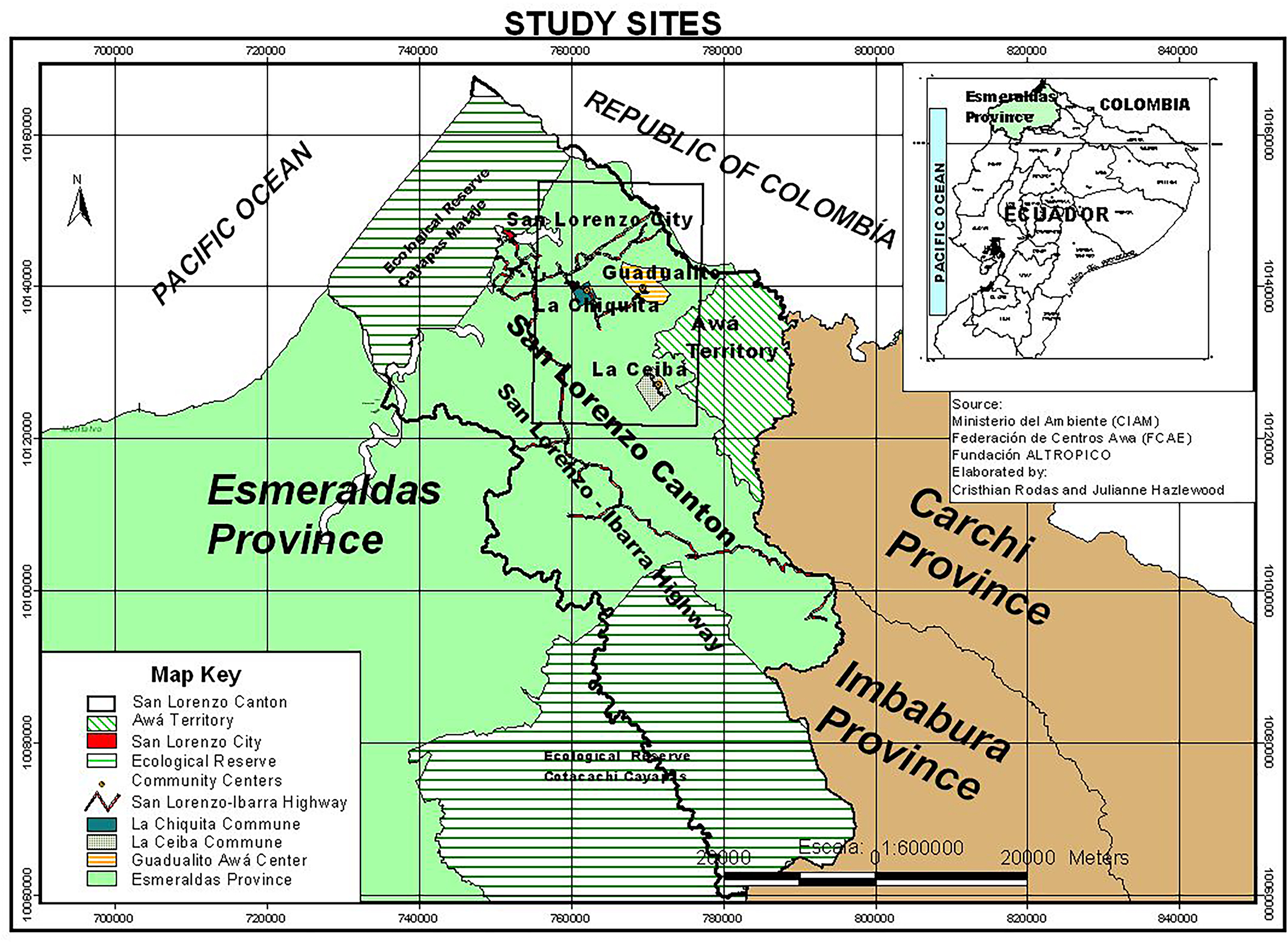
Map of Ph.D. research study sites (2008–2010).
In my research (1997-now) 3 , I “walk with”—accompany and act as an ally (Sundberg, 2006: 2)—Chocó Rainforest communities, investigating the human costs of oil palm monocultures/biofuel production and collectively standing against these purported solutions to climate change. Oil palm trees (Elaeis guineensis) are harvested for their fruit, from which oil is extracted, and biodiesel elaborated. 4 Biodiesel, in turn, is often presented as a better environmental alternative to fossil fuel extraction and, thus, a way to lower carbon emissions and mitigate climate change. 5
This is far from true in the Chocó Biogeographic Region. 6 Palm oil plantations and palm oil extractors have led to severe social, psychological, and environmental damage. 7 Esmeraldas researchers 8 have documented oil palm plantations replacing the last remaining lowland rainforests in Ecuador's Northwest Coastal Province since the late 1990s. Núñez Torres (1998, 2004) and Judge Juan Francisco Gabriel Morales Suarez's 2017 decision 9 verify that oil palm plantations and their extractors contaminate La Chiquita River with toxic chemicals.
As oil palm plantations expand their area and surround ancestral territories, their environmentally and culturally destructive practices generate socio-ecological violence and increasingly urgent circumstances in Northern Esmeraldas. Reaching across cultural differences within and beyond the Ecuadorian Chocó has contributed to visualizing and fortifying the Afro-descendant and Indigenous Awá communities’ struggles to protect their shared river and ancestral rights.
Hope can be understood as rolling out a multifaceted geography replete with topographies and shape-shifting pathways that we can call a Geography of Hope. In the Ecuadorian Chocó borderlands, Geographies of Hope (henceforth Ggs
10
Hope), when put into praxis
11
, have evolved into long-term and everyday non-deterministic collaborative efforts to uproot deep-seeded colonial continuities and keep water justice alive. Emergent, shapeshifting, and often messy
This article proceeds with a section that provides a historical and contemporary regional analysis of the Ecuadorian Chocó borderlands. I explain why enduring ongoing marginalization has led La Chiquita and Guadualito to unite to contest oil palm plantations/biofuel production as a viable way to mitigate climate change. The second section describes the circumstances that led me to transform my research and join the two communities in recruiting more allies to activate collaborative and hopeful pathways to water justice.
In the third section, I discuss five dimensions of GgsHope-in-Praxis: place, the (un)thinkable, alliances, perseverance/resilience 12 , and the (im)possible. Although each dimension is a standalone subsection containing a metaphor-oriented vignette, they are integral to one another. Using the five geographical dimensions of hope provides a tool to theorize how transforming ourselves and the world becomes more probable when people come together across cultural differences for justice.
Critical to healing from violence and trauma is believing that, despite life's adversity and subsequent grief, life can regenerate and be better than it has been—climate, environmental, social, and racial justice is possible. Additionally, we must have the language to discuss our experiences and other possible futures. As Brown (2021: xxi) states, “Language is our portal to meaning-making, connection, healing, learning, and self-awareness. Having the right words can open entire universes.” Thus, this paper intentionally uses poetic language to encapsulate conceptual and emotional experiences of long-term struggles that cannot be otherwise conveyed with already-existing positivist social science approaches.
Lastly, the conclusions underscore La Chiquita, Guadualito, and their allies realizing geographies of the (im)possible by co-founding a 501(c)3 non-profit organization, Roots & Routes IC (https://www.rootsroutes.org/) (aka. Roots & Routes, R&R) (Roots & Routes IC, 2022). R&R builds solidarity for Chocó territorial struggles and creates spaces for people to share ancestral, place-based teachings with the world.
Keeping diverse levels of action moving forward through organizational programs has become all that matters to me. Theorizing our collaborative processes has become secondary; honestly, I have deeply questioned the purpose of research and to what extent contextualizing San Lorenzo-based struggles into diverse academic conversations can make a difference (Reiter and Oslender, 2015). The fact that I am writing this paper affirms that reflection is necessary and bridging collaborative action and academic research matters for any parties engaged in GgsHope. As to substantiating how and why, that is the rest of the paper.
Geographies of (De)CO2loniality: “(Re)existing” be(y)on(d) the map
The hard part is that we don’t have water, teacher… There is no water. There is no food in the countryside. There are no schools in rural areas. What life are we going to make for ourselves?… The poor, we’re screwed.
-Isaha Valencia, La Chiquita Leader and Lead Plaintiff
In a moment of despair, Isaha Valencia speaks above to the Ecuadorian state's abandonment of the rainforest communities in the San Lorenzo Canton—the northernmost canton in the Esmeraldas Province. Across Esmeraldas's three cantons, an average of 90% of the population lives in poverty, and 54.15%, in extreme poverty; in my study area, San Lorenzo Canton, 85% live in poverty and 47.3% in extreme poverty (Minda Batallas, 2020). The most marginalized province in Ecuador, Esmeraldas, has suffered environmentally from long-duration extractive pillage (Minda Batallas, 2002, 2013, 2020) and remains as much in the fringes today as ever.
30 years ago, Esmeraldas's coasts and banks of the Carchi, Mira, Santiago-Cayapas, Esmeraldas, and Muisne River basins were covered by the lowland Ecuadorian Chocó rainforest. This area forms part of a contiguous ecological zone, designated in the late 1980s as the “Chocó Biogeographic Region”. 13 Encompassing 187,400 km2 (116,445 miles) (Anwar, 2021), “the Chocó”, extends through southern Panama (a.k.a., the Darien Gap) and down the coasts of Colombia 14 and Ecuador. It includes the rainiest rainforests in the world as well as the western range of the Andes Mountains’ cloud forests and highly diverse montane forests. Hundreds of resident Afro-descendant, Indigenous, and Mestizo communities call the Chocó their home.
“Afropacífico” and Tsa'chila, Chachi, Épera, and Awá Indigenous peoples have stewarded the Ecuadorian Chocó rainforests/rivers since the 1500s. A “periphery of the periphery” (Granda, 1977), the Ecuadorian Chocó's histories and present-day circumstances are not only little known to the world but also to most of the country's population. Afro-descendant and Indigenous people in San Lorenzo join forces to make the invisible visible and demand access to clean water and a healthy environment. Figure 2 speaks to San Lorenzo people's ancestral identity founded on love for place, suffering marginality, and hope for a better tomorrow.
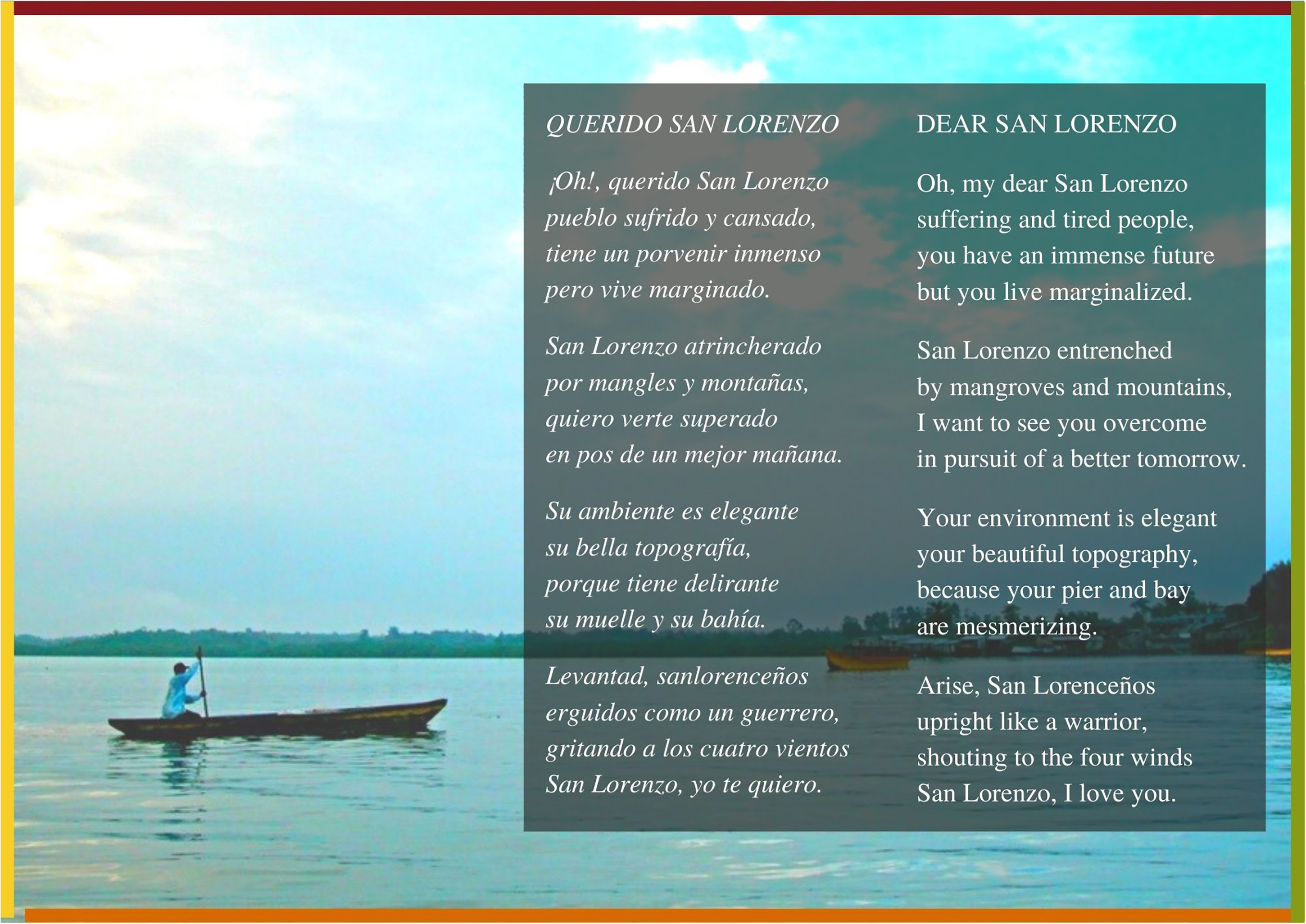
“Querido San Lorenzo” by Afro-Ecuadorian, San Lorenzeño décimero—an oral tradition poet from the city of San Lorenzo (Vergara Bolaños, 2018) (photo by author).
In general, San Lorenzo inhabitants’ daily struggles are beyond the map—in the shadows of what is demarcated and, therefore, on record as existing. Within these societal margins—outside the purview of the rest of the nation—the state has neglected its obligation to protect the communities and, instead, joined companies as accomplices to carry out plunder in ancestral territories. San Lorenzo Black and Indigenous communities refuse to be treated as disposable; they rise to be on the map. By putting ancestral versions of reality 15 front and center and decolonizing false solutions to climate change, they demand respect for their cultural-based rights to live autonomously in their territories. They demand to re-exist (Cuero Campaz, 2022; Walsh, 2013; Zinn, 2006).
Walsh (2023) theorizes re-existing as pedagogical practices of “…rising up and living on in the cracks” Caught between development versus conservation operations, the Ecuadorian Chocó people could potentially fall through the cracks. Instead, to ensure rising up, La Chiquita and Guadualito re-exist by doing the following: 1) declaring, “We are still here! And our lives matter!” 2) rooting into and visualizing the Ecuadorian Chocó borderlands, and 3) applying progressive national-level constitutional legislation. The three subsections below provide historical, present-day, and theoretical understandings of Ecuadorian Chocó borderland peoples’ efforts to decolonize and re-exist be(y)on(d) the map.
(Re)existing beyond the map and re-storying official versions of Ecuadorian history
Historically, Esmeraldas has been treated as an exception to the Ecuadorian state and demarcated as a sacrifice zone. A San Lorenzo collaborator (Dec 2009, personal communication) explains how Northern Esmeraldas was treated as open for the taking from 1859–1939: Ecuador could not pay the debt [to the British for providing economic backing in the Ecuadorian revolution against Spain]. Then, the Esmeraldas Province was like a poker chip, like a type of colonialism, where the British extracted the gold in the province. It was considered almost like a reserve to protect Ecuador until General Rodríguez Lara's government started to export petroleum to pay the debt to the British. It was until then that it was considered a reserve zone.
Environmental history studies (Leon and Rosa, 2013; Minda Batallas, 2020) back this testimony that Ecuador signed a treaty relinquishing sovereignty over the Northern Esmeraldas region. Great Britain (then Germany, followed by the United States) extracted resources for 80 years.
During the European descendants’ battles for the Independence of Gran Colombia (Ecuador, Colombia, and Venezuela) from Spain, forces led by Simón Bolívar called for extra reinforcements from citizens of Great Britain (Alfaro, 1896). In 1819, the equatorial region of Gran Colombia gained its independence from Spain, and in 1830, the Ecuadorian Republic became a national state. The two governments—Ecuador and Great Britain—signed a tax-free trade treaty (Exposición que Dirije al Congreso del Ecuador en 1853, 1853). The Ecuadorian President renounced state sovereignty over Northern Esmeraldas’ lands (Mensaje del Presidente de la República de Ecuador a las Cámaras Legislativas en 1856, 1856), marking the only British imperial project in Ecuador's history (Leon and Rosa, 2013).
As the country needed to repay 1.824.000 pounds to Great Britain (Convenio acerca de la Deuda Extranjera, 1855), Ecuador was born into a form of state-level external debt-peonage. Many Afro-Ecuadorian and Indigenous people were on the frontlines, therefore, integral to the battles for Independence. Despite this, it was their territories between Mataje River and La Tola (Terán, 1896)—200,000 square meters in Esmeraldas (Ecuador Land Company, Limited Prospectus, 1859)—that were declared wastelands, empty, and unused “terrenos baldios” and, thus, available (Pritchett, 1858). These “lawless lands,” according to British property norms/practices (Albornoz Peralta, 2001), were handed over to a London-based company, in this case, the Ecuador Land Company Limited (Leon and Rosa, 2013). In 1860, the first boat from London, Kittiwake, left for “the English Port” of El Pailón (San Lorenzo) (Fisher, 2000).
Ecuador abolished slavery in 1852. Yet, off the record, Black residents lived in enslaved conditions from 1859–1939 in Britain's Ecuadorian colony (Fisher, 2000; Leon and Rosa, 2013). Most Ecuadorians are unaware of Great Britain's imperial colony in Northern Esmeraldas and the price of independence for resident Afro-Ecuadorian and Indigenous peoples. Many Esmeraldeño people, however, remember, and they still await repayment for the gold, timber, rubber, vegetable ivory, and other products extracted from their lands. Figure 3 shows San Lorenzo youth marching to re-exist: to put their ancestors’ experiences on the map and re-story official versions of Ecuadorian history.
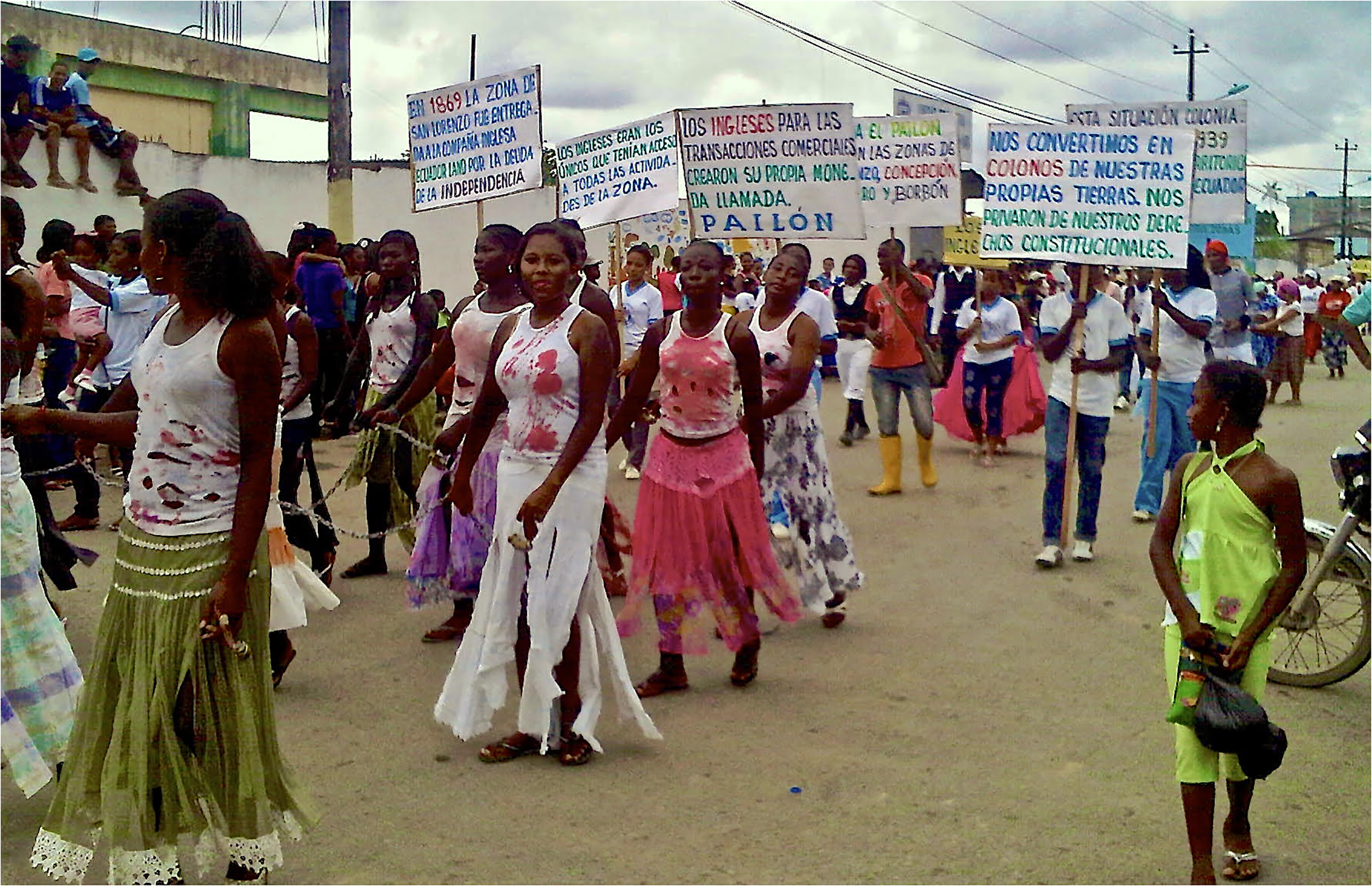
March for independence day. From left to right, the signs say, “In 1869, the zone of San Lorenzo was handed over to the English company, Ecuador Land. The English were the only ones with access to the zone's activities. They had their coin called ‘Pailón’ for their commercial transactions. The pailón circulated in San Lorenzo, Concepción, Eloy Alfaro, and Borbón. They converted us into colonists of our own lands. They deprived us of our constitutional rights. This colonialist situation lasted until 1939 when our territory was returned to Ecuador.” (Photo by author, 10 August 2009).
Re-existing amidst contemporary Ecuadorian Chocó landscape transformations
When I arrived in San Lorenzo canton in 1997, the Chocó rainforests exhaled with life. The rivers ran clear, and the children's favorite activity was to swim in the streams that glittered in the golden tropical sunlight (Figure 4).
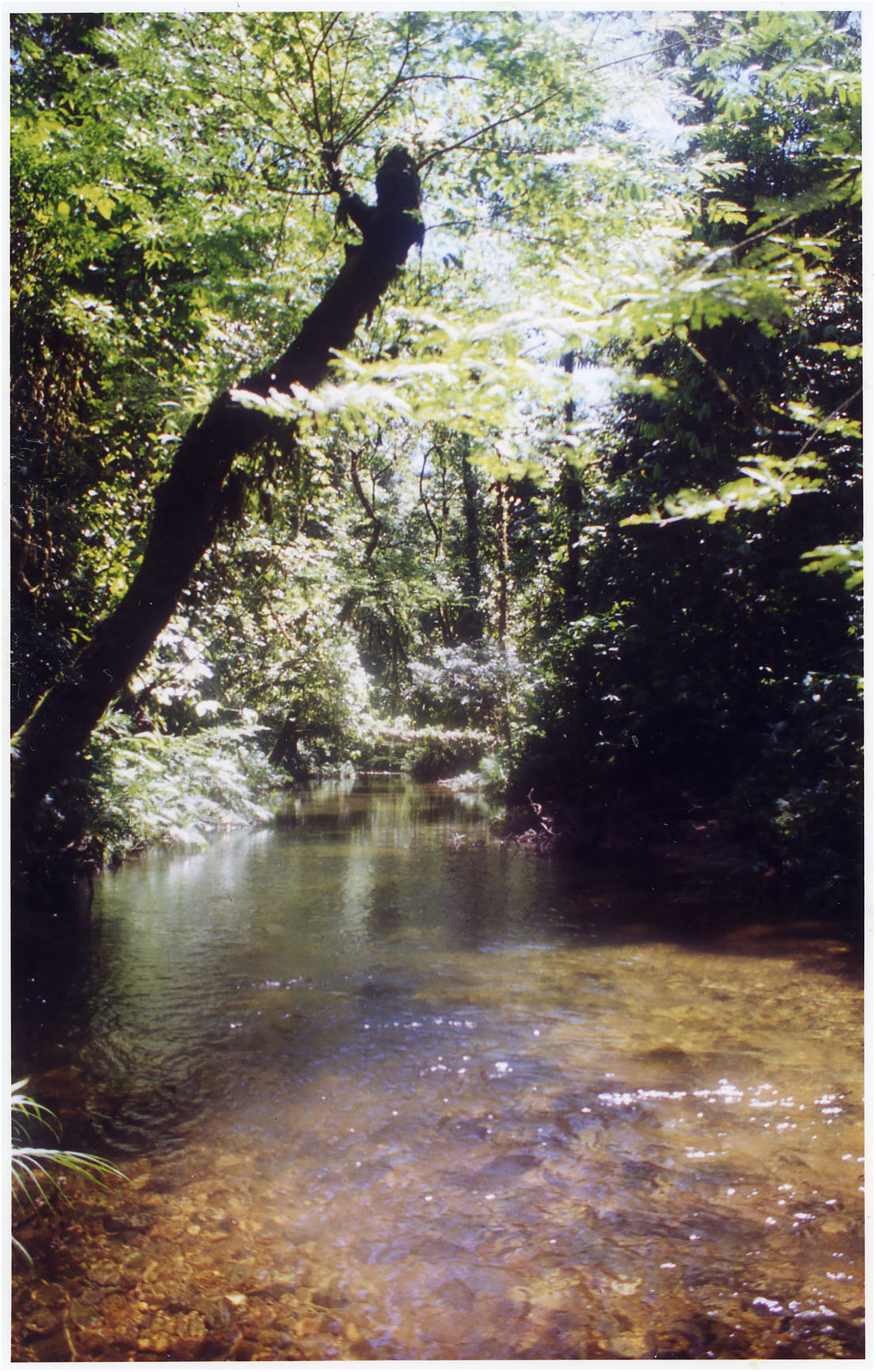
Clean stream in the Ecuadorian Chocó, pre-oil palm plantations (Photo by author, 1999).
Right before the turn of the millennium, a drastic shift took place. Many local people report that oil palm companies began forcibly grabbing land from ancestral Afro-descendant communities with violent tactics, including threats, bands of hitmen, causing intercultural land conflicts 16 , and corroboration with local officials. Other Afro-Ecuadorian people chose to sell their lands out of desperation. The result was the same: Forest landscapes and food forests were converted to monocultural oil palm plantations (Figure 5).
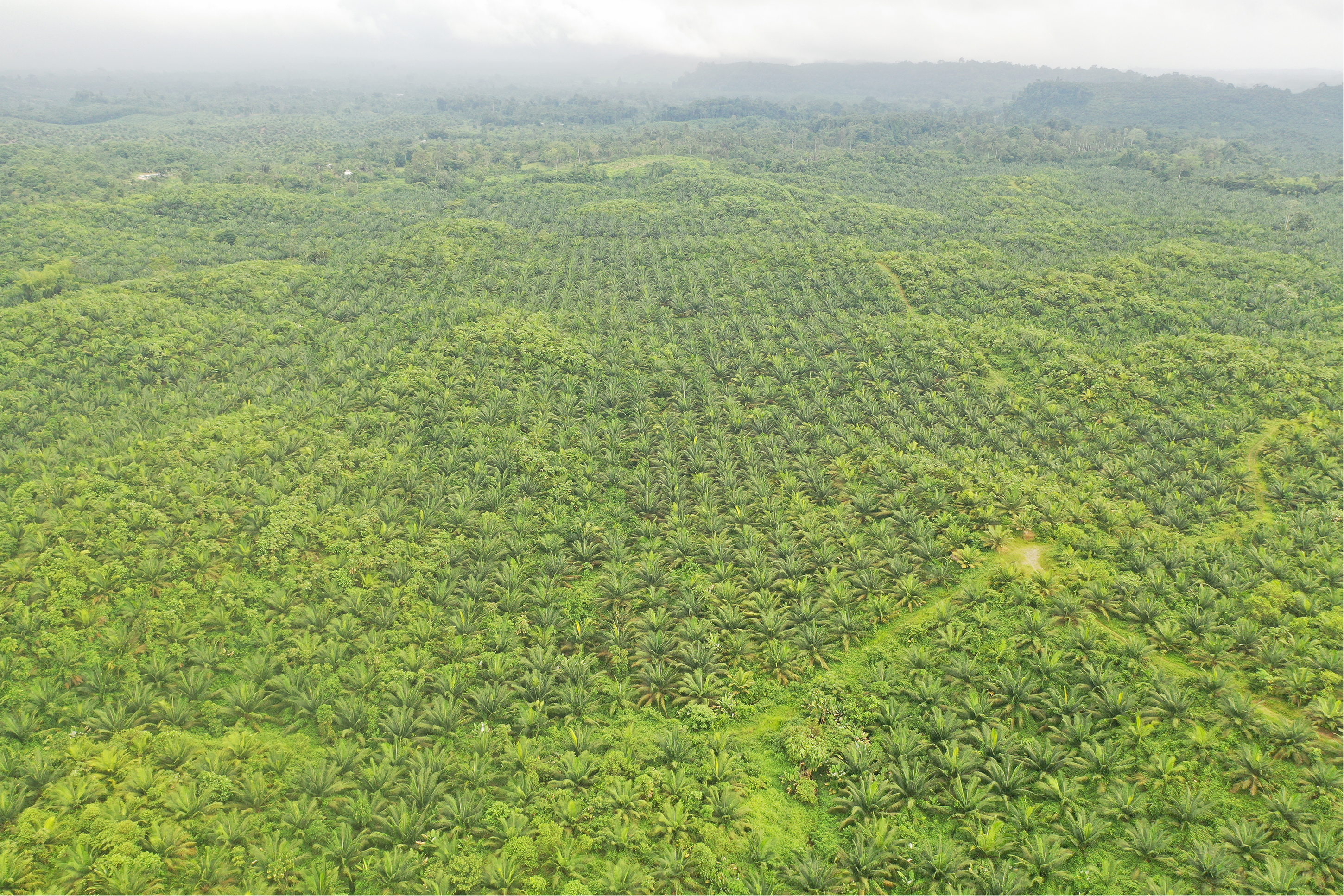
Los Andes oil palm plantation: Monoculture landscape. (Photo by Roots & Routes IC Intercultural Drone Team, 18 April 2019).
Forest protector Aquilino Erazo speaks to the effects of deforestation: “[The oil palm companies] have brought us problems because they have destroyed many hectares of forest. They have extinguished many species of animals that no longer exist” (Roots & Routes IC-Selvas Producciones, 2020). (See Figure 6).
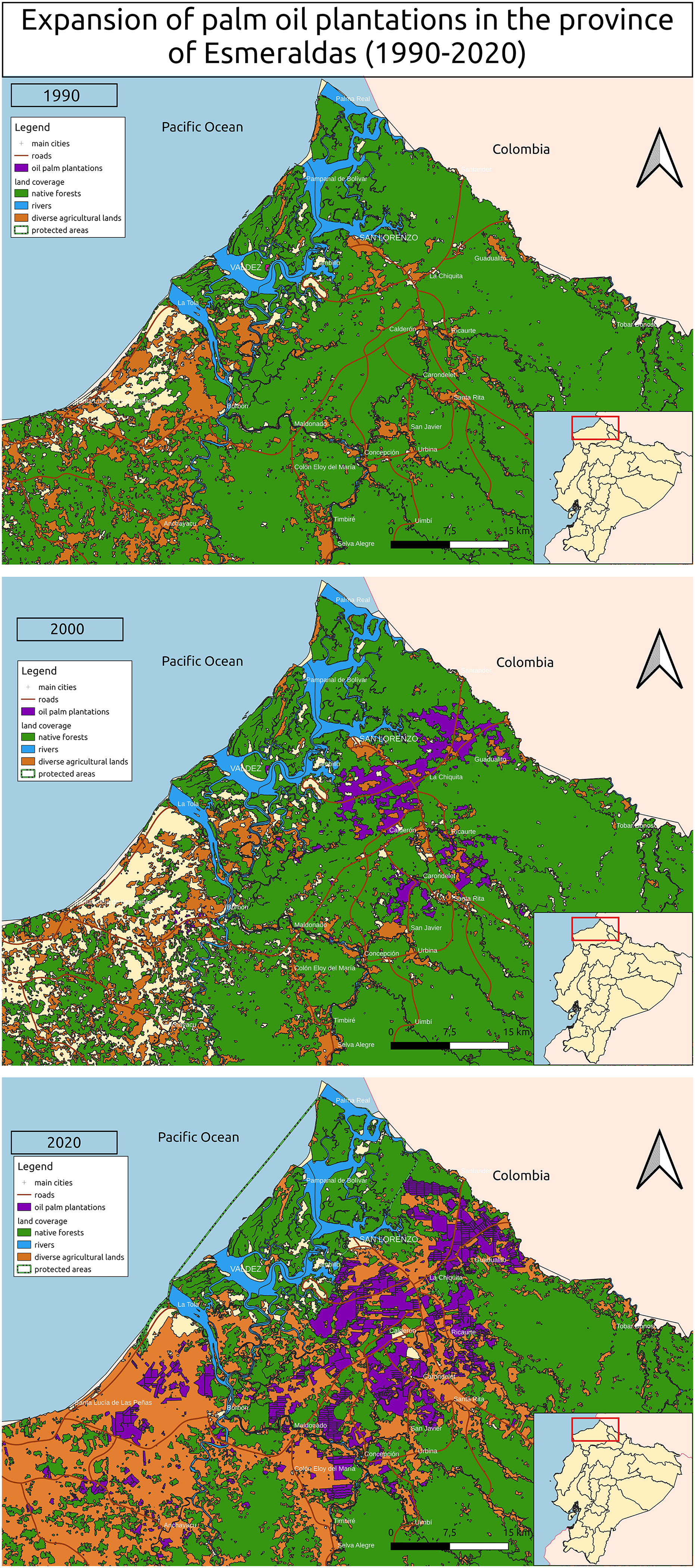
Comparative land use and cover change, 1990, 2000, and 2020: Oil palm expansion in San Lorenzo. Created by Cartographer Iñigo Arrazola Arranzabal, Colectivo de Geografía Crítica de Ecuador, 2023; Sources: El Ministerio de la Agricultura, Ganadería, Acuacultura y Pesca de la República del Ecuador (MAGAP) and El Ministerio del Ambiente, Agua y Transición Ecológica de la República del Ecuador (MAATE).
Once able to travel freely through one another's ancestral territories and across the Ecuador-Colombia border, resident Black and Indigenous communities are now surrounded by oil palm monocultures and isolated from one another. With such high degrees of violence, and limited ability to come and go, they seemingly live like castaways stranded on dispersed and isolated rainforest islands. 17
To make matters worse, oil palm plantations contaminate the rivers with agrochemicals, and palm oil extractors dump their chemical-laden black water runoff directly into the rivers. 18 Deforestation and water pollution impair every aspect of life—especially food sovereignty and health—for Black and Indigenous communities throughout San Lorenzo Canton. 19 (See Figure 7).
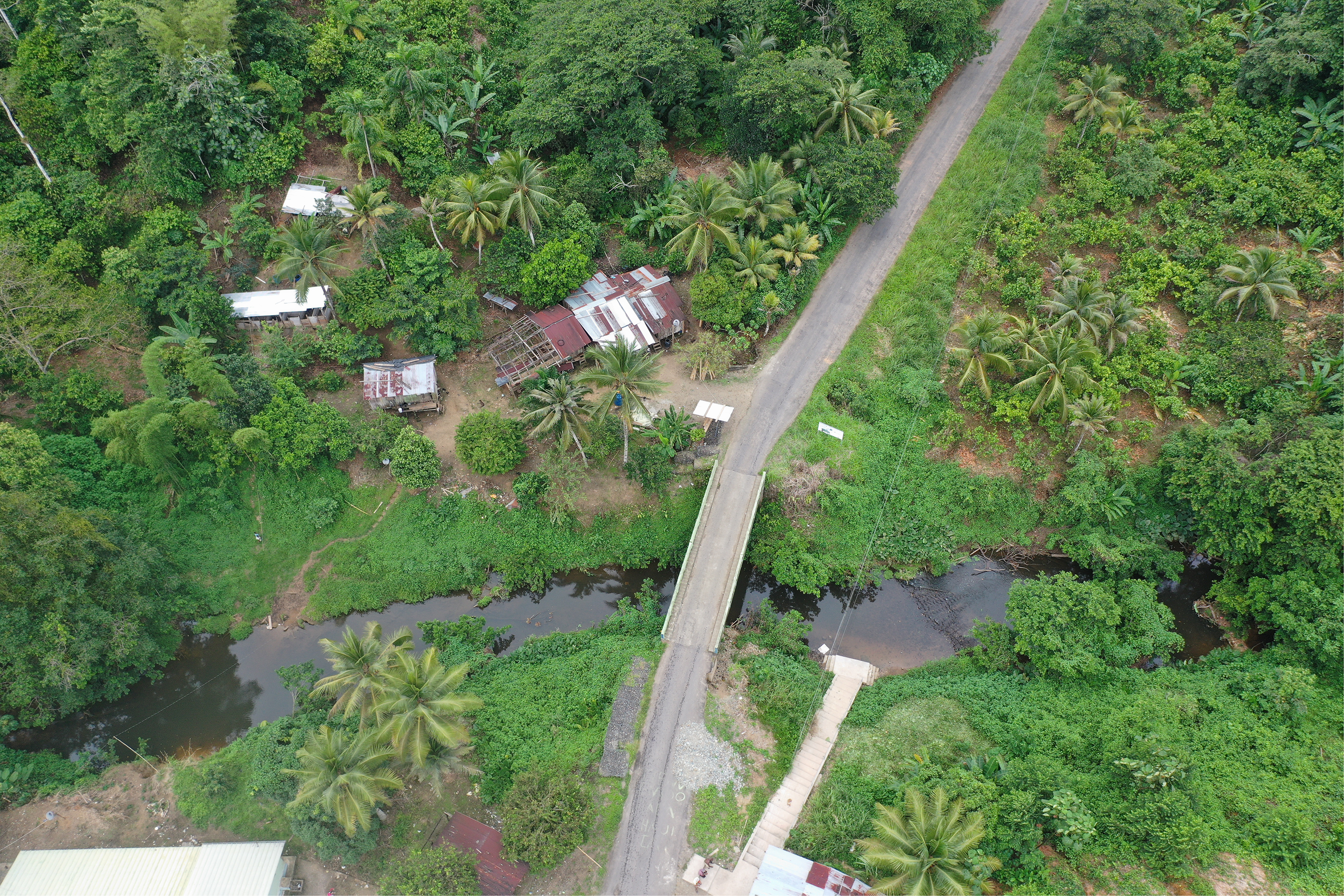
La Chiquita River runs black due to oil palm company’s contamination (Photo by Roots & Routes IC Intercultural Drone Team, 17 April 2019).
Local people testify that there is malintent, a kind of biological warfare. What they mean is that oil palm companies have sent their workers to cut the banana, manioc, and sugar cane plants so that local communities do not have a way to sustain themselves on their land (Awá Teacher, 2009, personal communication). La Chiquita resident Anaina Quintero Cortez states, “Now one lives with everything contaminated, with stomach aches all the time” (Roots & Routes IC-Selvas Producciones, 2020).
Even those who hope may find it hard to see the light amidst contemporary circumstances in the Ecuadorian Chocó borderlands. Since 2008, Esmeraldas has been periodically under a “state of exception”—a no-go zone for tourism, patrolled entry/exit of the area due to drug trafficking, special forces military presence, curfew, the presence of guerillas and paramilitaries, and money laundering (Green and Ferndández-Flores, 2023; Vanguardia, 2009). The situation has become especially tense since 2018, when two newspaper journalists were kidnapped and killed in San Lorenzo Canton (Casey, 2018). Expanding oil palm plantations are inextricably tied to such socio-environmental landscape transformations (Ballvé, 2013; Misión de Verificación al Pacífico Sur de Colombia, 2009). San Lorenzo communities strive to visualize what is happening and to re-exist.
Theorizing Geographies of (De)CO2loniality
Under a state of exception, Esmeraldas is simultaneously being treated as an exception to the state. Disaster literature provides keys to understanding the unfolding of long-term crisis/plunder conditioning. Disaster scholars examine catastrophes springing forth from the nexus of society, technology, and the environment; as they unfold, they re-implicate all aspects of the three planes. 20 Oliver-Smith (1998) posits that disasters, once they hit, require total reorganization of socio-environmental relations and, if attentive to their messages, hold the potential to inform about the appropriateness and adequacy of our systems.
Barnett and Blaikie (1994) introduce the “long-wave disasters” concept. As opposed to a sudden natural disaster, like a flood or earthquake, these slowly ripple through time and place. In less noticeable and nonlinear ways, they gradually reorganize communities, erode diverse scales of resilience, and augment socio-environmental crises.
Since its inception, the Ecuadorian state has precipitated and perpetuated a long-wave crisis in their Chocó borderlands by treating the forested, occupied lands as “empty”/open for the taking and the people as less-than-human (merely labor) in a purposely set aside “sacrifice zone”. 21 Also theoretically applicable is the work of Black Scholar-activist Cuero Campaz (2022), who builds upon Garavito's (2012) concept of “mined social fields”. Cuero Campaz conceptualizes state planning in the Colombian Chocó as an ongoing racist territorial ordering, including predetermined intent to mine Black spaces via scarce state presence, non-intervention in drug-trafficking-related violence, and deliberately setting aside “ethnic enclaves” for extraction.
Waldmueller (2020: 1) describes this ongoing phenomenon as “…the broader permanently neglected disaster in the Pacific border area.” While Harvey (1989: 303) pinpoints “organized abandonment”—a set of intentional strategies setting up organized political-economic chaos, Gilmore (2008) emphasizes the racialization processes inherent to them. Moreno Parra (2019: 20) adopts Zaragocín's (2018) concept of “la muerte lenta”, slow death, to describe the environmentally racializing wave in Esmeraldas as “slow motion genocide”. Building on these authors who conceptualize the interrelations between long-wave, slow-motion disaster and planned state abandonment, I call these centuries-long racialized trajectories “long-wave extractive coloniality”. I use this term to describe the multiple waves of state-permitted pillage that historically and still today tumble through Afropacífico and Indigenous ancestral territories, infringing upon their self-determination/sovereignty (Hazlewood, 2010a, 2010b, 2012).
Decolonizing economic and environmental processes is essential. Maori scholar Tuhiwai Smith (1999) describes
Walsh (2011) adds the parenthesis—
Going further, the Indigenous Environmental Network (2007) conceptualizes “
States claiming to reduce the harmful effects of climate change are once again encroaching on Indigenous territories and sovereignty. Grossman et al. (2012) describe a “triple whammy” of colonial waves: 1) settler colonization, 2) climate change, and 3) violations of sovereignty/self-determination and land grabbing that fall under the façade of climate change mitigation development. CO2lon
Expanding oil palm monocultures embody the most recent disastrous wave of extractive CO2loniality. Oslender (2007) shows how expanding oil palm frontiers are integral to a logic of forced displacement within a “geography of terror”. The plantations purposefully roll out waves of “territorial conditioning” (Oslender, 2008) that “forest cleanse” (Lohmann, 1999) by “desterritorialización” [deterritorialization](García Salazar, 2007), thus facilitating land grabbing for future megadevelopment projects.
In contrast,
Geographies of H2Ope: Activating collaborative pathways to water justice
Estamos unidos por el agua [We are united for/by the water].
-Dr Flavia Carlet, Brazilian lawyer, social scientist, and co-collaborator within our San Lorenzo alliance, 2020, personal communication
Carlet's statement speaks to how uniting for water inspirits collaborative pathways for
My Ph.D. dissertation research (2008–2010) was contextualized in a relatively new era of decolonizing research. Although for decades, Fals Borda (1987) had been discussing Investigación Acción Participativa (IAP, or Participatory Action Research, PAR)
24
, his framework referred to rural peoples’ ways of knowing as “folk knowledge”, and even if engaging with positionality to a certain extent, PAR still prioritizes political economy/ecology approaches. With Decolonizing Methodologies (1999), Tuhiwai Smith underscored these epistemological geopolitics by contesting the colonial, Eurocentric roots of research and asking these questions: Who produces legitimate scientific knowledge? And, who invites whom to participate? Her work created rippling effects throughout academia. A decade later, for instance, the Association of American Geographer's Indigenous Peoples Specialty Group (2010) ethics statement also went beyond “participatory” and delved deeper into why decolonizing knowledge is necessary: As researchers, we need to figure out and/or remember why we do research in the first place… What does a more…collaborative approach to research look like? How does the research that we as geographers do ultimately help keep knowledge in the hands of Indigenous peoples, so they can continue?
These conversations—complimented by what my Native professors taught me during my MA in Native American Studies (NAS) at the University of California, Davis (2004–2006)—led me to endeavor to create long-term respectful, responsible, and reciprocal relationships with ancestral and Indigenous communities.
The following story illustrates learning how to decolonize research. On November 7th, 2008, I met with Guadualito, the Awá community, for the first time. They insisted upon decolonial, just, and action-oriented research from the get-go. I listened to this conversation within the community: We have these problems with these recordings and interviews: here they interview, and over there, they add things that nobody has seen here in this country…”
An elderly woman adds, “…that one hasn’t said, you see.”
“…and besides, things that one has not said,” the first man continues.
“…or hasn’t seen either,” the elderly woman shouts again.
Another man explains: “We tell the truth, and this is to say that they have everything [that they need/want], also [and we do not]. For that reason, we are bored of giving this information. We require that what we want here is a way [out of our isolated circumstances]… to have a way [out].
(2008, personal communications)
They clearly expressed how previous researchers had manipulated their words and compounded feelings of abandonment. When I visited the Afro-descendant community of La Chiquita next, they were similarly adamant that research conducted in their community had not brought benefits.
My research plan prior to this conversation involved household surveys, semi-structured interviews, ethnographic participant observation, and mapping. Their perspectives, however, moved me to reevaluate my research path. I delved back into fundamental questions posited by my NAS professors: Why am I doing this research? Who initiated it? What does our connection mean to me—a white woman from Indiana who can create a secure life—if their lives are at risk? If my host communities did not have access to live with dignity, how can I only concern myself with completing my research plans? How could my research contribute, give back, and make a difference? Accordingly, how can I walk with the communities’ struggles for justice and respect?
To take our significant colonial differences seriously, Professor of Sustainability and Environment Kyle Powys Whyte (Citizen Potawatomi Nation) (2018b) underscores that we are not all in the same boat. To avoid white saviorism, I assessed my positionality. How do I be a good ally? Are there ways to work together to heal our respective “colonial wounds” (Mignolo, 2005)? How do we generate new understandings between us and co-create knowledge? Can we collaboratively transform deeply entrenched circumstances into more just ones?
I now share what I have come up with over the years since those 2008 conversations when I first realized something had to be done. With surrounding oil palm plantations and increasing isolation threatening the security of La Chiquita and Guadualito, it became clear that conventional research methodologies calling for objective data gathering were not safe, helpful, applicable, or ethical. The em-URGENCY situation called for establishing bottom-up, community-led responsible, and actionable methodologies. So, when asked to go beyond theorizing their situation within academic settings, I stepped in. I came to understand that there were no arbitrary lines such as, “This is my role as researcher, and your struggles are outside of that” (Ferguson, 1999). Crossing into the insider–outsider threshold was the only way forward. Writing articles didn’t matter. Instead, life itself became our medium, and research became fluid and ongoing.
The residents of Guadualito, La Chiquita, and San Lorenzo and I began to discuss how to strengthen their strategies of refusal (Coulthard, 2014; Zinn, 2006) and resurgence (Simpson, 2001, 2014) to stop oil palm plantations from polluting and defend all life forms for whom La Chiquita River Basin is home. La Chiquita leader, Isaha Valencia, expresses what hope for water justice—H2Ope—means to La Chiquita: “If we just had the water and river, good, healthy, like they were before when we had everything…” (Roots & Routes IC-Selvas Producciones, 2020). A similar sentiment is expressed in the words in the décima poem by San Lorenzeño Vergara Bolaños (Figure 8), which further elaborates on the inextricable human interrelations with rivers and clean water in San Lorenzo.
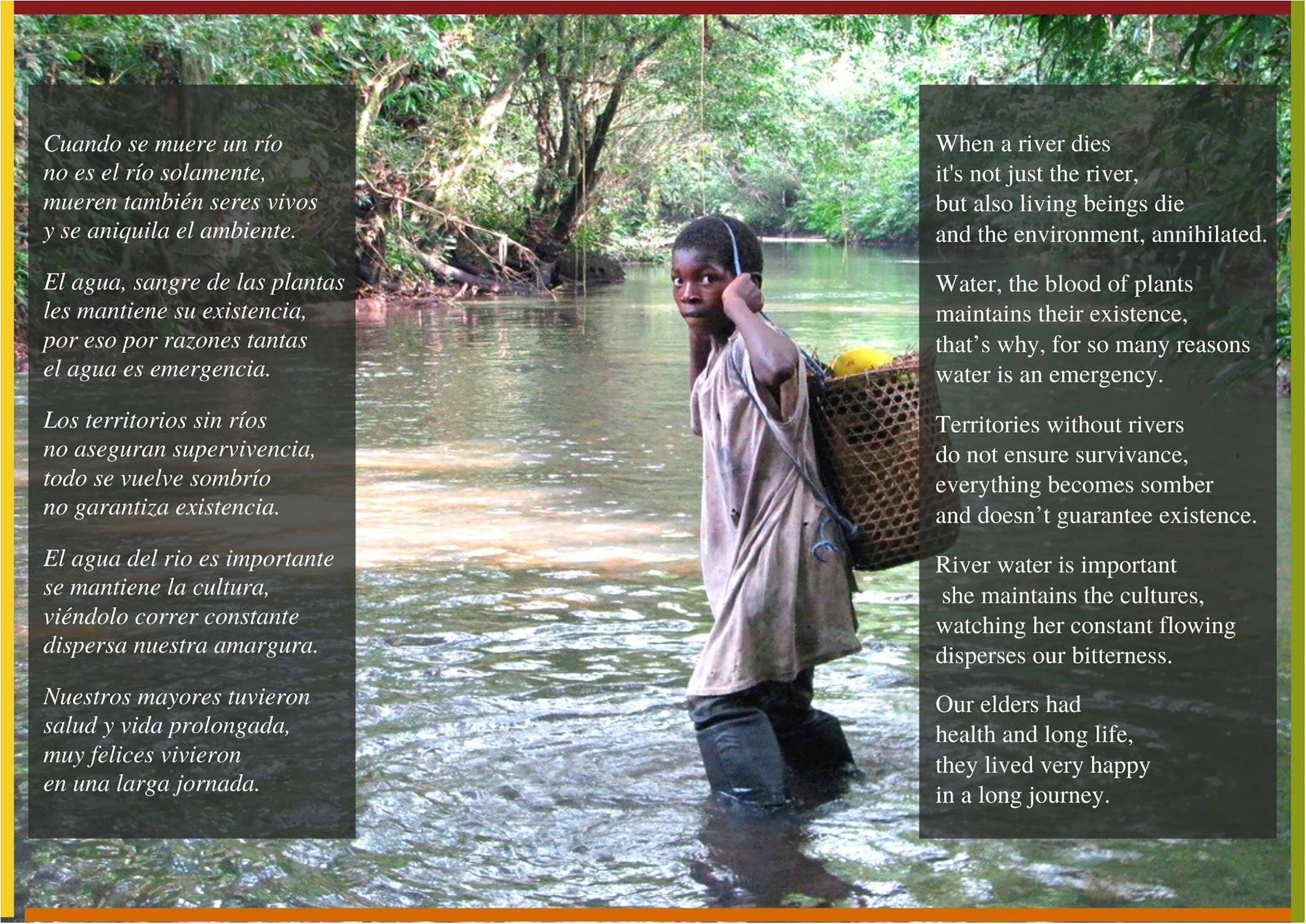
From San Lorenzeño décimero “Agua Limpia Merecemos” (Vergara Bolaños, 2018) (Photo by author, 27 July 2009).
Residents of the Santiago-Cayapas watershed, the people consider themselves and the other resident sentient beings as part of “a basin of relations” (Dolman, 2008). Embodying and enacting the web of relations within La Chiquita River Basin, they invite allies to walk with them to regenerate GgsH2Ope: to defend the rights of all beings' who share their watershed to reside in a healthy environment.
There have been communication breaches, internal disputes, and misunderstandings along the way. We have given one another space and time and come back together again. Collectively and individually, we have figured out how to overcome barriers of ever-increasing complexities, adversities, obstacles, and despair that are inevitable aspects of collaboratively moving forward to mobilize “hope-with-justice” 25 , and in this case, water justice. Like Wright (2019), who describes the emotional trials and tribulations of walking with Philippine communities and their allies to organize for their legal rights, we also testify to the psychological, spiritual, and emotional ebb and flow of hope.
Learning from our mistakes along the way, we expose multiple dimensions, topographies, and undulations of hope by “geografiando para la resistencia” [geographizing for resistance] (Colectivo de Geografía Crítica de Ecuador, 2017). By decolonizing false solutions to climate change and raising the bar for water justice, La Chiquita, Guadualito, and their allies lay the foundations for implementing Geographies of (De)CO2loniality/H2Ope (henceforth Ggs(De)CO2loniality/H2Ope).
Collaboratively geographizing a five-dimensional approach to Ggs(De)CO2loniality/H2Ope
Admittedly, Ggs(De)CO2loniality/H2Ope act like a set of coding for concisely theorizing the terrain of GgsHope specific to the Ecuador Chocó borderlands. This section unpacks these conceptual inventions to geographize processes of hope-in-praxis in Northern Esmeraldas.
When San Lorenzo communities and allies unite, we reveal the diverse topographies of on-the-ground struggles for re-existing. Joanna Macy and Chris Johnstone (2012: 32) offer “active hope”; they also highlight three dimensions—action, shifting consciousness, and changing the system—for creating hope-focused relational transformation and a greater sense of belonging to the Earth that they call “The Great Turning”. Similarly, engaging heart, body, spirit, mind, and all our relations, five principal dimensions are central to collaboratively geographizing Esmeraldas-based GgsHope praxes on-the-ground (See Figure 9).
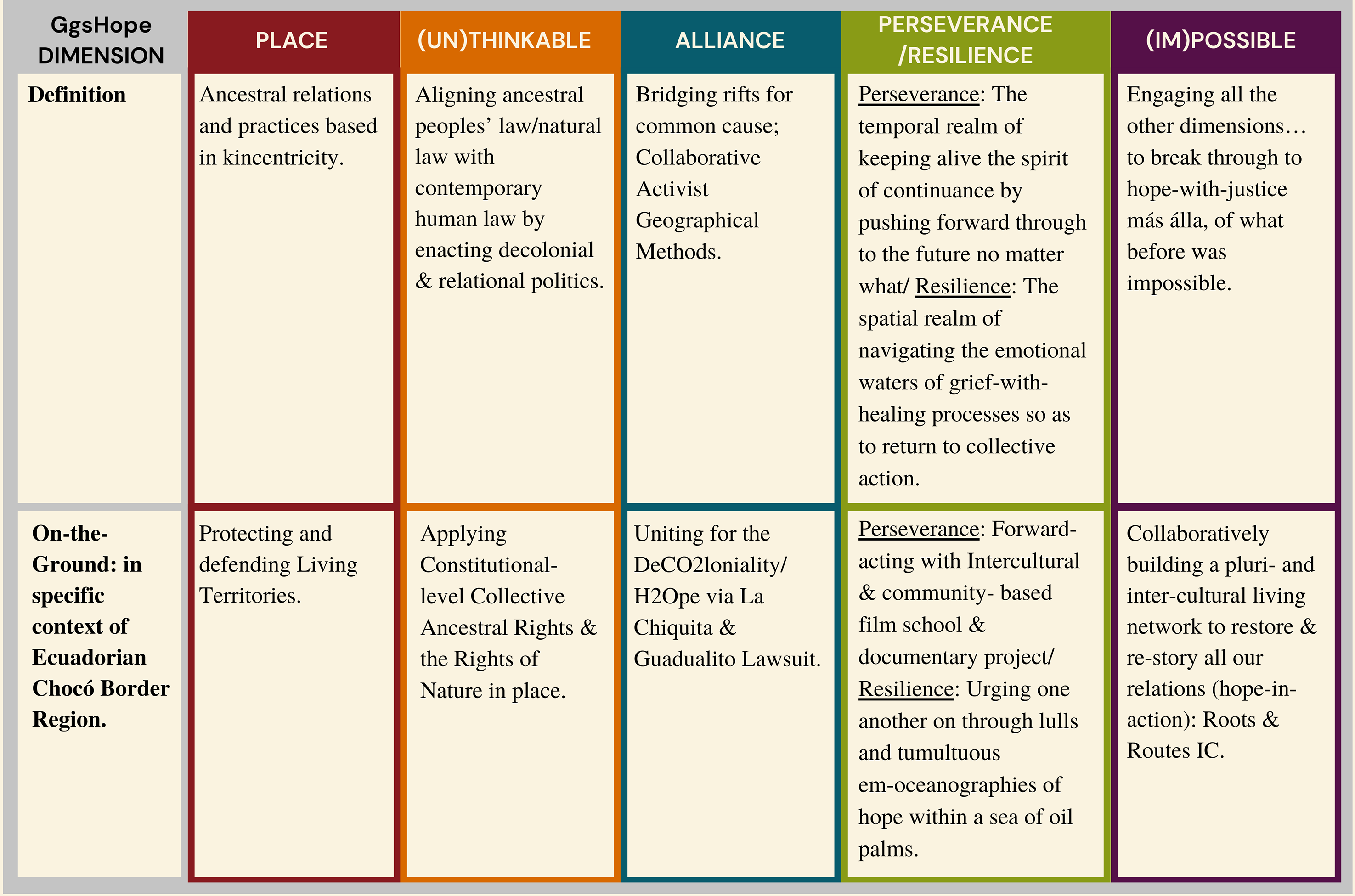
Definitions and Ecuadorian Chocó activations of five dimensions GgsHope.
Place, the (un)thinkable, alliances, perseverance/resilience, and the (im)possible holistically act as a pluriverse: a constantly shifting interdimensional ebb, flow, and spiraling of multiple interconnected worlds, all with contingent context-based topographies and movements. Escobar's (2008: 25) notion of “territories of difference” invokes the idea of distinct ethnic “territories of life” that include territory/place/culture-informed ways of being, knowing, and doing—what Oslender (2019) refers to as pluriverses. Oslender (2019: 1691) states, “The idea of the pluriverse calls for a co-existence of many worlds as an acknowledgment of the entanglements of diverse cosmologies.” Escobar (2012: 25) underscores allowing for a “…genuine pluriverse of socio-natural worlds…anchored in a vision of the Earth as an ever-emerging living whole”.
Through traversing a five-dimensional GgsHope journey, (de)CO2loniality and H2Ope go hand-in-hand. The praxes of the people of San Lorenzo who put their lives on the line for ancestral territories have taught me
Place-based GgsHope: Protecting ancestral territories and cultivating intra-island spaces
El Territorio es vida [Territory is life].
-Olindo Nastacuaz, Awá Leader and Collaborator, 2009, personal communication
Place is where people create relationships and cultivate knowledge embodied in their surrounding political, socio-economic, and ecological environments. Place-based GgsHope initiate from where people stand and thus are both situated and relational geographies. They are the everyday material and substantive practices that inform people's identities. Place-based GgsHope are constituted by “survivance” (Vizenor, 2008)—self-determinative resistance and continuance that nourishes Indigenous/ancestral ways of life (Survivance.org, 2013). Despite socio-environmental transformations surrounding their ancestral territories, people strive for “thrivance” (survivance + thriving) (Johnson-Jennings et al., 2019; Walters et al., 2020) of diverse cultural sustainabilities.
O’oodham/Chicano/Anglo Ecologist Dennis Martinez (2008: 2) refers to these interrelational ecological recognitions within Indigenous worldviews as “kincentricity.” Indigenous scholar-activists across the Americas 26 concur that “original instructions” (Nelson, 2008) based in kincentricity guide diverse Indigenous peoples’ cosmovisions to care for Mother Nature in ways that assure all beings’ value and rights to regenerate. This kinship-based relational view is fundamental to GgsHope in place: the world around us is living, and each of us is one within an interrelated community of beings. Similarly, kincentric views are explicit in the ways that Black and Indigenous Chocó communities defend what they consider to be living territories.
Those Afro-Ecuadorian and Indigenous communities who stood their ground against the encroaching oil palm plantations were literally and figuratively situated on islands of hope in a sea of oil palms. My dissertation framed these place-based GgsHope as intra-island and inter-island (Hazlewood, 2010a, 2010b, 2012). They amplify self-determinative and culturally-based ways of re-existing.
Chocó residents have culturally specialized intra-island ways of being, doing, and knowing by caring for their ancestral “island territories” (Hazlewood, 2010b: 229). They challenge colonial state and international development plans by continuing kincentric ways of life, thereby contributing to their territories’ self-sufficiency, sustainability, and resilience. These decolonizing and relational acts are hopeful paradigms in praxis. 27
Based on their four-world cosmovision and in respect of their ancestors, the Awá people call their territorial life plan “Inkal Awá Katsa Kual Wat Uzan”: Our elders struggled to defend our people's life, territory, language, culture, and unity. For this reason, we have decided to recuperate and strengthen the historical memory of our ancestors. We have decided to continue trochando [carving out trails] and walking together in minga [Kichwa concept, work trade] for in following the footsteps of our elders, like the Big Awá Family [across Colombia and Ecuador], we remain strong like the big tree [Katsa Tikana, Ceibo tree, from where they originated] (Gran Familia Awá Binacional, 2009: 3).
Today's Indigenous Chocó Forest and Afro-descendant communities traded and co-developed ecologically specific techniques to cultivate the lowland rainforests called topado [slash-and-mulch] (Thurston, 1997). Agroforestry spaces in Black and Indigenous Chocó territories are organized horizontally and mimic rainforests vertically. Horizontally, they plant what is used closest to homes and leave primary forests furthest away for hunting or, when needed, tree harvest (Figure 10). Vertical zones establish diverse, multiple-tiered agroecological communities from the forest floor into high canopies. Both are preventative, as subsistence and market products are interwoven into their crop patterns to withstand economic booms and busts and social crises. Similarly, Chachi, Awá, and Afro-descendant families use swidden farming techniques with chacras [farm plots] that rotate back to the forest.
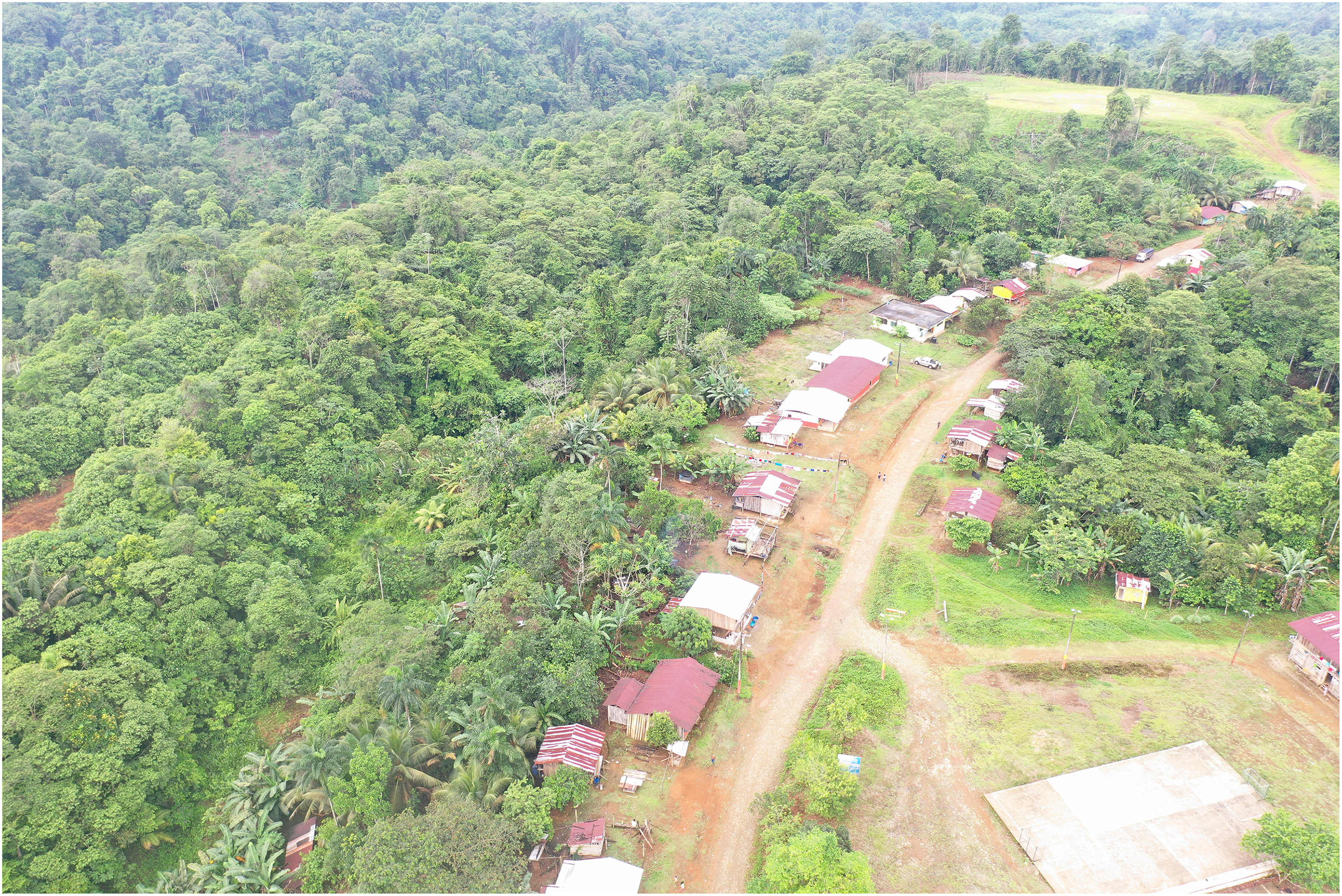
Horizontal and vertical zoned landscapes of the Awá community of Guadualito (Drone Shot by Roots & Routes IC Intercultural Team, 18 April 2019).
In contrast to surrounding agro-industrial monocultures, place-based GgsHope are multi-layered, agricultural polycultures, demonstrating “reciprocal relationality” (Todd, 2017: 107) among all inhabitants of ancestral territories. The Chocó peoples cultivate and sustain self-determination in and over their intra-island spaces. Flourishing cultural pluriverses, however, are impossible without simultaneously rooting into ancestral territories and coming together to create Inter-island GgsHope. These intercultural networks decolonize one-size-fits-all approaches to development and apply constitutional law that supports ancestral rights to pluricultural approaches to life 28 and the Rights of Nature (hereafter RoN).
(Un)thinkable GgsHope: Raising the bar for earth jurisprudence
Some call peripheral possibilities that unveil distinct relations to life “political imaginaries”. Haran (2017: 1) proposes that experimental, fictive/real-life metamorphoses can propel social movements forward as “imaginactivism”. (Un)thinkable GgsHope happen when those inscribed as disposable, powerless, ineffective, or not legitimate enact political imaginaries (Lawson and Elwood, 2018). This (un)thinkable dimension of GgsHope draws on how those from the Ecuadorian Chocó border put what were once merely political imaginaries—river basins as subjects of rights and water justice—into practice.
Approved in September 2008, the Ecuadorian Constitution was the first national legislative agreement in the world based in post-extractivist (Gudynas, 2011) and Indigenous and Afro-descendant kincentric-based “life-visions”, i.e., cosmovisions (Walsh, 2011). Among previously (un)thinkable legislation, it included Sumak Kawsay [Rights to Living Well] that encompass rights to clean water, food sovereignty, healthy environments, information and communication, culture and science, education, habitat and housing, health, and labor and social security (Asamblea Nacional Constituyente, 2008, Articles 12–34).
The 2008 Ecuadorian constitution also outlined the Rights of Nature: “Nature, or Pachamama, where life is reproduced and occurs, has the right to integral respect for its existence and for the maintenance and regeneration of its life cycles, structure, functions, and evolutionary processes” (Article 71). RoN insists upon the agency of the Earth itself (Plumwood, 2006). Despite its contradictions of naturalizing a Western rights-based approach (Rawson and Mansfield, 2018), RoN is setting the path to Earth Jurisprudence.
On July 23rd, 2010, those from the isolated peripheries of Ecuador stepped to the frontlines of constitutional-shifts-in-action by applying the (un)thinkable in their territories. Although La Chiquita and Guadualito began diverse legal processes in 2002 against three oil palm companies for contaminating their river, that day, they raised the bar for Earth Jurisprudence—an emerging field of law taking root worldwide confirming Nature as a subject and humans as part of a broader “community of beings” (Kauffman, 2020; Kauffman and Martin, 2017; United Nations, 2019).
La Chiquita, Guadualito, and their ancestral territories’ diverse flora, fauna, and incarnate beings formed a plaintiff community. They initiated a landmark intercultural and interspecies lawsuit applying legislation guaranteeing ancestral rights to clean water and the rights of La Chiquita River. They filed the first constitutionally-based RoN civil lawsuit against two oil palm companies—Esteros EMA SA Palesema and Los Andes SA—to the Provincial Court of Esmeraldas. La Chiquita, Guadualito, and Nature demanded that the two oil palm companies compensate them for environmental and communal health damages and repair La Chiquita River contamination.
La Chiquita and Guadualito residents activate (un)thinkable GgsHope. They ground imaginactivism by untangling, reconceptualizing, and transforming forces that prioritize economic profit and subjugate the intrinsic value of all sentient beings. La Chiquita's and Guadualito's lawsuit catalyzes the complete restructuring of life relations and insists upon respect (Indigenous Environmental Network, 2015). The San Lorenzo communities collectively enact decolonial and relational politics to align natural and contemporary human law. Imaginary-geographies-in-praxis, they demand implementing cutting-edge constitutional legislation that respects self-determinative Living Territories and executes ancestral rights to Live Well.
After six and a half years, in January 2017, Ecuador's Esmeraldas Provincial Court handed down its decision on the world's first accepted-for-trial RoN lawsuit based on a national-level constitution. It was “partially favorable”. Judge Morales Suarez confirmed that oil palm companies are guilty of environmental and psychological damages. Guadualito, La Chiquita, and Nature thus broke through the confines of constricting politics (Alianza Periodística Tras las Huellas de la Palma, 2022; Isaha Ezequiel Valencia Cuero v Palmeras de los Andes, 2017). They raised the bar by applying legal frameworks in territory and making paradigm-shifting contributions to Earth Jurisprudence worldwide.
Incongruously, the judge's decision avoided enforcing that the oil palm companies pay for and correct their violations. While charging that 12 state and provincial institutions start providing the services they were designed to do, he merely ordered the companies to plant bamboo and teach a local folklore course to their workers (Hazlewood and La Chiquita and Guadualito, 2017). One La Chiquita resident responded, “The sentence does not have either heads or tails.” The two communities wanted the oil palm companies to stop contaminating and repair the environmental damages.
Unfortunately, the two oil palm companies and the 12 Ecuadorian institutions have not rectified the situation. The intertwined Chocó Black and Indigenous Geographies of (De)CO2loniality/H2Ope—hereafter Ggs(De)CO2loniality/H2Ope—have yet to receive the attention and support they deserve within Ecuador and beyond.
Alliance-based GgsHope: Inter-island Geographies of (De)CO2loniality/H2Ope
After waiting so many years, we feel humiliated and deceived by the Court… The judgment does not recognize any aspect of the Los Andes and Palesema oil palm companies paying us for the repairs and damages caused to our environment, which have directly and negatively affected us… We want all humanity to know about our long struggle to ensure our rights are respected.
-La Chiquita and Guadualito community members (Hazlewood and La Chiquita and Guadualito, 2017)
To assemble public support for the long-term struggles of the Chocó communities, we began weaving an ever-growing coalition. Fellow researchers, lawyers, non-profit leaders, and Black and Indigenous activists from Ecuador and around the world have joined. The essence of the alliance-based dimension of GgsHope delves into how we bridged rifts of us-versus-them dichotomies for a greater cause. Working towards (de)CO2loniality and H2Ope became essential in creating Inter-island GgsHope.
Inter-island GgsHope are established by casting social nets between distinct ethnic “island” territories. Like a fishing net used as a tool for sustenance, the communities established a multi-scalar and intercultural “rooted network” (Rocheleau, 2016). This “meshwork” (Escobar, 2008) aided in garnering the support to implement constitutional law. In this case, what I call “Collaborative Activist Geographical Methodologies” (CAGM) (Hazlewood, 2010b) encompass elaborating a rooted meshwork of praxes to catalyze Ggs(De)CO2loniality/H2Ope. Figure 11 shows that four principal aspects lead this scholar-activist approach.
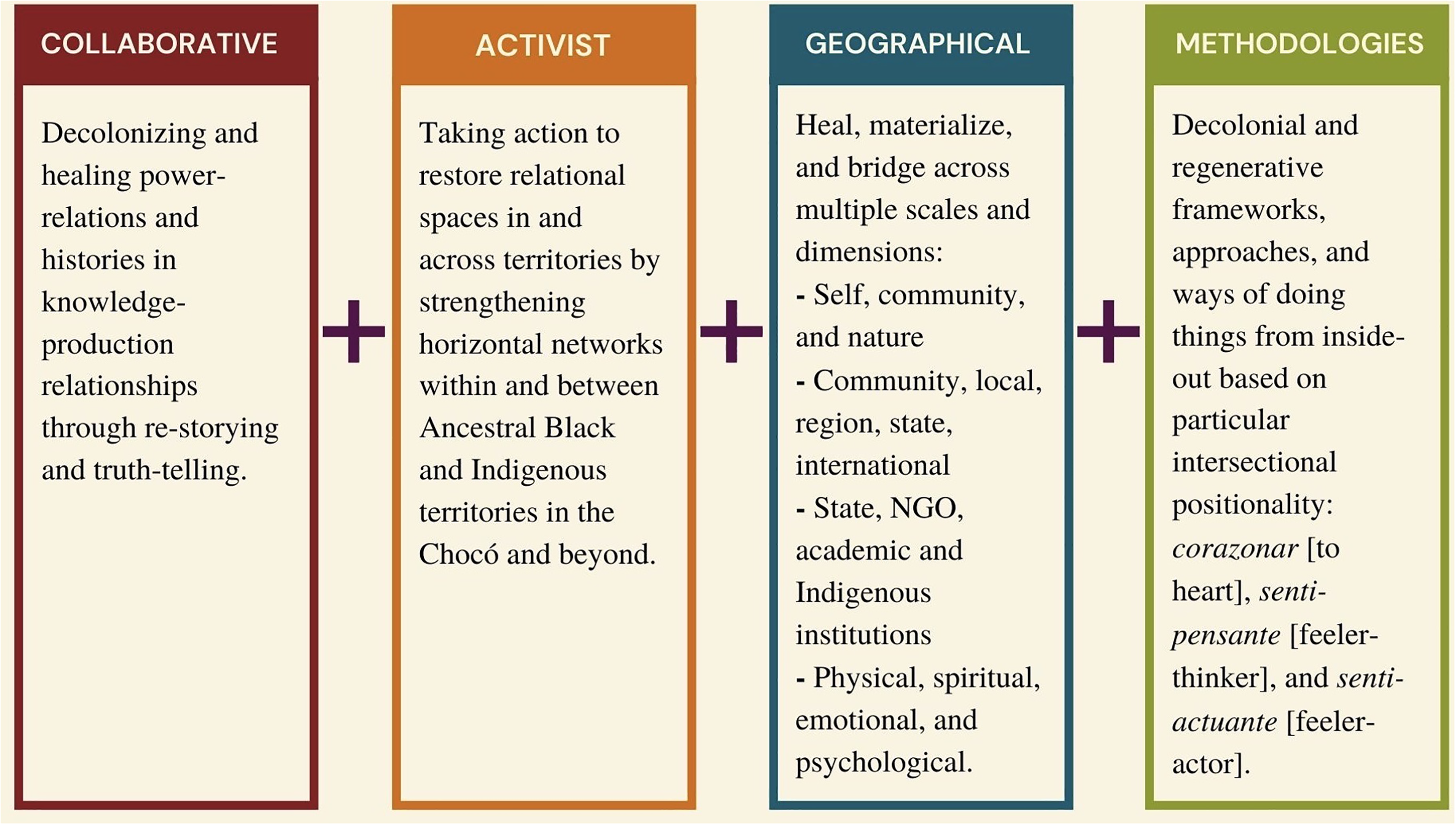
Definitions of Collaborative Activist Geographical Methodologies (CAGM).
The who, what, when, why, and how of power differentials of research must be teased out in collaborative research. CAGM goes beyond a researcher writing about their “research informants”. Instead of merely inviting the communities to become “participants”, they become co-collaborators in the research, making their priorities and determinative ways forward central to the project. The researcher transforms both themselves and their research to become “…a committed acompañante and facilitator in work led by… [the communities]” 29
Figure 12 shows the author and co-collaborator/friend Aquilino Erazo teasing out understandings of how racializing and colonizing processes take place and why collaborative research matters. In turn, I have opened spaces for publicizing his efforts to assure access to his 42-hectare (104-acre) farm—an island in a sea of the 1600-hectare (3954-acre) Papailon S.A. oil palm plantation surrounds his land. Papailon has poisoned his cattle and filled his fishponds with mud to deterritorialize him.
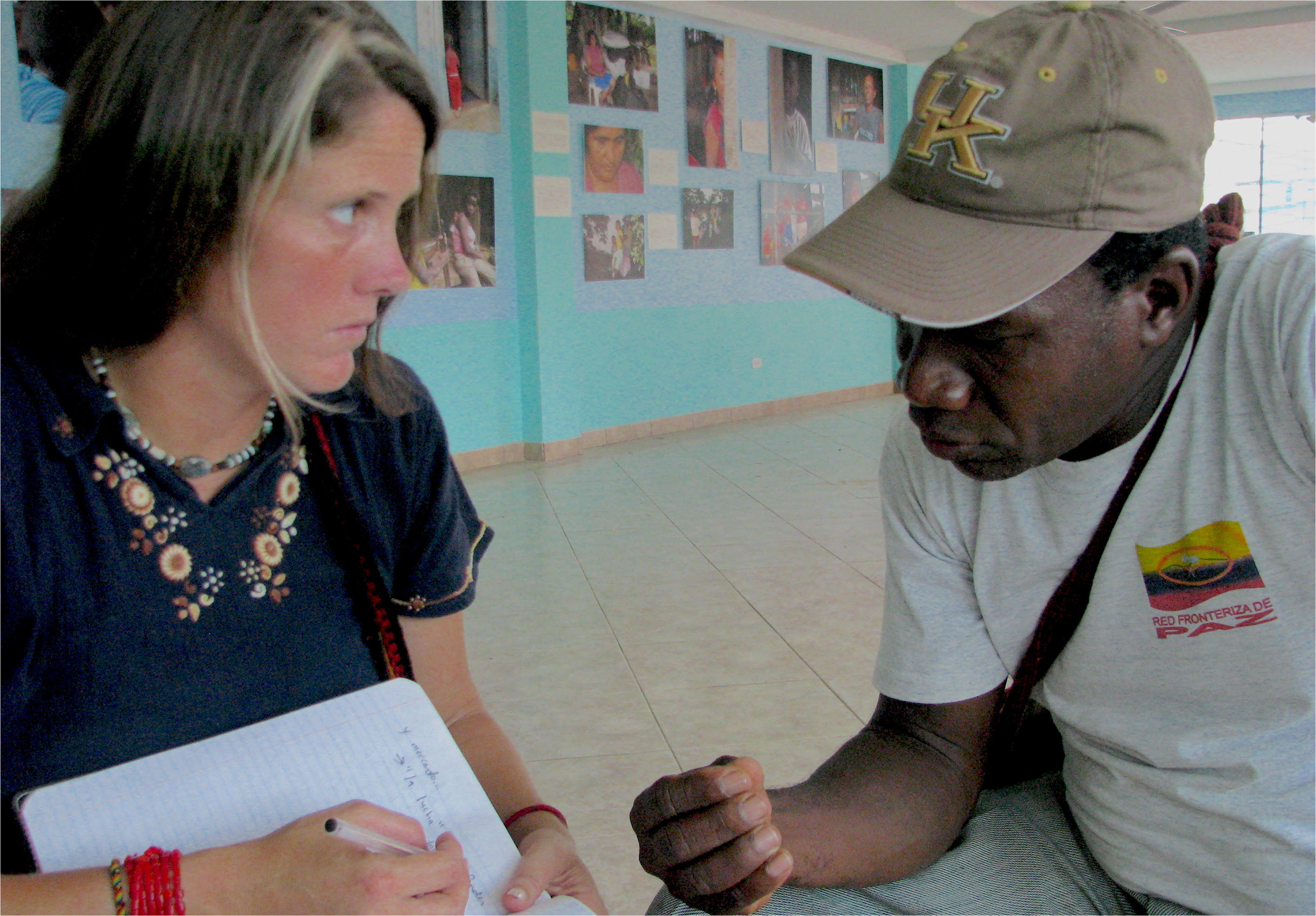
Author with collaborator Aquilino Erazo. Exchanging hats (he with a University of Kentucky hat, brought from my home institution) and creating concepts together: “The struggle for whom and why?” (Photo by Jimmy Coronado, Red Frónteriza de Paz, 2009).
When collaborating with Indigenous, ancestral, and other rural communities, the only ethical way forward is two-fold: 1) decolonizing knowledge production (research; what counts as Knowledge) and methodologies (how we do our research) (Pualani Louis, 2007; Tuhiwai Smith, 1999), and 2) working towards the material outcomes of collectively revindicating self-determination, (re)claiming territory, and demanding access to clean water (Tuck and Yang, 2012).
The basic premise of the
The
Both effective and affective
Within these “truth-telling” (Amah Mutsun Tribal Band Chairman Valentin Lopez, 2019, personal communication) action/healing frameworks, the San Lorenzo communities, and research allies established a meshwork of support for all living beings. See Figure 13 to learn about our specific tactics when applying Collaborative Activist Geographical Methodologies strategies.
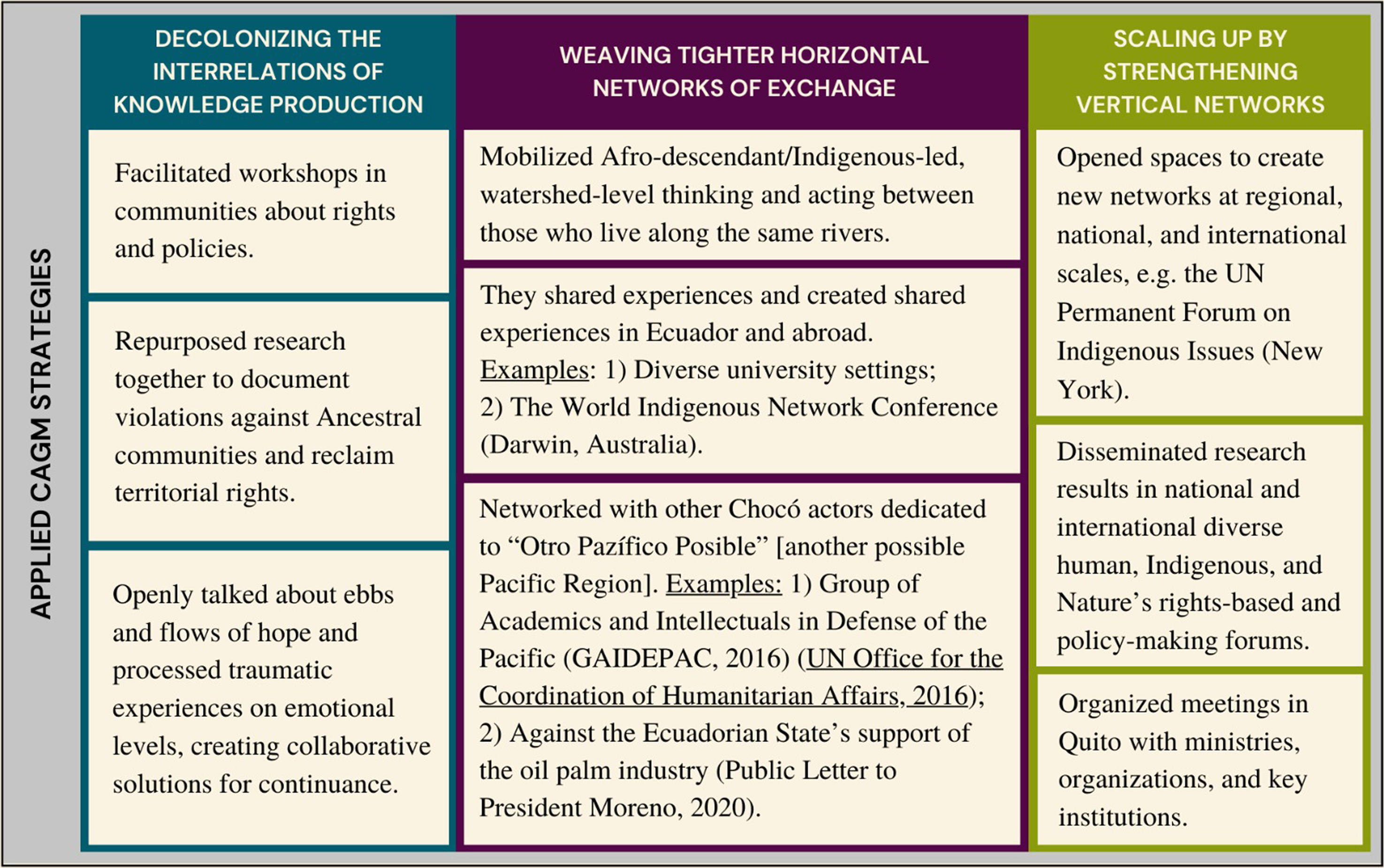
Applied CAGM strategies and tactics.
Alliance-based GgsHope breaks through isolation and form a rooted meshwork of inter-island Ggs(De)CO2loniality/H2Ope across scales that transcend us-them. Opaskwayak Cree scholar Shawn Wilson (2008: 15) wrote in his book Research Is Ceremony: It is the forming of healthy and strong relationships that leads us to being healthy and strong researchers… The reverse may also be true, in that the research process may also build or strengthen a sense of community. Through maintaining accountability to the relationships that have been built, an increased sense of sharing common interests can be established.
Stein et al. (2020) also emphasize relational and reciprocal learning methodologies. Together with other scholars, Kichwa Saraguro Lawyer and Amawtay Wasi Pluriversity Director Luis Fernando Sarango Macas (https://amawtaywasi.org/) discusses applying these same approaches in an Andean context (García et al., 2004; Sarango Macas and Saballos Velásquez, 2022). Alliance-based GgsHope situates relational and reciprocal methodologies in the Ecuadorian Chocó borderlands by interrupting researcher-researched boundaries, putting (de)CO2loniality into action, and collaboratively working to materialize H2Opeful possibilities of water justice.
GgsHope based in perseverance/resilience: Navigating spiritual and emotional realms of hope-with-justice
The water does not serve us because the water continues to be contaminated.
-La Chiquita resident Carmen Arroyo, 2017, personal communication
Perseverance-based and resilience-based hope are inseparable, hence perseverance/resilience-based GgsHope. Perseverance-based GgsHope keep the flames of hope-in-praxis alight for the long haul. Resilience-based GgsHope 32 navigate the tumultuous waters of fighting for (de)CO2loniality and H2Ope.
The oil palm companies and the twelve institutions are yet to address the reparations charged in 2017 (Alianza Periodística Tras las Huellas de la Palma, 2022; Isaha Ezequiel Valencia Cuero v Palmeras de los Andes, 2017). The Los Andes Palm Oil Processing Plant dumps their palm oil processing waste into the La Chiquita River.
33
The Black and Awá plaintiffs lack access to clean water to bathe, wash, cook, or drink. La Chiquita resident Anaina Quintero Cortez speaks to the injustice of the Ecuadorian state allowing the oil palm plantations to poison their lives: If you were to say to me, “Let's go see the President [of Ecuador],” the first thing that I would say to him is, “We want our water! It's your fault for permitting the oil palm companies that the people are dying! I would like you to go and drink that water.” What the government does to us is not just (Roots & Routes IC-Selvas Producciones, 2020).
Quintero Cortez is not alone. She speaks to what many people want across San Lorenzo Canton: to be heard, legitimized, and receive dignity-with-justice. The greatest challenge is to rise above the authorities’ inaction and reorient ourselves in the direction of hope. No matter how discouraged we individually felt, we encouraged one another to keep going by traversing the perseverance/resilience dimensions of GgsHope-with-justice.
Perseverance-based GgsHope: Keeping alive the fires of continuance
Perseverance-based GgsHope is temporal. This spiritual-psychological dimension of hope requires entering uncharted terrain where one is charged with 1) finding and igniting a spark within and 2) keeping alive the fires of continuance. There is a slow, steadfast progression through time, replete with overcoming setbacks. Hope glimmers when people find the wherewithal to take the next step forward, inspiring the unexpected. 34
In August 2016, Selvas Producciones, directed by Eriberto Gualinga of the Sarayaku Kichwa Original People from the Amazon, joined La Chiquita, Guadualito, and
Since 2016, we have been decolonizing methodologies by bridge-building, indigenizing technology, and re-storying (Tuhiwai Smith, 1999). In the Amazon-Chocó film school, the Chocó youth take the camera back into their own hands. Through their lenses, they tell stories of their culturally-based “life visions otherwise” (Walsh, 2015) and their hope-with-justice struggles (See Figure 14).
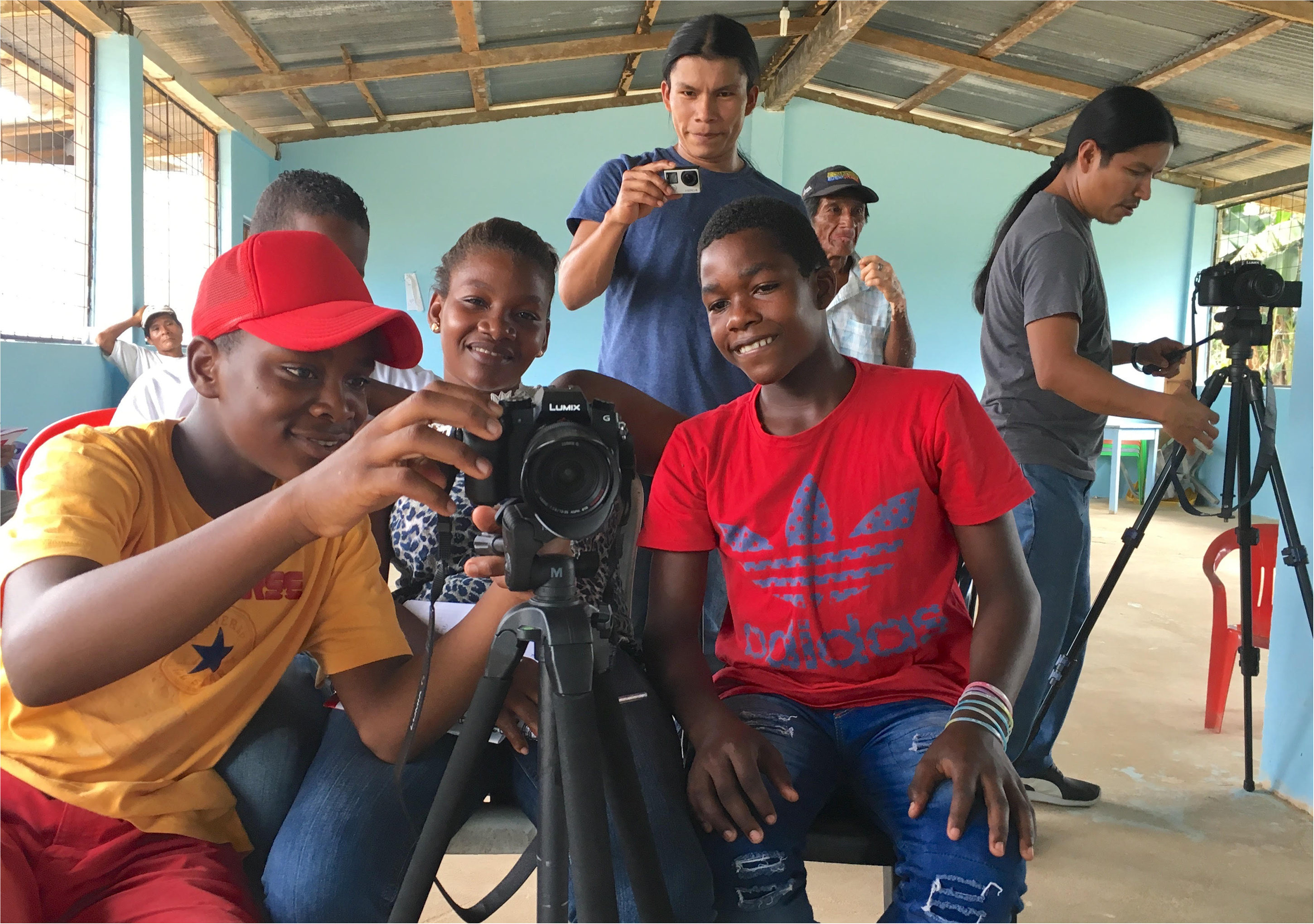
Youth from La Chiquita & Guadualito in Chocó-Amazon Film School (Photo by author, 25 February 2017).
The documentary contains heartfelt material revealed through the adolescents’ gaze into their film school experiences and mobilization for clean water. This handcrafted story packs a punch as forest peoples come together across cultures against oil palm plantations. Their message: The Chocó exists, and Black and Indigenous lives matter!
Truth-telling and healing relations through the film school/documentary has stoked the fires of an intercultural network essential to perseverance-based GgsHope. Tuhiwai Smith (1999: 149) affirms, “Connecting is about establishing good relations.” Continuing towards water justice, hope rekindles the embers of good relations across cultural, ethnic, and place-based differences.
Resilience-based GgsHope: Navigating em-oceanographies of hope
While all the attention is on those who went through the Earthquake, we are up here dying slowly.
-Isaha Valencia, 2016, personal communication
Resilience-based GgsHope is spatial. Within this dimension, we navigate the often-rough waters of hope. Hope involves vulnerability and undergoing wide-ranging emotional waves of individual-with-community “socio-ecological grief” 35 . Resilience-based GgsHope, therefore, is a realm consisting of wayfinding through an ocean of emotions—an em-oceanography of hope—where one may voyage into the outer edges of resilience. It is where socio-ecological grief-with-healing processes occur, and the inextricable ties between hope, social action, affect, and resilience are tethered. 36
Above, Isaha Valencia speaks to the discrepancies between how people respond to short-wave and long-wave ecological disasters. Within a still-expanding sea of oil palm monocultures, there are long-wave struggles for justice—like the constant poisoning of La Chiquita River—where people's individual and collective emotional elasticity and stamina are tested. Additionally, within long-term struggle, there are short-wave ebbs and flows of hope and despair as well as crests and troughs of inspiration to continue on (or not). People experience all these at different times. When navigating em-oceans of hope together, sometimes one can't row any longer and might lose an oar. While one wrestles with exhaustion and hopelessness, others covers for them. Eventually, recuperating as a whole, the crew snaps back to a collective rhythm of moving forward towards water justice. Isaha Valencia (2018, personal communication) states, “Of course, one doesn’t lose hope until one dies.”
How do we act in relation to those who are deemed disposable, yet are those from whom we learn invaluable lessons? Behar (1997: 14) accentuates going beyond “the spectator self” in research and plunging into the emotional vulnerability of “the enormous sea of serious social issues.” Mustering the courage to experience research from the “inside-out” (Garrett Graddy, 2018, personal communication) is central to feminist methodologies that contribute to the growing field of emotional geographies and vital social change processes. Krenak (2020) laments that for many decades, his nation in the Brazilian Amazon, the Krenak people, have been mourning agro-industrial interests defiling their river. 37 In the Ecuadorian Chocó too, we have experienced deep sorrow in relation to oil palm companies contaminating La Chiquita River, and we have helped one another through these troughs of hope. Consider this anecdote of socio-ecological grief-with-healing.
My Doctoral research underscored a central metaphor about San Lorenzo communities: San Lorenzo communities live stranded as castaways in their now scattered ancestral territories resembling islands in a growing sea of monoculture oil palm plantations. Shaken by the increasing violence within the border region, throughout my Ph.D. research period, I had a recurring dream: I was bathing in the ocean, and a gigantic tsunami was heading my way. I knew my only choice was to hold my breath and let it pass over me. I survived.
Through years of processing this dream, I realized two things: 1) The extent to which dreams inform (Lear, 2008) and the extent to which I was emotionally connected to the communities; 2) I also felt affected, pulled down into the deepest throes of the ever-expanding colonial wave of the sea of oil palms. When I finally let the pain of the Chocó Rainforest and peoples’ destruction wash over me, I momentarily felt caught up in the isolation of despair. I too feltlike a castaway.
I learned that, especially in geographies of violence, perhaps we become what we research. Being a castaway in a sea of palms was no longer only the central metaphor about them; it now united us. I had washed into the frontier space of us-them formation.
I remembered what I had to do. I needed to 1) acknowledge how the trauma of violence affected me and 2) step up even more in their struggles for justice-with-dignity. I witnessed my healing and their water justice
“Hope at sea” (Shewry, 2015) is necessarily decolonizing and relational. It's long-term and messy grief-with-healing processes of “suffering with” (Melissa Nelson, 2015, personal communication). In feeling compassion for the communities’ pain and realizing it is inseparable from my own, margins were erased. The tipping point was transcending us-them. That's when an unanticipated and unconditional sense of communal love flooded in. I felt a sudden sense of resilience as I came to the surface and felt the grandiosity of hope: Life often finds ways to win out; No matter what, we can do this. Hope at sea compels us to corazonar—a way of knowing-feeling from the heart and healing and (re)connecting to Mother Earth. Kichwa Karanki educator Kuyllur Saywa Escola Chachalo, my friend, is who taught me about corazonando—a concept that her grandfather had shared with her (2018, personal communication).
Processes that involve both decolonizing and healing 38 form a vital part of perseverance/resilience-based GgsHope. Rose (1993) also highlights crossing into mind-heart border spaces—“paradoxical spatialities”. She coincides with Guerrero Arias (2010) and Waldmueller (2014), who underscore corazonando as holding decolonial boundary-breaking and transformational potentialities.
GgsHope of the (im)possible: Collaboratively building a container for pluriversal hope-in-praxis
I don’t think I’ve ever heard of any other organization that has done something like this.
And I think we’re doing it based on Native understanding of networking, of projects, and that's something that is… It's hard to describe because it's something that is so new and is coming to fruition before my eyes.
It shows how different people from different parts of the world can come together as a family to produce something that has effects on different generations, different geographies, and even different interests, yet, all of it supported in one place.
-Dr Renee Pualani Louis (Kanaka Hawaiian Cartographer),
Co-founder & President of Roots & Routes IC Board of Directors.
GgsHope of the (im)possible show the transformative power of what can be done when people use their heart's eye to collectively envision and enact a reality más allá: a rooted meshwork of place-based GgsHope-in-Praxis that does the (un)thinkable by rewriting the story and changing the system. 39
GgsHope of the (im)possible are not an oasis or a destination at the end of the line, but instead, an aperture into new, previously unforeseen pathways. Nirmal and Rocheleau (2019: 465) refer to such “...pathways to autonomy, sufficiency, and resurgence of territories and worlds, through persistence, innovation, and mobilization of traditional and new knowledges” as “decolonized degrowth” (as opposed to deterritorializing growth economic practices and paradigms). The latter complements the GgsHope based in the (im)possible because it requires us to “…imagine what does not yet exist: our separate and collective socio-ecological futures of sufficiency and celebration in the multiple worlds of the pluriverse” (Nirmal and Rocheleau, 2019: 465).
Along this Chocó-based GgsHope-in-Praxis journey, we met community leaders and activists from Ecuador and beyond with whom we shared hope-with-justice stories. We assembled a shared space—a container for (re)learning how to restore and re-story the planet together—to mutually fortify one another's struggles and diverse cultural knowledges/practices.
In February 2018, we established a California-based education/research/cultural approaches to conservation organism that would do just that. We call the international community-led and youth-inspired organization, Roots & Routes IC (https://www.rootsroutes.org/). Roots & Routes facilitates sharing cultural knowledge and compassion between diverse cultures working to responsibly stewarding a flourishing living world. We refer to our processes as corazostenibilidades, “sustainabilities from the heart”. R&R's raison d'être includes decolonizing false climate change solutions—i.e., oil palm/biofuel production—and insisting on environmental justice and healing.
Walking the CAGM paths together in the Ecuadorian Chocó Border Region led us to interweave this pluricultural network. Our journey on-the-ground changed into something completely different and unexpected. We crossed through a huge transition to what was once unimaginable, and there is no going back.
We collectively strategize to materialize more of the (im)possible on all scales. In Ecuador, our 2022 projects include completing the documentary and amplifying the support of the La Chiquita and Guadualito struggles for Earth Jurisprudence. On an international level, we strengthen efforts like those in San Lorenzo and expand intercultural global networks and perspectives. Our virtual seasonal platform of 25–30 interns reaches across cultural differences in the name of collaborative action with youth worldwide. It is called the Youth Visionary Collective (YVC) (https://www.rootsroutes.org/yvc). Roots & Routes is also becoming an online and in-person action-learning platform—a pluriversity, a methodological space to bring Indigenous and all people/s together to share ancestral and/or place-specific cultural ways of knowing that do not need reinterpretation into Western frameworks to be valid. They already are!
Although the road into the (im)possible has been bumpy, tenuous, and messy, as Esmeraldeños say, “¡Pa’lante!” [Onward!]. Organizations before us showed us that assembling intercultural collectivities for re-existing and a common cause was possible. Now, as new constellations of peoples and organizations join forces, hopefully our Chocó-oriented collectivities also contribute to increasing the chances that pluriversal GgsHope-in-praxis shatter and expand existing (im)possibilities for justice.
Conclusions: Geographizing Ggs(De)CO2loniality/H2Ope as a journey-destination
We are the ones we’ve been waiting for.
-Ilarion Kuuyux Merculieff, Unandagan Elder (Aleutian Islands, Alaska)
Member of Roots and Routes IC Council of Advisors
Rooting into the peripheries of the peripheries, the Ecuadorian Chocó borderlands, we
Geographizing (de)CO2loniality/H2Ope from an Earth Jurisprudence point of view means engaging Geography's full potential as a holistic science (Hazlewood, 2020). Taking collective action to apply ancestral and Nature's rights in place insists on the intrinsic value of all beings who call the Chocó Rainforest and the Santiago-Cayapas watershed home. Working hand-in-hand towards implementing environmental-with-racial justice in the Ecuadorian Chocó Border Region further pushes the envelopes of the (im)possible.
Through establishing Roots & Routes to gather support for Chocó communities, each of us has traversed and delved into the topographies of GgsHope-with-justice alone and together. As such, our us-them formation processes offer multi-dimensional, complex, and Chocó-contingent lessons about hope's place-based, political, relational, spiritual-psychological, and emotional topographies.
Maneuvering between five dimensions of Ggs(De)CO2loniality/H2Ope—place, the (un)thinkable, alliances, perseverance/resilience, and the (im)possible—until we came out the other side, we had to come to terms with plunging into the unfamiliar ground of simultaneously undoing and doing differently. Navigating hope's ebbs and flows when decolonizing relations and regenerating relational spaces, we often end up with more questions about hope than answers. Yet, we learned that in praxis, whether we carry hope forward is ultimately a question of choice.
In coming together to decolonize both research and false solutions to climate change and to activate H2Ope-in-praxis for the rights of the river and water justice, we did not arrive at an idealized state of perfection. Instead, we are a work-in-progress, carrying ever-evolving understandings of one another and of collectively traversing pluriversal Geographies of Hope. Having glimpsed new potentialities of what's possible, we continue.
We are getting there. Step-by-step is another one forward. Geographizing Ggs(De)CO2loniality/H2Ope to be(y)on(d) the map is a journey-destination. As Merculieff proclaims, “
Footnotes
Highlights
Hope rolls out as a multifaceted journey-destination replete with arduous place-based, political, relational, spiritual-psychological, and emotional topographies, thus, a Geography of Hope. Investing in long-term, multi-dimensional methodologies can transform the purpose of community-based research from extractive documentation to collaborative action against racialized, extractive systems and processes. Emergent, shapeshifting, and often messy methodological processes of us-formation—multi-scalar, intercultural, and multi-dimensional—constitute the heart of Geographies of Hope-in-Praxis. Geographizing hope by establishing action-oriented networks across differences has contributed to visualizing Ecuadorian Chocó communities' struggles to re-exist and for the rights of a shared river. Decolonizing false solutions to climate change and raising the bar for water justice, Chocó borderland communities and their allies implement Geographies of (De)CO2loniality/H2Ope.
Acknowledgements
This article is dedicated to my mom, who encouraged me to keep hope close and reach for the stars. Mil gracias a los amig@s Afro, Awá y Chachi y a Dra. Flavia Carlet and Dra. Ximena Ron por luchar junt@s con esperanza. To the EPE Editors: Thanks a million for your support. I am indebted to the anonymous reviewers for in-depth comments. A heartfelt shout out to Eleonora Moen for accompanying me in refining my words, clarifying the message, and more. I am grateful to UCSC colleagues, Clara Weygandt and Patrick McKercher, for guidance on earlier manuscript versions. I am appreciative to Raquel Scherr, Skye Stevenson, Karen Kinslow, and Derede Arthur, who helped me on later drafts. Thank you to Roots & Routes youth—Aryan Trehan, Cameron Clark, Carolina Marca, Galen Tsongas, Griffin Harvey, Kate Velastegui, and Olivia Frykman—for contributing various elements. Muchas gracias, Aimee Maron for touching up my photos and a cozy Guápulo writing retreat. This publication’s contents do not necessarily reflect the views of the NSF, Inter-American Foundation, and University of Kentucky’s Geography Department, who funded my Ph.D. research. Thank you also to Roots & Routes’s generous funders since 2018!
Funding
The U.S. National Science Foundation, Inter-American Foundation, and the University of Kentucky's Geography Department funded different time periods of my Ph.D. research (2008-2010). Thanks to R&R's generous partners, from 2018 to the present, Roots & Routes IC has funded all community-based projects in and visits to San Lorenzo, Ecuador.