




Abstract
The postapocalypse as a mobilising discourse for climate action operates largely out of anger over experienced and anticipated injustices as well as paradoxical hope that fuses loss and grief with freed-up solidarities in support of liveable futures. However, negotiating this emotional tension can be both draining and isolating. Here, we examine how white settler populations in Western Australia balance grief and hope in places they hold dear and the role emotions such as sadness, worry, disappointment, joy, and pride play in relational place making. Through an innovative in situ and mobile methodology we call Walking Journeys, we trace how participants navigate their climatic-affective atmospheres and make sense of their agency in changing ‘Places of the Heart’. We find evidence for emotional complexities of solastalgia where pessimistic outlooks for the future are wrapped up in prefigurative visions of a better world. By holding the tension between paralysis and restoration, urban and rural residents explore affective co-existence and differential belonging in their homes and the landscapes around them. We highlight the challenge of enfranchising emotions beyond individuals and conclude by endorsing entangled, reflexive, and (re-)generative responsibilities for hopeful postapocalyptic journeying.
Keywords
“I don’t want your hope. I don’t want you to be hopeful. I want you to panic. I want you to feel the fear I feel every day, and then I want you to act. I want you to act as you would in a crisis. I want you to act as if our house was on fire. Because it is.”
Greta Thunberg (January 2019, World Economic Forum, Davos, Switzerland)
Introduction
Emotions such as hope, anger, and fear are the new fulcrum of environmental movements, and emotions tend to fly particularly high in public debates around the climate crisis. At least since Mike Hulme's (2009) book Why We Disagree About Climate Change: Understanding Controversy, Inaction and Opportunity, a core focus has been on coming to grips with the diverse beliefs and values that underpin individual and collective visions for a liveable future. More recently, contestations have centred on what narratives best mobilise climate action, and emotions play a fundamental role in such mobilisation. Greta Thunberg's 2019 speech at the World Economic Forum in Davos, Switzerland, encapsulates tensions between hope and fear. Yet, the polarising of emotions masks the much broader affective registers that we all navigate when wrestling with and attempting to locate ourselves within the imminent apocalypse.
Diverse and even seemingly contradictory emotional narratives can trigger climate action, as Cassegård and Thörn (2018) illustrate. Some narratives, the authors argue, such as those by established environmental movement organisations like Greenpeace and WWF, mobilise through ‘future-oriented optimism’ rather than despair and resignation which are seen as paralysing, based on a near romantic belief that threats can be averted and a better and achievable future is within reach. There is a sociocultural logic for this given that, as Head (2016) states, “[t]here is a deep cultural pressure in the West not to be a ‘doom and gloom merchant”’ (p. 2). This optimism is also easily discernible in the global weight accorded to reaching net zero carbon and the omnipresent rhetoric and policies on win-win adaptation and climate resilience. It is as if rising inequalities, domestically and abroad, could swiftly metamorphose into certified equal capacities and responsibilities. Other environmental narratives are fuelled by ‘“negative” utopian energies’ (Cassegård and Thörn, 2018, p. 566), imploring that the threat is unavoidable and all actions ought to be devoted to curbing the forthcoming catastrophe. The environmental youth movement and its rhetoric, including Thunberg's quote above, adopt such an apocalyptic discourse as it actuates through fear and rage as well as ‘anticipatory acts of hope’ (Friberg, 2022, p. 52) toward restoring a liveable order. Certainly, emotions have long played a significant role in harnessing energy for collective action (Goodwin et al., 2009; Jasper, 2011). The literature on emotions in social movements has particularly emphasised the mobilising role of anger (Ost, 2004; Woods et al., 2012), despite the negative effects of anger on activist wellbeing (Barker et al., 2008) and its limitations in terms of sustaining action over time (Brown and Pickerill, 2009). This type of mobilisation relies on transforming other emotive expressions, particularly fear, anxiety, sadness, and despair into anger and protest, as Pickard (2021) observes regarding Thunberg's leadership.
Yet, there is a third possible affect-fuelled environmentalism, that of the postapocalypse. It signals that catastrophe is already upon us, that fearing it as a future occurrence is misdirected and preventing it futile, and that coming to grips with inevitable loss is an essential component of active salvage and recovery. As Cassegård and Thörn (2018) argue, postapocalyptic narratives draw upon anger over injustices, where loss is seen not as paralysing but as a point of departure for political action. For them, it is at this juncture that the paradox of hope materialises: by accepting and verbalising loss, contesting societal wrongs, and acknowledging grief, it is possible to free imagination and embrace translocal solidarities in support of liveable futures. This kind of hope, as Wright (2019) sees it through the lens of land-based social movements, emerges from experience of struggles, anger, despair, and loss. It is both reparative and political and hence radically different from naive optimism. Rather, this version of hope aligns with Haraway's (2016) notion of ‘staying with the trouble’.
Here, we apply these insights on multifaceted emotions and struggles for a liveable future to explore individual affective spaces and how they mobilise and/or paralyse citizens’ actions in the context of environmental and climatic changes. Following Edensor et al. (2019), we opt for a focus on everyday lived realities and slowed-down temporal practices. We use a walking methodology to listen to residents in Western Australia explaining how they experience special places (Places of the Heart), identified by them as part of a research project entitled Locating Loss from Climate Change in Everyday Places. To do so, we bring into conversation these advances on environmental anti/a/postapocalyptic narratives of the climate crisis with literature on emotions from psychology. The psychologist Klaus Scherer (2005), in his componential theory of emotion, offers support for a generous understanding of agency, recognising that all emotion is linked to motivational consequences. More recent insights from environmental psychology (e.g., Miles-Novelo and Anderson, 2019; Clayton, 2020; Clayton and Karazsia, 2020) and ecopsychology (Roszak, 1992; Duncan, 2018) support the rationale for embracing a range of emotions, however subdued they might appear. In fact, much of this and related literature recognises multi-layered emotional states to be navigated, rather than succumbing to misleading binaries between ‘good’ and ‘bad’ emotions, conflating distress, grief, and despair with doomerism, or dismissing climate/ecoanxiety as intrinsically pathological. Growing scholarship on climate change education, particularly with youth protagonists (e.g., Ojala, 2012; Nairn, 2019; Verlie, 2019a; Jones and Davison, 2021), provides much needed insight into such emotional complexities.
As such, our study, focusing on how citizens balance often rich emotional registers in responding to change, contributes to the growing scholarship on ‘affective atmospheres’. This term, introduced by Anderson (2006, 2009), suggests that affect constitutes an atmosphere, an energy force or feeling of a place or situation that is shaped, shifted, and undone through the interaction of human and non-human bodies, practices, materials, moods, and sensations, all of which compel individuals to act (e.g., Thrift, 2004; Bissell, 2010; Duff and Moore, 2015; Laketa, 2016). While some – including Anderson (2006), following the approach of Massumi (1995) – interpret affect as a sensory experience that precedes cognitive emotions, others insist upon the interplay of affect and emotion, most prominently Ahmed (2004). Her phenomenological work on the cultural politics of emotions emphasises the connections between embodied affects and cognitively expressed emotions, and the ways in which these circulate through bodies, discourses, and places.
The participants in our study in Western Australia were mostly middle-aged residents. We focused on how they navigate emotions about environmental and other changes affecting familiar and cherished places, including homes, gardens, parks, farmland, unique landscape features, built heritage, and the bush. We were particularly interested in probing how these citizens – less often featured in affective climate scholarship – position themselves as potential agents of change, juggling hope and grief and other facets of their emotional repertoire. Ultimately, we hope to draw lessons for how to share and enfranchise a full range of emotions, beyond individual affective sense making, to foster collective efforts towards liveable and responsible futures.
Tracing emotions in everyday places
This research is part of a five-year project (2018 − 2022) that adopts a place-based approach to deliberating difficult value trade-offs in uncertain times and delineating inclusive, bottom-up adaptation trajectories that channel a range of emotions. When we first started recruiting research participants in 2018, via a flyer for an initial online survey, we debated whether or not to use the words ‘loss’ and ‘climate change’ in the one-page invitation. Would these terms instantaneously turn away a substantial pool of potential participants, especially those residents in Western Australia sceptical of or cynical about the climate crisis? And would ‘loss’ be too gloomy for all those who continue to relish their privileged lives in this settler-colonial environment, or too bleak for those who cling to hope for their daily survival? Ultimately, to cast a wide enough net during recruitment, we framed our invitation neutrally as ‘Valuing where we live in Western Australia’, also in line with the first phase of the project on sense of place and lived values. It generated 400+ survey respondents across eight communities (four with higher and four with lower socio-economic status), along an approximately 400-kilometre West-East climate gradient and experiences with different rapid-onset and slow climate emergencies. This cross-section included urban, forested peri-urban, and rural places and extended across the unceded territories of the Noongar peoples, from the state capital of Perth on the west coast through to the eastern edges of the Wheatbelt (the main agricultural area in the region, also featuring some mining).
Place is indeed much more than a mere physical location, as canonical work already established in the 1970s (e.g., Relph's (1976) research on place and placelessness and Tuan's (1979) insights into sense of place). Place, and the ways people comprehend and experience it, is intimately tied to our senses (Ashworth and Graham, 2017). Southwestern Australia is well known for its Mediterranean climate with hot, dry summers and mild, wet winters, now also accompanied by increasing maximum and minimum temperatures and declining annual and winter rainfall (CSIRO and Bureau of Meteorology, n.d.). Yet, it is the ‘climatic-affective atmospheres’ (Verlie, 2019b) that expose how these climatic trends and threats such as fires, extreme heat, droughts, flooding, and river erosions – all experienced across the communities in our research – are entangled with how people feel about where they live. This entails attention to how daily weather conditions, seasonal changes, and climate variability become active participants in place-making and hence shape the ways people, places, bodies, and emotions and affect are relationally imbricated, in rural and farming contexts (Adams-Hutcheson, 2019) as well as urban settings (de Vet and Head, 2020).
Hence, an explicit focus on place and emotions, as part of the wider affective turn in the social sciences, not only teases out aspects of identity and belonging, power, and politics but also re-humanises and re-embodies how place and space are understood (Collins, 2019). Emotions matter in everyday spaces as they offer a unique language through which to comprehend why people engage with the places they live in, through emotional connections and investments (Jupp et al., 2017) with other fellow beings and earth, water, air. It is not surprising then that scholars pursuing place-based research employ a variety of terms such as ‘emplacement’, ‘inhabiting place’, ‘ethics-in-place’ and ‘critical place inquiry’ (see short summary in Springgay and Truman, 2022) to examine the affective spatialities and temporalities of place, often influenced by feminist, anti-colonial, and more-than-human praxis oriented towards more just futures (e.g., Alaimo, 2016; Neimanis, 2017; Springgay and Truman, 2017; Truman, 2021). For instance, Collin's (2019) work on civic pride and shame in Nottingham, UK, illustrates how emotions, values, and practices can shape new forms of urban identity and resistance. Other examples include affective relations with place among (street) children and how everyday encounters, especially with fear, shape agency, inclusion, difference, contestation, and belonging (Witten et al., 2019; Gadd, 2021).
Building on this place-based literature, we deployed an in situ and mobile methodology (following Tschakert et al., 2013) which we call a Walking Journey. It was a key part of our first project phase, with the aim of examining the emotional tapestry associated with place and identifying the affective agency individuals may bring to subsequent community-driven adaptation. Methodologies to understand in/out situ experiences and phenomena have become quite popular as they make it possible to elicit experiential place-based knowledge (see Foley et al. 2020, and Lager et al., 2021 for overviews of the literature). As Foley et al. (2020) argue, ‘out’ situ approaches – best understood as in situ outdoors (Kusenbach, 2003) – such as go- or walk-along interviews and walking as storying allow researchers to ‘engage with embodiment and emotion at diverse temporal scales’ (p. 515). Such methodologies create openings to acknowledge the place(s) that participants share as a ‘third interview participant’ (p. 517), making visible the agency of place, with its abundant human and more-than-human matterings, as well as the webs of connection and responsibility that link them. Further, walking is not only sensorial but also a place-making practice (Waitt et al., 2009). For Foley et al. (2020), walking with research participants is imbued with an ethic of care that entails attentive listening and being-with, including receptivity to emotional and affective experiences. Such situated and relational research has lots to offer in geographies of health and wellbeing. As Springgay and Truman (2022) assert, (critical) walking methodologies bring to the fore how places are entwined with many of the current crises. By tapping into both the affective and political dimensions of place, such approaches enable situated, relational, responsible, and ethical encounters with past, present, and future worlds.
In the project's sequence of iterative engagements, the Walking Journeys followed the initial survey and a participatory, sit-down mapping activity, the latter conducted with 106 participants. This number included two Indigenous participants and one with an immigrant background, an admittedly meagre diversity outcome, despite our best efforts, yet roughly reflective of the 2–6% Aboriginal and Torres Strait Islander population in the participating WA communities as reported in the 2021 Census. The mapping exercise explored lived values (e.g., sense of community, safety, entertainment) and environmental values (e.g., aesthetic, recreational, therapeutic) across spatial scales, from a resident's home to the globe. Participants had an opportunity to identify places special to them (‘Places of the Heart’) such as spots people would visit to find solace or happiness, or locations people might cherish because of memories. They labelled such places (up to three) with a heart-shaped sticky dot on the map. Out of all possible scalar levels, 81.1% of participants identified their home as a Place of the Heart, 60.4% located one (or more) in their suburb or Shire and 33% in the Perth metropolitan area, and 26.4% identified either overseas locations or the world/planet itself. The two most often cited reasons for identifying these special places were that they were ‘home’ (77.4%) or valued for characteristics specifically linked to the chosen environment across proximate and more remote locales (53.8%), with additional justifications capturing family ties, birthplaces or places of childhood, wellbeing, and cultural heritage.
‘Home’ is a core locus in which spatiality, temporalities, social relations, materiality, memories, and meaning converge. Ideally (and bearing in mind that too many ‘homes’ fall short of such ideals), home is also a place of ontological security (Gorman-Murray, 2014) where dwellers can ‘achieve a sense of continuity, maintain self-identity and realise full agency’ (Ejdus, 2017, p. 25). Home is thus both physical and emotional, real and imagined, and always in the making, as Douglas (1991) showed, by bringing spaces under control. Indeed, in our value mapping activity, when indicating cross-scalar spheres of influence, participants identified the home and the suburb/Shire as places over which they felt they had most control, even if their sense of responsibility had a global reach. For Blunt and colleagues (2020), there is also a vital anticipatory element encapsulated in home, entangled not only with daily routines and rhythms, memories, and history but also ‘dreams and fears for the future’ (p3). A home can also be unmade, when all or parts of it are damaged, divested, or destroyed (Baxter and Brickell, 2014), for example during social or environmental breakdowns (McKinnon and Eriksen, 2021; Sou and Webber, 2021). Changes to homes, as well as neighbourhoods (known as suburbs in Australia) and other everyday places and landscapes, can severely erode familiarity, identity, sense of belonging, dignity, and wellbeing, and, as Lager and colleagues (2021) show for elderly urban residents in Holland, also undermine social networks.
Walking with participants to one of their Places of the Heart was thus an effort to acknowledge such affective dimensions of place in and on their properties or into surrounding areas, in the present, with respect to observed changes, and in anticipation of what the future may bring. A total of 69 residents out of the 100+ who had been part of the values mapping exercise were interested and available (for some participants, the logistics were not favourable, i.e., they were sick or were travelling during the research team's visits or they had other urgent life priorities – unfortunately, this was the case for our three Indigenous/non-white participants – or their special places may have been too far away, and no suitable, proximate alternative could be found at mutually agreeable dates). Hence, in this round of project engagements, all our participants were white and non-Indigenous, with more women than men and several from privileged backgrounds yet others facing severe socio-economic hardship. More than two-thirds were over the age of 55, with the youngest in their late 20s and the oldest in their late 80s, which is reflective of the overall, self-selected sample in our study. This demographic admittedly embodied the perspectives of what Plumwood (2008) has critiqued as individualist and proximate places and imaginaries at the expense of the other places, beings, and relations that sustain them (‘shadow places’), particularly in settler-colonial contexts. However, as Potter et al. (2022) argue in their Manifesto for Shadow Places, we cannot shy away from ‘interrogat[ing] western white privilege from the inside’ (p. 11) to expand from this vantage point and grapple with the relationality of place and the webs of connectedness that define daily existences. Such grappling includes us, the authors, and our positionalities as non-Indigenous, middle-class academics navigating our lived experiences as Australian and non-Australian white settlers, epistemological tensions of affectively knowing landscapes in WA, and our different scholarly struggles with inclusion and disenfranchisement along the lines of gender, ethnicity, indigeneity, race, class, and age, in Australia and global South contexts.
Our Walking Journey methodology is best seen as a participatory walking interview (Clark and Emmel, 2008; Evans and Jones, 2011) proceeding from the participant's high degree of familiarity with the area visited; yet, it did not always qualify as a ‘peripatetic practice’ involving walking from one place to another. Rather, we accompanied participants being and moving in one particular place. We often walked some distance with the interviewee, moving through the place as we talked; at other times, the conversation was less mobile—for example, if their special place was their back garden. In either case, the interviews asked for active engagement with the environment, involving pointing, showing, and – with the participants’ permission – photographing of significant sites or objects and participants themselves.
Following Spinney's (2015) request for more attention to affect in mobile methods, we also attempted to track participants’ emotional states associated with the place, and changes to it, experienced and anticipated. The walk-along interview thus focused on three core questions: 1) why is this place special to you? (when do you come here? how do you get here? why do you come? what's the first thing you notice? what do you call this place?); 2) what changes have you noticed in this place over the last 10–20 years? (do they motivate you to respond?) and 3) how do you imagine this place in 25 years’ time and what prospects do you see for its future? (what can you do to contribute to them)? At each of these steps, we asked participants to describe their emotions using the Geneva Emotions Wheel (henceforth ‘the Wheel’), a research tool developed at the Swiss Centre for Affective Sciences (Scherer 2005). The version of the Wheel we used (Figure 1) arranged twenty emotions in a circle, drawing upon the full colour spectrum. Each emotion was represented with two descriptors, indicating a range (e.g., sadness – despair), accompanied by bubbles increasing in size outwards for scoring emotional intensity, from 1 (weak) to 5 (very strong). Participants had a laminated Wheel in front of them (Figure 2) when verbalising their emotions.
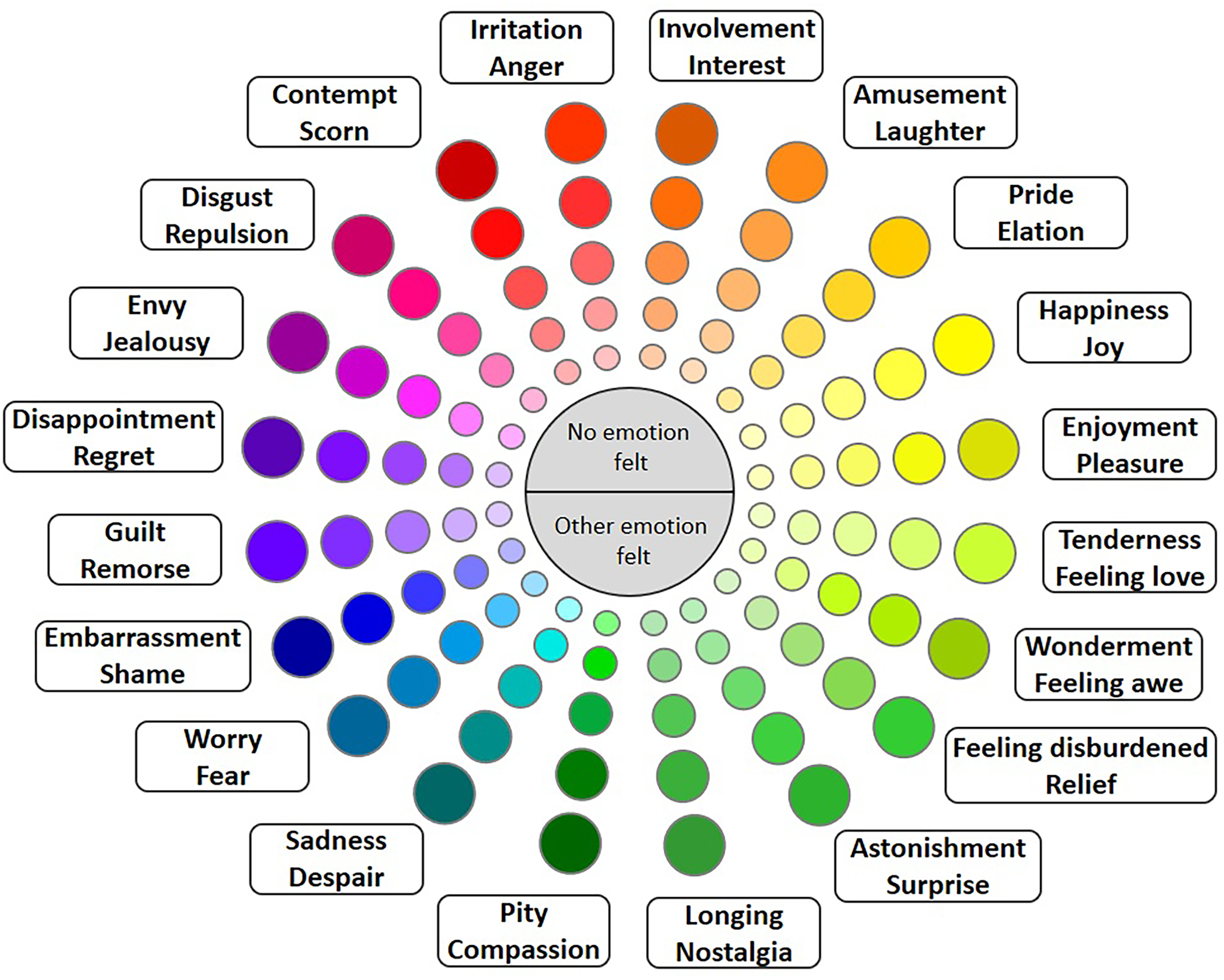
Geneva Emotions Wheel as used during the Walking Journeys.
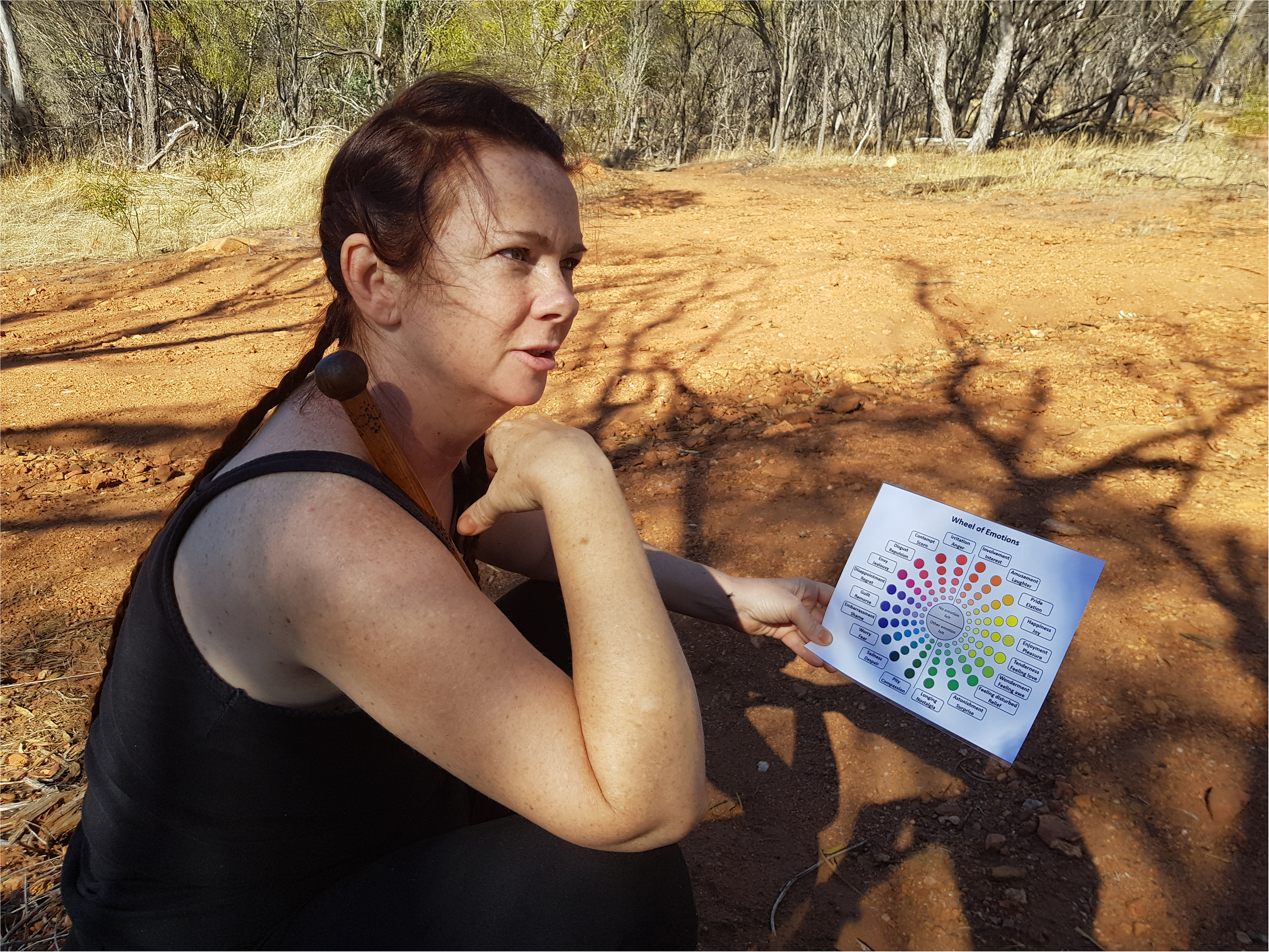
A participant verbalising her felt emotions on the Geneva Emotions Wheel.
Most Journeys took 40 min to 2 h to complete. The interviews were audio recorded; a notetaker accompanying the interviewer and interviewee also completed a proforma including a sketch of the place visited, noteworthy responses to the questions (with a time stamp regarding the recording), and the emotions identified. Similar to McKinnon and Eriksen (2021) who value the communicative capacities of speech as explored by feminist geographers such as Duffy and Waitt (2013), Ratnam (2019), and Koch (2020), we did not transcribe the entire audio-recordings of the Walking Journeys. Instead, we opted for careful listening the evening after an interview, adding insightful quotes and highlights to the proforma. Later, we went back to the selected recorded interviews of participants who had engaged more deeply with their emotional states and extracted longer, quasi-verbatim quotes which are used in this paper.
The emotional complexity of solastalgia
Over the 100+ hours of Walking Journeys, we had the privilege of being invited inside many Places of the Heart. We meandered through, around, and into small veggie patches and expensively landscaped gardens, modest government housing and mansion-like residences, rural cemeteries and churches, and up and down distinctive landscape features across Noongar Boodja (the Country of the Noongar peoples) such as granite outcrops, creeks, river valleys, and pools, all of which are imbued with Indigenous history and cultural significance. We also visited hard-worked farmland and barren agricultural trial plots, well-maintained parks, public gardens, and dog paths in urban settings, remote bush and dense forests, pinkish-white salt lakes, a shrine dedicated to a lost friend, a small-town theatre, and even an old shed remodelled as a tree-changer arts workshop that hosts a monthly cocktail party. Given that these were all special places and spaces in which people relax, cherish memories, seek peace and solitude, and find therapeutic escapes and solace, almost all emotional states conveyed to us about these places emphasised enjoyment, pleasure, happiness, joy, involvement, interest, pride, and/or elation. The last was particularly the case for domestic spaces such as houses, gardens, and farms over which participants expressed most control; they enable active emotional and material beautification and creation that further intensify place attachment. Wonderment and awe were often expressed with natural settings outside the immediate home boundaries, with places that induce spatial and temporal reflection, such as being able to remove oneself from the oppressiveness of the city and, for some, tuning into Aboriginal knowledge systems.
However, once the conversations shifted to changes observed in these places, other emotional registers on the Wheel came to the fore. The ‘climatic-affective atmospheres’ (Verlie, 2019b) became more imbued with worry, fear, sadness, despair, irritation, anger, disappointment, and regret, particularly with regards to weather and climatic changes including increased risk of bushfire, ecosystem changes, environmental degradation, development, and the interconnections between them. These sensations are well captured in the literature on ‘solastalgia’, a term coined by Albrecht (2005) which indexes emotional and existential distress and grief triggered by place transformations (Tschakert et al., 2013; Ellis and Albrecht, 2017; Cunsolo and Ellis, 2018; Galway et al., 2019). Such distress and grief, as Kelly (2009) argued, is often caused by ‘displacement and loss due to ecological crises by which places are traumatized to the point that they can no longer provide solace and sustenance’ (p3). Examples include gardens wilted from droughts in rural Australia (Sartore et al., 2008) to hollow homes in regional Ghana where place and self are literally and figuratively desiccated (Tschakert et al., 2013).
Higginbotham, Albrecht, and colleagues (2006) documented ample use of references to “I feel worried”, “I feel saddened”, and “I feel disappointed” when developing their environmental distress scale based on responses to the effects from open-cut mining in Australia's Upper Hunter Valley. Phillips and Murphy (2021) find the same three dominant emotions (and also “I feel upset”) when examining slow place disruption due to coastal erosion in Ireland; the higher the scores on place attachment, the stronger the correlation. Most studies so far have relied on surveys and Likert scale scores from strongly agree to strongly disagree, yet recent research (Phillips and Murphy, 2021) recommends in-depth, qualitative methods to tease out complexities and the simultaneity of affective belonging. Our Walking Journeys attempted to do just that, and our insights support a key finding of Phillips and Murphy who note that solastalgic emotions associated with pessimistic outlooks for the future, for current and future generations, are often coupled with some hope that the future could nonetheless be positive.
For instance, Jackie 1 , a resident in an affluent suburb south of Perth, expressed intense worry and fear over the shifting seasons, the excessive heat, and rising water levels in the Swan Estuary, despite the building of defensive limestone walls where there used to be a beach. She said: ‘The Earth is heating up. Climate change is not acceptable but it is inevitable…. I worry for my grandchildren, for what's going to happen in their lives. Climate change requires us to change. We can’t just bury our heads in the sand’. In a nearby spot on the foreshore, Bronwyn shared her high levels of sadness and fears witnessing the estuary and coastal erosion, the increasing swampiness of the foreshore, and big dying trees (Figure 3), yet wished to remain somewhat hopeful that ‘people will be looking after this place, planting natives, and doing retaining’. Monica, a single mother in a so-called rural SuperTown ∼100 km inland, is rather angry about the more frequent hot days and frost that afflict her small garden paradise (Figure 4), but she tries to keep her emotions at bay: ‘If you let bad emotions get a hold of you, you spiral. I can’t control the weather, so I need to take steps to manage what I do with my plants and my emotions … like building a living shade’.
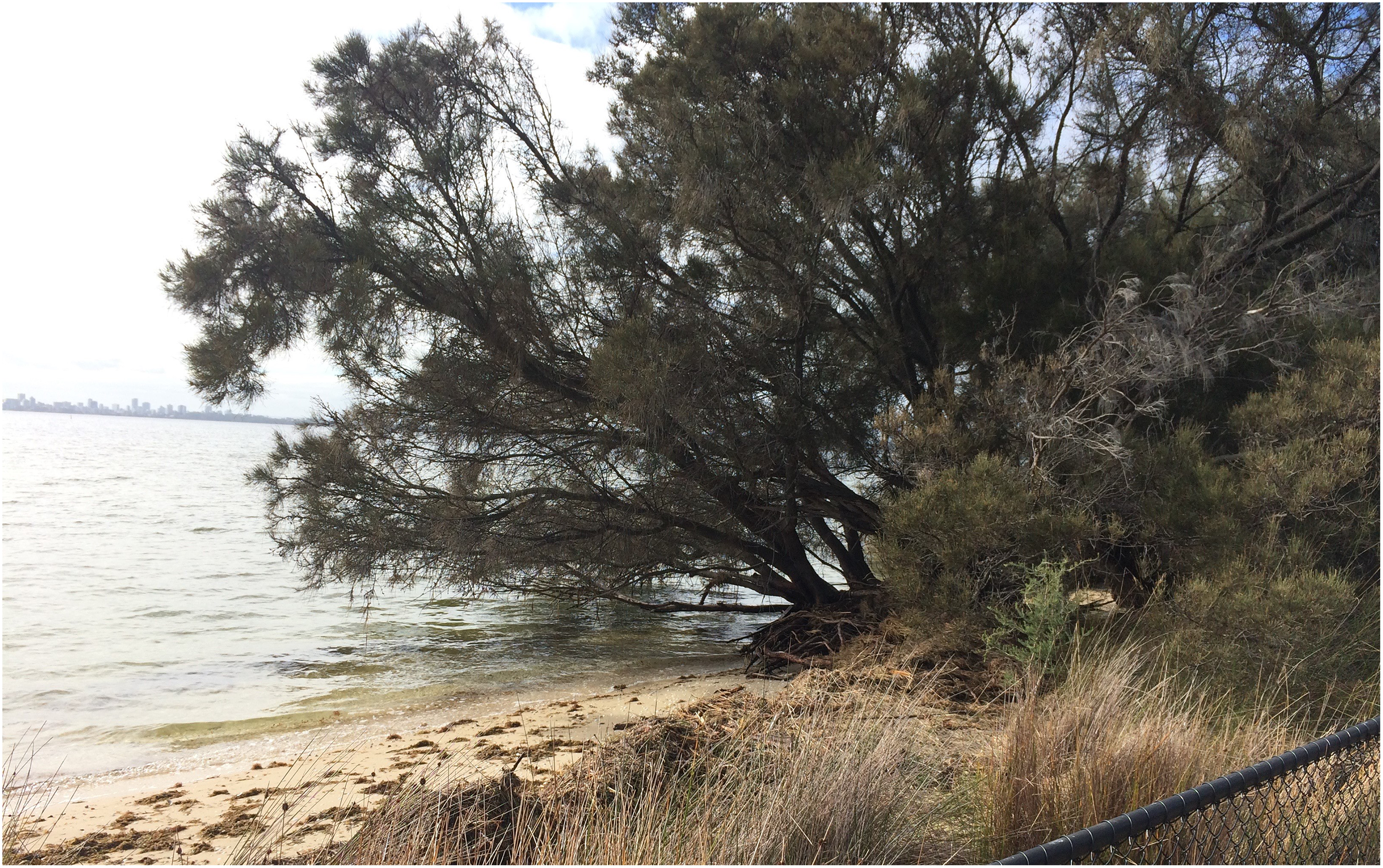
Flooding, river erosion, and dying trees along the Swan River.
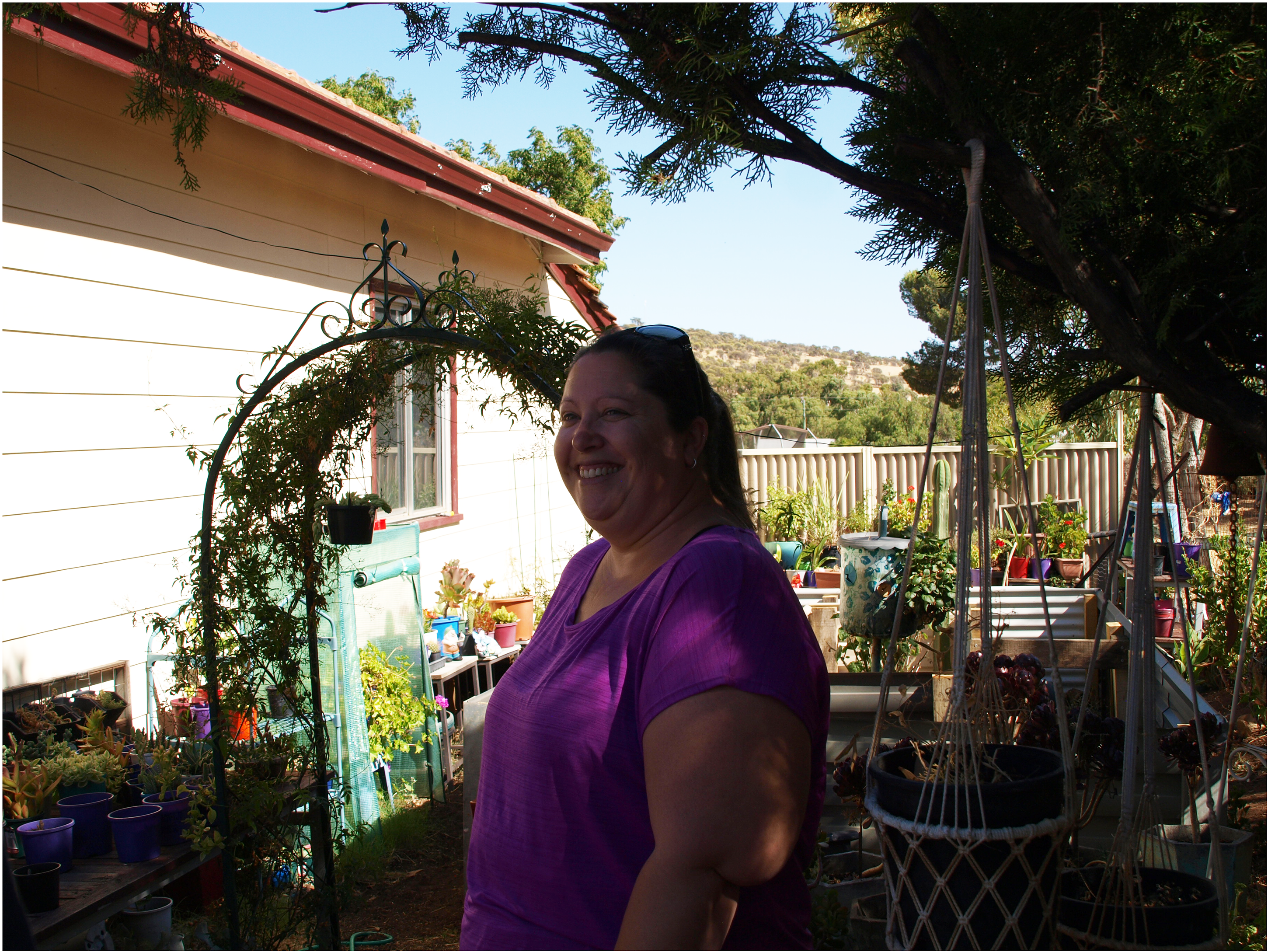
A participant in her home garden refuge.
For many, strong emotions were also reported in response to local development trends such as increasing population pressure and infills. In a lower socioeconomic suburb further south from the Swan Estuary, residents felt sad, disappointed, and furious about the continuous tree removal and bulldozing of small remaining pockets of urban green, for new subdivisions and high risers that, as Elizabeth feared, would ‘create slums’. Heather was quick to pinpoint ‘problems with the Council and oldies’ with regards to environmentally insensitive development, expressing considerable anger, sadness, contempt, and disgust. Freda, given her environmental science background, was more measured. She can see the connections between local development, our global human footprint, and changes to the entire riverbank system, like more frequent and intense storms, river erosion, and flooding. Even so, she remains hopeful with respect to adaptation and behavioural changes: ‘Most things are not either positive or negative, they can work out either way … there is a lot of uncertainty… another area could take over as the feeding ground for the birds, but I don’t know’.
Others were similarly inclined to blame environmental problems on political incompetence and failure in governance; for example, in a tree-changer community in the Perth Hills, several residents were exasperated about what they see as irresponsible bushfire risk management. For instance, Carol, when considering the reality of hotter and longer summers and the increased frequency and severity of bushfires, gave a maximum score of irritation and anger on the Wheel: ‘The government ignores the fire risk …. We’ve got national parks on three sides of our property. Their prescribed burning is inadequate; there is this increased fuel load all around us, and the risk of out-of-control fires. This restricts your lifestyle. We don’t go away over the summer so we can protect the house…. I’m not happy when I hear the helicopters coming. We’ve had a big bushfire here earlier in the year. It's devastating when you go for walks and there are dead animals and it's still smouldering’. With regards to the future, she expressed further irritation and sadness, especially if ‘the local authorities keep what they are doing … then bushfires will be unmanageable’; and extreme sadness and disappointment when considering that her home could be destroyed by a fire. These visceral concerns, however, were entwined with involvement and interest in “trying to keep on top of this”, referring to recent fire protection measures and experiences with staying and defending. Peter, a renowned weed expert in the area, also expressed irritation and disappointment over poorly managed burn-off fires, yet: ‘I have learned how to manage my emotional reaction. Rather than getting angry, which doesn’t achieve much, I feel disappointed and regret. But if it is a wildfire with a human cause, something stupid, I feel more contempt, disgust, and irritation’. His approach is to be aware and engage to understand, be better equipped, and ‘fill in the holes you don’t know’. This engagement is also fuelled by Peter's strong sense of relief, awe, and wonderment (4–5) when vegetation comes back after fires, even if some old trees perish.
As these comments illustrate, solastalgia is often characterised by the articulation of distress in conjunction with hope, expressed through increased efforts to conserve or rehabilitate valued environments (Higginbotham et al., 2006; Eisenman et al., 2015; Lemée et al., 2019). This concurrence was clearly expressed by Hugo, a retired hydrologist. He felt intensely proud and elated due to his life-long efforts to plant native and drought-tolerant trees on his bush property and enhance the family's sense of belonging, saying “it feels lovely to have witnessed all these changes”, despite or because of being acutely aware of the continuously declining rainfall over the Wheatbelt, the declining water tables, the salinity problem and the consequences for farmers. He remains optimistic regarding the future since he believes in the adaptability of farmers and the regenerative potential of the land, if cared for. Bob too, a soil scientist on an agricultural research station further east, feels pride about his commitment to vegetation rehabilitation and experimental progress in soil restoration, coupled with intense pleasure over the return of birds as a result of conservation efforts. Similarly, Jess, a farmer nearby, shared her substantial worries and disappointment over the driest years (2010 and 2011) that she and her husband had endured; but at the same time – gesturing towards planted trees and saltbushes on her property – she did not hold back on expressing the tremendous relief and pride felt during bumper years like 2013. Jess envisions a future brimming with positive emotions of joy and intense pleasure, imagining a new house, fully healthy trees, and new crop rotations for a flourishing farm.
Holding the tension between paralysis and restoration
This tension across the emotional spectrum – particularly between sadness, anger, and grief, together with joy, pride, and hope – was palpable across most participants, who were able to balance this affective co-existence by keeping multiple sensibilities in the frame when reflecting on existing changes. Yet, when considering in more depth what the future may bring, the emphasis shifted further and many tilted more towards powerlessness and despair. This state of emotional tension, as Clayton (2020) examines in her work on climate anxiety, eco-anxiety, and climate grief, is in fact fundamental for how to approach future-oriented thinking and behaviour. While anger, worry, anxiety, and grief are intimately tied to place disruption, the potential loss of ontological security (Norgaard, 2006; Gorman-Murray, 2014; Ejdus, 2017), associated with ‘psychoterratic’ (Albrecht, 2011) experiences of place identity being eroded, are generally not pathological but rather a reasonable or ‘healthy’ response to circumstances. As such, they offer trajectories not only towards paralysis and depression but also towards adaptive action. Clayton (2020) explicitly investigates this ‘state of tension between the motivating and paralyzing effects’ on behaviour (p. 4), the co-existence of getting engaged and giving up. For her, eco-therapy, or ‘taking therapy “outdoors”’ (p. 5) allows people to tap into the restorative potential of natural environments, even if these spaces are being eroded.
Findings from our Walking Journey research support this view. For example, Peta, a former teacher who has observed changes in weather patterns, the deteriorating water quality, and fluctuating water levels around Burlong Pool in the western Wheatbelt conveyed her simultaneous despair and joy that she feels when wrestling with climate change: “The young people, like Greta from Sweden, she talks about only having 20 years to turn things around before climate change, the 1.5°C [global temperature increase], will be irreversible. I have always felt we were on this never-ending stretch to destroy the planet, but now I also feel some joy over the fact that we can make a difference, and we do have the power to do so … like with innovations to take plastic out of the ocean”.
Luke, the secretary of the Climate Justice Union WA and a community activist, and among the younger third of our sample demographic, took us through a patch of uncleared Jarrah Forest that is part of the Armadale Nature Reserve, a place he crosses 3–4 times a week on his way to work. He has been living in his nearby residence for 12 years, has intimate knowledge of the various trees, animals, and wildflowers, and has been able to bear witness to changes over time, via thousands of photos taken as cumulative evidence. Luke has a substantial emotional repertoire for being in this special place, indicating mostly high scores on the Wheel for sadness, despair, embarrassment, shame, guilt, fear, worry, anger, and involvement; and also compassion, connectedness, tenderness, and love. He expressed a strong sense of responsibility for minimising loss, and pride over the protective fence that the community insisted be installed. He shared how he was feeling disburdened and relieved when touching old trees or walking through what he calls ‘the natural arc’, or simply joy and happiness when the sun was out. In talking about the heatwave that afflicted the Perth metropolitan area in 2012−2014, the ensuing death of trees, and the strong anger and disgust/repulsion he experienced, he said: ‘The heat wave was devastating. Everything dried up. The roots would no longer hold, and trees fell over, some caught on fire… a lot of bobtail lizards, during April and May, caught on fire’. Due to that devastation, he says he is now ‘mentally committed’. He sees the adverse impacts from climate change and the ever-present threat of development as inevitable: ‘That's my fear, the rate of retreat of trees with rising temperature is quite high … they may die during my life time. I don’t want to have to watch these die. But it may be a signal of the downturn of our community, and also a planetary one. This may happen despite our best efforts to protect … if we don’t protect, it will be even more devastating’. Asked if these emotions linger, he said: ‘They are omnipresent. I have lived my entire life in this place. They are always there, but not always at the forefront. Sometimes, they are more positive, optimistic. But with the collapse of the ecosystem and civilisation, competition over increasingly scarce resources, we descend into warfare. It's blatantly playing out in front of us, we’re potentially already over the edge’.
For Luke, the future therefore holds mixed prospects. Old trees may well survive and the bush reserve remains healthy, due to concerted human efforts. ‘It won’t happen if people like me don’t make it happen’. At the same time, he feels that climate change ‘could be overwhelming’, with sea level rise and salt water intrusion conspiring to a ‘doomsday scenario that we may not see within 25 years, unless it's the worst case scenario … I have zero faith in negative emissions. The amount of methane from wetlands is overwhelming. It's possible that we have already gone beyond the point of reversal’. He speaks about ‘a challenge at a scale that we have never seen, have never dealt with before’ while also longing and feeling nostalgic ‘for a future that doesn’t exist yet’. There is also guilt over his petrol vehicle and the fossil fuel heater. Yet, he says: ‘I try to hold not too much of that guilt by myself, it's a collective guilt … For me, the hope thing … the reason hope is not on here [on the Wheel] is because hope is not so much an emotion. Hope is a decision to go and see a pathway through this … Hope is a decision you make in response to emotions. It is the counter to despair. I think despair is not an emotion either. Sadness is, and despair is what happens as a result’. When it comes to anxiety, Luke concludes: ‘you can either tunnel down sadness and fear until you drown in it. And I have nearly drowned, a couple of times. Or you can keep getting back up, keep pushing through, and hope that, at the end, it has all been worth it’.
Simon, a retired environmental scientist and resident in the rather affluent Perth Hills, wrestles with the same tensions. We joined him on a walk through Beelu National Park, at the outskirts of the tree-changer community. Like Luke, he has extensive knowledge of trees, how they have been affected by temperature stress and drought, and the disappearance of plants, such as dwarf spider orchards. For Simon, ‘climate change is a slow-moving train wreck which humans are not well adapted to dealing with … and the impacts will be from subtle to catastrophic … no place is immune’. He worries about the increasingly hot bushfires and their devastating effects on plant survival and recovery and the gradual disappearance of habitat, also due to the encroachment of bush blocks. He sees ‘loss on a massive scale; loss of a world that my grandchildren have to deal with’, triggering feelings of sadness, worry, and fear, and also some anger, particularly vis-à-vis people ‘who don’t get it, who don’t care’. He experiences these emotions intensely as ‘the changes that will be required will be decadal and sustained; and we are still nowhere near even starting this process’. In response to these challenges, Simon's emphasis now is mostly on living a reasonably sustainable lifestyle, planting native species, and capturing water for the house while teaching younger family members and conveying his knowledge to those around him who are receptive. But, behavioural change in others seems slow to come – ‘I haven’t found a vehicle, really, apart from this study, for really getting involved in changing attitudes’. He feels torn regarding prospects for the future – profoundly sad, although not in a state of despair as ‘humans will muddle through’. Yet, he is troubled by his apparent failure to make a more substantive difference within his sphere of influence, despite all his expertise, and ‘that the things that I have experienced and really love about this part of the world will not be available in the same way as now to my grandchildren’.
Connectedness – inwards, outwards, and with more-than-humans
In our slow and contemplative Walking Journeys, we found compelling evidence for the conscious efforts individuals make to nourish connectedness in their special places, whether these be scenic spots in the extensive landscapes of the Perth Hills and the Wheatbelt or in suburban gardens. The in situ walking methodology invited citizens to share the often rich, emotional landscape they traverse in their cherished places and locate their agency within what otherwise can be an introverted experience. For some, embracing being outdoors as part of research sharpened onto-epistemological glimpses into what Neimanis (2017) calls a more relational ‘imaginary for being responsive to other human and non-human bodies with whom we share a planetary existence’ (p. 136). For so many earthlings, it is an arduous process coming to grips with the webs of connections that inextricably tie people to more-than-human species and beings, and link past generations to those not yet born. Yet, growing insights from posthumanism and multispecies justice literature, stretching from the environmental humanities to ecopsychology and Indigenous studies, remind us that ditching human exceptionalism is imperative (e.g., Plumwood, 2008; Neimanis, 2017; Mcphie, 2019; Celermajer et al., 2021). In her research on eco-therapeutic experiences, Clayton (2020) emphasises the restorative value of being with other-than-human life while Cunsolo Willox (2012) teaches us to mourn with non-humans to engender politically and ethically attentive climate discourse.
Bethan, for example, is energised by the regenerative Landcare actions she has been undertaking on her rural property: ‘I really love it here, for what I have created. I don’t want to go anywhere. I’m like this mad woman out here, but I love it!’ And, she teaches others how to care for the Earth. Similarly, Luke relayed his relationship with old Jarrah trees: ‘I have a strong connection to the big Jarrah tree in Armadale, the one they built the shopping centre around. It's 1500 years old, one of the oldest and tallest in the world. Aboriginal people have been telling stories underneath this tree for a long time before Whitefellas came …. I feel like [I’m] being called by the Jarrah trees (Figure 5(a))’. He also introduced us to one particular tree in the reserve: ‘The first time I felt a connection with Jarrah trees was with this one … I feel disburdened and relief when touching the tree … sometimes I sing here – Noongar Boodja Jarrah – and I feel compassion and connectedness, and tenderness and love’. And, when coming across a massive dead Jarrah, Luke explained: ‘They stick around for a long time, the wood doesn’t deteriorate fast, it doesn’t get eaten by termites. In here is a nesting hollow. There are lots of black cockies [cockatoos] here, and Christmas spiders’.
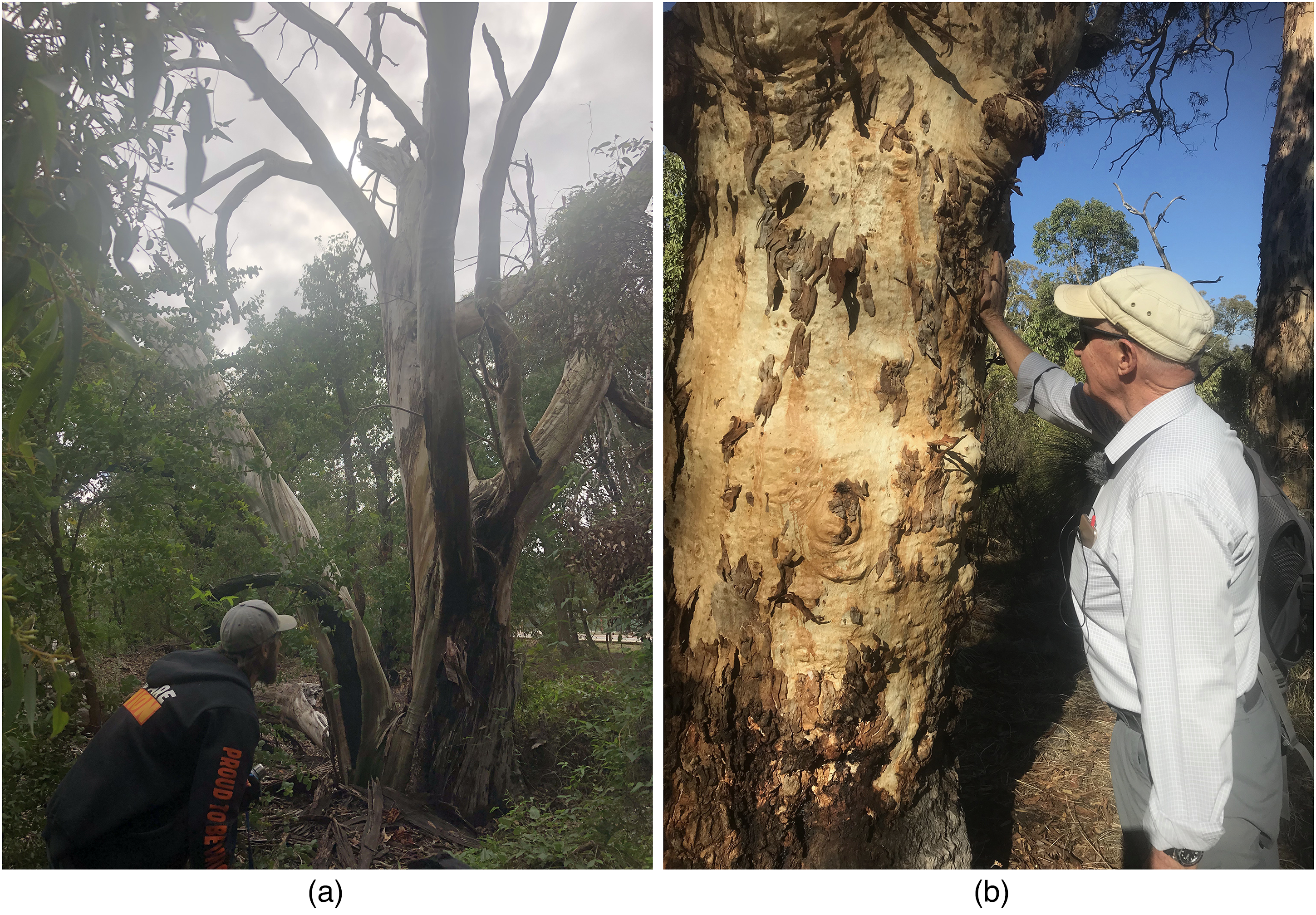
Being with trees in the Armadale Nature Reserve (a) and Beelu National Park (b).
Simon too nurtures his connections to trees and the bush of the Perth Hills: ‘I like to go up to a tree up here and give it a good slap, to feel its solidarity, to be in touch with these ancient things. They have survived so long, they are hundreds of years old’ (Figure 5(b)). He too has a long-standing interest in Noongar culture and ways of being with the land: ‘I try to think what it would have been here before, before the Whites … I think about Aboriginal occupation and wonder what it was like. Silence strikes me here … there is a ‘cone of silence’ around me, I feel I’m being watched [by the bush], in a funny kind of way. The noise, the birds, it's beyond’. Later on, he elaborated: ‘My caring role is for the bush that I love so much. I don’t pretend to have the same connection as the Noongar, but it is still a connection … I try to imagine these landscapes through their Noongar connections, the ceremonies, gathering yams. All this is gone now, but it would have been active before. This Nyaania Creek would have been a great place for foods, also a place likely for ceremonies. At least it has a name in Noongar culture. Up here, I imagine all this, and the further changes caused by humans’. Moreover, Simon's vision for the future is tied to how he anticipates the place changing floristically with a hotter and drier climate, making the more vulnerable and delicate plants disappear, including several endemic plants and leaving behind an impoverished flora across his local area. Nonetheless, he has no doubt that this ‘very ancient place will survive in one form or another … we need to better understand life cycles and connectedness’.
What is striking about the accounts of both Luke and Simon is their commitment to connect with Indigenous knowledge systems, beyond the Western scientific frame. These two Wadjela (white settler) male Australians have been on Journeys to Country, several times, with respected Noongar Elder, cultural guide, and story-teller Noel Nannup, who generously shares his knowledge of living in Country. Country is understood as beyond place, has agency (Moran et al., 2018), and asks us to ‘consider what it means to live as part of the world, rather than distinct from it’ (Bawaka Country et al., 2015, p. 269). While Simon and Luke were thus the most educated about Indigenous knowledge systems amongst our research participants, several others also spoke about what we could all learn from Indigenous heritage. Such desire to discard hegemonic conceptions opens vital space to move towards a joined-up ‘socionature’ knowledge frame and envision a different, more caring and more responsible future. Harcourt (2021), who positions herself as an ‘Australian white settler feminist political ecologist’ (p.1330), perhaps speaks for a good number of our research participants, and us authors, as she grapples with how to best rethink ‘life-in-common’ and differential belonging in the Australian landscape in the era of our socioecological crises. Building on other influential feminist scholars in this space (e.g., Plumwood, 2008, Rose, 1999, Moreton-Robinson, 2011; Watson, 2018; Wright, 2015), Harcourt wrestles with the ‘impossibility of making full sense of otherness’ and the need ‘to move beyond erasures and not to wallow in white guilt’ (p. 1331). Instead, she urges us to focus on the possibility of ‘lifeworlds’ in which multifaceted belongings of all kinds of beings co-exist and co-become, to remake themselves while acknowledging our differential situatedness and complicity in the erasure of others. Drawing on the language of posthumanist feminism and Indigenous cosmovisions, she argues for a ‘deep rethink’ among white settler Australians on what caring for Country means and, borrowing from Haraway (2008, p. 42), for the practice of ‘reciprocating complexity all the way down’.
This ‘rethink’ is in line with what Potter and colleagues (2022) demand as part of their Manifesto for Shadow Places, namely uncomfortable grappling with white privilege from the inside. Through the course of this project, we on the research team have been acutely aware of the missing voices throughout our iterative engagements with the same 8 communities. At the same time, we have tried to be respectful of Indigenous peoples’ wishes and those of residents with non-white, immigrant backgrounds not to participate and provide different socio-political narratives and more inclusive ways forward. As such, this grappling and wrestling remained front and centre, among us and community members, when contemplating connections to our respective special places, their numerous inhabitants, and differential belongings. Indeed, several participants who confessed to limited knowledge of or interest in Indigenous culture nevertheless spoke about their nascent shift towards a more relational mindset, especially in the wake of the devastating bushfires experienced during Australia's ‘angry summers’. Such sharing of a ‘messy kind of grief’ that is simultaneously tuned into connection to and abandonment of Country (Harcourt, 2021, p. 1339, based on a University of Deakin blog) also offers the radical hope that healing is conceivable for all of us. Here, as Poelina et al. (2022) suggest, the demonstrably regenerative and agentic power of the land or Country for Indigenous peoples (e.g., Bawaka et al., 2016; Cunsolo and Ellis, 2018; Martin et al., 2020) becomes a decolonising pedagogy of relationality, and climate activism takes the shape of performing new ways of living (Clayton, 2020).
Sharing emotions for relational place making
Embarking on this ‘messy kind of grief’ offers entry points into entangled webs of recognition, empathy, shared vulnerabilities and responsibilities that, in turn, help mobilise collective engagement and climate action. Recent advances in multispecies justice (Celermajer et al., 2021; Tschakert et al., 2021; Tschakert, 2021; Thaler, 2021) advocate for building diverse and deliberative coalitions and solidarity across scales of mattering on the long and arduous route to salvage and recovery. Shared suffering and joint loss and grief are also at the core of the postapocalyptic discourse – something Luke and Simon see quite clearly – as they hold the space for an unexpected, hopeful way forward to embody entangled responsibilities.
Such joint emotional wrestling with the climate crisis in which grief and hope can coexist, however, is challenging. Individual efforts to navigate climate-changed places, in themselves, require complex acts of negotiation across diverse and often contradictory emotional terrains, as examined in our study. In fact, they resemble walking a tightrope between avoiding naïve and potentially denialist optimism on the one side and paralysing fear and depression on the other; and in this sense, the postapocalyptic narrative (Cassegård and Thörn, 2018) may well be the trajectory that enables us to make it across. Yet, to embark on this trajectory as a collective is even more difficult. This appears to be particularly true for the many older participants in our study who often struggle with low visibility and recognition in their communities, even silencing and ridicule, despite many being well educated (Henrique et al., 2022).
Collectivising affective struggles and embracing inclusive visions for relational place making is taxing based on white settler colonial understandings, including notions of property and ownership. As Harcourt (2021) proposes to white settler Australians regarding differential belonging in the landscape, this means listening deeply and sharing responsibility for the adverse changes and socionatural damages experienced, witnessed, inflicted, and anticipated. ‘It is not just about listening’, she argues. ‘It is also about what you are ready to give up in the process of unlearning’ and ‘to sit with the discomfort, struggle with it’ (p. 1340). Such processes of unlearning, discomfort, and struggle are real. They entail our own self reflexivity on whose voices were heard and whose were omitted and often exist in tension with other pressures, such as the timeframes and exigencies of research projects. For instance, it would have been exceedingly valuable for us to go on a walking journey along the Swan River with the lone Indigenous Elder on our project and witness their storying of life-sustaining water ways. However, we failed to connect for this deep listening, despite several attempts, which then prompted us to further re-evaluate flexibility in our place-based engagements.
Relational place making and learning to embrace discomfort is part of affective journeying. Hence, insights into collective climate change engagements where complex emotional experiences can be situated, articulated, and shared across rather homogenous and diverse constituencies are welcome. They point, for instance, towards the vital role of community grief work and anxiety support groups, such as the Good Grief Network (Baudan and Jachens 2021). Among youth groups, community climate cafes and school programs (Dooley et al., 2021) and social media to cultivate and spread collective hope (Kelsey, 2016) have proven helpful. As Nairn (2019) finds with young people in New Zealand, the collectivising of despair makes it possible to share the burden of responsibility and action which, in itself, engenders hope. Such shared struggles validate a range of emotions and energies as productive on the rocky path towards accepting and embracing loss, enfranchising grief, and tapping into the paradoxical hope for a desired future. The notion of ‘enfranchising’ emotions stems from experiences with enfranchising grief, meaning the encouragement that bereaved people feel when they can acknowledge and share their grief, supported by an empathetic community (Thompson and Doka, 2017; Maddrell et al., 2022).
Our individual walking journeys are best seen as a primer for such collective engagements later on in our 5-year project. They were intended to tease out complex personal climate-affective atmospheres that would subsequently, and combined with other individual interactions, infuse community deliberations to envision equitable adaptation trajectories. For instance, follow-up community workshops opened spaces for shared situatedness via photographs of and quotes about ‘Places of the Heart’ visited. Subsequent workshops have offered and will continue to offer opportunities to compensate for hitherto underrepresented perspectives and jointly envision just, inclusive, and interconnected adaptation pathways in our settler colonial contexts. Without probing what matters and where precisely loss, grief, and hope converge for our respective participants, collaborative adaptive planning and decision making, we find, are counterproductive. As Verlie (2022) argues, such efforts require diverse and collective witnessing and multiple ways of narrating climate experiences. Lessons learned from emotive community workshops elsewhere underscore the crucial role of trust, care, empathy, curiosity, solidarity, wonder, and hope, alongside rather than as opposites to fear, anger, and guilt, in uphill battles towards a regenerative climate politics of place (Ryan, 2016).
Such grappling with relational co-existence and negotiating Indigenous, non-Indigenous, demographically diverse, and more-than-human politics of belonging is a new frontier in climatic-affective atmosphere; it appears akin to the hope Wright (2019) sketches, both political and reparative and inextricably enmeshed with multi-layered struggles, despair, and loss. Loss requires engagement, not avoidance; it is a vital ingredient in the ‘planetary grieving process’ (Kingsnorth, 2017, p. 98). Hence, as Cassegård and Thörn (2018) argue, verbalising and embodying loss as a lens to grasp social and societal rifts – including those resulting from Australia's colonial violence – may well ‘fuel’ rather than drown out political action. Yet, the everyday trade-offs around what we who have benefited from white privilege stand to lose, what we give up, and what we grieve entails serious emotional labour, as Shane, another Perth Hills resident, said: ‘We are not prepared to consider trade-offs […]. People think – if I have to give up something for the betterment of the environment, give up a degree of comfort or change the way we are living – sorry, I’m not prepared to do that. And yet, the price down the track could be quite huge…. This is about ‘false’ needs, but they actually aren’t needs. And we are not prepared to forego some of them or just negotiate them and make a judgment on whether they are really important. I’m quite frustrated, I want people to just stop and think’. For Lucas, a neighbour, doing so requires to engage with guilt and remorse, interrogating what part we’ve played ourselves in the intersecting crises and injustices. He believes in sufficient groundswell to affect systemic change, by living as responsibly and minimally as possible.
Luke, the climate justice champion, stresses his own agency in the politics of place making: “I turn to collective action, organising, building power in my community to leverage change. I believe communities themselves are the best ones to act. Collective action is the only thing that works. … There is an absolute shitload to do at the local level, to reduce, lessen, stop impacts, for humans and ecosystems”. And he adds: “Once we start looking at what is beneficial for all of us, then we can redesign our society … and look after our Earth because that's what we rely on to live on”. We remain inspired by efforts to practice (re-)generative responsibilities. Collectivising the simultaneity of harm, grief, wonder, and hope through more equitable adaptation trajectories is where our community-driven project on loss in everyday places aims to land. As such, we envision a relational politics of place making that prefigures entangled ways of coexisting, infused by individual, cumulative, and sometimes incongruous climate-affective atmospheres.
Conclusion
The emotional labour of resisting the temptation to resolve the tension between grief and hope when wrestling with the climate crisis, by balancing fear, despair, joy, pride, and more, can be overwhelming. Yet, its expressions should not be misinterpreted as eco-paralysis, nor as gullible hope. On the contrary, as Cassegård and Thörn (2018) argue and as our research participants demonstrate, accepting the catastrophe and engaging with loss and mourning enables us to reposition ourselves vis-à-vis numerous other beings: ‘we need to drop the premise that all mobilisation needs hope in the sense of upbeat optimistic messages …. The acceptance of loss can be a wellspring of new forms of activism and new forms of struggles, including attempts to salvage what can still be saved and demanding redress and settling wrongs’ (ibid, p. 674). As such, postapocalyptic narratives offer a radical and paradoxical form of hope that materialises once we are able to re-imagine ourselves differently, in terms of dialogue on the ground and translocal solidarities that are relational ‘all the way down’ (Haraway, 2014). The postapocalypse, as Friberg (2022) suggests, thus ‘become[s] part of our experience rather than being part of a distant future’ (p. 57) and hence constitutes an ongoing, long, and amplifying apocalypse.
The Walking Journeys, an in situ, mobile methodology as part of our research project Locating Loss from Climate Change in Everyday Places, afforded Western Australian residents — most of them part of an older and white demographic — a slow space to engage with ‘climatic-affective atmospheres’ (Verlie, 2019b) and verbalise their emotional states in places that have special meaning to them. Not all were equally interested in or capable of digging deep into their emotional repertoire when reflecting on observed and anticipated changes to their Places of the Heart. A few felt weather extremes and incremental climate change were secondary to other concerns such as urban development. Those who genuinely took on the challenge appreciated the ‘therapy outdoors’ (Clayton, 2020) to bear and give witness regarding their emotional journeys, tensions, and contradictions included. Several ‘voyagers’ shared a rich tapestry of feelings when envisioning adverse changes to their special places in the not-so-distant future. Yet, only a few appeared emotionally equipped to wrestle with the inevitable loss in the unfolding postapocalypotic reality and were able to convert their complex grieving into motivational agency to become part of creating a better world.
Our study revealed courageous acts of emotional labour by ordinary citizens trying to hold the tension between grief and hope with regards to their respective Places of the Heart. These individual efforts, we argue, are a prerequisite for appreciating the knotty coexistence of affect in community visions and place making. Despite the rather homogeneous sample of participants in this part of our study, we were reminded of the many different ‘climate worlds’ rural and urban residents inhabit when navigating uncertainties, belonging, entanglements, and loss (Henrique et al. 2022). Such ontological pluralism is crucial to eschew what Friberg (2022, p. 54) calls the ‘collective singular’ in the climate crisis.
A critical awareness of the power of non-western discourses and worldviews, particularly Indigenous caring for Country, opens a vital space for acknowledging both the past that never was and the future that ought to be prefigured. It foregrounds a relational sensibility, even where recognition of its resonance with Indigenous culture remains lacking, and despite continued attachments to colonial ways of thinking. This sensibility entails protracted messiness, discomfort, and emotional labour, a process of ‘staying with the trouble’ together. Rich emotional registers are vital for such relational journeying. They enable us to recognise mutual vulnerabilities and enfranchise grief in order to rethink and nourish our connections, empathetic bonds, and responsibilities with human and more-than-human fellow denizens, on the thorny trajectory towards an affective politics of hope.
Highlights
Climate action is often motivated by emotions such as fear and anger over injustices as well as hope for a better future.
White settler populations in Western Australia balance grief and hope in places they hold dear as part of relational place making.
Acknowledging diverse emotions, including grief over what is lost, is crucial for accepting that the apocalypse is already upon us.
Walking methodologies allow citizens to hold the tension between paralysis and restorative potentials, in their homes and familiar landscapes.
Enfranchised grief opens pathways to entangled, reflexive, and (re-)generative responsibilities in today's intersecting crises.
Footnotes
Acknowledgements
We would like to thank our research team and participants in the Walking Journeys: Neville Ellis, Suzanne Ho, Michelle Winder, Giles Knight, Sion Fowler Chiew, Jessica Taylor, Katerine Peña, Rebekka Grant Aarsand, Amelia Brashaw, Brenda Thompson, Nikita Paul, and Isabelle Flynn for their support with data collection and entry, and valuable discussions and insightful comments in the development of this project. We are also grateful to all our participants without whom this research would not have been possible as well as two critical and encouraging reviewers.
Funding
The author(s) disclosed receipt of the following financial support for the research, authorship, and/or publication of this article: This work was supported by the Australian Research Council ARC Discovery Project DP180103700.
