




Abstract
The present energy crisis is one which is rooted in the contradictions of the neoliberalisation of energy. The UK is one of the pioneers of energy neoliberalisation and has been experimenting with different market arrangements since the 1980s, yet has found itself particularly exposed to the impacts of a global energy price shock. Through an analysis of policy documents, regulatory reports and historical energy policy literature, I identify how privatisation, regulatory experiments and market engineering under a neoliberal policy paradigm helped to create the conditions for the present crisis. Drawing on Hall's conception of policy paradigms, I argue that the neoliberal policy paradigm, for energy, is locked in a cycle of interventions at the second order to manage the contradictions of the third order priority of securing privatised energy markets and maintain legitimacy for the neoliberal energy system. The current energy crisis has led to the government making increasingly extreme second order interventions to stabilise the energy system to secure the interests of electricity capital and fossil capital. The present crisis, however, exposes the limits to a socio-ecological fix (for people, and for capital) within neoliberal hegemony.
Introduction
In 1991 the UK Conservative politician, John Moore MP, wrote a triumphalist account of energy liberalisation, arguing that the problem with state energy companies was that they lacked the ‘ever present possibility of failure’ (Moore, 1992: 9). According to Moore, this led the managers of state companies to make poor decisions and attempt to please politicians. In contrast, private sector managers were ‘harnessed to the satisfaction of their customers’ (Ibid: 10), rather than trying to pursue the competing goals of elected representatives which often ‘distort the true market position’ (Ibid: 7).
Last year, the CEO of Scottish and Southern Energy (SSE), formed from the privatisation of two former public companies, was renumerated with £4.5million. His income was boosted by 47% on the previous year, due to rising wholesale gas and oil prices following COVID19 and the Russian invasion of Ukraine which increased the companies’ profits despite them performing the same tasks as the previous year. In line with the other ‘Big Six’ electricity and heating supply companies, SSE raised their prices to the highest level possible under UK regulation, a level that would financially cripple their customers. When then finance minister, Rishi Sunak, introduced a windfall tax to allow the Treasury to discount customer bills, the CEO complained that this tax would damage future investment (Lawson, 2022a).
Over 30 years on from Moore's triumphalism, the liberalisation experiment which he championed has created the very problem that it was supposed to eradicate. The UKs major energy supply and generation companies are ‘too big to fail’ and have leveraged sizeable state subsidies to allow their customers to afford to pay the bills and thus inflate their profits and executive renumeration. The customers are now harnessed to the satisfaction of the companies. One aspect of Moore's dream has been achieved though, and that is the energy companies no longer answer to the politicians’ priorities, rather, the politicians answer to the energy companies.
In the present crisis, the government has acted to secure the interests and rents of two fractions of capital: fossil (Malm, 2016) and electricity (Luke and Huber, 2022), with consumers paying signficantly more for energy even with government subsidies included. The prioritisation of these interests also shapes the response to the more significant and related ecological crisis, and the search for an appropriate ‘socio-ecological fix’ (Ekers and Prudham, 2017). The focus of this paper is how neoliberal energy policy has shaped the present energy crisis and the political limits it places on a socio-ecological fix.
Through an analysis of the history of the neoliberalisation of energy and the present energy crisis in the UK, this paper shows how internal tensions within a neoliberal policy paradigm have created a crisis-ridden energy system centred on protecting the interests of private companies. Drawing on Hall's (1993) conceptualisation of policy paradigms, I show how the last few decades of privatisation, regulatory experiments and market engineering of the UK energy system helped to create the conditions for the present energy crisis. Policy has focused on how to best reproduce commodified energy, at the expense of investment in new fixed capital (i.e., renewables and infrastructure).
Rather than ‘third order’ paradigmatic change, the UK government continues with second- and first-order changes to energy policy in a repetitive cycle of regulatory interventions. Responding to the present energy crisis and related ecological crisis is, however, calling forth more and more extreme second order interventions which threaten the legitimacy of the paradigm. The paper therefore contributes to research on the political tensions within socio-ecological fixes, through conceptualising the embeddedness of neoliberal energy policy at the less researched and theorised first and second orders of policy and the limits this places on a socio-ecological fix—one which decarbonises and provides stable and secure energy whilst maintaining capitalist relations.
I start by discussing the ‘socio-ecological fix’ and identifying the neoliberal ‘policy paradigm’. I then show how the UK energy system (for electricity and heating) was privatised and deregulated, only for the state to intervene and re-regulate to introduce ‘competition’ and to attempt to engineer the market to decarbonise electricity generation, before more statist interventions were made in the second order. I analyse the UK governments response to the present crisis, which shows that continued attempts to resolve the problem of creating competition within a sector of natural monopolies and direct the energy system towards public goods threatens the legitimacy of the neoliberal paradigm.
Socio-ecological fixes and the neoliberal policy paradigm
With the ecological consequences of capitalist production now unavoidable even to those in the wealthier parts of the world, one of the primary concerns of elites is on securing a new ‘socio-ecological fix’ for capitalist society (Castree and Christophers, 2015; McCarthy, 2015; Ekers and Prudham, 2017; Ekers and Prudham, 2018,). Drawing on Harvey's (2001) conceptualisation of the ‘spatial fix’, scholars have argued that the turn to renewable energy and other green technologies can provide an ecological fix for the problem of anthropogenic global heating (McCarthy, 2015). Others, such as Malm (2016), have argued that capitalism requires fossil fuels due to the intense, highly transportable energy they provide. What both sides of this debate agree on, is that any sort of socio-ecological fix will require a substantial overhaul of current production processes, energy systems and the patterns of everyday social life.
Doing so is going to require significant co-ordination and organisation, from states as well as firms. Harvey's original concept of the ‘spatial fix’ showed how capitalists and states respond to crises (particularly of over-accumulation) through displacing these crises geographically, a classic example being the mass re-location of manufacturing from the Global North to the South in response to increasing wages demands made by organised labour and facilitated by containerisation and new communication technologies.
Eker's and Prudham (2017, 2018) argue that spatial fixes increasingly take on a ‘socio-ecological’ character. Drawing on Smith (2008b), Katz (1998) and O’Connor (1988), they argue that capitalism (re)produces nature in two ways: as a ‘first nature’ (Smith's term) by reconfiguring ecological and biological processes, and as ‘second nature’ which is abstracted and commodified. The production of first nature is not always intended (e.g., pollution, global warming), rather there is a contradiction between how capitalist societies conceive of nature as second nature – in the abstract, as exchange value – rather than in terms of the use-values of first nature – for eating, drinking, producing energy.
Eker's and Prudham argue that this contradiction allows for the under-production of nature. To explain this, they draw upon what Harvey argues are the three circuits of capital accumulation. The primary circuit is the exchange of goods and commodities, in the short term, where goods and services are produced and sold within a limited cycle, e.g., in line with production contracts. Capitalists tend to over-produce in this circuit, leading to investment in secondary and tertiary circuits. The secondary circuit is that of fixed capital, longer term investments that yield profits further into the future. The third circuit is that of the reproduction of capitalism in general: science and technology as well as healthcare and education. What Eker's and Prudham argue is that this also relates to the production of nature, with capitalists and states under-producing first nature through their failure to invest in the secondary and tertiary circuits, even though this is required to secure the longer-term stability of capitalist society (Ekers and Prudham, 2017: 1382)
Thus, a ‘socio-ecological fix’ is that which redirects capital flows towards investments in fixed capital (e.g., wind turbines), technological innovation (e.g., geo-engineering), and even social reproductive interventions (e.g., urban agriculture) – what Harvey termed a ‘capital switch’. It is a fix, though, in Harvey's ambivalent sense of: solving a problem, fixing exploitative capitalist relations spatially, as well as the sense of a drug addict searching for another ‘fix’. Across the world, states, corporations and citizens are searching for and proposing different variations of the socio-ecological fix.
Actually enacting the fix is an inherently political process, and these political dimensions require further development particular vis-à-vis the hegemony of existing social orders developed, ideologically and materially, through producing nature in ways dominated by fossil capital (Huber, 2013, Malm, 2013). A socio-ecological fix has to work not simply in reducing greenhouse gas emissions, it needs to work socially too (e.g., affordable household energy). Ekers and Prudham (2018: 30) argue that: “there is no guarantee that the messages and representations embodied in any socioecological fix will be successfully translated into social action and life in the ways intended or that existing power structures, social relations, and institutions will be bolstered by the projects with which they become associated”
To do so, I draw upon the Peter Hall's (1993) conceptualisation of a ‘policy paradigm’. For Hal, a policy paradigm is the dominant set of goals and ideas which guide and shape the actions of state institutions and bodies at the ‘third order’. Within a policy paradigm, Hall argues there are two other orders of change. Second order changes are those which alter policy instruments, e.g., the reform and restructuring of energy markets. First order changes are more routine and are made with less consultation, e.g., state loans for domestic solar panels. Understanding energy policy in these terms reveals how reforms at the second and first order seek to address tensions in the third.
Neoliberalism and third-order paradigm change
Third order changes are ‘marked by the radical changes in the overarching terms of policy discourse associated with a paradigm shift.’ (Hall, 1993: 279). The neoliberal turn, in the 1970's, was a major shift in capitalist production and the ideological state apparatus of nations as well as supra-national bodies like the World Bank and IMF following a crisis in the post-war order of Keynesian liberalism (Harvey, 2007; Mirowski, 2014). In response so major crises within the capitalist economic and political order, governments across the world enacted significant, paradigmatic changes to key policy areas – via consent or as a result of violent interventions (Klein, 2008).
At the core of the early neoliberal turn were measures to ‘roll back’ the old order, ‘the active destruction or discreditation of Keynesian-welfarist and social-collectivist institutions’. (Peck and Tickell, 2002: 384). Government attempts to respond to a global energy crisis and high inflation, e.g., through price controls, were used by neoliberal writers and politicians as evidence of state interference which distorted the efficiency of the market (Huber, 2016), with neoliberals arguing that competition should regulate economic and social activity instead (Foucault, 2008).
In the UK, the Conservative government won power in 1979, through a promise to reform and revive the UK's economy as well as through articulating an ‘authoritarian populism’ (Hall, 1978; Hall, 1985) which targeted ethnic minorities, trade unions and socialists as the causes of the nation's economic and social malaise (Mondon & Winter, 2020, Kundani, 2021). They pursued the ‘shock treatment’ of monetarism, where the monetary supply was identified as the reason for inflation, the solution to which was to raise interest rates, tax consumption and cut public spending. The result was 3 million unemployed, a decline in economic output and the acceleration of deindustrialisation as investment in industry plummeted (McCombie, 2010).
As part of this restructuring, the overarching terms of policy discourse shifted towards privatising state industries, the cutting of taxes on income and businesses and deregulation (Gamble, 1994). Such changes were supposed to unleash dynamism and power of the ‘market’ and competition between private actors. The Conservative government instituted this paradigm across core areas of public policy. State companies, like British Airways and British Petroleum, were either sold off wholesale or in pieces. The financial sector was deregulated in what was emphatically titled the ‘Big Bang’. New Urban Development Corporations gave private developers significant influence over urban planning (Gamble, 1994, Hall, 2011).
The hegemony of neoliberalism in the UK though, as a common sense of government, was most clearly established when the Labour administration (from 1997) broadly continued neoliberalisation, albeit in a ‘in a significant and distinctive way’ (Hall, 2003: 321, original emphasis). Labour, like many other centre left parties, embraced a ‘third way’ politics in which progressive aims and goals were increasingly imbued with an economic (market) rationality or explicitly commodified (Davies, 2014; Brenner et al., 2010). Labour took up the task of the ‘modernisation’ (Finlayson, 1998) of the state, based on theories of New Public management which recast the citizen as the consumer and state actors and citizens to behave as ‘entrepreneurial subjects’ (Hall, 2005: 327). Policy paradigms were modified to aim towards more progressive goals, but at the same time expanded to cover more areas of public life – with greater private sector involvement in education, healthcare and local government, characterised as ‘roll-out’ neoliberalism by Peck and Tickell (2002).
The 2007/8 financial crisis threatened the dominance of neoliberal paradigms within government, particularly as the crisis exposed the high risk, speculative activities of much lauded financial institutions, many of whom were very close to government, and the failure of regulatory bodies to intervene (Jessop, 2009). Critical scholars recognised at the time though, that whilst the financial crisis discredited certain neoliberal interventions, such as light touch regulation, it did not mean the end of the road for neoliberalisation (Castree, 2006; Smith, 2008a; Crouch, 2011). As Peck argued, roll out neoliberalism was already a ‘crisis-driven form of market rule” which was mired in the “unending challenge of managing its own contradictions, together with the social and economic fallout from previous deregulations and mal-interventions’ (Peck, 2010: 106).
Thus, a crisis stemming from third order aims of deregulation was paradoxically fixed with the part nationalisation of several UK financial insitututions – before they were reprivatised once more. Across the rest of government, a new programme of austerity actually further expanded and deepened neoliberal policy making. There was a shift in the rhetoric and justifications for neoliberal policy, from ever expanding economic growth to the need to cut government spending in order to reduce government debt but many of the actual reforms were consistent with rollout and rollback neoliberalism's – e.g., the trebling of university tuition fees, expanding private sector involvement in schools, expanding work-fare schemes (Bruff, 2014; Davies, 2016).
Despite modifications, the core aims and principles of neoliberalism have remained hegemonic. Each policy area differs in how a neoliberal paradigm is articulated and the extent to which it is implemented, but at the core of each is the prioritisation of the private over the public, with more institutions and state practices subject to privatisation, deregulation/ re-regulation and marketisation in ‘an attempt to replace political judgement with economic evaluation’ (Davies, 2014: 3). Decision making power has been moved from the hands of elected representatives to private companies, public-private partnerships, thinktanks, NGOs or simply the executive level of the state (Crouch, 2004; Raco, 2005; Haughton et al., 2013; Brown, 2015; Fearn and Davoudi, 2022). Within these overarching policy paradigms though, there has been significant second- and first-order experimentation.
Second- and first-order experiments
The distinction between second- and first-order change is one of scale and scope. First-order changes ‘display the features of incrementalism, satisficing, and routinized decision making that we normally associate with the policy process’, whereas second-order changes involve ‘change and the development of new policy instruments may move one step beyond in the direction of strategic action’ (Hall, 1993: 280). There is not the space here to recount the various first and second order changes made through the neoliberal era, instead a few points of clarification can be made which will inform the analysis below. I take a broad view of what constitutes ‘policy’, not simply the written texts and ideas but the mechanisms and instruments that the state uses to shape a particular area of social life.
Firstly, much of the policy literature that is covered below is concerned with first- and second-order changes. It focuses on the various problems with developing market mechanisms for energy, and in dealing with problems created by initial waves of privatisation. It generally accepts the overall value of liberalised energy systems, critiquing particularly first and second order changes for their effectiveness and limitations. My aim here is to show how this very process, of experimentation and modification at the first and second order is in part generative of the present crisis – which in turn threatens the overall paradigm.
Second, in contrast, the critical literature I have discussed above both on the socio-ecological fix and on rollout/back neoliberalism tends to focus on the third order and what we might perhaps call the fourth order – the structural dynamics of capitalist production and social reproduction. What I show, is how reforms in the first and second order have so far sustained these higher orders through constant re-regulation (Keil, 2002; Castree, 2008), staving off a crisis of legitimacy, with reform of commodified energy markets in the first circuit of accumulation limiting the prospects of a socio-ecological fix by under-investing in the second and third circuits.
In the present energy crisis, the UK government is responding not just to public pressure but the interests of both fossil capital, understood as ‘self-expanding value passing through the metamorphosis of fossil fuels into CO2’ (Malm, 2016: 290) and electricity capital, understood as ‘the private accumulation of capital based on electricity provision’ (Luke and Huber, 2022: 1701). The focus of this paper is polices for ‘the coordinating regulatory, technological, and financial systems that enable’ (Ibid) the commodification of electricity and gas (for heating), as well as the fossil capital of the UK's North Sea oil and gas fields. It is a partial attempt to conceptualise the linkages between the different orders, and the relation between the reproduction of neoliberal energy systems and socio-ecological fixes.
Neoliberalising UK energy: A crisis in the making
The UK has been a pioneer in (neo)liberalising energy. Since the 1980s it has created one of the most corporate friendly regimes for an oil and gas field in the world as well as leading the way in liberalising gas and electricity generation and supply markets. It has arguably gone further in liberalising these areas than any other nation (Rutledge, 2007), even promoting its system abroad (British Embassy Tokyo, 2016). The UK is now also experiencing much higher price shocks than nations with comparable sized economies, and spending more on interventions to protect energy consumers and capital flows (Carrington, 2022). It therefore makes an ideal case study of paradigmatic neoliberal energy policy. Whilst there is not the space here to fully detail every part of the UK's energy (neo)liberalisation story, I will show how the neoliberal paradigm for energy was established at the third order, and how second- and first-order reforms have consistently failed to resolve the tensions inherent to privatising natural monopolies and in directing private interests towards public goods.
Establishing the paradigm: Privatisation and market creation
The neoliberal turn in the UK was a response to an energy crisis, which coincided with an energy transition. I highlighted above the ‘shock treatment’ of monetarism, but this was made possible by the boom in North Sea oil and gas which began just as Margaret Thatcher entered office (Christophers, 2020). The revenues from the North Sea allowed the Conservative government to simultaneously pay social security to the 3 million unemployed their monetarist policies created and cut taxes to support upwards wealth redistribution – whilst producing oil and gas to reduce reliance on imports.
Instead of following Norway (who share the oilfield) in establishing a sovereign wealth fund to invest in infrastructure and decarbonisation, the UK implemented a ‘fiscal regime’ where wealth flowed into private hands, effectively giving away oil and gas resources for nothing to fossil fuel companies through the most generous tax and subsidy arrangements for any oilfield in the world, with the state company British Petroleum privatised in stages as a further giveaway to capital (Christophers, 2022: pp.95–136). If the UK had followed the same fiscal regime as Norway (and created a soveriegn wealth fund) they would have netted an extra $326billion for the Exchequer just between 2002 and 2018 (Boué, 2020: 18).
The other side of the transition was moving away from coal, which Thatcher achieved through a conflict with the UK's powerful coal mining unions. Her plan to privatise the coal industry led to the yearlong strike of 1984/5, damaging and dividing working class communities across the country with the violent repression of coal miners (Glyn and Machin, 1997). The transition from publicly owned coal to privately owned oil and gas simultaneously helped to roll back the state-capitalism of the post war period, crippled the union movement that challenged the new neoliberal world, and created the conditions for a new hegemonic bloc centred on finance, home ownership and shareholding – or the aspiration towards these (Mitchell, 2009).
The Thatcher government also began liberalising the domestic energy system in 1986. They privatised British Gas in 1986, followed by electricity generation (minus nuclear), transportation and distribution in 1990. Twelve regional electricity companies were formed out of the public boards, responsible for distribution and supply. Each company had a stake on the National Grid Company, responsible for transmission, which would become its own entity in 1996. The Central Electricity Generation Board, responsible for all generation, was split into four companies, with three nuclear companies remaining in public hands initially. Most generation though, was ran by two companies, Powergen and National Power. The ‘Pool’ was introduced, a ‘spot’ market where nearly all electricity was bought and sold, though prices were regulated through the 1990s (for a summary of this history, see Pearson and Watson, 2012).
The Conservative government believed that the existence of higher profits would then encourage other firms into the market, competing on more diverse energy sources (Marsh, 1991). The 1995 Gas Act liberalised gas supply and increased market competition by splitting up British Gas PLC and separated supply and transport from production. The new gas market combined long to medium term contracts with ‘spot markets’ for shorter term purchases. The commodity trading was separated from transport contracts, from producers to end users (homes, power stations, industry) (Wright, 2005).
From very early on, it was understood there was a potential problem with making new energy markets competitive, due to the high barriers to entry. In the US, private electricity companies faced profit caps, but in the UK the Conservatives instead introduced price caps, of the RPI rate of inflation minus a figure (X) set by the regulator (Meek, 2014). This encouraged the new companies to cut costs to inflate their profits. They started with trimming bureaucratic excesses but soon turned to job cuts and scaling back research and development (Jamasb and Pollitt, 2008). Further, there were incentives to game the system by artificially limiting supply and not passing on low wholesale prices of gas and coal to consumers – as long as the RPI-X model was followed (Meek, 2014: 129)
Privatisation initially led to greater cost efficiency and some initial private sector investment (Pollitt, 2012), however in the long run it effectively allowed private companies to own assets, which they were sold at a discount, and sweat them for whatever they can extract. It is important to emphasise the monopoly powers the government gave away: people have to pay their energy bills, they need electricity and heating, and the network has many points where a company can extract extra profit by using their monopoly power (Christophers, 2022), particularly in the distribution and transmission networks which still maintain the geographical monopolies of the public Boards which preceded them (Baines & Hager, 2022).
Perhaps most importantly for the present crisis, privatisation handed over an energy system which had been heavily invested in by the state, allowing private companies to reduce investment to generate profits as and when this suited them (Helm, 2002). Companies did follow the government's desire for a ‘dash for gas’ by building new gas power stations, which created an electricity glut as well as having the unintended effect of reducing emissions (Pearson & Watson, 2012: 21). What the glut did though, was hit the profits of the energy generation companies whilst boosting the profits of those in distribution and supply.
What followed was a series of mergers and acquisitions, to create a small amount of vertically integrated firms (Meek, 2014: 133) who would come to dominate supply and generation. This first wave of neoliberalisation, in short, facilitated rapid accumulation of fossil and electricity capital primarily in the first circuit through commodifying gas and electricity and the very networks that deliver energy – at the expense of investments in fixed capital and the second and third circuits.
Privatisation and the creation of new markets radically shifted the common sense of energy provision, as well as the goals and role of government, towards energy and its associated infrastructure being understood as a private commodity which the government managed from a distance, representing a dramatic third order change. A system ran by public companies answerable to government ministers had been replaced by private electricity capital, with monopoly/oligopoly power over energy production, transmission distribution and supply. The new role of government was to manage the markets for energy, requiring second and first order interventions to direct these markets towards producing public goods.
Second and first order reforms: Re-regulating for the public good
The Labour government, elected in 1997, did not wish to challenge the new common sense on liberalised energy. Labour did though, make second and first order changes to attempt to deliver limited progressive aims – primarily reducing fuel poverty and decarbonising the energy system. Labour also introduced a one-off windfall tax on privatised companies to recoup some of the difference from the low price they were sold for, whilst maintain a general low tax environment for energy. Labour introduced new market mechanisms at the second order, whilst establishing OFGEM to make more regular first order changes. During Labour's time in government though, it became clear there were tensions not just between the paradigm and the wider social goals they wished to achieve, but also internal tensions between privatisation and competition.
To ensure affordable energy, Labour focused on ensuring new energy markets were competitive, extending “supply competition in gas and electricity markets to all domestic customers, something that had never been attempted anywhere in the world” (Rutledge, 2007: 903). By 1998, it was possible for all domestic users to switch their suppliers. Labour consolidated the gas and electricity regulator to create OFGEM in the Utilities Act (2000) with the specific role of protecting consumer interest through promoting competition.
OFGEM would oversee reformed energy markets, which were reformed in the second order away from the more price-controlled system of the ‘Pool’, towards the New Electricity Trading Agreements (NETA) that allowed suppliers and generators to agree bilateral agreements. This change was supposed to bring the wholesale cost of energy closer to the prices paid by consumers (Grubb & Newbury, 2018: 3–4). In practice, very few people beyond energy company experts and accountants had any idea how NETA worked (Meek, 2014).
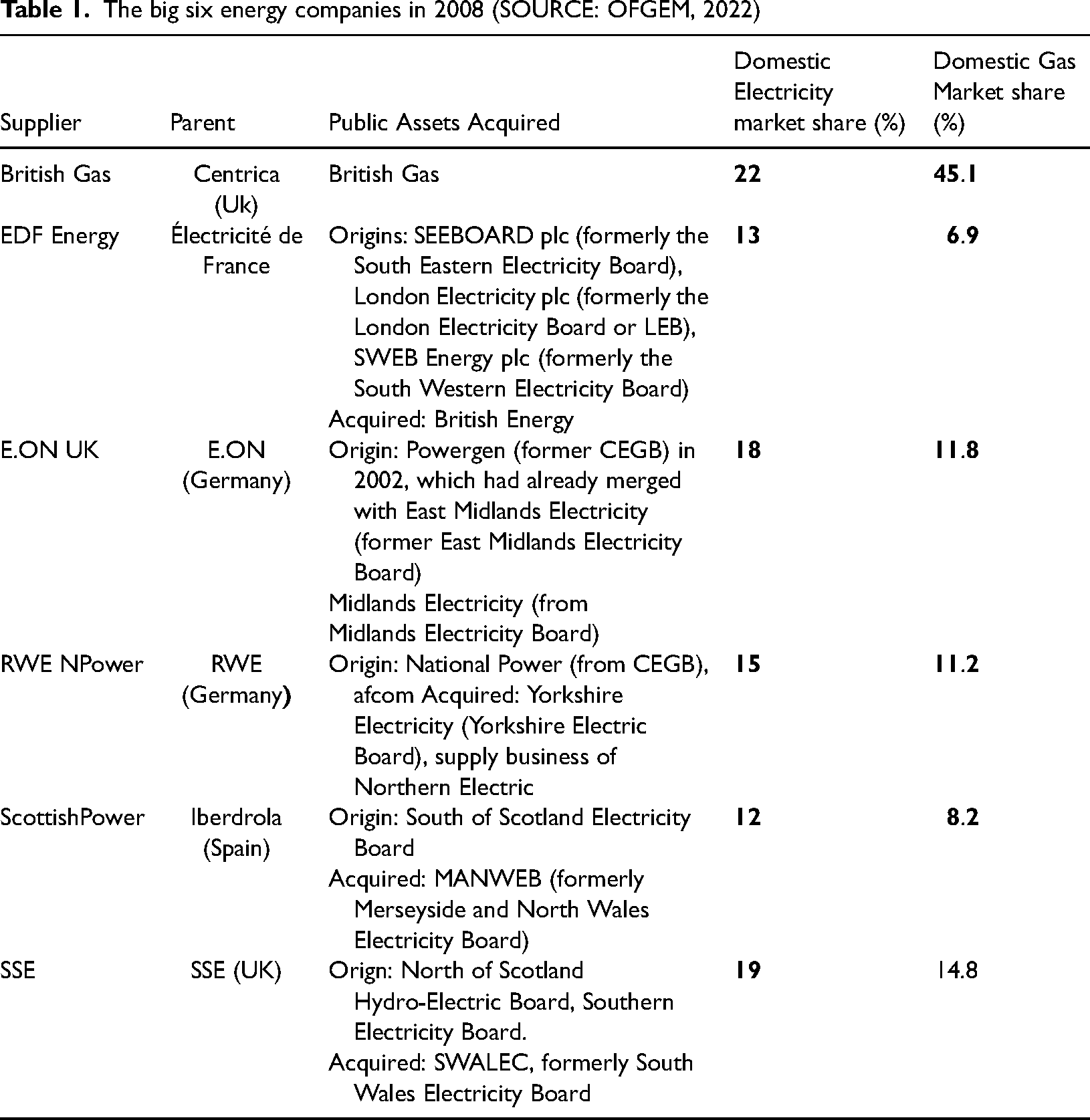
NETA only seemed to accelerate the merger of energy companies, which by the mid-2000s had consolidated into the ‘Big 6’ vertically integrated firms. These firms primarily merged supply and generation, with some also controlling distribution too. As Table 1 shows, these 6 companies dominated both gas and electricity supply, as regional public monopolies were replaced by an oligopoly.
The big six energy companies in 2008 (SOURCE: OFGEM, 2022)
As Helm (2002) argued, ‘keeping government out of energy markets and limiting their discretion were seen as desirable features of the regulatory framework’ through the 1990's. The problem with this approach, was that the regulatory mechanism of the market, that neoliberals promised would deliver optimum outcomes, was also rendered ineffective by the problems in creating competition. Further, the new consumers did not behave like ideal entrepreneurial subjects, as only a small number of customers actually switch suppliers and search for the best deals available. The range of tariffs became bewildering, and a whole new platform-capitalist industry emerged to facilitate price comparisons between companies (Christophers, 2022: 179–247).
What was also missing, was risk. British Energy was a private company formed from consolidating the UK’s nuclear assets. The glut of energy in the late 1990s meant that nuclear generation was expensive and uncompetitive, so British Energy faced collapse in 2002. The problem was, new forms of energy generation could not cover the capacity that would be lost by the collapse of the nuclear industry, let alone the implications for jobs and safety. Labour had to nationalise the company (Meek, 2014).
What is more, the new regulators first order changes to make the market work as they imagined it should, created new problems. British Gas was forced by OFGEM to sell off gas storage as it was seen as uncompetitive (Pearson & Watson, 2012). The storage was bought at a low price, meaning market ‘signals’ were that there was no incentive to invest in gas storage. In the winter of 2005/6, there was a price spike in gas due to lack of storage because no one had invested in it. The UK is paying the price of for lack of storage investment today (Rutledge, 2007).
By the early 2000s, it also became apparent that relatively low consumer prices were coincidental rather than as a result of privatisation, beyond the initial ‘dash for gas’. The global energy glut came to an end when OPEC started to squeeze oil supplies and the invasion of Iraq also sent prices up (Rutledge, 2007). Rising prices did mean rising revenues for North Sea gas and oil producers, however Labour continued the low tax policy of the Conservatives whilst ramping up regressive taxes on petrol, taking significantly more in revenue from the latter (Christophers, 2022).
Labour also struggled to re-regulate the market to decarbonise. The market mechanism they devised to decarbonise energy – Renewables Obligation Certificates (ROCS) – had made little impact. ROC's effectively allowed energy companies to buy their way out of producing renewables if they did not choose to invest in them. Energy companies that did invest increased the capacity of established technologies but did little for the newer and more risky renewables (solar, offshore wind, tidal), as the market experiments failed to create the incentives for private companies to invest. Labour missed the targets they set themselves for renewable energy generation by a significant distance (Carter & Ockwell, 2007).
The Labour government experimented with second order changes, directed towards social goals of affordable energy prices and decarbonisation. They were not able to deliver either to any significant degree. They were not able to because of a tension between privatisation, competition and deregulation. Privatised energy created natural monopolies in the fixed transmission and distribution networks (Baines & Hager, 2022). In supply and generation, companies were allowed to merge leading to the creating of the ‘Big 6’ and significant barriers to entry for competitors. Labour introduced second order changes, like NETA, to increase competition, but this only fuelled further mergers.
What Labour were left with was re-regulation in order to get private actors to behave as they wished. Second order changes, like ROC's, failed to coerce private actors into introducing renewables beyond some safe investments. OFGEM were tasked with making first order changes and specific interventions to create competition, but they suffered from regulatory failures (e.g., on gas storage) and political timidity, choosing to concern themselves with providing better information and more consumer switching for the ever elusive competitive market (OFGEM, 2008). Direct household subsidies for energy were used by Labour to mitigate for high prices for those on lower incomes, such as the Winter Fuel Allowance.
By the time Gordon Brown became Prime Minister in 2007, Labour had realised they needed to modify their energy policy with a ‘gradual return to targets and plans’ (Pearson & Watson, 2012: 33). Under pressure from opposition parties, Labour introduced the Climate Change Act (2008) which legislated for emissions reductions, a significant legal intervention at the second order which set out national limits to total greenhouse gas emissions (Carter & Jacobs, 2014). Labour also pivoted back to supporting nuclear and sold off British Energy to the French state company EDF to encourage them to build a new nuclear plant (Watt, 2017), as well as rolling out feed-in tariffs for renewable energy production (guaranteeing a decent price for would be generators) and offering free or discounted home insulation in the first order (Carter & Jacobs, 2014). A new Department for Energy and Climate Change was formed, to give energy (and climate change) greater prominence in government.
These more statist efforts on decarbonisation though, only further exposed the tensions within the energy system. After years of first order interventions to ensure competition, even OFGEM conceded that there was “reasonable doubt over whether the current energy arrangements will deliver secure and sustainable energy supplies” (Cited in Grubb & Newbury, 2018: pp8–9). Thus, the stage was set for a paradigm shift, given the failure of second and first-order change to deliver public goods through the privatised energy system.
Second order crisis management
There was no such shift. In 2010, a coalition of the Conservatives and the Liberal Democrats came to power following the financial crisis of 2007/8. Consistent with their overall programme, the Coalition introduced paradigmatically neoliberal reforms for energy in the second order to manage crises in the third (and fourth) order. They were more successful than Labour in directing investment into fixed capital for renewables, but continued to struggle with the tension between privatisation and competition for energy.
Early on, the Coalition government identified the historic lack of investment in energy infrastructure, and they tried to correct this with more statist measures which effectively guaranteed prices for energy generation, transmission and distribution. The first Coalition Energy Secretary, Chris Huhne, declared that: “More than £110 billion of investment is needed in new power stations and grid upgrades over the next decade, that's double the rate of the last ten years. Put simply, the current market is not fit to deliver this” (DECC, 2010)
The Coalition enacted new second-order instruments to increase investment in renewable energy following the Climate Change Act and EU directives. The Energy Act (2013) introduced Contracts for Difference, long-term contracts which are awarded at auction and provide a stable price. These contracts maintain a competitive element through their tendering process, but the contracts are signed with the government owned Low Carbon Contracts Company. The CfDs have been much more successful in increasing renewable production, particularly in offshore wind, albeit at a pace far behind what is required for decarbonisation (BEIS, 2019).
The Coalition also agreed a fixed price to be paid for the new nuclear plant, Hinkley C, which Labour had hoped EDF would build after being sold to British Energy at a discount. The guaranteed price they offered was seen as excessively high and required the Chinese governments’ nuclear company to come in as part of the deal (Perkins, 2015). The government also directly intervened in generation, deregulating and making executive level interventions to support a new shale gas industry (Fearn & Davoudi, 2022) as well as effectively banning onshore wind.
There was some internal resistance to more statist interventions though, albeit largely for green energy. Liberal Democrat ministers introduced the Green Deal and the Energy Company Obligation. The former took the form of grants and loans for people to help decarbonise their homes (through insulation, solar panels), the latter was on obligation on companies to help low-income households do the same (DECC, 2015). The impact of these schemes was small, but these and environmental levies (introduced by Labour) were targeted by Tory backbenchers and the Chancellor as a drain on business and (erroneously) blamed for rising energy costs (Carter, 2014) as the Conservatives looked to de-regulate Labour's re-regulation where possible.
Despite the more statist turn, competition and deregulation were still central to energy policy during the Coalition government. The second Liberal Democrat Energy Minister, Ed Davey (2014), claimed one of his main achievements was making the energy supply market more competitive. He celebrated how the deregulation of electricity supply had increased the number of suppliers outside the Big 6 oligopoly, and how switching between suppliers had been made easier. He claimed there were 18 additional new suppliers and 3.5million people had switched, with simpler rates introduced across suppliers. At the time he was writing though, energy prices were rising which led to an in investigation by the Competition and Markets Authority into the energy markets (CMA, 2016). Davey (2014) was left criticising the Labour oppositions “populist plans” to introduce an energy price cap to deal with rising bills, which competition had once again failed to prevent.
A price cap would, however, be what the next Conservative government (from 2015) would introduce. Responding to what was described at the time as an ‘energy crisis’ (Macalister, 2014), the new Prime Minister Theresa May adapted Labour's idea, and set out the ‘price cap’ that the UK has in place today with the Domestic Gas and Electricity (Tariff Cap) Act (2018). The ‘cap’ is set by OFGEM every 6 months (as a first order change), and affects the ‘standard variable tariff’ which most customers (who don’t ‘switch’, like Davey had hoped) are on. The Energy Minister, Claire Perry, said in the debate on the Act: “the price cap is a temporary intervention to protect consumers on standard variable and default tariffs while other reforms continue apace to bring about the conditions for effective competition in the retail market” (HC Deb 18th July 2018)
At the time this legislation was being passed in 2018, there were 70 suppliers fighting for customers. The problem was, most of these new providers did not produce any actual energy – they purchased energy from the Big Six and other firms that generated (but did not supply) energy. The vertical integration of the Big 6 on the other hand, meant they had their own production capacity which they were slowly transferring to renewables or nuclear. As soon as prices began to rise, the paper supply companies one by one began to go out of business. OFGEM transferred the customers over to one of the Big Six companies, and consumers overall paid the price with higher bills (NAO, 2022). Competition once again lost out, to the power of the private companies who still dominated the markets.
The Coalition and Conservative governments took a more interventionist approach that still worked within the third order paradigm, maintaining the primacy given to the private sector and pushing once more for greater competition to the Big 6 in order to reduce consumer bills. The overall drive for public spending cuts, however, reduced the resources for subsidies (on green energy and prices), meaning second order reforms eventually turned towards more direct price controls to manage a period of escalating social and ecological crisis – with increasing concerns over energy security. De-regulation returned to the agenda, only for re-regulation to follow in the form of the price cap – a second order change to be managed by OFGEM in the first order.
A terminal crisis or business as usual?
At the time of writing, there is another global energy crisis which is much more significant than the mini-crises that prompted many of the market reforms above and much more reminiscent of the crisis that ushered in the neoliberal turn. The crisis follows two price shocks; however, the UK energy system is particularly susceptible to these shocks due to the lack of investment, decarbonisation and the power of the energy company oligopoly. The UK government has had to borrow significant sums for another major ‘bailout’, as it did in the financial crisis. Similar to the financial crisis, the government aims to secure flows of capital without making significant structural changes.
The first price shock was COVID19, and the economic slowdown which followed from the restrictions imposed to contain the spread of the virus. This meant a contraction in the supply of fossil fuels, followed by a surge in demand for them again once restrictions eased (ONS, 2022). The second shock was the invasion of Ukraine by Russia. Russia is a major producer and exporter of gas (which the UK uses for around half of electricity generation as well as most of its domestic and commercial heating), and both the invasion itself and the sanctions placed on Russia restricted the supply of gas and pushed up prices further. Exacerbating the problem, OPEC also decided to limit petroleum production to take advantage of the opportunity for extra profits (Horowitz, 2022).
The government response so far has been twofold. They have effectively increased the scale of the second order, crisis management reforms, whilst simultaneously proceeding through the paradigmatic playbook of failed second and first order policy interventions covered above. I will show both sides of this response in turn.
Extreme crisis management
The scaling up of measures has focused on the initial problem of protecting consumers from simply unpayable energy bills. With prices rising so quickly, the ‘energy price cap’ was shown to be ineffective as OFGEM raised it by 12% in October 2021, and then 54% in April 2022 (Bolton and Stewart, 2022) – as otherwise the supply companies would not be able to make profits. The response from government, for consumers, is continuous with past energy policy of providing direct subsidies to households: a £200 interest free loan for energy bills, a £150 local tax rebate, and £150million for local government to provide one off payments to the poorest (Elliot, 2022). As prices increased they expanded these subsidies (HM Treasury, 2022a).
The ramping up of direct subsidies was implemented during a summer (2022) of political turmoil, which intertwined with the expansion of these measures. Prime Minister Boris Johnson's departure led to a leadership contest, during which opposition parties increased the pressure to take further action (Macaskill and Piper, 2022). OFGEM increased the price cap for October 2022 by 80%, meaning the measures introduced covered just half the increase in the average price of household bills, with little in place for business and industry. A grassroots organisation, Don’t Pay, began organising for a mass boycott of energy bill payments in a move which electricity and heating capital recognised as an ‘existential threat’ to their interests (Williams, 2022). Sunak, the frontrunner for the leadership, promised to increase the payments he had introduced as finance minister further, whilst urging caution on spending and government debt (Craig, 2022). His main opponent, Liz Truss, said that there would be no ‘handouts’ (Parker & Payne, 2022), and instead committed to tax cuts.
Liz Truss would eventually win, before enacting a series of measures that would see here forced to resign 47 days later, only to be replaced by Sunak. The short-lived Truss governments’ main task was to set out the UK's emergency intervention to the rising cost of energy. What they proposed was an Energy Price Guarantee, which meant the government promising to cover the rise in energy bills for households above the energy price cap by paying energy suppliers the difference. This was combined with an Energy Bill Relief scheme for businesses and other organisations e.g., charities (Bolton & Stewart, 2022). The problem that Truss and her finance minister, Kwasi Kwarteng, faced was that they announced the approximate £80billion increase in public spending (for the Guarantee) without cutting other spending or increasing the existing windfall tax. Combined with their other tax cuts, this led to the bond and gilt markets increasing the value of short-term government borrowing costs and household mortgages, leading Truss to resign (for a summary, see Lopez, 2022) after she lost a vote on removing the moratorium on shale gas fracking (Fearn, 2022).
The new Sunak administration managed to calm the bond markets, by revoking most of the proposals of the short-lived Truss government, including reinstating bans on shale gas fracking and onshore wind. What has remained is the Energy Price Guarantee, though from April 2023 the amount an average household will have to pay for gas and electricity could rise to £3000 per year as government support tapers. The windfall tax on energy has been extended until 2028, and increased by 10 percentage points (to 35%), though the effective rate still remains lower than in Norway. Electricity generators, including those producing low carbon energy, face a windfall tax of 45% (HM Treasury, 2022b).
Business as usual?
Alongside these dramatic interventions though, the government have continued the more prosaic attempts to manage the privatisation and competition problem. In July 2022, the government announced consultation for another major reform of the energy supply market: “it is unlikely that the significant investment needed to decarbonise the power sector will be delivered cost-effectively by our market arrangements in their current form” (BEIS, 2022a: 10)
The consultation document contains several acknowledgements of the problems of engineering a competitive market for electricity which also provides steady prices and ‘the difficulties of designing a market that reflects overall system value – the result is that wider competition does not always provide the greatest benefit to the system’ (Ibid). The core proposal in these reforms is to extend Contracts for Difference to cover more renewables under fixed price, long term contracts. The document does though, contain the usual references to re-engineering the energy market so that it brings back ‘competition to help drive down prices’ (Ibid: 48).
The government has also had to take an energy company into public ownership – Bulb Energy. Most of the smaller energy retailers that collapsed from 2020 onwards had their customers transferred over to the remaining larger companies: EoN, EDF, British Gas, Octopus, OVO and also Shell who were expanding into the supply market. Bulb Energy was impacted more significantly by the energy price rises, as they had been running at a loss to grow their customer base. OFGEM took it into public ownership, or ‘special administration’, before selling it to Octopus Energy (the 5th biggest supplier) (BEIS, 2022b). We have thus seen another nationalisation-reprivatisation, which will further bolster the oligopolistic electricity supply market.
Therefore, the response to the energy crisis so far has seen both a ramping up of crisis management measures in the second order, as well as first-order tinkering with market arrangements. As with the financial crisis, a series of global shocks have hit a system shaped by a neoliberal paradigm. The shocks have exposed the under-investment in infrastructure and fixed capital, as well as the power of electricity and fossil capital who make record profits as fuel poverty rises (Jolly & Elgot, 2022). The core government response has been to increase subsidies to households, consistent with neoliberal policy making, but at a much larger scale than previously seen. These subsidies have the dual effect of maintaining profitability in the first circuit of accumulation.
These drastic interventions though, sit alongside the familiar refrain of restoring competition, just as the government bolsters the power of the major energy supplier-generators through selling off Bulb. With UK electricity prices at nearly three times the EU average in July 2022 (Askew, 2022), though, the crisis and the extremity of the second order crisis management measures suggests that the UK's deep commitment to the neoliberal policy paradigm may limit the prospects of a socio-ecological fix for British capitalism.
Searching for a fix: Second order reform for third order contradictions
What the present crisis shows, in the UK at least, is a continued effort from the state and capital to create a socio-ecological fix within neoliberal limits. As Castree & Christophers (2015: 386) argued, there are historical and pragmatic reasons to think that in the short term ‘a greener and more socially just capitalism’ is possible. What I have focused on here though, is the ideological and material grip of neoliberalism, which limits the potential of this fourth order change. I will conclude the paper by explaining why.
First, there is the third order contradiction which successive UK governments have attempted to grapple with since liberalisation. The central principle of the neoliberal policy paradigm for energy is that energy markets of private companies operating in a (lightly) regulated market will deliver efficiency and public goods. The practical contradiction is that competition, the regulatory force of the market, is incredibly difficult to engineer in an energy sector which has natural monopolies (the grid, transmission networks), a small amount of large, fixed capital assets (power stations), and where consumers don’t treat the product (electricity and heating) like ideal entrepreneurial subjects ought to by regularly searching for the best deal.
What I have argued throughout this paper is that the last few decades of energy policy have been characterised by attempts to manage this contradiction through second and first order interventions. When global energy prices are lower, government initiatives to generate competition create new supply and even generation companies, but as soon as prices rise these companies collapse and are folded into larger ones or taken over by the state before being re-privatised into the larger companies. The present crisis is the third major wave of this consolidation of electricity and heating capital. This feedback loop, between privatisation and competition back to consolidation of private capital, maintains the flow of electricity and fossil capital but simultaneously undermines the stability of prices and thus the ‘socio’ aspect of a socio-ecological fix. In transmission and distribution, companies continue to make extra-ordinary profits absent any competition at all. The government is, nonetheless, embarking on another wave of competition reforms despite report after report from state bodies highlighting the failure of the previous round of competition re-regulation.
These first and second order reforms are almost reflexive, showing the deep institutional hegemony of the neoliberal paradigm. There persists a deeply engrained belief that privatised energy markets, if the elusive ideal market form can be found, will deliver affordable, green energy. The grip of the neoliberal paradigm is not simply ideational though, rather, it serves the interests of electricity and fossil capital by continuing to fetishize the first circuit of commodified energy (as abstract, second nature). Privatised energy is the unchangeable, ideological tenet of neoliberal policy, and it has created -and is now sustained by- the powerful interests and lobbying operations of fossil and electricity capital (Das, 2022, Clarke et al., 2016) and the ‘revolving door’ between politics and the energy industry (Scott-Cato, 2018).
Even in the present crisis, both major UK political parties refuse to countenance a challenge to the sanctity of energy companies’ property rights (Woodcock & Forrest, 2022), guaranteeing them monopoly rents and profits whilst increasing levels of state subsidy aim to direct capital flows into the second and third circuits. The elusive search for competitive conditions does the ideological work of imagining there is some way of making this privatise system equitable and able to deliver public goods, as companies sweat formerly public assets. It is no coincidence that nations with significant public energy companies, like those in northern Europe, have been able to keep prices lower for consumers. The fetishization of commodified energy in the neoliberal paradigm is one limit on a socio-ecological fix.
The second, and perhaps more novel, argument of this paper is the role of second order reforms in stabilising and destabilising the neoliberal paradigm. The scale of energy crises has only grown during the period of liberalisation, and in the present crisis the government has had to make its most significant intervention on energy prices ever, with the Energy Price Guarantee. Capital flows have been maintained in the first circuit, and the legitimacy of the system and government has been temporarily stabilised.
What this paper has shown though, is that the second order interventions within the neoliberal paradigm are becoming increasingly extreme in order to find a socio-ecological fix, of affordable prices and decarbonisation. The UK government is turning towards more statist interventions, and it is these (such as Contracts for Difference) which have had the most impact in terms of directing capital flows into the second and third circuits. The ascendant opposition, in Labour, is proposing even more significant public subsidies for energy with the government even committing to strengthening the UK Infrastructure Bank (HM Treasury, 2022b).
The problem is, even a capitalist socio-ecological fix calls for actions outside the neoliberal paradigm, i.e., some sort of co-ordinated, planned and most likely state-led restructuring and investment particularly in fixed capital. As Angel (2022) also finds in his study on ‘flexibility’ in the UK energy system, much of what is possible towards a socio-ecological within the limits of privatised energy markets has already been done – that which preserves first circuit capital flows and the neoliberal energy system whilst also decarbonising.
In the present crisis, second and first order policy interventions have temporarily stabilised the energy system, in terms of capital flows and also in terms of subsidising prices for consumers through direct household subsidies. These state interventions are consistent with previous rounds of neoliberal policy, however are considerably larger in scale, just as the subsides for renewable generation are. The upshot of this, though, is that the mega-profits generated from the present crisis are being directed back into investments in the fossil fuel economy (Lawson, 2022b)– further delaying a socio-ecological fix.
There are though, signs of rupture in neoliberal hegemony. The UK government is taking increasingly extreme second order measures to preserve the privatised system, ramping up the subsidies to electricity capital, maintaining price controls introduced as temporary measures and guaranteeing more prices for generation and production. Consistent with other wealthy nations, these second order changes strengthen the power and role of the state and lead in renewed struggles over the public control of energy (Chandrashekeran, 2022). If the government is setting prices and pumping public money into keeping the system going, it opens up political space to challenge why private companies are allowed to profit so heavily from an energy system so reliant on state largesse (Lawrence and Bueller, 2022).
With second order changes to the neoliberal paradigm becoming more extreme to find a socio-ecological fix, the opportunity for counter-hegemonic movements for new forms of socio-ecological life also opens up. The Inflation Reduction Act in the US and the EU Green New Deal are pushing the limits of neoliberal policy, expanding subsidies to stimulate private investment without taking on the interests of fossil capitalists. As in the UK, the very clear need to decarbonise requires innovations and new strategic interventions at the second order, which can bring into question the role of privatisation and competition as third order paradigmatic aims. At the second order then, reforms paradoxically stabilise and destabilise the neoliberal paradigm, as the UK government attempts to find a socio-ecological fix in a time of escalating crisis – e.g., by re-nationalising part of the National Grid's transmission network. The crisis-ridden, instability of neoliberal energy further undermines and limits a socio-ecological fix.
The UK may be an extreme case, due to how deeply liberalised its energy system is and with the uncertainty and political tensions created by leaving the EU driving forward a declinist attitude in its ruling elites. And as Furnaro (2020) has shown, neoliberal states can find ways to drive forward green energy transitions, albeit incidentally. Nonetheless, this paper has set out how a neoliberal paradigm for energy acts provides a limit to a capitalist socio-ecological fix, primarily through fetishizing privatisation. The UK government has struggled to divert capital to the second and third circuits as a result. Their second-order crisis-management reforms, however, are becoming increasingly more extreme, as the energy and ecological crises requires them to prop up the energy system or move beyond the neoliberal paradigm. The more extreme the second-order reforms, the more likely the third order comes into question. Absent a counter-hegemonic force, though, the UK can continue the energy experiment in the ‘ruins of neoliberalism’ (Brown, 2019) for quite a while longer yet.
Highlights
A critical analysis of UK energy liberalisation at a point where its failures are most stark.
Identifies the links between the present energy crisis and decades of neoliberal policy.
Proposes a novel conceptualisation of the neoliberal policy paradigm, the relation between its principles and reforms.
Centres the importance of fossil and electricity capital in shaping energy policy.
Footnotes
Acknowledgement
The author would like to thank Marissa Granath, Mike Raco and Yasminah Beebeejaun for their comments on an earlier draft of the paper, as well as the editor and reviewers’ very helpful points which improved the paper significantly.
Funding
The author(s) received no financial support for the research, authorship, and/or publication of this article.

Correction (May 2023):
Article has been added with acknowledgement since its original publication.