




Abstract
Environmentalism has been defined in multiple ways across the literature from a global perspective, both as an ideology and as a movement. However, the definitions of environmentalism have been either vaguely defined or broad with the most common characterization being that of conservation and preservation being at the heart of environmentalism. While there is considerable research on environmentalism in the industrialized world context, there is still limited research in developing regions, with a dearth of research in the Caribbean, hence the rationale for this research. The physical environments of former colonial states have always been subjected to exploitation, yet the way in which this resource has been used by local populations have not been characterized. This paper begins to examine the ways in which local populations of former colonized states view environmentalism. Taking a case study approach, Jamaica is used as the beginning point of reference. Using interviews with self-identified environmental activists, results indicate that there is, what is uniquely referred to in this paper, a decolonial environmental worldview (DEW) that exists among environmental activists. This worldview is grounded in a number of principles that are tied to the way in which the decolonization process continues to proceed in the Caribbean region. The paper postulates that this DEW framework has elasticity and should be applied to other postcolonial societies to determine its salience.
Introduction
There has been a significant amount of research on the concept of environmentalism globally. Yet the research on the ideology and environmental worldviews in the Caribbean region has been sparse, even though these states have had a history of having a complex relationship with the environment.
This current paper is part of a broader intellectual project that seeks to develop a theory of how, in postcolonial societies, environmentalism functions as an integral part of the decolonization process. The insular Caribbean share a colonial past and a struggle to shake off the legacy of colonialism. Decolonization here is an integral part of the struggle for economic and social development and full citizenship for all its people. The paper also seeks to decenter the notion that environmentalism is a new concept and that communities in the Caribbean are “learning” notions of environmentalism from the western perspective. Rather it seeks to highlight that environmentalism has always been a part of the Caribbean tradition and the ways in which modern groups are continuing that tradition.
This paper uses the case study of Jamaica as the start of a series of articles that work to show how environmentalism might be perceived and operationalized in decolonial Caribbean spaces, as legally defined by the UN declaration on decolonization. The paper is not attempting to see if there is a collective environmental movement in Jamaica or the Caribbean but rather the purpose of the paper is to look at the ways in which environmental action or work is being done by the different environmental activists, determine whether there is a common worldview that emerges from this environmental work and examine whether there is a connection to decolonality from that environmental worldview.
The paper begins with an overview of the literature on environmentalism both globally and in the Caribbean, along with a description of the frame that is being used for decolonization. It then describes the approach to data collection for Jamaica followed by an analysis of the emerging theory of what is being called a decolonial environmental worldview (DEW) that is present in Jamaica as a way of understanding the worldview that is driving activism work.
Environmentalism and environmental worldviews: definitions and application to the Caribbean
The literature on environmentalism is deep, for example, there are over forty thousand references in one search that was done that focused on the term environmentalism. The literature has focused on different elements such as definitions for the term (O’Riordan, 1976; Spieles, 2017; Kahraman and Baig, 2010), examining the historical context (Guha, 2000; Pepper, 1996; Benson, 2020; Woodhouse, 2018; Spears, 2019), to examining environmentalism in specific contexts such as its connections to religion or in a specific local context (Staggenborg, 2020; Hancock, 2017; Wald et al., 2019; Gatt, 2017; Li and Shapiro, 2020; Adaman et al., 2005). Globally the term of environmentalism has often been quite difficult to define and the terms have often been characterized as vague and contested. For example, Spieles (2017: 3) indicated the following: “environmentalism itself is polarized, with wide disagreements of theory and practice. Conceptually, it runs the gamut from spiritual biocentrism to wise-use conservationism to unrestricted biological and ecological engineering.” He goes on to indicate that there are a number of different dimensions to environmentalism: The biocentric to anthropocentric, the spiritual to material, and the ecocentric to egocentric. He also lays out six fundamental human values that form and drive environmentalism, which are utility, stability, equity, beauty, sanctity, and morality.
There have been typologies that have been proposed for the different ideological views of environmentalism. Conservationists are those that realize there are precious natural resources that should be preserved. Preservationists believe that there is a spiritual connection between humans and nature. Reform environmentalism is the ideology that considers effects of nature on humankind, specifically the health of humankind with that of ecosystems (Rootes, 2004). Pepper (1996) summarizes the ideology of those that are considered greens. Dobson (2007) and Goodin (1992) also provide more detailed explanations of the core beliefs of environmental activists that align with being green. Spieles (2017) takes a different approach and explains that environmentalism is based on two ideas. “The first is the idea that humans should consider their environmental surroundings in their actions—that we have a responsibility toward the nonhuman world. This includes the contested notions that places can have spiritual value, that animals have intrinsic worth and should have rights, and that there is a proper state of nature and therefore a proper relationship between human and nonhuman. The second idea is about our responsibility toward one another: that humans have, or ought to have, certain universal rights and freedoms, that these include, or should include, fair access to ecological goods and services, and that each individual and group should consider the consequences of their actions for others (Spieles, 2017: 11).” These two ideas are related to each other and implies an underlying sustainability ethic in addition to alluding to distributive justice elements.
Despite the large body of literature that has been written on environmentalism as an ideology globally, limited research was found on the specifics of the Caribbean. Indeed, there are multiple sources that examine global environmental movements (Carruthers, 2008; Doyle and MacGregor, 2013), yet though there is reference to Latin America and in the Caribbean, very little is actually written on the insular Caribbean. From the sparse material that is written on the region, there seem to be different ways in which environmentalism has been characterized.
A first theme that came out among the Caribbean research and what is most valid to the current research project is that of resistance and its connection to the environment. A couple of studies spoke to the idea of resistance to economic domination. For example, Pizinni (2006) speaks of local grassroot groups in Puerto Rico that were formed by resource users that seek to protect their own communities and areas. Jácome (2006: 21) in her work indicated that there is a group of environmentalists who “…view environmental problems from the standpoint of how they relate to economic, political, and social development.” She goes on to explain that a smaller number of environmental actors in the Caribbean engage in activities related to sustainable development and economic development or focus on improving the economic conditions of specific groups in society (farmers, young people, and fisherman). She also states, “with few exceptions, movement actors in the Caribbean define themselves as promoters of change at the economic, environmental, and sociocultural level” (Jácome, 2006: 24).
Possibly the only study that we found that made a link between environmentalism and resistance in terms of alluding to decolonialization was that of Lynch's (1995) work. In the paper, Lynch (1995) focuses on environmentalism in Hispanic Caribbean communities—Puerto Rico, Dominican Republic, and Cuba. Through her historical analysis, she finds that environmental discourse in these places contained common elements of resistance against the economic domination and industrialization of the sugar industry and the political domination of the U.S. marines (Lynch, 1995: 231). These elements have shaped Caribbean environmental perspectives with cultural and intellectual traditions from European and African migrations, landscape changes from a development process characterized by external forces and rapid industrialization and urbanization, and migrations to the United States and other northern countries (Lynch, 1995: 230). Moreover, past Hispanic writings about Eden and the Garden show a nostalgia for a past before it was abruptly disrupted by colonial expansion and rapid industrialization. Resistance to external influences, a nostalgia for past conditions, and a sense of nationalism characterize environmental discourses in these Hispanic Caribbean communities, which are in a sense “new social movements.” Puerto Rican environmental agendas, for example, have frequently been associated with the restoration of prior land and water rights and independence (Lynch, 1995: 241).
A final theme though only discussed marginally in the work on the Caribbean that we found still worth mentioning is related to religious persuasions. Puerto Rico had environmental activism that was organized around religious issues. Pizzini (2006) indicated that this type of activism involves religious, labor, social, or other activists that come together to form environmental social-political NGOs. Additionally, Jaffe's (2010) work on Rastafarianism though not exclusively on environmental activism highlights the way in which members of this religious group have systems of sustainable and environmental thinking woven into their fabric. She highlighted eating practices and material products that are sustainably grounded.
Regardless of the themes of mobilization for Caribbean actors, the uniting factor is the battle against industrialists and environmental harms involving water quality and health (Pizzini, 2006). Baver and Deutsch-Lynch (2006: 315) wrote about Caribbean environmentalisms where the environmental movement has diversified over time and mentions “possibilities for a ‘Creole environmentalism’” which suggests a more personal, grassroots form of environmentalism as opposed to the “elite status of many environmental activists.”
From the perspective of environmental worldviews, there is dearth scholarship for the Caribbean region (Baptiste and Thomas, 2018). There are some studies that focus on elements of worldviews like knowledge, attitudes, and perceptions for specific livelihoods. Gamble et al. (2010), for example, find that sensitivity to differences in moisture between growing seasons affect farmers’ perceptions of drought in Jamaica, while Baptiste (2016a; 2013b; 2016b) have focused on fishers perceptions of climate change in Jamaica and Trinidad and Tobago. Rauwald and Moore (2002) compare environmental psychological variables in SIDS to more developed regions finding that pro-environmental attitudes and behaviors vary between countries and are influenced by country-specific characteristics including gender and ethnicity norms. Further, Thomas and Baptiste (2018) co-edited an issue on environmental psychological variables and climate change for the Caribbean region as one of the few collective pieces that documents elements of individuals’ worldviews to environmental challenges in the Caribbean. Additionally, from a typology perspective on worldviews there is some research being done such as Devonish and Baptiste's (2019) work on Trinbagonian environmental worldviews as seen through public art. Baptiste and Thomas (2018) call for more research on environmental psychological variables for the Caribbean region.
Given the sparse body of literature on environmentalism and environmental worldviews in the Caribbean, this research begins to contribute to expanding our understanding of how environmentalism is defined, perceived and manifested through a worldview framework by individuals doing environmental activism in the Caribbean region. Additionally, it begins to explore the new area of seeing whether there is any connections between decolonialization and environmentalism in the region.
Decolonizing environmentalism
There is limited work that is within the field of environmental worldviews that centers the idea of decoloniality as part of shaping worldviews. A search for decolonization, environment and worldview yielded only 42 results many of which were not relevant, but there was a sub-section of that literature that seem to focus on indigenous knowledge and decolonizing the mainstream discourse of either environmentalism or environmental justice with having indigenous knowledge central to this conversation (Dhillon, 2018). Additionally, there have been limited literature that have used the concept of decoloniality when speaking about environmental concerns as summarized below.
Grove (1996) contends that the experiences of colonial empires in colonies led to the notion of environmentalism. The argument here though centers the colonialists as being the forebearers of environmental thought, rather than seeing the ways in which the ideals of environmental thought are innate to the population of these former colonial spaces. Ferdinand (2021) is another source that seeks to bring a theoretical lens to the idea of how decoloniality is related to ecological concerns. He uses the Caribbean as the region of focus and centers the region as the connection between the “old” and “new” worlds and the embryo for climate change concerns. One of his central points was the way in which colonialism left both the land and its people in the Caribbean “motherless” using the concept of motherhood as one of nurturing. His argument is that the process of colonialism resulted in a view of the land as a resource just to be used, damaged, and even abandoned. The people that occupied that land also became motherless with the loss of their land.
Ferdinand (2021) also spoke about the continued carelessness that is displayed towards the Caribbean region when it comes to environmental hazards especially in areas that have continued to have a colonial presence. He used the example of Hurricane Maria and its effects on Puerto Rico and Haiti and also used the example of Hurricane Katrina and its aftermath in the south of the United States. He indicated that there is discriminatory careless that can be seen before a disaster where infrastructure is often neglected and hence are not in a position to be adequate to withstand the disaster. Additionally, there is discriminatory neglect in terms of who gets adequate information to prepare for the hazard and also in the response to the hazard with slow responses to address the impacts. Finally, he highlights that there is discriminatory redistribution where in the rebuilding stages resources are often not provided to those who need it the most and in some cases it goes to those who already have resources.
Liboiron (2021), Pollution is colonialism is another source that tangentially speaks to the issue of decoloniality in environmental concerns. The book seeks to challenge the idea of the “status quo of ecological relations as well as provides a guide on how to live these relations otherwise” (Wiebe, 2022, p. 1). It speaks about the importance of relationship building when doing research as well as to the notion that “environmentalism often reproduces colonialism” (Wiebe, 2022, p. 2). Geraerts (2021) also presents a summary of the book Pollution is colonialism where a few points are made that may be relevant to understanding how decolonization is being viewed with respect to environmental concerns. One of the main points raised by the book is the idea that the way in which pollution is defined by policy makers, science, and environmentalism makes an assumption that the Land is readily accessible and that it has the ability to “produce value for settler and colonial desires (p. 134).” “Colonialism… is an extractive land relation built on possession that regards land (in a broad sense) as a resource to maximize” (p. 135). Liboiron (2021) therefore uses their research on plastics to discuss the “difference between decolonization (giving back land) and anticolonial science” (Geraerts, 2021, p. 136) which is seen as a solution to addressing plastics pollution. It is the former of viewing decolonization through the lens of giving the land back that is important for this paper as one element of attempting to understand environmental worldviews in the Caribbean.
Former colonized states have been subjected to exploitation of their physical environments from the time of their first encounters. In many cases these societies were seen as commodities serving the needs of the colonial or imperial states. Small island developing states of the Caribbean region were no different and were exploited for goods such as cocoa, coffee, and sugar to name a few.
Jansen and Osterhammel (2017) defined decolonization as both a moment and a process. As a moment it is defined as “…the disappearance of empire as a political form, and the end of racial hierarchy as a widely accepted political ideology and structuring principle of world order” (p. 1). As a process it is defined as “…the process whereby colonial powers transferred institutional and legal control over their territories and dependencies to indigenously based, formally sovereign, nation-states” (p. 2). It is often then asked when the decolonization process is “completed”. Jansen and Osterhammel (2017) indicated that a “simple answer would be: when a locally formed government assumed official duties, when formalities under international law and of a symbolic nature were carried out, and when the new state was admitted (usually within a matter of months) into the United Nations” (p. 2). Decolonization is therefore a process governed by international law and one that has United Nations oversight since 1945. As such, a discussion of a decolonial environmental worldview can start with the definition of decolonization given by this body. Decolonization is characterized by the Declaration on the Granting of Independence to Colonial Countries and Peoples also referred to as the Declaration on Decolonization which is the General Assembly resolution 1514 (XV) (United Nations, 2022).
The declaration states that there are six (6) different elements of the decolonization process (United Nations, 1960b). The first element indicates that the subjugation of people is contrary to human rights. It reads “the subjection of peoples to alien subjugation, domination and exploitation constitutes a denial of fundamental human rights” (United Nations, 1960b). This first point clearly states that no person should be subjugated to another person or controlled by other people. Rather there is an indication that people have a right to govern themselves. Hence, we see that the premier point is that of people's control of their destiny at the center of the decolonization process.
The second element indicated that “all peoples have the right to self-determination [and to] freely pursue their economic, social and cultural development (United Nations, 1960b).” In this point, it seems intentional that “development” is used as a key point. Here, we can assume that there is an assumption that colonial spaces are underdeveloped and hence there is a need to “develop” these spaces. It highlights that colonization as a process is itself under-developing. Here, the right is given to people of these colonial spaces to engage in righting the wrong of exploitation and underdevelopment with each of the forms of development being related to the physical space that they are given control over. Economic development speaks to the ways in which former colonies have to produce for survival and sustenance, as well as engage in trade. These activities cannot take place outside of the physical space and the resources that are available to the former colonized. Social development must take into consideration politics. Here there must be consideration of the politics that is involved in pursuing development and the decisions that are made for governing the spaces. Cultural development speaks to the beliefs and practices that the citizenry will hold as people occupying this newly decolonized space.
The third element indicates that even if the space is underdeveloped it should not be colonized. It reads “inadequacy of political, economic, social or educational preparedness should never serve as a pretext for delaying independence (United Nations, 1960b).” This third element is tied to the second in that it reiterates that colonized persons are underdeveloped, and they have the right to control their physical spaces.
The fourth, fifth and sixth elements of the UN Declaration raise a theme of controlling physical resources and the conditions that govern these. The fourth raises the issue of control of the physical space without the threat of force of external persons or nation states. It states “all armed action or repressive measures of all kinds directed against dependent peoples shall cease… (United Nations, 1960b).” The fifth element indicates that the right to control the physical space is convened to all and not to some. It indicates that there must be a “…transfer [of] all powers to the peoples of those territories, without any conditions or reservations, in accordance with their freely expressed will and desire, without any distinction as to race, creed or colour, in order to enable them to enjoy complete independence and freedom (United Nations, 1960b).” Here, it is speaking to equal rights to control and govern the spaces. In other words, power is given to all citizens of the colonized or formerly colonized space. Finally, the sixth element of the declaration reiterates the point of guarding against the threat of external forces to interfere by stating that “any attempt aimed at the partial or total disruption of the national unity and the territorial integrity of a country is incompatible with the purposes and principles of the Declaration… (United Nations, 1960b).” Once again, the rights are given to all citizens to make decisions and in essence it is protecting the decolonization process.
With respect to environmental resources there were two follow-up resolutions: Resolution 1515 (XV) of 15 December 1960, on the sovereign right of States to dispose of their own wealth and natural resources and Resolution 1803 (XVII) of 14 December 1962, on States’ permanent sovereignty over those natural resources (McWhinney, 1960; United Nations, 1960a). In these follow-up declarations we see that there is a shift from the power being given to “peoples” to “states.” This is an interesting observation as it raised the question as to whether local persons (i.e., the average man on the street) have control over their resources. This may create some contradictions in how environmental protection and use is managed in these former colonized states. There can be an assumption that rights were conferred to people through states. However, as we see from literature, states tend to represent elites rather than the average man on the street which lays the groundwork for conflict between states and people.
Using the elements of the declaration on decolonization a working definition for decolonizing environmentalism is developed for the purposes of the paper. Here, the working definition of decolonizing environmentalism is the process of the actual transition in terms of political, economic, and cultural subjugation away from the colonial or imperial empire either towards being an independent or autonomous state, where countries have control over decision-making processes for the sovereignty, use, dispossession and/or protection of their natural resources. This working definition of decolonizing environmentalism may be seen as a theoretical construct that examines the ways in which the formerly colonized control their physical spaces and resources and secondly make decisions regarding the use and management of said resources. Using this theoretical frame, the case of Jamaica will now be assessed.
Method
This project is interested in worldviews of individuals that are defined as or define themselves as environmental activists. For this paper the question that is being addressed is: to what extent is there a decolonial environmental worldview among Jamaican environmental activists and what form does this worldview take?
Jamaica is located directly south of Cuba, and west of Haiti and it is completely surrounded by the Caribbean Sea (Figure 1). Jamaica is estimated to have approximately 2.729 million residents (STATIN, 2016) and is the largest island of the Commonwealth Caribbean. According to the Central Intelligence Agency, the economy of Jamaica is heavily dependent on services (70%) while earnings from tourism and remittances account for 15% of the GDP (CIA, 2020). Approximately 16.5% of Jamaicans are currently living in poverty (Wright, 2018).
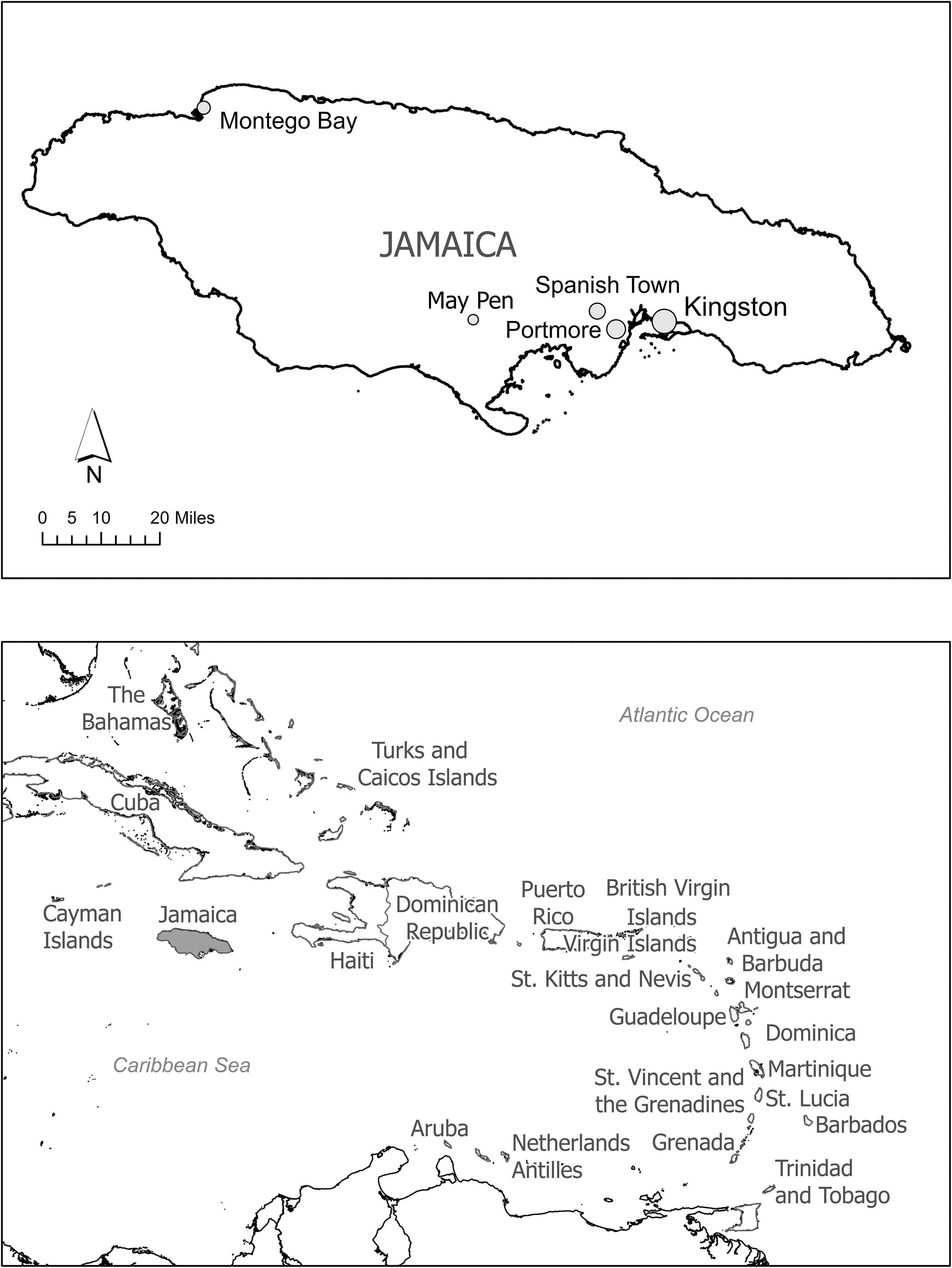
Map of Jamaica showing location within the Caribbean basin. Created by Myongsun Kong, Colgate University (2021). Data is courtesy of ESRI. City data is from 2013 of cities/large towns above 50k people, and the dots and fonts are generally representative of size of the city.
To identify environmental activists, those groups that were labeled as doing environmental work was targeted as the source. As such, an internet search was done using keywords such as “environmental groups,” “environmental organizations,” “environmental NGO” with Jamaica being added to narrow the search. From the internet search, the following were used to identify organizations and verify whether they were indeed based in Jamaica, W.I.: websites of these organizations, press releases they put out, and newspaper and other media coverage of their activities. A database was created of environmental organizations in Jamaica from the internet search. Seventeen (17) organizations were identified in this initial phase. Contact information for each organization was obtained from websites. Of the 17 organizations, we attempted to contact all at least 3 times using both email and phone. Of those that contact was made with, six (6) responded.
Of the activists that were interviewed five were based in the capital of Jamaica, Kingston and one was based in Cockpit country. All the activists were involved or have done work on national level environmental issues including environmental activism against extractive industries such as bauxite mining, fishing over exploitation, and development of sensitive areas. There were about three activists that were focused on what can be perceived as localized issues that were specific to a place without national recognition. With the exception of one interviewee, all the interviewees were known on the national level for their environmental work and hence while they may not represent all of the possible Jamaican environmental activists, they do provide a unique snapshot of the most prominent activists or advocates of environmental concerns in the country.
Five of the activists were interviewed in person and one (1) was interviewed via phone. In an attempt to expand the initial list, each interviewee was asked to refer names of additional activists, however the names that were provided were of persons that were already contacted (and either interviewed or planned to be interviewed). Hence the main limitation to the research was the small sample. However, though the sample size was small given the triangulation of the activists identifying a close circle, it could indicate two things: either that there is indeed only a small number of persons that are doing environmental work or that the current circle of known activists have not been expanded to include others that may be doing environmental work but not in the national spotlight. As such further research would be needed to broaden the activists pool in subsequent research on this topic.
All interviews were in-depth and semi-structured with the activists. Interviews were voice recorded with permission and each interview was between one (1) to two (2) hours in length. Questions related to themes about definitions of environmental work, perceptions of challenges that might exist in doing environmental work, and the relation to resistance and the colonial enterprise. All interviews were fully transcribed, and the transcriptions were read through a couple of times for quality control before analysis. Systematic thematic analysis was done on all the transcriptions of the interviews for emergent themes. Themes were then compared across each interview, and then collapsed into common themes.
In addition to interviews with the activists, narrative theory analysis of the websites of the non-governmental organizations was done. Narrative theory indicates that narratives are tools that are created by actors to organize information and construct strategies for social action (Hsu, 2007). Hsu (2007) indicates that narrative theory analysis can be used for understanding social action as narratives are created by actors as a way of sorting information and developing respective responses. Hence given that environmental activists create narratives that are documented on organizational websites, narrative theory analysis was used to determine the stories for each of the six organizations. Each website was analyzed to determine the main actors and the plot that is being portrayed by each organization. Following this, the information was then viewed through the lens of the decolonial environmental worldview.
Synthesis
From the synthesis of the thematic analysis of the interviewees there may be the development of what is being proposed as a
Environmental worldviews
Within the environmental psychology literature there is a sound set of scholarship that examines how individuals view the physical environment. The literature has examined a variety of approaches to capturing elements of worldviews such as knowledge, perceptions, concerns, and behaviors. Some of these measures include the New Environmental Paradigm (now the New Ecological Paradigm) postulated by Dunlap & Van Liere (1978; Dunlap, Van Liere, Mertig, & Jones, 2000); the Environmental Concern Scale developed by Schultz (2001) as well as the Integration of Nature with Self Scale (Schultz, 2000). While many of these measures of worldviews have been used in cross-cultural settings (Mertig & Dunlap, 1995; Dunlap, Gallup & Gallup, 1993; Rauwald & Moore, 2002 to name a few), there have been very limited approaches to understanding worldviews in the Caribbean region until recently. Within the Caribbean region, most of the work looks at components of worldviews to a specific environmental problem, with most of the work being done on climate change (Baptiste, 2018; Baptiste & Thomas, 2018; Thomas & Baptiste, 2018; Baptiste, 2016a, 2016b; Baptiste & Nordenstam, 2010; Baptiste, 2013a; see special issue on Knowledge, Attitudes and Perceptions in Journal of Environmental Studies and Sciences 2018). There has been a smaller body of Caribbean literature that has examined worldviews from more a holistic perspective with an attempt to develop a typology of specific worldviews in the region. For example, Jaffe's (2006) work looks at urban environmentalism in Jamaica while Devonish and Baptiste (2019) examined the Trinbagonian worldview to environmental damage through the lens of public art.
This paper is an attempt to continue to broaden the literature on environmental worldviews for the Caribbean region by developing a typology of an environmental worldview among activists within Jamaica. As such the decolonial environmental worldview is broadly viewed as a way of thinking about the environmental work that is being done in a postcolonial country. Going back to the frame of decolonization that was established using the UN Declaration on the Granting of Independence to Colonial Countries and Peoples (United Nations, 1960b, resolution 1514, XV) and the two follow-up resolutions, resolutions 1515 and 1803, there are four main components that are central to decolonization and that have relevance to environmentalism as interpreted as the physical environment. These are:
Every citizen is given the right to be involved in the management of the space that they occupy Decolonized states have the right to control their physical space, dispose of wealth and natural resources Decolonized states have sovereignty over their natural resources and should be free from external threats Decolonized states have the right to exclusively control decisions made about the environment An assertion of the right of citizens to be involved in the management of the space they occupy An assertion that states have the right to control the physical space, dispose of wealth and natural resources of the country An assertion that states have sovereignty over their natural resources and that external threats should not affect these resources An assertion that states have the right to control decisions made about the environment
The elements of the decolonial environmental worldview in Jamaica are connected to these components of the declaration on decolonization. Elements of a decolonial environmental worldview in Jamaica would therefore we expect it to include the following:
The discussion that follows looks at the themes that emerged from the interview data with Jamaican activists and the ways in which these themes relate to the varying components of decolonization as listed above. These themes form the elements of the decolonial environmental worldview (Figure 2).
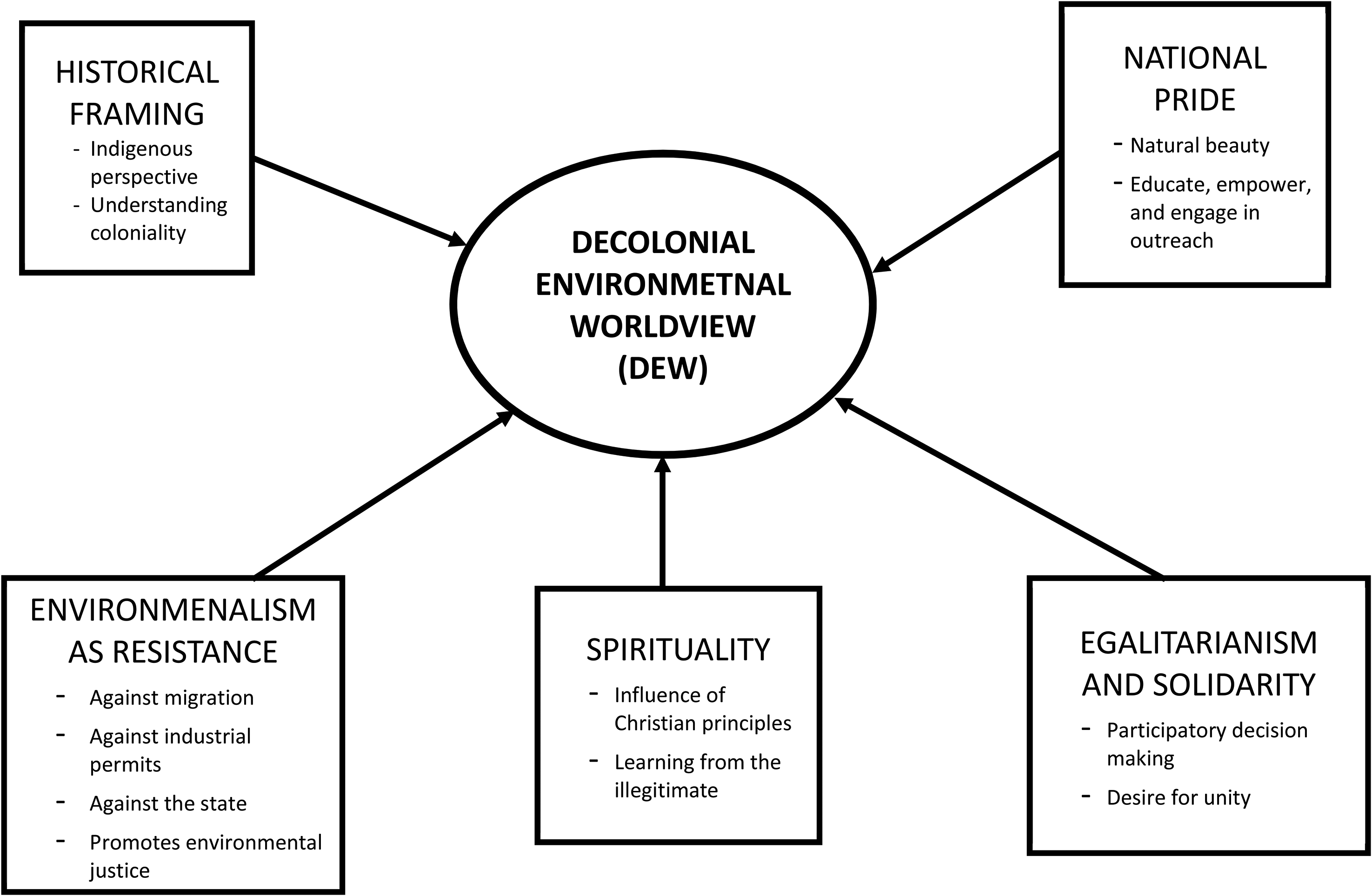
Graphic representation of the decolonial environmental worldview (DEW) as observed among Jamaican environmental activists. Source: Authors.
Historical framing
One of the first elements of the DEW that arose from the thematic analysis is that a historical frame is needed when viewing environmental issues. This can be seen on two levels. First, a few of the activists mentioned that it is important to understand the indigenous perspective. As interviewee 2 indicated “we're all as I said coming from ancestors who were far more connected and understood the world of nature. Now, we don't understand nature, and we've done a lot to eradicate it from this country, we know very little about our environment as a people which is a shame because we don't recognize that because it's not necessarily charismatic if you don't have lions and monkeys and giraffes running around in the cane fields, it's not as in your face, and so you don't recognize how different and special what is here and your responsibility to protect it (Interviewee 2, 2017, personal communication).
The importance of taking an indigenous perspective was also reiterated at the organizational level as seen from the narrative analysis of the websites. Two of the organizations indicated environmental work that surrounding the recognition of the importance of indigeneity. Organization 1 mentioned a conservation program where they experienced the “stealing of Tainos artefacts” from the caves in the protected area that they manage. Additionally, Organization 6 also alludes to the need to protect the indigenous perspective with their goals where they seek “to develop community heritage and eco-tourism in Trelawny by highlighting cultural traditions, historic artifacts and the biodiversity of Cockpit Country.” In both examples, the organizations indicate a need to protect and recognize the importance of protecting environmental spaces as a means of protecting indigeneity
This element of indigenous perspective is tied to the idea of rights that are inherited by the past and current population where there is a sense of entitlement to use the natural resources. This sense of entitlement is viewed as a right for the current population and is espoused as necessary for grounding how environmental work should be viewed. This sub-element of the DEW relates to the UN declaration component on the right to control the physical space, but also the component on the right to manage the physical space that is occupied, in speaking to how the ancestors were able to care for the resource. These sub-elements should be something that is passed on to current populations.
The second sub-element of the historical framing is understanding that a colonial mindset has been engrained in the society. There was a recognition that the history of colonialism has left a legacy with respect to how the physical environment is used, disposed of, and protected (or not). Organization 2 on their website alluded to the importance of recognizing coloniality. Their proposed work on the Heritage Village seeks a location “at the original sugar factory in Alley to establish a Heritage Village. This would include a museum with shops for craft and other items to be sold…” The objectives of this project are what align with this sub-element of the DEW. It states that two of the objectives are “To highlight the impact of sugar on southern Clarendon” and “To preserve our heritage.” Both objectives are alluding to the colonial history of the sugar plantation in Jamaica. Even though this is a new potential project, it still gets to the notion of understanding the colonial aspects that have influenced the environment around the area that the organization manages. From the interviews, as summarized by Interviewee 4, there is also the need to recognize the colonial history. “I think the colonialist mindset is one of control. You go and capture a place, that is essentially what it was. I mean there were people living here, the Spanish came and then the British and they just took it, killed all the people, cut all the trees and then planted sugar cane. Which you know, made them millions of dollars off of slave people, just to drag them away from their homeland. So, that is the colonial mindset, the land is a commodity, the people are a commodity, and they are there for the taking” (Interviewee 4, 2017, personal communication).
National pride
Having a focus on national pride was one of the central themes that emerged from the synthesis of the interviews as well as the narrative analysis of website content. In focusing on the national pride of the country there is a sense that the geology and natural beauty of the country are part of the identity of the nation and needs to be protected in some form. This relates to two of the UN declaration components: first, the fact that people are placed at the center of the declaration and second, that they have the right to control their own physical resources.
The beauty of the natural space is recognized by the organizations. All six of the NGOs have this recognition as central to the work that they do. For example, below are the lists of goals that relate to this theme from the organizations’ website Organization 1: their mission focuses on “… discovery, exploration, and preservation of the caves and karst of Jamaica”. They have a focus on reporting the threats to caves
Organization 2: “promoting “clean, land, water and air”; “sustainable use of natural resources”; “conserve threatened species, ecosystems”. Additionally, this organization has a number of programmes that are specific to protecting the natural environmental resources and hence the physical beauty and resources of the area that they manage: Columbid Gamebirds management; dry forest conservation programme; fisheries management programme; Jamaica iguana conservation programme; management of forest reserves and watershed management programme
Organization 3: was founded because of a concern “about the state of Jamaica's natural environment.” They undertake several projects that are related to addressing the physical natural beauty of the country. These include “beach and gully clean-ups”; “recycling projects”; “demand side management energy conservation” and their mission states that it is “to protect Jamaica's natural resources”
Organization 4: has a mandate to conserve Jamaica's natural environment. The mission statement focuses on advancing “environmental conservation and sustainable development with a focus on the Blue and John Crow Mountains National Park for the benefit of Jamaica and our people”
Organization 5: has two goals that allude to the national beauty of the country. They seek to build ecological resilience at multiple societal levels and strengthen and secure the rights of individuals and communities, through equitable access to the essential …. environmental requirements for a decent life.
Organization 6: seeks to promote development …. by implementing environmental conservation…projects. They aim to promote conservation and biodiversity through wise use of its natural resources.
This espousing of national pride is seen through the desire to ensure that the national population is made aware of the beauty. This is done by ensuring that environmental activists educate, empower, and engage in outreach to the national public about environmental issues. In terms of education Interviewee 2 (2017, personal communication) indicated that they see their role as an educator. They indicated “I see my role particularly when it comes to the public education part, which is why I spend so much time out at the discovery center… I think that [public education] facilitates some of the work that we will be doing through that center [which] is aimed at …helping people to reconnect to nature.”
Interviewee 6 as an example, highlights the significance of empowerment as part of the broader element of national pride. “…environmental work has a dimension of rights of use, whether it is ownership or not. And therefore, it has a dimension of empowerment. That means if I can say this resource is mine, because [when you talk about the] environment largely I think what you and I are talking about concludes to a large extent the resource and goods that are common property resources, whether it is the air, the watersheds, the beaches, the sea, the climate” (Interviewee 6, 2017, personal communication).
Outreach goes hand in hand with education and empowerment of the local citizenry. Organization 3 actively engages in outreach where they “promote environmental outreach to the wider school and local community.” Organizations 4 and 6 also engage in similar outreach strategies with schools and local communities in their respective areas. Interviewee 1 (2017, personal communication) indicates “Really our mission is just to document the caves in Jamaica, the features on ground caves, sinkholes, stuff like that. To visit them, to document them, and to put it online for public knowledge. Secondary to that is to focus on Jamaica, let Jamaicans know, so we run it on our website. We have our own website, YouTube channel and Facebook page. So, we post the data from our outings, video, photographs, whatever animals, water, hydrology, archaeology, that we find. [This is] just for the purpose of educating Jamaicans and the world about what exists on the ground in Jamaica.”
Environmentalism as resistance
A third element of the decolonial environmental worldview is understanding that environmentalism is seen as a form of resistance. There is in fact resistance in the movement against four specific things. First migration was raised as an issue and sub-element, that must be challenged in Jamaica. As interviewee 3 stated “If we get paid, and so if we can sustain these areas as suitable places for tourism destinations, then people can make enough money that the children will stay in the communities because there will be restaurants, the one man shop can stay in place, people will be making things, creating things selling things and making it in their communities, because they have something valuable” (2017, personal communication).
Second there is resistance to permits, the second sub-element. This is intimated by Organization 2 through the work that they do. They indicated that their “biodiversity and conservation program sees “unstainable development” as a problem that must be addressed with the subproblems being listed as “expansion of housing and urban areas to unsuitable areas,” “expansion of industrial areas to unsuitable areas,” “fish and shrimp farms,” “badly sited quarries, quarry zones and infrastructure.” “shipping lanes,” “poor agricultural practices” and “expansion of unsustainable tourism and recreation.” Interviewee 5 (2017, personal communication) expressed concern over permits in their response “…[we are resistant to] the permits being granted to destroy the environment in important places…what we are fighting for is to get people to understand that you are in a relationship with a place. A relationship with all the non-human inhabitants as well, part of your identity is this place, part of who you are. And if you treat it like a commodity that is just to be cut up and paved over, then eventually the place that you say you cling to and love and is your home, will be an extremely unpleasant place to live.”
The third sub-element of resistance is related to the second in that there is resistance against the “State” not prioritizing environmental protection which can also be seen in the above quote from Interviewee 5. Some of the activists felt that there needs to be resistance against the weak State that has put environmental protection on the back burner. The resistance against state was also evident through the organizations’ website. For example, three of the six organizations have explicit content that showed that there was active resistance against the state as it related to environmental protection and hence engaged in advocacy. Organization 2: engaged in community advocacy where they worked with communities to strengthen their capacity to protect their environmental rights against the state. For example they worked with “…communities near to mining and quarrying activities…and communities facing potential mining…to strengthen their ability to protect their environmental rights”. They trained communities to engage in citizens’ science to collect data on the environmental conditions of their communities to present to government regulators. Organization 4: was founded because there was a “conviction that Jamaica's natural heritage required an advocate to ensure that the environment was not sacrificed as Jamaica pursued development.” Here there is the allusion that there is a need to provide oversight as to where and how development should be pursued. Organization 5: Indicated that they help local communities to speak out on issues such as climate change, land degradation, energy, bauxite mining, coastal resource management and sanitation all of which are under the purview of the state for managing:
A final sub-element of resistance was pushing against environmental injustices. This element was seen through the work of five of the six organizations.
Organization 2: has a campaign that pushes the government to ratify the Escazu Agreement. This agreement seeks to promote environmental rights for all Jamaicans. The Escazu agreement is the “Regional Agreement on Access to Information, Public Participation, and Access to Justice in Environmental Matters.” This treaty is the “first ever environmental human rights treaty for Latin America and the Caribbean aimed at promoting the enhanced governance of natural resources in the region.”
Organization 3: alludes to environmental justice concerns with some of their projects, for example there is a focus on the environmental threats from air and water pollution that many communities face, however because of a lack of information access, communities “…are not able to easily assess the public health risks and environmental impacts.” This organization also has an advocacy campaign that generated a number of videos and reports around pollution with elements of environmental justice being subliminal in these. Finally, they work with communities facing the threat of mining “…to strengthen their ability to protect their environmental rights”. In some communities they conducted a “health survey” to determine the connections between environmental hazards and health circumstances
Organization 4: works on projects that seek to “to promote and facilitate sustainable livelihoods in the local communities.” This is important to environmental justice principles as it seeks to improve the quality of life for these communities.
Organization 5: has a slogan to address EJ: “To amplify the voices of the vulnerable, the marginalized and the excluded.” Additionally, they focus on strengthening and securing the rights of individuals and communities, through equitable access to the essential social, cultural, economic, and environmental requirements for a decent life. Here this organization is focusing on rights as well as procedural justice.
Organization 6: focuses on EJ through their ecotourism project. This project seeks to provide alternative business activities for local citizens that are consistent with conservation and sustainable use of the natural resources. They also engaged in a project that upgraded water systems in surrounding communities and they have a clearing house of information against the proposed bauxite mining. All these focus on rights and improving quality of life.
These elements of resistance are related to the UN declaration of decolonization, specifically the right for citizens to have control over how decisions are made related to the use and management of physical resources and the right to dispose of the wealth and natural resources of the country. Now follow-up resolutions (1515 and 1803) to the UN declaration of decolonization seem to contradict this first one in the sense that rights to control environmental resources are then given to States rather than citizens as stated in its decolonization declaration, resolution 1514. As such this often creates conflict between the ways in which States opt to use resources and exclude citizens or not take citizens’ concerns into consideration.
Spirituality is/should be central
One of the elements of the decolonial environmental worldview in Jamaica was the highlighting of how spirituality influences environmental worldviews and actions both among the activists and the general population. This theme emerged from the interviews rather than being explicit from the narrative analysis. However, it was important to highlight this theme as it was novel. Some of the activists spoke of their own spiritual connections and its influence on their environmental work while others stated that there are spiritual beliefs that can be used as examples for shaping “good” environmental actions in Jamaica and the Caribbean region. The two examples given are first the ways in which Catholicism shapes environmental work and second espousing that the broader community can learn from the Rastafarian community.
From the Catholic perspective, two interviewees alluded to the importance of theology “It is the work … that is more structural and spiritual and what have you. Which is to strengthen the connection that human beings have with what is around them. And some of our artists [are] doing that. But very few of the formal environmental organizations link with that or take on that dimensions (Interviewee 6, 2017, personal communication). “Therefore, what I am arguing for is a multi-disciplinary approach. And therefore, to take a purely one sided approach will fail. Even if you combine natural and social science together without asking why, why do we have ecology? Which is where the theology comes in. Because science cannot answer the question of ‘why’. It can say what, how, where, but not why. And therefore, I argue for my personal position, which is that the theology brings it all together, the philosophy too, to a unified whole” (Interviewee 4, 2017, personal communication).
Learning from other religious groups like Rastafarians is an interesting point that was highlighted. Interviewee 6 states “[the] strongest environmental movement in the English speaking Caribbean I would say that to me it is definitely the Rastafarian (Rastas) movement” (2017, personal communication). Rastas believe that “the entire universe is organically related and that the key to health, both physical and social, is to live in accordance with organic principles” (Edmonds, 2003: 60). There are a number of contemporary practices of Rastafarians that reflects environmental work or consciousness. These include the following as described by a number of studies (Campbell, 1997; Dunkley, 2011; Edmonds, 2003; Hamid, 2002; King et al., 2002; Savishinsky, 1994):
Organic cultivation and the production of organic products Development and promotion of a sustainable economy within their network. Here rastas produce their own food for their own consumption or for bartering and selling within their own communities. Natural living—here this refers to “off the grid” practices, in terms of the use of resources, water, and electricity. These tend to be hyper-conservative in the use of these resources to ensure that they are not wasting. Consumption of naturally cultivated produce—here they do not consume products considered harmful to the body. They consider their body the temple of God and as such they engage in practices that will not contaminate the body. For example, they do not consume alcohol. They also believe that they are the ‘salt of the earth’ as such they eat Ital, which refers to organically grown vegetarian food, cooked without salt.
There has been a perspective in past literature that Judeo-Christian religion is partly the reason why environmental crises emerged due to their anthropocentric view. Even though there was an increased promotion of environmentalism by Western churches in the late 1980s and early 1990s, those without religious affiliation have more environmental beliefs (Hand and Crowe, 2012) and there is a need to consider the ways in which other religious entities contribute to environmental work. Jamaican activists suggest that there are lessons to be learnt from the practices of Rastas that can be scaled up to the broader population that can be applied to environmental protection and conservation but also assist with some of the social environmental challenges like lack of access to food. There is an allusion to learning from those that maybe considered invisible or illegitimate in the society, which is part of the decolonial environmental worldview giving credibility to the African heritage from which this culture was developed. This point highlights the need of living along with the environment, seeing its value, and respecting that if the environment is destroyed that there will be broader implications for the society, particularly for decolonized island states where there is limited physical space. As such this element of spirituality relates to the UN declaration elements of recognizing the sovereignty of states to manage their resources. Here, there is the connection to not only recognizing the political sovereignty but also the social sovereignty of groups within the society who have developed traditions that promote environmental stewardship.
Longing for egalitarianism and solidarity
A fifth element of the decolonial environmental worldview is the idea of having unity among the various activists involved in environmental work and the need for an egalitarian approach to understanding and addressing environmental problems in countries like Jamaica. This is directly related to the UN declaration and its component that states that citizens should have the right to be involved in the decision-making processes. This approach is espoused on two levels. The first sub-element is an indication that the primary users of natural resources should be considered at the center of decision-making processes. Interviewee 6 (2017, personal communication) indicates: “…any form of environmental management would have to be inclusive and decentralized… [first] bottom up and [second] reorganizing the scales and the capital that exists among the people who actually use resources and feel the impacts.”
“[There is a] need for co-management & co-governance between government agencies and ‘small-businessmen’ who extract natural resources as a means of livelihood, [for example] fishermen. The governments are not willing to share the responsibility with these non-government small-scale stake-holders.”
The organizations also raised the need for participatory decision-making.
Organization 1 indicated on their website that “collaboration is invited”. This simple sentence indicated that there is an openness to participatory engagement. They are a membership organization, and they have both cavers and non-cavers as part of the group. They engage with scientists to ensure that the work is also documented via scientific principles.
Organization 2 shows that they are interested in working with communities and want participatory decision making as one of their major objectives is “community involvement”.
Organization 3 encourages participatory decision making by using law and advocacy as seen in the following quote: “…works to protect Jamaica's natural resources using the law, public participation processes, policy review and the media” (emphasis added).
Organization 4 has a governance and administration plan that seeks to bring multiple stakeholders together to manage the national park. They believe that “collaboration, and the involvement of stakeholders is a critical component in… management…”
Organization 5: “works to amplify the voices of the poor and the marginalized through the media and ensure their inclusion in public and policy debate…They also work with a number of different stakeholders in order to achieve their goals: civil society organizations, community-based organizations, media, government, donor agencies.
Organization 6: also espouses participatory decision making where they “…develop partnerships with government, the private sector, civic organizations, grant funders and financial institutions in order to access and combine human resources, technical expertise, physical facilities and finances in order to implement projects efficiently and effectively”. They also mobilize citizens living in communities … and stakeholders from across the country to discuss the conservation….
From the interview quotes and the information from the organizations’ website, the argument is being made that environmentalism should be characterized by participatory governance. There is a need for understanding why the environmental issues are pervasive from a community perspective. The activists indicate that rather than blaming primary users for the problem there is a need to understand that they do value the resource but in a lot of cases they may have no choice but to engage in the environmental damage. This is often due to the limited opportunities and resources that are available to many communities in island states like Jamaica. Further, the activists are pushing against the notion that there are experts who understand environmental challenges, that these experts are outside of the community, and they must be brought in to explain to the community what is needed. This is very much in the vein of recognizing the local expertise that exists within communities and finding a way to foster and extract that expertise so that the communities can collectively work on addressing environmental struggles. This latter sub-element relates to the UN declaration component on the right to sovereignty with the extension that social sovereignty in the form of recognizing local and indigenous expertise is important to environmental work.
The second sub-element for taking a multi-stakeholder approach is the need for more unity among the local activists. This is also part of the decolonial environmental worldview as here the activists recognize the old tried and true method of divide and conquer. Interviewees 2 and 5 summarize this point succinctly in the following quotes: “I think we are not united, if you said to everyone, ‘do we share the same vision’, everyone would say yes, we want the environment to be better. But as for collaboration, no one wants to subdue their own project to someone else” (Interviewee 4, 2017, personal communication). “…working together in the NGO community in Jamaica has pretty much died. It almost does not exist anymore. We very rarely speak to each other, we might see each other rarely at a meeting, but there is no coordinated advocacy work around any particular issue anymore. I think the environmental NGO movement in Jamaica is vastly weaker than it was even 15 years ago (Interviewee 5, 2017, personal communication).
There is also a recognition that there is a need for regional networking and connections. Interviewee 6 stated “What I am saying is that the region had a number of those networks, and I am not sure if they are functioning well now. And when I say I am not sure it is because I am being polite. I do not think they work” (Interviewee 6, 2017, personal communication).
Research has suggested that this lack of networking is common in developing countries. For example, Rootes (2004: 630) indicated that developing countries usually don’t have developed and resourceful national Environmental Movement Organizations (EMOS) to perform a networking role between communities of common concerns. As a result, local people can’t be connected to one another unless they have assistance from an external entity such as transnational EMOs. Jácome (2006) also explains that the local NGOs and regional NGOs in multiple regions of the Caribbean are not well-connected or cooperative with one another. Instead, local and regional NGOs focus their activities on their respective regions and prioritize relationships with other environmental organizations for primarily financial reasons, which typically involve international organizations. What these laments, about the lack of unity show, is that there is a recognition that solidarity is important for promoting environmentalism. This recognition is like the calls for solidarity in other environmental spaces dominated by people of color like environmental justice (Capek, 1993; Taylor, 2002).
Conclusion
Finney (2014: 27) in her book Black faces, white spaces indicated that “in regard to the environment, the single mainstream narrative is proven to be primarily a white movement on the conservation and preservation of nature.” Often countries in the developing world are viewed as being deliberate destroyers of the physical environment with the view that the western ideology is needed to “save” the barbarians from decimating the planet. But is this really the reality? This research argues that environmentalism has been a central part of postcolonial societies with deliberative thinking about the value of the physical spaces that we occupy. This work suggests that there is a
As seen from the above analysis there are specific characteristics of this DEW framework that are linked to the components of decolonization as intimated by the UN Declaration on the Granting of Independence to Colonial Countries and People. These elements include the following:
Historical framing National pride Environmentalism as resistance Spirituality is/should be central Longing for egalitarianism and solidarity
As defined by Johnson et al. (2011) worldviews typically consist of a) an explanation of the world, b) a prediction about the future of the world, c) ethics, i.e., what is the right thing for us to do, d) a theory of action, i.e., how to attain our goals, e) epistemology, what is true or false, and f) etiology, an account of the building blocks of the constructed worldview, i.e., its origins and how it was constructed. Taking these elements of worldviews into consideration along with the above synthesis of themes for Jamaican environmental activists, the paper postulates that there is indeed a worldview that is characteristic of Jamaica in response to the research question asked in the method section.
We can start with the ‘explanation of the world’. This is represented by the theme, ‘historical framing’. Here, the activist perspective is centered around the notion that citizens have descended from ancestors who were more connected and understood the world of nature. This world, according to this view, has been tainted by colonialism. Additionally, some NGOs centered the need to understand the historical context by recognizing the importance of indigenous elements and the plantation society that have shaped the physical environment. The implication is that the activists live in a world in which they are trying to undo the control, mental and environmental, imposed on it and them by colonialism. Colonialism, by seizing ownership and control of the national space and all that existed in it, human and non-human, animate and inanimate, ripped colonized humans from their pre-existing link with their natural environment.
The predicted, or at least hoped for, future of the world is one which was captured under the ‘national pride’ theme. In this world, the activist will be helping people to reconnect to nature—the nature from which they have been separated by colonialism. Environmental work has a dimension of rights of use, whether there is ownership or not. Recognition of these rights creates a dimension of empowerment. It would be one in which people have rights of use and are empowered to use and take care of their environment. In this world, people would be educated about the facts of the environment. The outcome of environmentalist work is aimed at educating Jamaicans and the world about what exists on the ground in Jamaica, giving them the knowledge to reconnect with a nature that was lost to them through colonialism.
Ethics, the notion of right and wrong, as a component of the Jamaican decolonial environmental worldview, can be seen in the quotes already made under the previous themes. These point to a strong sense of right and wrong and the role of the activist in doing the right thing by people and their environment. There is a sense from the analysis that doing right implies undoing the effects of colonialism, both on people and the environment on which their identity is deemed to be based. Ethics is also covered under the theme environmentalism as resistance, where there is a sense that the fight is for people to understand that there is a relationship with the place that they occupy. A relationship with non-human inhabitants should be part of your identity in the place. The claim in this theme, is that colonialism, by separating people from their environment and by extension their sense of who they are, had done a grave wrong that environmental activism needs to right.
Evidence of a ‘theory of action’ can also be found under the theme of environmentalism as resistance, as the activists mention that what they are fighting to get people to understand that relationship to sense of place. Here, there is the notion that ‘knowledge is power’. Knowledge, therefore, is a key weapon in the struggle to bring about change. Additionally, under the theme, longing for egalitarianism and equality, cooperation between individual users of the environment and the state should be part of the process for change. This should be in the form of co-management and co-governance between government agencies and small-businessmen who extract natural resources as a means of livelihood.
The worldview component, what is true and false, is deeply embedded under the theme of spirituality is/should be central. Here there is a call for users of the environment to view it beyond a commodity status. The view of the physical environment as a commodity is grounded in the colonial reality, results in exploitation and eventually environmental harms that are then experienced by the residences of the physical space, leading to unpleasant everyday life. The position is clear: accept the truth, act on it, and lead a pleasant life in a pleasant place or believe a colonizer's lie and lead an unpleasant life in an unpleasant place.
Elements of an etiology, an account of the building blocks of the constructed worldview tended to be raised by the more religiously inclined of the informants. There was a call for a ‘multi-disciplinary’ approach to the environment, that seeks to understand the “why” of protecting the environment. The answer to the why involves, theology or the underlying value system on which the society is based.
This paper argues that there is a single, integrated worldview. According to this, the people were once part of the land, at one with it. Then, colonialism came, alienating them from the land, making both them and the land commodities to be bought and sold. Decoloniality means healing that separation, restoring the people to the land, in an egalitarian and sharing relationship, under the guidance of a decolonial state dedicated to protecting and promoting this process. Colonialism everywhere involves the alienation of people from their environment. Using the decolonial environmental worldview (DEW) framework based on individual Jamaican environmental activists, the paper hypothesizes that the main observations may hold true in other decolonial environmental contexts and challenge other researchers to test this typology. The worldview driving such activists would be one which sees their role as restoring that connection between the people and their land, the person and the environment, destroyed by the colonizer as part of the colonial project.
Highlights
Decolonization influences the way in which the environment is viewed by activists in post-colonial societies
Decolonial environmental worldview (DEW) is postulated for the Jamaican context
Decolonial environmental worldview (DEW) has elasticity for other post-colonial contexts
Footnotes
Acknowledgements
We would like to thank the environmental activists who took the time to speak with me about their great work and share their multiple years and myriad of experiences. Additionally, we would like to thank our funder Colgate University who actively supported the field work. We would like to acknowledge and thank the multiple student research assistants from Colgate University: Bobbie Howie ‘18, Sydney Bird ‘19, Sabrina Callendar-Clewett ‘19, Johanne Castro ‘21, and Gordon Kong ‘21, all of whom has been actively involved in the background of this research project assisting with literature reviews, data collation and organization. Many thanks to them for helping to keep this project moving forward in the midst of all the other commitments. We finally, we would like to thank all the reviewers who provided substantive comments to improve the final version of this article.
Declaration of conflicting interests
The author(s) declared no potential conflicts of interest with respect to the research, authorship, and/or publication of this article.
Funding
The author(s) received financial support for the research from Colgate University's internal grant process.