




Abstract
In this article we discuss Mpala Research Centre in Laikipia County, Kenya as a distinctly colonial space. Drawing on historical materials, fieldwork observations and in-depth interviews, we build an account of British colonial expropriation of land, European and American modes of enclosure, and the development of a prominent site of knowledge production in the fields of ecology, conservation and evolutionary biology. Mpala is product and productive of colonial relations, ones where land use serves mainly Western interests in ways that sustain and entrench categories of coloniser/colonised. We support this claim by identifying three ways in which colonial legacies endure at Mpala in terms of (i) ontology, or the particular ways in which land is made landscape; (ii) race and the organisation of space and labour and (iii) silence (and silencing) as a mechanism that sustains colonial power relations. We further argue that turning to such a nameable site of contemporary academic extraction enables a shift from postcolonial critique to decolonial praxis. By naming Mpala in specific terms, the possibility of politics opens out from critical analysis towards a project of undoing the epistemological and material legacies of colonialism.
Introduction
In this article we discuss a specific site of field research as a distinctly colonial space. We do so to bring a detailed case into contact with a critical conviction that formerly colonised areas of the world have come to serve as a ‘repository’ of information to be extracted and commodified by researchers in the historic metropoles. The reading of the field in this view is that colonial patterns of extraction – of labour and resources – are replicated in the exploitation of research assistance and data by scholars and institutions whose relative positions derive from and reproduce colonial-era power relations. While such a view undoubtedly holds in general terms among critical scholars in geography (e.g. Driver, 2001; Radcliffe, 2017) and cognate fields (prominently: Ismail, 2005; Mbembe, 2021; Spivak, 1999; Stoler, 2016; Smith, 1999), there are conspicuously few detailed empirical accounts of how these relations emerge and persist, 1 thus leaving open the question of precisely how colonialism endures at specific sites of research. Our objective here is to provide such an account by attending to a crucial site for research on wildlife and the natural environment in the East Africa region – Mpala Research Centre in Laikipia County, Kenya – where a large amount of academic knowledge is produced in the fields of ecology, conservation, and evolutionary biology. As we will show, Mpala is product and productive of colonial relations, ones where space and labour are organised around Western interests in ways that sustain and entrench categories of coloniser/colonised. We argue that turning to such a nameable site of contemporary academic extraction enables a shift from post-colonial critique to decolonial praxis. By naming Mpala in specific terms, the possibility of politics opens out from critical analysis towards a project of undoing the epistemological and material legacies of colonialism.
The article is thus committed to a ‘discomforting’ decolonial politics that ‘implicates’ and ‘unsettles’ (Tuck and Yang, 2012, 7), a politics that is not subordinated to theory but one that constitutes ‘a way, option, standpoint, analytic, project, practice, and praxis’ (Mignolo and Walsh, 2018, p. 5). Guided by these and other key perspectives on decolonising (e.g. Esson et al., 2017; Wa Thiong’o, 1986), we frame the discussion here as a move towards the ‘change [in] the order of the world’ envisioned by Franz Fanon (1963, p. 36) and so many others (e.g. Freire, 1985; Wynter, 2022). This is not to overstate the article's potential contribution but to set out a particular politics of decolonising that is angled primarily towards the issue of real-world change via a shift from critique to praxis (Walsh, 2020, p. 606). In this shift we name and implicate different actors to provoke response and to foreclose the political impotence of certain academic niceties (see Healy 2017). In what follows, we therefore provide an account of an important space of knowledge production that traces precise trajectories of power with an imperative to position those trajectories less as an end of critique than as a beginning point of accountability and, eventually, material change. In the most direct terms: a project to decolonise Mpala must re-centre indigenous knowledge by shaking the grip of international funding that is conditioned on dominating roles played by (mostly white) scholars from overseas. Especially for readers who have worked at Mpala and benefitted from its facilities, parts of this article will read as unsettling. This is an intended and necessary fallout, though we do not write on any individuals in an accusatory manner. It is rather the structures and relations between organisations that we seek to open to decolonial praxis; the continuations of colonial power that make Mpala a space of exploitable land and labour.
Mpala Research Centre comprises ∼20,000 hectares of land expropriated by the British colonial state in the early 1900s. The land has since remained in European or American ownership that has upheld a mode of enclosure that strictly limits indigenous access while opening it to manifold Western capitalist, military and research activities. In its contemporary form, Mpala is one of the largest and most technologically advanced field research facilities in East Africa, mainly owed to significant investment procured by Princeton University and the Smithsonian Institution, who manage the Centre alongside Kenya Wildlife Services and National Museums of Kenya. It hosts hundreds of academics and students from American and European universities each year and employs a large in-country staff to take care of administration, field assistance, housekeeping and security. The information on Mpala presented here is drawn from three research activities: study of first-hand accounts (e.g. Schwarzenberg, 1946) and archival documents (from Kenya Gazette) related to the land that now makes up the Research Centre, including reference to secondary historical sources (e.g. Hughes, 2006; Matheka, 2008); a week-long residential visit to Mpala where we sought to undertake pilot research into working conditions at the Centre; and in-depth interviews with people who have worked at Mpala for extended periods. These three sources of information (we further explicate our methods below) have enabled us to construct an account of the operations of Mpala and something of the power relations within. Mpala is, as we will demonstrate, a distinctly colonial space where divisions of labour and patterns of extraction continue a century-long trajectory of Western exploitation of Kenyan land and people.
The article proceeds in three sections. In the first, we trace the history of Mpala using historical materials. We do so to connect the current use of land with the wider Laikipia landscape and to make explicit the crucial point that the Research Centre is built on indigenous lands that were forcibly expropriated by the British state. What has followed is also of relevance: the land has served British military interests for decades, visiting devastating violence on Kenyans who live around Mpala. The second section looks inside contemporary Mpala by drawing on both our research visit there and interviews with former Mpala researchers and staff. We document how Mpala Research Centre is organised along colonial lines in the conceptualisation of the land, the segregation of space and division of labour, and the silencing of indigenous voice. In the third section we pick up these themes to theorise three key ways in which colonial legacies endure at Mpala in terms of (i) ontology, or the particular ways in which land is made landscape; (ii) race and the organisation of space and labour and (iii) silence (and silencing) as a mechanism that sustains colonial power relations. Drawing focus on ontology, race and silence, we argue, opens the question of decolonising to material objectives. We turn to these themes in the concluding section to indicate potential contributions of the article towards a project of decolonising.
A concise history of Mpala
Mpala Research Centre is located 4 to 5 hours drive north from Nairobi on the Laikipia plateau in central Kenya. In this region, the land outside urban centres (Nanyuki, Nyahururu, Rumuruti) is mostly divided between large private ranches; around three-quarters of Laikipia is American-owned or European-owned and designated ‘conservancy’, a mode of enclosure that puts lands and fauna in the hands of private actors for tourism safari, hunting, and/or conservation research. High-profile properties that serve these activities include: Ol Jogi (∼24,000 hectares) in central Laikipia, owned by the art dealing French-American Wildenstein family; Lewa (∼25,000 hectares) on the eastern edge of Laikipia that has passed through different generations of the British Craig family; and Ol Pejeta (∼36,000 hectares) to the south that was declared Crown Lands in 1905 and has since been owned by a billionaire arms dealer and an international conservation foundation. 2 There are many more, and each vast property is the product of indigenous displacement and a continuing exclusion of remaining communities that is strengthened by significant capital investment from Western tourists and conservation actors. Laikipia is a destination for white settlement, luxury safari and conservation expertise, a region for moneyed visitors to experience and know “Africa” with a certain degree of comfort and authority.
Laikipia is thus a flashpoint of community-conservation conflict (see Mbaria and Ogada, 2016). There are headline-making events in this conflict – for instance, the murder of the British safari travel entrepreneur Tristan Voorspuy at Sosian Ranch near Rumuruti (BBC, 2017) and the shooting of Kuki Gallmann at Ol Ari Nyiro ranch by cattle herders searching for grazing (Guardian, 2017) – but these are only the eruptions of violence against a background of constant tensions between indigenous and outsiders, or the displaced and displacers (BBC, 2004). The ranches of Laikipia occupy the ancestral lands of the Maasai and other tribes on its peripheries (e.g. the Samburu to the north) whose displacement came at the hands of a British colonial administration with designs on productive and liveable lands for settlers. The suitable areas for settlement, extending around the newly completed Mombasa-Kampala railway and, eventually, north into the Laikipia plateau were figured as the ‘White Highlands’ in the early 1900s. There was no ambiguity to this place name: it was land sequestered precisely because of its cooler climate that made it ‘a territory admirably suited for a white man's country’, as the British explorer Sir Harry Johnston wrote as His Majesty's Special Commissioner in 1901 (quoted in Morgan, 1963, 140). Johnston was an expert land grabber, famed for out-scrambling competing colonialists from other European imperial powers to claim lands for the British Crown (Oliver, 1957). Rationalised with a familiar terra nullius logic – ‘the country in question is either utterly uninhabited for miles and miles or at most its inhabitants are wandering hunters who have no settled home’ (Morgan, 1963, 140) – the lands around the railway became crown possessions as part of the East Africa Colony in 1902. Laikipia was an important part of this project, initially as an area for re-location with the signing of The Masai Agreement of 1904 3 that obliged the Maasai of Naivasha and Nakuru to vacate their lands to make way for British settlers. The British promised Laikipia's desirable grazing lands ‘so long as the Masai as a race shall exist’.
In 1911 the British, never territorially satiated, reneged on this promise and, to expand the White Highlands for more settlers, coerced the Maasai of Laikipia to sign a second treaty, The Masai Agreement of 1911. While the 1904 re-locations were, by most accounts, relatively peaceable, the emptying out of Laikipia from 1911 to 1913 took place at gunpoint – the colonial administration having hired white settlers and askaris (guards) from other parts of Africa to forcibly remove the Maasai and their livestock (Hughes, 2006). Maasai accounts of the period accuse the British of deceit (DePuy, 2011) and claim that ‘hundreds if not thousands of people died from starvation, disease, exposure, or gunshot wounds’ (Hughes, 2006, 118). The re-location – to ‘poorly watered, low-quality land’ in a newly designated southern reserve (McIntosh, 2016, 55) – opened Laikipia to European settlement with prominent British landowners such as Lord Delamere and Gilbert Colville making swift moves to acquire large parts of the plateau. White settlers thus displaced black indigeneity, marking a racial regime of land ownership whose early 20th century roots remain strong to this day (Bhandar, 2018). There is no ranch in Laikipia whose lands are not violently stolen from indigenous peoples.
Mpala Ranch is the seventh largest private ranch in Kenya. It is managed by Princeton University in partnership with the Smithsonian Institution, Kenyan Wildlife Services and National Museums of Kenya, 4 an arrangement that came into being after the land was bequeathed to Princeton by George Small (1921–2002). Small had inherited the land from his brother and fellow Princetonian Sam (1918–1969) who purchased Mpala in 1952 from Princess Hilda of Luxembourg (1897–1979). Princess Hilda's then recently deceased husband, Prince Adolph Schwarzenberg (1890–1950) of German-Czech aristocratic ancestry, 5 acquired the land in 1933 from an Elsie Gwendoline Giddings Wilmot, a British settler. Wilmot is the earliest name on record of a European settler on the land after the expulsion of the Maasai from Laikipia in the years following 1911. 6 In the mid-century period, Mpala was a dairy farm with profits arriving from produce such as butter that was tinned and sold to British soldiers stationed in close-by Nanyuki. Prince Schwarzenberg introduced modern farming methods and built a hydroelectric dam and a complex of buildings for guests and staff. In his personal account of this time – A Kenya Farmer Looks at his Colony (1946), written for the Carnegie Endowment for International Peace – the Prince documents these significant developments with a modesty and sense of affection for this tract of Laikipia, albeit one made possible by that convergence of race and climate: ‘white men can live in health in the highlands of Kenya as nowhere else in central Africa’ (Schwarzenberg, 1946, 22). While Schwarzenberg had been a political exile from the Nazis with a record of protecting Austrian Jews in the 1930s, his own displacement (as European aristocracy with additional homes in the United States and Italy) spilled over and reinforced a wider geography of colonial displacement in East Africa.
After Sam Small's 1952 purchase, Mpala was run as a cattle ranch with limited success (DePuy 2011, 68) and income was eventually bolstered by an agreement in 1964 with the British Army to use ranch land as training grounds. It is difficult to overstate the significance of the agreement and the ways it deepened colonial roots at Mpala and across Laikipia. Mpala was the first Laikipia ranch to host British military training exercises; that number has grown steadily over the last decades to 11. Soldiers have been stationed at various locations in the area since 1945 and are now concentrated in the newly built Nyati Barracks on the outskirts of Nanyuki, 43 km south of Mpala, the base for the British Army Training Unit Kenya (BATUK). The Unit's access to Laikipia land has been key in preparations for neocolonial interventions elsewhere, even as recently as during the ‘War on Terror’ because the scrub bush and aridity approximate conditions in Afghanistan and Iraq. 7 At Mpala, the latest arrangement – according to available information – is that military exercises take place over 9 days in a month for no more than 3 consecutive months, with apparently little effect on wildlife populations (Awuor, 2015). 8 It must be strongly emphasised, however, that for local communities, British Army presence at Mpala and across Laikipia has been devastating. Abandoned ordnance has killed ‘up to 50’ herders in the region 9 and injured many others, in one case blowing off the arm of a 9-year-old boy, Eshuku Namoni, on Mpala land (Guardian, 2002), and in another leading to an alleged abduction of a 10-year-old boy, Ekisonga Nyasasai, as an attempt by army personnel to cover up the incident ( Telegraph, 2015 ). British soldiers are also linked to the murder of a 21-year-old woman in Nanyuki, Agnes Wanjiru, that was allegedly covered up by senior officers (BBC, 2021). These are not isolated events; they are part of a longer history of British Army abuse of Kenyan civilians that continues to this day. This is most starkly evidenced by the many hundreds of women who have accused British military personnel of rape. The cases of 650 women, some of them involving underage girls and more than half of gang rape, are documented between 1965 and 2001 (Amnesty International, 2003), and there are doubtless many more silence/d women. Mpala is named in reports cited here on unexploded ordnance and soldier rape.
The continued presence and violence of the British Army in Kenya – and part of its capacities to distribute violence elsewhere (in Afghanistan and Iraq) – rests on land access provided by Mpala and surrounding ranches. Sam Small could not have foreseen such unspeakable violence when he originally agreed to lease land to the Army in 1964 but it is telling from any perspective that in that year – one year after Kenya's independence – reserving land for the ‘outgoing’ imperial power effects less a break with the past than a continuity. This was a decision set in a colonial worldview that weighs on the present; Western ownership served Western needs and a wider colonial project, an arrangement with Mpala that remains to this day. After Sam Small's death in 1969, George's continued commitment to host the British Army on Mpala land eventually brought him the award of a Commander of the British Empire (CBE) by Queen Elizabeth II in 1997.
During the early 1980s, George Small approached Princeton University with a vision of setting up a ‘living laboratory’ at Mpala. In 1989 he formed the Mpala Wildlife Foundation and Mpala Research Centre was built in 1994. The Foundation, incorporated in Maryland and owned by Princeton, 10 owns the land with the Trust – Princeton, the Smithsonian, Kenya Wildlife Service and National Museums of Kenya – overseeing all activities at Mpala. Today the Centre is one of the largest field stations in East Africa with more than 700 employees and the capacity to host more than 150 researchers. Its facilities – for instance a genomics lab and stable isotope lab – make it a desirable and productive location for researchers from all over the world.
Inside contemporary Mpala
We are a research team of mixed expertise and ethnicity, comprising conservationists (Mueni, black Kenyan; Patel, British Gujarati Kenyan), an ecologist and public engagement academic (Baker, white British), and human geographer (Griffiths, white British) with complex and contrasting positionalities in a post/colonial context (for full discussions see: Baker et al., 2019; Griffiths, 2017; Patel, 2022). Acknowledging our diverse relations to empire, we are drawn together in a commitment to examining colonial legacies in the spaces of knowledge production. It was with this objective that we travelled to Mpala in the early part of 2022. There was no prior intention to write a critique such as that which follows; our minds were open and we had assumed that Mpala's colonial past would be more readily separated from its present.
For the visit we were put up in Mpala Ranch House, the residence built by Prince Schwarzenberg in the 1930s that is now used to host trustees and other ‘special guests’. The Ranch House sits on the brow of a hill overlooking a scrub bush flat with Mount Kenya as backdrop. The spacious rooms are beautifully kept, 11 each opening onto a veranda where beyond a lawn is a salt lick that attracts wildlife at sunrises and sunsets. Early evenings on the veranda are a particular delight. Breakfast and dinner are served in the library, a wood-panelled room designed to entertain and to impress. The wall-to-ceiling collection is orientated around farming techniques, wildlife taxonomies and literary tales of colonial adventure and exploration (e.g. Kipling, less-canonical others) and is most definitely a product of its pre-independence time (Figure 1). One wall of shelves is filled with glasses – wine glasses, gin, port, and whisky tumblers – that evoke high-level gatherings, another wall displays artworks. Prominent among them is a portrait of an officer of the King's African Rifles (KAR) in pith helmet atop a white horse in the role of overseer with silhouetted askari (rank and file) in the background (Figure 1). 12 It is a telling choice of imagery; KAR committed war crimes in Britain's brutal response to the anti-colonial Mau Mau Uprising between 1952 and 1960 (Elkins, 2005). For most guests it will appear a typical depiction against the backdrop of wooden panels and colonial literature; it will read differently to, for example, a relative of one of the thousands of Kenyans killed during that colonial war.
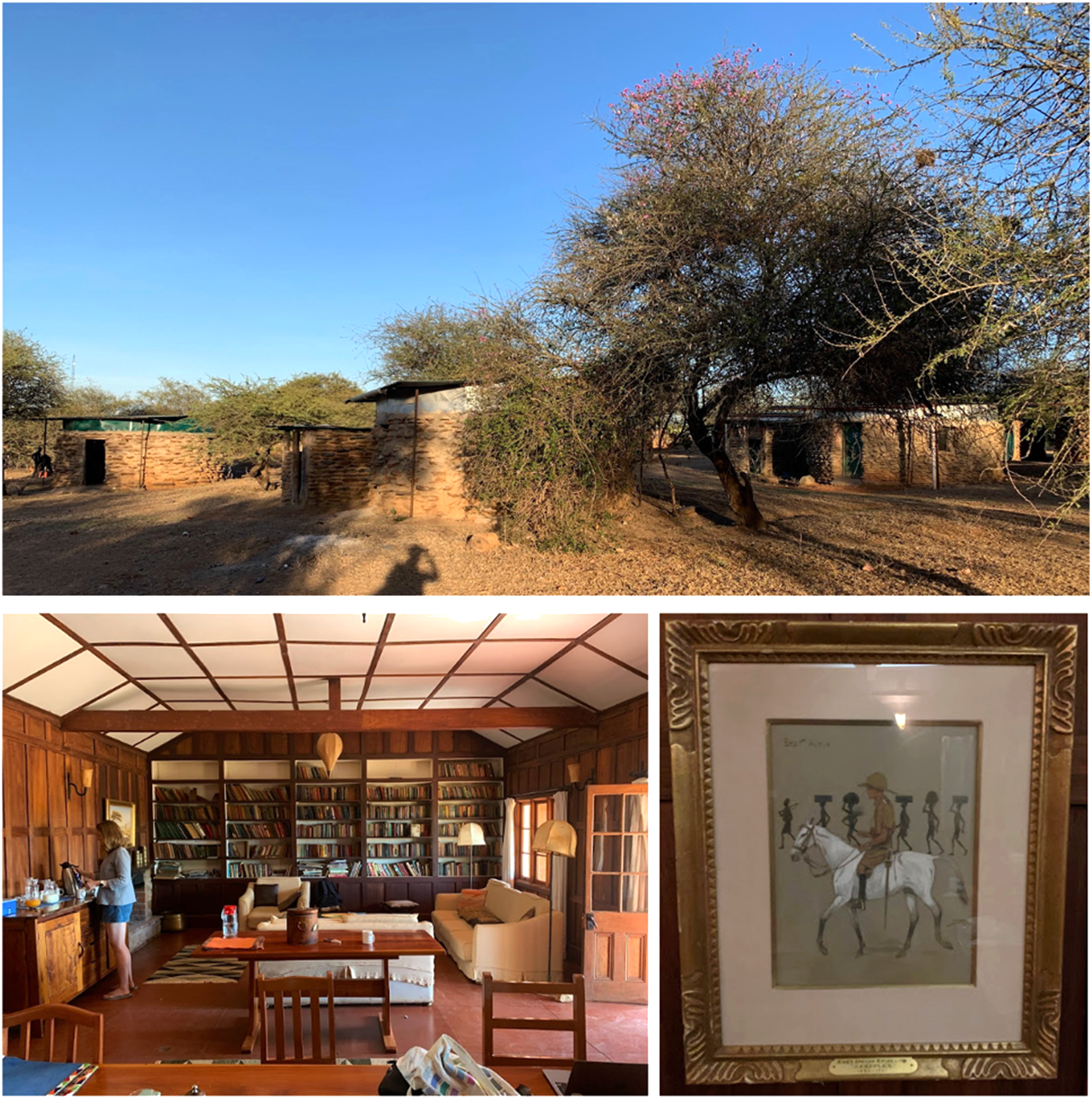
Composite image of (clockwise) staff village behind the Ranch House, King's African Rifles painting and Ranch House library.
In some ways this is a moot point. The only visitors to the Ranch House while we were there were white settlers and visiting professors who came to dine with the few other (also white) guests. It is to them and other esteemed guests that these artefacts are angled, making a space where whiteness sits comfortably. This is upheld by the consummate service provided by the Ranch House staff: a chef, a housekeeper and numerous security personnel. That their roles are largely carried out in the background is only partially to do with the nature of service work; in this particular setting, the sharp contrast between loquacious guests and muted staff reproduces categories of coloniser/colonised. Where once the settler families lived in the Ranch House with ‘native’ domestics, the contemporary arrangement differs little as funders, trustees, and professors have the load lifted by cheap black labour. Professor or trustee arrives from Oxford or Princeton to collect data that provides for their comfortable homes and lifestyle. The Mpala Ranch House extends that comfort overseas, a space where working and dining are made possible by a body of staff with vastly different working conditions.
Staff live in a village over the brow of the hill, out of view of the main ranch buildings. The village comprises around 30 bandas that are in different states of dis/repair (Figure 1). Since the village was built in the 1930s, little has changed except that low-paid farmhands are replaced by low-paid service and security staff. For all the that the Ranch House is made white, the village is black; it is the place where workers rest and re-charge for the next shift, where they are not afforded basic utilities, never mind any of the comforts offered in the Ranch House – the very comforts that they work to provide.
The Research Centre is about 2 km from the Ranch House. The site is impressive, comprising lodgings for visiting and resident researchers, administration buildings, a gym, a mess, a library and laboratories. Each building is named after a specific person (man) – for example, the Samuel A Graham Library, the Alan P Smith Hall, William S Eisenhart III Communications Network, the Frank Levinson Gym, the McCormack Library – who have donated to or worked at Mpala, some are famed ecologists (Alan Smith) others are decorated military veterans (Alfred McCormack, OBE) – none are Kenyan. The most important building is perhaps the mess, the social hub of the Centre that comes alive at mealtimes with different cohorts of students 13 talking about field exploits and evening plans. Like the Ranch House library, the mess hall is curated for a specific subject: its walls are given over to commemorations of different Princetonians who have served in the US military and there is a pride-of-place display for George Small, including his CBE and the accompanying certificate hand-signed ‘Elizabeth R’. Small is commended ‘for his assistance and goodwill towards the British Army’. There is no land acknowledgement.
Access to the mess follows a similar logic: of the ∼700 Kenyan staff employed at Mpala as askaris (guards), housekeepers and researchers, only administration staff (who number ∼20) are permitted to dine there. The effect is a segregation whereby visiting researchers spend hours in the field with a guard and Kenyan research staff to then separate for meals. In interview, one visiting researcher recounted as follows: ‘I wanted to have lunch with my field assistants and was told very explicitly that this wasn’t allowed … even when I wanted to pay for them it was discouraged’. The inevitable knock-on is that Kenyan staff are excluded from the making of social plans and discussions of field activities, two key activities not only in the production of knowledge per se but in the crucial question of who is positioned as knowledge producer. For the few Kenyans who do eat at the mess, there persists a form of separation. A long-term resident told us ‘[researchers] come and go and some how don’t feel weird about the fact that there's a white table and a black table at the mess hall, it's bizarre …’.
In similar fashion to the Ranch House (built 1930s), the Research Centre site (built 1990s/2000s) organises space along divisions of labour. The site entrance leads to the carpark where tens of 4 × 4 vehicles await fieldwork teams who arrive from the adjacent mess and nearby lodgings. Totally out of view to visitors is a second staff village where ∼100 Mpala employees live. The segregation is marked by inequalities, as another interviewee described: ‘[visiting researchers] have a kitchen, which is very well-equipped with a fridge and electricity and they can also eat in the mess … whereas in the staff village the situation is very different. They live in bandas that do not have proper windows and are not even secured for different insects and other small animals, they don’t have electricity. Their bathrooms are awful – they had to clean ours but theirs are awful’. Another interviewee reported: ‘there's not much in the way of amenities in the bandas, I just remember thinking it's a little ridiculous that I get hot water and the staff don’t get even electricity, it's insane … they do not have running water or electricity and literally a few hundred metres away is this research station that has running water and electricity, what can’t you just pipe that?’. There are serious consequences of this uneven distribution of utilities: ‘[redacted name] told me that people get sick a lot because the water isn’t filtered so I would bring water bottles of the water that was boiled for us [visiting researchers] because we’d be in the field from sunrise to sunset so I’d just say “okay, I’m just going to bring water for you” and I would pack extra lunches for them …’. This marked difference in living conditions was corroborated by all the people we interviewed for this research.
The working conditions for Kenyan staff are no better. Though we were explicitly not allowed to speak with staff onsite about issues such as labour rights and contracts, we have been able to glean information in subsequent interviews in which a range of issues were raised. 14 First, there are repercussions of a staff strike – described to us as ‘quite violent [but] it's difficult to know what really happened’ – in 2016 that caused the Centre to close temporarily where workers appear to be blacklisted, for example: ‘I was interviewing people to hire field assistance and there was an excellent one but Mpala didn’t want me to hire [them] because [they were] involved in a strike … they made excuses like “oh, [they have] an alcohol problem” but after long discussions they revealed that they didn’t want him back because of the strike … the message is that if you strike you’re out of Mpala – so it's very difficult for people to fight for their rights’. Another visiting researcher told us quite explicitly: ‘Labour rights are nowhere … they don’t allow field assistants to speak with us about their contracts but through relationships of trust I read some and they can be terminated at any time … there are some conditions but overall they can just fire them’. Moreover, there is a culture – one that has been strongly emphasised to us – of silencing where Kenyan staff are unable to voice grievances: ‘in general, they’re not allowed to speak about many things, dining area problems, contracts …’. In fact, it is no exaggeration to perceive even a culture of fear for Kenyan employees at Mpala: ‘field assistants are very cautious about what they say, even though we were working together, every day for two years, they knew that if they said something then they would worry about [keeping] their job …’
Mpala: Ontology, race and silence
In this final section we look back at our historical and empirical accounts to theorise three key ways in which colonial legacies endure at Mpala Research Centre. First, we draw focus on the ontologies of land-as-landscape, or the ways that space is made and read in research practices; second, we consider the arranging of space and divisions of labour in the re-production of racial difference; and third, we highlight the prevalence of silence (and silencing) as a crucial element in sustaining colonial power relations.
Our argument around ontology centres on the ways that research activities at Mpala bring particular things or objects into view (e.g. large fauna), while setting aside others (e.g. ‘the social’) via a specific mode of making and reading space. As we have explicated, Mpala Research Centre is product and productive of colonial power that centres on the control of land. This control, we argue, is as much ontological as it is material. To expand: while the materiality of law (i.e. tenure) and fences effects control, so too do the ways that the land is conceived as landscape – or land as it is culturally rendered (Cosgrove, 1985; Riding, 2020) – where the 20,000 hectares of Mpala become primarily (or even solely) a habitat of ‘significant biodiversity’. As habitat – for charismatic fauna and 100s of species of birds – the land-as-landscape can be figured as, to use Mpala's founding ethos, a ‘living laboratory’ 15 that provides ‘a hub for experimental and manipulative research by visiting scientists and students … without the restrictions of a national park, allowing scientists to manipulate the environment and conduct landscape-level, controlled experiments’. 16 The dynamics of power here are self-evident: national park legislation is sidestepped so that land and fauna can be manipulated by visitors for experimentation. Questions of land appropriation, indigenous displacement, and enclosure give way entirely to a performative vision of Mpala as a scientific training ground at the disposal of wealthy research institutions and funders.
There are deep colonial roots to the making of ‘African’ space as primarily an ‘unspoilt wilderness’ to be simultaneously known and preserved. This imaginary was at the heart of colonial designations of national parks and reserves from the mid-20th century that bound off vast tracts of Eastern and Southern Africa from indigenous peoples in the name of conserving wildlife and natural resources (see e.g. Ross, 2017: 239–273). In Roderick Neumann's (1998) genealogy of the spatial logics that underpinned this organisation of space in East Africa, the founding of conservation areas emerged through a combination of the colonial state moving to make land and inhabitants administratively ‘visible’ or ‘legible’ (see also Mitchell, 1991; Scott 1998) and a more region-specific drive to ‘civilise’ local populations. The Serengeti and Nyerere (Selous) Reserve in Tanzania, Tsavo and Maasai Mara in Kenya, as well as many other parks and reserves, are products of the same or similar colonial initiatives, each evolving through increasingly securitised enclosure and the eventual introduction of entrance fees for hunters and tourists – all to the effect of creating ‘de facto “whites only” parks’ (Dowie 2011, 26). It was in these spaces that a Western imaginary of ‘Africa’ could be fulfilled, where nature could be subordinated to a white gaze over a landscape ‘devoid of African people, full only of pleasing vistas and wild beasts roaming free’ (Garland, 2008, 61). The ‘living laboratory’ of Mpala is a contemporary re-formulation of such ideas where what-is and what-is-not is strictly delimited. Research in this part of Laikipia is pointedly fauna-centric at the cost of understanding the struggles of groups who are marginalised precisely because of the existence of the Research Centre and surrounding ranches and conservancies. As one interviewee put: ‘they only allow certain types of projects – it's all about the glory of the place – they will never entertain social justice or workers’ rights’.
It is not only the object of research, however, that produces a particular colonial ontology. Also, the research lenses through which objects are given meaning have strong ties to colonial-era ways of framing the world. As a range of scholars have documented (e.g. Barton, 2001; Scott 1998), conservation science and cognate fields (ecology, evolutionary biology and forestry) developed in tandem with the industrialised imperial European state, serving as utilitarian disciplines for economic ends. The interpretive tools at the disposal of ‘experts’ trained in such disciplines are well-suited to examining, for instance, taxonomies, spatial distributions, or evolutionary traits, but do not fully consider relations to the social. Issues such as grazing needs, human–wildlife conflict and, more broadly, indigenous relationships to land are thus always-already secondary to an outsider perspective on conserving habitat and non-human inhabitants. The result is a hierarchical ordering of knowledge where local ways of knowing – whether implicitly or explicitly – are ‘located low down on the hierarchy, beneath the required level of cognition or scientificity’ (Foucault, 1980: 82). Of the 100s of research outputs listed on the Mpala website, 17 none or few deal with marginalised groups as marginalised; they are instead addressed as small-hold farmers (Krell et al., 2021), poachers (Beery and Bondi, 2021) or as useful-or-not in already-conceived conservation initiatives (Schuttler et al., 2019). None of this research draws on critical perspectives on colonialism, race, gender, class and so forth, and where qualitative data is collected it tends to take the form of multiple-choice surveys that are quantified for statistical analysis (Oburah et al., 2021). 18 With these references, we stress, it is not our intention to direct critique at individual authors and articles but to demonstrate a structural issue where the practices of knowing the world are strongly centred on quantitative ordering of wildlife habitats. In ontological terms, therefore, the question of what is does not appear in any organic sense (if it ever could) but through a making of space and a reading of space that produces a particular object, one in which animal welfare figures above marginalised – and, significantly, the marginalisation of – groups who live around Mpala.
On the issue of race at Mpala, the arranging of space and divisions of labour come to the fore. As we have described, there is a marked spatial segregation for two key activities of everyday life – eating and sleeping – where most Kenyan staff are not permitted to eat in the mess and the main part of Kenyans who live onsite are assigned to the staff village. Visiting researchers (and a few of the more senior Kenyan researchers), meanwhile, stay in well-equipped shared or private rooms. In the one space, nutritious food is prepared at regular times when researchers connect with each other, professionally and personally. Accommodations provide comfortable beds, hot showers, potable water, electricity and protection against disease vector insects (mosquitos, tsetse) – a space to think, study and rest. In the other space, time and scarce funds must be dedicated to preparing food, mealtimes cannot be used for networking in any similar sense, and relaxation is limited by accommodations – the bandas are ‘dilapidated’ – that provide a much lower level of comfort. Such disparity produces effects, and while we have not interviewed current residents of the staff village (we were not given access), the information that we have allows for some carefully worded provocations. If it is the case, as an interviewee quoted above recalls, that poor-quality water has made people sick, or that the risk of vector-borne sickness is elevated, then spatial divisions produce health-related effects. If quality time to relax depends on space in material (e.g. a desk and lamp) and affective (e.g. without the pressures of housekeeping/cooking) terms, then segregated accommodation produces segregated levels of wellbeing. If researcher inter-connections, for example between tenured staff and graduate students over lunch, open opportunities to build careers, then differentiated access to networking spaces produces differentiated paths of intellectual and personal development. Segregated space is thus greatly significant for the ways that it also circumscribes a broad range of issues that can be mapped onto the production of racialised categories. The (mainly) white spaces of good health, comfort and career-advancing exchanges contrast starkly with the space of the staff village. 19 It is not just, therefore, that comforts are unevenly distributed along lines of race, it is also that this distribution exacerbates all manner of social markers to do with health, earnings and professional development that map back onto race. This founds a final provocation: the spatial organisation of Mpala reinforces categories of race where being black corresponds to exclusion from a white-dominated social and intellectual community. 20
The arranging of space thus contributes to setting Mpala within a broader racialised hierarchy within the production of knowledge on African landscapes. While there is a predominance of white experts in almost all academic disciplines (Shilliam, 2015), geography included (Desai 2017; Tolia-Kelly, 2017), the problem is particularly acute in conservation-related knowledge production in and on Africa (Mbaria and Ogada 2016, 130). Writing on the global visual economy of conservation, Elizabeth Garland (2008, 59) makes the crucial point that ‘it is [white faces] that most readily spring to mind when audiences worldwide think about the study and conservation of African animals’. This issue is not limited to readily recalled names (from Jacques Cousteau to David Attenborough) but rather that such figures are merely the popular versions of a great many practitioner and academic counterparts who work at Mpala and similar such research sites. Garland (2008, 59) adds the critique that ‘for every Western conservation superstar in Africa, however, there are hundreds if not thousands, of African people enabling their stardom, by allowing land and other natural resources to be allocated and used in ways that accommodate these Westerners’ desires and priorities, and by carrying out the actual day-to-day work of protecting and managing the wild animals and habitats they care about’. This racialised division of labour maps closely onto that at Mpala where Principal Investigators are, within and even beyond their fields, superstars whose careers depend on precisely the same access to African land and labour. Endowed chairs at prestigious American and European universities, millions of dollars of science foundation funding, internationally recognised publications – none of this is gained without the labour of Kenyans, and very little of it has (yet) gone to Kenyans. This is the case even more than 30 years into Princeton-led operations at Mpala that have seen countless PhDs and tenures accrued to visiting researchers with few similar benefits gained by Kenyan researchers. 21 It is thus beyond doubt, therefore, that the divisions of labour within Mpala Research Centre sit comfortably with the global divisions of academic labour outside it, where white-led research continues to dominate even in non-white contexts such as in Kenya.
Our final focus in this section falls on the imposition and function of silence and silencing at Mpala. This issue runs deep and must be prefaced by a relevant issue: the main purpose of our visit to Mpala was as part of a wider project on colonial legacies in the spaces of knowledge production. At Mpala we were warmly welcomed but it was made clear that the Research Centre does not facilitate social science projects that deal with questions of working conditions. 22 At the time we thought little of the rejection, but now we understand it as part of a wider regime of silence around issues of workers’ rights and conditions. According to the information we have since gathered in interviews, this works in two important ways. First, and as we note above, Kenyan staff are notably reluctant to discuss issues of salary, sick pay, (lack of) benefits, living conditions and so forth, and it is quite possible that they are explicitly forbidden from doing so, as more than one interviewee stated. Second, and a little more unexpectedly, there is a cohort of earlier-career visiting researchers who were moved to speak out on staff working conditions but decided not to for fear of repercussions. As with all quotes included here, this perspective from a former researcher at Mpala is shared with permission 23 : ‘it's even dangerous talk about [workers’ rights] … you can have consequences and retaliation and that's why we need to speak about freedom of speech … I met some other people with similar critiques and we wanted [in 2018] to write a public text and present everything we had witnessed at Mpala but, in the end, we were just really afraid’. This fear is not unfounded; there are various stories of researchers being sent home that indicate an explicit culture of silencing. The result is that ‘researchers feel they are there by the good grace of Mpala’, as one person phrased it, a situation that presents a stark choice: “if you want to be there you have to be in good standing … you can’t rock the boat as a younger researcher … you can also put the people around you at risk too’.
It is not simply, therefore, that there is a culture of silence at Mpala, but a regime of silencing that functions to maintain a status quo. There are two points that must be emphasised here. First a broad but relevant one: silencing is a powerful tool of mechanisms of oppression whose antithesis is at the centre of all rights and justice movements. 24 ‘Speaking out’ is the political drive of unionism, solidarity activism, whistleblowing and so forth, as it is simultaneously the target of powerful actors (states, militaries and corporations) who wish to maintain quiet on issues that might disrupt continued dominance. Without wishing to evoke a too crude a notion of power, it is telling that researchers enjoy access to Mpala ‘by the good grace of Mpala’ as a certain leverage that discourages breaking silence. Perceived threat to both or either one's own position and/or an other's thus functions to effect silence. ‘Rocking the boat’ would potentially affect everyone detrimentally, with little assurance of meaningful structural change – it is this calculus that discouraged those who wished to go public in 2018. A second point, and one that interviewees themselves raised consistently, is that the silence of others presents an ethical problematic for those with voice. If one knows of injustice to a silenced other, should one speak on behalf? What are the ethics of representing? The issue of silenced others greatly exceeds the scope here save to reference a rich body of work, especially in and on the field of subaltern studies (see Spivak, 1988; 1999), that considers silence an accomplice of colonial domination. Silence by this reading is intimately entwined with (colonial) power, it is that which enables gendered and raced modes of subjugation and exploitation, and to bear witness implicates: ‘ignoring the subaltern's or oppressed person's speech is “to continue the imperialist project”’ (Alcoff, 1991, 23; also: Griffiths, 2018). It is of course not our claim here that silence at Mpala indicates subalternity, nor is it to equate or compare different forms of colonial violence with what we document here. Rather it is to draw a similar logic in which silence is crucial to the sustaining of colonial power relations.
Conclusions
A key rationale for the research here is a recurrent observation that formerly colonised areas of the world have become a resource of data to be extracted and commodified by researchers based at wealthy institutions in Europe and North America. ‘In this global cartography’, Achille Mbembe (2021, 14) has recently written, ‘the functions of marginal regions of the world are to produce data and to serve as the test sites of the theory mills of the North’. Mbembe's is but one clear articulation of many: Gayatri Spivak (1999, 388) contends that ‘the South’ is reduced to a ‘repository of an ethnographic “cultural difference”; Ann Laura Stoler (2016, 5) notes how colonial archives are increasingly put to the service of a ‘dissertation industry’; and Linda Tuhiwai Smith (1999, 103) considers non-indigenous knowledge production on indigenous lands ‘a vast industry based on the positional superiority and advantages gained under imperialism’. In each their own way, these reflections recognise a colonial geography to contemporary practices of knowledge production. One response is to focus on interpretive practices (e.g. Chakrabarty, 2009; Spivak, 1988) that tether field observations to a colonial textuality where ‘text addresses, feels itself accountable and responsible to, the questions and concerns only of the powerful epistemological space of the West’ (Ismail, 2005, xxxi, original emphasis). A response that has gained momentum in recent years is a reflexive one that considers the research practices that make interpretation possible in the first place. Interventions in geography (e.g. Griffiths and Baker, 2020; Esson et al., 2017) and cognate disciplines that are prominent at Mpala – for example, biogeography (Eichhorn et al., 2020), conservation (de Vos and Schwartz, 2022), and field ecology (Baker et al., 2019; Leal et al., 2022; Trisos et al., 2021) – call into question the ways that research institutions, spaces and collaborations (re)produce colonial relations with an important emphasis on meaningful and practicable steps towards decolonising. Decolonising requires a focus on political accountability and the paths of material change that will undo the legacies of empire.
It is in this shift that a move from post-colonial critique to decolonial praxis can be effected. If questions of representation are at the core of postcolonial critique – that is, orientalism, subalternity, epistemological provincialising – then the tangibility of power relations are what marks out the project of decolonising. ‘We cannot just think, write or imagine our way to a decolonised future’, writes Leanne Batasamosake Simpson (2014: 16). From the symbolic domains of language and metaphor, therefore, we are brought to the materiality of land and labour, and understandings of how colonial space is made are made servant to strategies of its unmaking. Such an approach takes seriously an instrumental notion of ‘decolonising the mind’ that will undo a deep-set colonial psychological subjugation – or what Ngũgĩ wa Thiong’o (1986: 3) termed the imperialist ‘cultural bomb’ – towards a base objective of repatriating indigenous land – ‘all of the land, and not just symbolically’ (Tuck and Yang, 2012: 7). The dual task, then, is to traverse colonial delimitations of indigenous possibility to an end of restoring indigenous cultural and material stewardship of land; decolonising knowledge is but a preliminary step towards decolonising structures and institutions (Esson et al., 2017: 385). To counters that a vision of decolonised structures or repatriated land is ‘unworkable’ or ‘unrealistic’, the response is emphatic: decolonising is an inherently ‘discomforting’ process, ‘a programme of complete disorder’, as Franz Fanon (1963: 36) famously put it. The ordering of land and labour as producer of knowledge that accrues vastly more benefit to Western researchers and institutions must itself be rendered unworkable. Where order is colonially produced, disorder is the only proper response.
In the account of Mpala presented here we have sought to demonstrate precisely how colonial order is established and maintained. The site is historically produced, we have demonstrated, via a racist mode of land expropriation that has enabled more than 100 years of unfettered white land use, from farming to cattle ranching, from military exercise to Western-led academic research. It was not by chance that the first owners were Euro-American white men, nor that the land's productivity depended on segregated, cheap black labour. It is not by unconnected coincidence that the few who have built high-profile research careers from data gathered at Mpala are white, nor that the many who have facilitated that research are black Kenyan. In this crucial sense, colonialism did not end at independence, it simply re-organised, continued to function on the same logics, albeit deploying different terms. A crucial element of that re-organisation, and one common to many parts of Eastern and Southern Africa, is a gradual shift of white-owned land use from farming and hunting to conservation and research. Other transitions follow a similar pattern – from farmhand to security guard, agronomist to conservationist, agricultural production to data production – where each is a sideways move along structures built during the period of formal colonisation. The land and labour thus remain tightly bound to colonially established power relations with, significantly, little detectable prospect of change. And this is a major point we wish to emphasise in closing: that the situation is as it is 30 years into the project of building Mpala as a ‘living laboratory’ indicates a significant achievement in sustaining a status quo. It was always quite predictable that colonialism was crucial to the founding of Mpala Research Centre but that it is so deeply ingrained into its current operations signals an urgent area for decolonial praxis.
This leaves the question of what form disorder might take. As an initial move, silence no more: the dynamics of colonial power at Mpala Research Centre are now brought to a wider audience. It is here that we reach the limits of this research, at the point where indigenous voice must be brought to the fore. If this article is generative of anything, it must be of space for envisioning and effecting otherwise. It is on Princeton, the Smithsonian and other Western stakeholders to listen, (un)learn, respond, improve, and, where requested, step aside. Change, of a quality and at a pace that is Kenyan-led, and that undoes the deep-set Western control over Kenyan land and labour, is long overdue.
Highlights
The article discusses the colonial legacies that persist at an important site of conservation research.
The article addresses the tensions between decolonising theory and praxis.
The article articulates relations between space and race in the context of conservation.
Footnotes
Acknowledgements
We are very grateful to the people interviewed for this project, especially those who read and commented on drafts of the paper. We also thank the editor and reviewers for insightful comments and Andrew Terry for openness and support.
Funding
The authors disclosed receipt of the following financial support for the research, authorship, and/or publication of this article: This work was supported by the Royal Geographical Society (Environment and Sustainability Grant 2019-2022).