




Abstract
This paper explores the lamenting for a street tree to better understand reactions to ecological loss. It responds to calls for social studies research into how ecological loss is felt and expressed, particularly when that loss and its emotional impact is unrecognised. Drawing on a unique dataset of emails to trees in Melbourne, we consider the most emailed tree, a tree felled despite collective action. Lamenting for this tree is explored as an individual and collective process that includes but extends beyond grief. A lament, we argue, involves shaping and expressing an account of loss that holds others to account. Understood as an embodied and emplaced process, we develop the case for the concept of lament through detailing the feeling, narrating, sharing and placing of loss. We argue that examining lament in this way reveals new insights into lived experiences and expressions related to facing the damage and destruction of nonhuman life and landscapes.
Grasping (at) loss
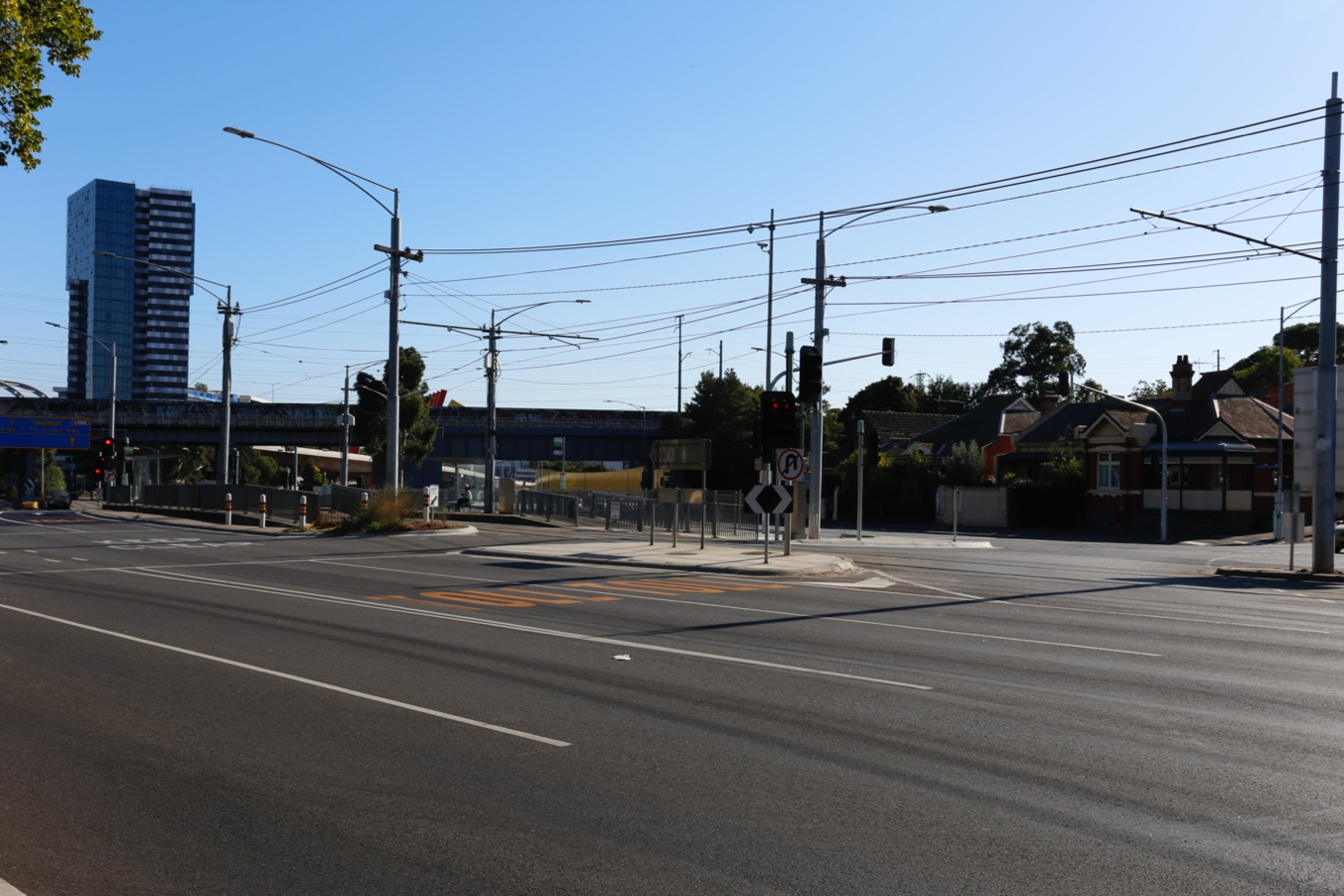
I am trying to imagine this tree I never met. Not easy while standing on a street median. Almost overwhelmed by the busy-ness and noise, I take stock: a tollway, a highway, two arterial roads, a tramway, a nearby train station, and bike lanes meet here. Residences on each side fade to background. Traffic, movement, reigns. Where would the tree have stood? I gaze at a section of five southbound lanes. I think of the traces we are trying to follow – material, emotional, digital. Fragments of destruction and remembrance. Even with their clues, I’m guessing. Where would the shade have fallen? I feel its absence while standing in the heat and glare.
The tree was cut down a month before I moved to Melbourne. So what? Trees are removed all the time in cities for infrastructure development, for age, for arboreal fashion, for? Planted, removed, planted, and so it goes to humanity's tune. This tree is one of a multitude. And an individual with a life and story.
The tree stands, in death perhaps as in life, outside my reach. At least partly unknowable, inscrutable, beyond. Still, here I am, trying to think-feel us into relation, looking for a guide for this story of loss. (Phillips, fieldnotes)
This overture, from Catherine, describes an attempt to visit an already-lost being to help develop understanding of an already-lived nonhuman death and its impact. The effort was prompted by the observation that ‘engaging with loss’ (Barnett et al., 2016) and ‘vegetal politics’ (Head et al., 2014) may prompt new sensibilities and ways of living together in multispecies places. This article aims to advance understanding of people's responses to ecological loss through developing the concept of lament. We began thinking of lament as the expression of grief. But it is more than this. Lamenting shapes and shares feelings of a loss, while calling to account the social and political relations felt to condition that loss. Lamenting involves grief, grievance and more. It draws attention to how one is (and has been) moved and how others might be moved. A small body of anthropological and religious studies recognise the power of lament; how its practice makes and unmakes feelings, selves and worlds (Ackermann, 2000; Feld, 1990). In geography, however, lament remains underexamined. We propose that exploring lament in more-than-human worlds helps us to better understand responses to ecological loss through highlighting complex processes of feeling and acting. To explore this potential, we conceptualise lamenting as a process through which feeling, accounting for, sharing, and placing loss fold through one another, through time, among bodies, and in places, taking shape in individual and collective ways.
To consider the experience and possibilities of lament, we draw on research into the feelings, experiences and valuations articulated by people in emails to the trees of Melbourne. In 2012, the City of Melbourne (CoM) launched a digital visualisation of all the public trees under their management as part of a tree inventory undertaken to develop Australia's first Urban Forest Strategy (see melbourneurbanforestvisual.com.au). As part of the process, email addresses were given to the trees. The aim was to make the City's management of the urban forest more efficient by allowing residents to report problems – fallen limbs, need for water, vandalism, etc. However, it became clear that people had other ideas. Emails to trees poured into the office, surprising in their number and their content. The email-a-tree program has been widely reported in media (e.g., Burin, 2018; Tan, 2015), prompting more emails. In this article, we focus on a story of the most emailed tree: the Flemington Road Lemon-Scented Gum (FG) 1 .
FG is both common and remarkable. As one of many street trees planted in median strips that people travel past every day, they are ordinary. But FG is also notable. Even in the urban context, where tree removal for development is common and trees are often treated as substitutable infrastructure, people's attachments to this tree provoked protests when removal was slated. And, even after death, FG is the most emailed tree (2012–2018). In 2015, the most emailed tree was a large Golden Elm – the recipient of many ‘love letters’ pointing to its outstanding aesthetic appeal (Tan, 2015). In contrast to FG, significant effort goes into caring for this Golden Elm; a small park was set aside and its spreading limbs, which enwrap the park, have stabilizers to ensure physical safety. But in 2016, FG supplanted this Golden Elm as the most emailed tree. We found that emails to FG had a significantly different tone. Along with appreciation, emails to FG are full of sadness, frustration and demands for change. In short, these emails are laments.
Our considerations of lament trace the removal of FG, a street tree in inner Melbourne (Australia), and are significant for three key reasons. First, we argue that the concept of lament advances discussions of the emotional geographies of ecological loss by helping to appreciate how it is experienced, and communicated, through an interweaving of emotions. Emotional responses to environmental change are receiving increasing attention. One of the most considered is ecological grief – or the grief that comes with actual or anticipated loss of valued nonhumans, ecosystems and associated experiences/knowledges. Eco-grief is considered not only as an emotional response that may harm people's wellbeing (i.e., a ‘negative’ emotion) but also as a relational and reasonable reaction to ecological loss, a response perhaps with potential to motivate environmental action (cf. Cunsolo and Landman, 2017; Head, 2016, Tschakert et al., 2017; Yusoff, 2012). Yet, a focus on grief alone can avoid consideration of the violences and culpabilities for destruction (Jensen, 2019; Yusoff, 2012), and/or of the enduring hope and anxieties of living through today's multiple socio-ecological crises (Head, 2016; Robbins and Moore, 2013). By exploring lament, in addition to addressing calls to advance insights into embodied emotional aspects of ecological loss (Cunsolo and Landman, 2017; Head, 2016; Mortimer-Sandilands, 2010), we respond to calls for further exploration of ambivalence and contradiction of feelings (Adey, 2021; Rose et al., 2021; Wilson and Anderson, 2020). As Wilce (2009: 30) observes, ‘apparently contradictory emotions of grief and joy can coexist in laments. In fact, the emotional key to a given lament may be neither grief nor joy but anger or outrage’. Joy, pleasure and appreciation accompany grief, anger and blame in the story we tell herein. Lament, therefore, enables consideration of emotional complexity and unrest that accompany, circulate and modulate loss.
Second, spotlighting the lamenting of a street tree enables exploration of micropolitics involved in ecological loss. Research on ecological loss has identified disenfranchised or denied grief for landscapes and nonhuman species, leading to calls to challenge notions that only humans are grievable (Cunsolo and Landman, 2017). Geography, among other fields, has taken up the challenge, particularly in relation to extinct species or valued ‘natural’ landscapes (see Bird Rose and VanDooren, 2017; Marshall et al., 2019). Plants, however, receive less attention. When trees are considered grievable, it is as old-growth forest and/or spectacular ‘wild’ beings (see Cianchi, 2015; Pike, 2017) rather than urban trees. Street trees, like FG, still tend to be treated as objects – cultivated, commodified, substitutable, service-providers for humans. ‘Feeling differently’ (Gammerl et al., 2017) can position emotions as out of place when directed to such nonhumans in such places. In the face of exclusions of (some) beings, emotions and activities, calls have emerged for more human-plant research that challenges human exceptionalism, details collaborative and conflictual relations and opens new spaces of action (Head et al., 2014; Phillips and Atchison, 2020; Straughan et al., 2022). Focusing on the micropolitics enables exploration of how power is experienced and negotiated in an everyday context, in ways that enable and constrain (Richardson and Bissell, 2019), and may spotlight what Anderson (2017) calls ‘sparks of hope’ for living otherwise, even in the face of ecological loss. With this in mind, we attend to how the death of FG as a street tree, like others, is deeply felt and deliberately expressed ‘sensual and emotional connections’ (Frers, 2013) that are part of bodies, practices and places.
Third, our analysis of emails illustrates how lament is lived through an intertwining of emotional, biophysical and virtual spaces in a complex geography. Existing scholarship on lament tends to focus on forms rather than spatial or temporal dynamics; however, studies addressing human death do consider differentiated lamenting between home and cemetery (Lysaght, 1997), exclusions of lamenting from public ceremonies and related power (Mukta, 1997), as well as the rhythms of sound and emotion with/in lamenting thinking-bodies (Feld, 1990). In geography, Lorimer (2019) illustrated place-writing with a pet cemetery – a place where bereavement for pets is not only enabled but ‘gushes’ and overflows. Arguing that mourning also occurs outside places like cemeteries and funeral homes, Maddrell (2016) mapped grief across physical, psychological and virtual spaces. In this view, both public and private spaces are part of deathscapes. Our study builds on such recognitions of the significance of loss, and its places, through orienting around a particular kind of response (lament) as expressed and enacted in varied spaces (especially people's emails). In addition to private experiences, public engagements can be important for healing, fostering collective sentiment, and confronting unjust norms. Through analysis of lamenting in emails to trees, we attend to how and where responses to ecological loss are not only felt but aired, to be dampened or find resonance. Based on our analysis, we argue that ecological lament means claiming space and time as individuals and collectives.
This paper proceeds, first, by outlining the research context and Melbourne's email-a-tree initiative. Then, drawing on emails, public documents and media reports, we sketch a story of FG's death. The penultimate section analyses the emails through the concept of lament, elaborating on how this loss is felt, accounted, shared and placed. We conclude by reflecting on the power and insistence of lament for understanding responses to ecological loss.
Melbourne and the email-a-tree initiative
Melbourne is located on Australia's south-eastern coast. Greater Melbourne has a rapidly growing population of over 5 million, distributed across almost 10,000 km and divided by 31 municipalities (ABS, 2021). Our case study focuses on the City of Melbourne (CoM), a central municipality made up of several inner districts.
The area that became Melbourne was managed by Bunurong Boon Wurrung and Wurundjeri Woi Wurrung people when settler-colonialism brought displacement and extreme landscape modification. Extensive clearing and replanting served to carve out streets, homes, markets and parkland. CoM's current form strongly reflects planning and management decisions made between 1835 and 1858 (Gould, 2004). Regarding street trees, early experiments with elms, London planes and blue gums lining avenues and populating parks are now part of the city's character (Frank et al., 2006). Parkville, FG's district, is considered to have ‘outstanding heritage value’ due to connections to Aboriginal culture as a meeting place and to demonstration of early planners’ attempts to create ‘a city within a park’ (Gould, 2004). Bounded by the boulevards of Flemington Road and Royal Parade, Parkville is largely comprised of Royal Park – about 170 hectares of parkland (including a zoo), the remainder of a larger tract set aside in 1854. Through establishment of such parks and creation of wide, tree-lined avenues, Melbourne became known as the ‘garden city’ in ‘the garden state’ of Victoria.
Today, over its approximately 37 km2, CoM manages about 80,000 park and street trees. Assessments indicate that Melbourne's trees are highly stressed by climate changes (Nitschke et al., 2017). Drought and heat waves over 1995–2009 put tree survival at risk; for instance, 2003 estimates deemed 30% of trees would need replacement over the next decade (Harris, 2003). Prompted by community concerns about tree survival and removals, CoM developed its first Urban Forest Strategy (CoM, 2012a) involving a suite of measures that led to CoM being considered an urban greening leader (Gulsrud et al., 2018). A tree inventory was undertaken to inform the Strategy. To maximise the use of collected data, a public-facing interactive online visualisation was created on which each CoM-managed tree is mapped with indication of species, age and further information. 2 Such data and visualisations are increasingly common – New York, Seattle, London, among others, have them. CoM, however, took the extra step of providing an email for each tree. The aim was to enable residents to send alerts about tree maintenance, though this is not the chief way that they have been used by the public. Emails to Melbourne trees come from around the world and range widely, including everything from brief hellos (e.g., ‘hey tree, how's your day been?’) to moving letters of several paragraphs. The initiative has inspired similar programs elsewhere (e.g., Newcastle, NSW) as well as interest in methods (Marquina et al., 2022) and digital participation (Prebble et al., 2021) relating to human-plant relations.
The research team formed a collaboration with CoM to analyse the emails in 2018. The data set includes emails (n=3251) sent to (and from) trees from the beginning of the program in 2012 to late-2018. CoM provided the emails in deidentified form in accordance with a mutually approved protocol. Our broader study includes qualitative, quantitative and spatial analysis, as well as artistic and community engagement. The qualitative analysis, upon which this paper draws, involved a multi-person, iterative process of coding, ordering, interpreting and developing thematic findings. We ran a series of tests, calibrations, codings, workshops and discussions among the research team and CoM collaborators. This process resulted in analysis of approximately half of the emails (n=1650), providing a basis to examine the dataset along select themes and/or cases. In this case, coding such as ‘loss’, ‘death’, and ‘grief’.
Using qualitative analysis combining thematic coding and case study, this article focuses on the most emailed tree in the dataset: FG. We chose to develop FG's story because it offers a compelling case, it is curious that a removed tree is the most emailed tree (even two years later), and it implies that even missing/missed street trees can teach us about human-nonhuman attachments. FG received 75 emails. Those sent during the campaign to save the tree (n=26) 3 highlight aspirations and actions to save the tree, hope for a revised decision, and thanks for the tree's influence in everyday urban life. Emails after FG's felling (or ‘murder’, as suggested) (n=47), illustrate a range of emotional responses and practical demands, which pointed to a need for conceptualisation beyond eco-grief to lament. The emails quoted in this paper illustrate patterns in accounts of FG. Following in-depth analysis of FG's emails, which was shared and discussed with CoM, we reviewed related news, Council reports, and social media 4 . A systematic analysis of these resources was not performed; rather, we employed their content to supplement the account of FG's life provided through the emails with contextual details. Still, we note that social media posts related to FG reflect the sense of lamentation we developed; however, the emails tended to be more expansive, detailed and personalised. Once drafted, CoM reviewed this paper, including checking details of the account.
In the following section, we tell part of the story of FG; ours is a continued effort to recognise FG's loss through the emails, along with other traces. In the main, our account is told in the present to evoke the life of the tree and the controversy around their death, as well as to further endeavours to draw others into continuing human-plant bonds. As Parr and Stevenson (2014) argue, telling stories of what is missing (and missed) can be a powerful way to convey and address painful events. Focus on a particular tree, rather than trees in general, reflects both the orientation in emails to personalisation and our desire to share the depth of experience and expression of lament for this individual. Yet this is a tricky undertaking as it risks ‘using’ those lost while attempting a ‘deliberate act of sustained remembrance’ and respect for the dead (Van Dooren, 2014: 142). Further, as Ahmed (2004) cautions, it may be that those lost may not welcome our contribution. Still, we hope this story of FG will help show how such losses matter, and the power of lament.
A lost tree and a controversy
Living amid
Lemon-scented gums have spread around the world. In Brazil, China, Malaysia, among other countries, they serve aesthetic and commercial purposes, inhabiting streets, parks, gardens, and plantations (CABI, 2019). The oil from their leaves is processed for insect repellent and toiletries, while construction employs them as timber. In some places, these trees thrive in ways assessed as problematic, becoming categorised as invasive. But this tree?
This tree was, and is, referred to as the Flemington Road Lemon-Scented Gum (FG).
The Flemington Road Lemon-Scented Gum (2010), photo courtesy of the National Trust of Australia.
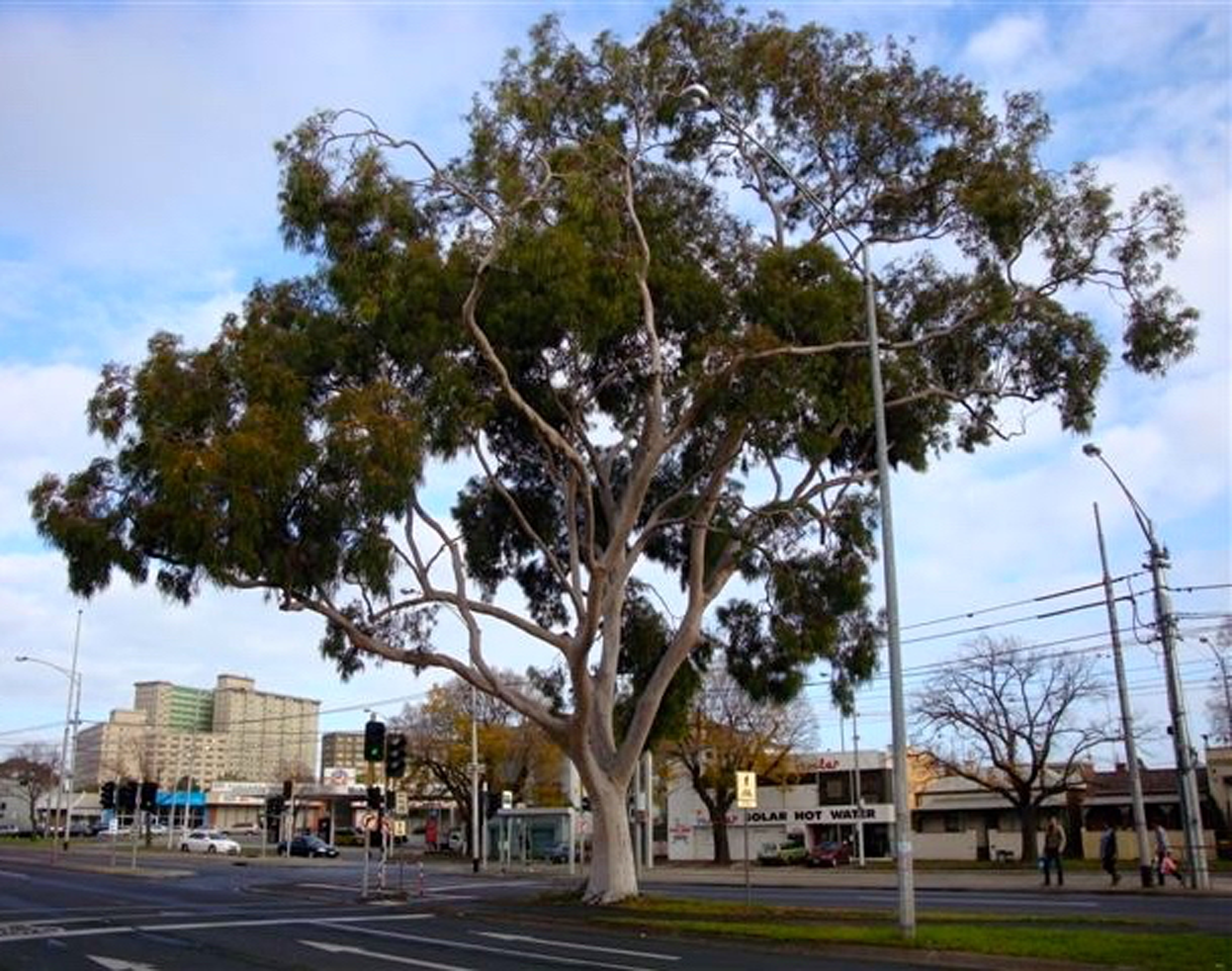
Over time, FG came to dominate their streetscape, eventually standing over 22 meters tall with limbs stretching up and across several lanes of traffic. Planted in Flemington Road sometime in the 1890s (Dow, 2016), FG arrived before Australian federation but well after settler-colonialists’ declaration of the city. The nearby rail line existed, as did Royal Park. The road was one of Melbourne's grand boulevards, and street plantings were valued; however, choosing a lemon-scented gum was odd. Conifers, elms, planes and blue gums were the preferred street trees – seen as survivors and mediators of the effects of urban living (von Mueller, 1861). Today, lemon-scented gums (among others) are known for dropping branches, resulting in ‘risky’ attributions and questions about where they belong. Perhaps as a result, these gums comprise less than one percent of Australia's street and park trees (Frank et al., 2006). Despite such concerns, over the years, a few more joined FG's place in the median. Perhaps people's praise of this tree encouraged planners in this direction, or maybe ongoing care by arborists helped the cause.
FG may never be the oldest or largest tree in the city, but they are more prominent than all their near neighbours, and central to this place. Indeed, in 1982, the National Trust registered FG as regionally significant (NTA, 2016). FG acts as a landmark for travellers in westerly comings and goings for places like the airport, Royal Melbourne hospital, and Royal Park. Greeting commuters and visitors, they offer a welcome to the city, ‘a floral gateway’, a spot of beauty and life in a sea of grey concrete (NTA, 2016; Prime, 2016). Sorry to see you go dear friend. They call it progress but I bet they never saw your welcoming shine in the evening sunset. (Pat)
5
Drivers caught in the flow of traffic cast FG admiring glances. If lucky with the traffic lights, they are stopped and rewarded with a closer view of blurring pinks, creams and coppers of curling bark. On warm or rainy days, the lemon scent, with just a hint of something warmer, spicier, drifts through the air. A few deep breaths fill the heads of passers-by. For those walking or awaiting a tram, the dappled shade provides a welcome break from intense summer heat. Years and years of people coming and going. Other creatures too. The branches have held so many birds, from lorikeets to miners. Even swift parrots drop by during their migration. Possums are frequent visitors. Honeyeaters, bats, bees, butterflies – nectar-eaters of all kinds flit among clouds of feathery white during blossoming. Native and non-native, endangered and common, plenty of critters find a spot here, if just temporarily. I wanted to thank the beautiful Lemon centred Gum for all its years of stunning bark and lemon cent and being a home for wildlife and tired birds on their flights and a much needed break a long there flight path :-), not to mention all the lovely dappled light from the bright harsh sun for cars driving under it, it's been a constant over the years and I wish it gets respected and kept there for many years to come ???? I give thanks to its helping us and our air quality and just for looking amazing for all its years! Not to mention all the memory's it's created!! Stand strong Lemon Centred Gum! (Drey)
Rooted and growing amid the flows and pauses, this tree shapes how the city is lived.
Notice of death, and opposition
On April 7th, area residents receive notice from the state transport agency that FG, along with several other nearby trees, will be chopped down in four days. The notice indicates the removal is part of redeveloping the CityLink tollway and Tullamarine highway to improve airport-city traffic flow, and that CoM will receive about AUD200,000 for greening programs as compensation (Dow, 2016).
Resistance is swift. Nearby residents promise civil action if the plan goes ahead. CoM Council unanimously states that no permission has been granted, no work order issued, and removals have yet to be shown as necessary (see FMC, 2016a). An alternative plan, retaining the tree while increasing traffic flow, is presented (‘Saving' 2016). The National Trust of Australia joins the struggle, launching a petition and encouraging people to send the tree an email in protest (NTA, 2016). Media reports on the outcry. Along with notes of appreciation sent to the tree, emailers express sadness, disappointment, and hope for repeal of the decision. Dear Lemon Scented Gum,
I was saddened last night to hear that there are plans for your removal to widen a road. I live very near to you, and so have appreciated you for years. […]
Is it any surprise that there are plans to remove you? Not really. When has any animal or plant or even assemblage ever taken priority over anything humans want to do? It doesn't matter that the road will have outlived its usefulness long before your demise. It doesn't matter that people will be increasingly deprived of green spaces and clean air heading to Flemington Bridge train station or the train stop, or as they use the bike and foot paths. All that matters is that we fit more cars onto roads.
I am very disappointed and hope that your preservation can be arranged for the sake of locals, public transport users, native animals and plants, and for environmental principle. (Ash)
The tree receives a reprieve.
Two months later, however, Council and residents are surprised by a new removal notice. In a letter to residents, Melbourne Councillor Leppert explains that VicRoads is bypassing Council and will no longer consider alternatives (Leppert, 2016a, 2016b). CoM's Tree Retention and Removal policy indicates that any public tree removal needs to be approved by Council. However, although the City manages street median flora, Victoria's Road Management Act (2004) gives the state jurisdiction over medians and their plants (VicRoads, 2016a). This means that, although Council and communities may be consulted, removal decisions are ultimately the state Minister's. Reasserting their position, VicRoads (2016b) states that removing the median (and the tree) is necessary to redress congestion, meet safety requirements and minimise community impact. Relocation, they argue, is not feasible. The tree will be removed. Emailers remain steadfast and continue messaging FG about their hopes for a decision change, though it seems increasingly unlikely.
Death watch
On the new day of removal, people gather to witness the tree's demise. Police stand ready. People attach themselves to the new safety fence surrounding FG. Four neighbouring lemon-scented gums are felled and chipped (Former Tree, 2016a). FG loses several limbs before the arborists stop. Cherry picker malfunction? Community protest? The cause is unclear but chainsaws and woodchippers still. Could FG survive losing 40% of their canopy? After this second failure, VicRoads indicates it will stop providing notice. Still, with doubtful hope, protesters (or protectors as they prefer) continue efforts to ‘stop the chop’. The petition gathers almost 2900 signatures. More letters are sent. The Lord Mayor makes another plea to the Minister (FMC, 2016b). More emails arrive – mourning the maiming, praising and encouraging FG, and renewing pledges to fight: Dearest Lemona,
It truly breaks my heart to see you standing out there with your arms hacked off. The very arms that once spanned an entire six lanes of traffic, providing much-needed shade from the summer sun. Arms that once welcomed travellers from all corners of the globe to this fair city. Arms that once embraced an otherwise bleak innercity intersection, cradling an ecosystem of native flora and fauna. I weep for you.
But be strong, my love. If we can save you from the chainsaws, you will survive the indignity of dismemberment! You are such a beloved member of our local community, we will keep up the fight until you are safe.
Sincerely,
(Jamie), Your friend and neighbour since 1992
Dear Lemon-scented Gum,
Just want you to know how special you are and that we will continue the fight to save you.
You are a landmark with so many memories, part of my journey to and from homes over the years since arriving in Melbourne from NSW to start a career in nursing in 1966.
The wildlife that calls you home mourn with us the loss of many of your branches and your beautiful flowers that sustain them. If we win the fight we will rejoice, if we lose we will stay with you to the end.
Shame, SHAME on VicRoads and Transurban who don't have the intelligence and integrity to find a better way. (Jo)
Not long after this day, a resident-protester hears chainsaws in the middle of the night and sends out an alert (Savino, 2016; Shugg, 2016; Watson, 2016). Several friends of the gum appear, bleary-eyed but unwilling to concede. Again, workers are stopped from killing the tree. A roster is created so the tree has company (protectors) at all times (‘Saving’ 2016). Over 500 people sit vigil (Mac, 2016).
The fall
Death comes on July 26th. Streaming tears, murmurs of moments now gone, and cries of ‘shame’ attempt to pierce the roar of chainsaws (Crothers, 2016; ‘Melbourne’ 2016). Tree segments crash to the ground. Sawdust swirls. Lemon saturates the air – once a welcome pleasure, now laden with loss (Former Tree, 2016c). Four guardians who refuse to move are arrested by police, others move out of the way but keep watch (Carmody, 2016). The body is distributed – limbs chipped, select trunk pieces stored in warehouses, roots covered over. Remembrances, recriminations and regrets continue: I have actually shed a few tears for you this morning hearing this dear Gum. For many years I passed by with my Dad as he drove me to school, and we saw you at all hours in all weathers. I would hope we got a red light so I could look up and enjoy the morning sun in your leaves. Since school days I have driven past myself on and off over the years and always said ‘hello’, usually out loud and prompting my passengers to look up and greet you too. I find it very difficult to believe it would not have been possible to save you, given what must be short-term benefit for traffic then funnelled into a problem displaced just a little further up the road. It seems a short-sighted and singularly stupid action, driven by misguided priorities that many thoughtful people are increasingly coming to question. I would love to say sorry somehow. (Rin)
An impromptu farewell is arranged in FG's former place (‘Tears’ 2016). Flowers are laid. Minutes of silence are observed and stories shared. Even after death, FG continues to receive emails sharing how people's lives were touched by the tree. These messages also come with declarations of honour and demands for change: The removal of this gorgeous tree is disgusting. […] For all the talk about increasing tree cover to help pollution, livability & the heat, it seems Council thinks just saying ‘there is nothing we can do’ is enough. Well, IT ISN’T, and we are fed up with the lack of urgency about saving these trees. If the laws can’t save them, CHANGE THE LAWS.
This gradual decimation is not healthy or moral and should not be tolerated.
These trees should have the special exemptions that VicRoads seems to enjoy.
Lift your game Council. (Jean)
The streetscape's redevelopment proceeds. Exhausted, disheartened, persevering, lamenters await the promised marker of the tree's place and life. […] Without the lemon-scented gum, the corner of Flemington Road and Church Street looks even more barren and ugly than I had anticipated. I find myself choosing other routes to travel, so that I do not have to go past the place where the gum used to be. I am so sad that it is gone and the act of chopping it down seems unbelievably destructive. (Leslie)
Dear Flemington Rd Gum,
You will live on in the determined arguments and actions of community right throughout Victoria.
The protest here is the flagship for all of us arguing against the failure of VicRoads to carry out all of their duties.
VicRoads fails to genuinely review the environmental, financial and community costs of projects.
You, and all the animals you have supported and homed over the last 120 years, have not died in vain.
(Sean)
Traffic flows on. As do demands for change.
The (no-longer) Flemington Road Lemon-Scented Gum (2019), photo courtesy of Sophie Takách.
Lamenting
Ackermann, contemplating lament as part of South Africa's truth and reconciliation processes, argues that writing about lament is challenging because ‘it is a coil of suffering and hope, awareness and memory, anger and relief, desires for vengeance, forgiveness and healing’ (2000: 138; see also Burarrwanga et al., 2019). Lament can involve (among other things) mourning, celebrating and protesting. It is an acknowledgement of broken and yet somehow continuing ties. In this complicated experience and expression of distress, a narrative of loss takes shape. Lamenting, however, is more than a notice of death, more than eulogy. Bruggemann (1986), considering religious texts, argues that lament occurs ‘when the injustice is intolerable and change is insisted upon’. Lamenting, thus, involves developing and sharing an account that holds others to account. It challenges underlying dynamics of unjust loss. Each lamenter has their own experience and account of events, but lament involves expression and, thus, may generate and reinforce collective feeling and action that challenges existing social and power relations. As Wilce (2009, 47) suggests, lament ‘is as much about stirring up emotion as expressing it’. In the following section, we explore emailers’ responses to FG death as lament, which we conceptualise as feeling, accounting for, sharing and placing loss.
Feeling loss
The emails to FG demand an acknowledgement of the tree and its affects. The emotional complexity displayed belies any definition of lament as a simple expression of grief, even a passionate one. Grief, though often still characterised as ‘negative’, is increasingly recognised as comprised by combinations of sadness, anxiety, anger and guilt (Price, 2010). The emails certainly display these emotions. They express sadness for the tree and for the emailer: ‘I weep for you’; ‘sorry to see you go dear friend’; ‘I can’t imagine how much I will miss you’. Others decry the loss, and their inability to stop it. Sometimes the messages end with apologies (‘sorry we couldn’t save you’) and/or blaming of authorities (‘SHAME on VicRoads’). Anger, frustration, disgust colour these fragments.
Feelings not commonly noted as part of grief also appear – joy, gratitude, love, hope, among others. Emailers offer thanks for moments of delight or for improving their lives. They tell of the tree making bearable repeated journeys by foot, bike, car, and tram, the beauty of its form and features, its wonderful scent and shade. Hope, if not optimism, for a decision change over FG's removal runs throughout the emails: ‘if we win, we will rejoice […] if we lose, we will stay with you until the end’. Smaller glimmers of hope appear even after death, transformed into dedication to social change rather than hope for FG specifically. FG will ‘live on’ in memories and in actions. This tribute is, in part, speaking well of the dead. But more than that, it reflects a sense of respect and reciprocity, of owing the tree thanks and honour (Phillips et al., forthcoming), even in death. All of these feelings relate with the loss being experienced, and with each other, taking shape as lament. In this context, it seems counterproductive to consider emotions as either ‘positive’ or ‘negative’; instead, we might consider their intertwining and patterns, and what these do.
The emails detailing tree contributions might be read simply as noted benefits to people (and their loss). Thanks offered for oxygen or for bird habitat are suggestive. This may be emailers’ intent. Or, perhaps they believe this language will convince authorities to act given urban greening agendas’ recognition of tree ‘services’ such as cooling cities, conserving energy, hosting biodiversity and so on (Perlmutter et al., 2017). Yet neither of these readings seems adequate. The emails almost exclusively address FG as an embodied subject (‘you’, ‘my beloved’, ‘Dearest Lemona’) and wrap any ‘services’ within situated, emotional messages (see also Marquina et al., 2022). Those lamenting seem to be grasping at how to explain why FG's death matters to them, and to others. Not just a resource, not substitutable, this tree, they insist, is loved and missed.
Noted benefits – beauty, habitat, shade and so on – become one way of narrating connections among bodies, places, and sensibilities. It is also a means of pointing to disconnections, what cannot be easily said, what limits possibilities (see Rose et al., 2021). In this way, living with death means recognising not only individuals affected but the (not necessarily obvious) ties formed and broken among them, and how these are part of one's life. Moreover, as Yusoff (2012) indicates, also at stake is an a priori interdependence of all life. The lived relations of this tree and emailers, then, do not end with how they have affected each other. The emails point to bonds linking other creatures, atmospheres, and worlds. As Poe et al. (2017) suggest, such relational ecologies can be challenging for city planning and management. Yet rather than ignore the complexities, we argue that detailing them is vital; the particularities of these biophysical, emotional and spatial attachments (and detachments) matter.
The emailers (and, more broadly, the petitioners and protesters) refuse norms that encourage them to deny the loss of FG, to leave the loss behind, to ‘move on’. Beyond ‘nature’ that is ungrievable, this tree is a commodified, ‘owned’ nonhuman, propagated and maintained in service of city people. Despite this context of instrumentalism and substitutability, these emailers lament the tree's loss, demanding that loss, pain, and culpability be publicly recorded. There is affinity here with suggestions in emotional geographies of ecological grief that there is not necessarily a lack of emotion, but a need to learn how to articulate, accept and act while living amid recurring losses (Head, 2016; Norgaard, 2006; Mortimer-Sandilands, 2010). Rather than denying the loss, and its impact, lamenting enables one to face loss, to turn toward it, to pause and feel, to cry, smile, and rage. In this way, expected responses to street tree removal transform into emotional unrest and dissent, building a charged atmosphere replete with suffering and challenge to existing social ordering.
Accounting for loss
In addition to articulating what has been lost, and how it is felt, laments involve an account of how the loss occurred. Emailers tell of first hearing about the planned felling, and their responses of surprise, distress and sadness. Attempts to ‘stop the chop’ also feature. Rather than thinking of such messages as only representations, insights from geography explain such storying as embodied practices of sense-making (Lorimer and Parr, 2014). Lament scholarship also reflects this understanding. For instance, Feld (1990) refers to lament as ‘wept thoughts’ and ‘thoughtful tears’, while Ratcliffe (2017) observes that narratives help make sense of the incoherent and discontinuous experience of loss. Such narratives highlight loss and connection, ensuring that nonhuman death is not disregarded. They also enable lamenters to relearn themselves and their experiences, often in ways that undercut or confront social norms.
More than announcements of biosocial connection and loss, laments are accounts that hold those responsible to account. Scholars have observed a range of objections in laments ranging from regret over a long absence between friends to the loss of a loved one through death or marriage (Tolbert, 1990), from condemnation of God's abandonment of cities to demands for redressing massacre (Lee, 2005). Ahmed's (2021) recent work on complaint is helpful for considering this aspect of lament. Ahmed argues that complaint makes clear two key things: first, that a wrong has been done and, second, that what happens does not ‘just happen’. In this case, emailers record the progressive violence of the tree's death: the announcements, sneak attacks, limb loss, disinterest in alternatives, wrong-headed love of concrete and drive for ‘progress’. Actors and roles are identified – the tree valourised, emailers figured as protectors, and authorities like VicRoads condemned. Sides are chosen, complaints lodged. A measure of regret for emailers’ own negligence can be found in apologies for not being able to participate in protests and for ultimate failure to save FG: ‘sorry we cannot help in your vigil’, ‘we fought very hard to save you but […]’. More commonly, however, blame falls on authorities (‘SHAME SHAME on VicRoads’, ‘Lift your game Council’). Lamenters make their pain and their demands known: this beloved tree has been killed, at the hands of authorities, despite alternatives and community insistence. It is time for change.
Lamenting as telling of the wrong and how it happened begins to reveal violence and suffering, and to unpack underlying power relations. The stories told, however, are not immune to questioning. What becomes told by (and for) whom is an important question. One might, for example, critique emailer accounts as wrongheaded, perhaps arguing (as VicRoads did) that Melbourne requires infrastructure development and this tree is a minor loss. Or, one might suggest these are simplified narratives (nonhuman=victim, protesters=good people, government=bad people) that obscure the complicity of urban dwellers in everyday practices and cultural norms of eco-violence. It should certainly be pointed out that this street tree was part of colonial-settler dispossession of Indigenous peoples and the ongoing erasure of their deep connections with Country. And, as such, these laments ignore more significant, lengthy, and covered-over violence and injustice. Still, FG was killed. And lamenting is an attempt to record not only the impact of that loss but what happened to allow it along with insistence on altered socio-political relations.
Not all who make wrongs known believe that resolution or justice is likely, or even possible (Ahmed, 2021). It is not possible to fix the killing of FG. For emailers, the offered compensation is an insult and a memorial, if it ever comes, a poor substitute. Yet, laments record not only grievance but determination to change things. Even after FG's death, emails reveal inspiration by FG and a sense of responsibility to honour them. Additionally, several emailers see FG's loss as part of a pattern of disrespecting trees and communities. Authorities are ‘misguided’ and ‘short-sighted’, and such tree removals ‘should not be tolerated’. Emailers ‘will continue to fight for your [FG's] brothers and sisters’, FG ‘will live on in the determined arguments and actions’ of tree activists in Victoria, and this ‘death will not be in vain’. Lamenting, then, can express (among other things) a refusal to reproduce a culture or an effort to stop something from happening (again). As Ahmed (2021) argues, anger and complaint can open possibilities, as being against something also means being for something even if alternatives are not yet clear. Through the work of lamenting, inspired by and in tribute to FG, new ways of listening to, feeling for and living with each other may be made possible.
Sharing loss
Though grief is still often configured as an internal and individual process, Neimeyer et al. (2014) emphasise that it is not just in shaping but in sharing accounts of loss that the ‘intersection of meaning, mourning, and memory occurs’. This reflects lament scholarship that notes a kind of responsibility to the dead to tell their stories, to feel what is lost for one's self and the world, and open possibilities for others to share that loss (Mukta, 1997; Ratcliffe, 2017; Suter, 2008).
Most directly, people use the space of the email to share their loss with FG and CoM. The emails are, in the main, addressed to FG, showing a desire to share pains, joys and complaints in loss with the tree itself. In addition, that public employees will be reading the emails is clear from the online interface and from media reports. Indeed, emailers seem to count on this as many write with explicit hope that someone is not only listening but will change decisions and underlying policies. This potential is recognised by FG's protester-protectors as illustrated by suggestions on social media that people email FG to express their concern. For instance, the petition information comments that ‘Emailing the tree is the best thing you can do to shift power towards smarter design that retains our city's trees’ (NTA, 2016). More poignantly, FG's final tweet reads: ‘Miss me now I’m gone? Please send me an email – I’ll use it to #stopthechop’ (Former Tree, 2016b). In this way, the space of the email is claimed for lament, including its resistance to existing socio-ecological relations. Such messages come from people proximate and distant from FG, tied together in their concern.
Consider also the process. To send an email to a specific tree takes some effort as people must know of, seek out, and navigate the map on the platform, and then find the correct tree to configure and send a message. The emails to FG are almost all personalised and often include several sentences, if not paragraphs, suggesting a more-than-incidental interest in communicating. Moreover, there is suggestion that the process of lamenting FG occurs in multiples ways. Many of the emails signal participation in related collectives through references to the protest and vigil, the petition, media reports, and even planning documents. Also included are promises that after FG's death emailers would take action in support of other urban trees.
Sharing can reinforce lamenting in ways that reverberate and bolster. The emails communicate a particular loss in hopes of making others feel that loss, and akin losses. In sharing loss, lamenters individual accounts play off each other, and off the responses of those not lamenting, fostering shared themes and moments in which feeling either intensifies or diminishes. For instance, responses by authorities to activism can reinforce feelings of confrontation and embattlement, providing a sense of shared focus but also side-stepping one's own complicity in a particular nonhuman death or patterns of eco-violence. Further, lamenting should not be understood simply as an expression or purging of emotion but, rather, ‘a creative “pulling together” of affect’ (Feld, 1990: 257). As such, understanding lament becomes less about labelling it as positive or negative or confining it to an expressive mode. Rather, a sensitivity to the spatial and temporal folds of lamenting is required to account for the emotional labour of ‘being moved and moving others’ (Ahmed, 2004) to recognise, to care, to contest, to reconfigure attachments.
Telling of one's loss, however, is no guarantee of being heard. Reflecting on grieving and coping, Harvey et al. (1992) note that to enable healing, sharing loss should involve communication – conveying, being heard and receiving feedback. However, in the context of ecological mourning, despite recent coverage of climate anxiety (Shain, 2021; Thompson, 2021), people often resist sharing due to expected dismissal, even mockery, in social or professional circles (Rennard et al., 2019; Head and Harada, 2017). In this context, CoM's platform not only allows emailers to connect digitally with a tree, but may foster a sense of safety in disclosure (see also Marquina et al., 2022). Emailers decide what, how much, and when they share, and do not need to be present for readings. Thus, the email-a-tree initiative may facilitate the sharing of intense, intimate experiences in a way ‘marked by a sense of freedom and openness’ (Koch and Miles, 2020: 11) that without the platform would not be possible. Moreover, emails make demands of those aside from the addressed tree, suggesting an expectation of emails being read and shared. Emails have been publicly released by CoM in well-publicised media reports, suggesting that those who email know that their messages, laments or otherwise, will be heard and (likely) shared further.
To change how ecological loss registers means not just allowing but hearing and acting upon lament. This involves attending to both those lamenting and those lamented. In reference to grief and complaint, Ahmed (2004, 2021) explains the need to develop a ‘feminist ear’, or learning to listen to what has been dismissed or silenced, attuning to suffering and exclusion. Hearing in this way requires practice and exposure, not just for those lamenting but for those learning to listen. For instance, although CoM did not authorise or support the removal, responses to FG's death (and this research) prompted staff to consider how community engagements might better recognise and respond to challenging emotions like anger and loneliness. How, in other words, might ‘feminist ears’ be developed in local government. Sharing and listening to lament can also help form collectives, providing support systems and potential for action. This is evidenced by FG protectors in the wake of FG's death, in moves such as the formation of the Public Land Advocacy Network to consult with VicRoads or involvement (physical and digital) in other tree-related disputes. This does not mean that further controversies will not occur. Removal of culturally and/or ecologically significant trees, as individuals and in large groups, continues to spur protests and court cases (for examples, see Glass, 2020; Kampmark, 2020). However, it does suggest that lamenters had some success in moving others through sharing loss.
Placing loss
The effort (and failure) to protect FG's life raises questions of how to place loss. In this section, we consider three spatial aspects of these laments: altering a sense of place, claiming spaces and desire for memorial.
FG's death is not taken lightly; it shapes the place and these people, even after death. Twenty years ago, Cloke and Jones (2002) highlighted how trees and place are co-constitutive by examining particular tree-places and arguing that trees intertwine creative biophysical and constructed meanings. As Ingold (2000: 192) observes, a place ‘owes its character to the experiences it affords to those who spend time there – to the sights, sounds, and indeed smells that constitute its particular ambiance. And these, in turn, depend on the kinds of activities in which its inhabitants engage’. This understanding of the importance of trees as place-makers reflects indications of the twin uprooting of FG and emailers’ sense of place. FG greeted and was greeted by commuters, hosted many nonhuman species, offered a cool spot to await the tram, and enhanced the aesthetics of the intersection. Relationships with FG, momentary or spanning generations, influence experience of the street, and the city. Loss can significantly change how a place is felt. Some emailers explain that they now avoid where FG once lived – the place now feels too empty, too ugly, too painful to pass. FG's absence is deeply felt in part because of the rupturing of more-than-human practices that made this place meaningful. The intersection, no-longer-FG's-place, for some at least, has transformed into a place of lament.
In addition to altering sense of place, the limited social acceptability of lamenting FG's death led emailers to seek outlets through which to share feelings and accounts. The need for public places, discussions, even rites to express and explain ecological loss has been repeatedly identified (Pike, 2017; Randall, 2009; Rennard et al., 2019). However, there remains ‘lots of evidence of environmental loss, but few places in which to experience it as loss’ (Mortimer-Sandilands, 2010: 338, original emphasis). Emailers, and protesters more broadly, refused to follow social conventions to ignore the pain (of FG and emailers) caused by the felling. Instead, virtual and physical spaces were claimed for and through lamenting. In the first instance, the online platform was repurposed through emailer engagements. Created through publicly-funded policy-making, the original aim of the digital visualisation was to enable residents to email municipal government about a tree needing maintenance. In messaging trees about all kinds of things, from short ‘hellos’ or jokes to letters of love and lament, people remake a space initially intended to improve efficiency into one for expressing and sharing connections to trees.
Adding another dimension to the claiming of space through lament, many of the emails sent to this tree are part of broader efforts to ‘stop the chop’, including signing letters and the petition appealing to government offices, being interviewed and quoted by media, and/or connecting with others through social media. In these efforts, lamenters insist on sharing their accounts of the life and death of this tree, among confidants likely to empathise but also with wider publics. Activist activities such as protests and memorial performances (e.g., funeral processions) point to the need to create spaces and practices through which to mourn pets or species extinction (Dillon, 2019; Pike, 2017). And, as Brigstocke et al. (2020) note, subversive acts like these can nurture new relations of authority. Responses to FG's situation suggest that losses beyond those of animal individuals or species require more attention. Further, those participating in FG's vigil, and especially arrestees, stood with the tree to resist action by the state (and its agents). Though the risk was significantly different among tree and activist bodies, there is a kind of solidarity and shared vulnerability involved in this act.
In addition to honouring FG through action, the emails highlight a desire for an in situ marker for FG. Trees have long played roles in memorialising people and events as grave markers, commemorative groves, honour avenue plantings, even as benches in favoured spots of the bereaved (Cloke and Pawson, 2008; Ramírez and Serpente, 2012; Stephens, 2009). Yet, how trees themselves might be treated as beloved deceased remains neglected. Dismay, even revulsion, with the treatment of FG's body is apparent in the emails (e.g., chipping is considered disrespectful). Instead, people suggest making FG's remains into a memorial plaque at the tree's place and/or dedicated benches in nearby Royal Park. In the aftermath, a Facebook poll of FG supporters ranked different memorial options, with top results for a cross-sectional historical timeline display and a carving/sculpture. The request for a memorial was acknowledged and endorsed by CoM and VicRoads, and retained trunk pieces could serve such a purpose. However, such a marker has yet to materialise. 6 Not wanting to rely on authorities, activists ‘rescued’ cut limbs, planting their seeds, and grew FG's progeny in backyards, supporting a kind of living legacy that takes material as well as immaterial form. Writing of a pet cemetery, Lorimer (2019) remarks that it is ‘[n]ot so much a place of death, rather a site in which death is placed’, ‘where it's okay to return and keep on saying goodbye’ and that others might be ‘left dewy or dry-eyed’ in the face of tributes to the dead (334–337). Those lamenting FG, among many other eco-lamenters, remain disenfranchised and displaced – without the potential solace, remembrance and recognition offered by such a place for the placing of loss.
Reflecting on collective grieving, Ahmed (2004) uses the metaphor of a scar, suggesting that ‘a good scar allows for healing, it even covers over, but the covering always exposes the injury’ (202, original emphasis). The character of lament, like a scar, may change over time, such that the affects of a lost beloved do not end but are exposed anew, time and again, remaking us and them in shared travels. Extending the scar metaphor, lament can be seen as an effort to create a ‘good scar’ that reminds of how life and loss have shaped and entangled selves, experiences and places. Moreover, the process of lamenting fosters new connections, actions and possibilities. There are, in lament, glimpses of existing and potential opportunities to live otherwise, of making cities with urban trees.
Concluding thoughts
In this paper, we proposed lament as a vital way to understand experiences and expressions of ecological loss. The concept of lament enables analysis of the complexities of loss through a framing including, but not limited, to grief. In our analysis, we drew attention to individual and collective aspects of lament, and to its entwining emotions, bodies, stories and places. Lament, in our analysis, exposes and orders loss in ways that remake ties, build empathy, and engage in social critique. It is not a gentle reminder or an abstracted plea. Whether weeping, cherishing or raging, lament insists.
To illustrate lament's power and insistence, we told a story of the felling of a Melbourne street tree: the Flemington Road Lemon-Scented Gum. Attending to this tree's death highlighted how (some) feelings about damage and destruction to (some) nonhumans in (some) places can be overlooked or dismissed. Recognising and registering more-than-human experiences of urban living, we showed how space and time are taken for lamenting, despite material and social impediments. Through the example of FG's death, we illustrated how lament is lived through multispecies worlds pointing toward some of the enabling and constraining influences in (all too common) ongoing battles to prevent ecological loss.
To understand the experience and expression of lamenting, we conceptualised it as a combination of feeling, accounting for, sharing and placing loss. Demonstrating the deep and varied emotional experience of ecological loss, we began with detailing interwoven emotions (love, dismay, pleasure, anger, etc.). We showed that moments of quiet and solace are part of lament, as are those of keening and accusation. Categorising feelings and responses, including lament, as improper or out-of-place grants power to those doing the labelling. However, the depth and strength of feeling for this tree, among other losses, overflows and challenges expected responses. In accounting for loss, we showed how lamenting teases apart and draws together loss, helping to make sense of the experience through storying. Importantly, such accounts tell not only of who/what is lost, and how that feels, but the causes of that loss. Moreover, lamenting demands loss be felt not just by those lamenting but by implicated others. This means lament accounts become shared, resonant and collective, such that loss stretches beyond individuals and initial locales. Finally, in placing loss as part of lament, we illustrated that, through lament, places are changed, claimed and scarified. Throughout these four aspects, we have argued that lament is political – it undercuts expectations of feeling, exposes damage and culprits, reformulates social relations, and claims space. Through emails sent to this tree, we demonstrated how lament enables facing loss – a refusal to forget connections or their rupture, to challenge their pre-conditions and to offer glimpses of how living with earth others is, or might be, done differently.
Exploring people's responses to the loss of a street tree has been our focus. In other words, in this paper, we attended primarily to lament for a tree. We opened with an attempt to become sensible to a tree's life and death through various traces made (mostly) by people. Stretching our thinking-feeling further, one might ask also about lament of a tree (or other beings). As inspiration, Saint-Amour (2020) points to the help, hope, and grief of trees arguing that humans, with differentiated culpabilities and means to alleviate ecological destruction, are called by other forms of life to learn how to live without destroying regenerative possibilities and that any losses should ‘at least re-bind us to being and beings’. Is there sylvan lament? Just asking the question confronts ontological, epistemological and ethico-political norms. It also points to limits, to how some things and worlds are unintelligible. Yet, the emails point to a desire to hear such a call, to ‘rebind’ with earth others and shared futures. Emailers ask trees how they are and if, like those writing, they are angry, suffering, frustrated, worn. What are we being called to do by FG, and so many earth others? If the project of dealing with ecological loss means not only recognising but disputing exclusions, damages and injustices, it seems past time to question automatic denial of lament (by humans and otherwise). Though not the same, there is, perhaps, lamenting that is none-the-less shared.
Highlights
The concept of lament adds another way of understanding people's emotions, expressions and actions related to ecological loss.
Lament can be understood as a means of accounting for loss and holding those responsible to account. We conceive of lament as an individual and collective process involving an interweaving of feeling, accounting for, sharing and placing loss.
Through an exploration of emails to a street tree, during and after its felling, we extend the kinds of beings and kinds of communication considered in studies of ecological loss.
Footnotes
Acknowledgements
Our deepest thanks go to all the trees and emailers who shared moments of their lives with us for this research. Thanks also to the wonderful team at the City of Melbourne for their engagement with the project (especially Dave Callow, Kelly Hertzog, Ian Shears, and Freya Thomas). We appreciate early feedback from David Bissell and Lesley Head. We offer gratitude to the anonymous reviewers and the editor for their constructive comments.
Data availability statement
For legal and ethical reasons, the research dataset for this project is not openly available. The City of Melbourne holds the dataset and restrictions apply to its availability. The dataset was accessed under a legal research collaboration agreement between University of Melbourne, and University of Wollongong, and City of Melbourne. Selected data that support the findings of this study are available from the corresponding author upon reasonable request and with permission of the City of Melbourne.
Declaration of conflicting interests
None of the authors has any known conflicts of interests. University ethics approval and a collaborative research agreement with the City of Melbourne governed research conduct. As a collaborating partner, the City has provided feedback on the draft of this article. Funding for this research was provided through internal schemes at the University of Melbourne and the University of Wollongong, as well as Australian Research Council Discovery Program (DP210100884 - Phillips, Atchison, Head).
Funding
The author(s) disclosed receipt of the following financial support for the research, authorship and/or publication of this article: Funding for this research was provided through internal schemes at the University of Melbourne and the University of Wollongong, as well as Australian Research Council Discovery Program (DP210100884 - Phillips, Atchison, Head).
