




Abstract
Imaginaries of protected areas as state-based fortresses have been challenged by expansion of the global nature conservation estate on non-government lands, notably in contexts such as Australia where neoliberal reform has been strong. Little is known about the implications of this change for the meanings, purposes and practices of nature conservation. Images are central to public understandings of nature conservation. We thus investigate the visual communication of environmental non-government organisations (ENGOs) involved in private protected areas in Australia, with particular focus on Bush Heritage Australia (BHA). We employ a three-part design encompassing quantitative and qualitative methods to study the visual imaginaries underlying nature conservation in BHA's magazines and the web homepages of it and four other ENGOs over 2004–2020. We find that visual imaginaries changed across time, as ENGOs went through an organisational process of professionalisation comprising three dynamics: legitimising, marketising, and differentiating. An imaginary of dedicated Western volunteer groups protecting scenic wilderness was replaced by the spectacle of uplifting and intimate individual encounters with native nature. Amenable to working within rather than transforming dominant political-economic structures, the new imaginary empowers professional ENGOs and their partners as primary carers of nature. It advertises a mediated access to spectacular nature that promises positive emotions and redemption for environmental wrongs to financial supporters of ENGOs. These findings reveal the role of non-government actors under neoliberal conditions in the use of visual representations to shift the meanings, purposes and practices of nature conservation.
Keywords
Introduction
Imaginaries play a key role in nature conservation, particularly through the spatial practices of mapping, bordering and territorialising that underpin protected areas (PAs) (Adams, 2020). Shaped by diverse visions of nature over the past 150 years (Castree, 2005; Cronon, 1996; Nash, 1982; Tsing, 2005), PAs have remained a key policy instrument in biodiversity conservation globally (Chauvenet et al., 2020). In settler-colonial societies, including Australia, the creation of national parks in the 19th century reflected Romantic sentiments about nature's purity (Griffiths and Robin, 1997). By the mid-20th century, public PAs became the basis for scientific narratives of ecological crisis as part of state-led projects of ‘fortress’ conservation through which remnants of ‘pristine’, wild nature were imagined to be protected by excluding people (Büscher and Fletcher, 2020). By the late-20th century, criticisms of fortress conservation multiplied (Dowie, 2009) and neoliberal agendas of sustainable development promoted new community-based approaches to conservation (IUCN, 1993). This reimagining of PAs as places for ‘people in nature’ decentred the state, giving emphasis to the role of civil society, First Nations, businesses and private individuals (Büscher and Fletcher, 2020). The result has been a rapid proliferation of PAs outside the public estate over the last 30 years, notably in Anglo-American contexts (Dudley and Stolton, 2020).
A diverse literature associates the rise of private PAs with an increased capacity of ENGOs to shape conservation agendas, actions and politics in the broader context of neoliberal governance. Contributions have studied some socio-political implications of an expanded role for ENGOs in PA conservation through land ownership and management. These include land exclusions and related injustices (Brockington et al., 2008; Büscher and Fletcher, 2020; Holmes and Cavanagh, 2016; Palfrey et al., 2021; Schetter et al., 2022), and rising private controls over innovation in conservation research and management (Hawkins and Paxton, 2019), creating and directing flows of conservation finance (Igoe, 2017), and shaping public awareness and debates about conservation (Büscher and Fletcher, 2020; Davison et al., 2022).
Research has explored nature conservation outcomes associated with the rise in Australia of ENGOs in PAs (Fitzsimons, 2015; Hardy et al., 2018; Heise-Pavlov, 2020; Ivanova and Cook, 2020). However, this research has not explored whether the growing influence of ENGOs, alongside a neoliberal roll-back of state-led conservation, has played a role in changing the meanings, purposes and practices of PAs. Here we explore how nature conservation has been represented by ENGOs involved in private PAs in Australia through a focus on visual communication. Our emphasis on visuality reflects the central importance of images in cultural ideas and practices associated with nature in modern societies (Castree, 2005; Hansen and Machin, 2013; Igoe, 2017).
Visual representations allow access to social imaginaries underlying nature conservation. ‘Social imaginaries’ are shared frameworks for engaging with the world, including picturing it, that integrate perceptions, values and practices in ways that build social cohesion (Taylor, 2004). Rather than being abstract ideas, imaginaries are ‘both factual and normative’ (Taylor, 2004: 24), providing a vision that encompasses the world as it is and as it ought to be. In the case of conservation, imaginaries integrate factual and normative claims about desirable and undesirable natures, linking together the institutions, narratives and practices that establish what conservation means, what its purposes are, how it is conducted, and what success looks like (Archibald et al., 2020; Krivý, 2021). As we explore, visually-mediated imaginaries (thereafter visual imaginaries) have been prominent as ENGOs have created private PA estates in Australia amidst neoliberal restructuring, making this a revealing context in which to explore political and cultural dynamics in conservation with global relevance (Beeson and Firth, 1998; Davison et al., 2022).
In what follows, we aim to understand how ENGOs involved in private PAs have visually imagined and communicated their activities to their constituencies. We ask what this reveals about the role of ENGOs in shaping the meanings, purposes and practices of nature and its conservation. We focus on the case of Bush Heritage Australia (BHA), a major national ENGO founded by a prominent environmentalist in 1990 (Martin, 2016). Our study considers the use of images and associated text in BHA's online magazine, and on the ‘home’ webpages (hereafter, homepages) of BHA and similar ENGOs, over the period 2004–2020. We first elaborate our conceptual interest in visual communication about nature conservation and place BHA and other ENGOs in the context of the emergence of private PAs in Australia. We then present our research design and findings before discussing their significance.
Visualising nature conservation
Nature is a ‘portmanteau word’ (Castree, 2005: 36) that gathers ideas about objects (e.g. animals), processes (e.g. evolution) and essences (e.g. naturalness) (Davison, 2008). As a result, nature is an inherently contested idea (Ducarme and Couvet, 2020) with talk of nature commonly giving way to imagery. The modern concept of wilderness, for example, has relied heavily on visual media stretching from Romantic painting to contemporary photography and film (Nash, 1982). Indeed, the modern visual imaginary of wilderness as pure nature that needed to be held apart from the modern world was central to cultural acceptance of fortress conservation (Cronon, 1996), and the on-ground implications that flowed from it (Büscher and Fletcher, 2020).
Visual analysis has been on the rise across disciplines (Pauwels, 2011; Rose, 2016), including in environmental research. Visual communication of wilderness (Crandell, 1993; Franklin, 2006; Giblett, 2009; Nash, 1982), biodiversity (Seppänen and Väliverronen, 2003) and environmental issues such as climate change (Hansen and Machin, 2013; O’Neill, 2013, 2020) have been investigated, as have the impacts of changes in information technologies, notably the internet and social media, on environmental communication (Arts et al., 2021; Comfort and Hester, 2019; Cox and Schwarze, 2015; Verma et al., 2015). Some proponents of conservation have investigated how media communication may improve conservation outcomes (Blewitt, 2010). A growing critical literature has explored how conservation has been reconstituted through different media engagements, especially given the tightening link between media and capital accumulation under neoliberal reform (Brockington et al., 2008; Büscher, 2021; Igoe, 2017).
The concept of the spectacle introduced by Guy Debord in the 1960s – ‘a social relation between people that is mediated by images’ (1983: thesis 4) – has attracted interest in critical conservation literature that explores the increasing visuality of conservation communication and its effects on the meanings and materiality of human–nature relations (Barua, 2020; Goodman et al., 2016; Igoe, 2010, 2017; Lorimer, 2015; Tsing, 2005). Debord (1983) argues that people living in modern societies are subjected to accumulating ‘spectacles’, being exposed to and embodying visual imaginaries that inculcate them to a consumer society (thesis 17). In the process, Debord argues that sight has replaced touch as the primary sense in these societies (thesis 18).
Paying attention to visual imaginaries, including possible mediations of human–nature relations by images (which Igoe (2010) names ‘spectacles of nature’), has become essential as conservation activities are becoming ever more embedded in visual media. Drawing upon Lakoff (2010), Goodman and colleagues (2016: 677) use the term ‘spectacular environmentalisms’ to define the ‘environmentally-focussed media spaces that are differentially political normative and moralized and that traverse our everyday public and private life worlds’. Spectacular environmentalisms function primarily through visual means. They work to not only influence cognition but also affect, to cultivate ‘emotions and ecologies of feelings’ that enable targeted audiences to become interested in, feel connected to and thus act upon environmental concerns (Goodman et al., 2016: 681).
Interactions with nature mediated via technologies have been identified as sources of new attitudes and behaviours towards nature that can achieve conservation objectives (Clayton et al., 2017). In particular, spectacular visual experiences are increasingly harnessed to communicate with the public, with the hope of raising awareness and motivating people to care for nature (Verma et al., 2015).
In the specific context of transnational ENGOs, Igoe (2010: 378) argues that the spectacle of nature has become central to enabling them to establish their legitimacy and attract funding: In their [ENGOs’] performances, images of dramatic landscapes and exotic people and animals are used to conjure urgent problems in desperate need of the timely solutions that the organization is uniquely qualified to offer. These productions influence individuals to provide financial support for conservation interventions, while presenting the only reality of conservation interventions that most will ever know.
A global turn towards capital and markets has indeed been observed over the past three decades. Non-government conservation actors increasingly seek new avenues for revenue, including through commodified encounters with (‘real or virtual’) nature (Lorimer, 2015: 142). In this context, spectacles of nature have been paramount to the emergence of ‘affective economies’, where the labour and representations of non-human life is ‘subsumed into regimes of generating surplus value’ to create revenue (Barua, 2020: 687). The use of ‘charismatic species’ (Lorimer, 2015) and the ‘Disneyisation’ (Barua, 2020) of animals and their ecologies to foster emotional connections and responses have been a cornerstone of ENGO efforts to generate philanthropic publics and new markets serving ‘ethical consumers’ (Lorimer, 2015: 142). More broadly, rising engagement of conservation organisations with interactive, web-based developments (i.e. social media, video and image sharing, apps and online games) has led to the emergence of what Büscher (2016: 727) calls ‘nature 2.0’. Such ‘new online forms and manifestations’ of a humanly produced nature ‘tailored to your interests’ and identity, align with spectacular productions reimagining human–nature relations based on the particular online nature individuals (‘you’) value (Büscher, 2016: 735).
Despite this body of literature, the links between diverse conservation actors and the visual representations they (re)produce remain underexplored, especially in relation to PAs. Little is known specifically about how the rise of non-government approaches to PAs in recent decades have enabled and/or been shaped by changing visual imaginaries, Igoe's (2010, 2017) analysis being an important exception. Before turning to this, we set the context of private PAs in Australia.
Private PAs in Australia
PAs on private land today exist in every state and territory of Australia and are owned by a diverse range of individuals, ENGOs and for-profit businesses. From the 1950s, the heritage focussed state National Trust organisations created conservation reserves on private land (Goddard and Yates, 2007; Round, 1994). The first organisation focussed solely on private reserves, Trust for Nature, was established by the Victorian Government in 1972 (this statutory body is independent of government and treated as an ENGO for the purposes of this paper) and operated at a small scale until the 1990s (Cowell and Williams, 2006). It was in the 1990s that community organisations began establishing private PAs. The first of these was BHA, formed in 1990 when Bob Brown, a pioneer of wilderness activism in Australia, purchased two blocks of forested land next to the Tasmanian Wilderness World Heritage Area (Martin, 2016). BHA remained a small organisation closely associated with environmentalist activism focussed on wilderness until the late 1990s (Martin, 2016).
ENGOs involved in private PAs in Australia proliferated at the turn of this century (Cowell and Williams, 2006; Fitzsimons, 2015; Davison et al., 2022). They included the Australian Wildlife Conservancy and the Tasmanian Land Conservancy, both formed in 2001. Reflecting a need for overall leadership, the state-based land trusts, BHA, and The Nature Conservancy Australia (established in 2002) – collaborated to form the Australia Land Conservation Alliance in 2011 (Fitzsimons, 2015).
The growth of private PAs has complex sources that can only be summarised here (see Davison et al., 2022 for wider analysis). Predominantly local forms of environmental protest and activism coalesced into a national political movement during the 1970s and 1980s (Doyle, 2000), aiming to save wilderness through PAs on public land. The political currency of environmental concerns in the 1980s and 1990s saw environmental movement leaders, ENGOs, and emerging environmental professions have increasing influence in government policies, programs and agencies (Doyle, 2000). This incorporation occurred alongside neoliberal reforms that took hold in Australian policy at this time with the aim of contracting public administration through privatising of assets and services, public–private partnerships, and philanthropic provision of public goods (Beeson and Firth, 1998).
The joint influence of environmental movements and neoliberal reform is evident in the development of Australia's National Reserve System of PAs, established in 1997 to meet obligations under the global Convention on Biological Diversity. Until 2013, the Federal National Reserve System Program – the largest single source of public funding in Australia for private PAs – funded land acquisitions by ENGOs on the basis that this public investment was leveraged by private funding. Between 1997 and March 2006, ENGOs added 28 properties to the reserve system, leveraging philanthropic funds of $AUS17 million (Gilligan, 2006, 53). BHA had received $AUD8 million of this funding by 2011 for the purchase of 11 properties (Martin, 2016, 45). The National Reserve System also provided funding to First Nations to create Indigenous PAs and enabled intermediaries like the Tasmanian Land Conservancy to create covenants (easements) that establish PAs on private land (Cowell and Williams, 2006). As a result, the Indigenous and private conservation estate in Australia has swollen from a scatter of small reserves in the late-1990s to encompass 56% of the National Reserve System (CoA, 2021).
Neoliberal transformation of environmental governance in Australia has seen ENGOs become prominent players in PA conservation. The role of ENGOs has extended beyond the ‘delivery arm’ of a state that has retreated from direct engagement (Jepson, 2005). ENGOs are now a vital source of policy, financial and on-ground innovation in conservation (Büscher and Fletcher, 2020; Palfrey et al., 2021; Schetter et al., 2022). While the state has provided legitimacy and a policy architecture to drive ENGO expansion of the PA estate (Iannuzzi et al., 2020), ENGOs have shaped new trajectories for conservation through philanthropic and corporate partnerships, co-management arrangements, for-profit conservation finance ventures, research and education initiatives, and media and communications strategies (Davison et al., 2022; Gulliver et al., 2020). Reflecting the global turn towards capital and markets, Australian ENGOs have become increasingly strategic in their operations to generate new sources of funding and deliver conservation outcomes. As we will explore, visual imaginaries provide insights into the role of ENGOs as professionalised actors within neoliberal environmental governance in shaping the meanings, purposes and practices of conservation.
Research design
To explore changes in the visual communication of BHA and other ENGOs involved in private PAs across time, we constructed a three-part design (adapted from O’Neill, 2013), with each part being guided by a research question (RQ) (Figure 1). Three methods were selected to enable both broad and deep analysis of pre-existing visual artefacts (Pauwels, 2011; Rose, 2016). The period 2004–2020 was selected to follow the expansion of PAs on private lands. The emergence of internet-based technologies over this period as a prime context of ENGO communication led to the decision to focus on materials available online. The three parts of analysis described below were conducted in parallel and collaboratively by all three co-authors. Findings are reported as an integrated whole (Figure 1).
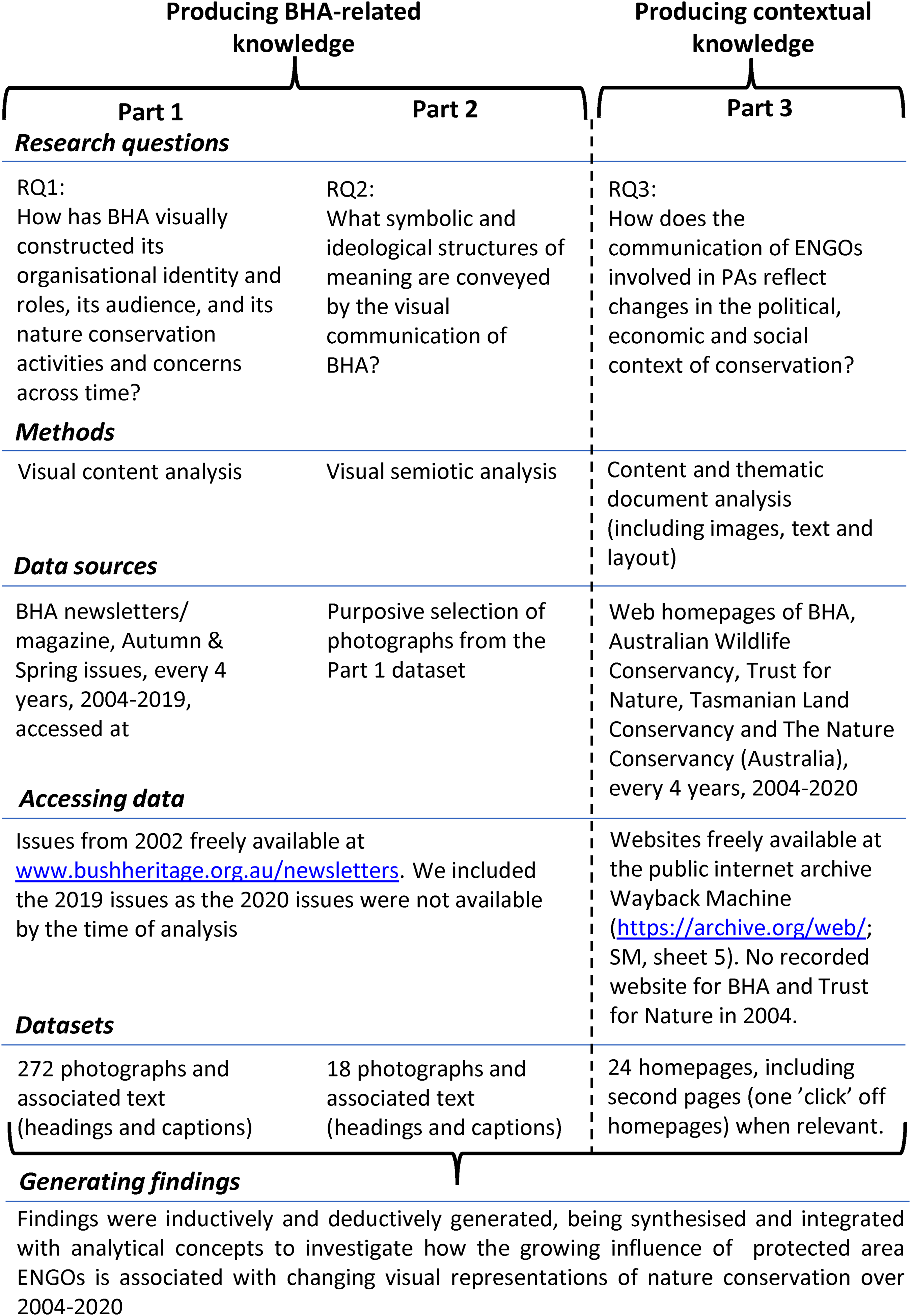
Summary of the three-part sequential research design.
Part 1: visual content analysis
Visual content analysis was applied to address RQ1. Visual content analysis is a quantitative method that systematically classifies the content of images to produce frequency data of visual representations (Bell, 2011; Rose, 2016). It relies on large samples of images to identify patterns in the composition, focus and substance, enabling general statements about difference over time and across fields of representations.
The sample was created from BHA's Bushtracks quarterly e-magazine (until 2014, the newsletter Bush Heritage News) (Figure 1). We selected BHA as it is the oldest national ENGO focussed on owning and managing private PAs across all states of Australia, with a clear lineage within environmentalist movements devoted to wilderness. We chose Bushtracks because it represented BHA's most prominent and long running form of public communication and engagement with members over the sample period. Through Bushtracks, were gained longitudinal insight into key organisational activities, appeals to donors and priorities, all articulated in visual form. We selected Autumn and Spring issues of the magazine to encompass seasonal variability, enabling us to observe patterns while keeping data at a manageable scale. A coding matrix was developed to produce frequency counts against portrayed representations of BHA identity and roles, nature and human–nature interactions (Supplemental Material (SM), sheet 1).
Part 2: visual semiotic analysis
To address RQ2, visual semiotics was applied to a sub-sample of 18 photographs to analyse symbolic and ideological structures of meaning (Bell, 2011). We constructed a protocol to guide the analysis (SM, sheet 4), drawing from visual semiotics informed by critical visual methodology (Roberts, 2016; Rose, 2016; van Leeuwen, 2011) and iconology (Bohnsack, 2020; Müller, 2011). In so doing, we extend a narrow semiotic focus on signs, to the role of signs in the creation, circulation and interpretation of meaning in specific social contexts across time.
We followed Barthes (1977), a pioneer of visual semiotics, to explore the differences between the ‘signifier’, or object being represented, and the ‘signified’, or conceptual meaning attached to that object (Hansen and Machin, 2013). This enabled an investigation of ‘what do images represent and how?’ and ‘what ideas and values do the people, places and things represented in images stand for?’ (van Leeuwen, 2011: 92). To do so, the analysist must disentangle denoted (descriptive) and connoted (coded) content (van Leeuwen, 2005, 2011). While denoted content is broadly accessible, connoted content is contextual. By decoding conceptual meaning in visual signs in relation to specific contexts and exercising their reflexivity, the researcher can move to the territory of iconology and access social imaginaries, political ideologies and social orders (Bohnsack, 2020; Rose, 2016).
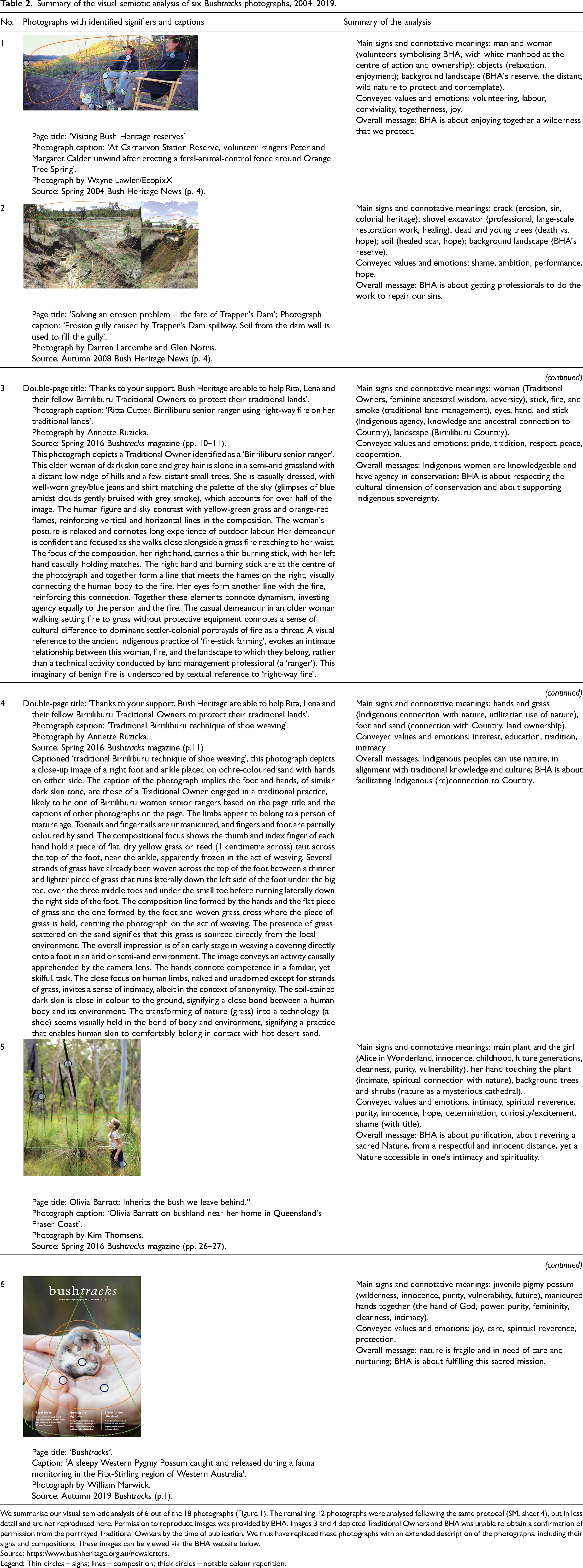
Sampling involved a first cut of photographs collected in Part 1 (N = 92) to capture some of the key temporal changes and continuities identified in coding for Part 1. In scrutinising this first cut, representations of human–nature relations were recognised as revealing temporal change in structures of meaning relating to organisational identities and roles of BHA and nature conservation activities and concerns. The selected photographs for analysis were identified as exemplifying this change across the sampled years (Figure 1, Table 2). Because connotative meanings are encoded within signs but also exist in relation between signs and in the interactions of images and written text (van Leeuwen, 2011), page titles and photograph captions were also included in the analysis.
Part 3: content and thematic document analysis of websites
RQ3 was investigated through a comparative content and thematic document analysis of 23 homepages of BHA, The Nature Conservancy (Australia), Trust for Nature, Australian Wildlife Conservancy and Tasmanian Land Conservancy (Figure 1, Table 1). The objective was to contextualise BHA by attending to the production, reproduction and transformation of conservation representations across the Australian ENGO sector. We explored the interaction of images and text and the denotative content of photographs on homepages, and, when relevant, investigated second pages (one ‘click’ off homepages). Websites were descriptively coded (SM, sheet 5). Interpretive vignettes were then prepared and synthesised with a focus on differences and commonalities across organisations in their representations of nature conservation.
Web addresses of the analysed webpages.
The three-part inductive findings were then synthesised and deductively interpreted in dialogue with analytical concepts, notably neoliberal conservation, and spectacular environmentalism. Our findings centre on visual analysis without empirical engagement with the people, organisations or policies that have also structured changes in ENGO engagement with PAs. However, this work is informed by our previous historical, key informant and policy analysis of the non-government conservation sector (Davison et al., 2022).
Findings
Our analysis revealed a growing emphasis by ENGOs involved in private PAs on communicating their professionalism over 2004–2020. This emphasis was evident in growing concern with their organisation's function, image and financial viability, alongside their founding concern with protecting nature. We identify three sequential but overlapping dynamics of professionalisation over the studied period: legitimising, marketising and differentiating. We also identify the interaction of these dynamics with the organisational mission of protecting nature leading to significant changes in the ways in which nature and the purposes and practices of nature conservation were represented.
Dynamic 1: legitimising
From the early years of our study period, the public communication of these organisations is shaped by a need to establish the legitimacy of both nature conservation and the involvement of ENGOs focussed on private PAs. In 2004, the emphasis of ENGO websites was informative, centred on describing the organisations, educating the public on the need for nature conservation, describing achievements and eliciting donations. Key textual messages align with environmentalist narratives about ‘threats’ to biodiversity and the need to urgently ‘protect’ and ‘save’ nature. The banner on Australian Wildlife Conservancy's 2004 homepage (Table 1), ‘Australian wildlife: unique, diverse and in trouble’ was characteristic of environmentalist concepts of nativism shaped in Australia by its settler-colonial history (Lien and Davison, 2010). Images of nature protected by ENGOs centred on distant landscapes commonly devoid of humans, and on endemic Australian species, particularly mammals. The visual narrative of ENGOs as protecting threatened native nature on public homepages was consistent with BHA's newsletters. The latter carried a visual narrative of a romantic, pure and passive wilderness protected by holding it at a distance through scientific (e.g. ecological surveys) and contemplative (e.g. landscape vistas) gazes, and related technologies (e.g. fencing). Natural features are focal subjects in 63% of photographs in 2004 (Figure 2(A)). When humans were portrayed, observing (including surveying), walking and posing for a portrait are the predominant activities (76%, Figure 2(C)).
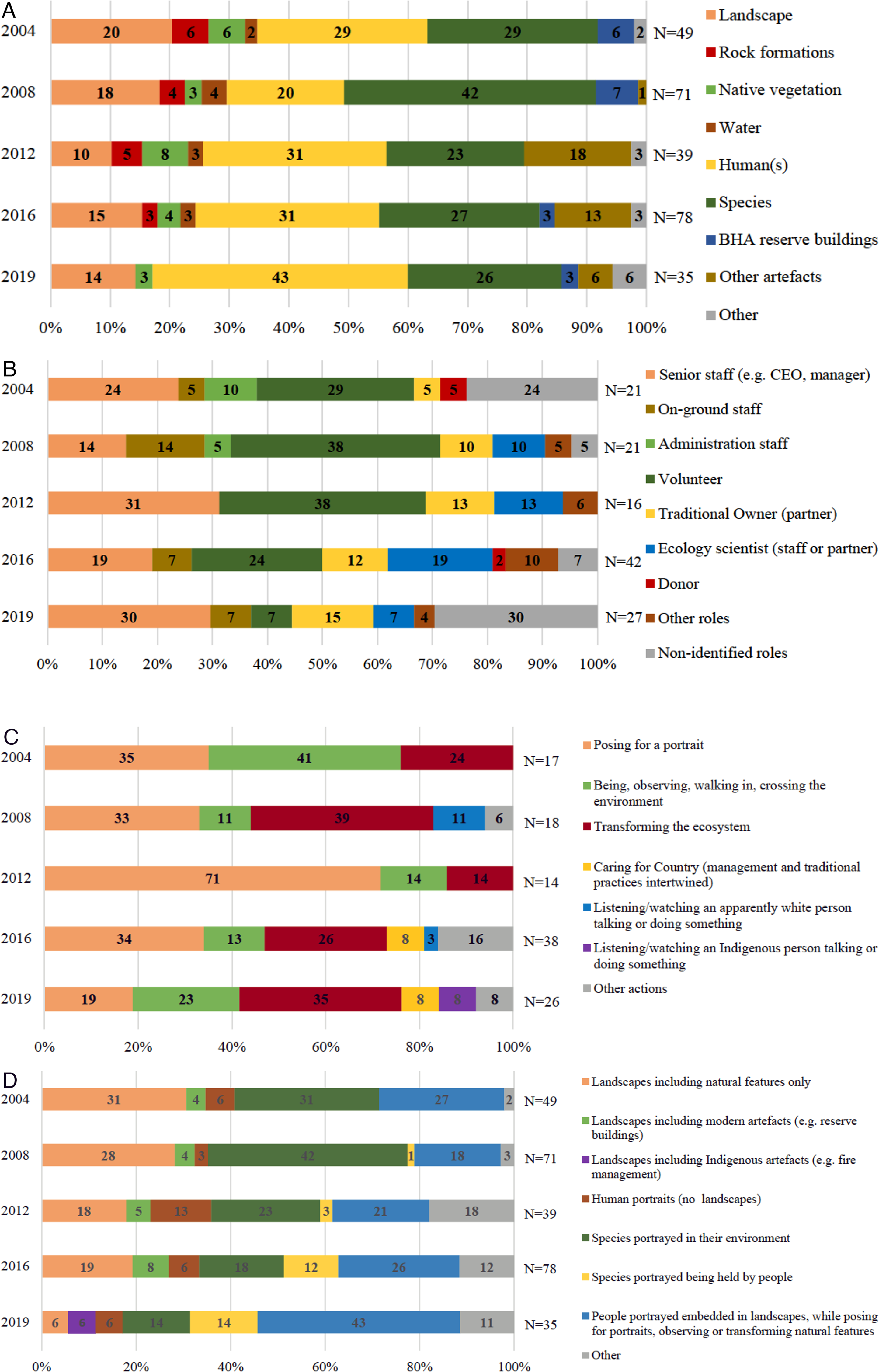
Visual content analysis of Bushtracks magazine, 2004–2019. (A) Focus components of photographs. N = total number of photographs included BHA magazines in a year (Spring and Autumn issues only). (B) Portrayed roles in photographs. N = Total number of roles represented in BHA magazines in a year (Spring and Autumn issues only), each role represented in a photograph was coded using presence/absence coding. (C) Types of portrayed actions in photographs. N = Total number of actions represented in BHA magazines in a year (Spring and Autumn issues only); each action represented in a photograph was coded using presence/absence coding; when individuals or groups seemed to have interrupted their activity to pose, they were still coded as ‘posing for a portrait’; people were coded as Indigenous when the caption of text would mention their Indigeneity. (D) Portrayed human–nature relationships in photographs. N = total number of photographs included in BHA magazines in a year (Spring and Autumn issues only).
In 2004, newsletters portray BHA as a grassroots group comprised almost exclusively of apparently white Australians. Stories about BHA's properties, evoked as ‘our reserves’, position private property as a key conservation tool. Images of collective conservation work in reserves predominantly depict staff (39%) and volunteers (29%) (Figure 2(B)). Visual cues that most volunteers are middle-class conform with evidence of the predominantly urban and tertiary-educated constituencies of environmental movements (Pakulski and Tranter, 2004). Apparently white men are centred (47% of represented groups), followed by apparently white women (29%), which contrasts with Traditional Owners (First Nations) (3%), and other ethnicities that remain unrepresented across our sample (SM, sheet 2, Figure 2b). Image 1 (Table 2) exemplifies this visual narrative, centring white men and depicting access to a pristine nature that is collectively owned, enjoyed and celebrated by Western middle-class volunteers in a casual and informal manner.
Summary of the visual semiotic analysis of six Bushtracks photographs, 2004–2019.
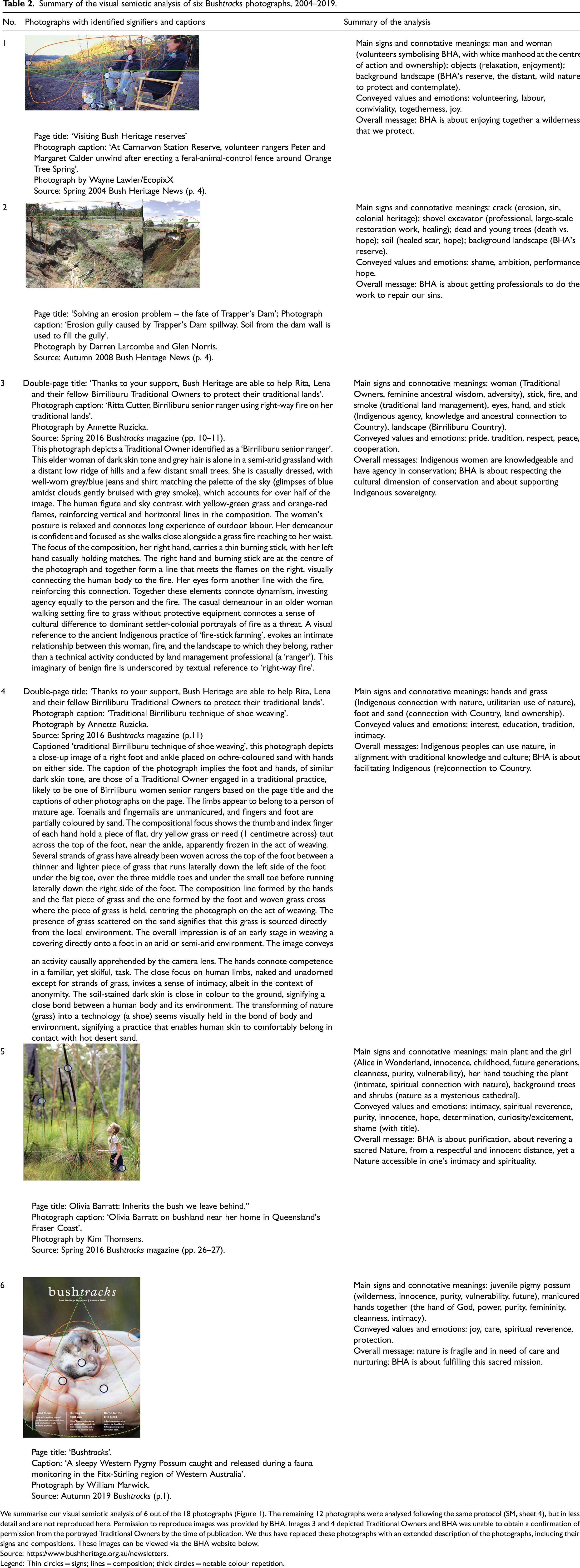
We summarise our visual semiotic analysis of 6 out of the 18 photographs (Figure 1). The remaining 12 photographs were analysed following the same protocol (SM, sheet 4), but in less detail and are not reproduced here. Permission to reproduce images was provided by BHA. Images 3 and 4 depicted Traditional Owners and BHA was unable to obtain a confirmation of permission from the portrayed Traditional Owners by the time of publication. We thus have replaced these photographs with an extended description of the photographs, including their signs and compositions. These images can be viewed via the BHA website below.
Legend: Thin circles = signs; lines = composition; thick circles = notable colour repetition.
Over 2008–2012, homepages reflect a private PA sector consolidating and growing in legitimacy through alignment with government policy and programmes. ENGOs adopt more explicit organisational structures, referring to organisational visions, objectives, strategies, plans, programs and reports, as well as formal governance structures such as the role of Chief Executive Officer (CEO), board of management and regional offices. Messages about the role of private property and private actors in conservation have become more direct and confident. For example, in 2008, Trust for Nature asserts that because ‘much of our natural bush … is privately owned’ it is therefore ‘out of reach of government protection’ (Table 1). The role of the state in defining collective interests is effectively ceded to nature (‘our natural bush’) through a national imaginary of Australia as a site of unique nature. This link reflects the pronouncement by the prominent environmentalist, and then Australian Wildlife Conservancy board member, Tim Flannery (2002: np), in his Australia Day Address: ‘Australia – the land, its climate and creatures and plants – … [is] the only force ubiquitous and powerful enough to craft a truly Australian people’. The visualising of nature in both BHA's newsletters (Figure 2(A); SM, sheet 2, Figure 3b) and websites, with frequent images of landscapes, mammals, birds and large trees, reflects this vision, presenting native nature as aligned with the identity of the audience (assumed to be Australians) and in doing so, implicitly resolving a potentially dissonant juxtaposition of private ownership and public interest.
Visual representations of the practices and priorities of nature conservation also begin to shift in the BHA newsletters from 2008. Portrayed staff roles diversify and include researchers, rangers, managers and CEOs (Figure 2(B)). This contributes to a trend across the study period of more people being depicted ‘in nature’ over time, with a wider diversity of people – in terms of roles, gender, age and ethnicity – doing a wider range of activities, but with a declining emphasis on volunteers after 2012 (Figure 2(B) and (D); SM, sheet 2, Figure 2b). In 2008, images depicting contemplative activities, such as surveying or walking, proportionally decrease, compared to interventionist activities, such as large-scale planting and seeding, often portrayed as involving large groups of volunteers (Figure 2(C)). For the first time in our sample, BHA makes visible the earth moving machinery required for large-scale landscape restoration (Table 2, image 2). With this visual imaginary of redemption possible via interventions in nature, the reader gets one of few brief glimpses of the destruction that BHA seeks to reverse.
The combined downplaying of the state and legitimising of ENGOs becomes more prominent from 2012. ENGOs communicate confidently an identity as conservation actors fulfilling a critical need beyond the scope of the state but underpinned by a national imaginary. On websites, the distinct role of private PAs is visualised through a focus on remote and vast ‘reserves’, although a majority of private PAs by this time were smaller parcels of rural-residential hinterland and hobby or small-holder farmland, close to cities and regional centres (Fitzsimons, 2015). The websites of BHA and Australian Wildlife Conservancy (Table 1) place strong visual focus on their largest reserves in arid and remote areas. In doing so, they implicitly tap into the long-standing resonance of the pastoral outback in Australian urban settler-colonial imaginaries (Davison, 2005); and provide a visual answer to calls for an ecological diversification of the Australian reserve system (Watson et al., 2009). After the mid-2010s, growing ENGOs (see dynamics 2 and 3) further participate in activities that were previously the domain of states, with most 2016 websites emphasising their contributions to conservation planning, and some ENGOs relying on mapping technologies previously pioneered by the Federal government. While the state is increasingly backgrounded, partnerships with Traditional Owners or corporations for example, are foregrounded, and used by some ENGOs to differentiate themselves from competitors (see dynamic 3).
Dynamic 2: marketising
With a rapidly growing conservation estate expensive to both acquire and manage, and financial austerity stemming from the 2007–2008 global financial crisis, the second decade of the 21st century saw ENGOs seek to further stabilise, secure and increase funding sources. Across the years, sharper focus on communicating ENGO achievements reflects growing organisational concern with brand, reputation and market-share. This focus, in turn, led to increasingly overt communication intended to sell products and/or services to consumers. The products and services to be ‘sold’ varied across ENGOs. Increasingly sophisticated and targeted appeals for tax-deductable donations spread across ENGO websites, including regular donations, large donations (e.g. personal bequests, properties and corporate sponsorship), and new forms of financial management (e.g. endowment funds). At that time, the need for increasing budgets in line with growing reserve estates aligned with expanding discourses that promoted the ‘enterprising’ of nature (Dempsey, 2016; Lorimer, 2015) and more broadly, ‘so-called’ market-based instruments (Pirard and Lapeyre, 2014).
The transactional focus here is not just metaphorical. Australian ENGOs have been pioneers in the use of real estate markets to both purchase private land to create reserves and facilitate others to buy land for conservation. Trust for Nature introduced the ‘revolving fund’ in 1989: a property is purchased, a conservation covenant is placed on the title, and the property is on-sold to recoup funds for a subsequent purchase (Hardy et al., 2018). By 2004, the Tasmanian Land Conservancy was promoting its revolving fund, appealing to environmentally minded retirees, peri-urban commuters or those wanting a holiday home or to ‘own [their] own nature reserve’ (Table 1). However, the commercial logic intensified by 2008, with homepage links of both Trust for Nature and the Tasmanian Land Conservancy showing the ‘Latest Real Estate’ and ‘Properties for sale’; and property advertisements primarily focussed on the property amenities to be enjoyed (including potential for building) rather than conservation management duties (to be included in the covenant) (Table 1). There has long been an influential narrative about housing as financial investment, inheritance and security in Australia (Davison, 2005). By inviting supporters to ‘be nature's guest and protector’, ‘claim [their] conservation prize’ and ‘get lost in [their] very own wilderness’ (see Trust for Nature's property advertisements, one ‘click’ off its 2012 homepage), these ENGOs encourage conservation property ownership and produce an imaginary of land owning as simultaneously a political stake in the polity and an act of private retreat. In the process, important legal questions about the relative protections offered by public and private PAs, such as the fact that subsurface resources are not encompassed in private land title in Australia (Fitzsimons, 2015), are overlooked.
A process of marketisation is also observed across the other ENGO websites and BHA newsletters. Following corporate branding practices, most ENGOs progressively redesign their logos from 2008. BHA introduces a professional uniform by 2012 and its CEO becomes its visual symbol and representative. In 2004, audiences were already invited into a relationship with wilderness through donations for on-ground protection – ‘$25per month will protect 10 numbats’ explains the Australian Wildlife Conservancy in 2004 (Table 1). Yet, starting in 2008 and 2012, some ENGOs also invite their audiences into new imaginaries of the economic protection of nature via ‘green’ consumption options, such as eco-tourism, e-gifts, ‘acre adoption’ or ‘conservation visa cards’ (‘take action through your transactions’ states The Nature Conservancy in 2012, see Table 1).
The confident representation of ENGOs as well as their reliance on marketising their activities are reinforced by a movement away from overtly activist environmentalist imaginaries. Communication becomes more carefully crafted for non-activist audiences, with websites distancing themselves from polarising images, language, individuals and events. Negative words and framings linked to the ecological crisis, such as human-induced threats and extinctions, were always sparse but now become absent. The imaginary of a ‘fight’ for ecological protection remains, as evident on BHA's online donation campaign against ‘feral pests’ or the ‘fire’ theme of its Autumn 2012 newsletter (Figure 3). Yet now, in the mid-2010s, the fight is to be primarily joined by supporting ENGOs financially, rather than through political intervention or volunteering labour. With these, we observe a starting shift towards ‘affective economies’ (Barua, 2020; Lorimer, 2015): portraits of charismatic species, vast expanses of land that ENGOs seek to manage or purchase, and conservation success stories start being harnessed to elicit emotive responses that generate financial support for the cause.
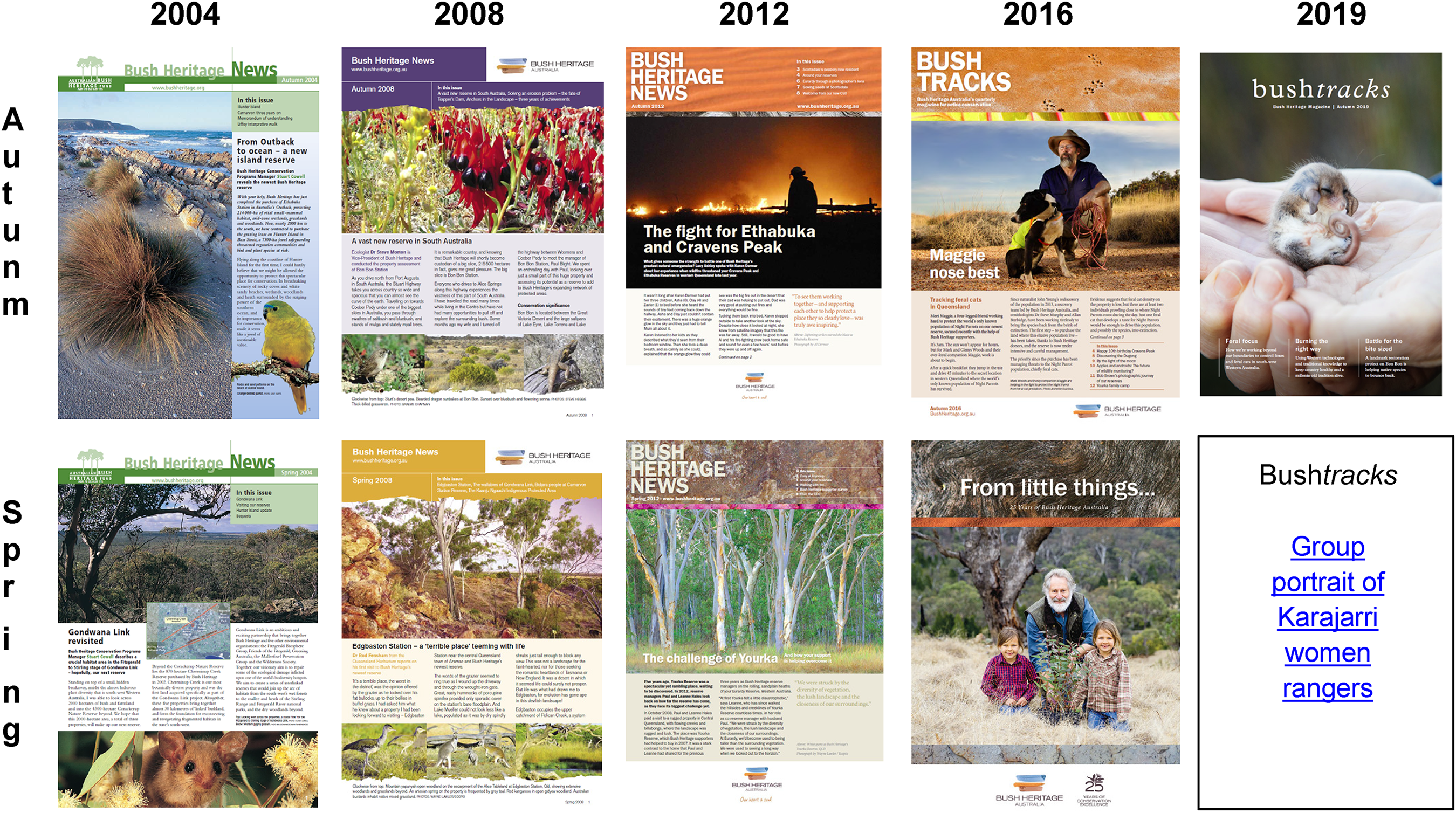
Bushtracks Cover pages (Autumn and Spring). The front cover of the Spring 2019 issue depicts a group portrait of Karajarri women rangers (See https://www.bushheritage.org.au/newsletters/2019/spring). BHA was unable to obtain a confirmation of permission from the portrayed Traditional Owners by the time of publication. Source: https://www.bushheritage.org.au/newsletters.
Representations of human–nature relations are more carefully crafted after 2008. Photographs of mundane organisational activities, already absent from homepages, disappear from BHA's newsletters after 2008 (Figure 2(B)), despite their importance for ENGOs (for BHA, administrative, communication, education and fundraising activities together represented on average 47% of total expenditure over 2004–2020; SM, sheet 2, Table 9b). Similarly, heavy machinery and the on-ground physical labour of volunteers fade away after 2008, while other violent tasks that conservation can necessitate, like herbicide application or feral species culling, remained unrepresented. Images focus instead on positive conservation activities. Photographs of staff and volunteers become more individualised and personalised from 2012, notably via portraits of smiling individuals and couples placed alongside textual testimonies of their impactful experiences. Representations of native species are also increasingly reworked as a vulnerable and innocent nature in need of saving, positioning BHA and its donors as compassionate saviours. This visual narrative appears in our sample in 2012 with the portrait of a BHA female ecologist in the Spring issue of the newsletter, wearing BHA's uniform and logo, gently smiling at the small mammal she is holding; and with the website photograph of a small mammal perched on human fingertips used to draw attention to BHA's report on progress in private conservation, Their Future in Our Hands (the cover of this report uses a further image in this genre) (Table 1). These intimate portraits of the meeting of human and nonhuman ‘hands’ simultaneously connect the audience to the organisation and to nature, prefiguring the spectacle of up-close-and-personal nature that becomes central in the final years of our study period as ENGOs face increasing intra-sectoral competition for market share.
Dynamic 3: differentiating
While dynamics of legitimising and marketising continue after 2012, visual communication in 2016 and 2019/20 reveals a new process of professionalisation: market-driven differentiation. In this third dynamic, earlier reframing of the audience addressed by ENGO communication from a small, committed group of grassroot members and volunteers to a larger and more diverse pool of donors and land buyers is pushed further. The terminating of the Federal National Reserve System Program in 2012 intensified funding competition between ENGOs (Davison et al., 2022), spurring efforts to present distinctive organisational identities and brands through representations of specialisation, novelty and partnership, so as to target a growing variety of possible audiences and funding streams.
The period 2016–2020 sees greater emphasis on ENGOs as providers of diverse services and products. Trust for Nature engages in relatively new conservation services markets, such as biodiversity offsetting and services to businesses, including those ‘looking at acquiring land for the purpose of conservation’ to ‘meet stakeholder interests and achieve environmental credentials’ (one ‘click’ off its 2020 homepage, see Table 1). All ENGOs increasingly promote their scientific credentials and contributions, positioning themselves not only as delivering science-based conservation outcomes, but as leading in knowledge production. This legitimisation through science seeks to attract more consequent research funding as well as large corporate and philanthropic donations. Yet differentiations also emerge between different forms of knowledge and management approaches.
In 2016, Australian Wildlife Conservancy positions itself as the ‘largest private owner of land for conservation in Australia’, the one ‘deliver[ing] effective conservation in the field’ and ‘represent[ing] a new model for conservation’, with ‘nearly 80% of our staff based in the field’ (Table 1). In 2020, it sets itself apart from ‘business-as-usual conservation’, implicitly critiquing other ENGOs for a lack of effectiveness (Table 1).
In contrast, The Nature Conservancy and BHA showcase their partnering with Indigenous knowledges as part of their conservation activities. This reflects a larger retelling of Australian environmentalist imaginaries through decolonising trajectories that recognise Australia as a cultural landscape (Bawaka Country et al., 2019; Moorcroft, 2016; Ngurra et al., 2019; Pickerill, 2018), the rise of Indigenous PAs as a major conservation estate in Australia, and the emerging expectations of targeted progressive audiences. In 2020, The Nature Conservancy claims it is ‘helping Indigenous people reconnect with Country’ (traditional lands and waters) (Table 1). BHA uses its magazine to recraft its image away from its origins in wilderness-based environmentalism and as a progressive organisation that supports Indigenous knowledges and cultures through a tripling in representations of Traditional Owners between 2004 and 2019 (from 5% to 15% of represented roles, Figure 2(B)). Indigenous PAs are showcased as ‘partners in conservation’ from 2016, with BHA introducing visual representations of the spectacle of Indigenous peoples actively managing landscapes, performing traditional practices on Country and/or being listened to or watched (Table 2, images 3 and 4; Figure 2(C) and (D)). For the first time in our sample, images also represent the utility of nature as a source of food and useful materials, via an emphasis on Indigenous women's labour (Table 2, image 4). In so doing, BHA acknowledges the biocultural dimension of conservation on Indigenous PAs and provides its supporters with privileged visual access to intimate biocultural practices. In contrast, there are no acknowledgements of Country or portraits of Traditional Owners related to BHA's own reserves in our 2016–2019 sample. The self-differentiating of ENGOs is supported through visual imaginaries that progressively move towards finely tuned spectacles of nature, of growing technical sophistication. These reflect both the broader development of information technology, web-based communication and marketing professions over this period, and the investment of ENGOs in new strategies for connecting with online audiences. Techniques already used by transnational conservation organisations (see Büscher and Igoe, 2013; Goodman et al., 2016; Igoe, 2010, 2017) are imported into the Australian context at that time.
On ENGO websites, positive emotions and spectacles of nature are evident through greater use of visual images relative to parred-back text; an increased image quality (e.g. clarity, depth, composition, use of macro-photography, i.e. the fine detail of close-up subjects); a more interactive, scrolling functionality suited to hand-held mobile devices; frequent positive framing and superlatives to describe the ‘extraordinary’ nature and to celebrate accomplishments; the use of the subject ‘you’ and imperative verbs to speak to a viewer (rather than a reader). The rebranding of BHA's newsletter as ‘Bushtracks magazine’ in Winter 2014 also reflects this shift in visual imaginary towards a sleeker style, denoted by a sharp increase in photograph size, quality and aesthetics (Figure 3).
The imaginary of nature shifts from the early passive vistas of remote wilderness to increasingly active and spectacular engagements with nature. Following broader trends (Clayton et al., 2017; Verma et al., 2015), technologies are harnessed to motivate people to become interested in nature and its conservation. The Australian Wildlife Conservancy's website in 2016 showcases helicopter vision of fire management that positions its staff ‘at the frontline in the battle to save our wildlife’, recalling action movie portrayals of warfare (Table 1). It invites online viewers to ‘take a virtual tour’ of the organisation, using tools such as Google Earth. The Nature Conservancy Australia's 2020 website (Table 1) offers a link to a real-time ‘reef-cam’ (‘you might see a dolphin’). Learning is to become effortless and fun (the ‘Great Big Nature Quiz’ or the ‘cool green science’ blog of The Nature Conservancy Australia in 2016). Contrasting with long, ecologically factual texts and the representations of labouring volunteers in remote reserves in the early 2000s (Table 2, image 1), ENGOs render ecologies increasingly digestible, engaging, accessible, and uplifting, and at the fingertips of their audience.
BHA differentiates itself by offering experiences of intimate – and sometimes spiritual – encounters with nature in its magazine (Table 2, images 5 and 6). Such images are constructed to trigger affects associated with joy, excitement and/or peace, and in doing so, to connect audiences to BHA and a shared ideal of nature. Intimate natures are primarily constructed through representations of non-instrumental encounters of human individuals with non-human individuals, and particularly small mammals being held, recalling Debord's (1983: thesis 18) insight that: the spectacle ‘elevates the sense of sight to the special pre-eminence once occupied by touch’. The spectacle thus paradoxically delivers a visually-mediated connection through a physical separation and distancing between the audience and protected nature, between the audience and a ‘world that can no longer be directly grasped’ (Debord, 1983: thesis 18; Igoe, 2010, 2017). The more audiences become distant across space, the more macro-photography is harnessed to ‘zoom-in’, and visually mediate experiences of touch and connection. In BHA's magazines, macro-photographs of species being held by humans indeed increase from 3% in 2012 to 14% of all photographs in 2019 (Figure 2(D)). The Autumn 2019 Bushtracks cover is illustrative of such intimate encounters (Table 2, image 6). Inverting environmentalist tropes about human dependence on nature, this imaginary evokes the dependence of an innocent and vulnerable nature on BHA. The gentleness with which nature is held connotes conservation as a feminine labour of care, while the white hand has resonances to the iconology of the ‘hand of God’ in Judeo-Christian art. Through it, BHA associates its mission and impacts to purity and sacredness and places itself as the professional intermediary through which supporters can save nature.
While science underpins BHA's core claim to offer donors impact in nature conservation, the visual narrative of intimate encounters connotes a sensibility of embodied care, one reinforced by more frequent visual presences of women and girls (57% of represented humans in 2019, against 24% in 2004, see SM, sheet 2, Figure 2b), and particularly Indigenous women (35% in 2019 versus 3% in 2004). ‘Caring about the environment has always been in my nature’ states a young woman volunteer in Spring 2016, while Karajarri women rangers ‘step up to care for their country and culture’ in Autumn 2019 (Figure 3). The representation of the active labour of a Birriliburu woman, embodying the ‘right-way fire’ knowledge to care for Country, marks a striking departure from early emphasis on passive Western contemplations of a pristine nature in BHA reserves and the centring of men (Table 2, images 1 versus 3). Increasing depictions of children such as Olivia Barratt, ‘who inherits the bush we leave behind’ (Table 2, image 5), connotes the shared innocence of nature, women and children, as well as the obligations to future generations and the legacies of current generations. These depictions are used to strategically invite bequests from senior supporters as BHA celebrated its 25th birthday in Spring 2016 (Figure 3); and to enrol the influence of children in the environmental choices of their parents (Spiteri, 2020).
In 2019, 43% of photographs portray BHA staff, supporters and/or partners embedded in landscapes (Figure 2(D)). Some of these actors deliver intimate biographical texts of their personal experiences with nature, such as Olivia Barratt noted above, reverently immersing herself in a natural cathedral ‘near her home’ (Table 2, image 5). This new focus on nearby nature, which might signal a rising interest of BHA in encouraging experiences with nature beyond its reserves, coincides with rising interest in urban nature in Australian cities (Cooke, 2020).
Through testimonies of personal encounters and acts of care, the message of a fragile nature is also reversed. Peace and human salvation are to be found in the comforting (mediated) embrace of a nature that offers forgiveness for past destruction and hope of future recovery. These individual, intimate stories not only seek to engage the viewer with nature, and deliver storylines that may soothe guilt and fear, while eliciting hope and joy, they also generate a deeper sense of belonging with the nature cared for by BHA. This belonging fuses BHA's identity and its conservation territories through personal experiences of nature that are celebrated as part of a collective (yet individualised) conservation journey towards a harmony between humans and nature, and between Indigenous and non-Indigenous people.
In ENGO websites over 2016–2020, spectacular human–nature encounters are also increasingly tied to monetary transactions. Donating is progressively transformed into an act of symbolic redemption, appealing to ‘ethical consumers’ (Lorimer, 2015). Consider the images found on The Nature Conservancy's 2016 homepage (Table 1). On entering the homepage we see a photograph of a tranquil forest pond bearing no (visible) human trace with a brightly coloured link to ‘Donate’ and the text: ‘Nature needs people like you. Help us to conserve our Amazing Australia’. Having established that ‘nature’ signifies a national imaginary that establishes collective ownership and spectacular exceptionalism (‘our Amazing Australia’) and that the viewer belongs to a community of shared interests and identity (‘people like you’), a link to ‘Our Impact’ assures to the viewer that ‘your gift will help us to address the most pressing conservation threats at the largest scale’. The bottom of the homepage returns to the effort to enrol the viewer via a shared identity (‘nature needs people like you’). There, the photograph of a hand holding sand can be linked to another photograph representing a hand holding money from which a tree is sprouting, with the title ‘Nature needs you! Become a Conservation Champion today’. The professional hand in the field, holding and saving nature, is visually conflated with the hand that scrolls, clicks and donates. Here too, ‘it seems possible to reach out to nature without ever touching and spoiling it. Pristine nature can be made to seem priceless and exchangeable, and money is cast as the medium of our planetary salvation’ (Igoe, 2017: 6).
The Nature Conservancy website of 2016 provides an extreme example of this transactional imaginary. Yet similar messages appear on other ENGOs’ websites by 2020, becoming increasingly focussed on generating emotional uplift. In effect, online promises of hope and positive identities are offered in exchange for donations. For example, following the unprecedented wildfires of 2020 in eastern Australia, BHA's 2020 homepage (Table 1) acknowledges that ‘You’ve watched. You’ve feared. You’ve grieved’ against the backdrop of two seemingly affectionate parrots, before declaring, ‘Now we’ve got work to do’ and inviting viewers to ‘donate today’ so that ‘together we can rise to the challenge in front of us’. The same year, the Tasmanian Land Conservancy adopts a scrolling banner about ‘lifting Tasmania's spirits’ and the Australian Wildlife Conservancy claims ‘providing new hope for Australia's Wildlife’ with a photograph depicting vivid leaves sprouting from a burnt trunk (Table 1). ENGOs use this visual imaginary to build empathy, solidarity, a shared identity and a desire to act amongst a conservation supporter base, with the aim of channelling this action towards online donations.
Discussion
The recent growth of Australia's terrestrial PA estate is remarkable. Alongside the state, Traditional Owners, ENGOs and individuals have transformed how PAs are created, managed and conceived in Australia. Our analysis has shown how the visual communication of BHA and other ENGOs involved in private PAs reveals that these organisations have not just grown and professionalised through neoliberal governance transformation, but they have actively renegotiated the meanings, purposes and practices of nature conservation.
Through our analysis, we explain the changes undergone since 2004 by BHA and similar Australian ENGOs as a process of professionalisation that occurred in a context characterised by strong neoliberal reforms (Beeson and Firth, 1998). This process is reflected in increasingly deliberate forms of public communication, where ENGOs have deployed new imaginaries (Taylor, 2004) to present nature conservation in ways that meet organisational objectives. PA ENGOs departed from an imaginary of nature conservation that contested dominant forms of political power in Australia, identified capitalism as a root driver of ecological destruction, celebrated activism and called for an intrinsic valuation of nature as important dimensions of conservation (Doyle, 2000). Instead, they progressively adopted apparently more apolitical imaginaries, which can be defined here as pragmatic in their efforts to avoid controversy and leverage funding and support within a system of neoliberal governance.
This visual re-imagining of nature conservation went hand-in-hand with the rise of a spectacular environmentalism (Goodman et al., 2016) seeking to cultivate positive emotions, engagement and support through visual means. Distancing themselves from the imaginary of a threatened wilderness to be kept untouched, ENGOs sought to instil optimism through positive depictions of scientific management of private PAs. Collective endeavours were replaced by a more individualist imaginary reinforcing the embedded cultural acceptance of the autonomy of Australian private landowners. By the end of our sampled period, a new imaginary had crystallised, portraying a specific ‘desired future realit[y]’ (Igoe, 2017: x) that empowers professional ENGOs, their partners and private landholders as the vanguard of Australia's conservation estate. With it, environmentalist tropes about the fatal flaw of elevating money over life were visually inverted, showing the life-giving power of money in the right hands. Aligning with Lorimer (2015: 142), this imaginary pushed the constituents of conservation towards an ethical consumption, with their primary role being to provide financial support for ENGO activities. By harnessing a seemingly apolitical and positive communication, this spectacular environmentalism aimed to widen the pool of supporters, from potential wealthy philanthropists and corporate sponsors wanting to associate with their brand, to individual landowners and donors who may not engage with negative tropes, and may not identify with, or may be hostile to, environmentalist politics. Avoiding criticism of government policies and programs may also increase opportunities to provide services on behalf of the state (Lane and Morrison, 2006). As they became accountable to larger and more diverse audiences while seeking to avoid controversy, ENGOs sought to visually reflect forms of social diversity not evident in earlier forms of activist environmentalism. Our visual analysis documents the de-centring of men and increasing depiction of feminine roles of care (that arguably remains defined by patriarchal dualisms, see Plumwood, 2002). Depictions of First Nations people (although not other non-Western cohorts or diverse social classes) also increased. Attempts at distancing from settler-colonial legacies (Pickerill, 2018) were noticeable via representations of biocultural diversity and an appeal to national imaginary grounded on the iconography of nativeness. Entertainment and web-based technologies triggering uplifting emotions also attempted to facilitate communication about nature to publics unfamiliar with conservation (Verma et al., 2015), and may foster new forms of human–nature connections, notably for those who do not directly interact with biodiverse natures in their daily lives (Clayton et al., 2017).
This emotional re-imagining of nature conservation progressively focused on appealing spectacles of nature. Aligning with findings about transnational ENGOs (Büscher and Igoe, 2013; Igoe, 2010, 2017), we found that the visual imaginary conveyed by Australian PA ENGOs placed their audiences in the positions of distant ‘spectators’. This was done by framing online entertainment and donations as the primary ways for people to care for nature, and, more importantly, as intrinsically satisfying, and sufficient forms of engagement.
Crucially, these spectacles of nature have implications for the practices, material worlds and human–nature relations they target, enrol and transform (Igoe, 2017). Symptomatic of this imaginary, donors were rendered largely invisible in Bushtracks (Figure 2(B)). The increase in spectacular representations of intimate interactions associated with calls for financial support over the study period reflects broader trends in the commodification of ‘authentic’ and ‘proximal’ encounters with charismatic species in conservation (Lorimer, 2015: 144). Importantly, it is not just charismatic species in isolation being enrolled into the process of making nature marketable. It is rather the ‘conjuring’ of positive, spectacular representations of human–nature encounters that are being connected to appeals for support, including donations (Barua, 2020; Tsing, 2005). As Barua (2020) emphasises, the positive register of conjured representations is critical to their intended effectiveness in the production of affective economies. While positive spectacles may provide an accessible entry point for new conservation audiences, it also ushers them into passive subject positions, in contrast to those of citizens, activists and community members. This is to carry into conservation specific subject positions that are amenable to the dominant neoliberal system of governance in Australia. In the process, this imaginary can close potentialities for bolder subjects intent on the transformative change – defined as ‘a fundamental system-wide, reorganization across technological, economic, and social factors, including paradigms, goals and values’ – deemed necessary to reverse biodiversity depletion (IPBES, 2019: 6).
Our analysis suggests that the apolitical identity projected by ENGOs involved in private PAs is rooted in organisational imperatives for viability within a neoliberal political economy. This apolitical identity is thus highly political in its effects, limiting the capacity of ENGOs to deploy transformative imaginaries. These findings reveal how requirements of legitimacy and reliable sources of funding have seen ENGOs actively avoid controversy that might alienate existing or potential partners and donors (see also Gulliver et al., 2020). The most striking example is a lack of attention given to climate change, an environmental issue that strongly polarises Australian politics (Tranter, 2013). While this issue has become increasingly prominent in the country and is central for the future of conservation, it was rarely present in the visual material we studied. Similarly, except for Trust for Nature, the ENGO homepages that followed the 2020 bushfires avoided directly naming climate change, focusing instead on hope and donations to their recovery work.
The turn to the spectacle of intimate nature is notable for the near-complete absence of images that elicit grief, loss and worry, including images of the drivers of ecological destruction (O’Neill, 2020; Schäfer, 2012). In rendering these positive imaginaries, ENGOs may capture the attention of new audiences and ethical consumers, raise awareness, avoid tensions or conflicts with large funders, as well as provide soothing answers to the concerning rise of eco-anxiety (Soutar and Wand, 2022). Yet, by focusing solely on affirming messages regarding the agency of distant donors and ENGOs, they also participate in eluding – or concealing – difficult questions about the efficacy of PA conservation in the face of systemic ecological changes. This also suppresses wider questions about the efficacy of private initiatives within a system that has structurally failed to slow or reverse biodiversity loss (Büscher and Fletcher, 2020; Heise-Pavlov, 2020; Jones et al., 2018).
Spectacles of nature also conceal many of the connections and contexts that have enabled the production of spectacular images in the first place (Büscher and Igoe, 2013; Igoe, 2010, 2017). This makes it difficult for distant viewers to comprehend or to question the social-ecological relationships underlying the images they see. Compounding this, competition for funding has seen ENGOs invest resources into advertising and marketing, increasing the strategic use of communication, potentially to achieve faster ‘returns on investment’ than to educate, inform or intervene. In the absence of deliberate explanations, visual focus on eye-catchingly intimate encounters with nature directs attention away from the social-ecological complexities, uncertainties and challenges that are inherent to on-ground conservation. It can also distract from less spectacular, but nevertheless central, organisational activities.
The spectacles of nature visually embodied by the PA ENGOs we studied also conceal the fragility and limitations of their own enterprises. The focus on images of nature in private reserves, the agency of individuals, and the right of landowners to manage their private land obscure legal questions about private land tenure, conservation questions about the landscape dynamics affecting ecological outcomes on PAs, and social justice questions about how private PAs may create uneven outcomes for various groups, including First Nations. The absence of visual representations of the state also limits the breadth and depth of its possible roles to be imagined in transformations (Eckersley, 2021), in a context where its policy, planning and regulatory roles have been increasingly contracted. More broadly, organisational dynamics of legitimising, marketising and differentiating have seen ENGOs increasingly shift attention from the root causes of the conservation problems they seek to address to visually embody uplifting and hopeful imaginaries in exchange for support. While further examination is necessary, the spectacle of nature in this context may inadvertently participate in reducing collective capacity for reversing ecological decline.
Conclusion
Today, BHA is largely unrecognisable from the small environmentalist organisation created in 1990 when a wilderness activist unexpectedly turned his attention to the real estate market. To unpack such change, we provided a visual analysis of the communication of ENGOs involved in private PAs in Australia, with a focus on BHA over 2004–2020. We documented how the professionalisation of ENGOs in response to neoliberal reforms has seen them deploy new conservation imaginaries made of mediated, uplifting and intimate encounters with nature, and moving volunteer conservation constituencies towards ethical conservation consumption. These findings confirm the significance of visual communication in nature conservation and, through the case of private PAs, reveal how organisational imperatives linked to political-economic reforms are reshaping the meanings, purposes and practices of conservation. Here, the effort of Australian ENGOs to be seen as legitimate, financially viable actors in the context of neoliberal reform have seen visual communication become increasingly strategic and curated, directing public attention away from structural challenges and towards emotional spectacles offering salvation to those who click ‘donate’.
Highlights
Environmental non-government organisations (ENGOs) play an increasingly important role in private protected area conservation
We studied the communications of Australian organisations with emphasis on Bush Heritage Australia between 2004 and 2020
Visual analysis investigated organisational dynamics and representations of nature conservation
Professionalisation of ENGOs under neoliberal conditions is linked to changing imaginaries in protected area conservation
Efforts by ENGOs to engage new audiences saw a shift from critique of root problems towards the spectacle of intimate encounters with nature
Supplemental Material
sj-xlsx-1-ene-10.1177_25148486221129418 - Supplemental material for Professionalisation and the spectacle of nature: Understanding changes in the visual imaginaries of private protected area organisations in Australia
Supplemental material, sj-xlsx-1-ene-10.1177_25148486221129418 for Professionalisation and the spectacle of nature: Understanding changes in the visual imaginaries of private protected area organisations in Australia by Florence LP Damiens, Aidan Davison and Benjamin Cooke in Environment and Planning E: Nature and Space
Footnotes
Acknowledgements
This research is supported by the Australian Research Council (DP180103118). We thank the four anonymous reviewers for their thoughtful and constructive engagement, which helped us improve our manuscript. We are grateful to Bush Heritage Australia for permission to reproduce images from their magazine, Bushtracks. A.D. acknowledges the muwinina and palawa peoples of lutruwita and B.C. and F.L.P.D. acknowledge the people of the Woi wurrung and Boon wurrung language groups of the eastern Kulin Nation on whose unceded lands RMIT University conducts its business and where B.C. lives and works.
Declaration of conflicting interests
B.C. is member of a Committee of Management for a Trust for Nature property in Victoria. He receives no financial compensation for this role.
Funding
The author(s) disclosed receipt of the following financial support for the research, authorship, and/or publication of this article: This work was supported by the Australian Research Council (grant number DP180103118).

Supplemental material
Supplemental material for this article is available online.
References
Supplementary Material
Please find the following supplemental material available below.
For Open Access articles published under a Creative Commons License, all supplemental material carries the same license as the article it is associated with.
For non-Open Access articles published, all supplemental material carries a non-exclusive license, and permission requests for re-use of supplemental material or any part of supplemental material shall be sent directly to the copyright owner as specified in the copyright notice associated with the article.
