




Abstract
This commentary proposes a research agenda for the concept of feminist digital natures (FDN). To demonstrate how we see FDN connecting existing research efforts, we review both the well-established and much-needed work in three overlapping areas of scholarship where we see the potential for productive discussions, new questions, and empirical analysis: feminist digital geographies (FDG), digital natures (DN), and feminist political ecology (FPE). We offer specific and grounded examples of topics and questions that scholars might pursue through an FDN approach. We encourage sustained, collaborative, and critical attention to the uneven consequences and political terrain of understanding natures as increasingly digitally monitored, managed, manipulated, and represented. We can and should think with digital relations, and we might benefit from new creative conversations across our areas of inquiry and action.
Introduction
Natures of varying scales and forms are digitally sensed, monitored, represented, manipulated, and governed, with uneven consequences. There are species identification technologies available through mobile phones. 1 There are apps such as Think Dirty® 2 that claim to help beauty product consumers determine if their daily body care routines are “clean” or “toxic.” There are hopes to “reforest the planet” with the assistance of drones. 3 There are expanding applications of CRISPR gene editing 4 technologies in agriculture and other contexts provoking ethical questions and challenging presumptions about the “unnatural” and “natural.” The recurring promise and attendant anxieties of “helping” bodies and natures emerges here through powerful relations with digital technologies.
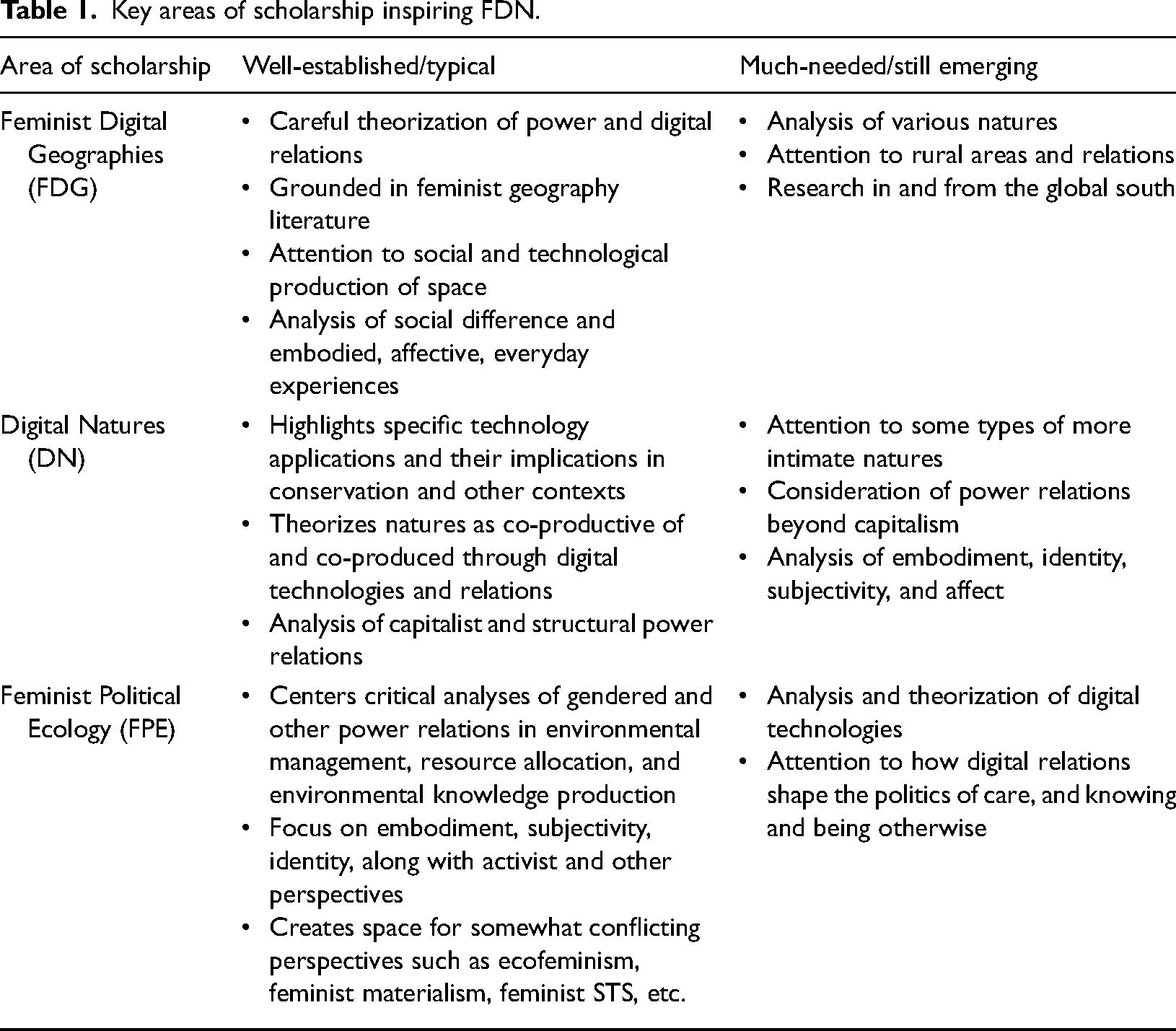
In this commentary, we encourage scholars to take up critical questions at the intersection of feminist digital geographies (FDG), digital natures (DN), and feminist political ecology (FPE). We see great potential to advance theory in all three areas respectively by engaging deeply with what we call feminist digital natures (FDN) (see Figure 1). Our work on FDN draws from our close reading of and our contributions to scholarship across the aforementioned sub-fields. We have repeatedly found that research questions and cases often partially overlap or combine two of these sub-fields, but rarely if ever bring together all three. Table 1 summarizes some of the well-established and much-needed work in the areas of scholarship where we see pathways towards an FDN approach. Specifically, FDN is an approach that combines feminist epistemologies and practices with an understanding that digital technologies mediate and co-produce many natures. We elaborate on an FDN approach below, offer readers suggested topics and themes of inquiry, and conclude with an invitation to study FDN together.
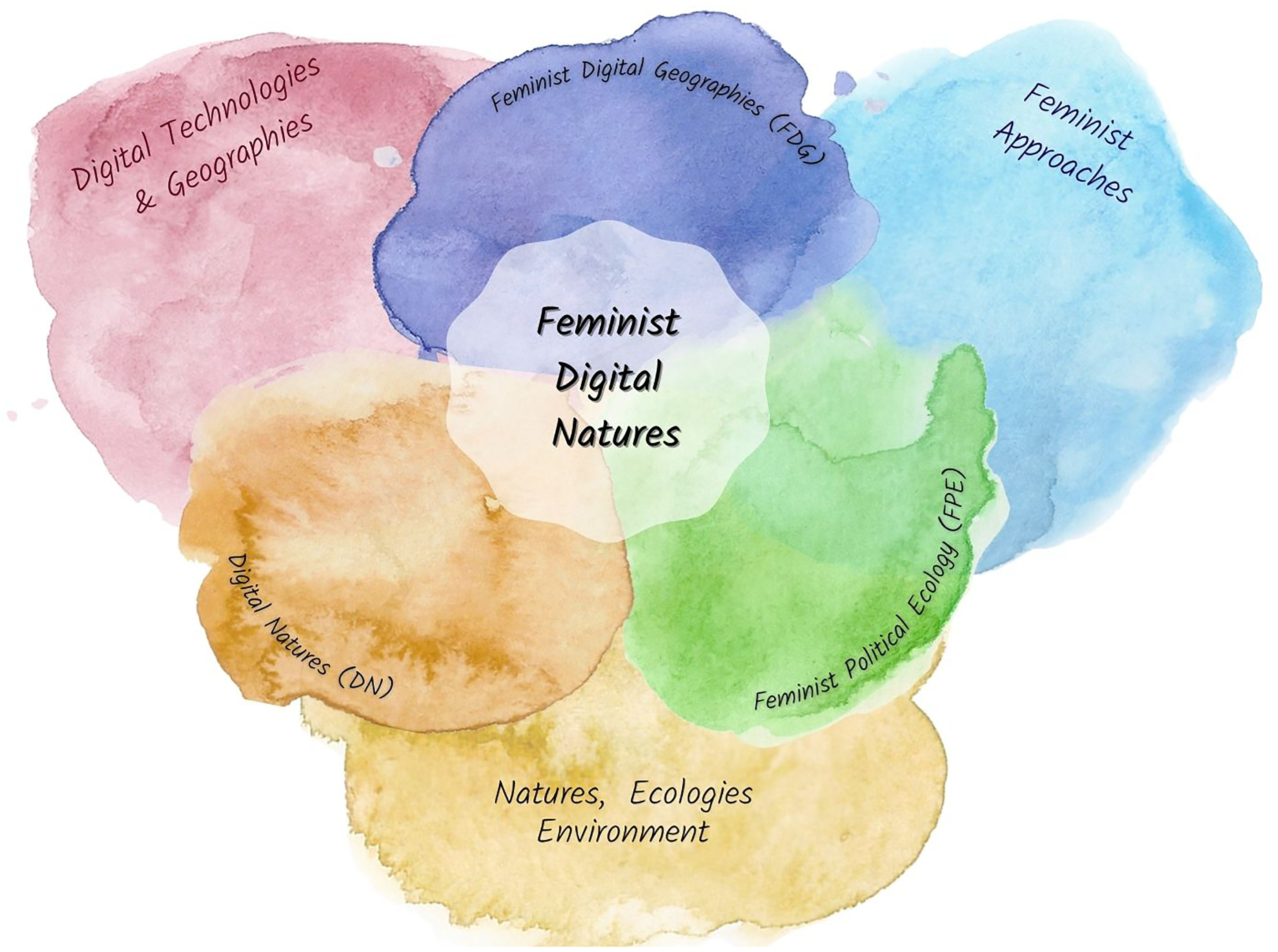
Positioning feminist digital natures.
Key areas of scholarship inspiring FDN.
Emerging contours inspiring FDN
Feminist digital geographies and FDN
Feminist digital geographies (FDG) offer compelling analyses of social difference, embodiment, affect, and everyday experiences with digital technologies. Scholars look at gender, race, sexuality, and many relations arising from, and mediated by, digital practices, representations, and spaces (Elwood and Leszczynski, 2018). Dealing with both mundane and spectacular experiences with the digital, many studies in FDG examine subjectivity, techno-capitalism, and surveillance. They show how normative racial, heterosexual, gendered, and patriarchal social expectations are already embedded in digital technologies, and so emerge from everyday interactions with technologies (Akbari, 2019; Benjamin, 2019; Cockayne and Richardson, 2017a,b; Gieseking, 2017; 2018). In this way, various forms of labor—digital or otherwise—produce and embody dominance in digital interactions, especially in urban places (Elwood and Leszczynski, 2018; Tuzcu, 2016). Related studies examine cyberfeminism (McLean et al., 2016), new spatial media and critical feminist GIS (Leszczynski and Elwood, 2015), affect and ICTs (Longhurst, 2013), data colonialism (Fraser, 2019), and technological sovereignty (Lynch, 2020). All of this scholarship inspires and informs our thinking as we work within feminist political ecology and digital natures networks.
At the same time, we wish that FDG scholarship would engage various natures and expand from its largely urban focus or add attention to natures associated with rural areas and relations. With some exceptions (Carraro, 2021; Datta, 2015; Guma, 2021; Ray, 2020), FDG could also strengthen its research in and from the global south. There are a few FDG works that engage with natures through topics such as interspecies care online (Nelson 2017; Jones, 2019), smart urban forests (Prebble et al., 2021), and digital mediations of animal presence queering space (Seegert, 2014), but attention to natures in FDG is still much-needed. We are proposing FDN to encourage more feminist digital geographers to show how natures are entangled with the various spaces, scales, bodies, technologies, and associated experiences that already constitute digital geographies (McLean, 2020). We see an FDN approach as a way of bringing FDG analyses of digitally embodied, gendered, racialized, classed—and more—power relations together with various contested natures and knowledge practices. As one takeaway from FDG, understanding exactly who creates and uses digital technologies, how they are used or affectively engaged with, and what users make of their contributions could reveal points of intervention. This is especially helpful to consider for settings framed by a history of exclusionary practice (see Leszczynski and Elwood, 2015 for more on “hacking” and reworking technological regimes within oppressive power dynamics; Egaña and Solá, 2016). As new environmental practices emerge with/from the digital, feminist digital geographers exploring FDN can help to push against normative categorizations of humans and more-than-human beings, challenge anthropocentrism and refocus on digital natures as open to plural, hybrid ontologies and epistemologies (Elwood, 2021; Hunt and Stevenson, 2017; Wilson, 2009).
An example of one area where an FDN approach might offer new insights to FDG is community-based environmental monitoring. Nature monitoring apps do not usually draw the attention of FDG scholars, but if they were to do so the nuanced analyses of the digital (re)producing socio-spatial relations could enhance our understanding of these apps, their meanings, and effects. There are a growing number of mobile applications, digital platforms, and emerging technology trends available for individuals and communities to map and monitor the places where they live and to connect with various beings and environments in personal, digitized ways. For example, iNaturalist is a citizen science network in which users, “contribute to biodiversity science, from the rarest butterfly to the most common backyard weed” by observing species through a mobile application (iNaturalist, 2022). From here, iNaturalist will “share your findings with scientific data repositories like the Global Biodiversity Information Facility to help scientists find and use your data. All you have to do is observe” (Ibid.). In this case, digital mediation is the most “approved” way to produce and share environmental knowledge in the citizen science network. Such digital practices increasingly come to define the practice and experience of community-based environmental monitoring in everyday living and working spaces more broadly, whether this is to track individual members of invasive or threatened species, report sites of potential chemical spills or monitor changes in air quality (Altrudi, 2021; Dodge and Kitchin, 2004). Increasingly too, people are providing environmental data “unconsciously, scraped from social media or recorded by specialized apps” that may not be intended for environmental applications, or that are “infrastructured” under algorithmic governance frameworks that have implications for climate and environmental policy (Adams, 2019:344; Machen and Nost, 2021).
An FDN approach would add FDG's ideas around power, embodiment, social difference, and emotions to analyses of community-based environmental monitoring. It could pose questions such as: How do environmental monitoring apps replicate the disembodied, “scopic” regimes (Amoore, 2011) of other surveillance technologies? What issues of privacy, safety, and ethics emerge through this app? How does a digital format reorient users’ bodies and senses to the environments with which they connect? An FDN approach could ask how natures, spaces, and people are datafied through digital environmental monitoring and made into probabilistic representations (Benson, 2014) that are distanced from their situated experiences. More broadly, it would also ask how digital technologies affect the everyday experiences, emotions, and sensations of socio-ecological relations. How do people connect or relate to natures through digital technologies? How do their thoughts, practices, relationships shift or not? Here, FDN can provide spaces to ask critical questions about “the digital” and about “natures”, which are promoted with a similarly faux accessibility despite being bound to an entrenched history where some uses of technologies reify various forms of socio-ecological oppression (Jasanoff, 2004).
Digital natures and FDN
Digital natures (DN) research includes work by geographers and others investigating how digital technologies mediate socio-ecological relationships, particularly in the realms of conservation and environmental governance. Advances in digital technology have meant that monitoring environmental phenomena at a variety of scales—from global satellite imagery of ocean currents, to drone or webcam video of endangered species habitats, to tracking insect movements—is easier, almost instantaneous and more readily available than ever. Alongside recent calls for political ecologies of data and anthropology of data (see Douglas-Jones et al., 2021 and Nost and Goldstein, 2021), many critical reviews of these “Smart Earth” and “eco-surveillance” technologies call for more attention to the politics of technology and critical data studies. They highlight the urgent need to identify who owns and controls these technologies, the data they produce, and to what financial and political ends, highlighting that “better data does not always lead to better governance” (Bakker and Ritts, 2018:208, see also Adams, 2019; Sandbrook et al., 2021).
In addition to, and often interwoven with monitoring technologies, is the use of digital media to shape, mediate, and augment human experiences with physical environments and more-than-human beings, or vice versa. One prominent conceptualization of this is Nature 2.0, which demonstrates how web and digital media technologies present spaces where humans may “(re)imagine and understand (the rest of) nature” (Büscher et al., 2017:111). Using this concept, scholars demonstrate how the digital may conceal the commodification of nature or the naturalization of capitalist accumulation in conservation contexts (Büscher and Igoe, 2013; Cavanagh and Benjaminsen, 2014). This often occurs through spectacle, celebrity, and popular media-based content encouraged in many digital spaces (Hawkins and Silver, under review; McCubbin, 2020). As a whole, the DN literature offers researchers insights into how nature and digital technologies intersect, particularly in the realm of conservation, and encourages explorations of how capitalist accumulation may underpin these processes, with unequal outcomes for particular people, natures and places.
Although DN research does well at drawing attention to the political economy of conservation, as feminist scholars, we are discouraged by the tendency for DN scholarship to ignore the possibilities of other forms of power relations beyond capitalist ones and to narrowly focus on one particular type of “nature.” While there are calls to examine who owns, designs, programs, and controls digital technologies that mediate natures, these calls are generally referring to corporate or political entities and their economic gains (Koot and Fletcher, 2020; Toonen and Bush, 2020). Taking inspiration from feminist digital geographers, it is also important to consider who designs and uses these technologies in terms of identities, subjectivities, and their embodied and affective experiences. Technologies designed and used by certain demographics of people (e.g., young, White, Western, men) experience and visualize some things and not others (Haraway, 1988). Digital natures can be sexist, racist, ableist, heteronormative, colonial, etc. and can reinforce, or occasionally dispute, discriminatory and entrenched inequalities (see Hawkins and Silver, 2017 for an example of how a hashtag disrupted colonial discourses of seal hunters as “savage”; Young, 2020). Researchers should also keep in mind that digital technologies can open up new possibilities of multi-species relating through embodied, affective, emotional interactions, and reciprocity (Kirksey et al., 2018; Verma et al., 2016). From an FDN perspective, the “nature” under investigation by researchers should expand beyond the repeated priority sites of colonizing development intervention such as popular charismatic megafauna habitats, and managed forests and fisheries. An FDN approach offers DN scholars a wider variety of sites for study including, urban landscapes, environmental hazards, waste flows, gardens, local flora and fauna, as well as individual people and organisms—and not just those located in the “global north” (Elliot, 2016; Perovich et al., 2018; Tuli and Danish, 2021). A wider understanding of nature enables attention to more situated, everyday and embodied experiences and circumstances.
An example of one area where an FDN approach might offer new insights to DN on different natures and power relations regarding “the natures closest in” can be the proliferation of mobile phone apps that encourage consumers to scan beauty and personal care products to determine if they are “clean” or “toxic.” Toxic ingredients in products like toothpaste affect people's bodies differently, both due to biological differences such as sex hormones, but also social ones. On the latter, for example, women (including cis and trans women) commonly use far more personal care products than men due to feminized beauty standards. In many cases, women of color and Black women especially encounter even more toxic products (e.g., hair relaxers, skin lightening creams) because of the specific formulations of products marketed to them based on racist beauty standards (Eberle et al., 2020). People who work in beauty industries, such as in hair and nail salons, are also at increased risk of encountering toxins because of this (Quiros-Alcala et al., 2019; White et al., 2015). In the absence of government control/policy, exposure to toxins through beauty and personal care products is increasingly mediated digitally at an individual level through apps and websites. Extended further, some of these apps also include information on avoidance of animal cruelty in product testing, an example of mixing scales and themes of ethical environmental concern.
While DN scholarship already focuses on the use of web and digital media technologies in conservation and natural resource commodity chains, an FDN approach would also consider how these play out for more intimate natures. It could extend ideas about commodification to the ethical consumption apps mentioned above, with feminist understandings of knowledge production and the personal as political. Using these apps, as emotional, embodied practices that work towards some idea of being “clean” may signal another case of “greenwashing” subjectivities or demands for “green citizenship” that appear with everyday products and personal beauty or care habits. An FDN approach might pose questions such as: How do digital technologies distinguish products and different people's bodies into “clean” or “toxic” categories? What affective and intimate experiences do technology users have while navigating this data in relation to their understanding of their own bodies as clean or dirty, natural, or unnatural? Does a feminist approach to digital natures make more sense at some scales than others (e.g., cells, bodies, landscapes, ecosystems) and what assumptions about the scalability and “nonscalability” (cf Tsing, 2012) of natures can an FDN approach interrogate (see Tait and Nelson, 2022)? Combining the insights of DN scholarship with feminist perspectives through FDN would allow us to attend to more nuanced relations of power and consider the intimate and embodied aspects of digital natures that are already always occurring.
Feminist political ecology and FDN
Unlike much of the digital natures scholarship, those practicing FPE scholarship and activism largely center embodied power relations with and as mutually constitutive of various natures in their work (Caretta and Zaragocin, 2020; Doubleday, 2020; Elmhirst, 2011; Faria and Mollett, 2016; Harcourt and Nelson, 2015; Hawkins et al., 2011; Nyantakyi-Frimpong, 2019; Rocheleau et al., 1996; Zaragocin and Caretta, 2021). FPE is a recurring “gathering space” where scholars, activists, practitioners, and teachers draw from and produce feminist philosophies and practices to make sense of and “trouble” power relations in sustainable development, the green economy, and other political and environmental projects (Harcourt and Nelson, 2015; Harcourt et al., 2022). Early FPE work made space for (at times) conflicting perspectives from ecofeminist ideas, feminist science, technology and society (STS) scholarship, activist experiences and strategies, and critiques of the international development sector's erasure—and uncritical celebration of—“women” and “gender” (Rocheleau et al., 1996). While FPE scholarship is not always published under the FPE banner, for strategic and sometimes discriminatory reasons (see Rocheleau, 2008; 2015), the collection of work that draws on FPE has made significant contributions to understandings of power relations and the contested production of and claims to environmental knowledge, expertise, and subjectivity.
One recurring challenge in FPE scholarship, is a persistent avoidance of engaging digital relations, despite the field's strong feminist STS influences and ongoing discussions regarding nature, gender, and technoscience. 5 More recent FPE scholarship frames expanding and intensifying digital relations as tools of further entrenching neoliberal “green economy” labor relations and expert subjectivities, environmental crises, and deepening surveillance (Nelson, 2016; 2020). Further works focus digital relations more narrowly on feminist activists’ strategic uptake of the internet and social media (see earlier works in the Harcourt, 1999 edited volume). More commonly, however, the ubiquity of technologies or the role of thickening and proliferating digital relations eludes the attention of FPE scholars altogether.
One example of a FDN approach offering new insights related to FPE can be in troubling assumptions about where and how digital technologies shape and co-produce everyday relations, social movements, sustainable development knowledge, and claims to expertise. Within FPE, there is a common framing of rural areas and sites in the “global south” as lacking sufficient data and technology (see Faxon, 2022 as an exception). 6 Digital technologies need not be the central focus of analysis, but they are shaping everyday socio-ecological relations and activism in new ways. For example, Indian police included facial recognition technologies among their tools for identifying and arresting activists in the January 26th, 2021 farmer protests in New Delhi (Parkin, 2021). This surveillance application of digital technology occurs in the context of no national law delimiting the technology's appropriate and inappropriate uses, its prior application in protests against an anti-Muslim citizenship law in 2019, and a multi-month farmer protest movement against three bills passed in Parliament in 2020 that removed minimum price guarantees on produce while encouraging more direct selling to private buyers beyond the dominant “mandi system” (BBC, 2021; Parkin, 2021).
Here, facial recognition systems used for surveillance are one digital technology among many, such as social media used for activism and farming, and precision farming tools used for agriculture, that co-produce everyday rural life in its banalities and spectacular moments of mass protest. While FPE illustrates power struggles centered on knowledge politics, natures and the political economic or other forces shaping socio-ecological relations in specific place-based struggles, an FDN approach adds even more attention to the “who” and “how” of the digital relations involved, particularly in view of social, economic, or political interventions. It prompts additional questions such as: How do facial recognition software and other technologies deployed by state and corporate entities shift key resistance strategies and affect socio-ecological relations? How are precision agriculture technologies shifting gendered workloads and affective relations with soils, plants and animals? Examining how FPE might “go digital” through FDN would allow us to attend more precisely to questions of how digital relations matter to questions of embodiment, emotion, affect, scale, and contested environmental knowledge and expertise.
Starting from an FDN perspective
In the previous sections, we showed how an FDN approach can expand on and complement FDG, DN, and FPE work. Through each of the examples—iNaturalist and species monitoring, clean beauty and consumption apps, facial recognition and farmer protests—we illustrated how extending FDG, DN, and FPE to include cases not normally under their umbrella reveals interesting questions and starting places for critical analysis and action. Thinking of cases not normally under each umbrella is one way to do this kind of additive analysis. For FDG, there can be more critical analysis of natures as social, ecological, and co-produced at multiple scales. Adding more about natures asks: how are digital relations and natures accessed, felt or embodied? For DN, there can be more robust conceptualizations of natures and power relations. Adding more feminist perspectives asks: what about natures such as bodies, waste flows, and gardens, and how are they also gendered, racialized, classed and more through digital technologies? For FPE, there can be more critical theorization of digital technologies and the ways they co-produce natures. Adding more about the digital asks: how can we challenge assumptions about where technology is significant, transformative, oppressive, lacking, abundant, and what does this look like?
We have pursued this adding and stirring in our own work and we have often been encouraged to fit our resulting analysis into either FDG, DN, or FPE, writing exclusively to these respective audiences. However, where we see the greatest potential is in framing our inquiry around FDN at the outset. For us, this “from the outset” approach entails understanding FDN as insisting on a more nuanced understanding of power, including situated and embodied perspectives, expanding what we mean by nature and attending precisely to the many forms, logics, and applications of digital relations. In other words, the “F” in FDN is about engaging feminist philosophies, politics, and epistemologies that analyze power as embodied, situated, and intersectional. The “D” is about noticing the various forms of digital relations, from social media platforms to more material digital infrastructures such as underwater cables, and attending to the logics and narratives that they carry. The “N” recognizes natures as existing or emerging through social and digital relations, not as separate, but already interconnected and mutually constitutive. Taken together, FDN combines feminist epistemologies and practices with an understanding that digital technologies mediate and co-produce many natures. Below, we begin to work through one example, illustrating how it could be approached from an FDN perspective from the outset.
Wildeverse
Wildeverse 7 is an augmented reality (AR) mobile game made by Internet of Elephants, a company that focuses on digital solutions to “create massive consumer engagement with wildlife conservation”. 8 The aim of Wildeverse is to connect people in urban settings with “endangered apes living in the world's most remote places” and to generate “understanding and support” for conservationists and their work with apes. Players receive missions to complete through an interactive chat bot featuring conservation scientists from the Borneo Nature Foundation 9 and the Goualougo Triangle Ape Project 10 . Then through their phone cameras, an AR overlay virtually transforms players’ surroundings into forests in Borneo and the Congo Basin. There they can observe individual animals: Fio (orangutan), Chilli (gibbon), Buka (gorilla), and Aida (chimpanzee). Players complete missions by observing the apes and forests through AR. On basic missions, for example, they are asked to scan the AR environment for a specific ape, to find fruit, droppings, or other indicators of the ape's activities in the forest. After completing each mission, more messages come through on the chat from the conservation scientists who provide more details about the animals, themselves, or their conservation efforts. As these features overlay the player's personal environment (i.e., the space that they’re in, whether a room or street), Wildeverse is meant to give people a “deeper understanding about what it takes to protect nature and the animals that live in the last wild spaces on earth. You are enlisted as part of our army of ‘urban conservationists”’ (Wildeverse, 2019).
Wildeverse connects to each of the “much needed” areas of work in FDG, DN, and FPE scholarship, as outlined earlier in Table 1. First, it meets FDG's need for more engagement with natures where it focuses on conservation. Wildeverse brings together ideas of urban and remote natures at a scale of the everyday where the game urges people to transform their “home, backyard, or neighborhood” into conservation spaces. It encourages questions like: How do digital formats reorient users’ bodies and senses to proximate and distant environments? Whose bodies are made more available to digital natures and with what consequences for whom? Second, it meets DN's need for more feminist perspectives through a focus on the situated, embodied experiences of human and nonhuman natures. Wildeverse actively attempts to emphasize both the experiences of the conservation scientists and endangered apes. It does so through the digital-material presence of the forest environment and apes in AR, as well as the chat feature where conservation scientists talk about their experiences, identities, and interests to the player (and asks the player about their own experiences, identities, and interests in relation to conservation). It prompts questions such as how are digital games and AR/VR technologies shaping ideas of multispecies futures? Do these games or apps sustain masculinist design logics and aesthetics and if so, how? Finally, Wildeverse meets FPE's need for more critical attention to digital technologies through a focus on AR building interest in multispecies care and conservation. There is a distinct suggestion in Wildeverse that by using this AR technology, players will develop enough of an emotional connection to endangered apes and conservation experts to become or continue building “urban conservationist” subjectivities. Questions arise such as: How are different people, expertise and knowledges enrolled in digital nature initiatives? Which people/knowledges, by whom and to what end? What potential does this technology hold for a feminist, socio-technical ethics of care?
In viewing Wildeverse as FDN from the start, it is possible to connect the various methods, theories, concepts, and more from each area of scholarship as an open, creative process where scholars can experiment and collaborate, not restricted to the epistemic expectations of their respective fields. Methodologically, there are many options of study for a case like Wildeverse. A participatory app walkthrough or game playthrough technique might be useful (Dieter and Tkacz 2020; Fernández-Vara, 2019; Light et al., 2018). It might look like talking to and observing people as they play the mobile game, perhaps as they walk around their neighborhood, or even at home. It might also include asking players to document themselves playing the game by screen recording their gameplay or creating gaming diaries to reflect on their experiences, with prompt questions about identity, multi-species interactions, or care, for example. Alternatively, this could be done using an autoethnographic approach coupled with critical discourse analysis (Fernández-Vara, 2019; Moss and Besio, 2019). Besides looking at the player side of things, researchers could also focus on game developer decisions (see Tait and Nelson, 2022 as one example of a more longitudinal game development analysis) and take a deeper dive into the computer vision algorithms and development processes that underly the mobile game's marketed novelty. This doesn’t necessarily have to mean learning how to create machine learning algorithms themselves, but follows calls for closer engagement and interaction with the developers and engineers who do the daily work of coding and software development (Douglas-Jones et al., 2021; Kitchin and Dodge, 2014; Whitson, 2020).
There are so many possibilities with FDN beyond what we have suggested here. The point is to combine and highlight the strengths of FDG, DN, and FPE. For example, analysis of Wildeverse could combine queer and feminist understandings of “code/space” from FDG (Cockayne and Richardson, 2017a; Gieseking, 2017), theories of affect and embodiment from FPE (González-Hidalgo and Zografos, 2020) and ideas about digital multispecies relations from DN (Kirksey et al., 2018). One direction could explore how digital multispecies subjectivities emerge with Wildeverse. There are multiple agencies, bodies, materials, and experiences intertwining through the gameplay of Wildeverse. There are the human players and conservationists, the computer vision algorithms, the endangered apes, and forests whose material presences are made digital, yet alter the bodies of those experiencing them through AR. People move their bodies in different ways, perhaps in familiar spaces, because of the digital natures projected through Wildeverse. Watching, listening to, playing with, imagining, or sensing the world with Wildeverse as a combination of digital, social, ecological practices/relations may frame “urban conservationist” as a digital, multispecies subjectivity. How digital multispecies subjectivities are constituted and in what ways they come to matter can be explored when FDG, DN, and FPE come together. We see this as one possibility among many that FDN holds.
Generative FDN pathways
Broadly, we do not envision FDN as a single theoretical framework. FDN is generative rather than a new exclusionary field or conceptual terrain. The examples and cases highlighted in this commentary only scratch the surface of what we see as potential pathways for sustained attention to FDN. We see possibilities for FDN intersecting with many other areas of study and activism such as critical disability studies, and/or decolonization and reconciliation efforts, among many others. As an approach that combines feminist epistemologies and practices with an understanding that digital technologies mediate and co-produce many natures, FDN can help to consider power dynamics that aren’t only about capitalism, to recognize perspectives at the individual scale as interconnected to the structural, and to view natures that are not positioned as opposite to urban places or limited to conservation and resource narratives. We hope to sustain attention to the uneven consequences and political terrain of understanding natures as increasingly digitally monitored, managed, manipulated, and represented. Ultimately we invite readers to critically consider how technologies reorganize the world, particularly where they affect questions of power, embodiment, and socio-ecological relations. As a set of practices or relations, FDN could shift our attention to topics, questions, and cases that reflect relationships or outcomes that we might be missing when we pursue FDG, DN, and FPE as siloed fields of study.
Footnotes
Acknowledgments
The authors thank Dylan Streb, Rahavee Manian, Emily Wanzer, Eloise Reid, Chris Gish, and Malia Bertelsen for their support with literature review, note-taking and database development. Emma Tait has contributed to ongoing discussions linking FDN and game studies in a piece by Tait and Nelson (2022) in this journal and in a subsequent project. We would also like to thank the anonymous reviewers for their detailed and thorough feedback. Any remaining errors or omissions are our own.
Declaration of conflicting interests
The author(s) declared no potential conflicts of interest with respect to the research, authorship, and/or publication of this article.
Funding
The author(s) disclosed receipt of the following financial support for the research, authorship, and/or publication of this article: This work was supported by Enrichment Funds from the Environmental Program and the Oaklawn Foundation Faculty Research Award (University of Vermont) and from the Social Sciences and Humanities Research Council of Canada.
