




Abstract
The El Niño phenomenon – and its associated phenomena El Niño Southern Oscillation (ENSO) and La Niña – have become probably the most well-known forms of natural climatic variability. El Niño forecasts underpin regional Climate Outlook Forums in many parts of the world. The declaration of El Niño conditions can unlock development aid money and El Niño events commonly receive widespread media coverage. Yet ‘El Niño’ has not always meant what it does today. The name was originally applied to an annually-occurring ocean current that affected northern Peru and Ecuador, so called because it arrived at Christmas (the Christ Child). The transition in meaning to a complex global phenomenon was related as much to commercial and geopolitical priorities as to the oceanic and atmospheric observations that underpin theories of El Niño dynamics. In this paper, I argue that scientific conceptualisations of El Niño are an example of path dependency. Badging ocean-atmosphere variability as ‘El Niño’ is unnecessary either for the advancement of science or effective disaster risk reduction; in fact, current definitions are confusing and can create problems in preparing for El Niño-related hazards, as occurred with the 2017 ‘coastal’ El Niño in Peru. This paper outlines the historical processes that led to the current conceptualisations of El Niño and suggests an alternative way of understanding ocean-atmosphere dynamics in the Pacific and beyond. It then considers the implications of this path-dependency on El Niño’s ontological politics; that is, who gets to define El Niño, and to what end.
Introduction
Northern Peru is a desert region, with rainfall usually limited to a short period in the austral summer. Since the 1890s, the occasional years where rainfall is incessant and flooding common have been associated with the ‘El Niño’ phenomenon. Notable El Niño flooding events have occurred in the austral summer of 1891 (Carranza, 1891), 1925 (Murphy, 1926), 1972–73 (Caviedes, 1975), 1983 (Caviedes, 1984) and 1998 (Broad and Orlove, 2007). Like many parts of the world, Peru is reliant on the global network of El Niño forecasts to prepare for these flooding events, particularly those released by the National Oceanic and Atmospheric Administration (NOAA) and the International Research Institute for climate and society (IRI) in the United States.
From January to March 2017, Peru experienced unusually heavy rainfall. The north of the country experienced the heaviest flooding, particularly around the city of Piura. Here the Piura River over-topped causing economic damages estimated at U.S. $3.1 billion (Leon and Kraul, 2017). The devastation was blamed on institutional weaknesses, corruption, and the neglect of flood management systems (French et al., 2020; Scipión et al., 2019). Poor preparedness was compounded by a failure of the advanced warning system, which is derived from international El Niño forecasts. These had successfully predicted a previous El Niño flooding event in 1998 several months in advance but had failed to forecast El Niño conditions in 2017.
Northern Peru is synonymous with El Niño. The phenomenon was named by fishing communities living near Paita (Carrillo, 1892), and written records of historical flooding in the region have been used as proxy indicators of historical El Niño variability (Garcia-Herrera et al., 2008; Ortlieb, 2000; Quinn et al., 1987). These historical analyses would have classified conditions in 2017 as El Niño, with characteristic warm water anomalies off the coast of Peru and an unusually severe rainy season. Yet 2017 was not El Niño under the influential NOAA-World Meteorological Organization (WMO) operational definition (NOAA, 2005). Rainfall that caused the flooding was associated with anomalously warm water off the coast of Peru, yet 2017 exhibited no warming signal in the central Pacific, a central feature of the NOAA definition. It was not, therefore, picked up by El Niño forecasting models (Rodríguez-Morata et al., 2019). Peruvian forecasters – reliant on NOAA forecasts – were taken by surprise by the warm water off the coast (Ramírez and Briones, 2017). Prime Minister Fernando Zavala stated that the country was ‘not prepared … for this type of event’ and that the event was ‘anomalous’ (La República, 2019).
The confusion over whether or not conditions in 2017 represented El Niño has been described as a ‘definition problem’ (Ramírez and Briones, 2017) in El Niño science. In this paper, I will argue that this problem is not just one of scientists trying to understand a multifaceted phenomenon that is often surprising in its variability. Rather, the very fact that particular patterns of variability are badged as El Niño is the outcome of a historical process of institutions coalescing around an idea – El Niño, or the El Niño Southern Oscillation (ENSO) – whose meaning has changed over time. A diversity of phenomena are now defined as El Niño or one of its variants, based on a variety of characteristics: the 2017 coastal El Niño (El Niño costero) was classified as such due to the appearance of warm water off Peru (Garreaud, 2018; Rodríguez-Morata et al., 2019); the ‘severe’ El Niños of 1982–83, 1997–98 and 2015–16 are classified as such due to Sea Surface Temperature (SST) variation in the central Pacific, and whether the ‘coastal’ and ‘severe’ phenomena share underlying dynamics is debated (Hu et al., 2019); the Corriente del Niño (El Niño Current), from which El Niño derives its original name, is different again.
This confusion over exactly what El Niño comprises is significant. Variability in ENSO has been linked to a range of meteorological anomalies in numerous other parts of the world, ranging from flooding in South America, California and East-Central Africa, and heatwaves in Alaska, to devastating droughts in Australia, Indonesia, China, Southern Africa and the Indian peninsula (Ropelewski and Halpert, 1987). ENSO forecasts underpin regional Climate Outlook Forums in Africa, South America, the Caribbean and Pacific islands (Orlove and Tosteson, 1999; Poterie et al., 2018). The declaration of El Niño conditions can promote widespread political and media interest and precipitate the release of development aid in anticipation of meteorological extremes. El Niño is frequently blamed for hydrometeorological disasters, representing a scapegoat that politicians and disaster managers can hide behind. El Niño and ENSO can thus obscure the social and political determinants of risk (Höhler, 2017).
In this paper, I argue that the historical processes that have led a diverse and evolving series of patterns of Pacific ocean and atmosphere variability to be categorised as ENSO represent a form of ‘path dependency’. Originally developed for economics and political science, this concept describes how institutions become locked into certain practices (David, 1985; Pierson, 2000a, 2000b). When applied to technology, the theory explains how sub-optimal technologies such as the QWERTY keyboard have gained prominence: first through stochastic selection and then through self-reinforcing processes that increase their usage and disincentivise alternatives, even if they are better suited to particular tasks (David, 1985; Mahoney, 2000). In a similar vein, institutions can become locked into ways of being through the emergence of particular practices, or ‘conventions’. For example, defined social roles and linguistic codes can be necessary for an institution's functionality, yet they can become ‘more refined and thoroughly ingrained through repeated use’ until the original purpose is lost (David, 1994: 212).
Path dependency within science is analogous to Thomas Kuhn’s (1970) concept of ‘normal science’, paradigms and revolutions (Peacock, 2009). Researchers working within a paradigm – or within a scientific institution displaying path-dependent properties – will share instruments, values and metaphysical assumptions; that is, conventions and codes. Path dependencies can be especially strong where expensive research technologies require returns on investment, tying researchers to particular practices and questions (Peacock, 2009; Yalcintas, 2012). Unlike Kuhn’s paradigms though, path dependency posits that paradigms never need to be optimal; rather, they can gain a foothold by chance. When this happens, however, scientists will align themselves with the new paradigm due to its familiarity and an opportunity for greater prestige, rebadging their previous research in the process (Jolink and Vromen, 2001; Yalcintas, 2011). For example, the emergence of a top-down, global lens within climate science occurred with the development of climate models and the concurrent growth in global forms of climate governance (Heymann, 2019; Heymann and Dalmedico, 2019; Hulme, 2010; Leyshon, 2014; Miller, 2004). This has made the global scale the default position in climate social science as well as physical science, positioning researchers as ‘metaphorical engineers whose job it is to help people cope with, or diminish, the Earth system perturbations unintentionally caused by their collective actions’ (Leyshon, 2014: 362).
Research on El Niño has reflected this broader scale transition in climate science. Originally conceived of as a local ocean current in Peru, the term ‘El Niño’ is now increasingly used to describe a phenomenon that is global in reach, to be understood through General Circulation Models (GCMs) and satellite observations. Meteorological variability that was previously considered unconnected and experienced through local narratives is now part of a global problem that can be solved through computational forecasts that can be shared around the world (Höhler, 2017). At least one major research institution – IRI at Columbia University – has been created specifically for disseminating ENSO forecasts (Agrawala et al., 2001). Yet this paper is concerned not only with the scale at which El Niño is understood but with the historical processes that have caused an evolving and expanding diversity of ocean and atmosphere patterns to become badged as El Niño or its variants. It was not preordained that ‘El Niño’ would become the dominant concept in tropical climate science and oceanography, and neither is the concept of El Niño necessary to explain ocean-atmosphere variability in the Pacific and beyond. Rather, the dominance and evolution of the term are related to the self-reinforcing processes that have caused institutions to coalesce around the concept and changed its meaning in the process.
In deploying the concept of path dependency, I seek not only to draw attention to the evolution in El Niño’s meaning, but also the institutions that have particularly influenced the path that the concept has followed. Whilst somewhat under-theorised within path dependency literature, path dependencies can be influenced by power imbalances (Pierson, 2011). Powerful actors coalescing around an idea or convention can strengthen its path dependency, at the same time shifting meanings and formulations towards their own interests. In the case of El Niño, this paper is particularly interested in institutions based within the United States, including commercial organisations that sponsored El Niño science, the geopolitical concerns of the U.S. government, media interests, and the U.S.-based scientific institutions that have researched the phenomenon and latterly developed and circulated ENSO forecasts. These institutions have influence and resources and have driven greater interest and focus on El Niño. In the process, they have further crystalised its formalisation as a distinct phenomenon and reassembled the dimensions of the phenomenon towards their own interests. Their dominance is particularly significant given that the majority of the United States is located outside of the key ‘teleconnection’ regions associated with ENSO variability (Ropelewski and Halpert, 1987).
This paper discusses the path-dependent processes that have led to the current conceptualisations of El Niño, and considers their implications for disaster management and the politics of blame. It draws on a comprehensive review of published papers on El Niño and ENSO research; detailed histories of ENSO science conducted by the author and others (Adamson, 2019, 2020; Allan et al., 1996; Cushman, 2004a, 2004b; Glantz, 2001; Grove and Adamson, 2018b; Philander, 2006); and original interviews conducted with 14 current and recently-retired El Niño/ENSO researchers in the spring and summer of 2016, including scientists based at NCAR (National Center for Atmospheric Research), IRI/Columbia University, and NOAA. 1 It is also invariably informed by my own positionality as a UK-based historical climatologist and social scientist who has worked in ENSO-sensitive regions (particularly India, Southern Africa and Peru). It is relatedly an English-language story. However, the choice to focus on the United States was not just for linguistic convenience. U.S. institutions have dominated El Niño research since the 1920s and the most influential forecasting tools are produced by or distributed through NOAA. This is also a narrative told primarily through science; complementary stories that could be told of the history of El Niño in development, or El Niño in commodities markets, would add to and complicate the narrative here. The significance of these is discussed further later in the paper and in the concluding remarks.
The first section of this paper presents an account of the history of El Niño science, followed by a discussion of the extent to which the history of El Niño science can be considered a path dependency. To present the argument that such path dependencies are not inevitable, the paper formulates a counter-historical narrative: an imagined trajectory of Pacific ocean-atmosphere research that does not use the term El Niño (or ENSO, La Niña or any other variant). Having presented how ocean-atmosphere diversity can be conceptualised without El Niño, the paper reflects on the implications of this, with a particular focus on the ontological politics of El Niño – an interrogation of who it is that creates these definitions, and who they benefit.
Past and future trajectories of El Niño research
As Kuhn (1970) states, science tends to advance when new researchers enter a field and older researchers retire. The history of El Niño research can be roughly divided into three such ‘generations’, a concept first suggested by El Niño scientist Pedro DiNezio during an interview with the author in 2016. Each generation has a slightly different understanding of the exact nature of the phenomenon/phenomena that they were studying, although this was not necessarily recognised by the subsequent generation. The transitions between the generations roughly correspond to the entrance of new institutions into El Niño research. During the first generation, the phenomenon was primarily of interest to those with a stake in tropical eastern Pacific fisheries. Within the second generation, an exemplary theory drove scientists from other disciplines towards El Niño, and precipitated a growing focus on the utility of the phenomenon for meteorological forecasts. Media interest in the phenomenon from the 1997–98 El Niño onwards has expanded its reach and has precipitated an increasing diversity of patterns of variability to be categorised as a variant of El Niño, ENSO, or similar.
Generation 1: 1891 to c.1970
Whilst particularly heavy rainfall in Peru in 1891 sparked the first scientific interest in El Niño (Carranza, 1891), the fishermen of Paita who had used the term for ‘centuries’ (Carrillo, 1892), referred not to these unusual rainfall events, but to an annual current of warm water that appeared around Christmas (hence El Niño: the Christ Child). The paper that brought El Niño some international attention – by U.S. ornithologist Robert Cushman Murphy on the impacts of another flooding event in 1925 – differentiated between this ‘more or less annual … countercurrent’ and a ‘longer cycle, traditionally believed to be seven years but less evident recently than in former times, [where] its manifestations are more pronounced and extensive’ (Murphy, 1926: 27). 2 German oceanographer Gerhard Schott’s first postulation of a mechanism for El Niño, which drew on Murphy’s work, had no mention of an annual event (Schott, 1931, 1932; Schott et al., 1935), describing the ‘niño [sic] current’ as ‘a great oceanic variation, probably produced by a great synchronic atmospheric variation’ (Schott, 1932: 98). Subsequent research papers have overwhelmingly ignored the original usage of the term, although it is still common in parts of Peru (Allan et al., 1996).
Interest in the phenomenon grew after the Second World War, as Peruvian anchoveta fisheries became important for North American poultry feed, and the Pacific tuna fishing industry developed an interest in oceanic variability in the eastern Pacific. 3 U.S.-led oceanographic expeditions produced observations of El Niño events in 1953 (Posner, 1954), 1957 (Bjerknes, 1966) and 1965–66 (Comisíon Interamericana del Atún Tropical, 1966). 4 El Niño at this time was generally defined as a diminution of coastal upwelling and a sustained reversal of the Peruvian/Humboldt current, both of which would affect anchoveta shoals. The latter two expeditions also recorded oceanic changes extending across the equatorial Pacific during the El Niño years. This led U.S.-based meteorologist Jacob Bjerknes to formulate a new conceptual model of El Niño variability, based on observations of tropical Pacific ocean-atmosphere variability from 1950 to 1967 (Figure 1) (Bjerknes, 1969). Bjerknes’s model represented El Niño as a coupled oceanic and atmospheric phenomenon related to the Southern Oscillation, a co-relationship of observed pressure variability between stations in the western Pacific and eastern Pacific/Indian Ocean, that had been isolated by British imperial mathematician Gilbert Walker in the 1920s (Adamson, 2020; Walker, 1923, 1924, 1928; Walker and Bliss, 1932).
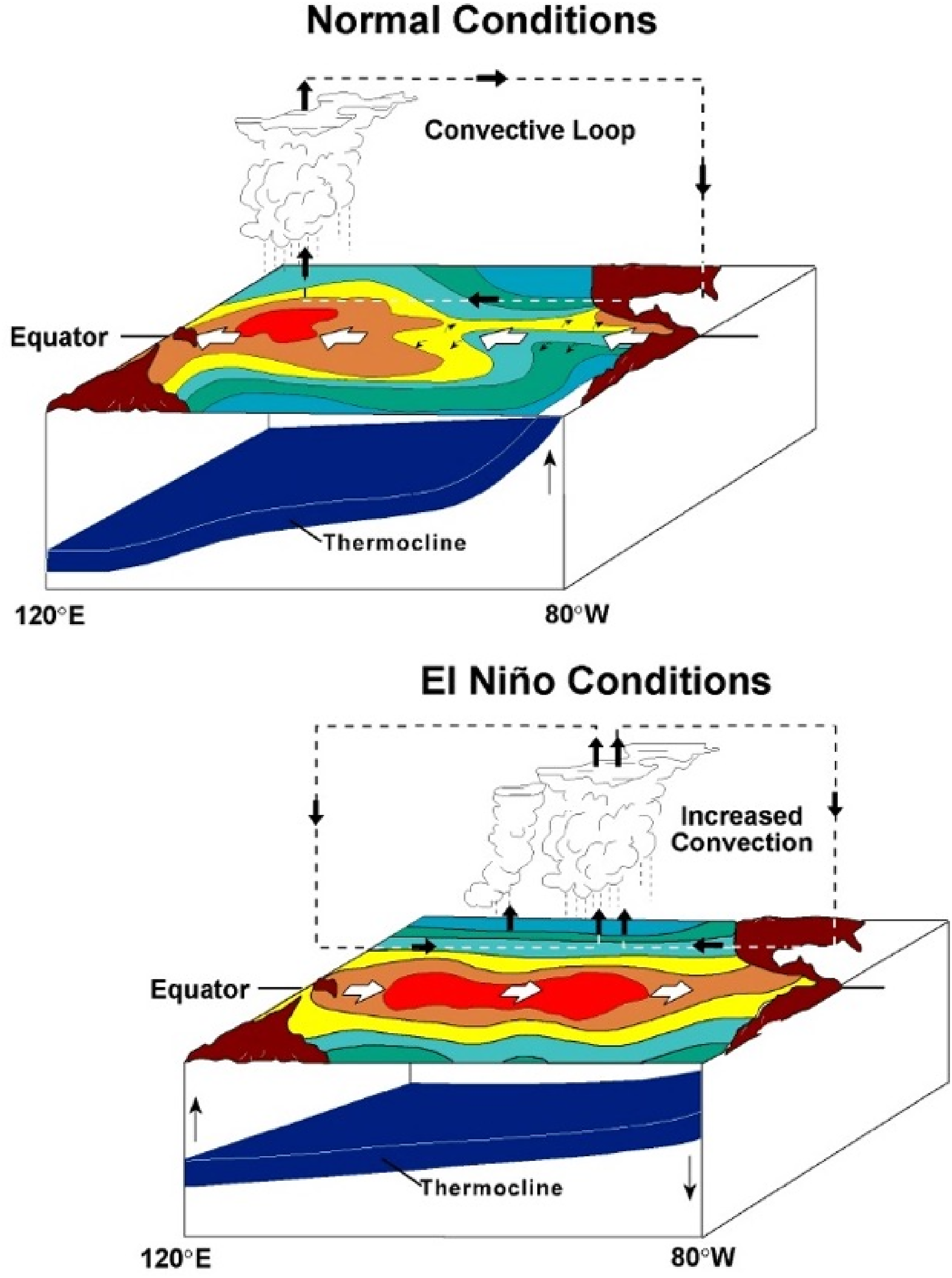
Conceptual diagram of the Walker Circulation under neutral and El Niño conditions. Image courtesy of NOAA Pacific Marine Environmental Laboratory, reproduced with permission.
Generation 2: c.1970 to c.2000
Bjerknes’s model catalysed greater scientific focus specifically on El Niño from the 1970s. Research at this time was particularly influenced by El Niño conditions in 1972–73 and 1976–77, both of which were linked contemporaneously to meteorological extremes across the Americas and Africa (Glantz, 2001). American scientists Klaus Wyrtki, Eugene Rasmusson and Thomas Carpenter built on Bjerknes’s model, the former accounting for the action of trade winds on sea level height (Wyrtki, 1973, 1975), and the latter jointly creating a composite of El Niño evolution based on six El Niños from 1951 to 1972 (Rasmusson and Carpenter, 1982). Their ‘canonical’ model of the ‘Southern Oscillation/El Niño’, remains one of the most highly cited papers within El Niño research, although the dynamical process that Rasmusson and Carpenter outlined has never been observed since. The El Niño of 1982–83 brought further impetus to El Niño research, being the first to receive media and government interest, partly because of the scientific failure to predict the event. This precipitated a shift in focus of the nascent Tropical Ocean Global Atmosphere (TOGA) project towards the equator, and El Niño in particular. 5
The TOGA project period (1985–1994) saw a huge increase in research dealing specifically with El Niño and the Southern Oscillation (referred to as ‘ENSO’ from 1985 (Yarnal, 1985)), including new observations from monitoring buoys and satellites, new theories of ENSO dynamics, the development ENSO forecasts (see McPhaden et al., 1998 and references therein), and new indices, notably the ‘Niño-1 + 2′ ‘Niño-3′, ‘Niño-4′, 6 and later ‘Niño-3.4′ index based on area-averaged equatorial SSTs (Barnston et al., 1997). 7 These allowed ENSO to be represented as discrete time series, precipitating a proliferation of studies that correlated ENSO with rainfall and temperature data elsewhere in the world (Kiladis and Diaz, 1989; Ropelewski and Halpert, 1987) – notably India, Southern Africa and the United States – and in proxies of past meteorological variability (see Gergis et al., 2006 and references therein). El Niño at this time increasingly came to be understood as one tail of the Pacific-wide ENSO phenomenon with widespread influence on tropical and extra-tropical weather patterns. Opposite ocean and atmosphere anomalies became formalised as ‘La Niña’ (Philander, 1985).
Developments in ENSO modelling and an increased focus on global meteorological variability led ENSO forecasts to be incorporated into a number of regional long-term precipitation projections (Orlove and Tosteson, 1999), coordinated by the newly-formed IRI and supported by new research that correlated central Pacific SSTs with socioeconomic indicators such as crop yields (Agrawala et al., 2001; Cane et al., 1994). Alongside the production of several statistical ENSO forecasts, the first dynamical model of ENSO was built at MIT in 1987 (Zebiak and Cane, 1987), deliberately designed to replicate the patterns of variability in the Rasmusson and Carpenter (1982) composite. 8 GCMs also increasingly began to represent ENSO dynamics (Ji et al., 1994; Latif et al., 1993), decisively shifting the scale at which ENSO was commonly represented towards the global (Höhler, 2017). This period saw the emergence of a ‘global assemblage’ of ENSO researchers, policymakers and disaster managers, connecting ‘El Niño researchers, program administrators, applications specialists … with elements of universal discourses of technoscience and development’ (Broad and Orlove, 2007: 287).
Generation 3: c.2000 onwards
The severe El Niño conditions of 1997–98 roughly marked the transition from the second to the third generation of El Niño researchers. Tracked in real-time by satellite data and successfully forecast several months before its peak, this ‘El Niño of the people’ (Glantz, 2015: 95) – so called because of the significance given to the event within popular culture – received widespread media coverage, particularly in the United States (Adamson, 2019; SA Changnon, 2000). The patterns of ocean variability revealed by satellites during the event became an archetype for El Niño (Höhler, 2017). Substantial growth in public interest led NOAA to push for an internationally-recognised operational definition of El Niño to provide a quantitative justification for the declaration of an ongoing event (see Adamson, 2022). 9 This was published in 2003 and adopted by the WMO in 2005 (NOAA, 2003, 2005). Subsequent work by Larkin and Harrison (2005) classified periods covered by the definition but not previously considered El Niños as Dateline El Niños, so called because of the location of maximum SST anomalies around the international dateline. Those that did not fit the definition but exhibited central Pacific warming were demarcated as pseudo (Modoki) El Niños (Ashok et al., 2007).
Several subsequent studies adopted statistical analysis and modelling to group late twentieth-century El Niños – and, often, La Niñas – into additional El Niño ‘flavours’: either ‘conventional’/‘Warm Pool’ (Kug et al., 2009) or ‘Central Pacific’ (Yu and Kim, 2010) types, or a mixture of the two (Karnauskas, 2013; Timmermann et al., 2018). The period also saw the isolation of other patterns of ENSO-like variability including the ‘thermally coupled Walker mode’ – which represents stochastic variability in the Southern Oscillation but with no ocean warming (Clement et al., 2011) – and ‘uncoupled warming’ years that conversely exhibit central Pacific warming but no atmospheric response (Hu et al., 2020). The Coastal (costero) El Niño type was defined in 2017 (Takahashi and Martínez, 2017), although the research that produced the definition predated the event, derived from ships’ logs SST data of the 1925 and 1891 El Niños. Conceptual models of ENSO dynamics also grew in number during the period; the ‘delayed oscillator’ model that was prevalent during the TOGA period (McCreary Jr and Anderson, 1984; Suarez and Schopf, 1988) 10 joined by the advective-reflective model (Picaut et al., 1997), the western Pacific oscillator (Weisberg and Wang, 1997) and the unified oscillator model (Wang, 2001), although none of these models could entirely explain the observed diversity in the ocean and atmosphere patterns of variability. 11
Many of the new flavours developed during the period were provided with their own quantitative indices and related time-series, calculated from the historical ocean and atmosphere data. This proliferated a number of research papers addressing relationships between the new indices and meteorological data from elsewhere in the world or in the past, including over 50 studies on the ‘unconventional’ ENSO types during the period between Ashok et al. (2007) and Karnauskas (2013). These studies explored the influence of ENSO flavours on meteorological variability in India, Australia and Antarctica, associated changes to ocean biology, and whether frequency or strength were changing over time due to anthropogenic warming or natural variability (see Karnauskas, 2013 and references therein). Forecasting skills, however, ‘plateaued’ during this period, 12 with most models incorrectly forecasting severe El Niños in 2012 and 2014 (Ludescher et al., 2014; McPhaden, 2015). At the same time, awareness of ENSO grew significantly, so that the next period exhibiting ‘severe’ El Niño conditions in 2015–16 received global interest, particularly from the development community (Glantz et al., 2018; IASC, 2018). This included the first use of forecast-based financing, using ENSO forecasts to release aid money in advance of anticipated disasters (Coughlan de Perez et al., 2015; Poterie et al., 2018), representing a new linkage between ENSO science, global finance and disaster management.
Path dependency in El Niño research
One of the most striking findings from the interviews conducted for this project was the degree to which scientists recognised definitions, framings and conceptualisations of ENSO to be partial, context-specific, and dependent on the question being asked and the purpose for which ENSO was being researched (see Adamson, 2022). Interviewees disagreed on whether El Niño should be considered a tail of ENSO variability or an ENSO event, whether ENSO is a Pacific phenomenon that affects other regions or a component of the holistic global atmosphere-ocean system, whether teleconnections are part of El Niño or caused by El Niño, and the best method for defining the phenomenon. Models were described as ‘human constructs’, with forecasts made using expert judgement as much as numerical model outputs. 13
In this section, I argue that the diversity in understanding El Niño is a symptom of its path-dependent nature. There are now at least eight variants of ENSO and its associated phenomena: the original El Niño current (now often called Fenómeno El Niño), warming of coastal Peru (coastal/costero El Niño), warming of the central and eastern Pacific (conventional/Cold Tongue/East Pacific El Niños), warming of the central Pacific (Modoki/Warm Pool/Central/Dateline El Niños), warming of the eastern Pacific (La Niña), warming of the central-eastern Pacific (La Niña Modoki), ocean warming without atmosphere response (uncoupled El Niño warming), and atmospheric variability without ocean response (thermally coupled Walker mode). Rather than being the last word on defining El Niño, the NOAA definition has proliferated an expansion, rather than convergence, in ENSO definitions. Whilst this paper does not set out to question the veracity of the science that underpins these definitions, I suggest here that the multiplication of ENSO definitions and ENSO types is a product of a desire to provide retrospective quantitative definitions to a phenomenon whose meaning has changed over time. Trenberth’s (1997: 2774) widely-cited El Niño quantitative definition of 1997, for example – which predates the NOAA-WMO definition but is also based on SST anomalies in the Niño 3.4 region – was designed to ‘match conventional wisdom as to what have historically been considered as events’. Furthermore, the dominance of NOAA’s definition has drawn El Niño towards NOAA’s institutional priorities, representing the latest stage in its path dependency.
The following section outlines the components of this path dependency. It is not meant to be exhaustive, but to summarise some of the key processes and institutions that have affected El Niño’s evolution from ‘an enchanting Peruvian current into a global climate hazard’ (Philander, 2006).
Commercial and interests
The term El Niño was taken from an annual event but morphed quickly due to institutional interest in its rarer, periodic manifestations. Research in the early 20th century was sponsored by commercial interests; Robert Cushman Murphy’s paper on the 1925 El Niño relied heavily on the support of the Compańía Administradora del Guano, an organisation unconcerned with an annual current but with a strong commercial interest in rarer events that could threaten the anchoveta fisheries and guano-producing seabirds that fed on them (Cushman, 2004b). Commercial interests funded the subsequent network of El Niño observers that Murphy developed, and precipitated the evolution of the term away from the annual water current and towards the rarer events.
An alignment of commercial and geopolitical interests also catalysed the renewed scientific attention on El Niño from the 1950s. The Comisión Interamericana del Atún Tropical (Inter-American Tropical Tuna Commission) funded Jacob Bjerknes’s work that led to the formulation of the Walker Circulation. The Comisión was also brought into a coordinate collaboration between the United States and Latin American countries in El Niño research from the 1950s to the 1970s. This research was funded through the U.S. National Science Foundation; in part, the result of a drive to spread U.S. soft power through scientific collaboration as part of the Alliance for Progress, an endeavour designed to develop new alliances with Latin American countries believed at risk of adopting communism, and demonstrate the progressive potential of Western science. The installation of El Niño monitoring infrastructure was also related to Cold War geopolitics, with Pacific monitoring buoys providing a secondary usage for detecting Soviet submarines (see Cushman, 2004a for a detailed exposition of U.S. institutional interests in El Niño during the Cold War). The discovery that El Niño events were associated with ocean changes beyond the Peruvian coast allowed El Niño research to further these interests, cementing the U.S. government’s focus on the phenomenon. This correspondingly elevated the scale at which El Niño was understood to the entire tropical Pacific. By 1975, ‘genuine’ El Niño years were described only as those that ‘come from a major alteration of the tropical circulation’ (Caviedes, 1975: 501).
Scientific institutions
El Niño research arguably became paradigmatic with the introduction of Bjerknes’s conceptual model, providing an exemplary theory around which researchers could coalesce. Seven of the 14 researchers interviewed for this study explicitly brought up Bjerknes’s model in interviews (without prompting), describing it as still essentially correct, if incomplete. 14 Scientists moved into El Niño research after the publication of the Walker Circulation, rebadging their previous research on upwelling or variation in the Humboldt current as El Niño, as Yalcintas (2011) has posited more generally for emerging paradigms that are becoming path dependent. 15 From the 1970s this included institutional interest from NOAA, attracted to El Niño research due to meteorological anomalies over North America that were associated with an El Niño event in 1976–77 (McPhaden, 2006). 16 Further institutional convergence around the concept of El Niño was brought with the failure to forecast the 1982–83 event and the subsequent hydrometeorological disasters in the United States that were blamed on it, re-focussing the nascent TOGA project towards the El Niño.
Conversely, the successful forecast of the 1997–98 El Niño and the concurrent formation of IRI drew attention to the apparent utility of El Niño forecasts and brought disaster managers into conversation with scientists. The implementation of forecasts created a self-reinforcing feedback loop. El Niño forecasting tools were developed precisely because atmosphere-ocean dynamics in the equatorial Pacific could be modelled, and their subsequent proliferation in commodities and disaster management then presented the phenomenon as something that needed to be forecast for economic or political reasons; essentially forecasting El Niño into existence. ENSO forecasts emerged in parallel with the growth in the profile of GCMs as a tool for understanding anthropogenic climate change, and each arguably reinforced the other by presenting climate as a phenomenon whose risks could be mediated using computer models. This also helped to shift the scale at which El Niño was commonly understood towards the global, aided by the development of new satellite tools that presented El Niño as SST and sea level variability extending across the Pacific and beyond (Höhler, 2017).
Media representation
Media coverage of El Niño began with the 1982–83 event and expanded considerably in 1997–98. Coverage within the American media in 1997–98 in particular extended El Niño’s reach, intensity and agency, presenting it as a destructive and omnipotent force, able to link otherwise apparently unconnected events (Sturken, 2001). American media blamed El Niño for ‘just about everything that has happened in the US’ in the winter of 1997–98 (Cleveland Plain Dealer 2 February 1998, cited in S Changnon, 2000), meteorological and otherwise, with the bumper sticker ‘Don’t blame me, blame El Niño!’ becoming briefly popular in California (Glantz, 2001). Media reports also further cemented the necessity of ENSO forecasts by presenting El Niño as a global scourge, whilst looking to science to solve the problems it purportedly created.
This ‘weather god’ image created by media formed a positive feedback loop within subsequent ENSO science. The scientists interviewed for this project discussed the 1997–98 El Niño regularly and often without prompting, with at least one younger researcher stating that media reports were their first introduction to the phenomenon as a child. 17 Scientists within the third generation of ENSO researchers thus came to research with an a priori understanding that tropical Pacific variability represents ENSO, 18 reinforced by their early experiences of El Niño in 1997–98. Similarly, scientists in the second generation had an a priori understanding that flooding and disruption to coastal flooding in Peru were caused by a phenomenon called El Niño, and that this phenomenon had a signature that extended across the equatorial Pacific. It is notable, therefore, that a recent historical analysis of SST data in ships logs suggests that the 1925 and 1891 El Niños also showed conditions similar to those seen in 2017, and would likely be described today as costero events (Takahashi and Martínez, 2017).
Personalisation and gendering
Media interest in ENSO has been partly enabled by the personalisation afforded by the anthropomorphic names ‘El Niño’ and ‘La Niña’. The ‘exotic and Latin’ connotation of these terms in the Anglophone world has reinforced their perception as distinct entities; Othered, and with the agency to change weather and bring destruction around the world (Grove and Adamson, 2018a). The introduction of the term ‘La Niña’ in the 1980s in particular, reinforced this personification, its designation as a distinct phenomenon both a result of El Niño’s path dependency and a contributor to it. The degree of scientific and media interest in El Niño has provided strong incentives to isolate other, similar phenomena – as witnessed by the proliferation of ENSO flavours – and hence conditions with anomalies showing the opposite sign to El Niño have been defined as distinct entities since Barnett’s (1977) use of the term ‘anti-El Niño’ in the 1970s. Yet while Barnett (1977: 634) stated that ‘El Niño (warm water) or anti-El Niño (cold water) are well documented in Peru’, this was only ever true for the ‘warm water’ events. The isolation of inverse events is largely a product of particular ways of representing Pacific ocean-atmosphere variability, either as the spatial variation between the east and west Pacific with the central Pacific forming a zero point, or as time series of anomalies. For example, the figures presented by Philander (1985) in the first paper to mention ‘La Niña’ – reproduced here in Figure 2 – led Philander to conclude that ‘the tropical Pacific is very seldom in a “normal state”’ (Philander, 1985: 2652). The veracity of this statement derives from an assumption that the ‘normal state’ is synonymous with the mean, an assumption that will necessarily create equal positive and negative anomalies. As one NCAR researcher explained in an interview: I think certainly one can categorise the El Niño state as an event, because it really is a disruption of the natural, the more typical airflow patterns and current-flow patterns that exist in the tropical Pacific. La Niña may be a kind of gradation on climate variability in there. But since we’ve isolated one phase as an event, the climatology around such events demands there be a negative phase of the phenomena … Because we’ve said that this is the anomaly, this is the positive anomaly, so in order to get climatology and El Niño as a positive anomaly there has to be a commensurate negative anomaly.
19
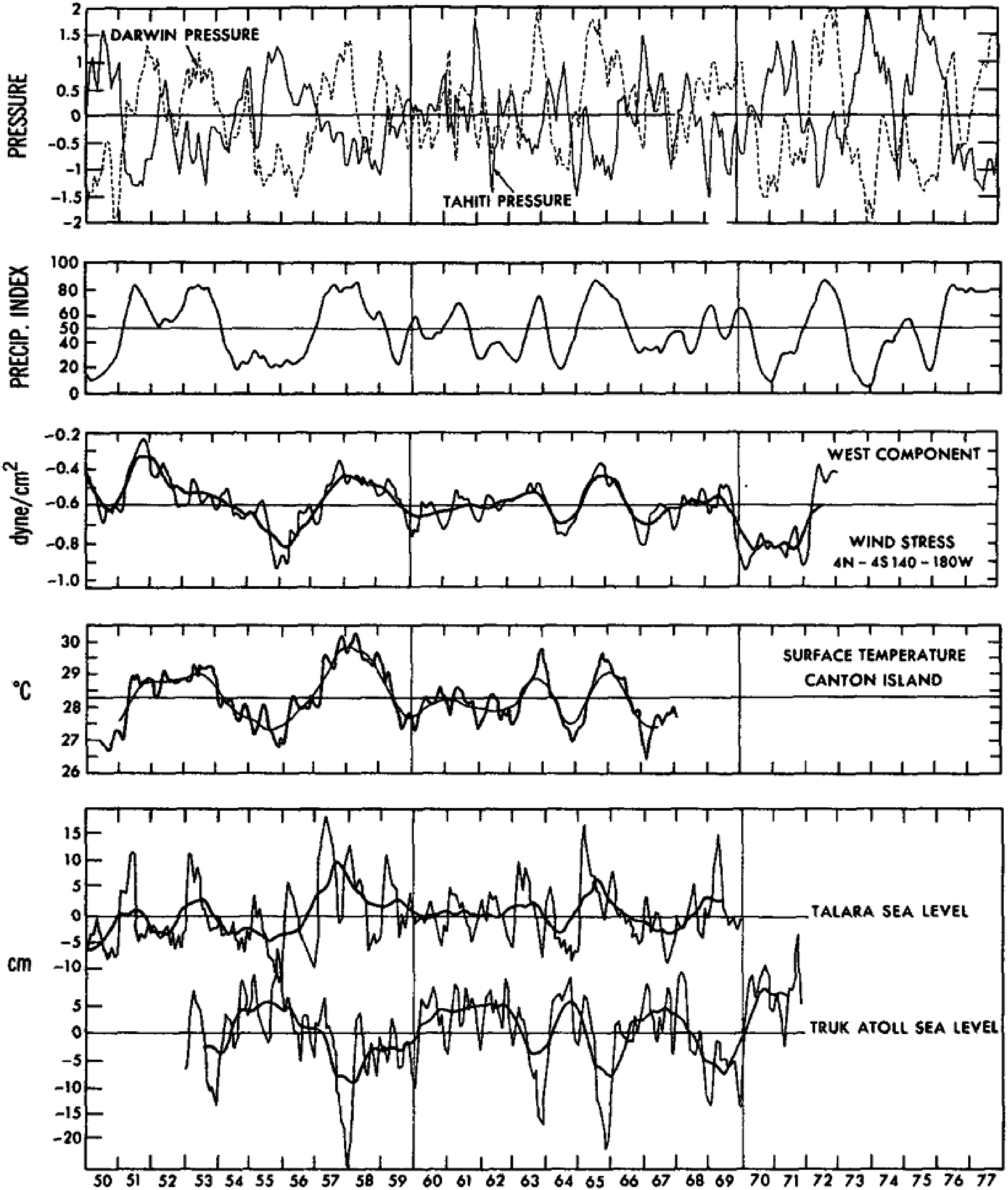
Three-month means of pressure anomalies, precipitation for Ocean and Nauru Islands, zonal wind stress, SST at Canton Island and sea level at Talara and Truk Atoll, as presented in Philander (1985: 2653).
Definitions of La Niña reflect this a priori assumption that the phenomenon is El Niño’s inverse, although early assumptions that La Niña teleconnection patterns were opposite to El Niño have been shown to be false in several ways. 20 This assumption reflects La Niña terminology, which often mirrors that of El Niño. There are ‘weak, moderate and strong’ El Niños and La Niñas, from which are derived ‘El Niño ready nations’ (elninoreadynations.com, n.d.) and ‘La Niña ready nations’ (laninareadynations.com, n.d.). The paper that introduced El Niño Modoki also introduced a La Niña Modoki (Ashok et al., 2007), although the isolation of distinct ‘flavours’ of La Niña has since been challenged (Timmermann et al., 2018).
As well as ‘anti-El Niño’ (Barnett, 1977), other suggested names have included ‘cold events’ (Kiladis and Diaz, 1989) and ‘El Viejo’ (Meyers and O’Brien, 1995). ‘La Niña’ gained acceptance in the 1990s following the popularity of the edited collection ‘El Niño, La Niña and the Southern Oscillation’ (Philander, 1989) 21 and widespread media usage of the term in 1999 after the 1997–98 El Niño (Glantz, 2002). Miller (2007) argues that the eventual dominance of this term can be explained at least in part by gendered norms in society. La Niña and El Niño match hierarchical and patriarchal dualisms that are common in western science, with one element assumed to be dominant over the other (Miller, 2007). El Niño and La Niña reflect ‘long-held cultural tenets’ that ‘things hot and dry – the sun, for example – [are] considered masculine, while things cold and moist – like the moon, or western regions of the earth – [are] thought of as feminine’ (Schiebinger, 2004: 38). Thus La Niña, as well as being a clear example of a path dependency itself, also serves to reinforce the path dependency of El Niño and ENSO. The idea of masculine and feminine elements in ENSO reflects norms in society, strengthening the idea that both El Niño and La Niña exist as distinct phenomena. This has also created the ‘very mistaken notion that El Niño is bad, and La Niña by implication is not so bad’. 22
El Niño without ‘El Niño’?
The previous sections of this paper have outlined the history of El Niño science, and the processes and actors that have contributed to the direction of its path dependency. Generations of scientists have coalesced around El Niño, aided by the interests of powerful and well-resourced institutions and by gendered norms in society that make it easy to relate to the terms ‘El Niño’ and ‘La Niña’. As the concept has evolved, its meaning has changed over time. David (1994) has written of how the ‘codes’ that are important for institutional functionality can encourage path dependency, and research on Pacific ocean-atmosphere variability has several such codes, which unite the aforementioned global assemblage of researchers and practitioners. These codes – which include El Niño and the Walker Circulation themselves, as well as Bjerknes feedback, teleconnection, cold tongue, Modoki, and so on – tie researchers and practitioners to the idea that Pacific diversity is El Niño.
The following section considers what ocean and atmosphere research, and associated disaster management, would look like without El Niño. At the centre of this is a counter-historical, presented in Table 1. This derives from a detailed review of the published literature on El Niño, the Southern Oscillation and ENSO since it was first codified in the 1890s. The left-hand column presents a summary of the dominant definition of the phenomenon/phenomena during a particular period in the history of research thereon, together with key papers that outlined this definition at the time. This column summarises the definition and presents a short list of key papers. The right-hand column, conversely, presents the same research but without the use of the terms El Niño, ENSO, La Niña, or their variants.
It is important to note that, whilst the right-hand column has been generated for this paper, both the left- and right-hand columns would have been considered scientifically correct at the time in question. As the table demonstrates, all of the advancements in the understanding of Pacific ocean-atmosphere dynamics – and associated variability in circulation patterns and meteorological variability around the world – that have been researched during the last 130 years, could be explained without recourse to El Niño. The only difference between the two columns is that the left-hand column includes El Niño and the right-hand column does not. The left-hand column represents the activities of El Niño; the right-hand column represents complex patterns of ocean and atmosphere variability across the Pacific and beyond. The left-hand column represents atmospheric and ocean science with an a priori assumption that the patterns of variability in question have a unifying causal mechanism; the right-hand column describes phenomena that may or may not be related.
The counter-historical presented in Table 1 shows that our present understanding of ocean-atmosphere dynamics does not require the badge of El Niño, and in fact this has always been the case. The patchwork of ocean current, SST, sea-level, meteorological and biological variability that make up the phenomenon that is currently called El Niño occur independent of whether or not they are classified as such. They can be researched and understood – either through science or other knowledge – without the concept of El Niño or any of its variants. Disaster managers do not require El Niño to respond to them, and forecasts – either of large-scale seasonal Pacific variability or regional meteorological forecasts – do not need to be forecasts of El Niño, either to maintain their functionality or useability. 23 It would be possible, therefore, to take ocean-atmosphere science and disaster management forward without El Niño.
El Niño research with and without El Niño.
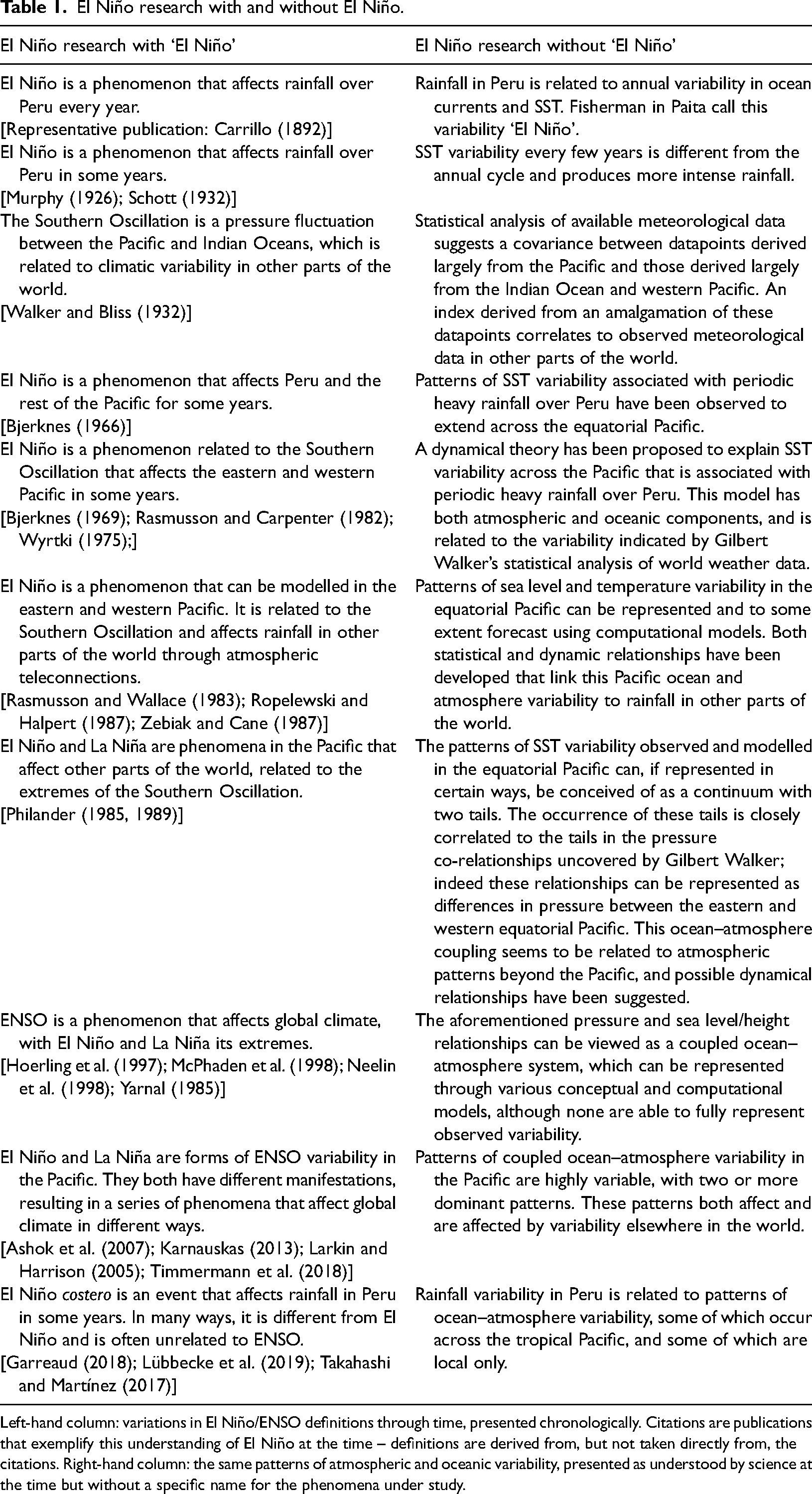
Left-hand column: variations in El Niño/ENSO definitions through time, presented chronologically. Citations are publications that exemplify this understanding of El Niño at the time – definitions are derived from, but not taken directly from, the citations. Right-hand column: the same patterns of atmospheric and oceanic variability, presented as understood by science at the time but without a specific name for the phenomena under study.
The purpose of generating this table is not to provide a plausible alternative history of Pacific ocean-atmosphere research without El Niño. Given the path dependencies detailed here, it is unlikely that science would have proceeded in this way, had the concept of El Niño not existed to draw institutions towards it, for all the reasons laid out in this paper. The commercial and geopolitical importance of the eastern Pacific may have been sufficient to maintain an interest in coupled oceanic and atmospheric variability in the region. However, the Bjerknes model may never have been developed, the focus of TOGA may have been different, early computational models may have focussed on other problems. The entire history of atmospheric and oceanic sciences in the twentieth century would have then been different. This would not necessarily have led to more desirable outcomes; El Niño has drawn different academic disciplines towards research on climate variability and associated hazards, and research on the phenomenon has had several co-benefits. The phenomenon is an ‘integrating concept’ that links ‘a range of disciplines in the Earth and related social sciences’ with ‘economic development, public welfare, and responsible stewardship of the Earth’s limited resources’ (McPhaden et al., 2006: 1744). El Niño and La Niña are concepts that are well-recognised, giving ‘people a sense that they have some control or influence over what the weather and climate does to them.’ 24 The declaration of an ongoing El Niño event is sufficient to raise substantial aid funding, and mobilise disaster managers and development organisations. It has been well documented that countries look to the impacts of previous El Niños to prepare for future anticipated events (Broad et al., 2002; Orlove and Tosteson, 1999; Poterie et al., 2018).
Yet as we have seen, badging patterns of variability as El Niño can have significant unintended negative consequences. El Niño’s are expected to exhibit predictable ‘behaviour’; Nature described the 2015–16 El Niño as ‘don[ning] a winter disguise as La Niña’ (Cohen, 2016) due to the absence of heavy rainfall in southern California, as had occurred in 1998. Similarly, El Niño ‘play[ed] hide and seek’ due to its appearance in 2015, and not in 2014 as had been widely forecast (McPhaden, 2015). Failure to exhibit these behaviours can reduce trust in expertise as well as creating confusion. Similarly, whilst the expectations of forthcoming El Niño-like meteorological variability can be a powerful motivator for action, this can confuse the probabilistic forecasts produced during El Niño events. For example, forecasts of a forthcoming El Niño in 1997 led farmers in several countries to be denied agricultural loans, on the basis of anticipated droughts that proved in some cases to be less severe than expected (Agrawala et al., 2001; Orlove and Tosteson, 1999; Philander, 2006). Perhaps the clearest example of the failure of both ENSO forecasts and definitions concerns the 2017 flood in Peru, which formed the introduction to this paper. This was an El-Niño-that-wasn’t: under all definitions of El Niño up to at least the 1950s the anomalous warm water observed off coastal Peru and associated flooding would have been considered as El Niño conditions. 25 Yet it was not categorised as such under the NOAA definition, due to an absence of SST anomalies in the central Pacific, and hence flooding was not anticipated. The absence of elevated rainfall in Peru during El Niño conditions in 2015–16 – considered a severe El Niño under the NOAA definition – exacerbated this lack of preparedness. El Niño forecasts in 2015 mobilised disaster preparedness activities, but the absence of any flooding contributed to a false sense of security over the impact of future events and an erosion of trust in disaster management expertise (Ramírez and Briones, 2017).
Appreciating El Niño’s path dependency could then go some way towards reducing these ‘shadow-forecasts’ that come with expectations of how El Niño will behave. Acknowledging El Niño as a constructed phenomenon with path-dependent properties also draws attention to which groups and institutions get to define what El Niño is; that is, El Niño’s ‘ontological politics’ (Mol, 1999). The most influential forecasts – and hence the most influential conceptualisations of the phenomenon – are currently those produced by the meteorological agencies in Japan, Australia and the United States. The NOAA definition is by far the most dominant, due to NOAA’s international influence and its adoption by the WMO. Yet other El Niños exist or have become lost over time. Countries like Peru are now reliant on conceptualisations of El Niño that have emerged through the interests of institutions based outside of the country, and these generally do not define El Niño based on its impacts in Peru. Appreciating that El Niño is path-dependent helps to reveal that NOAA’s understanding of El Niño is not universally ‘correct’; rather, it is one El Niño that has gained dominance over others as the dominant meaning of the phenomenon has evolved, in a large part in response to the institutions discussed in the Path dependency in El Niño research section of this paper. To the Peruvian coastal communities who continue to assign ‘El Niño’ to an annual water current that has cultural significance for them (Allan et al., 1996), both the national and institutions on whom they rely have a very different understanding of the phenomenon.
A recognition of El Niño’s ontological politics therefore draws attention to which El Niños are being produced, and the agency that they hold. This is true of the El Niños created beyond science. Media and political discourse are primarily responsible for the personification and Othering of the phenomenon (as well as, to a certain extent, science). There is evidence that governments in Ethiopia (Blench and Marriage, 1998), the Philippines (Bankoff, 2004) and Peru (Broad and Orlove, 2007) have used the idea of a personalised El Niño to cover up their own failings in disaster management. No doubt other examples exist outside of the peer-reviewed literature. It would be pertinent to trace the origin and agency of these particular framings of El Niño and how they become agents of blame, and to draw attention to how they are constructed. An idealistic goal in this endeavour would be to encourage greater nuance in reporting meteorological variability, so that it accepts that El Niño is a shifting concept that reflects the interest of certain institutions more than others, and does not attribute all unusual weather to an omnipotent weather god. Whilst this may reduce the efficacy that a declaration of El Niño has in mobilising disaster and development aid, it would also remove the apparent belief that El Niño years are uniquely disaster-prone, ensuring that El Niño years do not then monopolise available funding.
As well as benefits for disaster management and the politics of blame, recognising that El Niño is path-dependent may also have a liberating effect on science. Freeing ocean and atmosphere research from the constraints and incentives provided by a focus on El Niño could potentially open new possibilities for understanding the Earth’s physical processes, without an a priori expectation that some patterns of variability fall within a particular dynamical umbrella. This could open horizons for new and novel ways of understanding ocean and atmosphere dynamics, a particularly important goal in the context of anthropogenic climate change. One area where this may have a particular impact is palaeoscience, where ENSO tends to dominate research, particularly in the Pacific. At present, reconstructions of Pacific meteorological or ocean variability revealed through tree rings or corals are invariably badged as ENSO reconstructions (see for example D’Arrigo et al., 2006; Evans et al., 1999; Linsley et al., 2000), limiting the possibility for understanding more nuanced patterns of variability.
Similarly, extracting El Niño from our understanding of the global oceans and atmosphere draws attention towards the meteorological hazards and disruption to access to commodities associated with ENSO variability, rather than El Niño itself. A focus on forecasting Peruvian flooding, for example, rather than ‘El Niño’, would avoid much of the confusion seen in 2017, which could have gone some way towards increasing preparedness for the devastating floods. Forecasts of central Pacific SST and variability can be presented as such, and probabilistic regional forecasts can still be produced from them without recourse to El Niño. The term could then be left as a description of a warm-water current affecting northern Peru, as it was originally meant by the fishermen who named it.
Concluding remarks
The historical narrative and argument developed here demonstrate that understanding variability in phenomena called ‘El Niño’ or ‘ENSO’ is not necessary to understand the hydrometeorological variability that they represent; rather, they are path-dependent labels applied to an evolving diversity of related phenomena. Science may – of course – eventually show that these are indeed different versions of a single phenomenon, with a single underlying theory that explains their diversity. However, the current trajectory is towards fragmentation, rather than convergence. At the very least there should be a wider recognition that there are many scientific questions that are unresolved, and some of the claims are made using very sparse data. The Pacific is a poorly-sampled system; only a handful of ‘severe El Niños’ have ever been observed, and if ocean-atmosphere diversity is divided further into ENSO flavours, the numbers are even fewer. 26 Understanding the diversity of Pacific ocean-atmosphere patterns over time therefore represents an ongoing experiment. Any new analyses of historical data that purport to have isolated new patterns of variability should be presented as hypotheses that can only be confirmed via further observations, rather than the discovery of a new El Niño variant. Scientific communication with media should also reflect the ongoing nature of this experiment.
As this paper has argued, the labels El Niño, La Niña, ENSO and so on are unnecessary to explain ocean-atmosphere dynamics. Yet moving away from them may be difficult; path-dependencies are by their nature difficult to dislodge. Should it prove too difficult to move away from these badges, this paper has suggested turning attention to El Niño’s ontological politics. Although one NCAR scientist interviewed for this study described El Niño and La Niña as providing ‘a very good blanket synopsis of what might be more likely to happen’, 27 clearly the terms do not provide a ‘good blanket synopsis’ for all, as evidenced by the situation in Northern Peru in 2017. It would be prudent therefore to turn attention to exactly who is interested in ‘El Niño’, how they define it and for what purpose, and those who benefit from their conceptualisation of the phenomenon. Appreciating which El Niños dominate and for whom is a question that is paramount if we are to avoid confusion as occurred in 2017 and hence more serious societal consequences.
The focus on science and media in this paper has partly reflected the focus of the current literature. Histories from those who used the forecasts, or who have understood El Niño in different ways over time, have generally not yet been written. Future work on El Niño’s ontological politics should include attention to the agency that El Niño holds within the development and disaster management community. This would allow for a deeper understanding both of the historical path that the concept of El Niño has taken and its contemporary ontological politics. Moreover, the implications of ‘The Boy’ and ‘The Girl’ in Spanish-speaking countries are likely to be very different from those of El Niño and La Niña in the Anglophone world. Turning attention to the history and discourses associated with El Niño outside of the Anglophone world would help to illuminate the interrelationship between ENSO scientists – generally in the United States and other global North countries – and disaster managers in these regions, which have primarily been explored for this study from the perspective of the United States. This paper has drawn particular attention to Peru; the same is true of other countries outside of the well-resourced global North that are considered vulnerable to El Niño variability and its associated hazards.
Highlights
The badge ‘El Niño’ has been applied to a diverse and evolving set of ocean-atmosphere patterns over time.
This is a result of the phenomenon’s path dependency.
The paper demonstrates that ‘El Niño’ is not necessary to explain these patterns.
The implications of this for disaster management and the politics of blame are explored.
Footnotes
Acknowledgements
The author would like to thank Matthew Hannaford and Michael Mikulewicz for comments on an earlier draft of the paper, and Michael H. Glantz for support in organising the interviews and hosting the author in Boulder, CO. The author is grateful to the three anonymous authors, whose close reading and generous comments improved the manuscript considerably.
Declaration of conflicting interests
The author(s) declared no potential conflicts of interest with respect to the research, authorship, and/or publication of this article.
Funding
The author(s) disclosed receipt of the following financial support for the research, authorship, and/or publication of this article: Interviews for this project were funded through the Royal Geographical Society (with Institute of British Geographers) Small Grant SRG 21/16.
