




Abstract
Assumptions of trust in water systems are widespread in higher-income countries, often linked to expectations of “modern water.” The current literature on water and trust also tends to reinforce a technoscientific approach, emphasizing the importance of aligning water user perceptions with expert assessments. Although such approaches can be useful to document instances of distrust, they often fail to explain why patterns differ over time, and across contexts and populations. Addressing these shortcomings, we offer a relational approach focused on the trustworthiness of hydro-social systems to contextualize water-trust dynamics in relation to broader practices and contexts. In doing so, we investigate three high-profile water crises in North America where examples of distrust are prevalent: Flint, Michigan; Kashechewan First Nation; and the Navajo Nation. Through our theoretical and empirical examination, we offer insights on these dynamics and find that distrust may at times be a warranted and understandable response to experiences of water insecurity and injustice. We examine the interconnected experiences of marginality and inequity, ontological and epistemological injustice, unequal governance and politics, and histories of water insecurity and harm as potential contributors to untrustworthiness in hydro-social systems. We close with recommendations for future directions to better understand water-trust dynamics and address water insecurity.
Keywords
Introduction to trust and water security
There is a widespread, yet mistaken, belief that residents in higher-income countries need not be concerned with household water insecurity (See Meehan et al., 2020a). 1 The assumption of universal water security often flows from the “modern infrastructural ideal,” which suggests that water infrastructure networks and services are uniformly delivered to all people, at a similar cost across cities and regions (Furlong, 2014; Graham et al., 2002). Embedded within this ideal is the assumption that hydro-social systems—including water experts, infrastructures, and governance systems—operate effectively and fairly across diverse contexts and populations. Through such a lens, public trust in water quality and reliability should follow naturally from the functioning of the hydro-social system. Yet, recent studies show that tap water is not universally trusted in high-income countries, regardless of compliance with regulatory drinking water standards. At the same time, bottled water usage is on the rise; a trend is driven by tap water avoidance in some segments of the population (e.g. children from racialized, low-income and low-education communities) (Allaire et al., 2019; de França Doria, 2006; Felton, 2019; Fragkou and McEvoy, 2016; Morckel and Terzano, 2019; Rosinger and Young, 2020).
Within frameworks that follow technoscientific assumptions of water security and universal assumptions of “modern water,” lack of trust in these systems is often presented as an obstacle to be overcome. Yet, distrust of hydro-social systems is less puzzling when we recognize that these systems do not function as smoothly as they may purport. Racialized, low-income, and Indigenous communities, in particular, are prone to the breakdown of water infrastructures, long-standing and widespread water contamination events, drinking water violations, and lapses in the enforcement of safe drinking water policies, a global trend that is also acute in higher-income countries (Arsenault et al., 2018; Fedinick et al., 2019; Meehan et al., 2020a; Mendoza, 2019; Olson and Fedinick, 2016; Switzer and Teodoro, 2017; Ungar and Nichols, 2016). These failures in water delivery systems can cause significant harm to public health (Edwards, 2014; Edwards et al., 2009; Grey, 2001; Hanna-Attisha et al., 2016; Mac Kenzie et al., 1994). High water bills and the persistent threat of water shutoffs also render water provision unstable within such communities. In light of such realities, there have been growing public mobilizations for clean, affordable, and accessible water in higher-income countries, including initiatives demanding the enactment of stronger regulatory protections against lead in water and urging the adoption of state and national moratoria on water shutoffs (Food and Water Watch, 2020; Ignaczak, 2020; Lead-in-Water Grassroots Coalition, 2020; Meehan et al., 2020a; Pauli, 2019).
In what follows, we explore the disconnect between the presumed universality of water security in higher-income countries and dynamics of water-user distrust. We argue for a shift away from technoscientific approaches that minimize the relevance of understanding this distrust in favor of a relational approach that focuses on water system trustworthiness. Beyond documenting the existence of distrust, we aim to consider the broader array of considerations that contribute to water-trust dynamics in specific times and places. Within this framework, we shift the analytical focus to highlight longer, and often unequal and unjust, histories and contextual relations that might enable understandings of “trustworthiness,” including as an indication of systemic failure. This approach, we believe, is better suited to identifying hydro-social factors that contribute to distrust across different time frames, locations, and populations with potential application in policy to improve water security for all.
To achieve this, we first engage with theories of trust and trustworthiness and critically review their application within the current water-trust literature. We then turn to the implications of these ideas for water security, including a brief evaluation of three case examples. In doing so, we further illustrate and provide insights into both complex water-trust dynamics and the need to reframe our focus toward the trustworthiness of institutions and practices in the water security realm.
Trust, distrust, and trustworthiness in the context of water insecurity
Although definitions vary, trust is generally understood as a process of deferring with comfort and confidence to others about something beyond our knowledge or control (Whyte and Crease, 2010). This often occurs in a context of vulnerability whereby there might be perceived or actual harm that individuals, groups, or institutions can inflict, or that others might face as a consequence of trusting advice or actions of those entities (Levi, 1998; Whyte and Crease, 2010). Although we infrequently have a choice about the water systems we rely on, we can choose whether to trust or distrust the actors, knowledge systems, institutions, and infrastructures which comprise them.
In line with Meehan and others (2020a), we argue that prevailing conceptions of trust in tap water are linked with the myth of “modern water” and its associated modern infrastructural ideal. “Modern water” refers to water solely as H2O, or as a universal compound stripped of social meaning and contextual specificity. This notion is in opposition to relational conceptualizations of water as hydro-social—as both intimately connected to social-cultural and political dynamics (Linton, 2010) and, building on political-ecological scholarship, requiring careful tracing of water politics and inequality (Swyngedouw, 2009; Budds and Sultana, 2013; Harris, 2015). Many have noted that the rise of technoscientific and modern water paradigms in the early 20th century promoted the myopic understanding of water as a resource merely to be controlled, managed, and made available for human exploitation (Groenfeldt, 2013; Linton, 2010; McGregor, 2014; Strang, 2004; Wilson and Inkster, 2018). Following this historical trajectory, we assert that water user trust in part stems from a sustained belief in the modern water ideal. To a large extent, trust in abstract systems and institutions that privilege expert assessments over local knowledge is often a requirement of modern institutions (Beck, 1994; Beck et al., 1992; Giddens, 1990)—a phenomenon referred to as “epistemic dependence” (Hardwig, 1985). In the case of water systems, trust is generally understood as an important contributor to the smooth operation of water systems (e.g. de França Doria, 2010; Fragkou and McEvoy, 2016; Switzer and Teodoro, 2017; Yang and Faust, 2019). For instance, de França Doria (2010) notes that understanding water user perceptions, including trust, can improve the management of water systems.
In short, a feature of modern water and associated technoscientific systems and practices is the expectation that water users should inherently trust in systems of knowledge, expertise, and technology. With such a framing, instances of distrust are readily interpreted as a lack of knowledge or appreciation on the part of individual water users rather than an indication of a systemic failure. For instance, a sense that people need to be convinced that water is safe, or informed of the technical parameters of safe water delivery, or expertise of those responsible for water delivery, and trust should then follow. In this paper, we aim to investigate these water-trust dynamics to reveal important considerations for contemporary debates in water security and water governance. In particular, we explore the interconnections between water user distrust and historical, sociopolitical, and legal inequalities as well as ontological and epistemological diversity among the populations served by those institutions and practices. We suggest there is a clear need for alternative understandings beyond approaches that attribute distrust to misperception or knowledge deficits among users, and accordingly, something to be overcome by efforts to align water user perceptions with expert assessments (Wynne, 1995). A relational approach allows us to consider ways that distrust is not simply the opposite of trust (Luhmann, 2000) but can also stem from the informed and “confident belief that other individuals, groups, or institutions will not act as justice requires” (Krishnamurthy, 2015: 397). 2 In contexts of water insecurity and injustice, we propose that distrust can be a warranted response and an effective barometer of water systems’ ineffectiveness in meeting the needs of diverse water users. To achieve this shift, we propose replacing a flat and ahistorical notion of trust in water with a more dynamic evaluation of the trustworthiness of the individuals, networks, and institutions treating, delivering, and regulating water. Although there is no commonly accepted definition of trustworthiness, it is generally understood that a trustee should have (1) competence or the skills and abilities required to act within a specific context, (2) benevolence or acting without self-interest and in the best interests of the trustor, and (3) integrity or fidelity to a set of rules or principles that are acceptable to the trustor (Hendriks et al., 2016; Whyte and Crease, 2010). Importantly, perceptions of trustworthiness can and do shift. Changing circumstances can influence trust in different experts and institutions. As such, trust is often very fragile—one mishap can destroy trust in an instant, taking decades to rebuild (Slovic, 1993: 675–7)—if it can be rebuilt at all. This orientation toward trustworthiness provides a sensibility related to the diverse factors involved, as well as a sense that associated levels of trust must be continually be earned and negotiated (Levi and Stoker, 2000).
All such shifts have important analytical implications for water-trust dynamics. Among them, we can focus on how perceptions of trustworthiness are not just products of individual psychology but are also actively shaped by evidence of trustworthiness. As such, this approach has the potential to open understandings related to histories of institutional injustice, evidence of present-day sexism, racism, and classism, or dramatic instances of system breakdown that might give rise to the conclusion that experts and the systems they oversee are less than fully trustworthy. To illustrate this dynamic, the paper offers three case examples of communities in North America that have experienced high-profile water crises: Flint, Michigan; Kashechewan First Nation; and the Navajo Nation. These case examples show that interrogating the trustworthiness of water systems can bring to light social inequities, governance failures, and other key factors that pinpoint complex dynamics between water insecurities and distrust. First, however, we offer a critical overview of the state of knowledge on trust, water security, and governance in North America and also sketch a conceptual framework highlighting diverse factors that are likely to be important in water-trustworthiness dynamics.
State of the knowledge on water and trust in North America
Perhaps the most long-established and consistent finding in the literature is that trust in tap water is influenced by water’s sensory qualities, collectively known as “organoleptic characteristics” that include smell, taste, color, and turbidity. Trust in tap water is shaped by an individual’s organoleptic sensitivity, risk perception, and attitudes toward chemicals (de França Doria, 2010; de França Doria et al., 2005; Grupper et al., 2021).
Second, higher degrees of lingering distrust often result from severe tap water quality deficiencies. For instance, years after an algal bloom in 2014 in Toledo, Ohio’s water supply (Lake Erie‘s western basin), during which public health orders instructed people not to drink or even touch the resulting murky and green water tap water, residents reported remaining skeptical about the quality and safety of their tap water (Alliance for the Great Lakes, 2019). Similarly, work in the United States highlights that recent Latinx immigrants who had negative experiences with water quality in earlier locales of residence in Latin America were less likely to trust the water in their new homes (Hobson et al., 2007). As we demonstrate in our case examples below, experience with previous water insecurity also tends to mirror larger patterns of environmental injustice, which are well-established across environmental health domains, often along with the lines of race, class, and ethnicity (Corlin et al., 2016; Cushing et al., 2015; Pulido, 2016).
Third, closely linked to the above, trust in water is connected to broader histories of marginalization rather than solely linked with characteristics of water, per se. Research to date has shown that marginalized people (e.g. along with the lines of ethnicity, race, class, citizenship, etc.) often have lower levels of trust in public agencies and services more generally (Hobson et al., 2007; Pierce and Gonzalez, 2017a). In the United States, being a member of a racial or ethnic minority group (Hobson et al., 2007; Javidi and Pierce, 2018; Onufrak et al., 2014b), especially if one is an immigrant (Pierce and Gonzalez, 2017a), is strongly correlated with higher distrust in water sources. Being female and having lower educational attainment are also contributing factors, but generally less important than ethnicity, race, and citizenship (Pierce and Gonzalez, 2017a). In one study, distrust in tap water was shown to result in increased tap water avoidance among non-white populations including Latinx, African Americans, and other minorities. Further, it was also associated with increased consumption of sugar-sweetened beverages among Latinx populations (Onufrak et al., 2014b). Indigenous communities are similarly less likely to trust tap water (Spence and Walters, 2012; Wilson et al., 2019). As we explore more fully below, this is in part due to poor water conditions, experiences of poor water and ill-health associated with water insecurity, as well as broader experiences of settler-colonial injustice including epistemic marginalization (Mitchell, 2019; Wilson et al., 2021). As such, distrust in such instances is likely linked to failures of the water system per se (especially concerning those populations) but also broader histories and experiences of injustice and marginality.
Distrust in water can have negative health consequences, regardless of the quality of water. One increasingly well-documented consequence is mental ill-health, including anxiety and depression (Wutich et al., 2020), which can be linked to senses of inequity as much if not more than as it is a function of water insecurity (Wutich and Ragsdale, 2008). As well, water contamination is often associated with emotional distress in Flint, Michigan (Cuthbertson et al., 2016; Fortenberry et al., 2018; Sneed et al., 2020) and in colonias in Texas (Jepson, 2014; Jepson and Vandewalle, 2016). Although distrust is not the only reason for tap water avoidance, it is clear that lower consumption of tap water is to be associated with higher consumption of sugar-sweetened beverages and related health concerns (Onufrak et al., 2014b; Onufrak et al., 2014a; Rosinger et al., 2019).
Beyond modern water and technoscientific trust
Based on this review, and in conversation with the theoretical considerations highlighted, we find at least two important limitations of the present literature on water and trust. First, we find a dominant focus on technoscientific or cognitivist understandings of trust. Technoscientific trust generally compares the “objective facts” as produced by “experts” to the subjective “perceptions” of lay people or non-experts. In turn, the accuracy of lay perspectives is often evaluated in terms of the alignment with expert analysis and thus is deemed to be more or less accurate relative to “objective facts” (Lupton, 2013; Tansey, 2004). In line with this approach, most water-trust studies use survey data with quantitative multivariate regression analyses (e.g. de França Doria et al., 2005; Onufrak et al., 2014a; Pierce and Lai, 2019). Quantitative studies tend to rely on perceived water safety as a proxy for trust in water. For instance, Pierce and Gonzalez (2017b) use data from the American Housing Survey (2013), which asks “In your opinion, is the water from this source safe for cooking and drinking?” as a measure of trust or distrust in water (See Also Onufrak et al., 2014b). Trust in water systems is also sometimes measured directly. For instance, Grupper et al. (2021) ask about the extent to which they “trusted [their] local water utility to provide drinking water to [their] home that is safe to drink.” Such approaches generally are useful to show whether or not trust or distrust is in evidence, but generally do not go further to elicit narratives or explanations as to why people and communities might trust or distrust in the water, or the institutions that provide water and so forth. In contrast, qualitative methods, using ethnography, interviews, and focus groups, can be used to inductively explore narratives that explain why it is, in people‘s own words, that people distrust the water, or other features of the system (e.g. expertise, institutions, governance processes, etc.). Although there are examples that explore cases and processes in greater depth using qualitative methods (Driedger et al., 2014; Pierce et al., 2019), these studies are much less common in the water and trust field. For instance, to explore the impact of the Walkerton water crisis on the general public in Ontario, Canada, Driedger and others (2014) used focus group discussions to find that while participants initially expressed a general loss of trust in government, upon deeper discussion they also maintained confidence in the overall water system.
Second, whether explicit or implicit, a knowledge deficit model of public or “non-expert” understandings of science is predominant. In line with this, public distrust is often framed as irrational or stemming from a lack of knowledge (Irwin and Wynne, 2003; Parag and Roberts, 2009; Wynne, 1995). The deficit model suggests that the publics need to be better educated and informed to accept the “truth” of the science (Wynne, 1996) (e.g. to understand that municipal water is “safe” and they should trust and drink it). In cases of public distrust of water deemed by experts to be “safe,” the model often points to the need to better convey information about water safety (e.g. information campaigns or water quality dashboards) to make users more knowledgeable (Roy and Edwards, 2019a).
In the 1990s, there was a shift toward deliberative, two-way science communication between scientists, policy makers, and the public (Jasanoff, 2016), as well as the inclusion of “non-expert” knowledge in assessments of risk, including “lay knowledge” (Wynne, 1996), citizen science (Irwin, 2001, 2002), and Indigenous knowledge systems (Arsenault et al., 2019). Even with such pronounced shifts to include more diverse knowledges, however, it is clear that the seeds of the knowledge deficit model persist in explanations of distrust in the water sector. For instance, Mercer's (2017) provocative opinion piece in a leading water industry journal titled “Is fear a CEC?” argues that fear of tap water is becoming a “‘contaminant’ of emerging concern” that is particularly problematic “when the concentration of fear exceeds some MCL [Maximum Contaminant Levels] because of sensationalism or fear-mongering” (Mercer, 2017: 2). Other public health-industry studies offer a focus on “dispelling misconceptions and educating low-income people in urban areas” (e.g. Family et al., 2019). More subtle approaches incorporating the knowledge deficit model focus on improving the information and framing of existing water-trust tools such as “consumer confidence reports” (Evans and Carpenter, 2019; Roy et al., 2015). These are clear examples that suggest that public distrust of tap water needs to be overcome and constitutes a threat that may even exceed or exacerbate the actual risks in drinking water. Although the Mercer article represents an extreme example, other studies highlight a broader understanding of distrust as a lack of knowledge or misperception of “actual” water quality and safety. Writing in the context of public trust in science, Wynne (2006) argues that the persistence of the knowledge deficit model is linked with the ongoing failure of scientific and governing institutions to question the way their own “science-policy institutional culture” may also be contributing to public distrust—an approach we build on here.
Although we suggest that the existing literature on water and trust is useful to the extent that it can tell us whether people trust or distrust their water, as well as what socioeconomic and demographic variables mediate these sentiments, it does little to explain why this is the case, or how senses of trust or distrust may evolve. It also at times expresses that the experts are “correct” and as such implicitly endorses a model where the publics are irrational, unknowledgeable or need to be convinced of the truth. Such approaches imply that steps must be taken to bring user perceptions of hydro-social systems in line with “objective” expert assessments—for example, “building trust.”
As we introduce with our case examples and reconceptualization below, we find that there is fertile ground in retheorizing and refocusing aspects of water-trust dynamics, notably through greater attention to distrust as a barometer for overarching or targeted system failures, or broader sociopolitical concerns. Through stronger theorization of the “trustworthiness” of water systems, including the experts, infrastructures, and governing systems, our analysis brings into focus attention to systematic changes that are needed, and how these might be achieved such that the system is trustworthy. Therefore, distrust in “science” or abstract systems of “expert” knowledge might serve as calls to engage other knowledges (e.g. citizen or Indigenous Knowledges), and also for experts to do more or better to earn trust rather than working to convince the publics to trust under the existing circumstances.
Our review of the literature and also our primary research in diverse communities experiencing water insecurity and distrust provides a basis for the alternative conceptualization of water-trust dynamics, as illustrated in Figure 1. More specifically, we draw on insights from scholarship on environmental justice, political ecology, and water governance and insecurity to develop a framework for reconceptualizing issues of trust, distrust, and trustworthiness as a two-way relational dynamic that is embedded in broader histories and, often inequitable, interactions within a hydro-social system. In the case examples that follow, we reflect on the influence of four interconnected factors including epistemic and ontological injustices, unequal governance and politics, histories of water insecurity and harm, and marginality and inequity all shape the trustworthiness of hydro-social systems. With this reorientation, we can focus on other key questions specific to the history and context of the trustworthiness of water systems: have the institutions and experts done what is necessary to build and maintain trust? Whose values, priorities, and knowledges have been incorporated in assessments of water safety or quality? How might histories and contexts of broader injustice influence the water-trust relationships, in addition to the condition of the water per se?
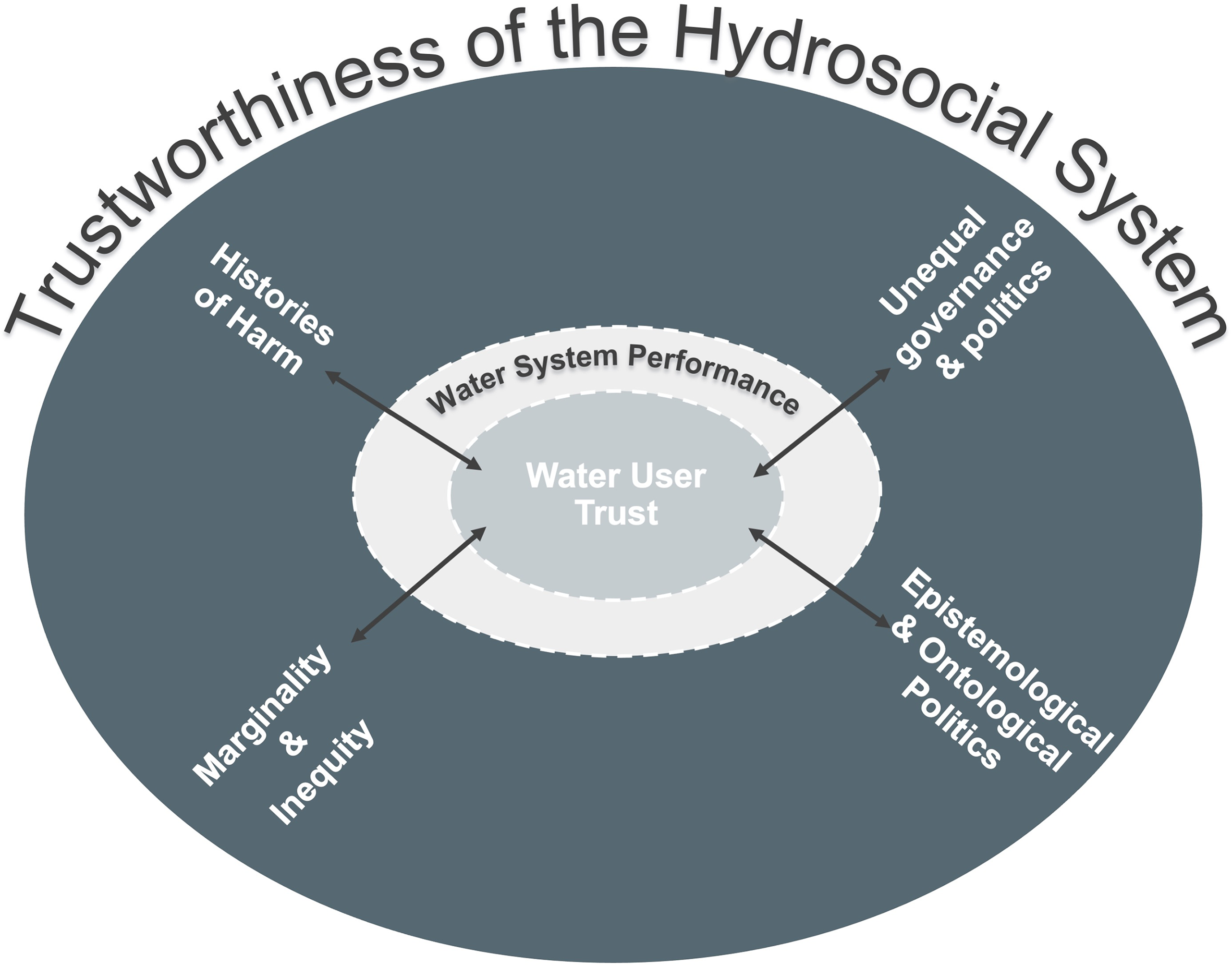
Conceptual diagram illustrates the need to move from a focus on individual trust to examine the trustworthiness of the broader hydro-social system as shaped by water system performance and interconnected factors including experiences of marginality and inequity, ontological and epistemological injustice, unequal governance and politics, and histories of water insecurity and harm.
Case examples
The three case examples that follow illustrate the importance of contextualizing distrust and water insecurity within broader hydro-social dynamics including the many factors that shape the dynamics of trustworthiness of water systems. The case illustrations are all based on primary research by the authors on these contexts and issues and help to illustrate the key themes highlighted in Figure 1: issues of marginality and inequity, ontological and epistemological injustice, unequal governance and politics, and histories of water insecurity and harm. In other words, the cases provide further specificity to help illustrate how distrust is often an outcome and reflection of the broader hydro-social interactions represented.
Flint, Michigan water crisis
It is hard to say how trusting Flint residents were of their water prior to the recent and ongoing Flint water crisis, when improperly treated water sourced from the Flint River in 2014–15 caused system-wide lead corrosion and a historic outbreak of Legionnaires’ disease, among other harms to infrastructure and public health (Morckel and Terzano, 2019; Sobeck et al., 2020). Nevertheless, there is strong reason to believe that the crisis had a negative if not “catastrophic” effect on trust (Pauli, 2019), and studies of resident attitudes have consistently found very low levels of trust in the safety of the water and the people and institutions responsible for ensuring it (Fortenberry et al., 2018; Gray et al., 2017; Morckel and Terzano, 2019; Sobeck et al., 2020).
Some research suggests that distrust of tap water is detrimental to Flint residents’ quality of life, linking such distrust with negative mental health outcomes like heightened anxiety (Cuthbertson et al., 2016). It must be remembered, however, that distrust has had its advantages in Flint. Because residents did not trust that changes to the color and odor of their water were merely “aesthetic,” as they were initially told, they conducted their own research into water quality, helped to uncover systemic lead contamination, and successfully pressured the city to discontinue its use of the Flint River (Pauli, 2019).
Even those who concede that resident distrust played an important role in uncovering the crisis, however, may argue that distrust has been less useful—and less justified—in the context of the recovery effort, which has seen a large-scale mobilization by government agencies, hundreds of millions of dollars of relief funds, and notable system-wide improvements in water quality. Indeed, lingering resident distrust is often depicted as an obstacle to full recovery, as increasingly detached from the reality of the situation on the ground, and as an emotional, irrational product of “trauma” (Bence, 2016; Fonger, 2016; Scipioni, 2016) or even a stubborn “victim” mentality (Roy and Edwards, 2019b). What these characterizations miss are the ways in which continued distrust reflects well-founded skepticism of the trustworthiness of the people and agencies leading the recovery effort (Brown et al., 2020; Pauli, 2019). Flint’s long history of the race- and class-based discrimination, marginalization, and neglect (Highsmith, 2015; Pulido, 2016; Ranganathan, 2016) provides the backdrop to this skepticism, creating the general impression that the “system” as a whole work against the city's predominantly black, and largely poor, population. More recent failures of government, especially the actions of the state-appointed “emergency managers” who oversaw the switch to the Flint River, also helped to create the belief that the agencies responsible for creating the crisis could not be entrusted with solving it.
Many residents found this belief confirmed in the manner in which “recovery” was defined and carried out by state actors, as residents were largely sidelined in decision-making, as certain forms of scientific inquiry into the water were officially discouraged, and as government agencies purporting to have residents’ interests at heart fought against popular demands for reparations (Brown et al., 2020). Dissatisfaction with the overall handling of the crisis response factored into residents’ reactions to official proclamations from 2016 about the water system’s recovery, which was widely seen as excuses to scale back assistance (e.g. free bottled water) prematurely, even as thousands of dangerous and damaged pipes remained in the ground. Activists’ refrain that Flint’s water was not yet “safe” came to embody political demands including the removal of these pipes at every affected home as much as it did any empirical claim about the continued presence of system-wide contamination.
Additionally, resident resistance to sweeping proclamations about the safety of their water has incorporated, explicitly or implicitly, hard-won insights into the limitations of modern water’s manner of regulating, treating, monitoring, and characterizing the safety of drinking water. Residents have come to realize, for example, that water can meet regulatory safety standards while bearing toxic-waste levels of lead within individual households; that water treatment involves tradeoffs, including the introduction of contaminants (like carcinogenic trihalomethanes) into water systems; that critical sites of water exposure (such as household showers) generally go unmonitored by water utilities; and that what is casually called “safe” water by officials is not necessarily safe for everyone, especially the medically vulnerable (Pauli, 2019). One could say that Flint residents have had a unique opportunity to appreciate what is inherently untrustworthy about modern water’s manner of operating, even in the absence of the acute crisis that has unfolded in the city.
Yet the narrative that distrust in Flint stems from deficits of knowledge and rationality on residents’ part—or even from moral deficits like self-indulgent victimhood—remains potent, as does the idea that distrust is contributing to further harm. Some have promoted the hypothesis, for example, that an epidemic-level outbreak of shigellosis in Flint in the summer of 2016 was caused by a decline in resident hygiene stemming from unfounded fears of the water that had been stoked by alarmist “bad actors” (Hohn, 2016; Roy and Edwards, 2019a, 2019b). While a CDC survey of shigella patients found that “changes [in bathing/showering/handwashing habits] could have compromised hygiene and contributed to the outbreak in Flint,” the analysis concludes that “given similarities [with other jurisdictions] in household uses of water for hygiene […] and other household characteristics, it is not likely that these changes in Flint caused the outbreak” (McClung et al., 2020, p. 845, emphasis added). Nonetheless, the idea has persisted that residents, in effect, made themselves sick through their own distrust of the water, contributing to ongoing stigmatization (Carrera, 2020).
Flint offers a powerful example of the ways in which distrust of water systems, and associated people and institutions, can be useful, rational, and galvanizing—in this case, contributing to important resident-led science and activism. It also illustrates the dependence of public trust on manifestations of official/expert trustworthiness in responding to crisis—as measured by the depth of commitment to addressing resident needs and concerns, respect for residents’ ability to make responsible decisions about their health and the health of their community, appreciation for residents’ knowledge, and tolerance of different perspectives and approaches in assessing and representing water quality.
Water crisis in Kashechewan
The fiduciary obligation to First Nations peoples in Canada is a legal obligation, as laid out historically, and in treaties and legislation (Dupuis and McNeil, 1995). Specifically, the Royal Proclamation of 1763 requires the Crown (at the time British) to protect the interests of “Indian” peoples (Borrows, 1997; Dupuis and McNeil, 1995; McNeil, 2008). Later, the British North American Act of 1867 gave control over “Indians” and “Indian lands” to the federal government (also affirmed with the Constitution Act 1982, and the Indian Act 1876). The obligation governs the relationships between Indigenous peoples and the Crown as represented by Canadian governments (primarily the federal government), requiring the Crown to act in a “trust-like” rather than an adversarial manner in relation to Indigenous people (inclusive of First Nation, Métis, and Inuit). Providing guidance on the nature of the relationships, this legislative framework also gives exclusive jurisdiction to the federal government for the provision of programs, services, and infrastructure to Indigenous peoples including health, education, social services, roads, housing, and water and wastewater management systems.
Although the fiduciary obligation is legally enforceable and imposed on the Crown by the Supreme Court of Canada (Beaton, 2018), this obligation is also one that involves maintaining the trust of Indigenous peoples. Yet, the First Nation drinking water crisis—consisting of long-term drinking water advisories and related issues of access, safety, and quality in many First Nations—and other ongoing freshwater crises demonstrate that this fiduciary or “trust” responsibility has, arguably, not been upheld (Boyd, 2011; McGregor, 2014). Although the federal government has invested millions of dollars to “fix” the water crisis through technologies of water treatment and “expert” science reports, the water quality crisis continues. Attempts by the state to build trust in water through addressing infrastructural deficits have done little to increase the trustworthiness within the broader context of over 150 years of colonialism and the enduring systemic injustices evident across all aspects of Indigenous lives.
Kashechewan First Nation is located on the banks of the Albany River in eastern James Bay, Canada. Although the Cree people of this community have thrived in this region from time immemorial, the present location of the community was the result of a forced resettlement plan of the federal government in 1957 as an “Indian Reservation” under the federal Indian Act. At the time of the resettlement warnings from First Nation Elders that the government-surveyed location for Kashechewan had a long history of flooding, ice dams, and related risks to permanent settlement went unheeded. The concerns of the Elders were valid. In the past 20 years, residents have been evacuated 14 times (in consecutive years 2004–2008 and 2012–2019), the result of community flooding (Khalafzai et al., 2019; White, 2020). In addition to flood evacuations, drinking water contamination has repeatedly caused significant human health concerns (CTVNews, 2017; Pope, 2006). Government engineers miscalculated ocean tide influences that cause sewage discharge into the Albany River to mix with the drinking water supply. The evacuation came close on the heels of a report from the federal Office of the Auditor General which found that residents of First Nations communities across the country did not benefit from a level of drinking water protection comparable to non-First Nations (Swain et al., 2006).
The crisis is far from over as Kashechewan is just one community among many that continue to face water insecurity every day in Canada. Here, we see how trust and trustworthiness are affected by the long durée and multiple intersecting issues of fiduciary responsibility, track records focusing on community needs and heeding community concerns, and failures to meet fiduciary obligations. This case example highlights the importance of coloniality for an investigation of water and trust for many First Nations in Canada. Recently (December 2020), the Government of Canada has indicated that it could not end the numerous drinking water advisories that plague First Nations by March 2021 as previously promised, further eroding the trustworthiness of the federal government.
Manipulations of place and space perpetrated by colonial governments have created conditions of community risk in Kashechewan, and from that, a lasting sense of distrust in both government policies and built infrastructure. The federal government knew there were problems, given repeated drinking water contamination events, yet failed to live up to its fiduciary obligation to Kashechewan. Commentators have addressed the ways that longer histories and practices of colonialism affect contemporary situations, whether it be of water insecurity, lack of disaster resilience, or other situations: There is something in the water in Canada, and, if we look to the issue of water, what we find should encourage us to think more critically about the connection between historical injustices, national narratives, and contemporary racism. There is no singular, temporally specific disaster in Kashechewan; however, there are a series of related tragedies and failures. Our pressing task is to track the disastrous effects that occur when ongoing colonialism transforms into crisis. (Murdocca, 2010: 397)
In this case, as in many First Nations, the fiduciary obligation on the part of the Crown is fundamentally rooted in unequal colonial relationships, which involve First Nation dependency on the Federal Government to deliver services and address infrastructure deficits (Lewis et al., 2020). The inequitable hydro-social system inherent in the fiduciary relationship between the Crown and First Nations is maintained by unequal political and governing systems that perpetuate injustice (Hill, 2021). The challenge is to establish and maintain trust between societies and nations on more equitable terms, which requires a demonstration of trustworthiness in multifaceted ways and at different scales (e.g. legal, political, institutional). In the case of the First Nation water crisis, building trust will require much more than infrastructure for water treatment. The larger, more essential, and more difficult project involves decolonizing the relationship between First Nations and the “Crown” such that the Canadian state is worthy of First Nation trust.
Navajo nation and “trust relationships”
Trust is a fraught term in other Indigenous contexts as well. As in Canada, trust and distrust among US Indigenous populations are often related to the limited legal obligations (referred to as “trust responsibilities” in legal terms) of the federal government with tribal nations as well as the frequent failure to live up to these. Beginning in 1831with the Cherokee Nation v. Georgia case, Chief Justice John C. Marshall affirmed the precedent of federal authority over Indigenous nations with the declaration of their so-called “domestic dependent” status. On paper, Marshall solidified in US settler law an ideology of Indigenous peoples as “wards of the state” whereby their land and livelihood were beholden to the sovereign federal body. The establishment of tribal reservations further materialized Marshall’s notion of wardship. What, then, does trust (including, but also beyond the legal framing) mean for water security in tribal nations in the United States today?
For tribes in the western United States such as the Navajo Nation, water security concerns largely pertain to two domains: physical infrastructure and entitlements to water on paper. The delivery of water as a physical entity requires adequate infrastructure and access. According to recent data, an estimated 40% of Navajo tribal members lack running water in their households and must rely on hauling water for domestic use (Deitz and Meehan, 2019). This disparity of water access is a consequence of the settler-colonial seizure of resources on tribal lands for the development of cities such as Phoenix and Los Angeles. On paper, tribal water rights are negotiated through each of the three states—Arizona, Utah, New Mexico—that overlap with the Navajo Nation. Although the precedent of the 1908 case Winters V. United States theoretically ensures that tribes have rights to water allocation, these rights are assumed to begin only at the moment of reservation establishment, essentially disavowing the existence of tribal water claims before western colonization. Critiquing the assumptions of recent water settlement negotiations with the Navajo Nation, Diné historian Melanie Yazzie (2013) argues that logics of “quantification-as-minimization” prioritize non-Indian water users. In other words, the act of quantifying water claims inherently minimizes certain claims over others. Likewise, Diné geographer Curley (2021) contends that settler-colonial dispossession is perpetuated through water settlements as a contemporary form of colonial enclosure, in the Marxian sense, whereby water is quantified and abstracted akin to commodities. Whereas Indigenous water ontologies understand water as a living entity, modern water imagines water as a resource to be managed, allocated, and regulated.
The 2015 Gold King mine spill brings concerns about trust and trustworthiness into stark relief. Following an accidental breach by EPA subcontractors of a bulkhead at the historic Gold King mine near Silverton, CO, over three million gallons of acidic mine water spilled into waterways below. The toxic flow eventually reached the San Juan River that weaves through the Navajo Nation. In the Diné language, this river is referred to as Tó Biika‘í, a sacred male entity that provides life-giving sustenance for the farming communities along with its banks. In the aftermath of the spill, several Diné communities opted to shut off their irrigation channels for an entire year for fear of contamination to their crops and water sources (Montoya, 2017). Conversely, the EPA determined that the affected waterways returned to pre-spill levels within two weeks of the rupture and thus no further precaution was necessary. This conclusion was reached based on preliminary risk assessments that only included recreational water use, an activity that is more typical of residents of Durango, CO, a predominately non-Native town along with the Animas River known for outdoor recreation. Such an assessment excluded the myriad cultural, dietary, and agricultural uses of the San Juan River by Diné communities downstream, not to mention that many Diné families rely on unregulated water sources for domestic uses. To address this oversight, Diné hydrologist Karletta Chief assembled a team of researchers to begin what would become a multiyear study called the Navajo Gold King Mine Exposure Project (Superfund Research Centre, 2020). Focus group data, collected from three Diné farming communities along with the San Juan River, identified 43 unique uses or interactions with the river indicating a far more robust relationship than the limited EPA imaginary of a kayaker or fisherperson (Van Horne et al., 2021). Researchers categorized these uses into five broad categories including livelihood, recreational, cultural and spiritual, dietary, and arts and crafts activities. Out of the 63 adults and 27 children recruited for the focus group portion of the study, researchers determined that there was a 56.2% decrease in the number of activities that Diné participants engaged in with the San Juan River following the spill. This statistic, they suggest, had detrimental consequences on the emotional well-being of Diné residents by impeding their ability to continue specific cultural practices with the river. EPA regulatory standards, as a manifestation of modern water, do not accommodate the dynamic relationship that Indigenous communities hold with water. Nor do they prioritize Indigenous ontologies of water in policy formation or paper rights. Trust in Indigenous contexts—as a legal category, fiduciary responsibility, and affective register of confidence—must be analyzed within a larger continuum of broader issues associated with trustworthiness and ongoing marginalization associated with settler-colonial governance. When Diné farmers and citizens from other Indigenous nations proclaim, “water is life,” this demand is not only for clean water free from repeated contamination but also for the recognition of water as a relative to be protected, honored, and respected.
This case example highlights the origins of distrust in the failure of settler-colonial water governance to ensure Diné water security including basic household water access and broader sociocultural relationships to water. At the same time, studies such as Navajo Gold King Mine Exposure Project provide a model for increasing trust through the fusion of western science and Indigenous knowledge to go beyond narrow material framings enabled by modern water to better represent and respond to the risks to Diné hydro-social relationships.
Discussion
Although we often assume that trust in water experts, infrastructures, and institutions is both an outcome of, and essential to, water security, our case examples reveal the uneven, fragile, tenuous, and evolving nature of trust and distrust in water systems (See also Meehan et al., 2020a). As discussed above, recent research shows that the water crisis in Flint, Michigan has contributed to a loss of public confidence in government and scientific authorities more generally (Boufides et al., 2019; Pauli, 2019), and even contributed to heightened distrust of tap water and increasing reliance on bottled water in many other locales across the United States (Rosinger and Young, 2020). Our case examples of Kashechewan First Nation and Navajo Nation illustrate the influence of broader colonial politics on water insecurity for Indigenous peoples (see also Wilson et al., 2021), highlighting other features of historical and institutional relations which significantly influence water-trust dynamics.
It is clear from these examples that water-trust dynamics are embedded within, and further contribute to, broader issues of distrust and marginalization vis-à-vis long-standing institutions and governance authorities. Simply focusing on the trust or distrust held by individuals and communities obscures the influence of these broader structural factors and conditions. In varied ways, the cases illustrate aspects of the reconceptualization of water and trustworthiness we offer in Figure 1, highlighting aspects of system failure (e.g. failure to provide safe and affordable water), as well as the interconnected issues of experiences of marginality and inequity, ontological and epistemological injustice, unequal governance and politics, and histories of water insecurity and harm. We further unpack these varied dimensions in the subsections that follow.
Marginality and inequity
Water insecurity is closely linked to spatial and socio-demographic patterns of racialized, colonial, class-based, and housing disparities (Balazs and Ray, 2014; Deitz and Meehan, 2019; Jepson and Vandewalle, 2016; Mascarenhas, 2007; Meehan et al., 2020b; Patrick, 2011; Pulido, 2016; Wilson et al., 2021). There are certainly examples of water insecurity among relatively privileged populations—for example, the Walkerton, Ontario water crisis in 2000, which has been described as a “shocking revelation that Canadians could not always depend on pristine and ever-abundant tap water” and which “seemed to resonate across the country” (Grey, 2001). However, experiences with water insecurity tend to mirror larger patterns of environmental injustice, which are well-established across environmental health domains (Corlin et al., 2016; Cushing et al., 2015; Pulido, 2016). 3 For instance, the Flint water crisis has been characterized as an instance of environmental racism against a predominantly African American population (Pulido, 2016; Ranganathan, 2016) as well as an outgrowth of classism (Pauli, 2019). The water insecurity described in the case examples of Navajo Nation and Kashechewan First Nation also reflects broad patterns of inequality. Both these Indigenous nations face significant infrastructural deficits and degraded environmental quality as the result of resource development in and around the Navajo Nation (i.e. with the Gold King mine spill in 2015) and Kashechewan First Nation's forced resettlement in 1957. While these environmental injustices parallel the experiences of many racialized and marginalized people, we argue that Indigenous peoples of water insecurity are distinctly shaped by settler colonialism (see Wilson et al., 2021).
Although research on trust and water has highlighted how marginalized people have greater distrust in their water systems (de França Doria et al., 2009; Hobson et al., 2007; Pierce and Gonzalez, 2017a), it often fails to attend to the systemic and structural contributors, and thus fail to emphasize the types of changes needed to increase the trustworthiness of the broader hydro-social system (i.e. to redistribute power and resources). Such interventions tend to be more complex and less appealing, particularly for those who benefit from the current system. For instance, addressing the root causes of water insecurity requires decolonizing the broader water governance systems, a solution resisted by elites or the settler-colonial state (Curley, 2021; Montoya, 2019; Wilson, 2019; Yazzie and Baldy, 2018). Experiences of marginality and inequality clearly intersect with the other dimensions of interest from our framework, namely, ontological and epistemological injustices, unequal governance and politics, and histories of harm.
Ontological and epistemological injustices
Early assessments of the question of epistemic trust asserted the rationality of ordinary citizens (“the public”) deferring to scientists because of the latter's competence and expert knowledge (Hardwig, 1985). There are certainly times when “expert” knowledge can and should be trusted (Whyte and Crease, 2010). However, expert knowledge often fails to reflect the knowledge and lived experiences of the public (Irwin and Wynne, 2003; Wynne, 1996). This disconnect is especially pronounced for Indigenous, racialized, and other marginalized peoples who face environmental and social injustices (Bullard, 2019; McGregor, 2018; Pulido, 2016; Whyte, 2016). Knowledge production within dominant institutions is often shaped by power dynamics that privilege expert knowledge claims over lived experience (Jasanoff, 2016) and Indigenous knowledge (Latulippe and Klenk, 2020). This has been called “epistemic violence,” as expert discourse imposes boundaries around what is considered “real,” categorizing as “unreal” anything falling outside of those boundaries (Spivak, 1988). Ontological justice is closely related to epistemic justice, in that it requires that we take seriously the existence of diverse ways of being within multiple worlds including the agency of more than human persons (Haraway, 2003; Hunt, 2014; Nadasdy, 2007; Todd, 2014). Kwagu‘ł (Kwakwaka‘wakw Nation) scholar Sarah Hunt links the epistemic and ontological violence of colonialism in Canada which imposes western worldviews while simultaneously marginalizing Indigenous worldviews or “those heterogenous, place-based ways of knowing through which Indigeneity comes into being” (Hunt, 2014: 29). Concerning water, justice requires taking relational understandings of water seriously, including Indigenous water relations wherein water is seen as a living entity with which people have reciprocal responsibilities (Chiblow (Ogamauh annag qwe), 2019; Craft, 2017; McGregor, 2014; Wilson and Inkster, 2018).
We find that epistemic and ontological justice—or the respect for the lived experience and knowledge of water users that informs trust or distrust in water (Visvanathan, 2005)—is essential to relational trust dynamics in water insecurity. Epistemic violence or exclusion shapes both the extent to which marginalized peoples’ knowledge claims are considered trustworthy and the trust these groups place in “expert” knowledge (Daukas, 2006). This phenomenon can be observed across all three of our case examples. In Flint Michigan, distrust of the official narrative about the safety of water led citizens to conduct their own research and advocate to stop using water from the Flint River (Pauli, 2019). Indigenous knowledge is also frequently sidelined in the assessment of risk (Cf. Donatuto et al., 2011; Hoover, 2017). This can be observed in the unheeded warnings of Elders at Kashechewan First Nation about the problems associated with the chosen site for community relocation. Similarly, it can be seen in the concealment of the socio-cultural impacts of contamination on Diné participants through the application of inappropriate assessments of risk based on modern water categories related to recreational use rather than the broader cultural, ceremonial, agricultural, and household uses of water in addition to more-than-human relationships with the San Juan River. In the context of Indigenous case studies, understanding trust and distrust in the scientific knowledge of water necessarily requires “exposing the ontological violence authorized by Eurocentric epistemologies both in scholarship and everyday life” (Sundberg, 2014: 34). Epistemic and ontological justice, therefore, requires a break with technoscientific approaches that view distrust as a problem of knowledge deficit, to pluralistically engage with and value multiple ways of knowing and being to better characterize water insecurity according to the lived experience and hydro-social relationships of marginalized and Indigenous peoples (Blaser, 2014; Wilson and Inkster, 2018; Yates et al., 2017).
Unequal governance and politics
Previous research has tracked the critical role that water governance and politics play in shaping water insecurity (Bakker and Morinville, 2013; Miller et al., 2020). Exploration of the implications of trust in government and faith in democracy for water insecurity has only recently begun (Harris, 2019). Adding to this literature, we find other ways that governance and politics shape the trustworthiness of water systems.
Scholarship on political trust—or the evaluation of the trustworthiness of the governance system including both individual and aggregate levels of authority structures such as institutions, bureaucracies, or nations (Levi and Stoker, 2000)—offers insights into the linkages between trust water governance. Scholars of political trust generally concur that the level of trust held is positively correlated with good governance—or the effectiveness and legitimacy of governance institutions (Draude et al., 2018; Levi, 1998; Putnam, 1992). Levi and others (2009) highlight three elements that contribute to the trustworthiness of governments: (1) Leadership motivations or the institutional constraints on the behavior of political leaders which are enforced by law and power external to the leader (e.g. democratic systems place limits on leadership behavior); (2) Government performance or the ability of governments to provide public goods to populations necessary for a minimum level of social welfare (e.g. water and sanitation infrastructure); and (3) Administrative competence or confidence in the government’s capacity to produce promised services as indicated by both honesty (i.e. lack of corruption) and the ability to implement and enforce rules and regulations. Turner et al. (2016) build on this work to find that high levels of trust increase public perceptions of the legitimacy of environmental governance systems. Yet, trust often varies among actors based on factors that cannot easily be addressed with short-term policy fixes as they are often entrenched within historical circumstances. In this sense, while states are neither inherently trustworthy (Scott, 1998) nor are they the definitive dispenser of justice, particularly for marginalized communities (Harris, 2017; Pulido et al., 2016), this framework is useful in pinpointing particular areas where governance systems may fail to demonstrate trustworthiness.
Our case examples illustrate how distrust in water systems is a warranted and even likely response in contexts where governance systems have proven themselves undemocratic, ineffective, or unjust. First, in the example of the Flint water crisis, unelected officials appointed by the state—as well as elected officials marginalized by those appointments—failed to respond adequately to residents’ concerns, prompting residents to look for assistance outside official channels (Lambrinidou, 2018; Pauli, 2019). Second, our Indigenous case examples in the United States and Canada demonstrate how federal governments and their representative agencies have failed to live up to their legal trust obligations and responsibilities for ensuring water security in Indigenous nations. For Indigenous peoples in particular, to the extent that the modern water regime is deeply entangled with settler-colonial state formation and nation-building in the form of infrastructure, mapping projects, and water quantification (Estes, 2019; Linton, 2010; Wilson, 2019), it is likely that there will be ongoing failures and disjunctures concerning water-trust dynamics. Some of these issues will likely be improved, but not fully addressed, given that Indigenous nations and communities demand not only access to clean and reliable water, in the basic modern water sense, but also the extension of legal protections for Indigenous relational ontologies of water (Craft, 2018; Wilson and Inkster, 2018). Just as African American residents of Flint might continue to distrust expertise and governance systems as long as concerns such as those related to the carceral and policing systems as exposed by Black Lives Matter (Maynard, 2017), so too will Indigenous communities continue to question broader systems and institutions of governance as long as their lived experiences and concerns are not taken seriously in broader national politics. In this sense, we argue that distrust in water is shaped not only by water conditions but also by the experiences of marginalized and Indigenous peoples in navigating unequal relationships with states and to broader governance systems, which are directly and indirectly related to water.
Histories of harm
Historical experiences shape understanding of the trustworthiness of water systems. Within the trust literature, linkages between race, historical experience, and distrust are frequently referred to as the “Tuskegee Effect” (Scheman, 2001). This term refers to the notorious 40-year government-funded Tuskegee Syphilis Study, conducted by the U.S. Public Health Service from 1932 to 1972, in which 399 African American men in Alabama were purposely left to die from untreated syphilis (Bates and Harris, 2004; Johnson, 2000). Despite the widespread critique of the study as a violation of medical ethics and informed consent, the study has had lasting effects on the African American community’s trust in the medical community and has become a symbol for the discontent of racialized groups who have been used as “guinea pigs” (Bates and Harris, 2004). The legacy of the study can be still felt, for instance in distrust in HIV treatment and prevention (Johnson, 2000) and COVID-19 vaccination (Letzing, 2020). Indigenous peoples in Canada and the United States were the subjects of similar unethical treatment by the medical community, such as nutritional experimentation on Indigenous children at residential schools (MacDonald et al., 2014) or the forced sterilization of Native American and Indigenous women in the 1970s (Lawrence, 2000). Although we are not suggesting that negative experiences with the biomedical community directly shape distrust in water (although they may), our case examples demonstrate that negative historical experiences related to water insecurity have enduring effects on trust in water, as well as the ways that broader experiences of this type may have long-term and far-reaching effects on other aspects of institutional trust.
Our review of the literature suggests that previous experience with water insecurity, including both single contamination events and more chronic conditions, strongly influences the extent to which people either trust or distrust their water sources. For instance, past experience with water insecurity strongly influences perceptions of the safety and quality of desalinized water in two arid Latin American cities (Fragkou and McEvoy, 2016). Yet, it is also important to acknowledge that trust in water is shaped by broader histories and trajectories of marginalization, rather than experiences with water, per se. Although present literature acknowledges that marginalized people tend to be more distrustful of water (e.g. along with the lines of race, ethnicity, or citizenship, and often have lower levels of trust in public agencies and services more generally (de França Doria et al., 2009; Pierce and Gonzalez, 2017a), our case examples highlight the value of contextualizing this distrust within both direct negative experiences with water insecurity and broader histories and trajectories of injustice shaped by systematic racism, settler-colonialism, and more.
Conclusion and future directions
In this paper, we have argued that a relational and systemic analysis of the trustworthiness of water systems—including water experts, infrastructures, and governance systems—is needed to understand and to potentially address, water-trust dynamics at play in water insecurity. Although the current literature tends to reflect an approach to trust aimed at bringing individual assessments of water security in line with expert knowledge and assumption of modern water, we suggest that instances of distrust can be a healthy response to injustice in instances where water systems are not working ensure water security for all. As such, distrust can serve as an indicator of a broader imbalance in the hydro-social system, social inequities, or failures of governance institutions to meet their specific obligations. Our case examples of high-profile water crises in Flint, Michigan, Kashechewan First Nation, and Navajo Nation show that focusing on the trustworthiness of the broader system reveals a variety of factors external to individual attitudes that shape trust and distrust, including the interconnected experiences of marginality and inequity, ontological and epistemological injustice, unequal governance and politics, and histories of water insecurity and harm. In attending to the factors that shape the trustworthiness of water systems, our goal is to highlight the shifts that are needed to develop water systems capable of providing safe water for all, and therefore deserving of trust across all populations. Furthermore, we note that interventions to increase the trustworthiness of the water system must address the root causes of distrust.
Based on this review, we find that there are several areas of investigation needed to advance understanding of trust dynamics and water insecurity. First, there is a need to understand whether there are also contexts where trust, distrust, and trustworthiness may not be as important in relation to water security. In research in China, Zhen et al. (2020) found that people in Shanghai often avoid thinking about trust or distrust in water because of their hopelessness and powerlessness to demand accountability or otherwise improve water quality or management within China’s authoritarian system. Rather, to address their concerns about water risks, people focus primarily on the apolitical coping strategies they can adopt at the household level: boiling, filtering, or buying water. Although similar coping strategies are also used in contexts where people actively express distrust in water and have minimal hope of changing the system (e.g. in Flint Michigan), Zhen and colleagues suggest that trust may not be as meaningful for theorizing people’s water perceptions and actions outside of the context of liberal democracies. Although there is a growing literature on political trust in China (e.g. Li, 2021; Wu and Wilkes, 2018), the majority of the literature on water and trust is situated in liberal democracies. Accordingly, we recommend further exploration on how trust and distrust in water systems work or fail to work in other political contexts.
Second, further research is needed into the specifics of trust, distrust, and water insecurity for Indigenous peoples. The influence of settler-colonialism on water insecurity for Indigenous peoples is the subject of a growing literature (Latchmore et al., 2018; Longboat, 2015; Patrick et al., 2019; Wilson et al., 2019, 2021). The specific legal relationships between Indigenous peoples and settler states—defined by the “trust” relationship in the United States and fiduciary responsibilities in Canada, would benefit from further exploration.
Third, there is a need to develop new methods to understand why people trust or distrust their water systems. As we have discussed, the majority of tap water distrust studies conduct quantitative analyses of survey data (often using stated preference elicitation methods). Qualitative approaches remain uncommon (but see: Driedger et al., 2014; Pierce et al., 2019). Our case examples reveal trust dynamics that are obscured through current studies rooted in technoscientific understandings of trust that flow from modern water. Future research should take more exploratory approaches—including qualitative, historical, institutional, ethnographic, and mixed methods—to identify the complexities of trust dynamics and reasons why water systems may not be considered trustworthy. We have concentrated here on cases of deepwater insecurity where injustice clearly underlies larger patterns of distrust, but future research could better clarify how a relational approach might offer value for understanding distrust where technoscientific measures of water performance are more robust (i.e. where water security exists according to these measures). Such research could help clarify the extent to which distrust is always a result of larger injustices and relational dynamics or might sometimes merely be indicative of a knowledge deficit.
Fourth and finally, greater engagement with proactive approaches to rebuilding the trustworthiness of water systems is needed. In contrast to the ample literature on broken trust, little scholarship exists on efforts to rebuild trust or reestablish trustworthiness. Although scholars have suggested various trust-building strategies (e.g. Drevno, 2018; Feingold et al., 2018; Morckel and Terzano, 2019), they have rarely evaluated the implementation of these strategies. Our research highlights how the trustworthiness of the water systems shapes trust dynamics. Thus, it follows that in contexts of distrust, trust cannot be rebuilt without increasing the trustworthiness of the water system. Still, critical questions remain largely unanswered. For instance, which strategies are most effective, and what contextual factors influence their effectiveness? To what extent do they address the complexity of conditions that contribute to public distrust and mitigate modern water's contribution to these conditions?
Highlights
A technoscientific approach to water user trust dominates the water security literature in higher-income countries.
The literature documents the existence of water user distrust but does little to explain the reasons behind it.
A relational approach that focuses on water system trustworthiness can identify broader hydro-social dynamics that contribute to distrust.
This approach recognizes user distrust as a barometer of system ineffectiveness in serving diverse populations, among broader socio-political dynamics.
Interventions to address the injustices that diminish trustworthiness are likely to be more meaningful.
Footnotes
Acknowledgements
This paper was initially conceptualized during the Household Water Insecurity Experiences in Higher Income Countries workshop at the University of British Columbia organized by the HWISE RCN in November 2019 and co-funded by the Peter Wall Institute for Advanced Studies at UBC. Finally, this paper followed the process outlined in Liboiron et al. (2017) for determining equity in author order.
Declaration of conflicting interests
The author(s) declared the potential conflicts of interest with respect to the research, authorship, and/or publication of this article: Dr. Benjamin Pauli and his family are residents of Flint, MI and have been directly affected by water issues in that community. Neither Dr. Pauli nor anyone from his family initiated, or were named as plaintiffs in, any of the class-action lawsuits filed in response to the Flint water crisis. Dr. Pauli and his family did decide to opt into the settlement that was reached in the consolidated suit, and as such, has agreed not to sue defendants in any future lawsuits. The publication of this article has no connection to the outcomes of the consolidated suit, and in no way affects the settlement that was reached prior to this article's publication.
Funding
The author(s) disclosed receipt of the following financial support for the research, authorship, and/or publication of this article: This work was supported by the Social Sciences and Humanities Research Council of Canada, Canada Research Chairs, Division of Behavioral and Cognitive Sciences, Division of Engineering Education and Centers, (grant number 435-2018-0316, 950-232734, BCS-1759972, GCR-2021147, EEC-1449500).

Notes
Correction (January 2023):
Article updated with grammatical error and declaration of conflicting interests since its original publication.