




Abstract
Attempts to shift the ways disasters have traditionally been managed away from authoritarian, top-down approaches toward more bottom-up and inclusive processes often involve incorporating viewpoints from marginalised and vulnerable groups. Recently as part of this process, there have been calls for greater inclusion of Indigenous peoples in disaster management. In theory, this also suggests a shift in power structures, towards recognising Indigenous peoples as experts in disaster management. However, in popular imagination and policy Indigenous peoples often appear to be caricatured and misrepresented, for instance through tropes of Indigenous peoples as custodians of the environment or especially vulnerable to environmental change. These framings matter because they can result in disaster management policies and practices that do not capture Indigenous peoples’ complex realities. However, these framings have not been analysed in the context of disasters. In this article, we aim to better understand these framings through a critical discourse analysis of how Indigenous peoples in disasters are represented in the expert news media. We identify five discourses, including a dominant one of disasters as natural phenomena to be addressed through humanitarianism and technocratic interventions. Such discourses render Indigenous peoples helpless, depoliticize disasters and are justified by framing governments and NGOs as caring for Indigenous peoples. However, we also identify competing discourses that focus on systems of oppression and self-determination in disaster management. These discourse recognise disasters as political and include discussion of the role of colonialism in disaster creation. As care emerged as a means through which intervention was justified, we conclude by asking questions of who is cared for/about in disasters and how that care is performed.
Keywords
- Discourses of disasters and the place of Indigenous peoples in disasters are explored in the expert news media.
- Fives discourses are identified: natural disasters, systems of oppression, humanitarianism, technocracy, and self-determination.
- Dominant discourses depoliticize disasters and vulnerability.
- Governments and non-governmental organisations are constructed as caring for Indigenous peoples, thereby justifying outside action.
- Less dominant discourses politicise disasters and suggest that governments are sometimes performative in their actions.
- Paternalistic, humanitarian care emerged as a form of governance in a way that is in contention with other forms of care, such as care-ethics.
Introduction
The COVID-19 pandemic, like other disasters before it, has revealed the power of news media representations of events and people in producing diverse impacts across public perception, policy, and practice (Feindt and Oels, 2005; Marks, 2015). Several significant discourses – “particular ways of representing particular aspects of social life” Fairclough (2001: 2) – have become prominent, including world leaders being framed as wartime presidents, fighting an invisible enemy which has allowed for draconian measures of control (De Rosa and Mannarini, 2020). Others have constructed the pandemic as nature seeking revenge on humanity (Gatti, 2020), used to justify greater focus on environment, sometimes in ways that negatively impact people. Deep-rooted racism and anti-Asian rhetoric in Western democracies has been exacerbated as world leaders looked to assign blame for the emergence of the virus (Wang et al., 2021).
Discourses represent a complex network of power that shape how disasters are managed. Meaning is derived from a multitude of discourses but, most fundamentally, from a dominant discourse (Joye, 2010). This makes discourses the sites of power struggles (Wodak, 2002), and control over discourse a powerful mechanism for sustaining power (Fairclough, 2001). For instance, where a disaster such as a famine is articulated as an environmental issue (e.g. result of drought), responses will likely focus on improving the quality of land. However, should the disaster be framed as a political one (e.g. the result of conflict), solutions will likely focus on ways to address these challenges (e.g. peacebuilding). The environmental frame, then, has the potential to mask political causes of disaster and keep in place oppressive sociopolitical processes, whilst political framings suggest political solutions. Depending on how some populations are constructed, they may be viewed as less deserving of assistance than others based on race, economic status, the type of disaster experienced, and numerous other conditions (Barreto, 2019; Méndez et al., 2020; Ticktin, 2017).
Discourse analyses of the news media have been particularly fruitful in uncovering social relations and ideological positions of those in power (e.g. Chouliaraki, 2008). This is partly because the news media is a powerful means of representing peoples, places and events to broad audiences. However, mediated representations can serve certain agendas that are not typically obvious (Knudsen and Stage, 2014): nuanced language and labels, which both facilitate and limit knowledge about social phenomena to structure public perception and cultivate a specific response, are often used (Davis and French, 2008). Thus, political agendas within the news media operate in very subtle ways and require close analysis (Pyles et al., 2017).
In this paper we examine how the expert news media discursively construct Indigenous peoples in relation to disasters. To do so we examine articles from two UN-maintained knowledge sharing platforms, PreventionWeb and ReliefWeb. Identifying how the expert news media construct disasters helps reveal the ideologies present amongst those who hold power. Indigenous peoples have historically been marginalised and misrepresented by media and other institutions, with very real negative outcomes for them and their communities (Lucchesi, 2019), but there is limited academic research on disaster discourses of Indigenous peoples that have focused on the media. This has policy implications: international policy frameworks and discussions (e.g. 2015 Sendai Framework for Disaster Risk Reduction), promote the decentralisation and localisation of humanitarianism and aid, as well as the increased participation of Indigenous peoples in disaster management (Hendriks and Boersma, 2019). These policy shifts theoretically correspond with a shift in power from those traditionally considered experts (Hilhorst et al., 2020). Untangling how the expert news media represent disasters and Indigenous peoples, and how discourses change and grow, in the context of policy shifts can help to understand whether these shifts occur in practice.
In what follows, we continue the literature review before detailing our methodology. We then present our results, including five discourses that emerged from news media reports. We discuss these discourses within the context of the disaster and humanitarian literature, before concluding.
Literature review
Discourses of disaster
Disaster discourses have traditionally been categorised into two areas: the (dominant) hazard paradigm and the vulnerability paradigm (Hewitt, 1983). The hazard paradigm holds that disasters are abnormal, environmental events, that require particular measures to return to ‘normalcy’ (Bankoff and Hilhorst, 2009). This implies returning to a set of social, economic, and political relations present before the event (Bankoff and Hilhorst, 2009). In viewing disasters this way, the existing social and political structures that render populations vulnerable are masked, while the role of natural processes, such as climate change, are overstated (Verchick, 2018). Conversely, the vulnerability paradigm views disasters as political and socially constructed (Hewitt, 1983). Thus, disaster management under this paradigm focuses on how vulnerability can be reduced through political actions, be that through poverty reduction (Nadiruzzaman and Wrathall, 2015), governance (Hilhorst et al., 2020), or changes in institutional arrangements (Das and Luthfi, 2017). Thus, hazard-centric environmental framings of disaster are generally concerned with preserving current political systems, whilst a focus on vulnerability centres social justice and change (Douglass and Miller, 2018; Raju et al., 2022).
These discourses, and others like them (see Bankoff, 2019), have implications for how different stakeholders might govern and manage disasters. Viewing disaster through the vulnerability paradigm promotes a shift toward disasters as ‘everyone's responsibility’, a multi-stakeholder endeavour involving a distended network of actors in the management of risk through cross-societal interventions (Clark-Ginsberg, 2020; Tierney, 2012). Who is specifically involved in this set of interventions is blurry and shifting (Meriläinen et al., 2020), but a common theme is the decentralisation of government responsibilities to local agencies (Curato, 2018a; Wisner et al., 2001) – a stark contrast to traditional, top-down and authoritarian disaster management practices of the hazard paradigm. While this can elevate the voices of local communities and other actors in disaster management (Curato, 2018a; Hilhorst et al., 2020), it can also create problems for those communities if implemented incorrectly. Relinquishing state responsibilities to others is one, in that responsibility is placed on individuals for their socioeconomic conditions, rendering conditions such as poverty and vulnerability a choice (Chandler and Reid, 2018). In doing so, those marginalised are responsibilised for the situations they are in: a hallmark of neoliberalism that has been critiqued in disaster and development research (Bankoff, 2019; Cheek and Chmutina, 2021). Another is accountability: NGOs also have a growing degree of power in disaster governance, but they are not accountable to a democratic governance structure and their goals can be driven by their donors (Reid-Henry, 2014). This has been used to critique international western NGOs working in non-Western contexts as a form of neocolonial interference with the norms and values of non-Western societies (Sripaoraya, 2017), oftentimes masked behind sentiments of care and compassion (Fassin, 2012). A third is often a failure to relinquish control. While the vulnerability paradigm pushes primacy of local stakeholders as bastions of knowledge, humanitarians may maintain paternalistic forms of intervention under a rhetoric of ‘care’ which exacerbates inequality, inhibits collective change, and serves colonising agendas (Murphy, 2015; Tronto, 2010, 2013).
Discourses around indigenous peoples
Discourses of Indigenous peoples vary globally. ‘Indigenous’ is a self-identified identity category broadly understood to be “the assembly of those who have witnessed, been excluded from, and have survived modernity and imperialism” as well as other forms of colonialism (Smith, 2007: 114). At national scales, dominant state discourses typically focuses on improving livelihoods of citizens, although Indigenous peoples are often excluded from these visions (Howitt et al., 2012), in part because of their positions as minorities in states where they were once sovereign (Smith, 2007). Thus, national development projects account for dominant society interests, but not Indigenous society interests, leading national projects to replicate colonial patterns that do not address structural inequality (Cameron, 2012; Young, 2020). The invisibility of Indigenous peoples in these discourses, and their marginalisation from instruments and institutions of power and policy mean that colonisation is also masked (Howitt et al., 2012).
Disaster management discourses often assume the universal relevance and appropriateness of dominant cultural values, responses and understandings (Veland et al., 2010). For instance, disaster management may not consider the importance of protecting equipment critical for subsistence (e.g. Kontar et al., 2015), the significance of certain sites or building types in recovery (Huang, 2018), and policies and planning may include high levels of bureaucracy that places a burden on Indigenous communities with small workforces (Ristroph, 2018). Thus, these discourses reinforce dominant political and cultural landscapes, which justify paternalistic and colonial actions that create vulnerability for Indigenous peoples (Howitt et al., 2012). In this way, standard procedures can cause long-term damage to Indigenous peoples and their institutions, through erosion of their capacity to deliver governance, support, meaning and recovery to affected communities (Howitt et al., 2012; Hsu et al., 2015). When crisis hits, dominant society may use disaster management mechanisms as a means of alienating Indigenous peoples’ property rights for private gain (e.g. Alvarez and Cardenas, 2019). Over the long term, Indigenous peoples and their interests are often framed as irrelevant to concerns of, for instance, national development (Lambert and Scott, 2019). Therefore, Indigenous peoples, their priorities, concerns and knowledge are excluded from disaster-related decision-making processes.
Understanding how Indigenous peoples themselves discursively construct disasters is necessary to avoid replicating colonial research practices that silence their perspectives. We note that Indigenous peoples and their beliefs are incredibly diverse (Watts, 2013), and have thus sought literature from various Indigenous scholars. While research by Indigenous scholars about disaster discourses specifically is limited, there is a significant body of literature by Indigenous researchers that highlights the separation of the natural and the social as a Western dualism, with many Indigenous groups viewing the social and the natural as intertwined (Ultramari and Rezende, 2007). Similarly, other Indigenous researchers point out that Land – alongside other-than-humans and more-than-humans – is sentient and has agency (Bawaka Country et al., 2013; Museka and Madondo, 2012; Todd, 2018; Viaene, 2021; Watts, 2013; Yazzie and Baldy, 2018). This fits with neither of the two disaster paradigms mentioned earlier, both of which separate the natural and social.
Disasters and indigenous peoples in the expert news media
Dominant discourses of disaster often frame disasters from a hazard paradigm as spectacular, natural, isolated events (Gotham, 2017), rather than from a vulnerability paradigm that recognises their sociopolitical origins. This feeds a discourse that rationalises Indigenous peoples’ vulnerability as an ordinary component of a global economic, political and social order (Howitt et al., 2012). For instance, Howitt et al. (2012) critique the dominant, racialized discourses of superiority and power that dominate disaster management, which overlooks colonisation in the creation of vulnerability. In a similar vein, dominant discourses of disasters have drawn on or reinforced a hierarchy of credibility, in which social issues and local voices are marginalised in favour of legal and scientific discourses, which possess strong legitimising potential and can lead to further marginalisation of those already most marginalised (Kelman, 2010).
The news media appears to be a powerful stakeholder that can shape discourses of Indigenous peoples, often in ways that negatively impact Indigenous peoples. The news media frequently reduces the complexity of Indigenous histories to ‘problems’, depoliticizing deep discussions about power to bureaucratic concerns of policy and procedure (Campbell, 2016). Indigenous peoples are also subject to silencing and misrepresentation in the media through caricatures (Guernsey, 2021; Said, 1978). The news media can be a space to resist dominant discourses (Myers et al., 2021), but this is rarely the case. Instead, the news media has often been to normalise dominant cultural assumptions, and to grant or deny framing power to some actors over others, rendering it a powerful means of controlling how certain groups and events are represented (Carvalho, 2010; Entman, 2007; Fairclough, 2003; van Dijk, 2011).
Limited research suggests that this representation extends to reporting of disasters, which shapes and attributes responsibility, fault, culpability, blame, guilt, victimage, and liability (Seeger and Ulmer, 2002). For instance, through emphasising their victim status and connection to the environment, Indigenous peoples have been used to highlight the urgency of climate change in ways that do not consider their political perspectives (Willow, 2009). How suffering is reported also has ramifications for the representation of certain groups. On the one hand, mediation of vulnerability and suffering can mobilise awareness and political action around issues that would otherwise go unnoticed by global audiences (Durham, 2018). However, such reports can be voyeuristic – something that disaster journalism has been critiqued for (Ong, 2015; Sontag, 2003). In particular, ‘bodily vulnerability’ (usually mediated through imagery of women of colour) is used as a soft power vehicle that circulates rapidly in global media (Butler, 2004). It is also a means of addressing contested histories, through defining what is the proper past and future of a society (e.g. who is innocent), whilst affectively charging news stories (Knudsen and Stage, 2014).
Methodology
To analyse the expert news media, we adopted critical discourse analysis (CDA). CDA is a social constructivist analysis technique that recognises that language is not neutral (Joye, 2009) and is centrally concerned with power (Fairclough, 2003). CDA has been described as the “single most authoritative line of research” in analysing news media (Carvalho, 2008: 162). Specifically, it highlights “patterns of domination whereby one group is dominated by another” (Philips, 2007: 288). It moves beyond textual analysis, to include wider systematic analysis of relations between discourse and other elements of social processes (Fairclough, 1989), as well as intertextuality, whereby the blended environment in which different kind of texts (and speakers) influence each other to legitimise a certain worldview (Chouliaraki and Fairclough, 1999). Ultimately, CDA facilitates the uncovering of political, economic and cultural hegemonies that perpetuate injustice (Pyles, 2011). Whilst there are critiques around the limits of social constructivist analyses of disasters, specifically they do not contribute to improving disaster practice (Wisner et al., 2001), we instead follow numerous authors (e.g. Chipangura et al., 2016; Tierney, 2007) who highlight the importance of constructivist approaches for understanding how disasters interact with social processes such as poverty and inequality. For these authors, language can shape what is possible and structure policy options that have a very real impact on disaster management.
We define the expert news media in disasters as news media that is created by and for disaster management practitioners. We recognise that the term ‘expert’ is a loaded one. In the context of this research, we adopt a normative definition of experts and expertise (Boyce, 2006), as our aim was to untangle discourses amongst those who hold power in global disaster management. As such, it was not our intention (nor our place as settler/coloniser researchers) to target our analysis at Indigenous sources. To identify relevant articles, we take a similar approach to Chmutina et al. (2019) in their study of language and disasters. Like them, we used PreventionWeb and additionally ReliefWeb to source articles. These are both collaborative knowledge sharing platforms targeting disaster policymakers, practitioners, and researchers (Murray et al., 2015). They cross the disaster spectrum: PreventionWeb focuses on issues of disaster risk reduction, including mitigation and prevention, and ReliefWeb mainly focuses on issues of emergency and humanitarian response. Both are managed by UN agencies, PreventionWeb the UN Office for Disaster Risk Reduction (UNDRR), and ReliefWeb the UN Office for the Coordination of Humanitarian Affairs, but the sites reflect a variety of voices as content is provided by disaster stakeholders themselves. Therefore, there can be room for counter-hegemonic stances to be represented (Djalante, 2012). These sites mostly publish in English, although some articles are in Spanish. We did not limit our search by language.
These two databases have thousands of articles. After conducting numerous test searches to ensure we were not excluding key populations or types of disaster, we decided to use the key word search terms ‘Indigenous’, ‘Tribe’, ‘Aboriginal’ and ‘First Nation’ in the news media section of PreventionWeb. These terms ensured that contexts in which the term ‘Indigenous’ is inappropriate was also included in analyses (Carlson et al., 2014). We found 485 articles using these search terms. On ReliefWeb, we used the same search terms with the addition of ‘disaster’, which returned 945 articles. We added ‘disaster’ to the ReliefWeb search to ensure that articles were specifically covering disasters rather than broader development initiatives. Since we aim to examine some of the growing discourses of Indigenous peoples, we focused on the time period from 2015–2020 as the start of the Sendai Framework for Risk and Disaster Reduction was in 2015. This framework is one of the ways the UNDRR has supported Indigenous peoples’ participation in disaster management through calls for increased decentralisation of knowledge and resources, and a recognition of the need for tailored approaches in Indigenous contexts (Lambert and Scott, 2019). To meet the inclusion criteria, each article had to provide a narrative of a disaster (e.g. conflict, earthquake, climate change) and include at minimum one paragraph focused on Indigenous peoples. We did not prescribe what type of disaster was to be included, nor who was or was not Indigenous. 31 articles were retained for CDA following this inclusion criteria, which is standard given that sample sizes for CDA vary, with some studies adopting a sample of only one or two (Sengul, 2019; Van Dijk, 1993).
Analysis
To conduct the CDA, a framework was created, informed by previous CDAs (e.g. Cox et al., 2008; Davis and French, 2008). This included typical CDA concerns: the use (and meaning behind the use) of construction of in- and out- groups (Cox et al., 2008; Joye, 2010; Wodak, 2001), modalities, presuppositions, passive voice, vagueness, overcompletedness, intertextuality, amongst others (Olaniyan and Adeniji, 2015). We included analysis of embedded forms of media, such as photography, given it is a powerful means of communicating bodily vulnerability (Durham, 2018). We additionally coded articles based on countries of focus, nationality of author(s), and the location of the headquarters of news agencies. We included codes for authors who self-identified as Indigenous.
Articles were read several times for familiarity (Cox et al., 2008). Analysis was initially conducted in qualitative research software (QSR) NVivo, before moving to manual analysis, a technique for lessening distance between the researcher and the data (Paulus and Lester, 2016). Once initial codes and themes were established, text was reread to tie emerging findings to ongoing socio-political processes, such as neoliberalism and settler colonialism (Carvalho, 2013). This was an iterative process that combined deductive and inductive approaches to coding, both of which are important for CDAs. Deductive coding made use of typical approaches used within CDAs, while inductive coding allowed findings to emerge, which was important given the nascency of this research (Willey-Sthapit et al., 2020), as well as the imperativeness to include diverse constructions of disaster. Recognising these diverse constructions of disaster is useful because their inclusion or exclusion within the expert news media is an indication of the level of hegemony of Western disaster paradigms.
Results
Fifteen countries were the focus of news articles, with Australia garnering the most focus (23%), followed by Brazil (13%). Most authors self-identified as non-Indigenous Australians (23%), followed by non-Indigenous US citizens (13%). The only self-identified Indigenous authors were First Nations people from Canada (3%), and Aboriginal people from Australia (6%), all of whom were writing about their own contexts. The headquarters for each news agency were mostly based in the UK (29%), followed by Australia (26%). The majority of articles were sourced from The Conversation (41%), followed by Thomson Reuters Foundation (22%). All articles were written in English. The types of disaster included were broad and ranged from slow-onset disasters such as famine and sea level rise, to sudden-onset hazards such as floods, pandemics and forced migration.
We found five discourses: two dominant discourses of natural disasters and humanitarian intervention, and less dominant discourses of systems of oppression, technocracy and self-determination. Below we describe the core features of each discourse and illustrate these with verbatim extracts. Table 1 provides an overview of the features and strategies used in each discourse.
Overview of the features used in each of the five discourses we identified.
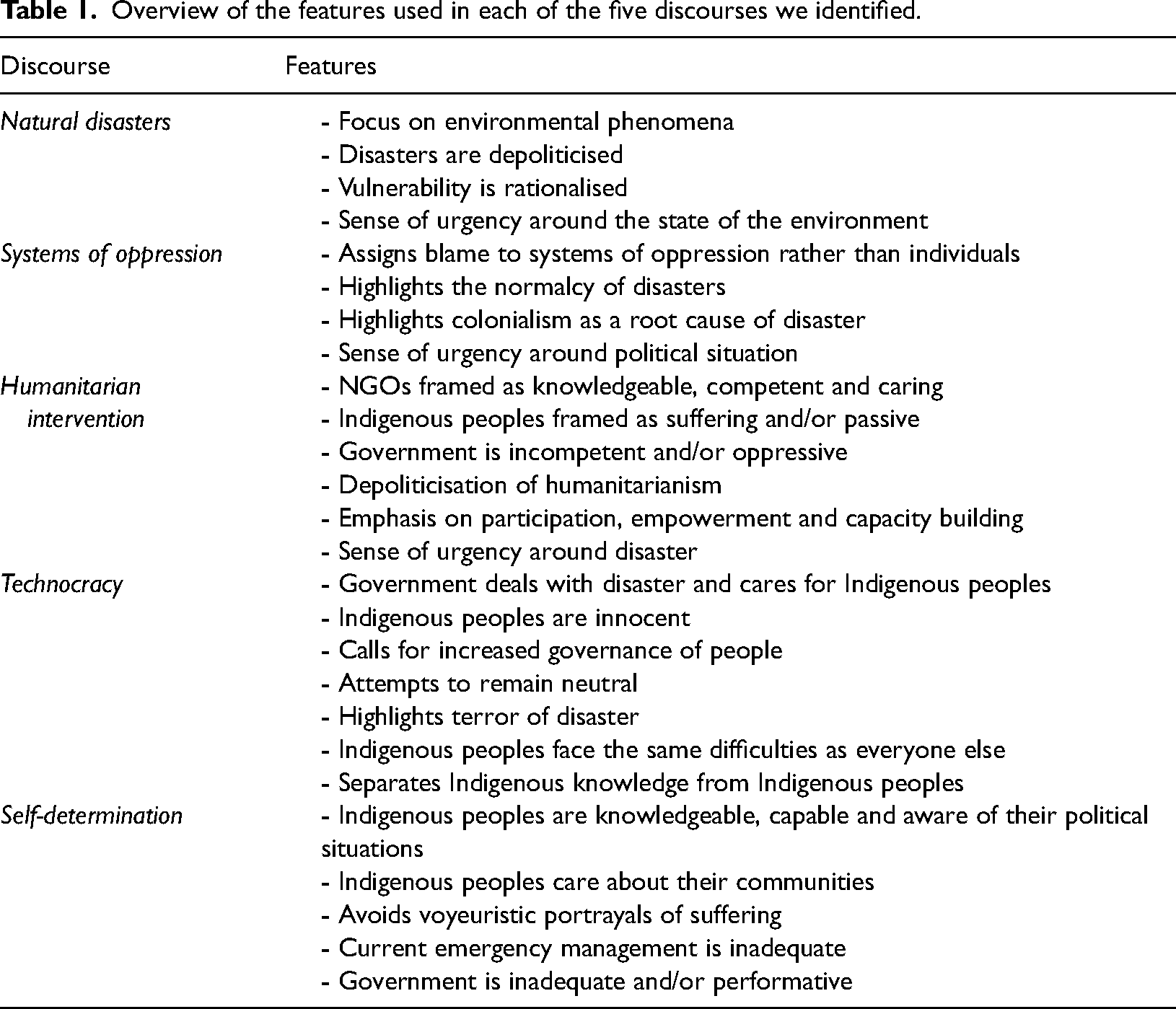
In the next section we describe each of these five discourses in more detail. We note that no article fitted neatly under any one discourse, and instead each article engaged with a variety of discourses.
Natural disasters
The natural disasters discourse viewed disasters as primarily environmental phenomena, and was the dominant way through which disasters were discursively constructed. The naturalness of disasters was evidenced through focus on environmental processes. For instance, in the context of the Australian wildfires, Barlow and Lees (23/08/2019) write the following, “[T]he intensity of a fire does not necessarily predict its severity. The lack of natural adaptation to deal with wildfires make rainforest species incredibly sensitive. Even a low intensity wildfire can kill half the trees. While small trees are initially most susceptible, larger ones often die in subsequent years leading to an eventual loss of more than half of the forest's carbon stocks. These large trees hold the most carbon, and subsequent regrowth of pioneer species is no compensation – once-burned, forests hold 25% less carbon than unburned forests even after three decades of regrowth.”
Focus on environmental processes depoliticised disasters, emphasised by textual silences about disasters’ social and political origins. Smith et al., (14/05/2020), writing on the COVID-19 pandemic is an example here, when they state that, “COVID-19 is the first global pandemic caused by a coronavirus.” This statement focuses on the hazard (i.e. the biomedical aspects of the COVID-19 pandemic), not the broader systems shaping vulnerability and access to healthcare.
Vulnerability was sometimes mentioned under this discourse, but when it was it was rationalised. For example, Godoy (27/09/2017), writing about earthquakes in Mexico claims that, “[t]hese are families who, because of their condition, have long occupied spaces in deplorable conditions (emphasis added).” Thus, vulnerability was mentioned, but the processes behind it were masked. Other articles also mentioned vulnerability, but reduced it to factors such as geographic location, age, and ability, treating these factors as inherently vulnerable rather than vulnerable because of how institutional structures marginalise these factors. In some instances, text was complemented with aerial imagery of small settlements surrounded by greenery or large bodies of water, as well as buildings on the edge of cliffs. Such imagery elevates the importance of the environment and reduces vulnerability to elements such as remoteness, proximity to potential hazards, and poor building structures, without recognising broader processes.
Authors engaging with the natural disasters discourse proposed solutions that were environmental in nature. In the context of wildfires in Australia, Alexandra and Bowman (06/01/2020) propose the following, “One model we could look to is Landcare, which has enjoyed 30 years of bipartisan support. Funded and supported by governments, local, semi-autonomous, self-directed groups aim to take a sustainable approach to land management through on-ground projects such as habitat restoration and improving biodiversity.”
Proposing environmental solutions was additionally coupled with the creation of a sense of urgency around environmental change. McDonnell (21/06/2015) highlights this in the context of Vanuatu: “While the science on increasingly intense tropical cyclones around the world is complex, as these experts have warned: the future doesn't look good for locations that are prone to natural disasters.”
Humanitarian intervention
The humanitarian discourse was also a dominant discourse that justified humanitarian intervention. Here, (mainly external) NGOs were framed as knowledgeable and competent. Godoy's (27/09/2017) article on earthquakes in Mexico, is an example of this dynamic, describing how “Fernández, a member of the non-governmental “Hadi” […] Otomí Indigenous Community, told inter press service (IPS) that humanitarian aid received so far came from non-governmental organisations and individual citizens.” In tandem with NGOs as saviours, Indigenous peoples were framed as suffering, helpless, and lacking agency. In their article on Namibians and drought-related migration Harrisberg (09/03/2020) exemplifies this:
“As rural Namibians move to cities to escape the worst drought in nearly a century, many find themselves navigating a no-man's land between over-saturated slums and the parched farmland they hope to one day return to.”
This statement shows the lack of agency Indigenous peoples have, as they are controlled by external factors and cannot live in the places they want to. Text describing the suffering of Indigenous peoples was often complemented with portrait photographs of them, especially of Indigenous mothers and children, usually with serious expressions. Many authors engaging with this discourse additionally framed the government as incompetent and/or oppressive, thus justifying NGO action. Fraser's (02/06/2020) writing on the COVID-19 response in Peru serves as an example: “In Iquitos and other places where government aid has been sluggish because of red tape or corruption, church groups have stepped in to provide crucial medical supplies, as well as food and other essential items for people whose scant incomes vanished when the government imposed a strict quarantine and curfew.”
In this quote the government's curfew, red tape, and corruption a damaging process to Indigenous peoples that NGOs must overcome. Emphasis on the extent of partnerships and collaborations was coupled with vagueness about their actions. For instance, the following excerpt by Bhandari (20/04/2020) in an article on climate change in Vanuatu, demonstrates the numerous collaborators involved in disaster risk reduction but remains vague about the nature of involvement: “Global women's rights organisation, ActionAid is collaborating with Shifting the Power Coalition (StPC), a regional alliance of 13 women-led civil society organisations from six Pacific Forum member countries, WWW, Women I Tok Tok Tugeta (WITTT), a coalition of women leader groups, and the National Disaster Management System in supporting local women through training, network building and research to ensure women's rights and needs are addressed in climate change and humanitarian disaster response.”
There were silences around the politics of humanitarianism within this discourse, which was also coupled with the creation of a sense of urgency around the disaster (as an event, rather than a process), Fraser's (02/06/2020) writing about Peru, exemplifies this: “[t]his is a disaster, and it will be a massacre, not only because of the virus, but because of official incompetence.” These two components – silences and urgency – worked together to eliminate the need to consider political elements of disaster management by masking the negative political aspects of humanitarian intervention, while emphasising the need for immediate action.
Systems of oppression
Another way disasters were discursively constructed was through a less-dominant systems of oppression discourse, which highlighted the interlocking systems of oppression that created vulnerability to disasters. For example, in an article on the COVID-19 pandemic, Seymour (22/04/2020) highlights that, “Canada's unequal health system may make remote Indigenous communities more vulnerable to the coronavirus”. Also in the context of the COVID-19 pandemic but focused on Brazil, Angelo (21/04/2020) writes that “[t]he Guarani Kaiowa are regularly displaced by agribusiness, loggers and drug traffickers, and violent clashes are common, leaving them with barely enough land to survive.” Although both authors are writing about the COVID-19 pandemic, they highlight processes that contribute to Indigenous peoples’ vulnerability, such as inequality and dispossession of land. In doing so, other actors (e.g. government, private companies) were constructed as powerful. Importantly, across the concourse, this was the only way the private sector was framed.
Other authors engaging with this discourse highlighted the normalcy of disasters. Writing about COVID-19 in Australia, Smith et al., (14/05/2020) state the following: “The COVID-19 crisis adds to existing pressures on remote communities. Families already live with regular loss of life, frequent funerals and an overhanging grief that contributes to intergenerational trauma”.
This normalisation highlights the already precarious situation many live in that contributes to vulnerability to the COVID-19 pandemic. The past was often referred to, highlighting the role of history, and colonisation in particular: “Aboriginal peoples live with a sense of perpetual grief. It stems from the as-yet-unresolved matter of the invasion and subsequent colonisation of our homelands. […] While there are many instances of colonial trauma inflicted upon Aboriginal peoples – including the removal of children and the suppression of culture, ceremony and language – dispossession of Country remains paramount. […] Since colonisation, many Indigenous people have been removed from their land, and their cultural fire management practices have been constrained by authorities, informed by Western views of fire and land management. In this way, settler-colonialism is not historical, but a lived experience. And the growing reality of climate change adds to these anxieties.” (Williamson et al., 09/01/2020).
While the natural disasters discourse led to proposed solutions that were environmental in nature, solutions under this discourse were primarily political. A sense of urgency was created around the political situation of Indigenous peoples, combined with the use of modalities to highlight the consequences of a lack of political change, as Baldo (07/01/2020) writes, “Without a radical reversal of the destructive policies that Bashir's regime used to manipulate tribal allegiances, this type of deadly inter-communal conflict will continue to erupt throughout Sudan.”
Technocracy
The technocracy discourse constructed the government and its agencies as experts that are competent in dealing with disasters. An example of this is Smith et al., (14/05/2020), an article on the COVID-19 pandemic in Australia: “People are appreciative of the efforts made by local police to keep them safe and connected. The mail is taken 50 kilometres to the Central Arnhem Highway turn-off. It is handed over to police and taken to Maranboy police station, 10 kilometres from Barunga. A community representative comes to the police station to collect it.”
Here, detailed and positive accounts of police action justify disaster management as an activity to be carried out by government and its agencies, while framing Indigenous peoples as passive. Where conflict was involved, it was reduced to “tribal clashes” (Sudan Tribune, 09/01/2020). In contrast to vulnerability perspectives that identify the significance of local knowledge and expertise, the technocracy discourse frames people as lacking in capacity and/or understanding around disaster management, with external ‘experts’ and authorities as responsible and capable. Together, this justifies government action.
Authors engaging in technocracy discourses attempted to remain neutral by remaining vague about the roles of various actors, as highlighted by the Sudan Tribune (09/01/2020), who used the passive voice to avoid assigning blame or responsibility in conflict in Darfur, stating, “the problem that occurred in El Geneina has two dimensions: the first is the politicization of tribes in Darfur states, and the second is the proliferation of weapons in the region.”
Indigenous peoples were constructed as facing the same challenges as everyone as highlighted here by Kanngieser (21/10/2018) in her article on Nauru and climate change: “Everyone on Nauru – Indigenous Nauruans and refugees alike – is experiencing the impacts of one the greatest social, economic and political threats faced by the world today: global environmental change.” Despite the unification of Indigenous peoples with non-Indigenous peoples under this discourse, the importance of Indigenous knowledge was still recognised. However, it was discussed in isolation of Indigenous peoples, and used for non-Indigenous priorities. This was especially evident in Farrell's (29/12/2019) article in the context of Australian wildfires: “There are two significant advantages of traditional burning that make it a good fit for property protection. Firstly, it can be implemented safely close to assets with minimal equipment. The second advantage is that it has an ecological end-state as an objective, often aiming to create an open, park-like vegetation structure that has much less potential for damaging crown fires.”
In this case, rather than being directed towards the benefits of Indigenous peoples, Indigenous practices of traditional burning is operationalised as a cheaper and more ecologically friendly practice for supporting Australian property owners.
For solutions, narratives around overpopulation, migration and urbanisation with frames of civil society as incompetent led to calls for the increased governance of people. Writing in the context of landslides in Bangladesh, Amas (25/06/2019) demonstrates this sentiment, stating: “Disaster risk experts and local groups say the dangers are exacerbated by communities themselves, through rapid and unplanned urbanisation.”
Self-determination
The self-determination discourse centred Indigenous peoples’ experiences. One way this was done was by opening articles with describing Indigenous peoples’ experiences. Indigenous authors Williamson et al., (09/01/2020) writing on, bushfires in Australia, demonstrates this: “How do you support people forever attached to a landscape after an inferno tears through their homelands: decimating native food sources, burning through ancient scarred trees and destroying ancestral and totemic plants and animals? The fact is, the experience of Aboriginal peoples in the fire crisis engulfing much of Australia is vastly different to non-Indigenous peoples.”
This excerpt and others like it highlight the unique experiences of Indigenous peoples, which worked in tandem with frames of current disaster management as inappropriate to the context. Elbein's (01/07/2019) article on storms in the USA shows this:
“[W]hen aid does become available, records can be a problem. “Our Native American producers aren't as accustomed to the detailed recordkeeping that non-Indian producers do on a regular basis,” Ducheneaux said, “because we don't have the access to capital in the same way, which would require reporting your livestock.” Because Indians are less able to get loans, Ducheneaux explained, they are also less likely to carry through on the sort of recordkeeping that becomes vital once disaster strikes”.
In contrast to the technocracy discourse, this discourse framed government as performative, as noted by Goering (04/06/2019) in the context of drought in the USA:
““As we looked at the future and where we were going to get water reliably, sustainably, we were really looking within,” said Harasick at [Los Angeles Department of Water and Power]'s high-rise headquarters, where pebble gardens filled with succulents border a reflective pool.”
This is similar to the ways the humanitarian intervention discourse framed government as incompetent but is more nuanced in that authors include quotes from government officials, which they undermine through parody.
Authors engaging in this discourse did highlight unique circumstances that made Indigenous peoples more vulnerable to some disasters. However, in doing so they managed to avoid voyeuristic accounts of suffering. Seymour's (22/04/2020) article on the COVID-19 pandemic is an example. In it, Indigenous peoples’ suffering is not described in detail, and individuals are not mentioned. Instead, Seymour (22/04/2020) highlights their knowledge and expertise as a mental health first aid First Nations co-facilitator: “As a mental health first aid First Nations co-facilitator, I have witnessed first-hand many tragedies within remote First Nations communities like Eabametoong (Fort Hope), Eagle Lake and Lac Seul. Homes can be unsafe, overcrowding is a huge concern, there is no clean running water, young girls are vulnerable to trafficking and there is a lack of timely access to health-care.”
Many authors engaging with the self-determination discourse were Indigenous, but some were not. These non-Indigenous authors typically adopted an approach of ‘learning with the reader’. An example of this is Goering (04/06/2019), writing about drought in the USA, where they extensively quoted and credited Indigenous peoples, elevating the importance of listening to Indigenous peoples’ experiences. This shift in expertise reflects a recognition of Indigenous peoples as knowledgeable, capable and aware of their political situations. As Stacey (23/06/2019) writes in the context of wildfires, “Nearly five years after the Tsilhqot’in Nation's landmark Supreme Court of Canada judgment, the Nation has laid out a detailed path for partnership with BC and Canada to ensure that Indigenous jurisdiction is recognized and supported in emergency management.”
Solutions under this discourse were not explicitly stated but, as disasters were framed as political, it follows that solutions were also political and therefore similar to those under the systems of oppression discourse. Authors also alluded to the complexity of finding solutions, as exemplified by Bond and Whop (02/04/2020) in the context of the COVID-19 pandemic in Australia: “[I]n a nation that steadfastly refuses to meaningfully recognise Indigenous sovereignty, this clearly is a bigger problem than public health and one likely to linger far longer than the coronavirus crisis”
Discussion
Discourses interlink to create two meta-discourses: The dominance of the environment and politicizing disaster
The five media discourses of Indigenous peoples and disaster – natural disasters, humanitarian intervention, systems of oppression, technocracy, and self-determination – appear to be entangled. The natural disasters discourse worked with the humanitarian intervention and technocratic discourses to create a depoliticized discourse on dominance of the environment. A second stream of discourses, self-determination and systems of oppression, work together to create a discourse that politicizes disaster. Further, some articles blended both the natural disasters and systems of oppression discourses as a part of their narrative structure, using environmental phenomena as a means to discuss political struggles.
Environmental discourse gave focus to the physical processes that create hazards (particularly global climate change), whilst minimising political and historical processes that create vulnerability. The mention of carbon storage is an example. Carbon storage is an example of climate change mitigation aimed at reducing the occurrence of future hazards that are driven by climate change. This emphasizes the importance of hazards, particularly climate change, over vulnerability in shaping risk. The mention of carbon stores being destroyed by wildfires also constructs disaster-affected places as crucial to all humanity, rather than merely to Indigenous peoples affected by wildfires; a discursive framing that could justify outside action that may or may not support Indigenous populations. As Erickson (2020) argues, discourses that portray environmental change as the defining problem of all humanity legitimise approaches that dispossess Indigenous peoples of their land. Here, the natural disasters and technocracy discourse complement each other, as the technocracy discourse unites Indigenous peoples and settlers in the face of environmental change. Overall, by bringing in global risks and climate mitigation, authors sideline Indigenous peoples’ experience, potentially pathing a justification for greater management of Indigenous lands in the interest of the global community. In this way, Indigenous lands are constructed as a global commons.
These discourses aligned with other studies on how the environment is treated as the cause for disasters. Significantly, the ways climate change discourse justified focusing on natural processes (Kelman et al., 2016), the naturalisation of conflict (Branch, 2018), and focusing on who is vulnerable rather than why (Carraro et al., 2021; Ribot, 2014). Therefore, the ‘natural disasters’ discourse does not exclude vulnerability, but rather adopts a narrow definition of it, perhaps one that would be termed ‘exposure’, ‘physical vulnerability’ or ‘environmental vulnerability’ in other contexts (e.g. Boruff and Cutter, 2007; Ford et al., 2006).
However, in contrast to previous studies, we find less dominant discourses of systems of oppression and self-determination were used together to highlight the political causes of disasters. In assigning responsibility to systems, the deep-rooted and systematic nature of Indigenous peoples’ oppression was evident. By doing this, reporters avoided becoming entangled within the blame rhetoric that some critique as hindering addressing structural inequalities (Young, 2006). Both discourses created strong links between present day conditions and historical processes by being specific. In this regard, Baldo's (07/01/2020) piece about conflict in Sudan was particularly significant as it was the only one that tied conflict to historical and political processes, thus implying that civil society was not responsible. These discourses did not deny environmental change as contributing to disaster, but rather positioned it as one of many factors that interact with ongoing settler colonialism (Guernsey, 2021). This is contrary to dominant discourses of disaster in the media, which favour portrayal of dramatic hazards, rather than slower, long-lasting processes of vulnerability (Curato, 2018b). It is also different to much mainstream media, which does not focus on colonialism in Indigenous contexts (Walker et al., 2019). Therefore, a minority of expert news media – most of these were authored by Indigenous peoples and focused on Australia and Canada – appear to challenge dominant discourses about both disasters and Indigenous peoples. These less dominant discourses differ to findings of others, such as Wilkes et al., (2010) and Roosvall and Tegelberg (2015) who critique media for omitting the political perspectives of Indigenous peoples in environmental issues. They align, instead, with discourses in fields such as disaster anthropology and political ecology, that view disasters as socially constructed.
The limited role of the private sector
Across all discourses there was no real acknowledgement of the complex role of the private sector in disasters. The systems of oppression and self-determination discourses painted a simplistic view of the private sector, portraying the sector as unregulated and free to do what it likes, often as part of extractive industries and agribusiness. There were textual silences in the other discourses about the role of the private sector, giving limited attention to its role. As others (e.g. Meriläinen et al., 2020) note, this lack of attention to the private sector may be a problem because it fails to account for the potentially transformative role the private sector can have in risk management, and the role that the government can have in enabling risk reduction and limiting risk creation. For example, while Angelo (21/04/2020) highlights the role of agribusiness, loggers and drug traffickers in Brazil in displacing Indigenous peoples, the reporter details how they are enabled to do so by what is in essence a complicit government (Ioris, 2020). Our findings of the limited and unidimensional view of private sector aligns with broader research on the private sector in disaster management, which shows that it is only superficially engaged in it (Blackburn and Pelling, 2018). We therefore call for deeper examination to reveal how governments work with the private sector, whether this acts to prioritise economic growth or, as Parthasarathy (2018), suggests delve into how current neoliberal global political economy prioritises economic growth by working with private for-profit companies and leaves non-profit NGOs and civil society to fill in the gaps.
Conflicting roles of the government
These media framings have important implications for the role of the state. The humanitarian and technocracy discourse aligned with the ‘natural disasters’ discourse and portrayed Indigenous peoples as vulnerable and helpless. The difference between these discourses hinged on how the government was portrayed. In the humanitarian discourse, the government was constructed as oppressive and/or incompetent, necessitating humanitarian intervention knowledgeable and competent from NGOs. Overall, the humanitarian discourse constructed humanitarian intervention as both necessary and benevolent, depoliticising it.
These implications are consistent with those of others focused on the shift from government to governance in disaster, including the hollowing out of the national level in disaster management (Hendriks and Boersma, 2019), and shifts in focus from the state to the individual in humanitarianism (Reid-Henry, 2014). The shrinking role of the state is a hallmark of neoliberalism, and thus its principles likely underlie much of the humanitarian discourse. We see this through the use of phrases such as ‘participation’, ‘empowerment’ and ‘capacity building’, which suggests that disaster management is being decentralised and localised from the state to the individual (Pyles, 2011). Some further argue that the language of participation and collaboration disguises the ways that state and/or international power is extended into the peoples and communities that are to be ‘empowered’ (Fache, 2014; Nadasdy, 2005), which could be the case here given the vagueness around the nature of collaboration with local NGOs. Likewise, the necessariness and benevolence of humanitarian discourses is consistent with various scholars who have long critiqued the depoliticising nature of humanitarianism (e.g. Ong, 2019), as well as those who argue that neoliberal forces are extended through populist media discourse during disaster (e.g. Pyles et al., 2017).
Conversely, the technocracy discourse constructed the government as responsible and competent, eliminating the need for humanitarian intervention. In line with the ‘natural disasters’ discourse, disasters were portrayed as natural, while the role of the state in disaster creation was masked; a problem when the state is actively involved in sustaining vulnerability (Huang, 2018; Lucchesi, 2019; Walch, 2018). This was especially evident where conflict was framed as premised on ethnicity, which is an oversimplification that masks processes such as militarisation, border politics, systemic marginality, amongst others (Abusharaf, 2010). Thus, the technocracy discourse lacked any interrogation of how vulnerability was produced, rendering it a technical problem to be addressed by disaster ‘experts’ targeting interventions in passive, local communities (Carraro et al., 2021; Mikulewicz, 2019).
Some articles within the technocracy discourse also portrayed Indigenous peoples as facing the same challenges as other groups (e.g. Kanngieser, 21/10/2018). As previously mentioned, this reinforces the importance of the environment. However, it does more than that too: by uniting people against a threat, people are portrayed as the same, erasing their unique histories and differential vulnerability (Chaturvedi and Doyle, 2015; Davis and Todd, 2017). This potentially paves the way for responses to disaster risk that are not cognizant of differential circumstances of Indigenous peoples, separating and operationalising Indigenous disaster management knowledge from Indigenous peoples.
The self-determination discourse was the only discourse that acknowledged the agency and expertise of Indigenous peoples and did not render them a spectacle for the settler gaze (Daigle, et al., 2020). Here neither governments nor external NGOs were constructed as necessary. The self-determination discourse portrayed government as neglectful of Indigenous peoples. However, authors took this further to suggest performative governance (Ding, 2020) is being enacted. This is where the state theatrically deploys symbols (e.g. statements, signs) to foster an impression of good governance to its citizens (Ding, 2020). Performative governance explains the inclusion of cultural approaches to emergency management within the technocracy discourse. While the technocracy discourse constructs the government as caring and responsive to Indigenous peoples’ needs, for instance through its support for Indigenous knowledge, the self-determination discourse counteracts this by recognising government action, but constructing it as performative, rather than substantive. Our finding aligns with others, e.g., Sylvander (2021), who argue that states often create policies that appear to respond to Indigenous demands but rather serve a neoliberal state agenda, thus running in opposition to meaningful autonomy for Indigenous peoples. However, many Indigenous groups do advocate for meaningful government action nationally and internationally (e.g. Whyte, 2020; Young, 2020). What appears missing from this discourse, then, is the meaningful and substantive action that governments can take with respect to Indigenous peoples’ self-determination.
Care as a means of governance
Cutting across dominant discourses was the use of care as a form of governance. Care is a slippery concept (Bellacasa, 2017), but what emerged in our findings is humanitarian care, specifically the processes through which intervention in Indigenous settings is justified through care for Indigenous peoples, usually in terms of attention to Indigenous peoples’ survival over political concerns. Time and time again, both governments and NGOs were constructed as caring for Indigenous peoples, supported though imagery of women and children, which strengthened the innocence and victim status of Indigenous peoples (Mostafanezhad, 2014). The reduction of children's bodies as apolitical subjects without agency is a common means of gendering vulnerability. As Hesford and Lewis (2016) argue, doing so acts to create a rescue narrative under the guise of humanitarianism. Sentiments of care also work to condition processes of control and structure of colonial violence, when enacted by states (Chhotray, 2014; Lindroth and Sinevaara-Niskane, 2017) and NGOs (Fassin, 2012; Kurasawa, 2013).
Here we see these processes at play: as imagery of bodily vulnerability is a powerful means of addressing contested histories and the proper future and past (Knudsen and Stage, 2014), such imagery reinforces a global order in which Indigenous peoples are suffering and need help, be it from NGOs or the state. The technocracy discourse was most frequent in articles about Australia and Canada, where international humanitarian action is less common. As such, it may be useful here to draw upon the concept of settler-humanitarianism, in which the settler state takes on a humanitarian role that is justified through care (Maxwell, 2017). This aligns with emerging literature, which highlights how the liberal state uses care as an instrument to manage disasters (Pallister-Wilkins, 2020).
Although this may seem contradictory to the ways that technocratic approaches to disaster management have sought to manage and control people traditionally, this is not the case. Instead, in constructing Indigenous peoples as suffering to the point that they cannot survive without state intervention, the state is legitimised and constructed as benevolent rather than genocidal (Lucchesi, 2019; Razack, 2015). Indeed, from this lens, humanitarian and technocracy both draw on care as a means of governance.
Such a conceptualisation of care is in stark contrast to other forms of care – such as care-ethics and radical care. These forms of care provide a way to think ethically about relationships between the self and others by focusing on interdependency, reciprocity and relationality whilst remaining attentive to inequitable dynamics and addressing these in solidarity with others (Brannelly and Boulton, 2017; Hobart and Kneese, 2020; Raghuram, 2016; Woodly et al., 2021). Applying care-ethics to disasters and humanitarian crises would frame those affected by disasters not as distant others, but rather as people connected to each other through processes such as colonisation. Addressing disasters whilst remaining attentive to these differences in power moves away from caring for the individual, and towards caring with/within the community, which challenge root causes of problems (Gilligan, 1993; Surman et al., 2021). Importantly, this caring with and within communities is implied in some articles engaging with the self-determination discourse, for example where Seymour (22/04/2020) writes from her experience of health facilitator working with her communities and others. Although these forms of care did not show up frequently, they do offer an alternative way of viewing care potentially productive for affecting systemic change.
Different temporalities
Time was a significant and differentiated theme across these five discourses. All discourses created a sense of urgency. For instance, our findings show that Indigenous peoples were used to elevate the urgency of a changing climate and environmental change more broadly in line with previous work (Belfer et al., 2017; Roosvall and Tegelberg, 2015). However, we also found that Indigenous peoples were used to highlight two other forms of urgency, political urgency – a need to move away from ‘politics as usual’ to avoid disaster – and post-disaster urgency – a need to recover and rebuild quickly. Yet while all discourses were engaged in urgency, different ones focused on different temporalities. The ‘natural disasters’ discourse focused on the future, portraying it as uncertain and dangerous, much as how Erickson (2020) highlights how the future is often used to justify unjust action in the present. The systems of oppression and self-determination discourses focused on the past, revealing the importance of history in shaping ongoing vulnerability and the Indigenous experience of disaster. In doing so, vulnerability was recognised as a process (Hsu et al., 2015). The humanitarian discourse focused on the present by discussing immediate needs. Combined with the sense of urgency created, this acted to eliminate the need for political concerns in disaster risk reduction and further depoliticising the humanitarian discourse.
Conclusion
We conducted a critical discourse analysis of the expert news media reporting on disasters and Indigenous peoples, finding five discourses: natural disasters and systems of oppression (which differentially framed disasters), and humanitarian intervention, technocracy, and self-determination (which differentially framed actors). We have discussed these in relation to disaster governance, principally around the contested role of the state, the varying framings of NGOs and Indigenous peoples involved in disaster management, and what this means for how disasters should be managed. Through our discussion, humanitarian care emerged as a form of governance in a way that did not align with the diverse ways care is conceptualised elsewhere (e.g. care-ethics, radical care) (Bellacasa, 2017; Hobart and Kneese, 2020). We conclude here by working through what the dominant and less dominant discourses posit about governance, alongside questions of who is cared for/about in disasters and how that care is performed in the expert news media.
Dominant discourses of natural disasters and humanitarian intervention, combined with a weaker discourse of technocracy, worked to justify outside action. These discourses were underpinned by the use of care and compassion, which carved out a role for both international NGOs and the State, driving agendas of international and settler humanitarianism. The expert news media mostly implied that governments and NGOs should care about the environment, rather than sociopolitical processes that underlie disasters. This care should be performed by experts (e.g. humanitarian agencies and/or government officials), who rapidly intervene in environmental problems to resolve them. In doing so, this surpasses important questions around politics, and especially self-determination, resulting in a colonial form of care, like that described by Ong (2019). Whilst caring about more-than-humans and other-than-humans is important for many Indigenous peoples (e.g. Bawaka Country et al., 2013; Yazzie and Baldy, 2018), the separation of people from these is not. Therefore, such a framing does not only neglect care about people (who are impacted by both environmental change but also historical and present social and political processes that lead to disasters), but it also conflicts with many Indigenous worldviews. That the majority of the expert news media continued to adhere to this dominant ideology reflects a trend visible in international politics in which Indigenous peoples are increasingly governed and controlled under the guise of care and compassion, sometimes through appearing to align with Indigenous priorities around self-determination.
Less-dominant discourses of systems of oppression and self-determination politicised disasters and suggested political change to address disasters. However, these discourses often masked the roles and/or capability of some actors, such as the private sector and government, as necessary for political change. Again, which is interesting given that academic literature does highlight the importance of government in political change (e.g. Carrigan, 2014; Young, 2020).
In terms of care, these discourses did allude to some ways in which colonial, paternalistic forms of care can be contested. The first and most frequently invoked way of doing so was through reframing and retemporalising disasters as slow, ongoing sociopolitical processes, often rooted in colonialism and neoliberalism. Here, the disaster process is not a spectacle, but a normal condition stemming from colonialism, and resulting in intergenerational trauma, marginalisation, and dispossession of land. In doing so, these discourses encouraged governments and NGOs to care about Indigenous peoples who are negatively impacted by these processes. In caring about people, rather than for people, focus is directed towards addressing processes such as colonialism and working in solidarity with Indigenous peoples, rather than imposing paternalistic, colonial and humanitarian forms of care.
The second means of contesting colonial care was through reframing governments as uncaring, genocidal, and manipulative in settler colonial contexts, for instance through referring to past invasion and ongoing conflict. This pushes back against frames of a caring and benevolent government, bringing into question the legitimacy and authority of the state, which then lays the foundations for arguments for Indigenous peoples’ self-determination and sovereignty.
Finally, when mentioned the private sector, including the extractive industries and agribusiness, was responsibilised to care about Indigenous peoples, through the sociopolitical processes they were implicated in that create disasters such as climate change and public health emergencies. This sits firmly in contrast to dominant discourses presented here and elsewhere (e.g. Bankoff, 2019), where civil society and especially marginalised groups are responsibilised for the situations they are in.
As care gains traction in disaster studies and related fields, we suggest that future disaster research focuses on engaging with the politics of care, care-ethics, radical care, and other forms of care more thoroughly, particularly as care is vital yet underappreciated in navigating precarious worlds (Hobart and Kneese, 2020; Woodly et al., 2021).
Footnotes
Acknowledgements
We are incredibly grateful for the valuable feedback of three anonymous reviewers, who improved the quality of this manuscript. AM would especially like to thank Katy Davis and Ruth Smith for their insight, support and comments during the research process. Funding: AM was funded by the Economic and Social Research Council's White Rose Doctoral Training Partnership, project number 2113218. SS was supported by funding from Economic and Social Research Council's Centre for Climate Change Economics and Policy, grant number: ES/K006576/1. ACG was funded by National Science Foundation / National Oceanic and Atmospheric Administration, under the project entitled “Belmont Forum Collaborative Research: Community Collective Action to Respond to Climate Change Influencing the Environment-health Nexus” (Award number 2028065).
Declaration of conflicting interests
The author(s) declared no potential conflicts of interest with respect to the research, authorship, and/or publication of this article.
Funding
The author(s) disclosed receipt of the following financial support for the research, authorship, and/or publication of this article: This work was supported by the ESRC Centre for Climate Change Economics and Policy, Economic and Social Research Council White Rose Doctoral Training Partnership, National Science Foundation / National Oceanic and Atmospheric Administration, (grant number ES/K006576/1, 2113218, 2028065).
