




Abstract
Nature conservation turns violent when it leads to enclosure, dispossession and militarisation, causing suffering among people living in the environment that is to be protected. Resettlement projects are meant to facilitate the process of repossession for dispossessed people as the proponents promise improved housing and physical infrastructure outside the protected area. While scholarly attention has been paid to the violence of dispossession, little is known about the ways in which the post-resettlement built environment turns violent for displaced people as well as people remaining in the protected area. Drawing on field research on water infrastructure in two resettlement villages in Mozambique's Limpopo National Park (LNP), this paper analyses how the violence of resettlement is entrenched in the material, ecological and political framework that shapes the resettlement project. It pays particular attention to the process by which the resettled citizens struggle with the everyday sufferings in their new built environment in order to expose how physical infrastructure and the lack thereof led to new social infrastructure, which have enabled the remaining park residents’ resistance against resettlement. The emerging resistance indicates the urgent need to pay attention to the built environment expanding outside the conservation area in order to address the violence of resettlement as well as to pursue nature conservation itself.
Introduction
According to a former officer who was in charge of the resettlement project of Mozambique's Limpopo National Park (LNP): “the [resettlement] project of the park is very big and covers everything … it's extremely demanding… [compared to other resettlement projects].” 1 The complexity of the park's resettlement project has attracted wide scholarly attention. Early studies questioned the official framing of the project as a voluntary resettlement project. The LNP was created in 2001 as a part of the Great Limpopo Transfrontier Park, which consisted of South Africa's Kruger National Park and Zimbabwe's Gonharezou Park. As the LNP had little wildlife left due to previous wars and hunting practices, border fences between the national parks were removed and big game animals were actively transferred from Kruger to the LNP (Massé, 2016). Since 10,000 people still resided in the LNP, human-wildlife conflicts became ubiquitous between game animals and LNP residents who were predominantly farmers, fishers, hunters, and cattle herders. The creation of the national park had made hunting illegal, yet no viable ‘coexistence’ policies were put in place (Nyhus, 2016). This situation through which park residents were forced to want to leave home led scholars to argue that the LNP's resettlement project was in fact an involuntary resettlement project (Massé, 2016; Milgroom and Spierenburg, 2008; Witter, 2013).
In 2003, the Mozambican government officially applied the World Bank's involuntary resettlement guideline (Cernea, 2000; World Bank, 2004) to displace 7000 park residents from nine communities into three different districts around the LNP. The involuntary resettlement guideline usually obliges resettlement proponents to conduct consultations and provide agreed-upon compensation, which include housing and physical infrastructure. Upon giving consent to the resettlement conditions, a community of 18 households moved out of the LNP in 2008. By 2015, two larger communities had been resettled (Figure 1). 2
Yet, at the time of writing (2022), the majority of park residents in five remaining communities are still waiting for resettlement within the park, making the LNP's resettlement project one of the most protracted resettlement projects in Africa (Lunstrum, 2016). Studies have pointed out that new agribusinesses and associated land acquisitions in the district of Massingir, where most of the resettlement villages would be built, caused delays by making land for resettlement and livelihood reconstruction less available (Lunstrum, 2016; Milgroom, 2015; Otsuki et al., 2017). Meanwhile, wildlife conservation in Kruger was militarised to deter mostly Mozambican poachers. This generated a new debate on the complex relationship between transfrontier enclosure, the criminalisation of—and violence against—LNP residents, and justification for the subsequent involuntary resettlement (Lunstrum, 2014; Massé and Lunstrum, 2016; Witter and Satterfield, 2019). The studies on the LNP's complexity thus evidence the enclosure of a nature conservation area entailing a violent process of dispossession and the complexity of resettlement (e.g. Agrawal and Redford, 2009; Brechin et al., 2003; Brockington and Igoe, 2006; Cernea and Schmidt-Soltau, 2006; Schmidt-Soltau and Brockington, 2007).
However, scholars have paid little attention to the built environment which unfolds due to resettlement outside the enclosure. When the LNP official said he has to deal with everything, he was in fact attributing the complexity of the material consequence of involuntary resettlement: an extensive newly built environment consisting of concrete houses and new physical infrastructure which emerged due to the resettlement. The management of this built environment requires sets of expertise beyond the application of the involuntary resettlement guideline. Nonetheless, in general, debates on involuntary resettlement induced by development and conservation projects have overlooked the materiality of a resettlement project, that is, a newly built environment in which resettled people are forced to establish new civic lives. While the quality of provided houses and physical infrastructure is known to cause the resettled people's sufferings (Cligget et al., 2007; Milgroom and Spierenburg, 2008; Otsuki et al., 2017; Parque Nacional do Limpopo, 2015) and, thus, turns violent in people's everyday lives (Rodgers and O’Neill, 2012), the question of how to manage the new built environment in the context of nature conservation remains quite elusive.
In this paper, I explore the consequences of overlooking the significance of the built environment in nature conservation in order to identify the ways people cope with the physical infrastructure and shape their social infrastructure with which they ‘either expend enormous energies to make up for the deficits and/or are left unable to secure basic provisions’ (Silver and McFarlane, 2019: 15). By identifying social infrastructure, I argue that it is imperative to conceptualise resettled people not as victims of forced displacement or beneficiaries of a new resettlement project, but as new citizens who potentially reconfigure power relations between the government authority and themselves (Anand, 2012; Venkatesan, et al., 2018). Drawing on recent experiences of the LNP's resettlement project, I aim to show how resettled people's agency further leads communities within the LNP to resist resettlement and how establishing the link between physical and social infrastructure becomes vital for our understanding of resistance against resettlement more broadly.
In what follows, I first review the relationship between nature conservation, the violence of dispossession in the LNP area and resistance, in order to specify what the focus on the violence of resettlement and physical and social infrastructure seeks to address. I then draw from field research conducted in the district of Massingir in 2018–19 to describe the ways in which two types of water infrastructure—one for drinking water, the other for irrigation—‘become violent, for whom, under what conditions, and why’ (Rodgers and O’Neill, 2012: 402; see also Truelove and O’Reilly, 2021), and how they shape social infrastructure for resistance in the LNP. The case is followed by a discussion on how to integrate the materiality of resettlement into a wider discussion on the violence of resettlement, resistance and the agenda for nature conservation.
Nature conservation, the violence of dispossession and resistance
Since colonial times, government authorities have established their presence by clearly demarcating frontiers where new rules of land control and property regimes can be imposed (Bromley, 2003). Nature conservation is one major frontier of such land control (Peluso and Lund, 2011). Various cases of ‘fortress conservation’ in Africa (Brockington, 2002; Newman, 2002) have shown that the imposition of new rules justified the creation of protected areas and ‘wildlife frontiers’ (Massé and Lunstrum, 2016). This model of conservation turned the original residents of these frontiers into ‘dispensable citizens’ to be removed and dispossessed of their ways of life (Jalais, 2010).
More recently, scholars have pointed out that the fortification of conservation enclosures and the associated dispossession are closely linked to the globally induced commodification of nature consumed by elites and the middle classes (Fairhead et al., 2012; Igoe and Brockington, 2007). The process towards the establishment of the LNP is an example of this making of a so-called neoliberal conservation enclosure for consumption by tourists. Originally a hunting concession established by the Portuguese colonial administration (José, 2017), the LNP was created in 2001 as a part of the new Great Limpopo Transfrontier Park, which was intended to become ‘the globally preferred prime ecotourism’ destination (Great Limpopo Transfrontier Park, 2019). The South African Peace Parks Foundation manages the LNP in collaboration with the LNP's administration under the auspices of the then Mozambican Ministry of Tourism (currently, the National Conservation Agency), with ample financial support from western European donors (Büscher, 2013).
From its inception, the LNP was expected to follow the example of South Africa's Kruger National Park, one of the first fortress conservation examples in southern Africa and the most developed safari tourist destination in the world (Carruthers, 1995). Park administration promoted the restoration of ecological corridors for wildlife movements, free from human incursions and international borders, between Kruger and the LNP. As the wildlife in LNP was decimated during Mozambique's civil war (1977–92), the establishment of the ecological corridor—or the wildlife frontier—was also meant to repopulate the LNP area with wild animals as tourism resources.
However, this demarcation obviously does not automatically displace the park's residents and, consequently, human-wildlife conflicts are intense within the LNP. The conflicts led park administration to persuade the residents of nine villages in the LNP to relocate from the area of the ecological corridor (designated as the low-density tourism zone along the Shingwedzi River) mainly to the district of Massingir. The resettlement project was proposed in 2003 as an incentive for this relocation.
The process towards realising the LNP's resettlement project exemplifies how different types of violence pertaining to nature conservation intertwined and together shaped the violence of dispossession. From the beginning, park residents were forced to agree to resettlement as large game animals were transferred to repopulate the LNP. The forced displacement and involuntary resettlement cannot be a ‘completely peaceful process’, as it inevitably causes ‘a wound’ (according to a resettlement officer in Mozambique quoted in Wiegink, 2020). In the LNP, the new ‘wound’ opened up old wounds, as the residents slated for the park's resettlement project had already gone through a series of displacements due to two successive wars between 1975 and 1992, collective villagisation promoted by the post-independence socialist regime during the 1980s, and the great flood of the Elephant River in 2001 (José, 2017; Lunstrum, 2010).
Experiences of repeated forced displacement and resettlement led park residents to negotiate the conditions for resettlement while land pressures increased in the main host district of Massingir during the 2000s. Meanwhile, a more spectacular type of violence began to occur due to the militarisation of conservation aimed at combatting rhino poaching in Kruger, as the price of rhino horns spiked in 2010. Kruger Park rangers were armed to deter poachers, and cases were reported that poachers were detained or killed even though they were largely ‘foot soldiers’ (Witter, 2021) such as young and poor LNP residents or young men from Massingir hired by local kingpins connected to the black market. Scholarly debates surged to problematise this ‘green violence’ (Büscher and Ramutsindela, 2015; Duffy et al., 2019; Lunstrum, 2014).
The studies on green violence point out that militarisation and ‘securitisation’ of the protected areas by rangers and guards have worked to justify the displacement and resettlement of the park's residents (Lunstrum, 2016; Massé and Lunstrum, 2016). Negotiations between park administration and the residents intensified during the 2010s in order to accelerate the resettlement process. In this process, LNP residents were increasingly labelled as illegal residents (and poachers) in a protected area and denied of possibilities to improve living conditions within the park even when droughts became frequent and improved water infrastructure was desired. Studies suggest that park residents currently experience ‘slow violence’, that is, structural violence exacerbated through harsh environmental conditions (Nixon, 2011; Witter and Satterfield, 2019).
Therefore, the link between the conservation enclosure, displacement, and violent dispossession has been well established in LNP. Some recent studies problematise structural violence behind this link, and frame commercial poaching as an agentive response by the LNP residents against this violence. For example, Lunstrum and Givá (2020) show that experiencing the structural violence exacerbates senses of inequality and frustration among LNP residents who see commercial poaching as a way to overcome inequality. Witter (2021) argues that poaching can be framed as an act of ‘defiance’ by LNP residents against coercive authority.
This recent attention to the agency of the LNP residents is in line with earlier studies that framed the initial resistance of residents against displacement as resistance against environmental subjectivity imposed by the authority (Agrawal and Redford 2009; Spierenburg et al., 2006). More broadly, as studies on resistance to development-induced displacement and resettlement have shown, people facing displacement tend to craft a variety of practices and strategies to shape their resistance movements (Mehta 2009; Oliver-Smith 2010; Satiroglu and Choi 2015). However, existing studies tend to overlook the fact that, due to involuntary resettlement and the construction of resettlement villages, the built environment has extended outside of the enclosure; this has produced new contexts for resettled citizens to rebuild their civic lives, often in close communication with the residents that remain within LNP. Little scholarly and policy attention has been paid so far to the question of how this this interaction, enabled by the new built environment, has been influencing the violence of resettlement and the emerging acts of resistance against resettlement.
Violence of involuntary resettlement and the role of infrastructure
The first physical resettlement of the community of 18 households from LNP took place in 2008. Studies show that this community, called Nanguene and which had agreed to be resettled following the ‘beautiful promises’ that offered a modern and improved way of life (Otsuki et al., 2017: 160), was soon exposed to the reality of resettlement. The houses were of suboptimal quality, promised water and electricity infrastructure was not provided, and social disarticulation ensued (Milgroom and Ribot, 2020). Despite the known problems, park administration went on to resettle two larger communities: 164 households from Makavene 3 and 120 households from Massingir Velho in 2013 and 2015 respectively in Massingir. By this time, Massingir began to embrace the expanding, newly built environment in its territory. These resettlement villages suffered from the inability to reconstruct or improve their livelihoods and establish a higher quality of life. Together, the resettlement villages actively voiced their grievances in 2015. Their voices revealed that the violence of involuntary resettlement was unfolding, and physical infrastructure that shaped the resettlement villages seemed to have played a large role in this violence.
Infrastructure is ‘the system of public works of a country, state, or region’ (Merriam-Webster Dictionary, 2020); it comprises ‘the architecture for circulation, literally providing the undergirding of modern societies’ (Larkin, 2013: 328). Infrastructure shapes ‘how people relate to’ the environment and ‘to each other’ (Rodgers and O’Neill, 2012: 403). In other words, infrastructure facilitates the connection between the state apparatus, modernity and people's everyday lives embedded in particular ecological and relational contexts (Ramakrishnan et al., 2021). However, this connection can turn violent in a few ways. First, a lack or malfunctioning of infrastructure reflects the incapacity of the state apparatus as well as the structural violence of modernity, which has worked to marginalise already vulnerable individuals and cause their everyday suffering (Desai, 2018; Truelove and O’Reilly, 2021). Second, functioning infrastructure also turns violent in the context of resettlement: once new infrastructure is provided, repair and maintenance become imperative and bills must be paid even when livelihood reconstruction and cash availability are delayed for resettled citizens. The matter of the repair and maintenance of infrastructural services is generally neglected in discussions on resettlement planning, since much of planners’ and financiers’ attention is on the provision of new infrastructure (Howe et al., 2016; Ramakrishnan et al., 2021).
The lack of promised infrastructure, the decay of bad quality infrastructures and the maintenance of the provided infrastructure all shape the violence of resettlement and so cause the resettled people's suffering. Yet, the allure of modernity associated with infrastructure can lead people to accept resettlement in the first place and become new subjects of national development (Yarrow, 2017). De Boeck (2011: 278), who spoke with informal settlers in Kinshasa whose houses had been demolished to pave the way for the redevelopment of a new residential area, reported the following words of a fisherman: ‘Yes, we’ll be the victims, but still it will be beautiful.’ Likewise, in the context of the LNP resettlement project, the new infrastructure embodies the ‘beautiful promises’ made by park administration, which raised the residents’ expectations for the new life even if the realisation of these promises is not guaranteed.
At the same time, the resettled people strive to cope with the situation after years of experiencing the violence of resettlement and elevated expectations. They started to find ways to cope with the frustrations by shaping a new set of ‘social infrastructures’ (Silver and McFarlane, 2019), including new resident associations for mutual help, for communicating grievances with the authority, and supporting civil society organisations. The social infrastructure that addresses deficits and suffering also works to create a new social environment in which people negotiate for the physical infrastructure they find appropriate or they improvise it to try to maintain themselves (Otsuki, 2019). Such social infrastructure works to change the ways resettlement is negotiated within the LNP because park residents deemed to be displaced have become increasingly defiant to the resettlement plans (Witter, 2021) and have begun to shape their resistance against resettlement.
Yet, little systemic effort has been made to accompany this process because there is little understanding about how infrastructure—both physical and social—works in the involuntary resettlement process to address the violence of resettlement. Consequently, we fail to explore how to support the new civic life emerging in resettlement villages (Otsuki, 2021) as well as how to deal with the emerging resistance. At this point, I turn to two types of water infrastructure—one for drinking water, the other for irrigation agriculture—observed in two resettlement villages built out of the community of Makavene in the district of Massingir. By detailing how water infrastructure did and did not function, I analyse how they shaped the social infrastructure that led to the resistance of the three remaining villages, the largest of which is Mavodze, within the LNP.
Methodology
The descriptions of physical and social infrastructure, which constitutes the resettlement villages, are based on field research conducted in June and November 2018 and in February–March and July–August 2019, mainly in Makavene-Tihovene and Makavene-Banga. Makavene was originally one community of 165 households within LNP, but in 2013 residents decided to resettle in two different locations: 52 households resettled in Makavene-Tihovene, near the city centre of Massingir, as its leader took the resettlement project as an opportunity to lead an ‘urban resettlement’, 4 while 115 households formed Makavene-Banga, as they chose to resettle in Banga in an environment similar to the LNP, surrounded by forests, more than 20 km from the city.
Over the past 15 years of protracted resettlement negotiations with the nine communities, the LNP's resettlement project had become a sensitive but well-discussed issue for the Nature Conservation Agency, which oversees the LNP administration, and the Massingir district administration, which is responsible for providing land and basic infrastructural services to the resettled villages. With repeated visits to the authority who authorises research in the resettlement villages, and with the support of the locally based Massingir District Platform of Forum of NGOs (known as PLADISMA)—a network of local groups and associations—I was able to stay in Makavene-Tihovene and Makavene-Banga and observe how basic infrastructure worked in each village. The PLADISMA leader and members were instrumental, as they organised focus group discussions with, on average, 10 men and 10 women; they also acted as translators from the local Shangaan language to Portuguese. Discussion participants usually expressed a wide range of grievances concerning the conditions of the provided resettlement houses, the undelivered promises of basic infrastructural services such as drinking water and electricity, and the process of livelihood reconstruction that largely relied on irrigation infrastructure, which in their view had been inadequately provided. They then usually showed me the infrastructural conditions that they had discussed, and I documented my observations in the form of photographs, videos and fieldnotes.
The visits and discussions with resettled villagers have enabled me to further interview the district administrator and the officers of the park administration and Natural Conservation Agency and the Peace Parks Foundation, as well as those from the Ministry of Land, Environment and Rural Development (MITADER), which oversees resettlement projects in Mozambique. All officers shared their views about what is wrong with the LNP resettlement project, which gave me an overarching understanding of the political-economic framework in which the resettlement villages and their infrastructure are embedded. Based on the information I noted during the observations and interviews, I have chosen two water infrastructure—infrastructure for drinking water and infrastructure for irrigation agriculture – to construct case descriptions and to highlight how physical infrastructure have led to new social infrastructure that started to allow resistance to emerge against resettlement in the LNP.
Water infrastructure and the emergence of social infrastructure
Infrastructure for drinking water and resettlement committee
When in 2013 all resettlement houses in Makavene-Tihovene and Makavene-Banga had been occupied, the park installed a communal water borehole and a tank in each village (Figure 2). In the case of Makavene-Tihovene, the installed taps were broken in 2015; in Makavene-Banga, the water pump connected to the borehole suffered mechanical problems and by 2016 was no longer functioning. In order to combat such collective water unavailability, each concrete resettlement house had been connected to a concrete water tank via a plastic gutter to facilitate rainwater harvesting. However, with more prolonged dry seasons rain has been increasingly scarce in the region and the individual water tank remained empty. As Mozambique experienced record drought from late 2015 to early 2016, the lack of rain and potable water became a matter of survival. In particular, women, who are conventionally responsible for fetching water, had to purchase water at the city centre in Tihovene as well as collect water from the river seven km away from the resettlement village in Banga.
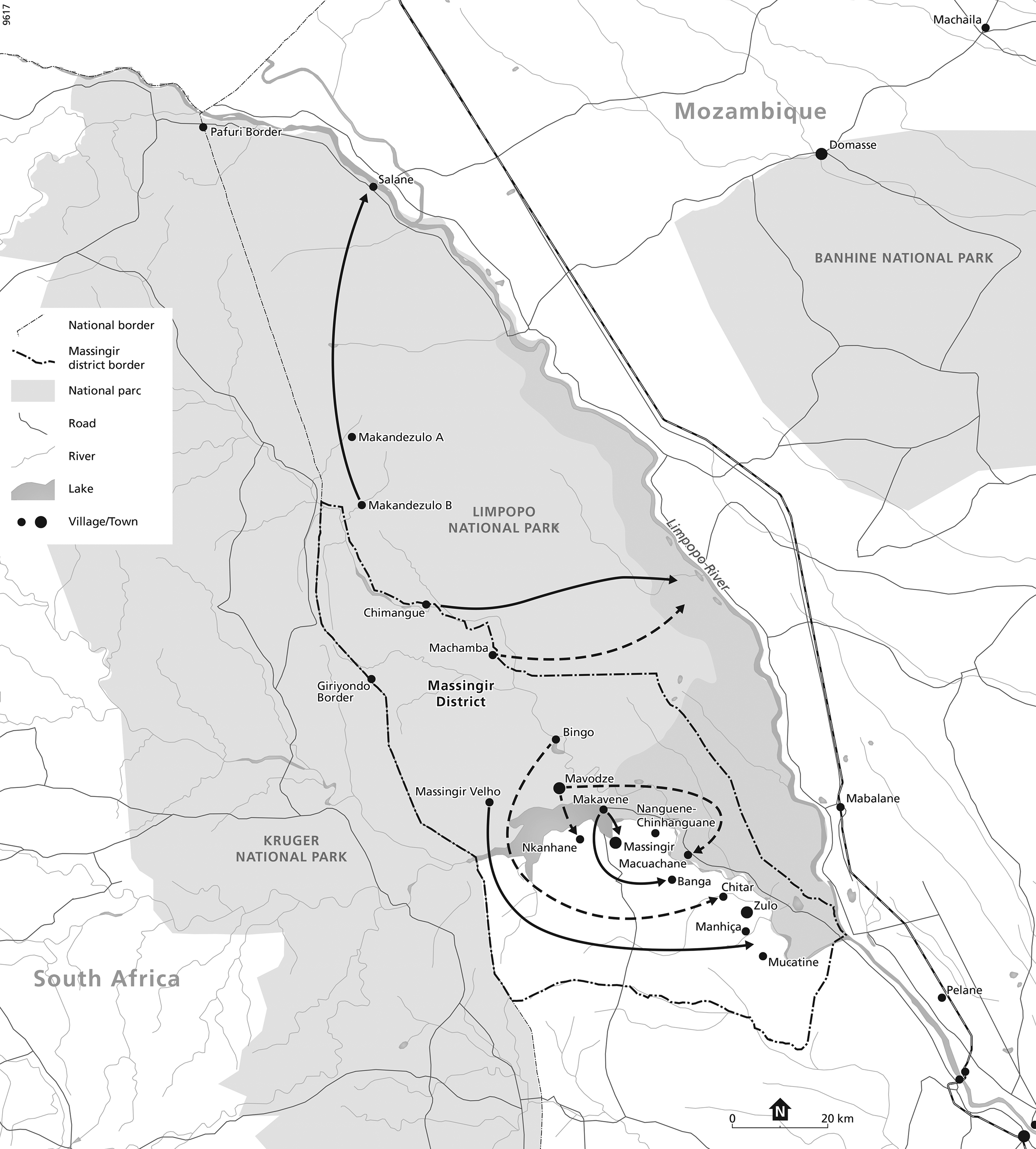
Resettlement as planned in LNP.
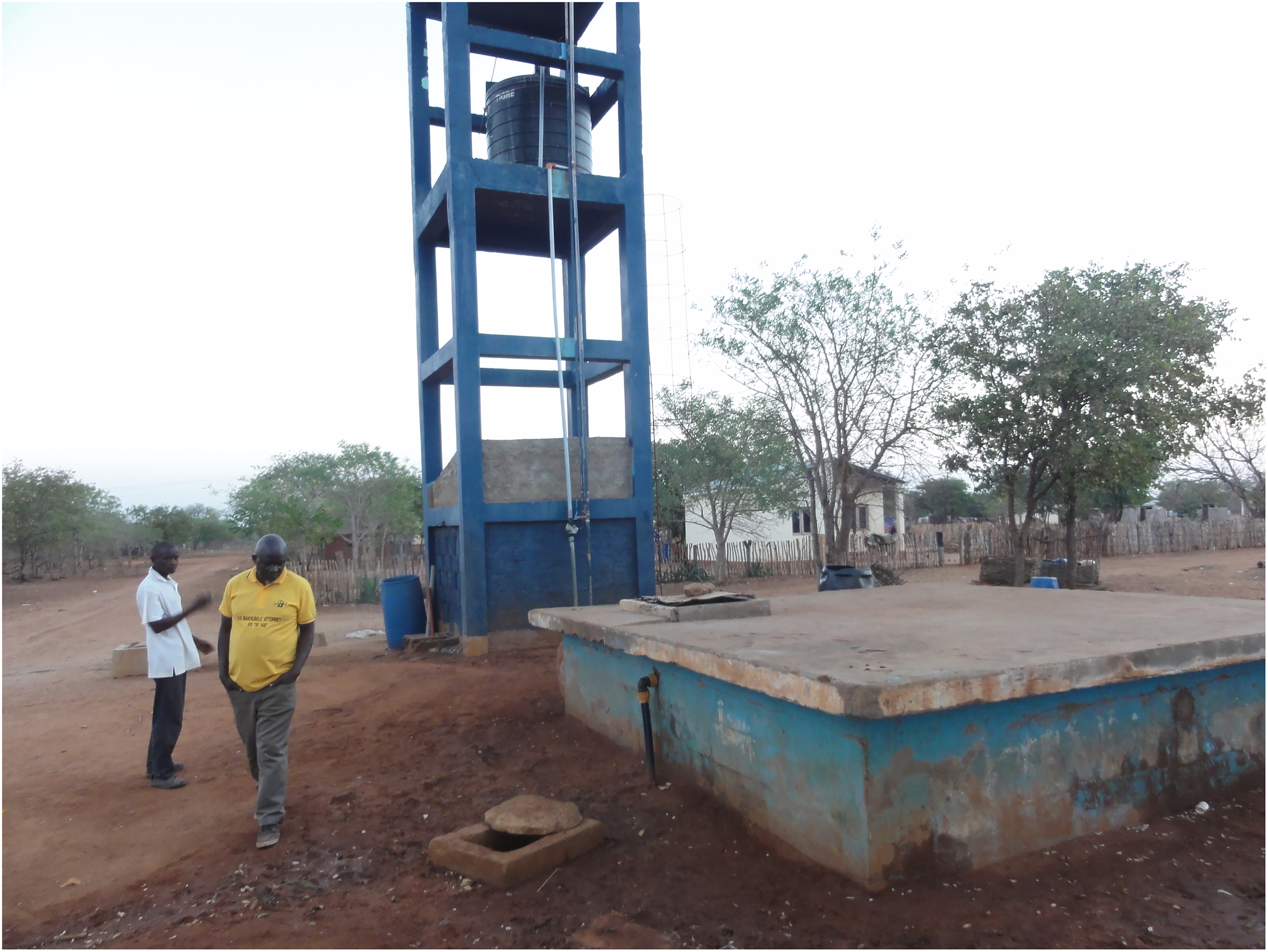
Broken water tank and pump system in Makavene-Banga.
This situation led the leader of Makavene-Tihovene to remobilise the resettlement committee in 2016; this committee was originally created in 2006 within the park for the purpose of negotiations in public consultations, to gather the community leaders of the resettlement villages, namely Makavene-Tihovene, Makavene-Banga, Nanguene (resettled in 2008), and Massingir Velho (resettled in 2015). In addition to the resettled villages, the leader of Mavodze, which is the largest community of 700 households and still waiting to be resettled in the LNP, also joined the committee. The remobilised committee worked as the first social infrastructure that emerged in the struggle to address the deficient infrastructure by officially communicating resettled people's grievances to park administration.
In the case of Makavene-Tihovene, the committee managed to obtain a few water taps connected to the city's grid around the resettlement village. However, in other resettlement villages, this arrangement was not easy to make. In August 2019, Makavene-Banga's women were still walking to the river, and people in Nanguene and Massingir Velho collected water at their host communities’ boreholes, paying fees to the host communities. The leaders complained to park administration, which directed them to the district administration, as the resettlement villages are in the district's territory and connection to the water services is within the district's domain.
In an interview on 5 March 2019, when another drought hit Massingir, the district administrator explained the situation as follows: Until now there was no clarity … but yesterday, at the meeting with MITADER, the park [administration] and the donor, we decided that we, the [district] government, will take care of the basic infrastructure for resettled communities. Thus, we will provide five things: [a] school, [a] hospital, water boreholes, electricity and roads. All the rest should come from the park, and the budget of KfW [German Development Bank] will take care of the houses and compensation including irrigation … [infrastructure].
This shows that not only for the resettled people but also for national and local government officials, the question of who is responsible for providing the most basic lifeline infrastructure for the citizens in resettlement villages had not been clarified. Park administration initially included basic infrastructure as compensation in order to incentivise the people to accept the resettlement, but it failed to clearly communicate this to the district administration. Consequently, the district did not make it a policy priority until recently, years after resettlement had taken place. The resettlement committee's demands thus forced the officials to finally prioritise their lifeline infrastructure after six years of the Makavene's resettlement.
However, the budget for the new infrastructural connections or installation of water infrastructure is not readily available. As one of the African nations deeply indebted to the international monetary system, Mozambique experienced structural adjustment at the end of the 1980s, which opened the door to donor interventions in all public spheres (Hanlon and Smart, 2008). Over the past decades, the neoliberalisation of the state, combined with an authoritarian, practically one-party regime mired with accusations of corruption, has chronically weakened the government's capacity to provide public infrastructure services to the citizens. Simultaneously, Mozambique as a donor darling kept attracting to Massingir new investors, including Chinese contractors and engineers, Portuguese construction companies and South African tourism industries. The presence of these foreign investors, in combination with more traditional civil society interventions and the presence of NGOs, tends to make district administration promise new infrastructural projects without having the planned state budget to do so.
A consequence of such ‘projectisation’ of public services with foreign investor and donor involvement (Picciotto, 2020) is sporadic and ad hoc installations of infrastructural projects. In the resettlement villages further from the city, such as Makavene-Banga, Nanguene and Massingir Velho, the practical provision of infrastructure for drinking water had to be an off-grid solution. In 2019, Makavene-Banga demanded its own installation, having learned about a similar installation in a village about 10 km away.
5
According to one elder: The government sent the Chinese [contractor] to dig our borehole. But they found that the water was not potable and closed… [the borehole]. Banga [host community] was also going to get their borehole and we are all suffering. Our women have to keep on walking to the river to get water. There is not much water around here. God stopped the rain…
6
Women were deeply disappointed with the non-functioning water infrastructure, which stood at the entrance of the resettlement village. They said that they at least wanted to use the water for washing or bathing even if it was not potable. Women often set off to the river in the early morning, to avoid the heat of the day, carrying loads of dirty clothes on their heads. They would wash their clothes in the river and then carry them back to the village, walking nearly 15 km in total. The district administration maintained that, for health reasons, it had to dig a new borehole or secure a budget for water treatment, and both would take time.
Even when the water becomes available, as seen in Makavene-Tihovene, the resettled citizens who enjoy public services discover that being connected to water infrastructure means that they have to earn cash to pay for it or learn how to manage the installations to maintain the infrastructure. As we see below, livelihood reconstruction as a part of compensation has encountered drawbacks, and men in the resettlement villages mostly go to South Africa to engage in seasonal wage labour while women work on other people's farms nearly 10 km away from their villages for a few dollars a day. Of course, the cash income is not only for the connection to or maintenance of the provided infrastructure, but the resettled people discovered after connections were established that they had to cover this extra cost of their resettlement.
7
As one woman in Makavene-Tihovene lamented: I thought it was really nice to have a water tap near our house. We could even farm a little in our garden. My husband is in South Africa so I need to do something to earn money and eat until he comes back. But I was surprised to see the cost of this water! The farming is over. We will be poor again.
8
The infrastructure for drinking water therefore causes people to suffer when it is not installed, when it is installed but malfunctions or breaks down, or when it is installed and functions but the knowledge required to use it has to be learned the hard way. At the same time, such deficient infrastructure also worked to remobilise the resettlement committee to renew negotiations by the resettled people with the authority and to give opportunities to villages remaining in the LNP to learn post-resettlement realities.
Irrigation infrastructure and new associations
For the resettlement committee, another issue was to promote livelihood improvement in order to earn cash and secure food for the household in an increasingly dry environment, as most of the resettled people engage in farming or fishing. The infrastructure for irrigation agriculture thus became vitally important, especially for women, who had fewer migration opportunities. The importance also made the irrigation infrastructure contentious because the resettled people expected to use it for commercial agriculture, and its absence or malfunctioning let them down.
In the park, most adults had their own farm and grazing land for their cattle, one of the main assets of many households in LNP. Outside the park, individual plots were simply not available due to increased land pressures in Massingir. There were two reasons for the land pressures. First, the creation of the LNP itself: in 2001, Massingir gave 60% of its district territory to the LNP, thus radically reducing the area available for the resettlement villages. Then, large-scale land investments appropriated large tracts of arable land in Massingir between the late 2000s and the mid-2010s, while the resettlement negotiations in the park dragged on.
Meanwhile, communities outside of the park had already cultivated much of the available land, and park administration offered Makavene-Tihovene and Makavene-Banga as well as Nanguene and Massingir Velho cash compensation for the reduced plots of land. In Makavene-Banga and Massingir Velho, people were also disappointed with the provided plots of land, as the park initially had discussed the readily arable fields. Instead, they had to first prepare the soil, which required intensive labour. In addition, no one knew how to fairly calculate the compensation since invisible losses of cultural sites and medicinal plants were not addressed at all in the resettlement process (Witter and Satterfield, 2014). The irrigation infrastructure was supposed to at least bring a sense of fairness by enabling the villagers to intensively cultivate a collective farm if they secured farmland themselves.
At the end of 2015, while both Makavene-Tihovene and Makavene-Banga were struggling to find collective farmlands, park administration delivered two motorised water pumps and rubber tubes to the leader of each resettlement village. In 2018, Makavene-Tihovene managed to secure a plot of land from a neighbouring village called Marrenguele in exchange for an additional water pump. In 2019, three water pumps were finally installed and agricultural production started. In the same year, Makavene-Banga also secured a plot from its host community, Banga, but the water level of the plot's nearest river dropped dramatically due to drought and in 2020 they were still struggling to find an adequate spot to install the water pumps.
At the collective farm of Makavene-Tihovene and Marrenguele, irrigated farming started in the summer of 2019. When I asked the leader how things were progressing, he replied: I actually do not know how it works or in what space I can bring this issue of systems that the park talks about… they say we need a drip system and we should produce tomatoes. That is another problem. Everyone around here produces tomatoes. So where can we sell them? The market is full of tomatoes!
9
While the staple crop of the people in the region is maize, which is usually a rainfed crop and stored after harvest in traditional grain huts, the resettled people were advised to learn how to engage with the new cash crop. Drip irrigation requires more infrastructure than just rubber tubes connected to water pumps, but the park had not provided it. What the park administration did provide however, through an arrangement with the provincial government, was a technical person who could help the new irrigation farmers to at least manage the use of the water pump, and to allocate water without losing too much in the absence of a drip system. However, as implied by the leader's words above, he is not satisfied with this arrangement since the real ‘space’ to discuss the better use of the infrastructure does not exist
The resettled people also realised that they needed to purchase fuel for the water pumps after the initial supply ran out. Consequently, they created two farmer associations to collectively save money to buy fuel and other agricultural inputs while opening the ‘space’ for further negotiations with park administration. In this process, the matter of the commercialisation of tomatoes became urgent. The leader sought advice from the district's secretariat of agriculture, as well as a national NGO that provides technical assistance and advocacy services in the district, but they have failed to commit so far due to a ‘lack of resources’. 10
Just like the infrastructure for drinking water, the absence and inadequacy of irrigation infrastructure causes everyday suffering among the resettled people, who are striving to reconstruct their livelihoods and pay for infrastructural services through commercial agriculture. Even when infrastructure is provided, irrigation based on a motorised water pump also incurs costs and requires cash for fuel and presumably for maintenance. Moreover, irrigation infrastructure continues to generate new needs for assistance and aspirations for the future. The association led by the leader of Makavene-Tihovene is planning to ask for more infrastructure, such as storage and transport for their produce, as their collective farm is 10 km from their resettlement village and the city market. However, he is wondering who to ask for all this help. While the responsibility for getting the villagers into this situation lies with park administration, people know that it has no one with the appropriate agricultural or infrastructural expertise and resources. At least, associations make barulho (noise) and protest against park administration in the hope of getting their voices heard.
The two infrastructure examples show that, once provided, they can cause symbolic violence (Bourdieu, 1989) through which people are forced to accept new roles as citizens who purchase water services and are expected to invest in new forms of cash-earning livelihoods (LaRocco, 2020). Infrastructure thus works to generate ‘cruel optimism’ by which resettled people as new citizens retain ‘affective attachment to what we call “the good life”’ while enduring ‘a bad life’ that wears them out because they find ‘their conditions of possibility within it’ (Berlant, 2011: 27). In order to develop the conditions of possibility, the resettled citizens strive to build their social infrastructure to negotiate with different governmental actors and NGOs and discuss among themselves how to keep on living in the new, built environments that constantly give them harsh living conditions.
The communities that are waiting to be resettled in the park, led by Mavodze, are already experiencing such a violence pertaining to the materiality of resettlement by actively participating in the remobilised resettlement committee and observing the protest over land and irrigation. They are currently beginning to shape their social infrastructure to resist resettlement, reconfiguring their relationship with the park administration.
Resisting resettlement
In February 2019, I met with an LNP officer who is in charge of communicating with communities within LNP. He explained what his work is all about. We have to convince the communities in the park to go out… we still have Mavodze, Bingo, Machamba inside… I started to work to complete this move in 2017—then till May 2018, nothing … [happened]. In April [in 2018], we saw there were problems with houses… [built for Mavodze]. They had splits in the walls… the resettlement …[project]… has to improve them for the people to be convinced, you know…
11
The officer lamented that the negotiation was becoming increasingly difficult for park administration. This was primarily due to the resistance mounted by Mavodze, the largest community (officially 700 families, but most likely more) 12 waiting to be resettled. The community still serves as an administrative post for Massingir and the leader has been an active resettlement negotiator right from the beginning of consultations, which officially started in 2006. The community is also home to poachers, and many young men from Mavodze have been killed in Kruger. The male residents mostly own large herds of cattle and they tend the cattle of people who are already resettled in Makavene-Tihovene or Nanguene and do not have enough grazing land. The presence of a large number of cattle in their community means they are constantly exposed to wildlife conflicts such as with lions that occasionally kill their cattle. In other words, Mavodze has become the primary victim of green violence that affects their members and cattle, and the park administration and the Peace Park Foundation have been eager to resettle it to solve the conflict.
The LNP officer visited Mavodze every week in order to win the community's consent for resettlement. In 2017, Mavodze acquired two resettlement locations, following similar logic as Makavene: one part of the community would settle in Nkanhane near the city, and the other would settle in Mucatine, with a wide area for farming and cattle grazing. The community also demanded better resettlement villages than the previous ones, with more solid housing with better foundations and functioning infrastructure in place before moving into the villages. Trying to meet this demand, at the end of 2017, park administration, in collaboration with the district administration, contracted the Portuguese construction company to build new resettlement housing. Nonetheless, the community had not moved by the deadline at the end of 2019, partly due to the delay in the construction of houses and infrastructure and more importantly due to new conflicts between Mavodze and the park administration.
In July 2019, after some lions killed a dozen cattle in a corral in Mavodze, the young men of Mavodze revolted. They blocked the main ‘tourist’ road with the bodies of dead cattle and hijacked the park administrator's car when he came to talk to the community. They also demanded compensation for the 186 cattle that had been killed by ‘the park's animals’ over the years, including the newest dozen killed. 13 The community calculated the compensation themselves, based on the market price of cattle. According to the park administrator, he was forced to approach the donor and the provincial government to secure the budget to pay this compensation, but so far no actual commitments have been made. 14
Meanwhile, Bingo, which had been rather willing to leave, began to align its policy with that of Mavodze. Together with the smaller community of Machamba (‘the community of hunters’, as people call it), which had always resisted resettlement, all the remaining villages to be resettled officially declared that they would refuse to be resettled until their demands were duly met and the agreed compensation paid.
In this context, the materiality of resettlement fed into discursive strategies for the community leaders to explain their logic of resistance. According to the leader of Mavodze: We want to move. But the park never consults us about the kind of houses we want. They never invite us … [to see the construction site]. We want to move to those areas if they get enough land for our cattle and water boreholes … also for the cattle. We don’t want to suffer like Nanguene or Makavene. And they have to compensate us for our cattle and young men that their animals killed.
15
There is conflicting information about the houses, since LNP administration maintains that the houses for Mavodze had been built in accordance with the community's demands, namely that better foundations and materials be used. One officer said that Mavodze had already accepted that the land for cattle was not going to be sufficient, especially near the city, so it would be odd that the leader complained about it. Yet, the issue no longer seems to be whether the information is true or false. The leader used the existence of contentions, which were becoming explicit through the emerging social infrastructure, in order to strengthen his point about achieving justice for his people and their cattle. Sharing the experiences of earlier resettlement villages, Mavodze and surrounding communities resisted the lure of beautiful promises and becoming obedient subjects of development and conservation.
The resistance is further delaying the resettlement process, and the communities in LNP are continuously exposed to green violence and pressure to resettle in their liminal conditions. At the same time, their continuous presence in LNP undermines the envisioned fortress conservation.
Discussion: Reconfiguration of power relations to address the violence of resettlement
In the LNP's resettlement project, park administration and their officers had always been at the forefront of negotiations for nature conservation and resettlement until the resettlement committee by the resettled villages was remobilised to communicate grievances about their water infrastructure. The mobilisation was effective to the extent that it made the district administration admit that the provision of basic lifeline infrastructure was its responsibility. Consequently, it also revealed that district administration had to admit that it was dependent on donors and investors who are not consistently present in the district.
Meanwhile, the resettled people also realised that once infrastructure is provided, more infrastructure will be needed to reconstruct the community's livelihoods or to enable them to earn cash to pay for infrastructural services. For these infrastructural service provisions, more actors will be involved, and the resettled citizens will need to be vigilant about how to keep everyone accountable for their suffering when the promised infrastructural services fail. The associations they created were a step towards the collective negotiations and monitoring of the situations.
The emerging resettlement committee and associations as social infrastructure in resettlement has enabled Mavodze and the adjacent communities in LNP to reshape the process of resettlement negotiation and make clearer demands regarding the amount of compensation and the timing of its payment as well as the specific infrastructural conditions that they need to confirm before being displaced. This change of the communities’ attitudes has made park administration rather defensive, but it is an opportunity for it to reflect on how it should perhaps shape ‘more positive politics’ (Rodgers and O’Neill, 2012: 401). For example, park administration, the district, donors and communities themselves come together to outline what their ‘regimes of quality and collective benefit’ (Rodgers and O’Neill, 2012: 401) would look like, starting from planning for affordable basic service—primarily the provision of water, the consolidation of economic activities through longitudinal thinking about agricultural infrastructure development, and the maintenance of provided infrastructure and quality services.
Technically, this means that governments at different levels—especially the district government and MITADER, and more probably intermediated by the provincial government—must coordinate the provision of physical infrastructure and services and establish their infrastructural powers in the context of new settlement construction. In particular, if the district had been given a clear mandate from the beginning of resettlement negotiations to plan infrastructural provisions for resettlement villages, the resettlement villages would not have had to wait for so long for clarity about who is responsible for their lifeline infrastructure. And if the district, together with the park's field officers, had explained what infrastructural services entailed, such as the cost of their services, people would have been less frustrated or could have demanded that the initial costs be a part of the compensation.
These technical solutions are only possible when resettlement projects are embedded in a wider political context where citizens are allowed to raise their voices and keep negotiating with the authority. As the state capacity to demonstrate its infrastructural powers in Mozambique is significantly influenced by international donor politics and the global investment environment, their responsibilities for ensuring budgets to be used for the management of the new environment must be clarified. More specifically, in 2019 park administration had only one livelihood reconstruction officer, and he had just been recruited from Zimbabwe and had no knowledge of local agriculture. The German consultants also frequented the resettlement villages to give ad hoc advice on livelihood reconstruction as short-term assignments. As the district administrator put it: ‘The park likes studies but we don’t see the real results.’ 16 Studies by consultants about the resettlement project and its livelihood survey are available, but none of them currently includes concrete planning for alleviating the existing violence of resettlement and emerging resistance within the park by providing more expertise and resources to manage the resettlement's built environment. Furthermore, these studies fail to recognise how this neglect of the built environment simultaneously undermines the agenda of nature conservation.
Conclusions
The objective of this paper was to draw scholarly and policy attention to the roles of physical and social infrastructure in the context of establishing a nature conservation enclosure. Using LNP's resettlement project in Mozambique, I have shown that although infrastructure is often framed and used as compensation for displacement, this framing prevents the providers of such infrastructure from envisioning the situation when infrastructure becomes the source of people's everyday suffering after their resettlement. Moreover, ‘infrastructure as benefit’ overlooks the fact that resettlement is a continual process of livelihood reconstruction and improvement, and that as infrastructure ‘lives’ this process, the nature and extent of its violence keep on changing (Amin, 2014) or ‘mutating’ (Arce and Long, 2000). In this process, people are not only victimised but rather shape their social infrastructure and resist the idea of accepting what is offered at face value. The promoters of resettlement projects thus need to be aware of this trajectory of infrastructure and its material power when they plan resettlement, as they tend to underestimate their significance until they become overwhelmed.
Resettlement induced by nature conservation can become very complex or even more contentious than other resettlement projects induced by development projects, since the expertise involved in nature conservation is often far removed from infrastructural planning and built environmental management. The park officers’ and donors’ interests and expertise in the LNP, as well as in Kruger, are in the management of flora and fauna, and very little in the boreholes and water pumps that they promise to install outside the park. There is a need to recognise the importance of the infrastructural expertise that should be involved in conservation-induced resettlement so that violence pertaining to resettlement can be anticipated and dealt with before it escalates. The LNP resettlement project shows that when promises around infrastructure fail (or when missing or faulty and inappropriate infrastructure is prevalent), it works to justify resistance and thus undermine the original objective of establishing transfrontier conservation areas free from human incursion.
Theoretically, this paper has clarified the importance of understanding resistance in relation to new civic subjectivity assumed in infrastructural materiality and politics surrounding nature conservation. While infrastructure was initially used as a means to establish ‘foreclosure of resistance’ (Foucault (1990[1988]), it has become the reason for resistance and thus a potential tool for power reconfiguration. New citizens have been produced in the park who envision how to develop their own resettlement projects, and who are becoming more vigilant about who is accountable for supporting their own development.
Recognising citizens who are to be resettled not merely as beneficiaries but as active actors who could establish the regimes of quality and collective benefits requires us, researchers, to take seriously methodologically their everyday experiences with mundane, water and other lifeline infrastructure's limitations and omissions. They might show the direct suffering of resettled citizens—especially women, who are traditionally in charge of securing water for their households in many cultural contexts; consequently, a more gender-specific research agenda and policy formulation could be envisioned. And as for the nature conservation agenda itself, we can more concretely show that development of the built environment outside enclosed protected areas can significantly influence the agenda of conservation and tourism development. Ultimately, clarifying the roles of physical and social infrastructure in the context of conservation-induced resettlement is a way to avoid careless resettlement project planning associated with the establishment of protected areas and thus prevent the further suffering of resettled and waiting-to-be-resettled people.
Highlights
Studies have mainly focused on violence of dispossession and conservation and paid little attention to violence of resettlement and the role of resettlement's materiality
Resettlement becomes violent when physical infrastructure is deficient, inadequate or difficult to maintain, causing everyday suffering of the resettled people
As people start expressing their suffering, new social infrastructure emerges and enables resistance against resettlement
The resistance against resettlement undermines the original nature conservation objective
It is imperative to include built environment and associated social infrastructure in a discussion on nature conservation
Footnotes
Acknowledgement
I thank Salvatore Chivite, Cidalia Bombe and João Ngoca for assisting with the field research and all the people who interacted with me in the research process in Massingir and LNP. Ton Markus of Utrecht University's Cartography Department kindly and swiftly made Figure 1.
Declaration of conflicting interests
The author(s) declared no potential conflicts of interest with respect to the research, authorship, and/or publication of this article.
Funding
The author(s) disclosed receipt of the following financial support for the research, authorship, and/or publication of this article: This work was supported by the Toyota Foundation, (grant number D17-R-0498).
