



Abstract
This article explores community-based organisation and non-governmental organisation ‘senses of justice’ and their interaction with community procedural environmental justice claims. The research was centred on a study of Peru’s Loreto Region and the pollution impacts from oil extraction. This was conducted through the political ecology of voice theoretical framework which can act as a bridge between the fields of environmental justice and political ecology. Semi-structured interviews were conducted with eight relevant non-governmental organisations and four community-based organisations operating in Loreto, alongside testimony from other stakeholders. Results show that sense of justice synergies can occur between non-state actors and local communities, achieved through inclusive participatory mechanisms and equitable partnerships. This synergy enables local struggles to be made visible to the wider world as well as heard, evidenced through the grievances being addressed by the state and resource extraction industries. Nevertheless, how transformative these partnerships are is variable, with procedural legal justice offering the most beneficial way for community-based organisations and non-governmental organisations to support local justice struggles. Moreover, to be truly a transformative process, there is a need for these legal justice partnerships to challenge the deeper structural injustice of misrecognition so that human rights, alternative livelihoods and developmental futures are recognised and safeguarded.
Keywords
Injustice is a multi-faceted and deeply entrenched global issue. It is evident in political (Beckett and Sasson, 2004), economic (Sobhan, 2010), social (Levy and Sidel, 2013) and environmental (Drake, 2018) contexts which often overlap, interconnect and exacerbate each other. How the global community successfully mitigates injustice and upholds and strengthens the rule of law and human rights remain ongoing challenges. A particularly pressing concern is the climate crisis, which is irrevocably accelerating injustice in different areas including food, water and energy security (Dodds et al., 2009; Hanjra and Qureshi, 2010) and development in areas such as urbanisation (Khosla and Bhardwaj, 2019). This is particularly pressing in the Global South (Page, 2008). Governance at different spatial scales (Lawhon and Patel, 2013), incorporating actors such as the state, international financial institutions and non-state actors like non-governmental organisations (NGOs), have significant input into facilitating solutions to the climate crisis, though not without problems (Dunlap and Sullivan, 2019; Natarajan et al., 2019).
To fully understand environmental injustice, one must focus on its underlying causes which relates to questions of power (Sébastien et al., 2018), the challenges of land or resource ownership (Carruthers, 2008; Wolford et al., 2013) and the absence of equitable values within the global economic system (Bell, 2011; Pulido and De Lara, 2018; Wolford, 2008). However, one must also consider how procedural justice operates through different actors and the ways in which these processes and mechanisms interact with and shape local societal injustice grievances. Through a case study of Peru’s Loreto Region, this paper explores community-based organisation (CBO) and NGO ‘senses of justice’ and their interaction with local community procedural environmental justice claims. Cuninico, an indigenous village in this region provides a detailed example of this non-state actor and community procedural justice interaction.
Peru’s Loreto Region has been chosen as the focus of the investigation for several reasons. High levels of injustice caused by the oil industry (Orta Martínez et al., 2007) remain an ongoing issue whilst CBO and NGO groups undertake important outreach work in the region (Nelson-Nuñez, 2019). Western academic research has also predominantly focused on Peru’s mining sector (Ali and O’Faircheallaigh, 2008; Muradian et al., 2003) with less attention paid to the impact of the oil industry in Loreto, making it a constructive site for empirical analysis. Lastly, PhD fieldwork was undertaken in the region enabling the researcher to draw upon relevant empirical data.
This paper will show that the political ecology of voice (PEV) theoretical framework can act as a theoretical bridge between political ecology and environmental justice. It does so by exploring the impact that underlying social, political, economic and geographical factors have on senses of justice being vocalised by and within marginalised groups and those that represent or work with them. Results indicate that a shared sense of justice can occur between local communities and non-state actors. This ‘sense of justice synergy’, achieved via inclusive participatory mechanisms and equitable partnerships, enables struggles to be made visible to the wider world and heard, evidenced through the grievances being addressed by the state and resource extraction industries (REIs). In these engagements, local community voices were not dispossessed, or their justice struggles co-opted by non-state actors. Nevertheless, how transformative these engagements are is variable. Whilst procedural justice can be secured in these partnerships through negotiated agreements with the state and REIs, these are only short-term successes which do not alter the state’s power to ignore the stipulations or its ongoing neoliberal development pathway. The process of securing justice through legal means would appear to offer the most beneficial way for NGOs to support local justice struggles as it can lead to stronger assurances that local justice claims are both listened and responded to. However, to be truly transformative process, there is a need for legal procedural justice to not only tackle the injustice impacts caused by neoliberal extraction but also challenge the deeper structural injustice of misrecognition prevalent in Peru so that human rights, alternative livelihoods and developmental futures are recognised and safeguarded.
This paper will begin with a literature review exploring the relationship between procedural justice and transformative power, society and non-state actor engagement and ‘senses of justice’ before outlining the PEV theoretical framework and the connection between ‘voice’ and ‘justice’. This will be followed by an outline of the case study and contextual background on the wider PEV Loreton challenges alongside the methodology. An Empirical section is detailed and subsequently analysed in the Discussion before a Conclusion summarises the article.
Environmental justice and the struggle for transformative power
The unequal distribution of pollution and the ability to seek redress remain ongoing sources of contestation that shape environment–society relations. Environmental justice, a reference to the human right to a healthy and safe environment, access to environmental information and participation in environmental decision-making (Bell, 2011: 241), has become a key avenue through which these challenges have been explored. The concept was established in the United States in the early 1980s after civil protest at the racialised dumping of PCBs in Warren County, North Carolina and the disproportionate exposure of minorities and the poor to pollution (Bryant, 1995; Bullard, 1999; Maantay, 2002; Zimring, 2015). This focus on distributive justice, whilst still explored in different U.S. contexts (Goodling, 2019; Graddy-Lovelace, 2017), has extended into a global, empirically rich and plural research agenda (Martin, 2015; Schlosberg, 2004; Walker, 2009). This encompasses topics including the environmentalism of the poor and the petro-violence of oil frontiers (Peluso and Watts, 2001; Watts, 2015), ‘slow violence’ (Nixon, 2011) and structural injustices connected to polluted landscapes and ‘sacrifice zones’ (Lerner, 2010).
Theoretically, environmental justice is now understood as a three-dimensional (Fraser, 2008) or trivalent (Schlosberg and Schlosberg, 2007) concept that has expanded from a distributive focus onto other overlapping dimensions which are of importance for this paper. The first is procedural justice which investigates the processes and mechanisms by which goods are allocated and the decisions made (Clayton, 2000) and requires states to provide access to environmental information and access to decision-making and justice if these rights are infringed (United Nations, 2018). Myers et al. (2018: 3) suggest that procedural justice is ‘fundamentally about meaningful participation in decision-making, including having a seat at the table, having a voice, and ultimately having power’. Effective and meaningful local level actor participation rather than tokenism (Arnstein, 2019; Gonzalez and Brown, 2021) is integral to achieving fair distributive outcomes (Clayton, 2000). Environmental justice scholars have highlighted how environmental management regimes are often rooted within the ideologies and practices of colonialism (Richmond, 2013). Whilst there have been post-colonial efforts to improve indigenous voices and rights within environmental management systems (Barrera-Hernandez et al., 2016; Phromlah and Martin, 2015; Richmond, 2013), these often produce ‘marginalised opportunities’ (Delabre and Okereke, 2019; Richmond, 2013; Schilling-Vacaflor, 2017) that fail to deliver procedural justice.
The second interlinked dimension is recognition which can be understood as a struggle for the ‘recognition of difference’ and the injustice of ‘misrecognition’ (Fraser, 2000). In this context, academics have stressed the spatial constitution of recognition (Walker, 2009) and the ‘politics of territory, place and networks’ (Holifield, 2012: 609), which impacts what is misunderstood or misrecognised. A capabilities approach to environmental justice has shown how the indigenous peoples’ struggle for recognition encompasses wider capability issues including the preservation of native cultural practices, language and religion, respect for sacred sites, the protection of traditional village economies and the health of the environment (Schlosberg and Carruthers, 2010).
In Latin America, there have been notable improvements in this regard with pluricultural and plurinational constitutions in Bolivia, Ecuador and Venezuela providing state recognition and rights on a host of areas including cultural and religious identities and land and territorial ownership (Rodríguez and Inturias, 2018). Nonetheless, research has shown how the absence of meaningful participation is mirrored in the depreciation of indigenous and traditional peoples’ knowledge about natural resource management and the environment (Aseron et al., 2015). Their alternative cosmological visions (Fausto and Heckenberger, 2007; Smith, 1996) and anti-modernity and decolonial agendas (Escobar, 2008, 2018) are directly contradictory to the expansion of western neoliberal capitalist development which is racialised (Pulido and De Lara, 2018) and extractive-oriented (Enns et al., 2019). Subsequently, one finds that whilst these visions and agenda have achieved some recognition, e.g. Buen Vivir (Rawson and Mansfield, 2018; Villalba, 2013), they are predominantly excluded from natural resource management systems and discourses (Aseron et al., 2015).
The crucial and underlying challenge for trivalent justice for indigenous and tribal peoples remains the struggle for power. Critical environmental justice scholars indicate the need for researchers to reflect on and engage with the deeper, entrenched and embedded forms of social power, including state power, in society (Pellow, 2016; Pellow and Brulle, 2005). ‘Effective participation always means an adjustment of political power, and if legal arrangements centralise power then effective participation is unlikely in practice even if suggested in principle’ (Phromlah and Martin, 2015: 140). In a paper by Rodríguez and Inturias (2018), they outline two kinds of power: hegemonic power or ‘power as domination’ and transformative power. The former can occur in visible forms, e.g. through environmental management regimes and decision-making mechanisms or in less visible processes such as hegemonic discourses, narratives, practices and worldviews. Hegemonic power processes cause domination, division and distributive injustice in which environmental burdens are adversely affecting certain groups.
There is also a second form of transformative power often referred to as the ‘power of agency’, in which social actors mobilise resources to create and implement a desired solution to socio-political problems (Rodríguez and Inturias, 2018). Unlike power as domination, transformative power is often collaborative and entails understanding how excluded people make use of their resources and sources of power to counteract the forces of domination (Rodríguez and Inturias, 2018). Social transformation and environmental justice can only occur when frameworks, people and dominant discourses are altered. In this paper’s context, one must consider how community actors seek to achieve procedural justice and the wider social actor partnerships that support this transformative power process.
Non-state actors, power and ‘senses of justice’
CBO and NGO actors are important to consider in relation to the mitigation of socio-political problems, such as environmental injustice, but also due to their facilitation of transformative power. For example, NGOs can represent and ‘scale up’ citizen political voice (Bebbington et al., 2008b; Perreault, 2003; Thomas, 2008) by challenging ‘the territorial power of nation-states’ (Walton, 2016: 11) through their role as the organisational face of deeper, internationalised networks of social action and knowledge exchange (Bebbington, 2004; Bebbington et al., 2008a).
Nonetheless, citizen interaction with these actors indicates the ongoing battle for political power and participation to mitigate environmental injustice. These organisations can struggle to provide public participation (Desforges, 2004; Kotte and Kakumani Lavanya, 2011) due to a recent NGO shift away from social and political mobilisation, so-called ‘depoliticisation’, towards apolitical service delivery (Banks et al., 2015; Rahman, 2006). Their roles as ‘intermediaries’ (Simon, 2009) results in a delicate balancing act between different competing relationships and interests (Hulme et al., 1997; Rahman, 2006) which their participatory self-selection bias can polarise and exacerbate (Chambers et al., 2020). One must consider how these groups implement participatory processes in pursuit of environmental justice and whether it is through transformative empowerment for local people or conversely tokenism.
The difficulty for citizens is that they also lack power to force downward accountability (Bawole and Langnel, 2016; O’Dwyer and Unerman, 2010). This is partly due to the competing, shifting entanglements within transnational civil society, in which certain third sector configurations will become central to transnational politics whilst others will be ignored or marginalised (Pieck and Moog, 2009). Consequently, even with NGO commitment to community-driven, grassroots approaches (O’Leary, 2017), poor, minority groups, who already suffer from exclusion or ‘un-entitlement’ to the benefits of democracy and citizenship (Coddington, 2017; Hammett, 2008; Mavroudi, 2008) may struggle to seek redress. These unequal power relations between citizens and non-state actors are exacerbated by the ‘politics of scale’ (Kurtz, 2003). This reveals ‘the tension between the scale(s) of the problem itself and the scale(s) at which the problem is to be resolved (or at least ameliorated) via public policy’ (Williams, 1999: 50). Societal efforts to resolve problems with and through non-state actors do provide the benefit of transcending local concerns into new spaces and networks (Escobar, 2001). Nevertheless, how environmental justice struggles are scaled up into national regional or international contexts is inexorably tied to each non-state actor’s conceptualisation of this idea.
The way in which non-state actors perceive or understand different theories or contexts has been explored in relation to nature (Arora-Jonsson and Ågren, 2019), peace building and security governance (Ebo, 2007) and poverty (Bebbington, 2005). For example, research by Bebbington (2005) on Dutch and Peruvian NGO aid chains concluded that their representation of the poor is constructed through their ideas, discussions and reports about how society and the economy is, in different spaces, how they have become the way they are, and crucially, how they believe they should be.
In relation to environmental justice, Svarstad and Benjaminsen (2020) suggest applying the notion of ‘senses of justice’, a term connected to and building on the ‘sense of place’, which acknowledges the importance of capturing and recognising people’s thoughts about their home place in the remedial process (Barron, 2017). The senses of justice concept, reached through a political ecology lens, recognises the ‘ways in which affected people subjectively perceive, evaluate and narrate an issue, such as their perspective on environmental intervention’ (Svarstad and Benjaminsen, 2020: 4) and requires researchers to investigate how senses of justice are expressed by and within marginalised groups. Crucially, one can argue that the senses of justice in social contexts also applies to other actors such as CBOs and NGOs. This is a significant point to note as it has implications on how local justice struggles are scaled up and represented by these actors. There is an absence of research empirically investigating the senses of justice concept applied by non-state actors and how these interact with local justice conceptualisations and struggles. In essence, whether the interests of local, particularly poor people are being upheld (Lindell, 2010). This paper seeks to explore this knowledge gap and will do so through a political ecology lens.
Despite the distinct emergence and evolution of each field (environmental justice concentrating on United States pollution and political ecology on Global South natural resource governance), both have clear overlap in their critical study of environmental interventions (Svarstad and Benjaminsen, 2020). However, there are of course notable distinctions. One of the major differences is the interplay between theory and practice. The initial environmental justice activism in the United States has given environmental justice an empirical and methodological orientation which has meant that the field has not had the need to theorise itself (Holifield, 2019; Swyngedouw and Heynen, 2003). This has often led to a failure to place justice issues in a larger political economic framework with its key strength instead been on supporting and advancing social and environmental movements (Lee, 2009). On the other hand, political ecology has a broad theoretical perspective (Swyngedouw and Heynen, 2003) but can often fail to be practically applied to real social and environmental problems, which are directly connected to justice concerns. Moreover, political ecology does not try and actively solve the problems that cause environmental pollution or social marginalisation (Lee, 2009), instead concentrating on refining and expanding its theoretical and political repertoire (Holifield, 2019).
Consequently, studying environmental justice through a political ecology lens has significant theoretical benefits. The senses of justice indicates how political ecology can strengthen the theoretical framework underpinning environmental justice, and in so doing aid efforts at decolonising the environmental justice field and the dependency on recognition by the liberal state (Pulido and De Lara, 2018). This theoretical benefit is also evident when reflecting on the process of power; whilst both fields recognise its importance, political ecology has a more explicit understanding of what power means and how it is utilised. For example, the power as domination and transformative power previously described by Rodríguez and Inturias (2018) is understood in political ecology and wider social sciences as ‘actor-oriented’, in which power is ‘exercised’ by those implementing environmental interventions or conversely those resisting them (Svarstad and Benjaminsen, 2020; Svarstad et al., 2018). This study’s investigation into how senses of justice interact between citizens and communities on the one hand and non-state actors on the other is underpinned by the process of actor-oriented power and would thus benefit from a political ecology approach. However, to provide further clarity on how senses of justice are expressed in these interactions, this paper conducts analysis through a specific political ecology approach termed PEV.
Vocal justice through the political ecology of voice
PEV integrates political ecology and its core themes of power, scale, space and time with the political economist Albert Hirschman’s voice theory which has been reconceptualised into an environmental context (Gonzalez, 2015) (see Figure 1). 1 It can be defined as ‘the study of a specific temporal, economic, political, social and geographical environment in which various stakeholders (e.g. citizens … CBOs and … NGOs) utilise their voice over an environmental issue’ (Gonzalez, 2015: 467). PEV can provide a stronger theoretical framework for the study of environmental justice whilst also enabling political ecology to be practically applied beyond merely theoretical debates (Lee, 2009). Consequently, the PEV framework can act as a theoretical bridge between both fields by exploring the impact that underlying social, political, economic and geographical factors have on senses of justice being vocalised by and within marginalised groups and those that represent or work with them. A PEV study in this context is a study of how challenging the process of achieving environmental justice is for local actors.
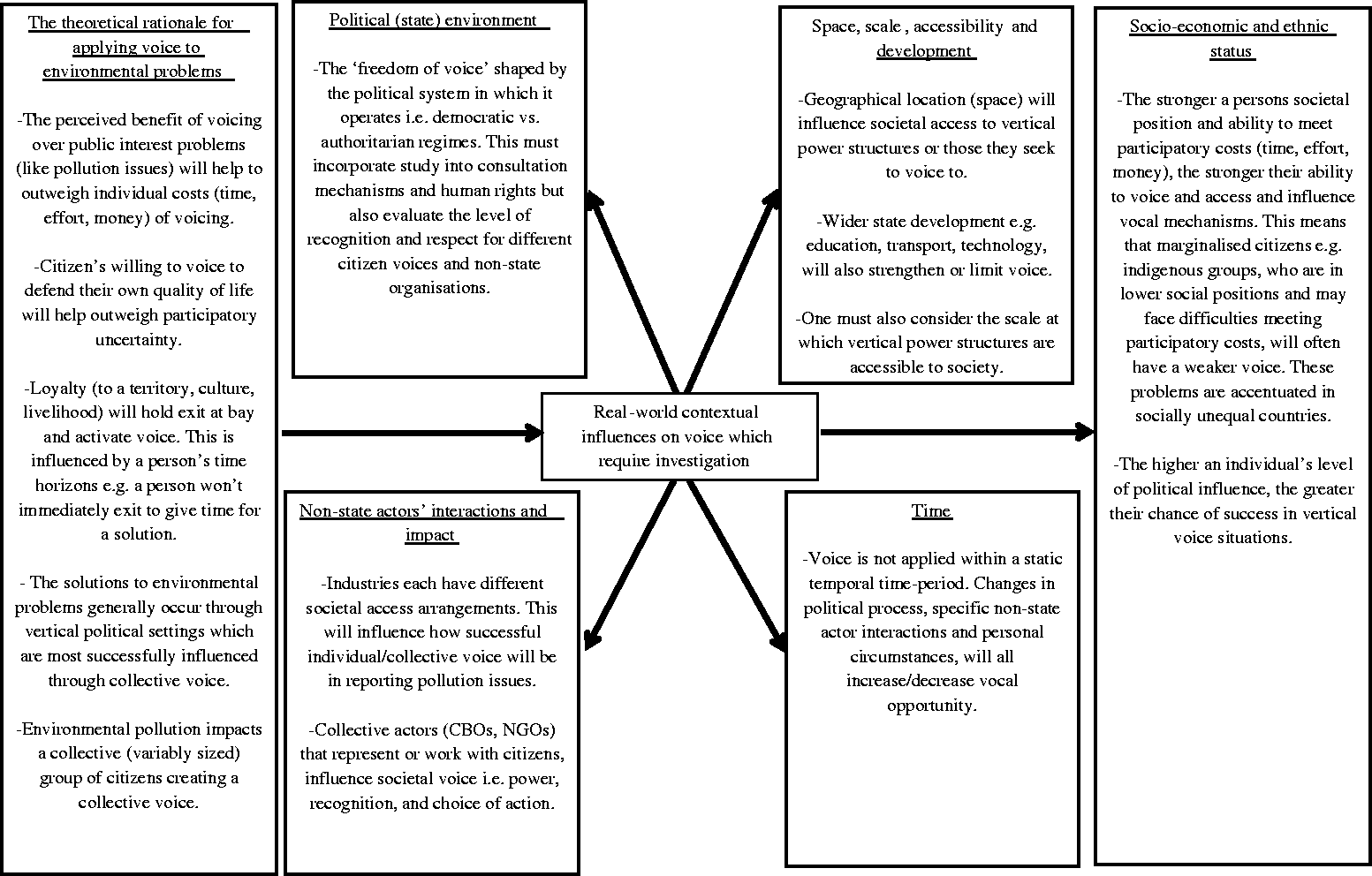
The political ecology of voice (PEV). Modified from Gonzalez (2015: 479).
A focus on voice, as opposed to ‘entanglements’ (Pieck and Moog, 2009), ‘negotiation’ (Ball and Piper, 2002) or ‘advocacy’ (Banks and Hulme, 2012) requires us to be clear on what voice means in this environmental justice context. In a previous paper, voice was described as an active statement of protest surrounding a disagreeable issue (Gonzalez, 2018a). Here, however, voice has a multi-faceted meaning that directly connects to the trivalent conceptualisation of environmental justice. It can be understood as an active attempt to make distributive injustice issues visible to the wider world, as well as heard, evident through the grievances being redressed by the actors responsible. This response to the different vocal acts requires evaluating the processes and mechanisms of procedural justice and will indicate whether these injustice problems and those voicing them gain recognition.
This paper’s focus on non-state actor senses of justice and their interaction and possible contestation or ‘competing entanglements’ (Pieck and Moog, 2009) with local procedural claims provides further specificity to our exploration of voice in this justice context. It will enable us to uncover how local justice concerns are being framed and vocalised by non-state actors, in effect what ‘sense of justice’ is being pursued. In so doing, it will evaluate whether these partnerships signify a transformative power process that strengthens local, particularly subaltern voices (Naidu and Makanda, 2015; Routledge, 2003) and their injustice grievances, evident through recognition and respect by the state and other actors. Conversely, one could instead find that these interactions dispossess local claimant voices (Bourdieu, 1986; Mohan, 2002), thereby reinforcing the structures of hegemonic power and oppression that local, marginalised communities face.
Peru information and methodology
Loreto Region
Two of Peru’s main economic activities and principle national exports are mining and hydrocarbons, which account for over 14 per cent of the country’s gross domestic product in 2019 (EY, Peru MoFA, Peru MoEaM and Perupetro, 2019). Peru’s Loreto Region is integral to this oil exploitation. It is a vast territory, covering nearly 369,000 square kilometres (Finer et al., 2013) but is sparsely populated, with 45 per cent of its 1 million + inhabitants residing in the regional capital Iquitos, whilst the remainder dwell in over 2000 smaller, remote river communities (Brierley et al., 2014).
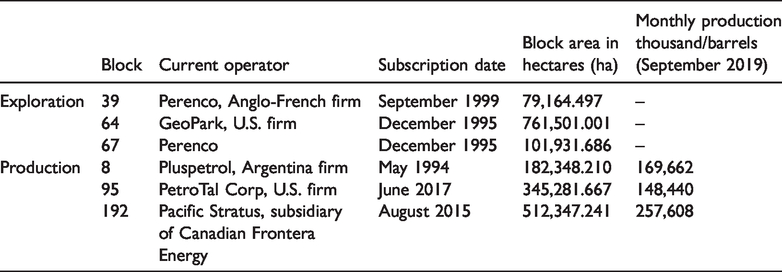
Oil was first discovered in Loreto by the state-run company Petroperu in the 1970s (Haller et al., 2007), but it was only after structural reforms in the 1990s that Peru’s hydrocarbon sector became more competitive. Since then, the industries have witnessed increased investment and areas zoned for operation (EY, Peru MoFA, Peru MoEaM and Perupetro, 2019). Oil production (see Table 1 and Figure 2) is predominantly centred on Blocks 8, 95 and 192 (formerly Block 1AB) which account for 16.3 per cent of Peru’s total oil production in 2019 (Petroperu, n.d.a). A further three other exploration blocks have also been leased. The North Peruvian Pipeline and a northern pipeline branch were completed in the 1970s to transport crude oil from production blocks to the Talara refinery on the pacific coast.
Loreto hydrocarbon exploratory and production blocks (as of September 2019) (Bnamericas, 2019; EY, Peru MoFA, Peru MoEaM and Perupetro, 2019; Perupetro, 2019; PetroTal, n.d.).

Location of Loreto’s exploratory and production blocks and case study village (Perupetro, n.d.b).
Despite its long oil history, Loreto remains a challenging production environment. Blocks 8 and 192, along with the North Peruvian and Northern Branch pipelines, have been a major source of ongoing contamination. In 2016, seven ruptures, spilling an estimated 10,000-barrels of oil occurred (Law in Action, 2016), which forced Petroperu to shut down the pipeline for one year to complete repairs (The Chaikuni Institute and ORIPO, 2018). Since 2016, the National Environmental Monitoring Agency (Organismo de Evaluacion y Fiscalizacion Ambiental, OEFA) have claimed that more than 20,000-barrels of oil have spilt from the pipelines in 15 vandalism attacks and 5600-barrels have been lost due to corrosion or operative failures (Cespedas, 2018). Meanwhile, the absence of free, prior and informed consent (FPIC), environmental pollution and chronic underdevelopment have led to ongoing indigenous protests including river and pipeline blockades (The Chaikuni Institute and ORIPO, 2018; Taj, 2019a), alleged pipeline vandalism (Cespedas, 2018) and oil installation seizures (Taj, 2019b). These protests, alongside the pipeline closure, has had a significant impact on Loreto’s oil production and firm investment (Bnamericas, 2019; Cervantes, 2019).
One community affected by pollution caused by Petroperu serves as a specific case study of this procedural justice partnership. Cuninico, a Cocama (also spelt Kokáma) indigenous village of between 450 and 500 inhabitants, is located on the Marañón Riverbank in Urarinas district, Loreto province (Latitude: –4.81667, Longitude: –75.16667). In June 2014, the North Peruvian pipeline burst, spilling an estimated 2000 barrels into its dredged floatation channel that flows into the Cuninico River and eventually the Amazon River (Fraser, 2016). This incident is the basis of their justice struggle outlined in the empirical findings.
Contextualising environmental justice in Loreto
It is “quite easy to manipulate them [indigenous communities] …. That is what authorities do … the ones with more knowledge, more education”. (NSI5R1, Public Prosecutor Specialised in Crimes of Corruption for the decentralised Judicial district of Loreto)
It is important to summarise the wider PEV contextual environment in which environmental justice operates in Loreto. The first aspect concerns Peru’s political environment and the freedom of voice, a concept similar to U.S. freedom of speech, which requires exploring societal rights and the possibility for this action by citizens and other actors. The second area is societal accessibility to state-based environmental justice and the level of state support and recognition for peoples claims.
In relation to Peru’s political environment, the country has begun to consolidate democracy through adherence to global norms that provide its citizens with a broad freedom of voice, though of course challenges remain (Human Rights Watch, 2020). However, the political environment surrounding hydrocarbon consultation highlights a far more restrictive, suppressive freedom of voice. This is due to Peru’s aggressive hydrocarbon and development agenda, termed a ‘selva (rainforest) hydrocarbon and development vision’ (Gonzalez, 2018a). The advancement and protection of this agenda by the Peruvian state means that citizens are denied the opportunity to provide FPIC to development projects, thereby contravening Peru’s ratification of the International Labour Organisation’s Convention 169 in 1995 (International Labour Organisation, n.d.). Additionally, opponents of these projects, notably land and environmental rights defenders, are delegitimised and attacked by the state through judicial harassment and physical violence (Front Line Defenders, 2014), a situation contributing to ongoing deaths (Global Witness, 2018). Consequently, gaining state recognition for justice claims against these extractive projects is incredibly challenging and undeniably risky.
Regarding the second PEV aspect, recent research (Gonzalez, 2019) found that rural Loreton communities suffer from poverty and chronic underdevelopment, which leaves them unable to access the state or its judicial mechanisms. Their isolation is exacerbated by discrimination and silent racism (de la Cadena, 1998), evident in the reluctance of elected political representatives to visit and engage with indigenous selva communities at the periphery of state and society. It is also evident in the systematic human rights abuses and exploitation caused by Petroperu (Gonzalez, 2018b). The absence of political engagement increases community mistrust of the state and compels indigenous communities to become reliant on their own informal governance systems. This continues Peru’s historic process of indirect ‘rural governance’, which has sought to maintain racial domination by subordinating indigenous people under a distinct set of decentralised, fragmented ‘native’ institutions that do not challenge the racialised status quo (Scarritt, 2012).
This challenging rural societal access and interaction with the state has significant implications on the concept of environmental citizenship. 2 Peru’s rights-based approach to citizenship, including the environment, does not extend into rural spaces. This leads to what I term ‘shadow environmental citizenship’ (Gonzalez, 2019) in which Loreton communities cannot access or claim their environmental rights from the state, which fails to adequately support or recognise these citizenship grievances. Shadow environmental citizenship has two notable impacts. Firstly, it forces communities to utilise unorthodox informal voice actions, e.g. alerting actors through the media, or radical voice activities, e.g. oil pipeline sabotage, to try and be heard and/or seek redress for infringement of human and environmental rights.
Secondly, communities become more reliant on links to non-state actors for the provision of services (Nelson-Nuñez, 2019) and in the struggle for environmental justice. During 2015 fieldwork, two NGO spokespeople sought to make clear that their mission ‘isn’t to fulfil the state’s role’ (NGO5R1) as they ‘are not the state and by no means do we pretend to occupy their place’ (NGO6R1). However, there is an ‘open space’ (NSI2R1), a ‘gap that the state isn’t filling’ (NGO6R1) that non-state actors can have a great deal of influence in (CBO3R1; NGO4R1). As Cuninico’s Catholic priest explained: in this area [the Marañón river basin], there are not isolated indigenous, they … have contact with western society … [but], it depends, people can have contact with the government but not with the [Catholic] Church, or with the Pentecostal Church but not with the Catholic. Each one decides what they want (CBO4R3).
Methodology
Data were acquired through a multi-method qualitative approach integrating semi-structured interviews and micro-geography interview observation (Elwood and Martin, 2000). Interviewee consent enabled the audio recording of interviewees, which were led by a paid local interpreter and anonymised. An interview guide tested through several pilot interviews and revised through contact summary sheets served as the basis for interview questions. Each person was given a coded category made up of their broad professional occupation, ethnicity, geographical location and interviewee and organisation (if relevant) number (n) (Appendix 1).
A theoretical sampling approach for data collection was taken in which I actively sampled for relevant data. Initial contact was made with several potential collective voice actors and gatekeepers of case-study communities via a Google internet search. These were three NGOs: E-Tech International (NGO1R1), The Peru Mission (NGO2R1) and Alianza Arkana (NGO7R1) and an indigenous environmental watch-dog CBO, Red Ambiental Loretana, (CBO1R1). Aside from E-Tech International, all are based in Iquitos.
In total, 110 interviews were conducted with 105 interviewees during PhD fieldwork, recruited through the snowballing effect. 3 Of this total, interviews with 57 participants discussed procedural justice in Loreto and included a mix of CBO, NGO and state representatives alongside the experiences of Cuninico’s Cocama community. Further questions surrounding procedural justice were emailed to CBO and NGO representatives in 2016 with several responses received. Appendix 1 provides information on these different representative organisations. The 57 relevant participant interviews comprise 29 Cuninico interviews, 9 participants representing 8 separate NGOs, 10 representatives from 4 separate CBO organisations, 5 government interviewees, 2 academics, 1 journalist and 1 environmental and human rights lawyer.
Interview transcripts were produced by paid UK translators and analysed through QSR Nvivo 10 software in which data were coded through typologies (concepts, categories and propositions) via a weak form of inductive or conventional analysis (Taylor, 1998). The inductive analysis was combined with analyst-based typologies and where possible indigenous or emic typologies (Patton, 1987), so that interviewee voices were ‘heard’ as often as possible and utilised in a way that did not alter their voice. To help underpin the coding process, a loose PEV research storyline was established, incorporating initial concepts and categories.
Empirical findings
One important line of CBO and NGO interview questioning was to understand the types of activities these actors implemented to facilitate local environmental justice. Educational activities were an important feature of NGO community engagement, principally teaching indigenous peoples about their human and hydrocarbon process rights (CBO4R3; NGO6R1; NGO7R1; NGO8R1). Whilst the Ministry of Culture and Vice Ministry of Interculturalism had been created in 2011, state limitations mean that ‘in many opportunities it can be us providing logistics for the state’ (NGO6R1). For instance, Law, Environment and Natural Resources, a non-profit civil organisation centred on sustainable development and natural resource management, concentrate part of their work on ‘strengthening the organisation of indigenous people’ through education in the Ucayali province, Loreto Region (NGO8R1). Equally, Nature and Culture International (NCI) (NGO6R1), a non-profit private institution focused on biological and cultural diversity, train ‘communities in their rights so that they know them well …. and know how they can claim them’ (NGO6R1).
A second key activity was ‘vigilancia de la comunidad’ (NGO8R1) or environmental monitoring, which was implemented by several NGOs (NGO1R1; NGO4R1; NGO8R1). The NGO ProNaturaleza, focused on sustainable development and conservation, has established environmental monitoring services in the Corrientes river basin for over eight years. This provides training and capability [through equipment including GPS and cameras] to the people in charge of monitoring the communities, elected by Assembly, in order to be able to monitor the oil activity. The community monitoring programmes don’t replace the monitoring the companies are required to do, but it [sic] complements it. (NGO4R1)
Over the course of interviews with different actors, the conversation turned towards a discussion of environmental injustice and their respective organisational focuses (NGO7R1), agendas (NGO2R1b; NGO3R1) and ‘intentions’ (NSI2R1), i.e. senses of justice, and the way justice should be procedurally pursued. A fascinating discussion was held with a representative of the CBO Red Ambiental Loretana, who recounted their experiences of mobilising and supporting Achuar indigenous communities. The CBO sought to represent local community voices through a sense of justice that was ‘attuned with local community issues’ (CBO1R1) concerning environmental and human rights abuses. This long-running campaign, beginning in 2004, demanded that the government and the oil company Pluspetrol, who had controlled Blocks 8 and 1AB/192 since 1996 and 2001, respectively, reinject the heavily toxic produced water into the oil fields, thereby removing the government’s ongoing exemption of Pluspetrol’s compliance with existing Peruvian laws (Orta-Martínez et al., 2018; Vasquez, 2013).
Justice was pursued through a non-violent campaign, a strategy agreed in discussions between the local communities and the CBO (CBO1R1). It consisted of ‘sit downs, protests … meetings, talking to the press … visiting schools … [and] universities’ within Iquitos. Initially, the government viewed these actions as ‘a nuisance’, but due to the campaigns growing local traction, subsequently ‘became very sensitive to our … voice’ and moved to expel the CBO co-ordinator back to his native country, a situation only averted by significant national and international attention and condemnation (CBO1R1). Further mobilisations followed. In November 2006, through the CBO’s coordination, more than 800 Achuar indigenous people staged a peaceful two-week blockade of Blocks 8 and 1AB/192, shutting down power to most of Loreto’s oil production and its road, airport and river access (Collyns, 2006; Orta-Martínez et al., 2018).
Aside from non-violent campaigns, other more radical forms of vocal action such as riots or oil pipeline sabotage exist and are used to make local injustice issues visible and heard. However, when these examples were put to different non-state actors, none of the representatives supported gaining procedural justice through these means (NGO5R1; NGO6R1; NGO7R1; NGO8R1), though one Catholic Church interviewee (CBO4R3) described supporting its use in previous decades. In contemporary Peru, the Red Ambiental Loretana spokesperson believed that justice struggles by citizens and CBO and NGO actors no longer had ‘to be a protest’ (CBO1R1), due to the growth in Peruvian societal environmental concerns (CBO4R3; IUA3; NGO6R1), improved NGO involvement in Peru (CBO1R1) and an increase in media coverage (ILP1; NGO2R1b).
Another key sense of justice uncovered through reading prior to fieldwork was the use of private, negotiated financial settlements between indigenous communities, their federations and REIs. A recent illustration of this form of procedural justice which was discussed with interviewees was Occidental Petroleum’s 30-year oil extraction operations in the Corrientes river basin and the resulting socio-environmental impacts on Achuar residents (Goldman et al., 2007). In 2007, the Maynas Carijano v. Occidental Petroleum legal case was started on the behalf of 25 indigenous plaintiffs by the NGOs Amazon Watch and EarthRights International in the Los Angeles U.S. Federal Court. Ultimately, the case never came to trial as the parties reached a confidential mutual financial settlement in September 2013, only publicly announcing it in March 2015 (Cultural Survival, 2015; Earth Rights International, 2015).
In discussing this sense of justice, a representative from the government’s National Environmental Monitoring Agency gave the example of a human rights lawyer that advises Loreton indigenous federations to pursue this justice: he has his own [justice] perspective you know, he thinks like negotiating with the government is just worthless because they are not doing anything more than their job …. I believe he sees that in a way of they [sic] deserve this compensation. Which is true but instead of taking it into the [legal] justice level to court or anything he is trying to negotiate; he is advising them to negotiate. (NSI2R1) there is a conflict of interests – sometimes the community is divided, and parts of the community want to get access to money. There’s an issue there from the federations too, they sue the company for spills and problems, and they ask for money as a remedy. (NGO4R2b) I think it’s, let’s give them whatever we need to give them to keep them quiet and at some point in a couple of years of time, we will give them another palliative to give them to keep them quiet [sic] … keep them calm you know [pause]. Its massive social divide. (NGO2R1c) people need money. Those are places [the selva] where money does not flow … then, the possibility of an oil company is the possibility of money flowing and people want that …. and we would be naive if we said that they don’t look for money …. You can’t live isolated saying well, I don’t belong in the world … they realise it is poisoned money … but they need [it]. (CBO4R3) I hate it when other leaders that maybe you will interview, they will tell you “yeah yeah, no no we don’t want money, we don’t need money. We want just like agreements with the government.” [pause] Hey everybody wants money, you need to survive, and you’ve been abused from the government for the past forty years, that nobody has like provided any service to you. Hey, you are like in an oil paradise and you don’t get, you don’t see anything, any benefit from that? How will you feel? [Slaps leg]. (NSI2R1)
For over 20 years, CBO4R3, alongside their colleague, have served the spiritual and educational needs of Cuninico and other communities along the Marañón River (CBO4R3). This long-term engagement, and the community trust in the Catholic Church that it generated (IRC13; IRC16; IRC20; IRC23), appear to be key to the village alerting the priests to the 2014 oil spill, thereby breaking through Petroperu’s efforts at silencing the community’s concerns at exploitation (Gonzalez, 2018b). Long-term education was critical for the community’s pursuit of environmental justice through legal action. As one villager told me; ‘[t]hey’ve [the Catholic Church] done the trainings, they explain …. And based on that [pause] we notice that it’s our right, no? Of course, and we’re going to fight until we get it’ (IRC18). Catholic Human Rights Commission representatives stressed that communities have a choice about whether to pursue legal redress. ‘We try and listen to both parts [i.e. arguments] because it’s necessary’, after which consensus is sought as communities ‘need to feel that what they’ll get is for everyone’s benefit’ (CBO4R1a). In Cuninico’s case, ‘the community has united, and we have accepted to be able to do the process towards the state’ (IRC8) which was supported by this CBO.
Catholic Church representatives sought to strengthen community comprehension for legal justice by talking about the spill in a simple, clear way (IRC7). Written information, showing Petroperu’s lack of compliance with Peruvian laws (IRC9), was provided which allowed residents ‘to be informed’ (IRC6) and make a choice that they more fully understood (IRC6; IRC18). The formulation of all the legal strategies ‘are being done and discussed with them, altogether. Involving them is a very important part of the process’ (CBO4R1a). In April 2015, representatives visited Cuninico and ‘had some workshops and villagers identified the problems and how these had manifested. Now, [names redacted] translated those thoughts by the community to a more legal language’ (CBO4R1A).
The Catholic Church and its partner organisations, the Institute of Legal Defence and the Regional Organisation of the Indigenous Peoples of the East (Organización Regional de los Pueblos Indígenas del Oriente, ORPIO) (IRC1; IRC4) were able to secure access to national and transnational legal mechanisms on behalf of Cuninico and support their litigations. At a national level, the Catholic Church and partner organisations initiated a constitutional lawsuit against the Ministry of Health (Ministerio de Salud, MINSA) and Regional Government of Loreto to demand specialised healthcare for communities like Cuninico affected by the oil spill (Younger, 2020). Alongside this national legal action was transnational litigation. On 9 June 2016, a public hearing on Cuninico’s case was held at the Inter-American Commission of Human Rights (IACHR) in Santiago, Chile, which was attended by a Peruvian state delegation comprising representatives of the Ministry of Justice, the Foreign Ministry and Petroperu’s Chairman. Aside from collated locally grounded legal testimony, two Cuninico citizens, the male community leader and a mother of four children, were funded by these non-state actors to attend and give testimony. A bottle of water polluted with oil was also provided as evidence by one of the Cuninico villagers (Alvitres, 2020).
The hearing saw Petroperu admit responsibility for several oil spills for the first time (Peru Support Group, 2016a) and led the IACHR to visit the affected sites and gather information on the situation in July 2017 (Capasso, 2017; Organisation of American States, 2017a). In response, in December 2017, the IACHR granted a precautionary measure to protect the life and physical integrity of Cuninico and San Pedro (Organisation of American States, 2017b). This stipulated that the Peruvian state conduct medical tests on community members and provide any necessary medical aid, access to portable water and a nutritionally and culturally appropriate diet (Organisation of American States, 2017b). The government has now installed a water purification tank which gives Cuninico water for two hours per day through a tube system between houses, whilst a water purification plant is being built nearby (Alvitres, 2020).
Similarly, the long-running national constitutional lawsuit was ultimately won by the non-state actors and communities in January 2018, leading to a September 2019 announcement of a roughly 3 million soles ($900,000) health plan by the Regional Health Directorate (La Dirección Regional de Salud de Loreto) (DIRESA) within the Regional Government of Loreto. This is the first time that a Peruvian court (in this case, the Civil Chamber of the Central Headquarters of the Judiciary of Iquitos) has ordered the design, financing and implementation of an emergency public policy response to the health impacts caused by oil spills (Younger, 2020).
In a final part of the interview with Cuninico’s Catholic priest, I asked him about how the village would have responded to the oil spill without the Church’s involvement. Whilst his response is pure conjecture it is nonetheless important: ‘I suspect that … nothing would have happened …. It’s just that … who do they go to? You have to know people to ask for help, so, who do they go to?’ (CBO4R3). ‘Really, we would have been … abandoned’ (IRC6), a ‘forgotten town’ (IRC13).
Discussion
National neoliberal and environmental governance models have created significant implications for indigenous people (Gombay, 2015; Perreault, 2003), who can become framed by the state as objects of development, resulting in a false choice between marginalisation and assimilation (Grydehøj and Ou, 2017; Theriault, 2017). This binary choice is exacerbated by indigenous peoples struggle for power over environmental governance and the recognition for alterative cosmologies and nature–society relations.
In this context, the importance of NGO community empowerment becomes evident (Banks and Hulme, 2012; Mohan, 2002). In Loreto, one can see that NGO actors are enabling community empowerment through their support and facilitation for environmental justice. Educational outreach is a critical and transformative activity which seeds local knowledge about human rights, responsibilities and justice and can help counteract the yoke of oppression and societal inequality and vulnerability which plague post-colonial societies (Eckstein et al., 2003; Telles and Bailey, 2013; Wade, 2010). The reviewing and simplification of EIA proposals and the production of technical documents enables local justice claims and community procedural vocal dialogue with other actors to be strengthened. These ‘enabling roles’ (Yan et al., 2018) are particularly vital given the challenging context of Loreton indigenous rural isolation, underdevelopment and limited educational opportunities (NGO8R1) (Casapia et al., 2007).
However, it is important to stress that CBOs and NGOs ‘aren’t everywhere’ (CB03R1) in Loreto. Their limited operational funds and personnel combined with the region’s geographical distance and travel times, means that there are rural communities that lack any non-state actor support (CBO3R1; NGO1R1; NGO6R1) (Nelson-Nuñez, 2019). For example, Regional Organisation of Indigenous Peoples of the East, Loreto’s regional indigenous CBO, gave a specific example of the Urarina people, living along the Chambira River (Alto Nanay district, Maynas province) who ‘don’t have NGOs and they are not connected well with the cities’ (CBO3R1). NGO focus on connected areas, through attention to urban over rural areas or development hotspots, confirm that NGOs serve to ‘pluralise’ certain spaces at the expense of others (Bebbington, 2004; Mercer, 2002) leading to an uneven grounding of NGOs at the local level (Bebbington, 2004). There is thus a plausible argument that these actors are not well ‘placed’ to implement environmental justice as their inconsistent local engagement in Loreto can reinforce the inequality of environmental justice for rural communities caused by shadow environmental citizenship. However, without their engagement in Loreto and important service-delivery facilitation (Nelson-Nuñez, 2019), it is conceivable that the struggle for justice would be even more pronounced for local people.
According to an anthropologist at the Research Institute of the Peruvian Amazon, there is a ‘gap’ that cannot be bridged between the liberal state on the one hand and indigenous people on the other (IUA1). It is evident that interviewed Loreton CBO and NGO actors are not seeking to ‘bridge’ this gap by promoting the benefits of neoliberal development to local communities, though this can often remain an objective due to the close links between foreign aid agencies and the neoliberal approach (Makuwira, 2018). Instead, they seek to strengthen and support communities in their dialogue and probable ongoing contestation with the liberal state over environmental management issues and environmental injustice. The success of Loreton CBOs and NGOs in supporting local environmental justice struggles is dependent on securing and maintaining the trust of the community, an integral parameter (Deng and O’Brien, 2020), but also having a shared sense of justice between both parties. This was apparent in the work of Red Ambiental Loretana and the Catholic Church and Catholic Human Rights Commission, whose senses of justice was ground in and mirrored those of the communities, and which undertook procedural justice actions agreed in tandem with local people.
This ‘sense of justice synergy’ is built on two interlinked processes. Firstly, evidence suggests that the ‘listening’ of local community voices by non-state actors is often merely about finding out how to frame a specific issue in a way that is acceptable to local people (Jeater, 2011). However, these two CBOs used ‘invited spaces’ to facilitate participatory opportunities for local people (Cornwall, 2008). There was no suggestion that local community voices were dispossessed, or their environmental justice struggle or procedural justice decisions co-opted by these non-state actors. Secondly, these inclusive participatory dialogue mechanisms indicate a recognition of their powerful positions vis-a-vis communities, and a proactive willingness to facilitate engagement with local people in a more equitable ‘partnership’ approach rather than through top-down dictatorial processes. A sense of justice synergy is thus built on inclusive participatory mechanisms and equitable partnerships.
Whilst no interviewed CBO or NGO actors in this research supported pursuing private, financial agreements, this sense of justice appears to offer greater participatory and justice concerns. It is probable that financial compensation can exacerbate communities already divided by neoliberal resource development (Folami, 2017; Ogwang et al., 2019), thereby increasing the likelihood of social conflict. In this situation, it becomes less clear precisely whose sense of justice is being delivered when local communities become separated and embittered. This can lead to situations where locally dominant, authoritative, predominantly male voices will be amplified, whilst other views, such as those of the elderly or women, already marginalised in a highly patriarchal society (Clark and Laurie, 2000; Moser, 2003), may be lost. The loss of this collective community solidarity exacerbates their already weaker power vis-a-vis non-state actors, who in turn can more easily co-opt local people into actions which they may not fully understand or agree with. Whilst there is an argument that local communities suffering environmental injustice deserve financial compensation, its ‘palliative’ (NGO2R1C) effect hugely benefits not only REIs, whose production is no longer threatened, but also the state, who can continue with their neoliberal extractivism. Meanwhile, NGOs can laud their role as mediators between conflicting parties, a responsibility which may see them inadvertently shift from ‘mediation’ to ‘domination’ of local communities (Chernela, 2005).
It is important to evaluate how transformative these Red Ambiental Loreton and Catholic Church sense of justice synergies and processes of procedural justice are. The non-violent campaign orchestrated by Red Ambiental Loretana instigated the Dorrisa Accords, an agreement which stipulated that Pluspetrol reinject all the produced water in both Blocks, fund a comprehensive 10-year $10 million health plan via the Ministry of Health and prepare, lead and execute a $3 million development plan (Gonzalez, 2017; Orta-Martínez et al., 2018). This campaign helped to make a local injustice claim visible and strengthen citizen dialogue, whose demands appeared to have been recognised and listened to by the state. However, the long-term developmental aspects of this agreement were never implemented, causing a resumption of mass mobilisations and radical acts by citizens (Zaitchik, 2017) and the signing of further negotiated agreements (Orta-Martínez et al., 2018). This is clear evidence of ‘placation’, one example of ‘counter-participatory strategies’ used by the state to subvert critical voices and discourses thereby maintaining racialised capitalism and extractive development (Gonzalez and Brown, 2021). Placation sees the state implement tokenistic dialogue to achieve a negotiated agreement that, in the short term, pacifies communities but is never fully implemented or completed, leading to a cycle of negotiation, agreement, placation and hostility (Gonzalez and Brown, 2021). Crucially, environmental injustice concerns can remain unaddressed or ignored.
It is thus unsurprising to find high levels of social conflict and radical voice actions in Peru (Defensoría Del Pueblo, 2019). Orta-Martínez et al. (2018) suggest that the recent decision by the Peruvian Achuar indigenous people to engage in open conflict shows the existence of a ‘conflict imperative’, in which overcoming environmental injustice, in certain circumstances, requires direct action that drives grievances to the open conflict level. The problem is that these ‘desperate acts’ (NSI2R1) are either ignored or the citizens placated or suppressed by the state. Collective mobilisations, though an attempt to make injustice visible, help to legitimise the racialised developmental narrative disseminated by the state. Indigenous people are depicted as ‘savages’, unable to hold civilised dialogue, despite state intransigence in refusing to recognise or listen to the indigenous struggle for environmental justice, even if this occurs through non-state actor partnerships. This indicates the reality of the struggle for power between the state and civil society and affiliated actors and the limits of transformative power processes.
Conversely, the partnership between Cuninico and the Catholic Church and their procedural justice claim saw Peru’s legal system uphold the rights of marginalised communities affected by oil pollution for the first time, a process strengthened through parallel engagement with a transnational autonomous justice body (the IACHR). As Juan Carlos Ruiz from the Institute of Legal Defence commented: There’s a political message here …. This is no longer only a local or regional problem. This issue is now in the Commission’s radar – which means the Inter-American Commission of Human Rights is checking what the government is doing about the case. (Capasso, 2017: 6)
Conclusion
To conclude, several key points are apparent. Firstly, the Red Ambiental Loretana and Catholic Church examples indicate that through a sense of justice synergy, local struggles can be made visible to the wider world and heard, evidenced through the grievances being addressed by the state and REIs. In these engagements, local community voices were not dispossessed, and nor were their justice struggles co-opted by non-state actors, which instead supported community justice. Nonetheless, concern was raised about private negotiated financial agreements as a form of procedural justice, which can stoke community division, resulting in the loss of collective solidarity and weakening their power vis-a-vis non-state actors, thereby increasing the likelihood of being co-opted and dominated.
Secondly, these partnerships have a variable transformative impact. Whilst Red Ambiental Loretana secured justice through a negotiated agreement, this was only a short-term success which did not alter the state’s power to ignore the stipulations or alter its ongoing neoliberal development pathway (Gonzalez, 2018a). The agreement is an illustration of placation, one counter-participatory strategy used by the state to subvert critical voices and discourses, thereby enabling racialised capitalism and extractive development to continue (Gonzalez and Brown, 2021). On the other hand, the Catholic Church’s procedural legal action was a more transformative power process and enabled Cuninico’s justice struggle to access, transcend and be heard in new national and international opportunities of engagement that were previously unavailable to them.
The process of securing justice through legal means would appear to be one of the most beneficial ways for NGOs to support local justice struggles as it can lead to stronger assurances that local justice claims are both listened and responded to. In turn it can help reform illegal or poor operational practices which can have wider beneficial impacts for other communities suffering injustice (Forest Peoples Programme, 2017, 2018). However, success is not guaranteed as the historic 1994 Aguinda v. Texaco court case in Ecuador indicates (BBC News, 2018). Moreover, the fact that Cuninico’s case is the first time that a Peruvian court has ordered an emergency public policy response in recognition of damage caused by oil extraction indicates the resistance that liberal state mechanisms have had to these concerns over the preceding decades. Given Peru’s ongoing resource extraction agenda (Gonzalez, 2018a), this resistance looks set to continue.
This situation illustrates that deeper, transformative structural changes are also required. Cuninico’s legal victory does not alter the state’s ongoing retention of power and decision-making over nature–society relations or the direction of national development. Nor does it challenge the state’s lack of recognition for indigenous people’s livelihoods and distinct cosmologies, respect for sacred sites, the protection of village economies and wider territorial and citizenship rights (Schlosberg and Carruthers, 2010). To that end, NGOs must seek to tackle the injustice of ‘misrecognition’ (Fraser, 2000) by campaigning and supporting legal procedural justice claims that rectify these issues and challenge the liberal state. There is evidence of this occurring in Peru.
In January 2020, indigenous communities living in voluntary isolation, again with the support of the IDL, won a landmark legal victory which has led to the exclusion of oil exploration and exploitation in the Sierra del Divisor national park near the Brazilian border. It is the first time that a Peruvian judge has ruled in favour of indigenous people in voluntary isolation against oil companies (Cervantes, 2020). Similarly, in June 2020, a five-year legal battle delivered a similar historic victory for indigenous communities in Peru’s Constitutional Court. The case, presented by the Interethnic Association for the Development of the Peruvian Rainforest (Asociación Interétnica de Desarrollo de la Selva Peruana, AIDESEP), a national indigenous organisation and the National Coordinator of Human Rights (La Coordinadora Nacional de Derechos Humanos, CNDDHH), a coalition of human rights organisations, sought to appeal against Law 30230. This law, passed in July 2014 aimed to boost foreign investment by significantly reducing scrutiny and oversight of development projects (Peru Support Group, 2016b). The recent ruling saw the Court not only recognise the importance of communal and territorial rights but also, for the first time, recognise that indigenous groups have the right to be consulted prior to the creation and implementation of laws that affect their lives. However, the Court did not agree that Law 30230 threatened the plaintiff rights to a healthy and clean environment, showing that the fight to gain holistic indigenous recognition must continue (Peru Support Group, 2020).
‘NGOs have always been in part a response to state failure’ (Bebbington, 1997: 1764). Through community and non-state actor partnerships and sense of justice synergies, legal procedural justice can tackle the adverse distributive impacts caused by neoliberal extraction. Moreover, they can also challenge the deeper structural injustice of misrecognition prevalent in Peru and elsewhere, so that (environmental) citizenship, human rights, alternative livelihoods and developmental futures are recognised and safeguarded. It is this transformative power process that will most successfully confront the hegemonic power of the liberal nation state. Whilst there are concerns that the saturation of service-delivery NGOs has a negative impact on the relationship between citizens and government in Loreto (Nelson-Nuñez, 2019), it is evident that without them, the struggle for justice for local communities would be even more challenging.
Lastly, the PEV theoretical framework has been immeasurably useful in exploring environmental justice. It can act as a theoretical bridge between both environmental justice and political ecology by exploring the impact that underlying social, political, economic and geographical factors have on senses of justice being vocalised by and within marginalised groups and those that represent or work with them. Exploring the senses of justice approach through PEV has enabled us to uncover how local justice concerns are being framed and vocalised by non-state actors, in effect what ‘sense of justice’ is being pursued. In so doing, this paper has shown that these partnerships and sense of justice synergies signify a transformative power process that strengthens local, particularly subaltern voices and their injustice grievances, evidenced through recognition and respect by the state and other actors. It is clear that their involvement is critical for securing transformative environmental justice for local indigenous communities that tackles both distributive and misrecognition concerns.
Highlights
Article explores how non-state actor senses of justice interact with community procedural justice claims. Conducted through the PEV which can act as theoretical bridge between environmental justice and political ecology. Sense of justice synergies can occur between communities and non-state actors which allow local struggles to become visible and heard. Procedural legal justice offers non-state actors the most transformative and beneficial way to support local justice struggles. To be truly transformative, there is a need for legal justice partnerships to challenge the deeper structural injustice of misrecognition.
Footnotes
Acknowledgements
I wish to thank my supervisor Professor David Simon for his support during my thesis research, my interviewees, two interpreters, gatekeepers and team of translators. I would also like to thank Dr Tomas Frederikson and colleagues at the Global Development Institute, University of Manchester and the two anonymous reviewers from Environment and Planning E: Nature and Space for their constructive and insightful feedback over the course of writing this paper.
Declaration of conflicting interests
The author(s) declared no potential conflicts of interest with respect to the research, authorship, and/or publication of this article.
Funding
The author(s) disclosed receipt of the following financial support for the research, authorship, and/or publication of this article: This research was supported by a Royal Holloway, University of London Irene Marshall Scholarship, Paul Broome Development Research Prize and Cardiff University Disglair Development Fund.
