



Abstract
In Spring 2020, amidst a COVID-19 state of emergency, the City of Toronto's Parks & Urban Forestry department posted signs in the city's remaining Black Oak Savannahs to announce the cancellation of the yearly ‘prescribed burn’ practice, citing fears it would exacerbate pandemic conditions. With this activity and other nature management events on hold, many invasive plants continued to establish and proliferate. This paper confronts dominant attitudes in invasion ecology with Indigenous epistemologies and ideas of transformative justice, asking what can be learned from building a relationship with a much-maligned invasive plant like garlic mustard. Written in isolation as the plant began to flower in the Black Oak savannahs and beyond, this paper situates the plant's abundance and gifts within pandemic-related ‘cancelled care’ and ‘cultivation activism’ as a means of exploring human-nature relations in the settler-colonial city. It also asks what transformative lessons garlic mustard can offer about precarity, non-linear temporalities, contamination, multispecies entanglements, and the impacts of colonial property regimes on possible relations. Highlighting the entanglements of historical and ongoing violences with invasion ecology, this paper presents ‘caring for invasives’ as a path toward more liveable futures.
Keywords
In a global state of precarity, we don’t have choices other than looking for life in this ruin.
Transformation doesn’t happen in a linear way, at least not one we can always track. It happens in cycles, convergences, explosions. If we release the framework of failure, we can realize that we are in iterative cycles, and we can keep asking ourselves – how do I learn from this?
Writing from home amidst a pandemic intensifying inequities throughout the globe, amidst the ongoing violence of colonialism and racial capitalism, with the escalation of housing crises and food insecurity in my city and beyond, while climate and biodiversity crises are also ongoing, rest is not coming easy. Parallel to this unrest, I witnessed the springtime spread of plants deemed invasive in my neighbourhood on my daily walks. Some of these non-native, invasive plants crowd out native flora, severing centuries-old relations with native pollinators, while others poison the earth as they take root in the soil. Some of them aid in renaturalizing toxic lands while presenting reminders of the violent conquest that enabled European settlement on Turtle Island. 2 Staring out at a wounded and contaminated landscape – an assemblage of native species and thriving fields of invasive flowers, dispossessed from their rightful stewards, such as the ones I see in the ravines and Black Oak Savannahs near my home in Toronto's west-end – I have felt immense grief regarding the implications of large-scale invasions.
It is in response to this grief that I found it necessary to rethink my relationship to ‘invasive’ more-than-human life in racial capitalist, settler-colonialist, toxic ruins. 3 White settlers of European ancestry living on stolen lands deliberately reshaped by “colonial fill” (Bang et al., 2014) like myself have a responsibility to understand how conquest and dispossession continue to inform life and death in settler-colonial places, be accountable to their peoples’ violent inheritances and harms, and commit to transforming toxic, unethical relations. Teachings on introduced species from Indigenous epistemologies (Kimmerer, 2013; Reo et al., 2017; Reo and Ogden, 2018; ILSC, 2019a; 2019b; Grenz, 2020) and permaculture (Orion, 2015) have been precious guides in helping me unlearn and release dominant framings that I once took for granted as an invasive species management volunteer in Montreal or Tio’tia:ke / Mooniyang 4 four years ago. A purity-driven invasive species paradigm insisting on good vs. bad, native vs. alien, natural vs. unnatural components of renaturalizing ecosystems was especially hard to shake in the midst of ecological collapse. Paying attention to the springtime abundance of garlic mustard (Alliaria petiolata), an invasive, maligned plant I came to know while living in Tkaronto 5 in 2020, I found a relationship through which to examine grief and invasiveness. Embracing Anna Lowenaupt Tsing's (2015) idea that precarity is the global condition that defines our world and makes way for meaningful, liveable collaborations, I committed to looking for life amidst ruin and disturbance, prioritizing human-plant collaborations that highlight all lifeforms’ vulnerabilities to others rather than the toxic languages of scarcity, war, progress, and human exceptionalism.
Garlic mustard is native to Eurasia and was introduced to Turtle Island by white European settler colonizers around ca. 1860 as a garden herb for cooking and medicine (Rodgers et al., 2008). Once it took root in the soil, its seeds gradually spread from colonizers’ gardens, eventually populating disturbed and non-disturbed landscapes alike, falling out of relation with the people who brought it here. Its first recording in Tkaronto was over 140 years ago, in 1879 (Anderson, 2012). All parts of the plant are edible to humans and since it is high in A and C vitamins (Rahman et al., 2018), it is valued for its nutrition. Its most popular use is in pesto, but it can be included raw or cooked in various dishes to add a garlicky flavour. Nonhuman herbivores on Turtle Island, however – including deer, rabbits, and squirrels – will not eat it, as its leaves contain chemicals that deter them. These are the same allelopathic chemicals in garlic mustard that disturb native fungal communities in the ground and make the soil hostile to native plants. For Potawatomi biologist Kimmerer (2013), garlic mustard is a challenging plant for its threats to biodiversity – along with common buckthorn, it follows the very footsteps of the Anishnaabe monster Windigo's environmental destruction for reasons that will be clarified later. It is, as Stinson et al. (2021) write, a “problematic pesto” (243).
The dominant impulse in media and mainstream invasion ecology to vilify invasive plants like garlic mustard has stunted helpful reframings for more collaborative futures. As Nlaka’pamux scientist Jennifer Grenz (2020) notes, invasive species management has “created the perception that research on these species wasn’t needed at all,” relying on harmful absolutes that close the door on further learning. If we take to heart Kimmerer's (2003) teaching that plants appear when they are needed, it follows that we would need to take a step back to examine what need might be communicated by garlic mustard's thriving. What is its abundance signalling about the health of nearby ecosystems, or about histories and ongoing structures of dispossession, including property regimes? What alarms does it sound about broken relationships, and what gifts can it offer for repair? This paper highlights the ways in which the settler colonial city prohibits meaningful relations to garlic mustard and asks which allies might be found in disturbed landscapes, in spite of the barriers to relationship. Starting with the humble refusal of vilifying garlic mustard, and being attentive to our shared entanglements with histories of conquest 6 and dispossession, I ask what worlds we are nurturing, and can nurture, together, through a relation of care.
Critical invasion ecologies
In the last few decades, the ‘invasive species paradigm’ (Ogden, 2018) that informs the fight against plants like garlic mustard in North America has been challenged on numerous grounds, both within the humanities and the sciences (Foster and Sandberg, 2004; Ogden, 2018; Robbins, 2004; Stanescu and Cummings, 2017; Warren, 2007). Within critical geographies, the notion that ecological concepts are constructs with historical-cultural contexts (Greer and Cameron, 2015) has been instrumental in clarifying how dynamics in invasion ecology are not neutral but rather value-laden (Foster and Sandberg, 2004; Qvenild, 2014; Warren, 2007). Furthermore, scholars have written about how dominant metaphors and portrayals of invasive species as ‘threats’ and opponents in ecological restoration clarify how notions of species invasiveness in conventional restoration ecology are socially constructed and therefore, ever-changing and disputable (Foster and Sandberg, 2004). Scholarship has also pointed to the issues with a narrow view on invasive species management that looks to individual ‘aggressive’ species rather than ‘invasive networks’ (Robbins, 2004). Indeed, invasive plants are not necessarily more “aggressive” than native plants. Rather, invasives spread because they encounter ideal conditions for their thriving (Orion, 2015: 81). Yet, as Foster and Sandberg (2004) and Gobster (2005) have argued, complex, ambiguous dynamics of species invasions are often omitted from the conversation in the interest of rallying public interest in the biodiversity crisis and ecological devastation.
In the context of settler-colonial nation states founded on conquest and Indigenous dispossession, such as Australia, the United States, and Canada, where settler and racial ecologies were crucial to the colonial project, it is especially critical to examine how logics of conquest and dispossession are bound up in restoration ecology. For some Indigenous peoples, ecological restoration's fixation on the problem of invasive species obscures the historical and ongoing violences that so dramatically shaped indigenous ecologies. In their research on Indigenous perspectives on the global threat of invasive species, Reo and Ogden (2018) learned that Anishnaabe tradition bearers (Sault Ste Marie & Bay Mills Tribes) were more concerned with an ‘invasive land ethic’ than the threats of invasive species (1449). This ‘invasive land ethic’ – “the imposition of Euro-American property ownership regimes, ‘command and control’ forms of environmental management, and a worldview predicated on the separation of people from nature”– is more harmful than the spread of invasive plants and animals (Reo and Ogden, 2018: 1449). Moreover, the proliferation of certain species deemed ‘invaders’ is thanks in great part to the violence of European settlement on Indigenous lands – many travelled with settlers and vessels of industry, and many thrive thanks to the conditions of landscapes wounded by colonial and capital interests. As Myers (2018) writes, so-called invasive species “grow where lands have been destroyed. They grow on sites of dispossession. They grow where lands and bodies are out of relation.” These contributions demonstrate that any serious account of invasive species in North America must contend with the settler-colonial ‘invasive land ethic’ and the ‘colonial fill’ (Bang et al., 2014) produced by white settler society. As Mastnak et al. (2014) put it, “Settler colonialism was always about the ‘settling’ of plants as well as people” (367).
Critical scholarship on invasion ecology has also clarified ways in which questions of ecological belonging and indigeneity become more complex in settler-colonial places as settlers contend with the inheritances of a colonial project that included the establishment of settler ecologies, coming to terms with their own belonging (Head and Muir, 2004; Trigger et. al., 2008). However, the roles of racial capitalism and racializing logics in shaping invasion ecologies has not been sufficiently addressed. Building on recent work in abolition geography (Gilmore, 2017) and abolition ecology (Heynen, 2016; Heynen and Ybarra, 2021; Kimari and Parish, 2020) is crucial in addressing the ongoing white supremacist logics of racial capitalism and settler colonialism and imagining more liveable futures with all lifeforms in ecologies dramatically altered by conquest and industry. By discussing the question of property and engaging lessons from transformative justice frameworks, this paper attempts to push discussions on invasion ecologies beyond what is possible with the analytic of settler colonialism.
Pandemic relations
Care on hold
In the wake of COVID-19, many regular invasive species management practices were cancelled due to fears they would intensify community spread of the virus (Fendt, 2020; Haggert and Williscraft, 2020). Soon after Ontario announced a state of emergency, I noticed a poster (Figure 1) beside the path to South Humber Park, one of the locations of the rare Black Oak Savannah ecosystem. It read “Prescribed Burn Cancelled” for reasons due to COVID-19. This came after news that last year's burn was also cancelled to give regenerating plants a bit more time to establish. The Black Oak savannah, a 10 000-year-old “Indigenous environmental legacy” (Heritage Toronto, 2016), is a delicate ecosystem that has adapted to and is dependent on fire for its survival and thriving. An open grassland on sandy soil with wildflowers, medicinal plants, berries, nuts, fruit, and scattered oak trees, the savannah attracted deer, black bear, bison, elk, and turkey, making these important hunting grounds for Indigenous peoples before European colonization (Johnson, 2013). Wendat, Haudenosaunee, and Anishinaabe peoples cared for the savannahs by performing controlled burns that kept the grasslands thriving, and the savannah cared for these Nations by providing medicines, food, and areas for settlement (Johnson, 2013). Indigenous peoples therefore existed in a reciprocal relationship with the savannah and millennia of Indigenous care practices are to thank for the existence of this ecosystem (Myers, 2017a). Today, after hundreds of years of cultural genocide and suppressed Indigenous stewardship, less than 0.5 percent of Ontario's Black Oak savannahs remain intact. The remnants of the savannah in High Park and South Humber Park are part of that small percentage and are approximately 4000 years old (Johnson, 2013).
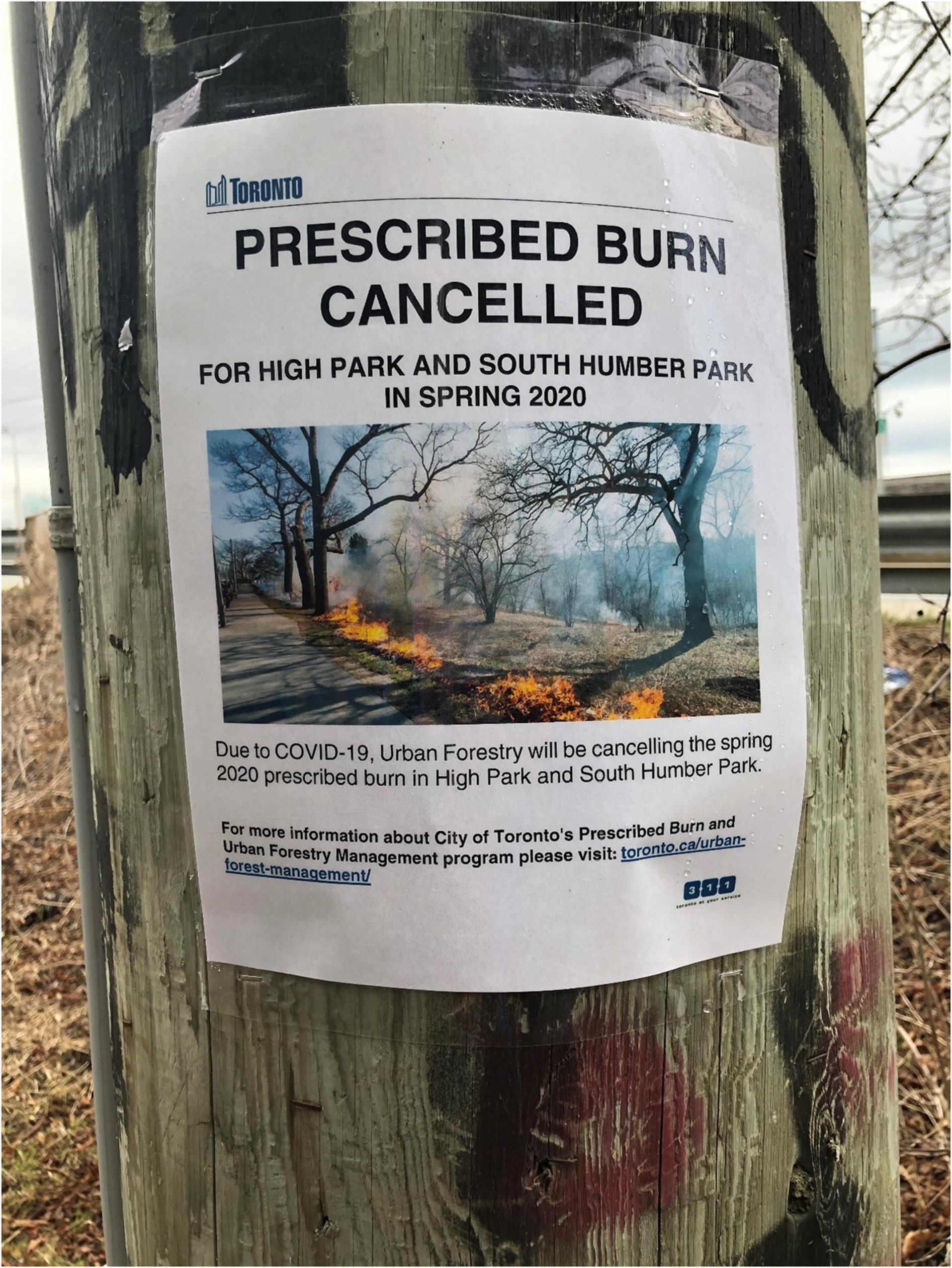
Poster announcing the cancellation of prescribed burns in two of Tkaronto's black oak savannah areas, as seen on a path to South Humber Park in March 2020.
After the suppression of fires due to settler colonial management of the savannahs, High Park and the City of Toronto commenced a prescribed burn program in 2000, initially citing their observation of the success of an accidental fire at the park, rather than crediting millennia of Indigenous care practices. 7 While the City of Toronto acknowledges the damage that fire suppression caused to the savannahs, it does not explain the dispossession by colonialism nor the misinformed settler literacies of nature that caused this suppression. As if these erasures of Indigenous earthwork, epistemologies, and dispossession were not violent enough, the fire suppression means that non-native, ‘invasive’ plants brought to Turtle Island by settler-colonizers, including garlic mustard, more easily took root in this ecosystem, creating greater challenges for current restoration efforts (Myers, 2017a; 2017b).
Within many Indigenous epistemologies on Turtle Island, caring for the wellbeing of plant communities means respecting all plants, even non-indigenous ones. In many Indigenous teachings, plants are not vilified even if their presence threatens indigenous ecologies – rather, they are embraced as Relatives and teachers (ILSC, 2019a). Reo and Ogden (2018) note that a dominant Anishnaabe teaching is that all plants and animals are kin, “respected as elder siblings to humans,” and their migration cannot be inherently good or bad (n.p.). They also note that according to Anishnaabe, “humans have an obligation to figure out the nature of our relationship with new arrivals, which includes careful consideration of their potential gifts and our reciprocal responsibilities” (2018: n.p.). Finally, they write that settler-colonial, Euro-American invasive species management programs “can create barriers to Anishnaabe fulfilling their responsibilities to plant and animal kin” (2018: n.p.).For the Tkaronto-based Indigenous Land Stewardship Circle (ILSC), stigmatizing non-native plants “would make it impossible to learn what it is they are here to teach [them]” (ILSC, 2019a). Species named ‘invasives’ by dominant ecology are Relatives and their eradication by violent – and sometimes chemical – means only aggravates ecological problems (ILSC, 2019a).
Friend or foe
While not exactly new, garlic mustard has recently been championed by ‘cultivation activists’ and herbalists doing public outreach on urban gardening and food security amidst pandemic conditions (Grow Food Toronto, 2020; Segal, 2020). A nutritious and edible weed, garlic mustard is championed by local native plant garden advocates as an herb that can be promptly weeded from garden beds when first noticed and embraced in everyday cooking (Grow Food Toronto, 2020). Indeed, at a time of increased food insecurity and intensified concern for the health of human immune systems, perhaps the abundance of an edible, nutritious herb is not so catastrophic. Tamara Segal, a settler herbalist in Prince Edward County, Ontario, even characterized garlic mustard as a well-placed ally for COVID-19 – its vitamins are essential to immune system functioning and it can be used as an expectorant to clear phlegm and help with respiration (Segal, 2020). In folk medicine, it has also been used as an antiseptic and diuretic as well as a disinfectant (Kumarasamy et al., 2004).
While some might be keen to see garlic mustard as an ally, many others are quick to call it a virus in its own right, even going so far as to name it “nature's coronavirus” (Gartner, 2020). In cities and towns neighbouring Tkaronto, op-eds and newspaper articles have referred to the plant as ‘threatening’ and worthy of ‘war’ measures (Healey, 2018; Seltz, 2017; Taft, 2017). Headlines include “Wanted Dead – Garlic Mustard” (Homeyer, 2014) and “Evil Plant on the loose” (Hill, 2012), describing its invasion to a crime worthy of a death sentence. In 2017, the Nature Conservancy of Canada hosted a garlic mustard removal event called ‘Eviction Notice – Garlic Mustard’ in the Happy Valley Forest north of Tkaronto, comparing the plant to troublesome tenants in the forest. A recent report (Municipal Licensing and Standards, 2021) proposing amendments to Toronto's Grasses and Weeds Bylaw for property owners lists the plant as one of 13 prohibited species, whose presence is worthy of a hefty fine. Even the Ontario Invasive Plant Council (OIPC), whose guidelines inform ecological restoration initiatives throughout the province, embraces the criminalization of invasives as a tactic for public education, parodying criminal posters as resources for the most common plant threats in Ontario (Figure 2). Titled ‘UN-WANTED Invasive Plant Species,’ the series includes ‘mug shots’ and ‘alias names’ of the plants in question and shares information on their arrival to ‘Canada’ and detrimental impacts on native ecosystems, provides tips on how to manage them, and even offers an ‘Invading Species Hotline’ as support (OIPC, 2016). The OIPC presents itself, in this sense, as a policing authority sounding the alarm to threats to ecological order.
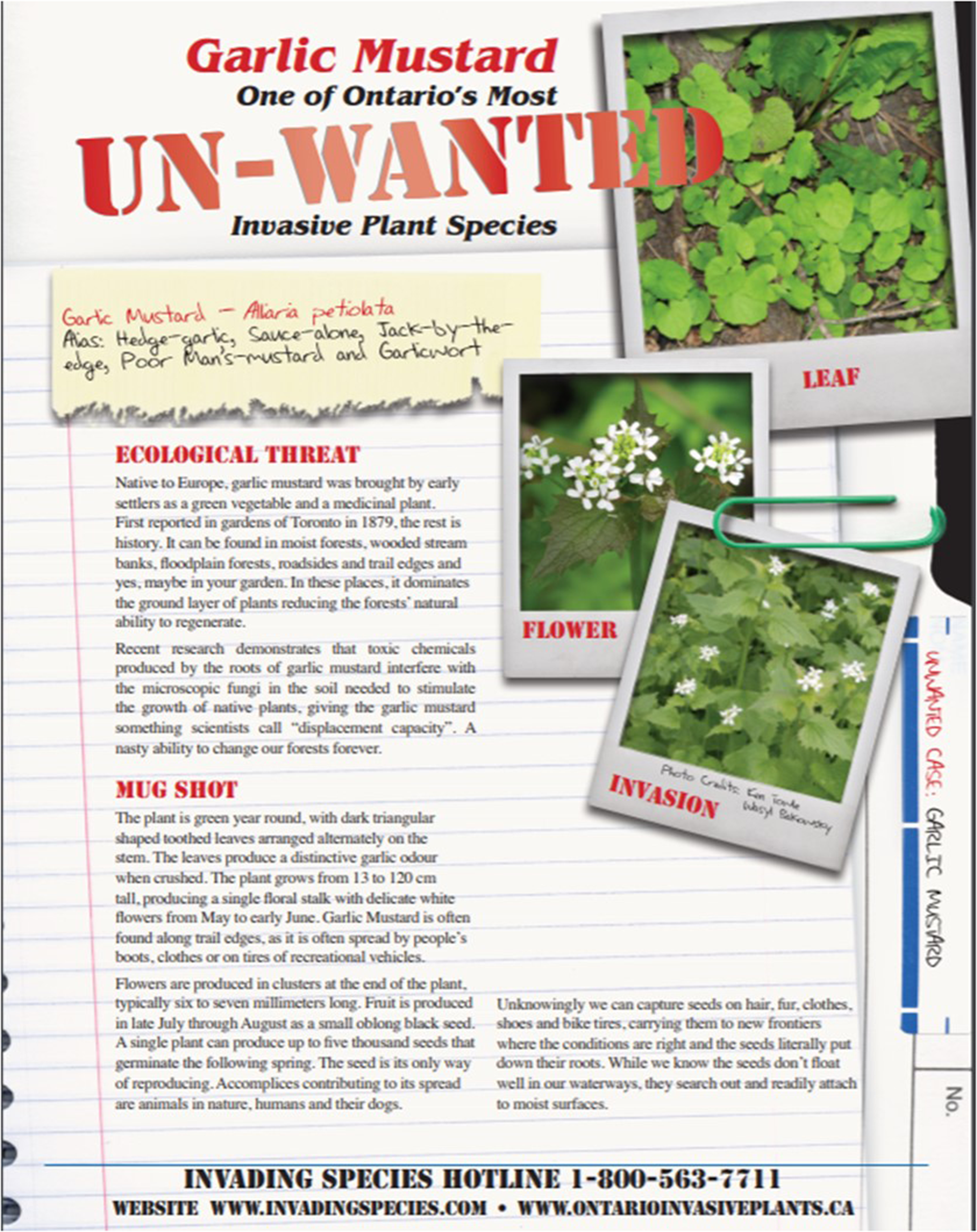
The Ontario Invasive Plant Council ‘Un-wanted’ poster for garlic mustard. [Source: Ontario Invasive Plant Council (2016) Available at: Https://www.ontarioinvasiveplants.ca/wpcontent/ uploads/2016/07/unwantedlettersGarlicMustardFINAL.pdf (accessed May 15, 2020).].
Rather than building stronger plant and animal communities, the war logics of invasion ecology – attacking invasions, killing some species (Orion, 2015), detaining or cordoning off others (Trigger et al., 2008) – perpetuate harm. Managing species called ‘invasive’ with care requires asking deeper questions than those asked by conventional ecology. It is here that reflections raised by transformative justice (TJ) work may be useful in reframing relations to garlic mustard and all invasives more broadly. Beyond the ‘punishment’ of punitive justice and beyond the restoration of ‘original conditions’ of restorative justice, TJ digs deep to find the root causes for harm, recognizing systemic injustice and centring systemic change (brown, 2018). The Young Women's Empowerment Project embraces the following definition: TJ acknowledges the reality of state harm; looks for alternative ways to address/interrupt harm, which do not rely on the state; relies on organic, creative strategies that are community created and sustained; and transforms the root causes of violence, not only the individual experience (cited in brown, 2017: 135). It refuses addressing violence with more violence. Mariame Kaba (cited in Dixon and Piepzna-Samarasinha, 2020) further adds that TJ is not interested in experts, underscoring the humility necessary for undertaking TJ. It involves asking questions and doing self-assessments in the interest of building deep trust, healing, and resilience (brown, 2020; Dixon and Piepza-Samarasinha, 2020). As an abolitionist method, it recognizes the problem of innocence, focused on diminishing and remedying harm rather than committing to “better forms of punishment” (Gilmore, 2017: 236).
In settler-colonial places, explicitly decolonial, indigenized transformative justice can also comprise everyday, grassroots acts of Indigenous resurgence and the unsettling of colonial relations at the local level (Nagy, 2021). With its emphases on community, root causes, and mutual thriving, the principles of TJ are well-suited to conflicts and harmful power structures affecting human-nature relations and the global health of ecosystems. As such, it feels important to resist a present and a future where garlic mustard is treated as a problem and instead embrace it as an active agent prompting reflection for more liveable human–other-than-human collaborations. Rather than a convenient metaphor, the relevance of TJ work and abolition geography in a discussion around invasive species relations clarifies how invasive species management works within a national, colonial project that is committed to defining who and what has value and belongs. It clarifies the extent of how these systems shape our relationships to one another. In an attempt to bring this work in conversation with a transformation of invasive species relations, I am led by a curiosity about what it might look like to love garlic mustard, to hold space for appreciating its abundance and recognizing its harms. What would invasion ecology and restoration ecology look like without opponents? What would change if love, compassion, and harm reduction were truly at the root of all restoration activities in disturbed, renaturalizing landscapes? What if ecological restoration explicitly unsettled colonial, extractive, violent relations?
At a time when invasion ecology still relies upon chemical management for invasive species, contaminating ecosystems with toxic pesticides (ILSC, 2019b) – when dominant restoration ecology is still so fixated on visible, large-scale growth and rarely champions the restoration of microscopic life (Young and Black Elk, 2020) – when native plant enthusiasts still rely upon colonialist notions of purity and wilderness through their nativism (Trigger et al., 2008) – and when restoration ecology continues to create barriers to Indigenous self-determination and environmental justice (ILSC, 2019a; 2019b; Reo and Ogden, 2018), it becomes vital to organize for a collective change of heart. Other relationships to garlic mustard – ones that are grounded in respect and accountability, and that do not glorify settler-colonial grammars of nature, 8 but rather call these very grammars into question – are possible.
Transformations
Garlic mustard's relations
Bang et al.'s (2014) alternative term to so-called invasive plants—“plants that people lost their relationships with,” developed in the context of an urban Indigenous land-based education project – offers an important starting point for this section. It illustrates that prior to its forced displacement via European settlement, garlic mustard had its own relationships, many of which continue today in its native ecosystems. Once brought to Turtle Island, the plant was meant to be tended to in home gardens and used by its stewards. Do the patches of garlic mustard in Tkaronto's oak savannahs and along trails and roadsides miss the relationships they had with the people who relied on them for medicine and cooking? Severed from their past relationships, garlic mustard plants are also making new relationships on Turtle Island's soils. They are linked to a mutual thriving relationship with non-native earthworms in North America (Davalos and Dobson, 2018) and many pollinators here feed on their flowers. They appear in people's gardens in residential areas, in agricultural fields (to the chagrin of dairy farmers, whose milk is spoiled by a garlicky taste if their livestock eat the plant), and temperate forests (Anderson, 2012). They are continuously weeded where they take root in food gardens and beyond, destined for dumpsters headed to landfill (Figure 3) instead of compost piles as per city disposal policies to reduce their spread, where they meet other discarded plant matter and insect life.
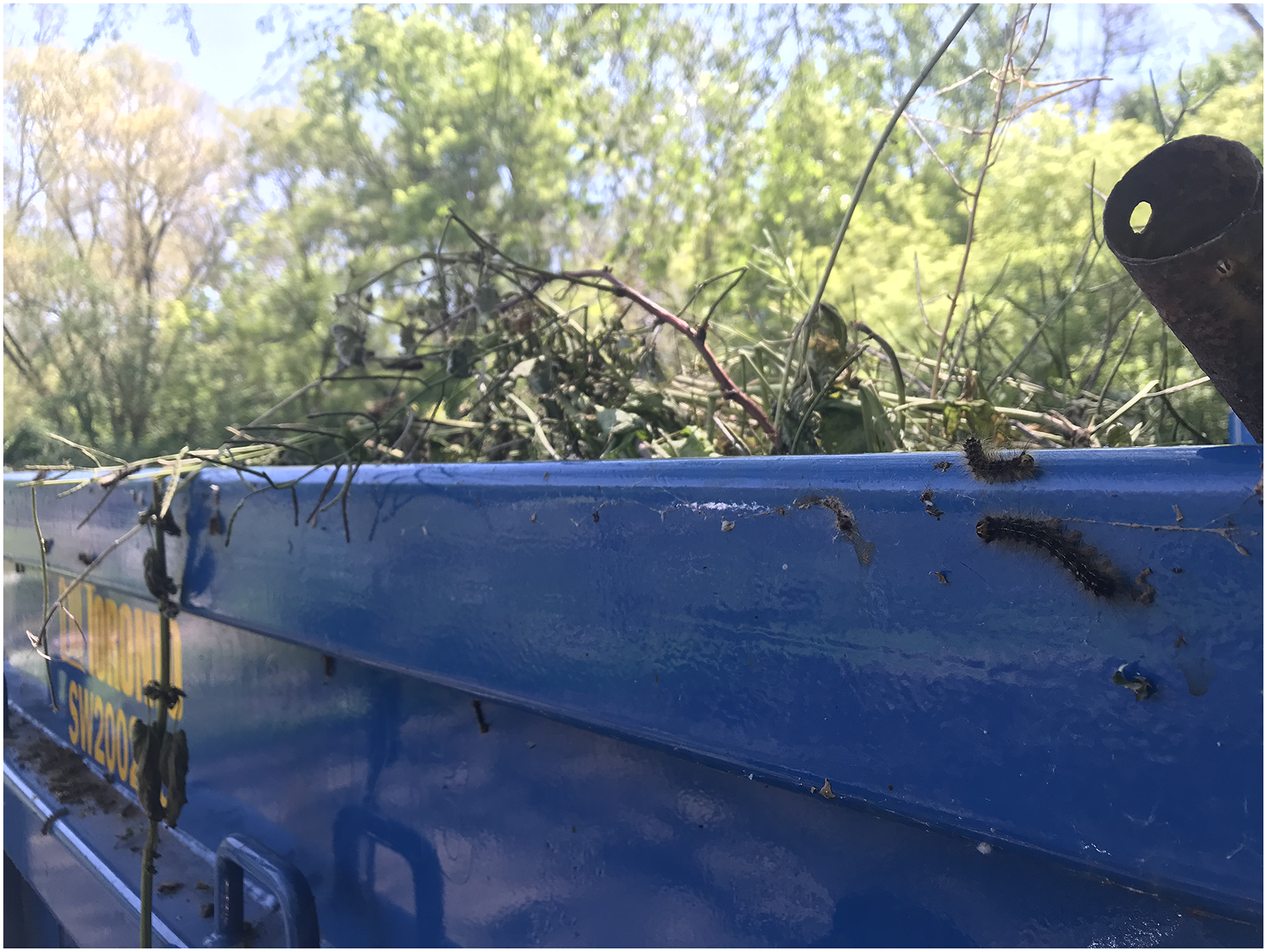
Lymantria dispar dispar (LDD) moth caterpillars on the allotment garden dumpster at high park, with weeded garlic mustard visible. Summer 2021.
Beyond consumption
In recent years in Tkaronto, a popular strategy in the so-called ‘fight’ against garlic mustard has been to say the plant is harmful, yet delicious. As Natural Conservancy of Canada program coordinator Kristyn Ferguson expressed, “In another prong in the effort to fight [garlic mustard], we’re going to make people want to eat it” (Howells, 2017). Just this year, a local community organization posted signs identifying garlic mustard in Scarborough's Warden Woods with the tagline “EAT ME,” asking passersby to “eat their way out of this mess” (Danforth Gardens Neighbourhood Association, 2021). As part of my changing relationship to garlic mustard, I too thought it was convenient that perhaps we could eat our way out of garlic mustard invasions, and initially felt excited about the ‘cultivation activism’ I was seeing taking place amidst the pandemic. The first wild herb I have ever foraged, I ate it raw, seasoned dishes with it, cooked with it. The taste was delightful and I was able to appreciate for the first time its place here, as an introduced herb, intended to be harvested. Having Michael Carolan's (2015) notion that biodiversity is not something you can just know, but “something you have to feel and taste” (326) in mind, I felt excited that I had experienced a pleasurable way of relating to garlic mustard.
While garlic mustard's edibility to humans is indeed one of its gifts, it also demands some problematizing, particularly with regards to how its edibility is taken up in management efforts. The call to harvest huge amounts of garlic mustard relies on the construct of plant-as-resource to address the notion of plant-as-problem. I therefore want to challenge the idea that garlic mustard's only worthwhile quality is its edibility. Why does garlic mustard have to be labelled as ‘evil’ for folks to feel they have permission to eat it, and why do the politics of number that play into perceptions of its abundance made it so acceptable to despise it? When human-nature relations are this broken, and invasives vilification is the standard, we simply cannot eat our way out of this problem. Eating and cooking with garlic mustard indirectly honours the severed relations people once had to this plant, but it does not necessarily unsettle garden and ecology relations in settler-colonial places.
Eating garlic mustard foraged from the ravine near my house also prompted me to reflect on the ways that property regimes mediate relationships with garlic mustard in the city. The only legal and recommended ways for Toronto residents to manage invasive species is through property relations, either through actions on one's own property (plant removal and privileging native plants in the garden) or by abiding by property laws in park areas (staying on trails and keeping pets on leashes). In fact, the act of foraging for garlic mustard (or any plant, for that matter) on city property is itself prohibited by a city of Toronto parks bylaw. Considering that property regimes are key to conquest and dispossession in the settler-colonial city, producing the city as a settler-colonial space (Dorries et. al., 2019), and garlic mustard's disregard for property lines, its abundance elucidates an important fact about dominant invasive species management in Toronto: municipal regulations prohibit meaningful human-nature relations. Many people have, and will continue to, disregard the bylaw against foraging, especially as it appears to not be actively enforced (Kowalski, 2014), but who feels safe to do so will be commensurate with which communities are least likely to be policed in public spaces.
Soil poison and underground stories
Garlic mustard is maligned primarily because it is a known soil poison – as it grows, it kills native fungal communities, in a process called ‘allelopathy’ (Anthony et al., 2019). That has been one of the most challenging things to process and reframe in this imagining of collaborations with garlic mustard. Wherever there are fields of garlic mustard fungal communities below the soil are disappearing and the soil becomes increasingly hostile to native plants. That said, many plants native to Turtle Island also have allelopathic properties, including sumac, elderberry, goldenrod, and black walnut; allelopathy is a means of survival in nature. Paying attention to stories below ground can help to further develop and complicate more ethical relationships to invasive plants. Ethnobotanist and restoration ecologist Linda Black Elk (Catawba nation) highlights how important it is to tend to soil biota – the microscopic level of restoration – rather than just the macro level – when restoring landscapes (Young and Black Elk, 2020). Indeed, there are many oft-forgotten communities in the ground. Kimmerer (2013) explores this when talking with wonder about the complex fungal networks that allow trees to communicate with one another and act as one (20). The ‘underground city’ and ‘underground stories’ that animate part of Tsing's analysis of fungi in disturbed forests are also relevant to digging deeper with garlic mustard (2015: 139).
Fungal communities are collaborative champions, coming into existence “only through interspecies relations” (Tsing, 2015: 138) – but garlic mustard is not collaborative with soil biota. There is no denying that garlic mustard is rapidly proliferating and changing the composition of the soils in which it grows its roots, and there is much uncertainty regarding its long-term effects. In one study, three years’ time was not sufficient to restore native fungal communities in a field recently rid of garlic mustard (Anthony et al., 2019). Garlic mustard's poison to the earth – and its introduction by colonizers – is the reason Kimmerer (2013) says it follows the footprints of the Anishnaabe cannibalistic, infectious villain Windigo, a representation of greed, selfishness, and unsatiable hunger (304–306) that threatens reciprocal relations. That said, garlic mustard's chemicals and survival mechanisms are hardly justification for vilification – rather, they point to the urgency of planting and tending to native plants and flowers so they too may find resilience and relationship in wounded, disturbed soils.
Cycles and contamination
By taking a step back from grief and fear surrounding the future of soils in the Black Oak savannahs and beyond as a result of garlic mustard abundance, it becomes possible to notice that a fixation on doom and failure is probably unhelpful in imagining more liveable worlds. An insight from adrienne maree brown (2017) serves as a useful reminder here: “Transformation doesn’t happen in a linear way, at least not one we can always track. It happens in cycles, convergences, explosions. If we release the framework of failure, we can realize that we are in iterative cycles, and we can keep asking ourselves – how do I learn from this?” (105). This refusal of linearity – an openness toward unknown entanglements, temporalities, and stories, as well as a willingness to learn – is key to perceiving what Anna Tsing calls the third nature, “what manages to live despite capitalism,” in “capitalist ruins” (2015: viii). Given that garlic mustard is well-established on Turtle Island (Rodgers et al., 2008), the refusal of a progress story, and the noticing of other temporalities, is integral to learning to live with garlic mustard.
Noticing and appreciating cycles is one part of lessening the burden of imagining a garlic mustard-filled future. As a ‘pioneer species,’ that is, a short-lived biennial that is one of the first to occupy a disturbed landscape, garlic mustard could be understood as laying the groundwork for later stages in succession, creating the conditions necessary for the growth of other plants, like shrubs and bushes (Orion, 2015). As Orion (2015) writes, “no single species will survive for time immemorial in a given ecosystem. Every species is part of the ecosystem's successional drive, and eventually, the conditions will not be appropriate for a given organism's growth” (79). Being mindful of cycles and succession rhythms can help to soften one's reaction to species invasions.
Take for instance the recent fear and despair around the widespread Lymantria dispar dispar (LDD) moth caterpillar invasion in many ecologically significant areas in Southern Ontario, including High Park. The infestations originate with French lithographer and amateur entomologist E. Leopold Trouvelot's promethean quest to start a silk industry with the imported moths in America in the 1860s (Spear, 2005). While grief and panic have reasonably set in for folks witnessing defoliated trees in parks and their backyards, responses from conservation biologists have stressed the phenomenon of boom & bust cycles and the ability of nature to repair itself after periods of stress (Butler, 2021). Indeed, while their spread is ever-expanding, individual garlic mustard populations can be self-limiting over time, and have been successfully replaced with biodiverse plantings (Stinson et al., 2018). While it is probable that invasions will intensify in future boom cycles if barriers to Indigenous stewardship continue and with the added pressures of climate change on ecosystems, naming cycles can be useful in reframing language of despair.
Further softening to garlic mustard and invasive species also requires a reckoning with our contaminated present. Here, an acceptance of the present is not defined by indifference to the ecocidal effects of industry, but rather by a radical acknowledgment of entanglement and refusal of purity. It is an acceptance of the inevitability of species invasions and a commitment to relationality. The alternative to this – staying stuck in a mindset that privileges and expects purity in response to devastation – is harmful for several reasons, justifying violence against human and other-than-human life. Purity insists on colonizer-created myths of pristine wilderness, erases Indigenous relationships of care to the land, and reinforces systems of classification (Shotwell, 2016). Accepting contamination is a rejection of all attempts to categorize the world and its lifeforms “into something separable, disentangled, and homogenous” (Shotwell, 2016: 15) and a call to collectivize. Without purity and with contamination, we enter more easily into collaborative relations.
Caring for invasions
Working towards a relationship of learning-with and working-with garlic mustard has been slow and challenging, and the relationship continues. Paying attention to gifts and responsibilities, as Kimmerer and brown encourage their readers to do, has been integral to this process. Garlic mustard invited me to notice it, again and again, and to notice the health of the ecosystems nearby my home and the ongoing ecological legacies of settler colonialism, too. It invited me into a relationship with foraging and harvesting, helping me to understand Tkaronto's black oak savannahs as the edible entanglements that they are. Garlic mustard also confronted me with ecologies out of balance and out of relation, as well as with the rigidity of municipal regulations. With time, garlic mustard started to tell me stories of this place, including stories of settlers’ property-making past and present, of survival, of broken relationships, and of underground soil communities.
I noticed the centrality of property regimes to nature relations in the city, as well as invasives' transgressing of property lines. I noticed the vehemence certain people had for its presence, intensifying the hypocrisy of an invasion ecology that does not take seriously the invasions caused by white settler violence. Looking at the plant through the framework of transformation and the lens of care also encouraged me to notice the role of fear in dominant relations to invasive species. It helped me to sit with uncontrollability and interconnectedness. This was an incredible gift amidst a global pandemic, when governments and media so often failed to reckon with the systemic issues impacting the unevenness of COVID-19's spread. Refusing vehemence and neglect, this process with garlic mustard allowed me to consider, for the first time, the notion of caring for species invasions. Building on Ureta's (2016) discussion of “caring for waste,” caring for invasives means recognizing our entanglements with species invasions and embracing a responsibility to and for all plants and animals deemed invasive.
Many invasive species management activities carried out by the City of Toronto, volunteer groups, and individuals, including public education on best practices for species removal, suggest a great amount of care for the environment. The issue then is not a lack of care, but rather that the vilifying of plants common in these activities represents 1) an attachment to a certain kind of landscape that remains dispossessed from its original caretakers, 2) a fixation on purity that does not account for messy entanglements of urban ecologies, and 3) an unwillingness to name the systemic processes and histories of conquest and industry that are to blame for this scale of species invasions. A more transformative relationship to garlic mustard and other invasives, then, would centre respect for the plant's relations and entanglements and look to targeting the root causes of their invasions, such as the devastating ongoing impacts of Indigenous dispossession and violent displacement.
Caring for species invasions also requires the unsettling of conventional invasion ecology through the centring of Indigenous epistemologies and different worlding practices. It requires acknowledgment of harmful relationships and commitment to better ones. It demands honouring responsibilities to do more to nurture balance in ecosystems than merely removing a problem species. As millennia of Indigenous stewardship practices exemplify, the health of the ecosystems in which garlic mustard is taking root depends on a practice of restoration that values bodies on the land. Ecological restoration requires relationship and the leadership of Indigenous peoples. In the words of the ILSC, “Indigenous stewardship does not seek to reduce the labour of earthwork; it is by tending the lands that we come into Right Relation. Indigenous stewardship requires getting more people out on the land. And for us this is a good thing. Earthwork gives our people the opportunity to heal from the traumas of colonialism by engaging the land in ceremony and in community; this is how we pass on our land-based teachings to future generations” (ILSC, 2019a).
Repair & abundant futures : A conclusion
While ecosystem collapse is a complicated equation with many contributing factors, at the core of it is this very simple explanation. We collectively have ceased to fulfill our role as the balancers. The settlers did not know that this was our role. If we continue only to address environmental degradation, we will continue to only treat the symptoms of the greater problem. (Grenz, 2020) How we are at the small scale is how we are at the large scale. The patterns of the universe repeat at scale. There is a structural echo that suggests two things: one, that there are shapes and patterns fundamental to our universe, and two, that what we practice at a small scale can reverberate to the largest scale (brown, 2017: 52)
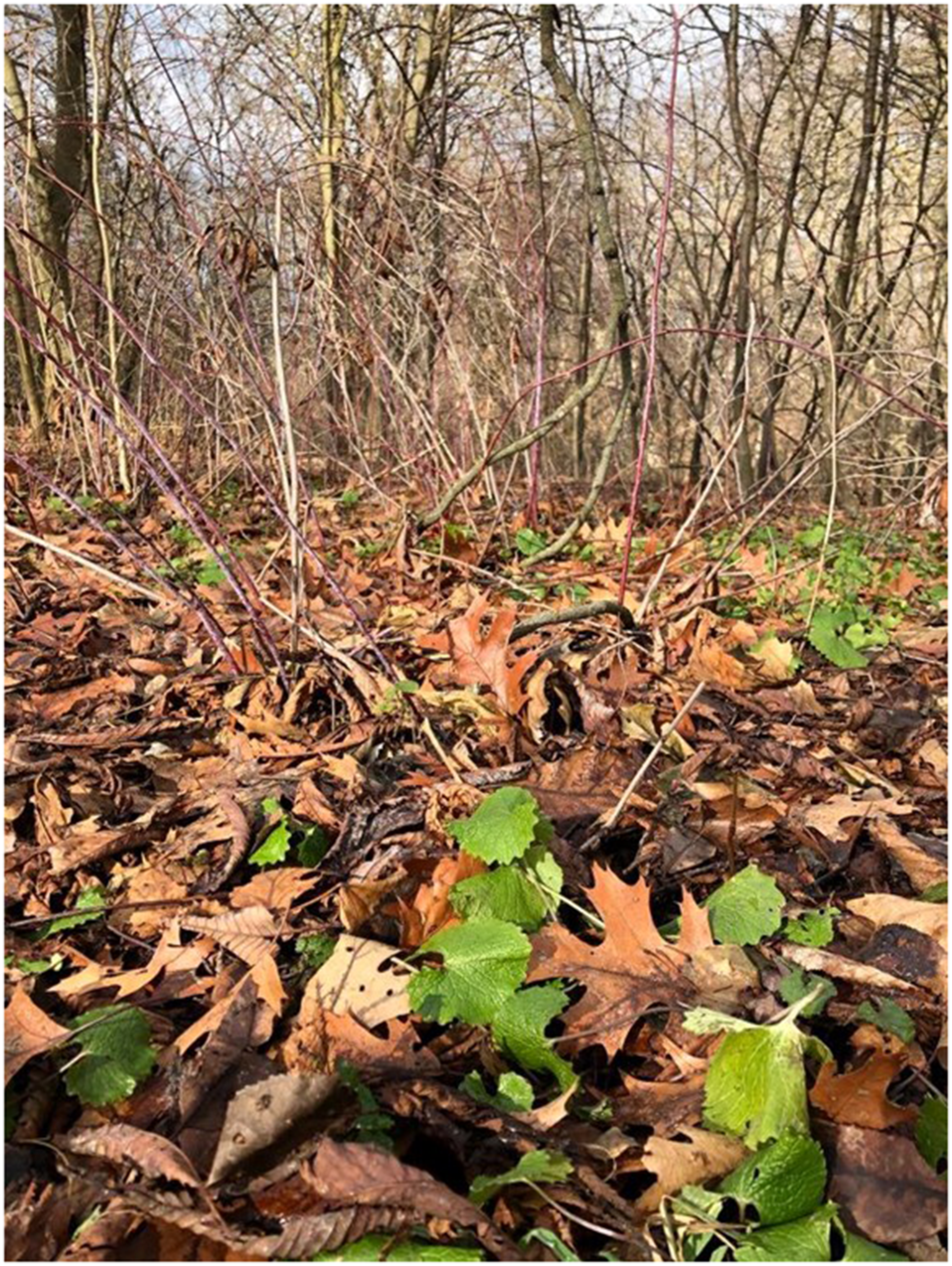
Frost-hardy garlic mustard leaves in High Park getting a head start on the growing season, winter 2020.
Studying entanglement and relationships is integral to acknowledging the agencies and needs of invasive plants. Yet, as Collard et al. (2015) write, noticing entanglement alone cannot undo colonial formations such as Nature and native/invasive (Collard et al., 2015). Deeper questionings and commitments are necessary. What is needed is a response to invasive species that is attentive to historical and ongoing violence against peoples, lands, and waters and demands the witnessing of ecological loss and species migrations. Kimmerer (2013) importantly highlights that it is not only the land, but peoples’ relationship to land, that is broken, and that ecological restoration of damaged landscapes is an “empty exercise” if it does not seek to restore damaged, ruptured relationships (338). Relationship is the most authentic and lasting facet of restoration work (336).
Garlic mustard is an easy villain – a perceived threat to biodiversity, a poisoner, a resilient plant that multiplies while crossing borders and boundaries (Figure 4) – but it is not to blame for the conditions that facilitate its thriving. Blaming invasive species for their effects on ecosystems conceals and fails to contend with the mess of racial capitalist, colonialist, and patriarchal doings. And in this troubled cacophony, I take inspiration from Tsing to suggest that the art of noticing where garlic mustard appears, and the work of forming a relationship with it beyond plant-as-resource could itself be a world-making practice. To be sure, other worlding practices relevant to building new relations to invasive species already exist and are ongoing through the advocacy, initiatives, and justice-centred teachings of nearby Black- and Indigenous-led initatives such Black Creek Community Farm and the Indigenous Land Stewardship Circle in Tkaronto. People are already modelling liveable collaborations with species deemed invasive.
I opened this article by committing to working through related feelings of frustration and overwhelm at witnessing garlic mustard abundance. I still feel the grief and I still feel the overwhelm, and it is impossible to imagine that this will change as long as ecologies are tangled up in webs of suffering produced by racial capitalism and settler colonialism. That said, learning more about garlic mustard – its gifts, its cycles, its history – offered avenues for softening my relationship to its abundance, not through apathy, but through care. It also reinforced the notion that suppressing traditional earthwork practices – via settler-colonial politics, pandemic policies, and the like – is colonial violence, and that ecological restoration will be unsuccessful if it does not prioritize Indigenous-led stewardship.
While “#humansarethevirus” was trending on Twitter in April 2020, police state responses to COVID-19 conditions in many cases intensified already existing barriers to land stewardship in healing landscapes. Meanwhile, state-coopted care practices, such as the prescribed burn in the Black oak savannahs, were cancelled. When meaningful care and earthwork practices are put on hold, who and what is harmed? What is upheld? These questions highlight the urgency of Indigenous stewards’ efforts to reclaim the practice of burning co-opted by municipal authorities and to reclaim their practice of stewardship and species management in Tkaronto's renaturalizing landscapes (ILSC, 2019a; 2019b). While change is slow, my hope is that collaborating with garlic mustard and other plants thriving in this time – through noticing and other relations yet unknown – can be a small, transformative worlding practice that complements larger-scale work towards more liveable futures.
Highlights
In the wake of COVID-19, individuals identified the invasive garlic mustard as a plant ally to the pandemic as well as ‘nature's coronavirus’
Dominant responses to garlic mustard in invasive species management vilify the plant, using the language of war and perpetuating colonial logics
Relations to garlic mustard and other invasive plants in settler-colonial places are mediated by property regimes
Indigenous-led stewardship and notions of transformative justice are critical to rethinking relations to garlic mustard and other invasive plants for more liveable futures
‘Caring for invasives’ is a worlding practice and responsibility that involves the centring of Indigenous epistemologies and stewardship, a recognition of entanglement, and a reckoning with violent histories and presents
Footnotes
Funding
The author(s) received no financial support for the research, authorship and/or publication of this article.