




Abstract
Net zero emissions targets are of growing international relevance given their increasing uptake by governments across the world. This article analyses net zero targets as a distinctly future-oriented approach to environmental governance. It does so from a critical perspective, examining whether net zero targets serve to reproduce the existing temporalities of environmental policymaking or whether they represent a break with current practices and, in turn, develop new temporalities and novel ways of engaging with the future. In order to do this, this article focuses on efforts to reduce agricultural emissions in England to net zero. In 2019 the United Kingdom introduced legislation requiring a reduction of greenhouse gas emissions to net zero by 2050. This, in turn, has encouraged actors in the food system to produce various imagined pathways to net-zero agriculture. This article critically analyses how these imagined pathways are discursively produced by influential actors within this sphere through a critical discourse analysis of recent grey literature produced by Defra, the Climate Change Committee and the National Farmers’ Union. It asserts that, to an extent, the net zero and target oriented approaches enshrined in current environmental policymaking represent the ongoing reproduction of both an ‘empty’ modernist future with some post-political dimensions. This assessment is, however, nuanced by recognising the tensions that emerge within and between the state and non-state institutions producing these discourses. Ultimately, however, the net zero transition draws actors together around a techno-optimistic vision of an agricultural future defined by sustainable intensification and negative emissions technologies. In doing so, it serves to suppress calls for transformative change in agriculture based on social as well as material change.
Introduction
Target-oriented ‘net zero’ approaches towards greenhouse gas (GHG) emissions reduction are of growing international significance as a mode of environmental governance. China has committed to reaching net zero emissions by 2060 (Mallapaty, 2020), Japan (McCurry, 2020) and the European Union (European Commission, 2018) by 2050 and the Biden administration consistently refer to 2050 as their target for reaching net zero emissions (Milman et al., 2021). In the United Kingdom (UK), not only is the 2050 target for net zero emissions legally binding, but a broader target-based approach is also coming to define the Westminster government's post-European Union regime of environmental regulation and legislation (Defra, 2020a).
Targets, as a form of planning, are by no means novel processes for the modern or neoliberal state (Abram and Weszkalnys, 2011). Yet the proliferation of net zero targets arrives at a time when theorists have suggested that the near future is being ‘evacuated’ (Guyer, 2007), the future is ‘coming towards us’ (Latour, 2015) and that the environmental crises of the Capitalocene (Moore, 2017, 2018) call for a critical re-evaluation of the nature of global times and temporalities writ large (Kolinjivadi et al., 2020). The temporalities of the COVID-19 pandemic and the visibility and gravity of responses by governments worldwide further nuances these questions. Therefore, critical examination of the spatio-temporal dimensions of such approaches is both timely and novel and can serve as an entry point to analysing this particular form of environmental governance. This article takes agriculture in England as a case study through which to flesh out these ideas. In 2019 the Parliament of the UK passed an amendment to existing climate change legislation which set out that targeted GHG emissions were to be reduced to ‘net zero’ by 2050. Legislating to reduce the UK's GHG emissions by 2050 created a spatio-temporal relationship between governance, territory, biophysical processes, and calendrical time. Further, in legislating to reduce emissions to net zero by 2050, parliamentarians were creating a distinct and promissory relationship with the future.
Agriculture in the UK is estimated to have accounted for 77% of land use in 2018 and 9% of GHG emissions in 2017 (Climate Change Committee, 2020: 20–23). The UK's net zero legislation necessitates a reduction in these emissions. This has led to the publication of numerous documents by actors in the UK food system, ranging from non-governmental organisations (NGOs) to transnational corporations. These texts map out preferred ‘pathways’ to net zero emissions and principles which should inform such efforts. As such, different actors have discursively produced different ‘sociotechnical imaginaries’ (Jasanoff, 2015) of net zero agricultural futures. Each imaginary offers varying configurations of technological development, altered land management practices, dietary change, and policy-oriented reform. Further, different imaginaries portray, understand, and relate to the future in different ways. Central to the discursive field in which these documents emerge are agenda-setting texts produced by governmental or quasi-governmental actors such as the Department for Environment, Food and Rural Affairs (Defra) and the Climate Change Committee (CCC) and organisations like the National Farmers’ Union (NFU). Agricultural policy is a devolved area of competence for the nations of the United Kingdom and, as such, the attention to these particular institutions within the analysis below focuses this article on English agriculture.
This research asks to what extent these approaches represent a break in the way environmental governance currently relates to the future. Do attempts to reduce GHG emissions by 2050 represent a novel spatio-temporal principle in environmental policymaking? Or are such targets a repackaged discursive manifestation of the modernist, ‘empty’ and colonisable future described by Adam and Groves (2007)? Secondly, to what extent are net zero targets representative of a shift in the gravity and intent of environmental governance in England and the UK? Can this new framework catalyse efforts to address the roots of the various concurrent environmental crises produced by industrial agriculture in the UK and globally? Or do they represent the sort of “anti-political” environmental governance observed by Bracking (2015, 2019) in the context of climate finance or the “post-political” tendencies noted by Swyngedouw (2007, 2010)? And, finally, what can these processes tell us about the contemporary functioning of the English and/or British state in the face of environmental and ecological crises?
This article will be structured in four subsequent sections. The first section will situate my approach towards net zero targets in the context of existing relevant literature. The second section will briefly set out the methodological approach which informed the research. This will be followed by an analysis of documents produced by Defra, the CCC and the NFU, before the final section offers some concluding comments. In sum, I argue that, at this point of time and in the English context, work towards net zero can be partially understood as representative of a spatio-temporal and discursive extension of the post-political dynamics described by Swyngedouw (2007, 2010) which reproduces the ‘empty’ time posited by Adam and Groves (2007). However, these assessments are complicated by a recognition of the tensions and contradictions the net zero project creates for those institutions and class fractions involved in its regulation, realisation, and contestation, as demonstrated below.
Theorising net zero futures
Spatio-temporality and futurity
Theoretical efforts to unpick the construction and operation of political ecological temporalities offer starting points for this analysis deriving from multiple disciplinary perspectives (e.g. Fitz-Henry, 2017; Kolinjivadi et al., 2020; Nixon, 2011). Further, theorists like Thrift (1977a, 1977b; May and Thrift, 2001) and Massey (1999, 2013) have addressed understandings of time whilst noting the indivisibility of spatiality and temporality. The UK's net zero targets are a spatio-temporal phenomenon in that they are a future-oriented objective within a legislative territory. As such, the different spatio-temporalities these targets discursively construct is taken as an entry-point for a critical analysis of net zero environmental governance in England. Central to this project is a belief in the need to unveil, criticise and challenge the spatio-temporalities generated within capitalist social formations in order to highlight both their legitimating function and their contingency (Harvey, 1996; Jessop, 2008).
Of particular relevance to this critical perspective of net zero targets are theoretical approaches to the future. As with social scientific approaches to time in general, theories of how humans imagine, construct, and enact the future come from a variety of disciplines. Geographical approaches have often centred around imagining and governing ‘socioecological transformation’ (Braun, 2015) or processes within distinct socioecological milieux, such as mining (Chowdhury, 2016), fossil fuel extraction (Kama, 2020) or rising sea levels (Fincher et al., 2015). Notable also is the significant body of work on anticipation and future-oriented governance by, for example, Anderson (2007, 2010, 2017) or, in a more environmental context, Granjou (2016). Although such logics of pre-emptive governance have clear relevance to the world of net zero governance, they do not form a substantive focus of this research.
This interest in futurity does, however, pay particular interest to the work of Adam and Groves (2007). In Future Matters: Action, Knowledge, Ethics, Adam and Groves suggest that the social processes of modernity have produced a particular and abstract form of experiencing and reckoning time (see also Adam, 1998). In turn, this ‘modern’ temporality creates a relationship with the future, in which the future is open, empty, and colonisable by rational human action or ‘future-making’ (Adam and Groves, 2007). Given technological development and the expansion of capitalist modes of production, this mode of relating to the future has proved unable to effectively account for the ramifications of modernity and capitalist development. For Adam and Groves (2007: 79) this is akin to a ‘Promethean moment’. Those who are deemed responsible for shared societal futures now operate in a context blind to the long-term environmental impacts of their actions. This includes the institutions of liberal democratic government that rely on science, law and economics, knowledge practices which are not “fully equipped to deal with the futures of their making, and are thus limited in their contributions to the understanding, administration and regulation of the temporal realm” (Adam and Groves, 2007: 116).
With this in mind I ask, then: are net zero targets a new way of thinking temporally about environmental governance that moves beyond the empty futurity critiqued by Adam and Groves (2007)? And to what extent are they likely to facilitate the requisite transformation of agriculture and the agri-food system? My answers to both of these questions are entangled and partial, yet they act as a way to bring an analysis of net zero targets into conversation with existing analyses of the future of the agri-food system and its governance.
Imagining and governing agricultural futures
Given this article's focus on the potential reduction of agricultural emissions in England there is a broader critical literature concerning food systems into which this intervention arrives. This literature includes debates concerning the relationship between the paradigms and discourses of ‘food security’ and ‘food sovereignty’ (Holt-Giménez and Altieri, 2013; Jarosz, 2014) and the extent to which agricultural systems are considered, or should be rendered, ‘productivist’, ‘post-productivist’ (Marsden et al.,1993; Potter and Tilzey, 2005; Ward, 1993; Wilson, 2001) or ‘agroecological’ (Altieri, 1995). Fundamental to literature in this vein is a desire to understand the role of agri-food systems within global capitalist relations, such as how they form different relatively stable ‘food regimes’ through time (Friedmann, 2005; McMichael, 2009), and the environmental ramifications of contemporary agricultural systems (Weis, 2010). This paper builds in this space. However, it does this whilst remaining attentive towards the construction and political relevance of the spatio-temporality of social systems and, as a result, offers a new theoretical perspective.
Adjacent to this literature is a burgeoning area of work which combines a critical approach to both food and food systems with an attention to their futurities. This includes work by geographers regarding ‘rural futures’ in the British context (Lowe and Ward, 2009; Woods, 2012). Notably, Nimmo (2021) and Jönsson (2020) have also taken inspiration from the work of Adam and Groves to look critically at the exploration of futures suggested and invoked by technological developments in the food system, looking at robotic pollination in the case of the former and cellular agriculture in the latter. Donaldson et al. (2020) consider the ways in which supply chain mapping in turn becomes an anticipatory technique for ‘risky food futures’. Other work by Goulet (2020) on family farming in Argentina, Cardon (2020) and Tétart (2020) regarding knowledge practices that foresee food systems futures and Eriksson et al. (2020), addressing the relationship between planning food and defence futures, draws on theory derived from Science and Technology Studies. In doing so these efforts look to problematise future-oriented knowledge practices and their associated epistemology. In particular, this work demonstrates the utility of thinking through futures as ‘sociotechnical imaginaries’ set out by Jasanoff (2015). According to Jasanoff (2015: 6) sociotechnical imaginaries are “collectively held, institutionally stabilized, and publicly performed visions of desirable futures, animated by shared understandings of forms of social life and social order attainable through, and supportive of, advances in science and technology”. These sociotechnical imaginaries, as ways of relating to the future, also co-produce different understandings of space-time which must be accounted for (Jasanoff, 2015: 31).
As for the governmental context of net zero targets for agricultural emissions, existing literature looking at UK targets in the context of transport has dismissed such approaches as ‘symbolic meta-policy’ (Bache et al., 2015). This policy-oriented scholarship, however, lacks a substantive critical foundation or an analysis of the spatio-temporality of such approaches. This can be facilitated through an engagement with efforts to unpick the underlying logic of contemporary modes of environmental governance. Swyngedouw (2007, 2010), for example, sets out a critique of neoliberal environmental governance hinging on the relationship between apocalyptic imaginaries of the future and the post-political and technocratic environmental solutions endorsed to ‘manage’ climate change. Bracking (2015, 2019) develops a similar approach in the context of ‘climate finance’, suggesting the point of such projects is hegemonic obfuscation rather than societal change and are, as such, ‘anti-political’. For Swyngedouw (2007, 2010), these modes of governance involve the ‘fetishization of CO2’ in which the environment or ‘Nature’ is seen as something apart from human societal and technological development which must be tamed via human intervention. Net zero targets offer an opportunity to apply and stretch these concepts in a novel empirical setting. This interest is balanced and filtered through an approach to governance and statecraft that recognises that the state must be understood as a social relation (Jessop, 2015). This builds on existing work in the agri-food space by Tilzey (2018, 2019), Potter and Tilzey (2005). These strategic relational or neo-Gramscian approaches are particularly compatible with the methodological approach which shaped this research, to which this article now turns.
Methods
As part of research encompassing a broader array of texts of varying type, provenance, and length I performed Critical Discourse Analysis (CDA) on documents produced by the CCC, notably their report Land Use: Policies for a Net Zero UK (2020), the NFU (2019, 2020) and recent publications by Defra (2019a, 2019b, 2020a, 2020b, 2020c, 2020d, 2020e). Texts produced by Defra, unlike the other two institutions, were not explicitly concerned with reaching net zero, yet integrated this target into a broader imaginary of agricultural change in the coming decades. Further, as highlighted above, the decision to focus on these institutions means that the analysis is only pertinent to England as a result of the architecture of political devolution in the UK. Although the CCC has a UK-wide remit, the NFU represents farmers in England and Wales and Defra in theory represents the UK-wide Westminster government, the below can only really offer an insight into English governance. Scotland, Wales, and Northern Ireland each have their own agricultural ministries and the pace and shape of agricultural change in the coming decades will vary across the UK. This work does, however, open up space for further research examining the tensions between the nations of the UK which emerge from this reality.
As Jasanoff (2015: 39) highlights, policy documents are integral to the construction of and contestation between socio-technical imaginaries within specific fields. Outputs from these organisations vary in their projections and recommendations for how net zero targets should be met. Nonetheless, when taken together, shared elements of these contrasting institutional socio-technical imaginaries can demonstrate some of the key tenets of a broader hegemonic projection of what it means to set a net zero target for English agriculture and the currently dominant conceptions of how to achieve it. It is as a result of this mixture of tensions and coherence that this mixture of hegemonic and sub-hegemonic texts was selected for further analysis and discussion here. They also offer a closer view of the dynamics which permeate relationships between institutions within the state and between the state and a historically proximal corporatist institution like the NFU. This decision and its ramifications play out further in the discussion to follow.
Yet, these imaginaries exist in relation to a broader discursive field occupied by other actors including parliamentarians, civil society organisations, trade associations, agri-food businesses, and consumers. The broader range of texts initially subject to CDA were found using systemic search terms and selected from this field according to three central selection criteria: firstly, they were published between 2018 and 2020, secondly, they specifically addressed reaching net zero GHG emissions in agriculture and, thirdly, were produced by UK governmental, quasi-governmental or civil society organisations, rather than academic or journalistic sources. For the purposes of this article, however, I will focus on critically unpacking the discourses produced by the three institutions highlighted above in order to offer an introductory analysis of the relationship with the future upon which orthodoxy in this discursive field seems to be derived.
CDA, as established by Fairclough (2001, 2010a, 2010b) and in his work with Chouliaraki and Fairclough (1999), combines analysis of discourses in practice with an appreciation for the more profound role of discourse as but one ‘moment’ within social processes that also encompass power and social relations, institutions, materialities and imaginaries (cf. Harvey, 1996). ‘Discourse’ then is used “to refer to semiotic elements of social practices” which are always in “articulation with other non-discursive moments” such as material activity or social relations (Chouliaraki and Fairclough, 1999: 38). Studying net zero targets and the idea of futurity also meshes well with this approach given the centrality of studying change to CDA. For Chouliaraki and Fairclough (1999: 125) social structures must be understood as “relative permanence – open to change but with relative stability”. This interest poses questions which helped shape the direction of the analysis below. To what extent can discourse alone catalyse the necessary material and social change to mitigate and adapt to climate change in the future? Are discursive and imagined constructions of the future just “empty words” (cf. Levidow and Raman, 2020), which are not integrated into broader social practices (Chouliaraki and Fairclough, 1999: 29)?
The fundamental shortcoming of this entire approach, however, is that in relying only on analysing discourse this research is partial. As Chouliaraki and Fairclough (1999: 61) suggest, CDA is best employed as part of a broader approach including, in particular, ethnography. Aspects of a broader research strategy allow analysis of the more interactional dimension of discourses through discussion with participants in the field about how they understand texts as part of everyday practice (Chouliaraki and Fairclough, 1999: 67). This is not to discount, however, from the insights generated by this analysis, which provide initial critical scrutiny of net zero target governance. It is to this analysis this paper will now turn.
Analysing net zero discourse
Competing elements, societal project
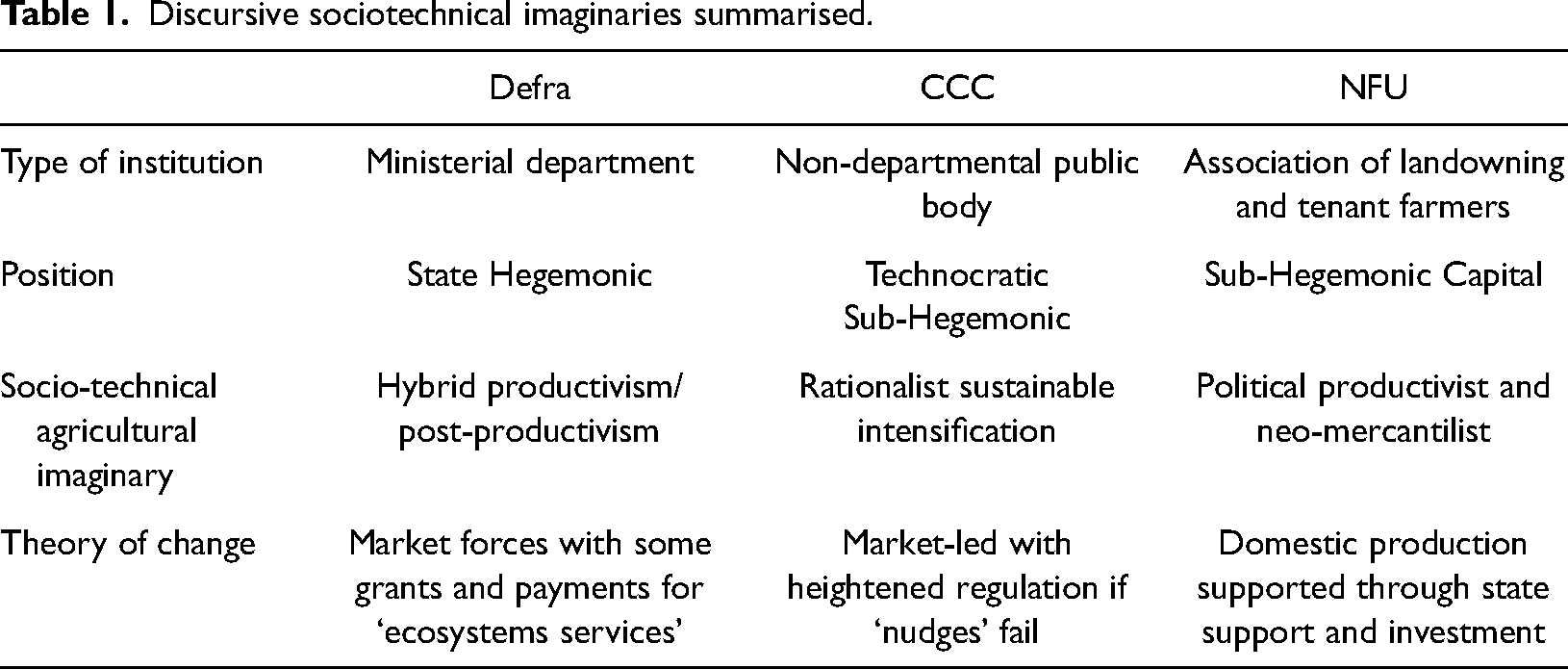
Before assessing the shared themes discursively constructed by Defra, the CCC and the NFU it is necessary to sketch out each institution's position and their differences. The first two actors in question, Defra and the CCC, represent distinct institutional aspects of the state apparatus. Defra, as the ministerial department with legislative responsibility for food and farming in England, represents a hegemonic actor within the field. As a department Defra, and its executive agencies involved with regulation and enforcement, undertake a mixture of legislative, financial, and regulatory functions within the English agri-food system. The overall ‘pathway’ to net zero, however, which emerges from their published work is an approach characterised by faith in markets to solve complex socio-ecological problems (Defra, 2019a, 2019b, 2020a, 2020b, 2020c, 2020d, 2020e). For the most part, the Defra approach places responsibility for reaching net zero on individual farmers, the prospect of innovation and the rationality of the market. This is supplemented by some grant-based investment in both on-farm capacity and innovation, although these are often framed in terms of productivity (e.g. Defra, 2020d). This can be broadly understood as a ‘neoliberal’ approach (Potter and Tilzey, 2005), although this is caveated below given the centrality within Defra's net zero vision of the nascent Environmental Land Management Scheme (ELMS), England's post-Brexit farming subsidy support system which looks to implement a post-productivist ‘public money for public goods approach’. Nevertheless, despite sympathy and participation from environmentalist civil society groups for impending reform, this approach remains to a great extent consistent with decades of neoliberal government and governmentality across the UK.
The CCC's position within the state differs, given its role as an independent non-departmental body tasked with producing publicly available, independent expert advice on the government's ongoing efforts to meet its climate change targets. Their output in this sphere (notably Climate Change Committee, 2020) is more technical and intended as an objective analysis of potential pathways forward to ensure the government's environmental targets are achieved. Further, the CCC's strategy of publishing various emissions reduction scenarios broadens their capacity to make suggestions for more drastic change (e.g. Climate Change Committee, 2020: 32). Given this positionality they are able to make recommendations or suggestions further from the existing frame of political acceptability than a ministerial department. This includes, for example, acknowledging the need for significant reductions in UK meat consumption (Climate Change Committee, 2020: 50). The CCC, however, as is also illuminated at length below, operates within the conjunctural orthodoxy and does little to challenge existing political ‘common sense’ around the efficacy, rationality and desirability of markets, for example, calling for the creation of market mechanisms to stimulate efforts to protect peatland and to afforest land (e.g. Climate Change Committee, 2020: 14–15). Given the nature of the institution within the state and the input of both report-specific expert advisory panels (Climate Change Committee, 2020: 2), civil servants and permanent political appointees (HM Government et al., 2010), they could thus then be considered a ‘technocratic sub-hegemonic’ fraction within this discursive space (cf. Tilzey, 2019).
The NFU represents a different prospect, given their position representing the interests of the English and Welsh farming sector from outside of the state apparatus. Nonetheless, they represent a sub-hegemonic class fraction and their underlying ‘neo-mercantilist’ (Potter and Tilzey, 2005; Tilzey, 2017) imaginary of the future of British food and farming permeates their discursive efforts to map a ‘pathway’ to net zero by 2040. The NFU is itself a diverse organisation, representing growers from a range of agricultural sectors and farms of varying sizes, each of whom will be unequally positioned to reduce on-farm emissions swiftly and cost-effectively. Despite this variety, the NFU's founding mission, to promote domestic agricultural interests and develop corporatist ties with the state (Cox et al., 1991), continues to inform their approach, which emphasises bolstering and greening domestic production through state backed programmes, subsidies and high standards that, in theory, prevent emissions ‘leakages’ to competitors overseas (NFU, 2019). This differs, clearly, to the Defra oriented vision of a transition to net zero guided by market rationality and individual farmers.
These tensions and contestations underline the reality of environmental governance as a site of competing institutional logics. This meshes with an understanding of the state as a social relation within which the shifting interests of various fractions of capital are relational and entangled. This is linked to a return to the work of Bob Jessop (2015; 2018) and parallel neo-Gramscian analyses of the food system by Tilzey (2019) developed further below. Firstly, however, the analysis focuses on the discursive coherence and similarities of net zero pathways across hegemonic and sub-hegemonic representations, with a particular attention to their future orientation. In this sense another concept borrowed from Jessop (2020: 90), the idea of the ‘societal project’, helps frame this work, in that the transition to net zero represents a shared imaginary pregnant with contradiction and contestation between hegemonic, sub-hegemonic and counter-hegemonic groups. Yet, nonetheless, the project coheres and, to a degree, has already ‘sedimented’ (Jessop, 2020: 90) over time as accepted orthodoxy and teleological purpose. It is the shared aspects of the discourse which facilitate this, and their inherent futurity, which CDA helped draw out and which will now be unpacked.
An empty future
Socio-technical imaginaries regarding the future of food production are of central importance to the order of discourse. The solution to reaching net zero emissions in agriculture for Defra, the NFU and the CCC alike is producing more food on less land by using improved yet ‘sustainable’ agricultural methods. This then allows for land to be spared for carbon sequestration through forestry or cultivating biofuels. This approach is encapsulated, for example, by the CCC's assertion that: “Sustainable agriculture productivity growth is a key driver in our land use scenario: it allows more to be grown with less land and other inputs and enables land to be freed up for other uses.” (Climate Change Committee, 2020: 39)
This tendency allows us to begin to link the net zero discursive socio-technical imaginary to two discursive frames fundamental to the contemporary agri-food system. The first is a specific understanding of ‘food security’. Jarosz (2014) explains this discourse of ‘food security’ as emphasising the need for increased outputs and production through technology, neoliberal policy, and the expansion of international trade. Adjacent to this are the twin discourses of ‘productivist’ agriculture (state-assisted, intensified, expansionist and technologically driven) and ‘post-productivist’ agriculture (less intense, more focus on agri-environmental schemes and associated ‘sustainable’ governance, less state support, more regulation) (Marsden et al., 1993; Ward, 1993). These axes are roughly drawn paradigms which exist in complex relationships, rather than as polar opposites, as Jarosz (2014) demonstrates for the former and as Wilson (2001), for example, does for the latter, building on the work of Marsden et al. (1993) and Ward (1993). The approach forwarded across the sociotechnical imaginaries of Defra, the CCC and the NFU utilises aspects of each these approaches, tempering a food security approach in which English farmers must ‘feed the world’ with a ‘post-productivist’ intention to do so without explicit recourse to chemical and fossil fuel driven intensification. As former Secretary of State for Agriculture Theresa Villiers surmised it in a speech these are “the global challenges of a larger, richer population living on a hotter, less resilient planet” (Defra, 2020b).
This envisioned trajectory belies a faith in the capacity of the existing dynamics of the English agricultural sector to offer imminent and ecologically sound productivity growth within the near future. This hinges predominantly on a belief in the emergence of improved farming methods and the advent of certain forms of technological development stimulated by state grants (e.g. Defra, 2020c: 20–22). For Defra the inevitable triumph of research in this area is not blanketed with the conditional tense when they assert that: “Research will support the transition to low-carbon farming methods and contribute to delivery of net-zero” (Defra, 2020c: 21). The success and uptake of biotechnologies, such as gene editing (NFU, 2019: 7), and general projected improvements in efficiency attributable to the logic of competition and the government's post-Brexit agricultural subsidy regime are also central assumptions upon which this imagined future is based (e.g. Defra, 2020b).
Current government data shows a gradual annual increase in agricultural productivity of around 0.7% per year between 2000 and 2019 (Defra, 2020g). However, the scale of change required to make good on this mode of ‘sustainable’ agricultural improvement by squeezing more out of less in the coming years of more extreme weather events demonstrates an approach towards the future insufficiently attuned to the environmental challenges of the years to come. In very recent history alone, the UK's wet autumn of 2019 contributed to a 37.5% reduction in the following years’ wheat production (Defra, 2020f) and extreme precipitation events in autumn and winter are forecast to increase as the 21st century continues (Watts et al., 2015).
This view of a future characterised by guaranteed increases in productivity is indicative of the techno-optimism that permeates the socio-technical imaginaries in question. Faith in the capacity of Carbon Capture and Storage (CCS), in particular, offers a bellwether for this techno-optimism. Within the NFU's projected pathway to net zero emissions by 2040 the proliferation of growing crops for bioenergy, carbon capture and storage (BECCS) is significant, representing 26 MtCO2e/year of their forecasted total reduction of 45.6 MtCO2e/year (NFU, 2019: 6). The emissions reductions scenarios set out by the CCC also involve significant scaling up of the growth of bioenergy crops, although their estimates are less optimistic, their commitments to CCS are vaguer, and acknowledgement is given to the environmental risks and shortcomings of this approach (Climate Change Committee, 2020: 61). In any case, given the technical and environmental challenges and uncertainties associated with various forms of emergent BECCS technologies (e.g. Fajardy et al., 2019) this ambition hints at a techno-optimism likely influenced by the epistemological tendencies of the dominant future orientated scenarios created by the Integrated Assessment Models (IAMs) which present BECCS as a necessary reality for any viable future of climate change mitigation and adaptation that does not disrupt existing social formations built around capital accumulation (Carton, 2019).
This techno-optimism, I argue, is rooted in a belief that technology will allow us to manage ‘nature’ to such an extent that it becomes possible to “return the earth's temperature to its benevolent earlier condition” (Swyngedouw, 2007: 16). Defra's submission to the EFRA Parliamentary Committee inquiry regarding net zero typifies this. Selective breeding programmes, crop genetic improvement, engineered feed additives and slurry acidification are foregrounded as tools necessary to facilitate a transition to net zero (Defra, 2019b). Minette Batters, the NFU President also brings this approach clearly into focus: “I’m confident that new feed additives and minerals will also help further reduce methane and regular benchmarking ensures I’m getting the best performance and productivity out of my livestock. Focusing on health status and the right genetics are key to carbon neutral farming.” (NFU, 2019: 2)
What is considered ‘natural’ is also considered mutable. Technology allows control down to the molecular level, in theory allowing farmers to meet the requisite emissions outcomes with the “right genetics”. CDA also encourages attention to verb usage (e.g. Fairclough, 2010b) and, although much of the discourse around technological innovation is blanketed by use of the conditional tense, the lack of alternative suggestions if such technologies do not turn out to be viable speaks to the anticipation, expectation, and ‘hype’ (Borup et al., 2006; Brown, 2003) around emergent techno-fixes. This tendency leads to a futurity akin to what Schiølin (2020) calls ‘future essentialism’, in which powerful actors are able to construct optimistic narratives of inevitable technological progress. In due course the passage of time and the dominance of these discourses squeezes out alternative approaches predicated upon alternative projections of the sort of societal reform required to tackle contemporary environmental crises. Work by Gardezi and Arbuckle (2020), for example, demonstrates this process in action, establishing a link between a techno-optimistic outlook and a reluctance to act on climate change in the present amongst a sample of 5000 American farmers.
Further, the reality of agriculture as a mesh of entangled processes involving human and extra-human natures is made clear by the conflicting biophysical ‘timescapes’ (Adam, 1998) with which pathways to net zero must contend. Two notable examples of this concern the atmospheric lifespan of methane and the capacity of trees to sequester atmospheric carbon over time. The CCC's report, for example, highlights the complexities of accounting for emissions like methane which have a different temporality to CO2. There remains contestation between different techniques of aggregation required to flatten this difference in the interest of a comprehensible and quantifiable future of emissions reduction (Climate Change Committee, 2020: 41–45). The CCC also relies on a different knowledge practice, this time economic rather than environmental modelling, to iron out the temporal complexities created by the time it takes trees to absorb increasing amounts of carbon dioxide as they grow. The CCC concludes that: “the private net present value (NPV) of planting trees is -£21,000 per hectare for conifers and -£25,600 per hectare for broadleaves, assessed over the time period from now until 2100” (Climate Change Committee, 2020: 62).
Understanding and valuing the biophysical processes required to reach net zero takes place through a market-oriented temporality of cost-benefit analyses. However, whereas the CCC goes some way to make efforts to factor in the ecological futures of afforestation or, for example, the realities of attempting peatland restoration in a rapidly warming world (Climate Change Committee, 2020: 12), such dimensions of the complexities of agricultural adaptation in the face of environmental crises do not feature in the public-facing discourses of Defra or the NFU. This is, however, explicable to an extent given the more technical nature of the CCC's publications. Nevertheless, as mentioned above, the extent to which the future is already pregnant with the immanent realities of a changing climate and latent ecological damage is rarely seriously acknowledged.
Instead, we encounter across these discursive socio-technical imaginaries the modernist ‘empty’ and ‘abstract’ futurity criticised by Adam and Groves (2007). In setting out their pathways to net zero Defra, the CCC and the NFU each assert their faith in the linear onward march of technological progress and the continued evolution of the agricultural metabolisation of nature through science and innovation. These projections are justified thanks to the belief in an abstract future, made legible through environmental and economic modelling and money as a universal common denominator of value extending through time. The future is a problem to be solved in the present through rational action and governance. Adam and Groves’ (2007) theorising around the ‘Promethean’ nature of contemporary “future-making” bears out here. Despite the inherent futurity of the target-oriented approach to reducing emissions in agriculture, the resolution through governance of socio-ecological problems remains reliant upon “mechanistic foundations” (Adam and Groves, 2007: 82) and divorced from the complex and processual temporalities through which they unfold. However, through conducting CDA, the way in which the discourse speaks to Adam and Groves’ work can be nuanced by examining more critically the links between the socio-technical imaginaries in question, the way in which they relate to the future and the conjuncture within the relevant social field of environmental governance
The evacuation of the near future
The idea, then, that the transition to net zero focused environmental governance is representative of a new temporality and futurity in statecraft is problematic. However, it is possible to move beyond situating this net zero discourse within Adam and Groves’ theorising around modernist temporality and to instead consider how this target-oriented approach relates to late capitalist environmental governance, its attendant spatio-temporality and contestation within and around the state. To do this we can look to ideological understandings of power, capacity and possibility within the discourse as encouraged by CDA (Fairclough, 2001): which actors are presented as capable of “making” net zero futures and under what circumstances? How do these considerations differ according to the discourse in question? And, further, what does this then tell us about the future orientation of contemporary environmental policymaking and English statecraft?
The extent to which the state can or should be the actor pushing the sort of ‘future-making’ endeavours required to achieve these targets varies across the discursive field. Across the publications produced by Defra, the CCC and the NFU the capacity of the state to push the agricultural sector towards net zero emissions is framed principally in terms of a balance between financial incentives and regulations. The NFU, as highlighted above, calls for state support in the form of “measures not just from Defra but also… other government departments to enable investment in new technology” (NFU, 2019: 10). The CCC (2020) leans further towards a mixture of rules, financial incentives, and the creation of market mechanisms. They propose tighter regulation only as a last resort in some sectors, however, behind softer ‘nudge’ oriented policies and efforts are made to convey a desire to balance regulation with incentives, outcomes, and the possibility of their enforcement. As shown, for example, in that they: “…recommend that actions beyond those required to meet the new regulatory standards should be publicly funded. There is also scope to pay for any additional measures required by new regulation for a limited period of time.” (Climate Change Committee, 2020: 62)
Defra's current approach to moving farmers towards net zero emissions similarly leans towards incentives for going beyond a regulatory baseline. This strategy is set out in their existing plans to transition away from existing European Union derived agricultural policy and subsidies, the Environmental Land Management Scheme which, it is asserted, will help reach net zero emissions in agriculture by the legally necessary date (Defra, 2020d: 17). The agency of the state to regulate and incentivise exists both in tension and in unison with a faith in the logic of the market and profit-seeking actors to respond to the appropriate incentives or opportunities when they are forthcoming as a result of state activity. Take this excerpt from Defra's response to a parliamentary inquiry about reaching net zero as an example: “It is worth noting that excessive land use control could hinder the function of market forces and lead to an inefficient allocation of land between economic agents. This may inflict an overall cost to society…” (Defra, 2019b)
The message is clear that an overreaching and ‘excessive’ state will impede the logic of the market as a result of its inefficiency. Harnessing the power of the market is the key to achieving a reduction in the environmental impact of farming for key political and expert actors within the discourse. This is evinced further, for example, by the CCC’s (2020) suggestions regarding establishing “market mechanisms” for afforestation and the restoration of peatlands (cf. Carton, 2017). Such approaches within the text gain authority through use of a discursive voice which borrows heavily from the neoclassical economical rhetoric around costs, benefits and an associated understanding of rationalist futurity and agency (cf. Adam and Groves, 2007), for example the CCC describe their methodology for evaluating future scenarios in line with the government's ‘Green Book’ guidelines on cost-benefit analysis: “For all options, private costs, private benefits and social benefits are calculated, and the Net Present Value (NPV) and Benefit-Cost Ratio (BCR) are used to assess impacts to the UK and to an individual or private business of the land use change.” (Climate Change Committee, 2020: 54)
Associated with this belief is an understanding of the role of the state as a facilitator of market activity rather than a driver of the sort of reform required to, in this case, reduce agricultural emissions to net zero. This dimension is most apparent in Defra's publication ‘Farming for the Future’ (2020c). The government's policy aims are “to enable the creation of a more dynamic, self-reliant agriculture industry” and their priority is a “productive, competitive farming sector” (Defra, 2020c: 5). This creates a tension with both the NFU perspective and the emerging paradigm of target-led environmental governance. If the government is focused only on establishing appropriate market conditions, who is responsible for meeting the net zero targets? Who will be responsible in case of failure? Is it the government's role to meet the targets or simply to create the market conditions for which it is possible for them to be achieved?
There are, however, discourses produced by Defra which highlight a growing recognition of the extra-economic value of ‘the environment’ (e.g. Defra, 2020a, 2020d, 2020e). This articulates with the growing discursive presence of the environment in the current Conservative administration's messaging, as manifested by, for example, hosting the 2021 COP summit, the upcoming Environment Bill and the end of badger culling intended to suppress bovine tuberculosis in England (Defra, 2021a). These proclamations of environmental sensibilities are also notably channelled into discussions of ELMS, England's nascent post-Brexit agricultural subsidy regime. In fact, the provision of considerable financial subsidies for agricultural producers for providing environmental goods clearly complicates the claims above that existing agricultural policy looks only to facilitate free markets.
I contend, however, that the emergent ELMS policy framework is a fusion of productivist and post-productivist approaches (Marsden et al., 1993; Ward, 1993; Wilson, 2001). Whilst producing some environmental benefits, it may encourage the development of a part of the agricultural sector which emphasises productivity, output and scale as close to the regulatory baseline as possible in order to remain viable. This is exacerbated by the voluntarist and financially uncertain nature of the proposed ELMS framework at this point in time (Defra, 2021b). As such, it is possible to speculate that post-Brexit English agriculture will be be characterised by two contradictory yet complementary sociotechnical imaginaries materialising in parallel (yet likely unevenly distributed spatially): those in a position to look to produce ecosystems services and those oriented towards land agglomeration and productivism under the guise of sustainable intensification. These tendencies represent the continuation of long established contradictions within the European agricultural policy, as elucidated by Potter and Tilzey (2005) and will likely exacerbate existing dynamics of income inequality by farm type and associated landscape (Defra, 2020h).
The doxa of the state's understood capacity to ‘make’ a net zero future for agriculture is also demonstrated by the recourse to nudge-oriented approaches, financial inducements and stimulation of private capital investment. The temporal and future-oriented impacts of such discourse is significant and under-explored. The way in which contemporary institutions relate to the future forwarded by Adam and Groves (2007) homogenises the ‘future-making’ efforts of elites across the knowledge practices of law, science, economics, and policymaking. What can be seen instead are glimmers of how English environmental governance balances understandings of an ‘empty’ future with ideological constraints on its own capacity when confronted by the temporality of ‘endless accumulation’ (Sewell, 2008) characteristic of contemporary political orthodoxy. This dimension of neoliberal target-oriented governance is reminiscent of what Guyer (2007) has called an “evacuation” of the near future. The long-term calendrical targets and objectives are set by government as an auditable “temporality of dates” (Guyer, 2007: 412). However, responsibility is, at this point at least, deferred to a large extent to farmers, land managers and agri-food chain businesses with varying levels of capacity or intention to meet these targets in an immediate future constrained by the structural forces of the existing political economy of the food system.
This future-oriented dynamic in turn feeds back into an understanding of what is politically possible in the present. Differing levels of faith in markets or optimism about technology result in contrasting visions of how different the future should be and how much change is possible and/or necessary to achieve net zero emissions in the future. This example from a policy paper on Defra's broader environmental target framework illustrates how ideas of possibility are constructed within the discourse: “…we want to develop ambitious targets, but in doing so make sure that they are achievable. To inform this we will analyse the historic pace of change to the natural environment and consider future trends, including possible policy mechanisms and socio-economic drivers.” (Defra, 2020a)
Ambition and achievability are in tension. The past and present are analysed in order to understand the future and take appropriate action that is considered ‘viable’. The viability or achievability of these targets is rooted in the contemporary capacity and ideology of institutions. This is left unsaid but emerges in work by the CCC who list ‘political acceptability’ as a criterion for policy recommendations. They must ask: “Is the policy expected to receive broad support and does it limit the costs to the Exchequer?” (Climate Change Committee, 2020: 84). However, such a statement poses questions about the relationship encountered here with the future and time. Is it possible to square the assertions of Adam and Groves (2007) concerning an empty or abstract future with the hegemonic ideological conservativism of institutions in contemporary political governance? Why is climate change forecasting not resulting in dramatic anticipatory action and governance? Will the significant government actions in response to the COVID-19 pandemic shift the common sense of what is or isn't possible as regards environmental and ecological planetary crises? In this cross-section of discourse at least, which pre-dates the pandemic, radical change is considered unpalatable politically or unfeasible economically as a result of the contemporary political logic discussed above which predetermines ideologically what the state should or should not do.
What is possible is also framed based on what is judged to have come before within an anthropocentric understanding of the current state of ‘the natural environment’, rather than recognising the unprecedented complexity and potential severity of the environmental crises to come. In one sense this endorses the idea that the future is a blank canvas. But on the other hand, it articulates with claims about the logic of contemporary “post” or “anti-political” (Bracking, 2015; Swyngedouw, 2007) neoliberal governance and residual antipathy within the current paradigm of environmental governance towards significant exercises in state planning or the sort of modernist “future-making” endeavours of the 20th century. The advent of target-oriented governance can perhaps be understood, in the first instance, as a result of the emergent tensions created by attempting to tackle ongoing global environmental change via the apparatus of lethargic or self-limiting state institutions and bureaucracies. The results being a combination of the ‘market creation’ and ‘market correction’ functions highlighted by Tilzey (2019). The next section will take this analysis further and demonstrate how net zero governance can also be read as an effort to delay or offset alternative post-capitalist futures, as well as to facilitate a ‘green capitalist’ one, as well as what it can tell us about contemporary contestation between hegemonic institutions within the British agricultural policymaking sphere.
Beyond the discursive moment
The theoretical dimensions of CDA concerning the internally related ‘moments’ (Harvey, 1996) of social processes are useful here in linking the socio-technical imaginaries established by the NFU, Defra and the CCC to a critical perspective on the broader conjuncture. Central to this analysis is the extent to which the discourses dwell on the technological dimensions of agricultural production and the material ‘moment’. Tighter and evolving control over the material processes through which ‘nature’ is metabolised as agriculture are seen as the key to achieving a net zero future by actors across the order of discourse. Consistent with the general tendency within capitalist ideology to fetishise technology (Harvey, 2003), the material moment of the social process is constructed as highly mutable. Innovation alone gives the future plasticity, from genetics to BECCS at the expense of considering other more political forms of transformation, such as social relational or institutional change. This is broadly in line with the work of Adam and Groves (2007); however, such an analysis can also be linked to broader work around the other strategies of ‘green capitalism’ (e.g. Surprise, 2018) and the ‘corporate-environmental’ food regime (Friedmann, 2005).
So, such socio-technical imaginaries of net zero agricultural futures are reliant on an ‘open future’ of technological possibility whilst being simultaneously constricted by conceptions of what is or isn't possible or desirable governed by political and institutional logics. How truly ‘empty’, then, is the future? The answer is, perhaps, that this contemporary mode of discourse-oriented target governance does not in reality attempt to ‘make futures’, as Adam and Groves (2007) suggest, but only to facilitate the construction of future markets and market futures. This tension suggests that governmental discourses around net zero are not in essence about delivering the requisite social change required to drastically reduce carbon emissions produced by, for example, agricultural production. The role of certain techno-optimistic discourses analysed is, then, the illusion of governmental effort whilst simultaneously facilitating the “permanence” (Harvey, 1996) of the current hegemonic social formation and its attendant modes of governance.
The imaginaries portrayed by discourses of net zero are in a sense ‘empty words’ (Chouliaraki and Fairclough, 1999). But they are empty words which serve a purpose and remain, as with all discourses, internally related to the other social moments. That purpose is the maintenance of continuity in the face of, or even through, environmental crises and its viability as an approach is premised upon a gamble that the trajectory of capitalist technological innovation and the rationality of the market will arrive in time to ‘save us’ from the sort of environmental crises which they have served so far to only produce. Within this dynamic accepting the role of the state as only the provision of regulatory nudges or financial incentives to the market makes sense. But in the face of mounting environmental crises and the potential realisation of O’Connor's second contradiction of ecological exhaustion and underproduction (1991) how long can such approaches hold? And what happens when they are proven insufficient (cf. Wainwright and Mann, 2018)?
This links, then, to a return to the work of Swyngedouw (2007, 2010) regarding the ‘post-political’ nature of environmental policymaking. I argue that Swyngedouw's ideas are, to a certain extent, consistent with the above analysis. Discourses produced by the institutions in question rely, to varying degrees, on competing narratives of how to technologically manage ‘nature’ back to an imagined equilibrium in a way that is both more ‘efficient’ and more ‘sustainable’. To go further, I argue that the net zero mode of governance is, in a sense, a spatio-temporal extension of this manner of post-political environmental politics. The trans-electoral scope and the underlying fetishisation of CO2 inherent to net zero targets attests to this. As does, I argue, the spatio-temporality it serves to reproduce, in which the rhetoric of the grand technological challenge fuses with a target-orientation that ‘evacuates the near future’ (Guyer, 2007). The future, rather than the present, becomes the domain of action.
These dimensions resonate with broader critiques of the emergent ‘eco-modernist’ or ‘green capitalist’ paradigm of adapting to and mitigating climate change. Emissions can be reduced within the same systemic framework through which their proliferation has occurred. Yet this time the intensification will be sustainable, and the new dynamics of the markets created for carbons sequestration of afforestation will help offset the externalities from the old-fashioned markets for the cheap food that helps keep other things cheap (Patel and Moore, 2017). Overall, this broader overarching socio-technical imaginary of techno-optimism can be situated somewhere between ‘greening the market’ and Neo-Schumpeterian techno-optimist discourses highlighted by White and Roberts (2020). Such discourses are also comparable to the idea of the spatio-temporal ‘green capitalist’ fix as examined by Carton (2017, 2019) in the context of market-based mechanisms and negative emissions technologies and Surprise (2018) as regards geoengineering.
However, in making these assertions it is possible to fall back on the deus ex machina generation and efficacy of governmental logics and their attendant spatio-temporalities. It is important to remember that these futurities and spatio-temporalities emerge from organic and ongoing tensions and contestations between fractions of capital and institutions employing various knowledge practices and capitals across the field. In this sense, this account becomes vulnerable to the criticisms Tilzey (2019) outlines of McMichael and Friedmann's work on food regimes in which the state and agricultural capital are seen to be homogenous in both ends and means. This is not to discount the coherence of net zero as a ‘societal project’ or, arguably, a ‘semantic fix’ (Jessop, 2020) with broad-based support from hegemonic and sub-hegemonic institutions within this space. Yet the positions and intentions of each institution behind the discursive production outlined at the start of this analysis must be acknowledged. So, as Jessop (2008: 153) considers, the role of the state is essential in “redrawing the spatio-temporal matrices within which capital operates”, whilst both facilitating capital accumulation and “rendering capital's temporal horizons and rhythms compatible with their statal and/or political routines, temporalities, and crisis tendencies”.
Any signs of coherent and aligned hegemonic structuration of the field and its attendant spatio-temporalities and future-orientations are, then, the product of ongoing and dynamic processes within and around the state apparatus. It is, however, difficult to square this dynamic reality with any description of this sphere of governance as ‘post-political’ or ‘anti-political’ (cf. McCarthy, 2013). This will become even more evident when the differential realities of what transitioning towards net zero in agriculture (and reaching other biodiversity and environmental targets) become apparent. Existing inequalities between tenant farmers and landowners, uplands and lowlands and arable and livestock sectors will be tested. The management and ramifications of these dynamics are significant and, unfortunately, beyond the scope of this research. However, they certainly provoke further critical and empirical inquiry.
Such speculation aside, the ways in which net zero target governance ‘evacuates the near future’ and facilitates buy-in across the field through its shared techno-optimist and productivist futurities is still markable. This, I would argue is enabled by the discursive and imaginary flexibility its temporalities enable, creating if not a post-political reality, then some dimensions of a post-political societal project. In this direction, the coherent discourse around net zero governance can also be seen as what Tilzey (2017) describes as a ‘flanking measure’: the absorption of oppositional discourses by hegemonic and sub-hegemonic institutions to assuage resistance. In this case the adoption of climate-induced environmentalist future in the face of growing crises as regards the legitimacy of the contemporary corporate food regime. Just as Carton (2019) shows fossil fuel companies can cite the future promise of BECCS to legitimise their current practices, so too can large corporate actors in the agri-food world rely on government and bodies like the NFU to disseminate and legitimise such techno-optimistic imaginaries to the detriment of calls for genuine transformation. Not only this, but the transition towards net zero agriculture can be cast as an opportunity to move ahead into the future by becoming a global leader in the ‘climate smart’ agriculture that will ‘feed the world’. Meanwhile, responsibility for diminishing the production of emissions within the food system is individualised and disseminated to consumers and food producers. The powerful processors and retailers who to a great extent define the current corporate food regime and its market conditions (McMichael, 2009) are subject to limited scrutiny, beyond perhaps the need to introduce new labelling schemes or consumer information policies. The structural political economic conditions which force farmers to produce as much as possible to remain financially viable remain unchanged.
Conclusion
It is necessary to return to the three questions set out in the introduction to this paper in order to summarise and reiterate the discussion. As regards whether net zero targets represent a novel spatio-temporality of environmental policymaking, this article has looked to nuance the ideas of Adam and Groves (2007). The ‘empty’ and ‘abstract’ future they propose, and its attendant linear temporality, certainly contributes to the discursive construction of techno-optimistic imaginaries of agricultural innovation facilitating net zero transitions. However, through discourse analysis, the contradictory pressures which institutions have channelled into their discursive representations of the future, have become clearer. Yet, in the form, of net zero targets, the discursive efficacy of this understanding of an empty future is demonstrable as a driving facet of this ‘societal project’ (Jessop, 2020) around which hegemonic, sub-hegemonic and counter-hegemonic visions are coalescing.
This leads to a reconsideration of the question around the ‘post-political’ nature of net zero governance in this sector. As is set out above, the tendencies highlighted by Swyngedouw (2007, 2010) certainly resonate in this field. Not least the capacity that the discourse displays for isolating the ‘material’ moment as a site of future innovation and change at the expense of considerations of social relational and institutional transformation. However, this assessment necessitates revisiting the final question posited above regarding the state and governance. It has also been demonstrated, with particular reference to the work of Jessop (2008, 2015, 2020) and Tilzey (2017, 2018, 2019), that attributing the ‘post-political’ label to a field wherein even relatively aligned institutions are in tension is overly simplistic. The unfolding of these tensions in the coming decades must be attended to in a way that does not reify a monolithic state-capital nexus, but instead acknowledges the dynamism and lived nature of institutions and the class interests they represent, modulate, and materialise. These fissures are currently predominantly discursive in nature, but as the British countryside is reshaped in various forms by impending socio-ecological change, they will become socio-material gulfs. It is also foreseeable that those who are already struggling to make ends meet producing food are unlikely to thrive in a future wherein an agricultural transition is predicated upon novel inputs and agri-tech machinery.
However, the above approach focuses exclusively on the discursive dimensions of the temporalities of net zero governance. As such future ethnographic work in this context is desirable to begin to assess the way in which discourses of net zero circulate and to better conceptualise the political ecological aspects of these envisioned pathways as (or if) they begin to manifest in the England's agricultural sector. Further this article has assessed just one corner of the ‘order of discourse’ which has emerged regarding the transition to net zero emissions in the UK's agri-food sector: the documents produced by large England-oriented organisations rooted in hegemonic orthodoxies of the contemporary food system. Further research assessing the uptake of net zero discourses in different organisations, such as environmental NGOs and charities, would help assess the extent to which net zero discourses are indeed ‘flanking measures’ (Tilzey, 2017) in practice. Finally, a more spatially oriented approach could supplement this initial focus on temporalities. Net zero targets and associated approaches based on emissions have increasingly come in for criticism for their neo-colonial intention or potential (Boyle, 2021). In the agricultural context, a considerable proportion of the food consumed in the UK is imported and consideration of the way net zero governance could lead to the offsetting or outsourcing of emissions and other forms of ‘carbon leakage’ is required. Furthermore, comparative examination of the elaboration and enactment of net zero target governance across the nations of the United Kingdom and internationally is required. This research helps lay the ground for further efforts in these directions.
Discursive sociotechnical imaginaries summarised.
Highlights
Offers a critical discourse analysis of policy documents concerning reaching net zero agriculture in England
Analyses approaches to reducing agricultural emissions from a spatio-temporal perspective concerned with how the future is constructed
Asserts that net zero approaches reproduce existing spatio-temporalities of technological progress towards an ‘empty’ future
Demonstrates how this articulates with the ‘post-political’ marginalisation of efforts at genuine systemic changes to how food is produced
Footnotes
Acknowledgements
I would like to thank Steven Emery, Julian Clark and Jessy Shallcross for their constructive feedback on earlier drafts of this article. Thanks also to Kiri Santer, Nina Khamsy, Paaras Abbas and Costanza Ragazzi for taking the time to discuss these ideas with me.
Funding
The author(s) disclosed receipt of the following financial support for the research, authorship, and/or publication of this article: This work was supported by the Economic and Social Research Council (grant number ES/P000711/1).
