



Abstract
Digital surveillance technologies enable a range of publics to observe the private lives of wild animals. Publics can now encounter wildlife from their smartphones, home computers, and other digital devices. These technologies generate public-wildlife relations that produce digital intimacy, but also summon wildlife into relations of care, commodification, and control. Via three case studies, this paper examines the biopolitical implications of such technologically mediated human-animal relations, which are becoming increasingly common and complex in the Digital Anthropocene. Each of our case studies involves a different biopolitical rationale deployed by a scientific-managerial regime: (1) clampdown (wild boar); (2) care (golden eagle); and (3) control (moose). Each of these modalities of biopower, however, is entangled with the other, inaugurating complex relations between publics, scientists, and wildlife. We show how digital technologies can predetermine certain representations of wildlife by encouraging particular gazes, which can have negative repercussions for public-wildlife relations in both digital and offline spaces. However, there remains work to be done to understand the positive public-wildlife relations inaugurated by digital mediation. Here, departing from much extant literature on digital human-animal relations, we highlight some of these positive potentials, notably: voice, immediacy, and agency.
Keywords
Introduction: Wildlife in the Digital Anthropocene
Surveillance technologies are increasingly used to sate the public's curiosity for interactions with wildlife, offering windows into nonhuman lives at a scale previously unimaginable. Trail cameras, GoPros, digital photography, dashcams and webcams, thermal imaging sensors, and biotelemetry devices are among some of the new technologies that generate second virtual lives, which Adams (2020) describes as ‘digital animals’. These animals are digitally mediated, displayed, encountered, consumed, and interacted with by users via screens (Arts et al., 2015). What does digitisation in general—and real-time surveillance of wildlife through biosensing and broadcasting technologies specifically—mean for the way people view and relate to wild animals in what McLean (2020) calls the ‘Digital Anthropocene’? In this paper, we show how the public relates to wildlife surveillance in three principal roles: 1) as producers of wildlife data in their daily lives, through field-based citizen science programmes like eBird, iNaturalist, and MammalWeb, or crowdsourcing platforms like Zooniverse and VertNet; 2) as consumers tuning in remotely to view and engage with wildlife surveillance livestreams involving closeups of, for example, wildlife nests and dens; and as 3) interveners in the physical lives of wild animals on the basis of surveillance data. All three of these modes of engagement grew considerably in popularity and scope during COVID-19 lockdowns, warranting further attention to trace their impacts into the future (Sandbrook et al., 2021; Turnbull et al., 2020).
Why do various publics seek out such digital encounters with wildlife? Apart from enabling enhanced data collection and analysis for informing conservation projects, digital technologies for wildlife surveillance appear to offer connections of immediacy and intimacy between the public and wildlife (Blue, 2016; Kamphof, 2013). As such, digital technologies make the public less reliant on biologists or journalists as the exclusive mediators of wild animal lives (Benson, 2010). Publicly available surveillance technologies now mean that amateur users can capture and experience different registers of experience with wildlife that are not ordinarily recorded by experts (Benson, 2017; Gabrys et al., 2016; Kamphof, 2011). Wildlife, too, is said to be emancipated from contrived forms of representation such as edited nature documentaries (Lorimer, 2010; Mitman, 1999; Turnbull and Searle, 2021) and allowed to “tell their own stories” through real-time footage or animal-borne cameras (Verma et al., 2016).
In reality, the extent to which modern technologies can give voice to animal agency in this regard is disputed, as surveillance often conceals power and presents the illusion of freedom (Mitman, 1996). For all promises of participation and immediation (Mazzarella, 2006) offered by surveillance technologies, uncertainties still remain about what kinds of biopolitical practices of care, commodification and control are involved in their deployment. Moreover, it is unclear how such digital public-wildlife relations will evolve in the future, given the rapidity with which such technologies are being deployed by a range of actors for diverse purposes. In light of this, research is required to interrogate what digital surveillance actually entails in terms of its constitutive effects on public-wildlife relations in the Digital Anthropocene (McLean, 2020), an era in which our contact with Nature and wild animals is increasingly mediated via screens and digital devices (Adams, 2020; Altrudi, 2021; Büscher, 2014; Stinson, 2017; Tait and Nelson, 2021). In this paper, we examine three instances of digitally mediated public-wildlife relations, building on scholarship from geography, anthropology, and media studies. We link these discussions to Indigenous perspectives on animal agency, which demonstrate that surveillance technologies do not have a monopoly on giving voice to non-human animals (Tallbear, 2011). Indeed, whilst affirming the potential of digital technologies for fostering convivial multispecies relations, we caution that the hype surrounding the potential of digital technologies may obscure other modes of relating to the nonhuman world.
The Anthropocene is the name given to the putative geological epoch in which humanity has become a planet-changing force (Crutzen and Stoermer, 2002). Previously considered geologically insignificant, humanity's impact on planetary systems is now ubiquitous, from the universal presence of microplastics and radionuclides in the environment to the unfolding effects of climate change. ‘Humanity’, however, does not refer to a homogeneous population of humans. Rather, this geological impact is the product of specific colonial and capitalist histories, in which certain human societies cause significantly greater environmental and geological detriment than others (Davis and Todd, 2017; Yusoff, 2019). Influential conceptual alternatives such as plantationocene (Haraway, 2016), capitalocene (Moore, 2017), and anthrobscene (Parikka, 2017), to name a few, embody such critiques. Hence, for Lorimer (2015) the recognition that human actions exert an influence over all life on the planet demands new kinds of conservation attentive to this fact. Following many others, Lorimer proffers a new politics of conservation oriented away from the static concept of ‘Nature’ – as a pure place untouched by humanity – towards ‘wildlife’, a concept more attentive to the world-making agencies of nonhumans that are entangled within human political, economic, and social systems. As a term, the Anthropocene has exploded in popularity, becoming a major part of the intellectual Zeitgeist (Lorimer, 2017). We are interested here in one useful iteration of this Zeitgeist: the Digital Anthropocene.
McLean's (2020) Digital Anthropocene is a means of examining the digital technologies that have, in part, produced the current global environmental crises (see also Parikka, 2015). McLean draws attention to the affective environmental relations that emerge via digital mediation, encouraging scholars to take such relations seriously rather than diminishing their importance and suggesting their inferiority to relations that occur in the ‘real’ or ‘physical’ world. Indeed, McLean (2020: 34) considers such digital relations to be ‘more-than-real’: dismantling the firm boundary between so-called digital and real worlds through the “deepening reach of the digital in everyday life,” paradoxically “reworking spatial connections and disconnections.” The Digital Anthropocene is already host to an array of unexpected encounters with digital animals: from the virtual petting of free-roaming dogs in the Chornobyl Exclusion Zone and therapeutic virtual visits to animal sanctuaries (Turnbull et al., 2020) to the use of trail cameras in a public vote to determine the winner of ‘Fat Bear Week’ in Katmai National Park, Alaska (Miller et al., 2019). Digital infrastructures also overlay physical settings (Jørgensen, 2014): in Finland, for example, the pelage and fur patterns of the Saimaa seal population can be scanned by an app - like QR codes - by visitors, allowing photo-ID to immediately reveal the individual seal's name, age, and family history (Chehrsimin et al., 2017).
Some of these projects approximate forms of citizen science, where publics can learn about wildlife while contributing to research and conservation (Bonney, 1996). Other digital engagements are set up chiefly to provide entertainment for users, like partaking in wildlife treasure hunts (Greenhill et al., 2014) or enjoying the relaxing ambience of watering holes in livestreams like Africam (Kamphof, 2011). Some ways of capturing and containing wildlife for posterity have analogue predecessors (Ryan, 2000), but other technologies and webpages also hint at novel public-wildlife arenas.
Our paper starts with the premise that new relations between humans and wildlife in the Digital Anthropocene involve a series of paradoxes pertaining to biopower. These involve rendering wildlife simultaneously more abstract and intimate to us; more proximate and distant: (1) Wild animals are simultaneously enrolled in relations of care and control; presented as free and independent agents telling their own stories, whilst surveillance technologies allow for calibrated interventions into their lives. (2) Certain species’ antics are more likely to become popular for Internet viewers whilst others lack the charisma to compete for attention online. Thus, the curation of such relations entails navigating authenticity and artificiality in mediating wild lives. (3) Finally, data generated by such technologies is subject to both decentralisation - through deploying networks of citizens and electronic sensors (Verma et al., 2016) - and recentralisation - by experts when the data are pooled and operationalised. These paradoxes make it profoundly difficult to predict the sorts of relationships, roles, and practices that will proliferate between publics and wildlife in the future.
We examine how these paradoxes have been engaged by previous scholarship on wildlife conservation and science and technology studies, but not as a suite of related tensions produced by an overarching regime of biopower. Extending extant work on biopower, wildlife, and surveillance technologies, we take particular interest in instances in which technologies allow for direct disciplinary intervention into the movement and behaviour of wildlife, in so-called next-generation monitoring (Gabrys et al., 2016). The use of automated triggers coupled with surveillance in next-generation monitoring offers fertile ground for theorising biopower anew for the Digital Anthropocene. This focus sets apart our cases from earlier analogue iterations of recording, studying, and managing animals that lack the immediacy afforded by new digital technologies. Our paper is a collaborative project across communication studies, science and technology studies, human geography, and ecological science, and is grounded in three empirical case studies of wildlife surveillance: wild boar, golden eagles, and moose.
Paradoxes of the Digital Anthropocene
In his 2012 TED talk The Secret Lives of Wild Animals, Nick Whitney opens by stating that we need to know about the secret lives of wild animals “to protect them, ourselves, and our environment.” Here, Whitney gestures towards the employment of digital surveillance for purposes pertaining to biopower: to protect or promote some forms of life, whilst culling or controlling others deemed threatening (Biermann and Mansfield, 2014; Braverman, 2015). As a technique of biopower, surveillance facilitates the production and processing of big data on wildlife populations and movements. In turn, this engenders opportunities for remotely controlling and managing wildlife through abstraction and calculability. Using algorithms, data from surveillance is now actively used to predict wildlife distributions and movements, which then become subject to proactive intervention by experts (Adams, 2018, 2019; Galán-Díaz et al., 2015; Nading, 2013).
The top-down nature of surveillance is an underpinning logic of societal governance, for humans and animals alike. As such, scholarship on human and wildlife surveillance needs to be brought into further conversation (see Sandbrook et al., 2018). The logic of biosurveillance can be traced back to the Cold War's Military-Industrial-Ecological Complex (Benson, 2010), in which aspirations to “keep a round-the-clock vigil on animals, no matter where they wander on land, sea or air” began to be voiced (ibid., p.213). This appears increasingly possible to achieve today, where initiatives like Project Icarus (International Cooperation for Animal Research Using Space) impart a regime of 24-hour surveillance of animal movement at a global scale, allowing both publics and fellow scientists to follow wild animals’ journeys, to contribute to their stories, or to collaboratively input their data.
What is perhaps most striking about this top-down logic of wildlife surveillance, is the desire for bottom-up participatory involvement by the public (Benson, 2017; Schuttler et al., 2018). Wild animal surveillance by the public, both in terms of producing data via citizen science practice and consuming data via screens, requires experts to relinquish some degree of control over the domain of wildlife (Woodcock et al., 2017), allowing for diverse and situated experiences to proliferate and be acknowledged. Accordingly, such surveillance technologies could be seen as offering a more inclusive approach to knowledge production (Guston, 2004). At the same time, in enrolling the public in biopolitical regimes through the guise of citizen science, members of the public often unwittingly collect data that is deployed in the pursuit of top-down control over wildlife - culling, relocating; conserving some species while letting others die (Braverman, 2015). Although this may appear a cynical take on citizen science, which can also be rewarding and may proceed through bottom-up knowledge production (Schuttler et al., 2018), we must still ask: how does the public's involvement, through producing and consuming surveillance data, become part of the infrastructure of a centralised wildlife surveillance system, in which the latter seeks to realize a “high-tech narrative of remote control” (Haraway, 1990, p.107)? This is a central paradox for public-wildlife relations in the Digital Anthropocene.
Modalities of digital surveillance
To make visible these aforementioned paradoxes of abstraction/intimacy, proximity/distance, care/control, subject/object, and vernacular/expert, we relay three case studies concerning wildlife surveillance in the Sweden and neighbouring countries (Fennoscandia). In each of these case studies, surveillance is used for different purposes, all of which relate to biopower - the control and governance of life (Biermann and Mansfield, 2014; Johnston, 2019). Deploying the typology outlined by Whitney (2012), our case studies involve instances in which surveillance is used for: (1) protecting humans; (2) protecting the environment; and (3) protecting wildlife. However, as our cases demonstrate, these imperatives overlap, so we forward a more topological understanding of surveillance. Our first case concerns wild boar (Sus scrofa), which is often perceived as an invasive pest species in Europe. Surveillance is used to track disease distribution and wild boar presence in the vicinity of agricultural and pork production (protecting ‘humans’). The second is an example of an endangered and red-listed species, the golden eagle (Aguila chrysaetos), (‘protecting animals’). The third example is of a prized game species, moose (Alces alces), whose surveillance is undertaken to calculate harvests for the following season, as well as to protect forestry (protecting the ‘environment’, including human interests). These different types of surveillance entail differences in what is seen as at risk and what is seen as a risk. Our geographic focus on Fennoscandia was selected due to high levels of digital literacy amongst the public, the prominence of collaborative wildlife management, and a strong tradition of citizen science in conservation.
The biopolitical underpinnings of surveillance can be further elucidated when considering Hinchliffe and Lavau (2013)'s two modes of watching over. The first involves being on guard, or practicing vigilance, towards that which is being watched over due to the potential threats it may pose. The second mode involves watching over to keep safe. Hinchliffe and Lavau (2013) point to two alternative understandings of surveillance. The first involves making observations from among or amidst the targets of surveillance, corresponding to a situated perspective. The second, from the French ‘sur’ (‘over’, ‘above’), denotes observing from a vantage point beyond/outside the population under surveillance, corresponding to a bird's eye view, or Haraway's (1988) ‘God trick’. Surveying populations of wildlife – e.g. calculating fish stocks as aggregated biomass - may be termed biopower surveillance, or the control of life. Other forms operate at the level of surveilling individuals, understood as anatomopolitics, the control of bodies (Foucault, 1991). While citizen volunteers have often championed surveilling individual animals as a more sensitive, intimate and meaningful way of knowing animals (Mitman, 1996), it too has a logic of control when such data becomes centralised (Benson, 2017). Rendered simply, we show how biosurveillance can operate on micro, meso and macro levels: population, individual and for wild boar, also the microbial.
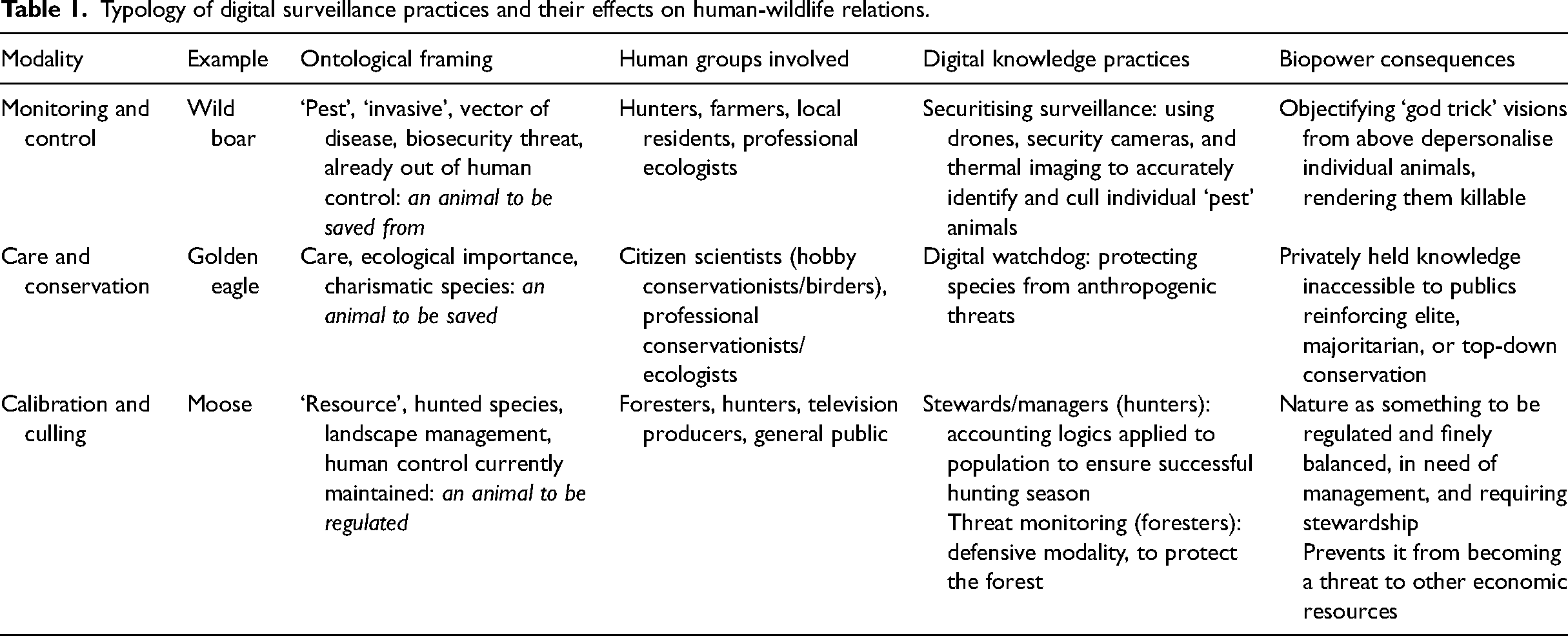
While our cases of wild boar, golden eagle, and moose manifest differences in surveillance modalities, they have several things in common. An overview of their similarities and differences is presented in Table 1. We argue these commonalities are hallmarks of emergent forms of production and consumption of wildlife data in the Digital Anthropocene: they represent the increasing consumption of surveillance data by publics online, including livestreams, slow TV broadcasts, and Facebook watch-parties; they involve the gamification of the labour of collecting or classifying data; they involve a spectrum from passive to active engagement with the data; and they are located at the cusp of what is called next generation monitoring, which uses surveillance for the direct, remote nudging of wildlife on the ground (Gabrys et al., 2016). These interventions include cues and repellents acting upon wild animals, ranging from deterrent sounds at railway crossings to smart collars and virtual fences (Seiler and Olsson, 2017). In our discussion, we use these case studies to consider the future of digital wildlife surveillance by examining changing roles, relations, and practices between wildlife and the public.
Typology of digital surveillance practices and their effects on human-wildlife relations.
Wild boar – clampdown
Wild boar have been discussed as an expanding invasive species which spreads disease, wreaks havoc on crops, endangers public safety in cities, jeopardises domestic pork industries, and even threatens native biodiversity (Massei et al., 2011). While wild boar are also valued as a game species for hunters, current threats pertaining to African Swine Fever have produced a powerful surveillance apparatus for the species in Europe (von Essen, 2019). Surveillance technologies, including thermal infra-red cameras for night tracking and CCTV for border control, are increasingly used in wild boar monitoring in several European countries. By outsourcing part of this surveillance to hunters, farmers, and local residents, managers take advantage of the diffuse nature of biopower. Thus, hunters and landowners send in shots from trail cameras, input extremely detailed online protocols on harvests and locations of boars (Vajas et al., 2020), and submit meat samples for trichinosis testing. They do so both as a safety precaution for their own meat consumption and to feed into the Veterinary Authority's records – not dissimilar to Australia's public participation to combat invasive toads in the ‘Toad Tracker’ application (Büscher, 2014). Several initiatives of next generation monitoring in which surveillance is coupled with action to deter boars from agriculture or roads are reportedly also underway.
Next generation monitoring acts directly upon individual boars, typically with aversive conditioning to correct their behaviour or spatial transgressions. Wild boar are also monitored by hunters who have motion- or pressure-triggered cameras at boar feeding stations, allowing them to receive live remote alerts to their smartphones to boar presence to increase their chances of a successful hunt (von Essen, 2019). While not yet in operation in Europe, the use of Judas boars, GPS-collared individuals that indicate the location of other wild boars to managers, may be anticipated as a form of surveillance in the coming years, drawing in individual boars as unwitting biopolitical actors in broader management projects.
The ‘clampdown surveillance’ modality for wild boars is reflected in the sorts of camera recording styles in use for monitoring the species, including anti-boar border fences and feeding sites (Edmond et al., 2021). There are few up-close den cameras of wild boars which reveal the intimacies of porcine family life, 1 and neither can the public follow the perspective of boars mounted with GoPros on their backs. Instead, hunters are the main users of GoPros in a wild boar context, fitting such devices on their dogs to capture the chase and kill of wild boars by dogs. Aerial drones can be deployed to chase wild boars during drive hunts, and may perpetuate a dominionistic view on the animal (cf. Haraway, 1988) as well as violating standards of fair chase among hunters. The chief manner for recording wild boar appears to be that of drones with integrated rangefinders or security cameras, but also thermovision at night to facilitate hunting. Hence, and as boar hunting YouTube videos testify (cf. Mörner and Olausson, 2017), the majority of devices aim for more accurate identification to foster shooting wild boars in higher numbers. The clampdown modality for monitoring wild boar is thereby premised on a logic of watching over in the policing-surveillance sense, seeing the object as a threat (Hinchliffe and Lavau, 2013), and human interests as the objects under threat.
Nevertheless, we are also beginning to see human-boar entanglements characterised by neighbourly co-existence or even affective attachment (Boonman-Berson et al., 2019; Kowalewska, 2019; O'Mahony, 2017), especially in urban centres like Barcelona and Berlin where wild boar live close to humans. This gestures toward care becoming a consequence of control. Indeed, individual boars whose antics have been gone viral in social media and various digital platforms, such as Elsa the boar who stole a nudist's laptop at a German beach (2020), have also achieved micro-celebrity status and have featured in petitions against culling. It is likely that such relations with boars may lend themselves to different recordings and digital disseminations of the species in the future. At present, however, monitoring of wild boar is an example of ‘clampdown’, where biopower involves an attempt to protect against the threat a species poses. This kind of surveillance occupies the intersection of disease monitoring (African Swine Fever, trichinosis, and various other parasites) and the protection of agricultural interests. The surveillance of wild boar operates on boar populations (biolpolitics), individual boar bodies (anatamo-politics), and across multispecies assemblages of (boar-microbes). That is, it is aimed at controlling (and stopping) the mobilities of populations and (infected) individuals.
Golden eagle – care and conservation
The second modality of wildlife surveillance involves a red-listed European species of bird whose monitoring is undertaken to secure its conservation status (Jachowski et al., 2014). The golden eagle monitoring project in the Nordic and Baltic countries draws in two dedicated civilian communities: hobby conservationists and birders.
Golden eagles are typically surveilled as breeding pairs on the basis of territories. Capture and marking is mainly undertaken by volunteers who are veteran bird ringers (Figure 1). This takes place in the spring and summer following nesting and hatching, after which the size of breeding populations is calculated. Chicks are handled and marked in their nests and assigned registration numbers. At present, three different kinds of transmitters are used to track golden eagles in the Nordic-run Golden Eagle Monitoring Project. These practices require repeated physical handling of the eagles and detailed tracking of their whereabouts, in a manner that approximates both care and control (see also Holmberg, 2021).
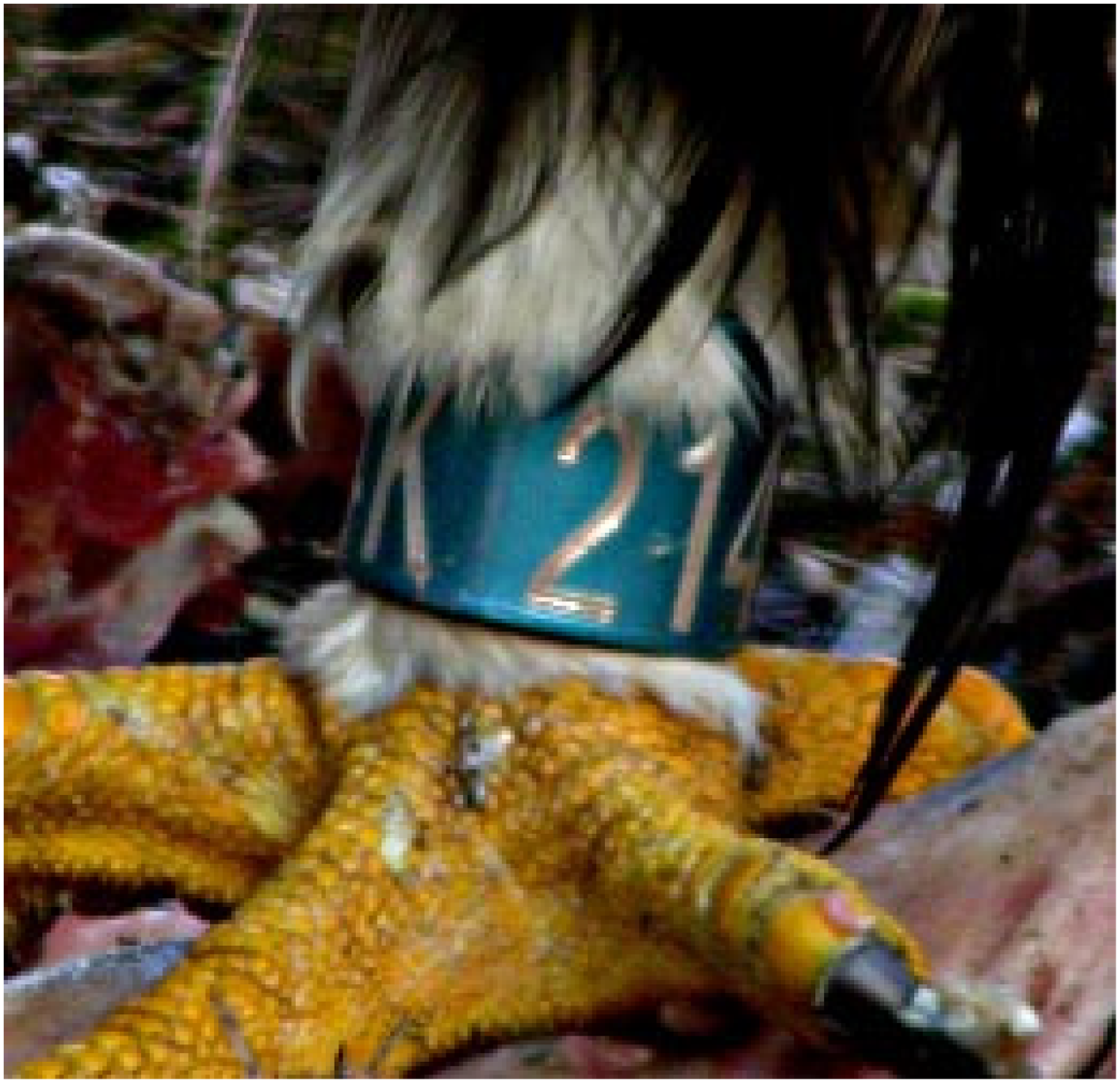
Bird ringing of golden eagle.
The Nordic countries currently struggle to unite citizen science monitoring approaches for the golden eagle. The intensive monitoring ‘Norwegian model’ - which involves the capturing of birds to pluck feather samples for DNA testing - has been heralded by managers, but has had limited uptake by birders in Sweden. Sweden hosts the largest population of golden eagles of any Scandinavian country, reflected in the number of marked individuals, but currently pursues a more extensive monitoring model with lower resolution and rigour. 2 The golden eagle's range, and those of the citizens who monitor them, coincides with a number of controversial land-uses, from wind power turbines and powerlines to reindeer husbandry by the Indigenous Sami. Accordingly, surveillance of golden eagles also proceeds from a conflict mitigation point of view to minimise negative interactions. This care modality means that the data output from its surveillance promotes a logic of avoidance, seeking not so much to build affirmative human-wildlife relations or bring out potentials for interspecies meetings (like kills, in the wild boar case above), but to minimise encounters between the eagles and various groups of people.
Golden eagles are also surveilled through webcams placed by conservationists in their nests. This form of surveillance serves the purpose of providing a conservation watchdog, wherein volunteers check camera feeds and receive live images sent to them via email. When they spot malfunctions or dangers, volunteers often visit the nesting site with binoculars and telescopes to check on the eagles. These webcams also have other uses. For instance, they have become a popular form of entertainment (Turnbull et al., 2020), including a way for national parks to bolster attendance. However, golden eagle locations and movements are kept from the broader public due to concerns related to persecution and hunting (Van der Wal et al., 2015). This puts a temporary restraint on initiatives to commodify and broadcast the livestreams.
Upcoming initiatives that seek to develop next generation monitoring applications for livestock protection from large carnivore attacks also point toward golden eagles potentially being the subject of deterring cues triggered by surveillance when they get too close to livestock pastures (using, for example, the RISE Autonoma System to detect herd behavioural anomalies), or they move into areas where they pose a threat to arctic fox populations. Hence, golden eagles are promoted within narrow parameters for their acceptable existence, and surveillance becomes a tool to monitor and non-lethally correct for transgressions beyond these parameters. Care has thus become entangled with control (de la Bellacasa, 2012) and as we show later, violence.
Moose – calibration and culling
The Swedish moose monitoring system is a collaborative wildlife tracking project originally run by hunters, but now includes more interest groups (Singh et al., 2014). Its ostensive purpose is to survey the number of moose to calibrate cull quotas for the next hunting season. Hunters watch over moose in the stewarding sense of the term (Hinchliffe and Lavau, 2013), whereas landowning foresters watch out for moose as they pose threats to the regeneration of forests. For the most part, moose are counted on a population level through counts in each älgförvaltningsområde (moose management area) and älgskötselområde (moose management unit), the latter of which are subsets of the former.
Moose monitoring is also unique in terms of its temporality, constituting in part a long-term ecological study. It has been running since 1995 in Sweden, having started with analogue practices of scat and track analysis that now include digital elements, including simulations of projected growth. It also has extensive outreach campaigns for feeding back to its collectors in collaborative ways: citizen sensing is accompanied by weekend get-togethers in moose management areas at the end of every season, where hunters, foresters, scientists, and wildlife managers socialise and discuss data flows, the network of sensors and surveyors, and graphs made from the data.
While not an endangered species, moose monitoring comes with rapidly increasing distribution of surveillance data for public entertainment that gestures toward a likely future for other wildlife surveillance. The popular slow TV show on moose migration, which is broadcast on Swedish public network Sveriges Television (SVT) from April to May, livestreams migrating moose to viewers. As part of this broadcast, scientists also capture and tag moose with GPS collars using WRAM (Wireless Remote Animal Monitoring), discussing their age, health, and other characteristics on screen in documentary style. The communal nature of following these slow TV livestreams appears key to enjoyment in which communities come together and bond over the viewing experience as “a deeply social event, extended and augmented by digital media” (Jørgensen, 2014, 105). According to the project communications officer that we spoke to in early 2021, people are beginning to manifest affective and proprietary responses toward moose, choosing individual favourites and following their well-being over the seasons. In this way, individual-level surveillance of moose is the principal optic for the broader public.
A look at the Facebook fan group of the ‘Great Moose Migration’, which remains active with several threads a day even outside of broadcast season, reveals the motivations of people tuning in to the livecast. In a thread started by a moderator asking how and why people view it, an equal number of people admit to ‘sitting glued to the TV’ as those who leave it on in the background while working or doing house chores (cf. Turnbull et al., 2020). These users note that the ambience of ‘forest sounds’ soothes them, pointing to the importance of audio in facilitating desirable digital animal encounters. Furthermore, when reviewing the highlights from past broadcasts, the most popular videos are those that feature something unexpected, cute, anthropomorphic and, perhaps more significantly, animals other than moose coming into view. Beavers, foxes, birds, reindeer and even a wolverine feature in the 2020 highlights (Figure 2). In the archived streams, these sightings are timestamped for easy viewing, something that is done mainly by viewers and verified by technicians.
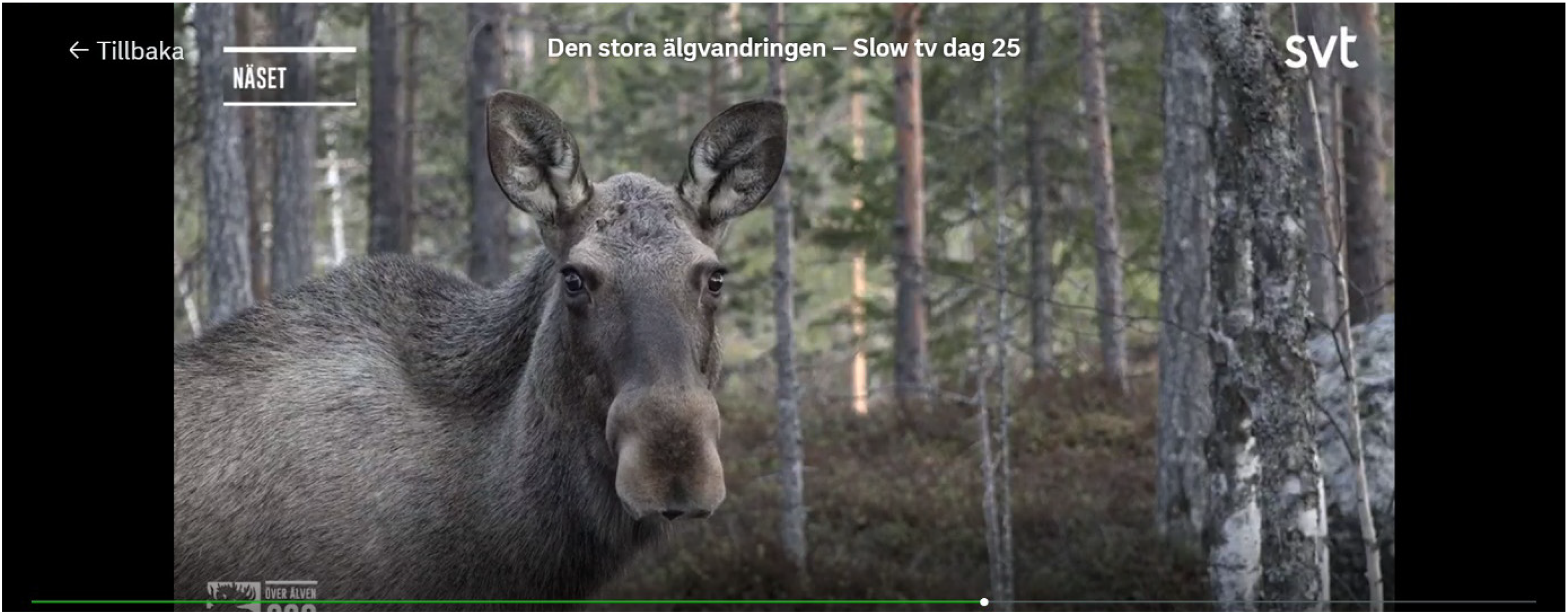
Highlight reel annotated at timestamp by user, featuring a moose 'breaking the fourth wall'.
The Facebook page and blog run by Swedish Television also contains games, competitions, and countdowns to the upcoming moose migration. Competitions range from identifying other species in the footage, voting, submitting funny captions to snapshots from the livecast, and users posting the image of the day that they have captured. Entries engage not only with the joy of nature, but users educate one another about ecology and raise critical questions about land-use, hunting, forestry, and the ethics of intervention, particularly when moose fall through the ice.
The land-use controversies raised by moose management means that surveilling moose in Sweden, where forestry is a national industry and sector, often invites conflict. The use of the data by experts is sometimes seen as a process where the real collected data is ‘cooked’ (see, for example, Bowker and Star, 2000). For instance, hunters complain that foresters somehow manipulate the numbers, illustrating that these actors do not necessarily have shared interests. Finally, hunter volunteers may also be seen as becoming objects of governance themselves, insofar as geo-tags in their data collection communicate their locations on private land and elsewhere. In some cases, segments of the countryside population have been deeply suspicious of the new reach of wildlife surveillance, which, at times, is seen as a thinly veiled excuse for monitoring hunters or troublesome farmers (Urner et al., 2020). Indeed, such surveillance has been labelled ‘countryside cinema’ by some Swedish hunters (von Essen and Allen, 2017, 87). If surveillance can be used to produce a finely calibrated moose harvest whilst also helping to conserve moose into the future, many Swedish hunters are mostly willing to pay the price of increased surveillance of their own practices.
Discussion
New relations for the Digital Anthropocene
In Table 1, we summarised the general features of our three cases. These cases offer snapshots of complex and evolving wildlife surveillance projects that involve multiple parties. With empirical attention to these case studies, we now discuss the new relations, roles, and practices that emerge between publics and wildlife in the Digital Anthropocene.
Digital surveillance of wild animals involves elements of control and care, sometimes simultaneously. For example, monitoring golden eagles is motivated by care, and is ostensibly the only of our case studies that is not also predicated on culling the species. But care is a complex practice. “Caring or being cared for is not necessarily rewarding and comforting” (de la Bellacasa, 2012, 199). However benign its intentions, the way surveillance is carried out asks much of animals, including the sacrifice of their privacy (Holmberg, 2021; Nelson, 2017). Specifically, it involves recording and capture and fitting of chicks with trackers and plucking feathers (the Norwegian ‘intensive’ approach). For such care to take place, the species must be proximate enough to humans in the first place, and to some extent have the will to enter into such relations. Whitney (2012) sees this as a form of partial domestication, and Kamphof (2013) as digital domestication. The surveillance of golden eagles often involves deterring birds away from wind turbine parks, arctic fox breeding sites, and reindeer herding areas – all of which pose risks to the birds – meaning that this form of surveillance involves a close relationship between care and control.
Immediate welfare concerns follow the surveillance of animals, even with good intentions. Capturing wildlife to track them may mean injuries, stress, trauma, and pain on repeated occasions. As battery lives of trackers improve, requiring fewer captures over an animal's life, and recorders become minimal chips rather than bulky backpacks, some animal welfare issues are improving (Reinert, 2013). However, there is an acceleration of sensor deployment on the whole. On top of this, invasive tagging techniques still exist for many species. The installation of cameras near nests, for example, can be disruptive to birds in nesting and fledging cycles (Ratz and Conk, 2010).
Projects which are motivated by an affirmative biopower of care are regularly accompanied by necropolitics (Mbembe, 2019) - the hierarchical valuation of certain forms of life over others and the subsequent governance of who/what dies - or violence directed towards other species that get in the way. (see Holmberg, 2021; Reinert, 2013). As other authors have noted, care can also form the basis for an almost pathological form of control (Braverman, 2015; Candea, 2010). For example, attachment to an individual animal known from a livefeed can harm the collective or vice versa (Isaacs, 2019), and animosity can become directed at those perceived to be taking insufficient care of the animals on the broadcast (cf. Nelson, 2017; Rooks, 2016). In de la Bellacasa's (2012) words, care can turn into “a devouring will for controlled accurateness” (p. 211), given that something made with or prepared “with care” becomes synonymous with exactness to the point of harm.
Surveillance of wildlife by publics also appears to produce paradoxes of simultaneous intimacy and abstraction, proximity and distance, and decentralisation and recentralisation. In moose surveillance, moose can appear as abstract GPS dots on a map to a hunter that visits the web platform, at the same time as an individual looking into the trail camera broadcasting to hundreds of thousands of viewers sitting at home on their couch. This multimodality enables a parallel consumption of moose as distant nature, experienced through data and media, and close nature, more directly experienced through the body (cf. Moretti, 2007). In Candea (2010), the popular show ‘Meerkat Manor’ is similarly explained as involving gazes of both detachment and attachment: volunteers, for instance, exercise detachment by engaging with the entire meerkat population and the refusal to be attached to just one. Meerkats were assigned both a unique code (detachment) and a personal name as the marker of a relation. In this way, they internalise both a proximate and a distant relation. Some technologies permit users to choose how to view the animal, such as remotely operating drones or toggling through pan-tilt-zoom functions on static cameras (Chambers, 2007). While for the Great Moose Migration this is currently executed as editorial choices by the production team, we see the possibility for more autonomy and choice on the part of viewers in selecting and viewing livestreams in the future.
Given the richness of digital encounters with wildlife, designating end users ‘merely’ as consumers may be unfair. Users may feel as though following livestreams of wild animals is a proactive undertaking, engaging in what Doane (1990, 222) calls “a present-ness—a this-going-on rather than that-has-been” separating it from the embalmed nature of edited film. This may be the case, indeed, even if they did not personally install the camera in the field. Moreover, the addition of social chats, running commentaries, annotations and forum threads further heighten these viewers’ activity levels. The golden eagle case study shows us that viewers can come to act as watchdogs on streams checking in on the health of animals (Dale et al., 2016; Turnbull et al., 2020). This is also a feature in viewing the Great Moose Migration, during which users have alerted wildlife managers to the plight of wildlife they happen to witness. Moreover, intervention undoubtedly takes place in animal lives on the basis of private feeds that citizens operate, such as rescuing abandoned golden eagle chicks when they fall from their nest or hunters attempting to trap wild boars.
From individuals to commodities
Cases of charismatic animals attaining celebrity status via social media are involved in the production of value and publicity for those initiating the digital streams (Barua, 2020). While clicks and likes may generate funds that can go toward the conservation of species in the wild, when commodified in this way, surveillance data functions to turn these animals into spectacles and commodities (Büscher, 2014; Igoe, 2010; Verma et al., 2016) with which users can have a potentially problematic ‘virtual intimacy’ (Marres, 2017). In this section, we examine these potential problems alongside the potential benefits of such digital encounters for both wildlife and the public.
First, where human digital relations can enable symmetrical digital intimacy between consenting users, this intimacy is asymmetrical when it comes to wildlife (Kamphof, 2013). Individual moose on the Great Moose Migration, such as ‘Joker’, does not know he is the star of a Facebook watch group and has a cult following from a TV broadcast. As far as we know, Joker the moose does not feel a connection to the users that follow him. But people behind screens feel closer to him. By marketing Joker and other wild animals as charismatic characters to sell to consumers, broadcasts in effect capitalise on the distance and alienation most people experience in relation to the wild. Obligations to him end after the feed cuts out (Nelson, 2017). This is akin to a form of ‘false intimacy’ (Bousé, 2003). We potentially invite wildlife into the dubious role of ‘honorary pet’ (after Scruton, 2000), to whom obligations and connections are not binding. While the Great Moose Migration currently runs on public TV, not at a profit, its tendency to Disneyfy moose and to generate media products point to the potential of such projects to become commodified in coming years. This is especially the case if individuals are given personified social media accounts, like OurChickenLife on Twitch (Oliver, 2021), Koko the Gorilla and Fiona the Hippo's Twitter accounts at Cincinnati Zoo, and a range of animal influencers.
Much animal audio-visual media appeal in an increasingly direct manner to elicit simple affective responses (Wittkower, 2012) in what Dale et al. (2016) term ‘consumable cuteness culture’ (p.114). Keul (2018), for example, shows how capitalism's commodification of animals involves a process of abstraction from living being to commodity, which entails the replacement of a unique form with a general one for marketability. This abstraction takes place at the same time as proximity to the animal is artificially constructed for the viewer. In the moose migration livecast, for instance, we observed that the most popular moments of moose have been carefully curated; severed from the rest of the feed, annotated and time-stamped with the highlight, and they focus on anthropomorphic antics. Inasmuch as research has intimated that livestreams are beneficial for wildlife in terms of showing us a less sensationalist and more realistic glimpse into the mundane everyday lives of wild animals (Blue, 2016), internet culture still partly filters the more memorable aesthetics for public consumption. Editing seems an unavoidable practice, and here it involves compression of behaviours to their most “visually interesting forms” (Burt, 2002, 121). Writing on the Polar Bear migration livestream in Canada, Lafontaine (2015) reveals strikingly similar findings to our Great Moose Migration. For example, the most popular videos are of polar bears interacting with devices or ‘acting out of the ordinary’. Moreover, the single livestream is actually a network of HD cameras whose footage is curated by an editor to produce “the most interesting feed” for viewers. The broadcast also features ‘greatest hits’ at the click of a mouse, for when instant gratification is needed outside of the season (see also Rooks, 2016).
Individual animals may also lose their complexity and subjectivity in the process of digital translation when they become displayed as standardised markers on a map. This may be understood as part of a delocalisation process. Here, sites of camera trapping are delinked from the sites of processing data, which in turn delink from the sites of viewing, exporting wildlife from their original habitats “to another sphere” (Kamphof, 2013, 87). More interestingly, wildlife may be further delocalised when they are collapsed into currency in the now numerous species collections, treasure hunts, and species identification games that users engage in online through their digital devices. Here, wild animals become assimilated in metrification (“you observed 10 bird species today!”), competition (“top collector of the month”), and gamification (“spot the badger”). We note that these digital interspecies encounters are arguably not so much about public-wildlife relations, as about self-enhancement and self-monitoring for users (Arts et al., 2021).
The digital's relationship with the ‘real’
Wildlife representations from surveillance have consequences for how we view wildlife in the future. Bergman (2005) considers the production of wild animal images online as simulacra, images that have lost their contact with reality and have become their own order of (hyper)-reality, which changes expectations for encountering the real animal. The public encounters technologically prestructured rosters through which they can experience wild animals. To be sure, any format for consuming nature comes with its structuring characteristics (Kahn, 2011). As Jørgensen (2014) argues, “we seldom experience nature fully directly and unfiltered, but instead mediated through, even enabled by different technologies” (p. 97). Older technologies of capturing animals - analogue photography, taxidermy and more - have also structured human-wildlife relations with commercial, artistic and scientific aims (Patchett, 2017; Ryan, 2000). Viewing wild animals while walking, through the window on a train, on TV, or on livestreams are all shaped by particular technological frames. Research also indicates that while these consumptive pursuits of animals may be heavily structured at the outset, and may potentially remain digital only, they can also contribute to unanticipated positive outcomes, such as pro-conservation behaviour and ecological knowledge (Altrudi, 2021; Crowley et al., 2021; Haggerty and Trottier, 2013).
We do not mean to say that digital-only relationships are meaningless, mattering only insofar as they inform or distort the ‘real life’ relationship. Clearly, digital engagements with animals carry their own evolving criteria for authenticity, care, and connection in ways that will be meaningful for research to track. Specifically, it seems evident that the sorts of connections that users will have with wildlife depend on their engagement at various stages in the surveillance cycle. Venturing out into the field, installing and tinkering with a camera, encountering animals while doing so, or seeing the neighbourhood fox re-appear on one's personal livefeed, are all encounters that entail meaningful relationships that should not be ignored. Digital and physical animals are thus entangled in ‘more-than-real’ worlds (McLean, 2020).
For the digital user, a relationship with a digital wild animal may involve a high-resolution, synchronous, 24-hour virtual livecast. As von Essen and Allen (2020) show for wild boar monitoring in Sweden, hunters use trail cameras to identify recurring individuals, their family packs, and interpersonal dynamics, choosing to spare sows that they have seen accompanied by litters. A positive reading here would suggest that technology becomes a basis for more informed practices of care. At other times, technology needs to be studied as a catalyst for a real-life encounter, not a replacement of it. This is clear in the example where users geotag or post about wildlife sightings – most popularly birds – whereupon other users venture out to the location to view the wildlife in physical form.
At other times, technology can augment the live wildlife encounter: seeing a radio-collared moose both in an interactive map and with your own eyes. This may be studied as the wildlife moving through two types of landscapes at once, the immediate/physical and the mediated (Adams, 2020; Jørgensen, 2014). Hunters are already well familiar with this multimodality, seeing wild boars on their trail camera and as observed data entries on databases. For this reason, the digital neither erodes nor replaces connections with physical animals in all cases. Indeed, what these examples show is that for wildlife, digital and actual presences co-exist and map onto each other.
To capture this multimodality and complexity in wildlife mediation, research going forward should attend to data stories (Bell et al., 2015; Gabrys et al., 2016). This involves tracing data from capture on a device, to uploading onto a database, to its use in models, to informing policy. This includes, for example, the data trajectory of moose observations becoming harvest quotas. Other data have other stories to tell: from capturing on a device, to uploading on a database, to becoming a livecast for entertainment online. Still others may skip processing stages, and proceed from capture by a device to automated feedback to the wild animal, in next generation monitoring, like for wild boars in agricultural fields or deterring golden eagles from arctic fox breeding sites. We have also considered how following data stories may start from the other end. Here, noting a geotagged bird observation on a web platform may compel the user to seek it out in person, transforming it into a physical relationship (Adams, 2019). In this way, a chain of transformation characterises the animal's journey from observation to pixel or vice versa. The “travel in both directions”, or interruptions and opting out of the chain at various points, characterises this journey (Latour, 1999, 69).
Animal (and citizen) agency in digital space: prospects and limits
In bird tracking apps, users report that birds “are writing these blogs and making the maps with the aid of technology. They’re out there doing their things, and without any physical input from us” (Verma et al., 2016, 83). As Donna Haraway writes, “anything can happen when an animal is your cameraman” (Haraway, 2008, 252). There is now a growing volume of literature that considers animal agency, response-ability, and animal resistance to biopower and subjectification. Such research demonstrates animals sabotaging, manipulating, and even deceiving efforts at capturing traces of them (Evans and Adams, 2018; Hawkins and Paxton, 2019; Knight, 2003). On a more conceptual level, Verma et al. (2016) have argued that the data generated in surveillance of wildlife provides them with authorship of their narratives. In this way, the digitisation of surveillance may realise goals of a non-representative methodology by allowing for articulated animal agency, capturing their unpredictability and liveliness in a way that is as free from human mediation as possible (Collard, 2016; Lorimer, 2010). Politics of representation are thus replaced by politics of articulation (Blue, 2016).
Differences in recording set-ups and data output formats on web platforms have different implications for animal welfare, animal agency, and the more intangible aspects of animal autonomy, dignity, and privacy. Wild boars are captured primarily when they congregate around feeding stations and moose are photographed when crossing rivers during migration, but the nest cameras operated for eagles and their hatchlings represent a more intimate yet also more intrusive view of wild animal lives. They may not know that they are being surveilled, even if research and viral media stories now document the (often funny) ways in which wild animals catch on to the fact that they are being bugged (Benson, 2008; Caravaggi et al., 2020). Indeed, wildlife is being made “perpetually encounterable” on 24/7 broadcasts that digitise birth, eating, mating, and dying (Collard, 2016, 477).
Insofar as technology is said to deliver animal agency, it may do so at the cost of silencing Indigenous voices that do not strip nonhumans of agency in the first instance. Todd (2016) suggests that the notion of an animal voice is not unique to academic theorising or delivered single-handedly by modern technology (Todd, 2016). Indeed, Indigenous cosmologies have always recognised nonhuman animal agency (see e.g. the critiques of Belcourt, 2014; Tallbear, 2011, 2017; Watts, 2013). For all its promises, then, surveillance technology may alienate human groups in three fundamental ways. First, by championing it as an “ontological moment” for realising animal agency (Todd, 2016) Indigenous knowledges may be looked over or silenced (Tallbear, 2011). Second, as per delocalisation, the technologies of surveillance that involve capturing and relocating animals from their original sites are often geared towards consumption in the West to the detriment of other populations (Patchett, 2017). Third, the enterprise may enrol publics in the same sorts of surveillance schemes as wildlife and thereby render them subject to the same kind of biopower. Tracking human and non-human migrants, for example, increasingly utilises the same sort of infrastructure and is justified with the same sorts of biosecurity rationales (Casas-Cortes et al., 2017). While these remain three risks that reproduce centralised biopower, it may be how these surveillance technologies are used by people that matters most. Equally, though, they can be used as creative tools available to a breadth of publics to better understand, capture, and represent animal agency, or as sensors for the quality control of a monopolised regime of wildlife knowledge (see, e.g. Benson, 2017).
Concluding thoughts on wildlife in the Digital Anthropocene
While digital technologies seem to promise to make visible the secret lives of animals, the links that are forged through digital surveillance and biotelemetry of animals are deeply entangled with human values and priorities. Our case studies problematise the registers in which certain people come to view and know wildlife digitally today. We asked not only what digital surveillance of wildlife is evolving toward, but also what it does to the human-wildlife relation as an instrument of biopower. We pointed out the paradoxes that involve the reconfiguration of proximity to animals on screen, whereby they can be at once intimate and abstract. These are functions not just of technology, but also of how citizens produce, curate, and consume digital wildlife. They are also a function of how the objects of surveillance – the animals – interact with devices. Livecasts from surveillance are a rising phenomenon and will likely further develop in the future, not just from centrally-run cameras, but from networks of people's private cameras. Our cases also reveal a tension between the personal attachment to, and emotion pertaining to, experiencing individually surveilled animals and centralised data on species (Benson, 2017; Mitman, 1996; Verma et al., 2016). In this way, it is interesting to follow data stories to show how passionate immersion (Tsing, 2010) can result from centralised data and vice versa.
In the end, we remain optimistic about the prospects of the public to influence, innovate, and cultivate communities around wildlife data in the Digital Anthropocene. These communities are both geospatial, comprising the citizen scientists in the area, and cosmopolitan, comprising users tuning in globally for animal livecasts. Such communities can co-exist and overlap, as we saw in the moose surveillance case. The cultural processing that citizens can engage in on these platforms hints at the premises for a rapidly evolving frontier for human-wildlife relations - an online third space, or a ‘virtual campfire’ (Jørgensen, 2016). This space suggests affordances for cultural practices (Shirky, 2010) that may promote reflection and awareness around wildlife beyond what experts intended (Sandbrook et al., 2018). Indeed, in contrast to scientific institutions historically disciplining volunteers’ engagement and data input, there are also emerging decentralising tendencies that beckon toward emancipatory practices. Insofar as we began by arguing that people's innocent hobbies in sensing wildlife may be actualised into a centralised surveillance regime in its exercise of biopower, then, the opposite may also hold true: platforms seeking systematic wildlife observations for management may be ‘derailed’ by users. How various publics relate with digitally mediated wildlife is an exciting area for future research, requiring the development of novel ethnographic methods for the Digital Anthropocene.
Highlights
Users both produce and consume data from wildlife surveillance through digital technologies
The gaze enabled by outsourcing biosurveillance to citizens produces great scope for control of wildlife
The digital neither erodes nor replaces relations with wildlife
Digital mediation of wildlife enable delocalization and abstraction of animals whilst simultanesouly inaugurating relations of intimacy and care
Next generation monitoring couples surveillance to direct interventions, representing a new biopolitical instrument for controlling wildlife
Footnotes
Acknowledgements
We wish to thank editor Rosemary Claire-Collard for her help with this manuscript, along with three anonymous reviewers who raised our attention to issues previously unaddressed. Finally, thank you to Anke Fischer who read an early draft.
Authors' note
Adam Searle, Université de Liège, Belgium.
Declaration of conflicting interests
The author(s) declared no potential conflicts of interest with respect to the research, authorship, and/or publication of this article.
Funding
The author(s) received no financial support for the research, authorship and/or publication of this article.
