



Abstract
Can fossil-based fuels become carbon neutral or carbon negative? The oil and gas industry is facing pressure to decarbonize, and new technologies are allowing companies and experts to imagine lower-carbon fossil fuels as part of a circular carbon economy. This paper draws on interviews with experts, ethnographic observations at carbontech and carbon management events, and interviews with members of the public along a suggested CO2 pipeline route from Iowa to Texas, to explore: What is driving the sociotechnical imaginary of circular fossil carbon among experts, and what are its prospects? How do people living in the landscapes that are expected to provide carbon utilization and removal services understand their desirability and workability? First, the paper examines a contradiction in views of carbon professionals: while experts understand the scale of infrastructure, energy, and capital required to build a circular carbon economy, they face constraints in advocating for policies commensurate with this scale, though they have developed strategies for managing this disconnect. Second, the paper describes views from the land in the central US, surfacing questions about the sustainability of new technologies, the prospect of carbon dioxide pipelines, and the way circular carbon industries could intersect trends of decline in small rural towns. Experts often fail to consider local priorities and expertise, and people in working landscapes may not see the priorities and plans of experts, constituting a “double unseeing.” Robust energy democracy involves not just resistance to dominant imaginaries of circular carbon, but articulation of alternatives. New forms of expert and community collaboration will be key to transcending this double unseeing and furthering energy democracy.
Introduction
The fossil fuel industry is confronting how it can decarbonize its own operations. Decarbonized fossil fuels might sound like an oxymoron at first. Yet Occidental Petroleum aims to become a “carbon management” company; Aramco has introduced 4Rs: Recycle, Reuse, Reduce, and Remove; and the Biden administration has renamed the Department of Energy's Office of Fossil Energy as the Office of Fossil Energy and Carbon Management. The basic idea of “circular carbon” is that of a closed loop system. A linear model of carbon extraction and release into the air is replaced by a circular model of capturing CO2, recycling it into products, and sequestering it underground (Aramco, 2021). The concept encompasses decarbonizing fossil fuels, and also works as a model for the future of fossil fuel companies. Yet it is not simply an industry talking point. House Democrats who call for R&D into capturing carbon dioxide and turning it into drop-in fuels that can run in conventional auto and jet engines (House Select Committee, 2020) are on the same page as the more climate-forward voices in the fossil fuel industry, in terms of imagining circular carbon as a destination.
Climate math frames the need for circular carbon. First, there's the climate math of the Intergovernmental Panel on Climate Change's 2018 Special Report on 1.5°C, which stated that curbing emissions to 1.5°C above preindustrial temperatures will require removing between 100 billion and a trillion tons of CO2 from the atmosphere over the next century (IPCC, 2018). This was a wake-up for all kinds of actors. For example, in Houston in July of 2019, in a heavily air-conditioned hotel ballroom, I joined engineers, sustainability consultants, and fossil fuel personnel at the “Carbon Management Technology Conference”. In one plenary, a PowerPoint slide was captioned: “IPCC REPORT HAS RAISED AWARENESS AND URGENCY.” The slide showed a figure with four curves, different scenarios for reaching net-zero by the end of the century (from IPCC, 2018). Variations of this figure appeared several times throughout that conference — and many other events — with captions like “Paris objectives are not possible without BOTH rapid decarbonization AND carbon dioxide removal.”
Then, there's climate math in the form of net zero. Net zero goals hinge on a balance: positive, “residual” emissions from hard-to-decarbonize sectors are balanced by negative emissions generated through practices and technologies that remove carbon from the atmosphere. This logic of balance is embedded in the Paris Agreement, which in Article 4.1 states that countries must reach peak emissions “so as to achieve a balance between anthropogenic emissions by sources and removals by sinks of greenhouse gases in the second half of this century.” Removals can be achieved via methods like afforestation, soil carbon sequestration, accelerated weathering of rocks, pairing bioenergy with carbon capture and storage, and building machines to remove carbon directly from the atmosphere (direct air capture), among others. The framing of net-zero opens up an ambiguity around how much carbon will continue to be emitted and how much will then need to be removed; i.e., are we looking at a downscaled fossil fuel industry, or an industry with significant continued volume, but whose outputs are decarbonized or offset by removals?
“Circular carbon” is a concept that preserves this ambiguity. This paper takes the view that circular carbon is likely to fail to materialize, though not simply because of the reasons suggested by theory and activists to date (e.g. that it is a nonproductive expense for capital, or that it is a mere greenwashing attempt to deter mitigation). Fossil capital may well be willing to settle for activities which have a lower return on investment if those activities are more secure investments. Rather, the reason why circular carbon is unlikely to succeed is that the sociotechnical imaginary, as currently articulated, does not fully account for social considerations and is not functioning on the spatial scales needed to address these considerations. This imaginary evolves through practices of mapping pipelines, understanding where “good” geology lies subsurface, analyzing state-level regulations about injection wells, and assessing particular project sites, not to mention theoretical life cycle analyses. But it is a sociotechnical imaginary that tends to be thin on the social, especially in terms of what happens between the project site and national-level policy. Circular carbon requires the support of the state to come alive, but carbon professionals — here defined as those at companies, think tanks, and academic institutions who work with circular carbon —are not engaging with the publics who make up the state. To be clear, this is not purely a critique aimed solely at these professionals for failing to dialogue with publics: they may not have the expertise, they may not see it as their role, or they may not have mechanisms to do so. The failure here is a structural one, and the state has a responsibility in addressing it.
At the same time, people on the ground often aren’t in a position to see the expert visions for using their landscapes as zones of renewable energy production and circular carbon flows. They have little knowledge of the technologies involved, nor a sense of the scale of activity and infrastructure that full decarbonization requires, and in some cases may not have a sense of the full implications of climate change. In general, this applies to renewables as well as carbon capture, use, and storage (CCUS) infrastructure. There is often insufficient context of how proposals for their community or landscape might fit into the full picture of a net-zero United States. The full picture is expressed as a set of graphs or projections that exists in reports, roadmaps and slide decks that publics largely don’t have access to, and even if they did have access to those roadmaps and visions, publics may have different ways of understanding them.
The situation is that of a “double unseeing”: circular carbon experts generally are unable to or choose not to see publics, while publics generally are unable to see the expert sociotechnical imaginaries of the energy transition, including circular carbon (Figure 1). Both of these failures to see have been described in various literatures. Research in political ecology has explored, for example, how land becomes rendered empty and investible through technical and bureaucratic processes (Nalepa et al., 2017; Nalepa and Bauer, 2012), e.g. how remote sensing techniques lead experts to class land as marginal while it may be used by people on the ground. Fairhead, Leach and Scoones point to how a “green gaze” valuing a tropical forest looks at its potential for carbon storage, its trees as a source of REDD funding or sustainable biochar, etc.; the valuations esteemed by this gaze are co-produced by science and institutionalized by international institutions and NGOs (2012). The transformation of carbon into an exchangeable commodity, where a ton is a ton, facilitates the disconnect between places where carbon is combusted and sequestered (Fairhead et al., 2012; Lyons and Westoby, 2014).
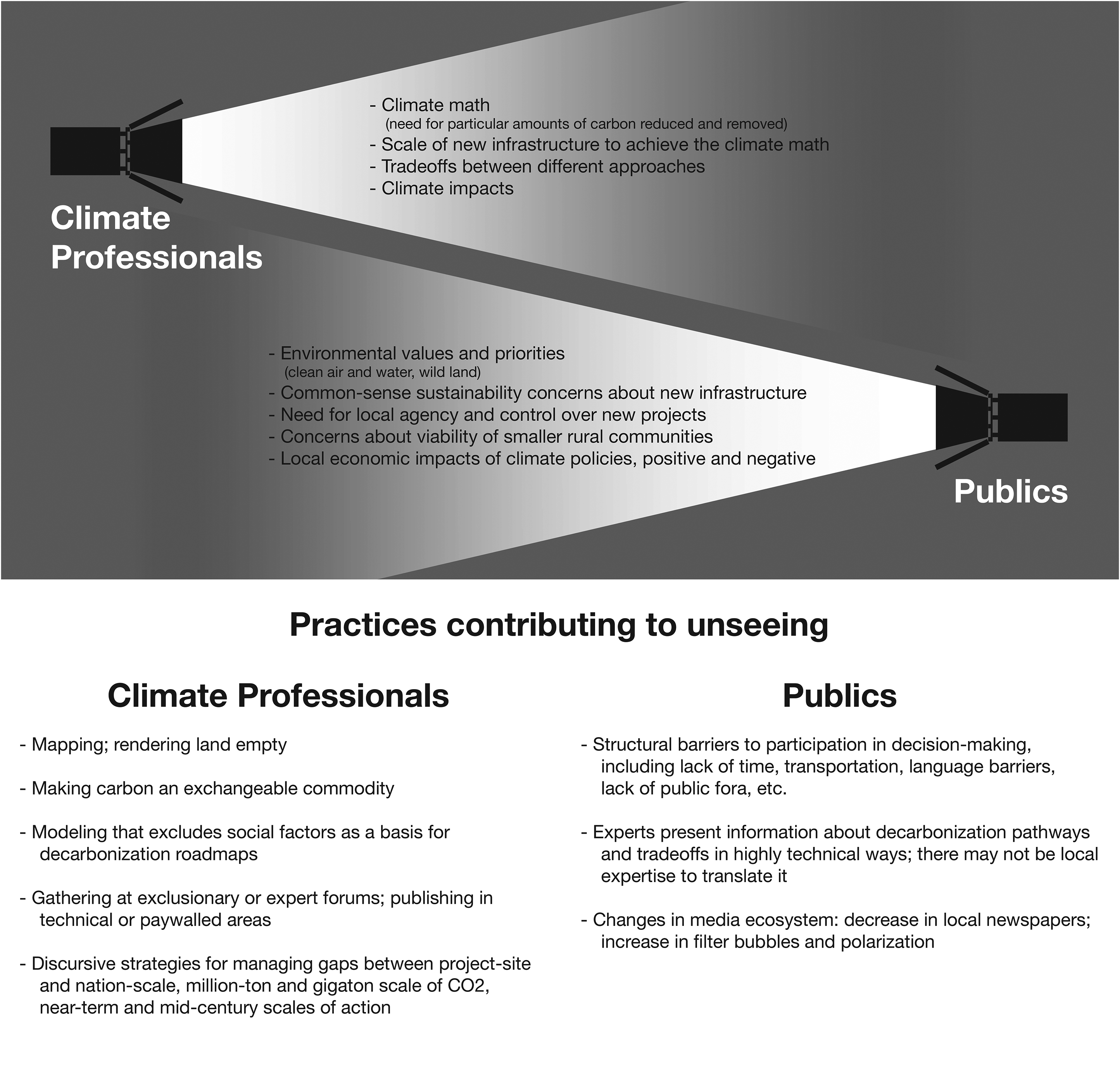
Elements of double unseeing.
The other side of the unseeing — the way publics on the ground do not see expert roadmaps, plans, and visions for the decarbonization project — is covered in literatures from science communication and public engagement. The deficit model (e.g. that people fail to act on climate change because they “just lack information”), is persistent (Cortessa, 2016), but has been rejected time and again (Cook and Zurita, 2019). The disalignment between scientists and publics can relate to values, as well as structural barriers and power differentials when it comes to meaningful public participation in decisions about land use or new technologies. But replacing the deficit model with a dialogic model of science communication may not work (Suldovsky, 2016), and the “promise of participation” often goes unrealized (Chilvers and Kearnes, 2016; Cook and Zurita, 2019). By referring to an “unseeing”, I am not simply suggesting that publics simply lack information about expert plans (though they often do), nor that the remedy is to inform them. What's missing is a dialogue about values, participation in decision-making about both new infrastructure and projects and broader climate strategy, and a real reckoning with how power shapes the choices at hand.
In what follows, I explore: What is driving the sociotechnical imaginary of circular carbon among experts, and how do they see its prospects? How do people living in the landscapes that are expected to provide carbon utilization and removal services understand their desirability and workability? First, we will cover some background on the concept, the technologies, and the actors involved.
The genesis of circular carbon
Circular carbon was rarely mentioned before 2017, and its use increased during 2019. Actors like the Circular Carbon Network (a non-profit initiative which is managed by the XPRIZE Foundation) and the venture catalyst firm Pure Energy Partners are using this language to describe a “modern industrial revolution”, one that is driven by the goal of the “reduction and drawdown of CO2 at scale” (CCN, 2020).
Circular carbon builds upon a decade and a half of earlier carbon capture, utilization and storage (CCUS) advocacy from a well-organized fossil fuel and industrial lobbying coalition. CCUS is a term which collapses not just several techniques, but several goals. The idea of the “U” in CCUS is that many products can be made by utilizing carbon dioxide, from chemicals to concrete to fuels — in fact, to fail to use it is to waste it. The “circular carbon economy” can be seen as an update to the CCUS discourse, one which enrolls a wider set of actors and which is in tune with the balance implied in net-zero targets.
Circular carbon's other antecedent is the broader idea of the circular economy. The circular economy is most frequently depicted as reduce, reuse and recycle activities, noted an analysis which examined 114 definitions (Kirchherr et al., 2017). It has roots in 1960s-era ecological and environmental economics, industrial ecology, and cradle-to-cradle product design. The circular economy's most recent incarnation comes from an awareness of scarcity and maximizing value in an age of resource depletion (Reike et al., 2018). Circularity resonates with biogeochemical cycles, and the effort to restore fluxes to their natural levels (Murray et al., 2017). Critiques of this broader circular economy discourse include its limited and fragile enactment, the way in which the idea of a perfect circle comes to be taken for reality (Gregson et al., 2015), and the way the future imaginary is removed from biophysical reality (Kovacic et al., 2020).
Competing circular carbon imaginaries
Which “circular carbon” will prevail: one guided by the fossil fuel industry, or one guided by imaginaries of the circular economy and balancing carbon cycles? There are many approaches to circular carbon under discussion, and some are shaped by the fossil fuel industry. One involves pairing carbon capture with enhanced oil recovery (CO2-EOR). Conventional oil production leaves 2/3 of the oil in a well underground, but a further 10–20% can be extracted by injecting carbon dioxide into the well, in a process known as enhanced oil recovery (CURC, 2018). CO2-EOR has been done in the US for fifty years, with over 6000 km of pipelines transporting CO2 to oil fields. Right now, 85% of the CO2 for EOR is mined from naturally occurring but depleting underground sources (McQueen et al., 2020). But if the CO2 for this process is captured directly from the air, this is conceptually a circle — albeit not a tightly closed-loop circle, but a circle that involves wandering molecules in the ambient atmosphere. There is also the option to inject more CO2 into the well than is necessary to extract the oil, in essence using it as a storage site; the resultant oil could then be described as “carbon neutral” or even “carbon negative” depending on the life cycle analysis (IEA, 2019).
However, advanced fuels with varying degrees of circularity or renewability may not require new extraction of oil and gas. Renewable gas and fuels can be made from hydrogen and CO2, using “power-to-x” technologies. “Power-to-liquids” describes bonding hydrogen with carbon dioxide to create combustible fuels; they would be relatively sustainable if the hydrogen is produced from electrolysis with renewable electricity. While hydrogen has already had a hype cycle in the 1990s (Hultman and Nordlund, 2013; Sovacool and Brossman, 2010), the urgency of IPCC predictions, investor nervousness in fossil fuels, the successes of climate action campaigns, and technological innovations all may be factors that make the hydrogen economy more real this time around. The notion of the hydrogen economy works in tandem with ideas of circular carbon, as they are both ways to articulate a mid-century or end-of-century future for industry and transport.
These varying imaginaries seem complementary at the moment, but they may eventually compete. On one hand, tech enthusiasts like Peter Diamandis suggest that circular carbon technologies like synthetic hydrocarbons will equalize fuel costs and liberate fossil fuels from geography: “Remote or oil-distant regions, which currently suffer high fuel prices given long-distance transit, will be able to source their own fuel, regardless of geography. And not only will DAC [direct air capture] fundamentally redefine geopolitics, but it will be an economic boon to nations like Australia, no longer in need of international oil shipments” (2019). On the other hand, it's clear that the umbrella concept of circular carbon has the promise of extending fossil fuel production into the foreseeable future — at least for some decades — as well as allowing fossil fuel companies to retain a central role in the energy landscape. Meanwhile, most of these technologies are virtually unknown to publics. While circular carbon is a sociotechnical imaginary (see Jasanoff and Kim, 2009) right now, if various circular carbon approaches are developed, they will involve production in particular landscapes.
Political ecologies of circular carbon
What do theories from political ecology and critical geography suggest for understanding the contradictions, demands, and motives of circular carbon? It is easy to see circular carbon as one more instance of an attempt at reform-oriented ecological modernization (Mol and Sonnenfeld, 2000), green capitalism, and “planetary improvement” (Goldstein, 2018). The “work” circular carbon is doing can also be read as a tactic of delay (Carton, 2019) whose performance is serving useful functions for the fossil fuel industry: the need to maintain social legitimacy, the need to reassure nervous investors when divestment is a demand, the need to retain talent in an era where people might not want to work in the fossil fuel industry, and the opportunity to have a competitive advantage in lower CO2-intensity fuels and distinguish one's company in the market.
Circular carbon is a further step in the production of nature. As Smith (2007) describes, a range of “ecological commodities” came online in the 1980s and 1990s, which owe their existence to the success of the environmental movement; regulation created a scarcity of “allowable natural destruction”, leading to the development of new markets in ecological goods as well as “bads.” Those hoping to develop an industry in CCUS need for this to be repeated at a much larger scale — the commodification and financialization of nature “all the way down” even further. Circular carbon, and valuing waste CO2, could be a driver of making carbon into a commodity, or it could be a corollary of it; either way, the circular carbon framework is set to extend “accumulation by decarbonization” (see Bumpus and Liverman, 2008).
Circular carbon is also what Birch et al., call a “techno-knowledge fix”, with “new institutional, societal and policy frameworks in order to ensure the expected flow of potential products that new technologies promise” (2010: 2904). New forms of life cycle assessment, regulation, and data are needed to actualize the promises. The state has a role in coordinating and delivering these new frameworks. Importantly, the socioecological fix (Carton, 2019; McCarthy, 2015) here is not just about circular carbon, but renewables, which the state had a role in delivering — a role which is imagined to be reprised for CCUS. Cheap renewables helped unlock the circular carbon imaginary. Up until now, CO2 utilization had been unattractive due to the low energy level of the CO2 molecule. But catalysis research during the 2010s demonstrated chemical reactions in which CO2 can partially replace crude oil in chemical production (Aresta et al., 2013; Bruhn et al., 2016). These advances joined with the development of renewables to make things like power-to-liquids and green hydrogen seem viable. Jason Moore talks about how “cheap is a strategy, a practice, a violence that mobilizes all kinds of work—human and animal, botanical and geological—with as little compensation as possible”; cheapness as a set of strategies to manage relations between capitalism and the web of life by temporarily fixing capitalism's crises (2017: 22). Cheap renewables are perhaps then a way of appropriating extra sunlight for the use or benefit of fossil capital.
Looking at the theoretical literature, one could conclude: this next move for fossil capital will never work, because it's too expensive and against the logics of capital. Capital, with the aid of the state, attempts to exert control over the conditions of production (O’Connor, 1998: 168), with more planning, and more regulation. But it needs the people to pay for this. Recycling carbon is an unproductive expense. As McKinsey analysts write, “Storing CO2 at scale is a pure cost, and related investments have (understandably) been limited” (Biniek et al., 2020). Who will pay for both the creation of substitutes for fuels in carbon production (synthetic fuels) and the wider repair of the conditions of production (e.g. the “pure cost” of carbon removal for climate stability)? The latter work is so immense that a neoliberal state would be unable to broker such a fix. Whether it is too immense for a Keynesian state to broker a fix is actually a matter of debate, and may hinge on technological improvements in direct air capture as well as public support for this sort of project.
However, in the US context at least, the state is poised to mobilize at least some of the technologies and frameworks needed to begin creating a circular carbon economy. Instruments like the 45Q tax credit, which pays $50 per ton of carbon dioxide storage and $35 per ton for carbon dioxide utilized for enhanced oil recovery, have been stacked with California's Low Carbon Fuel Standard to make new projects economical. The “covidbus” budget/relief legislation passed at the end of 2020 contained an Energy Act which funded demonstration direct air capture and carbon capture projects, and legislation like the recently re-introduced Storing CO2 and Lowering Emissions (SCALE) Act would support financing for new CO2 pipelines. In short, there are initial promises of state support for sociotechnical imaginaries of carbon management and circular carbon. Carbon professionals — scientists and experts working in policy, academia, NGOs, industry, and philanthropy — have been instrumental in mobilizing these early promises.
How experts see the development of CCUS
Carbon professionals have a common solution set for developing CCUS: implement regulations, support research and development, enable infrastructure, plus a variety of things within the basket of “creating a business model.” This section is largely based upon analysis of reports and scientific assessments, and supported by eight semi-structured interviews with CCUS experts, conducted over phone or video chat from August of 2019 to May of 2020 (see Appendix). These interviewees were selected based upon products they had authored relating to the development of CCUS, and represent a mainstream set of perspectives within the policy community that works on this topic.
Roles for government: Policies on the table
Governments are clearly imagined to play a central role in enabling circular carbon: as one respondent said, “I think about the fact that 70% of investment in the energy transition will either be directed by government or the direct result of government policy. I think their commitment is essential” (E8). First, regulations for life cycle assessment, monitoring, and safety are seen as things that the government needs to provide. In a sense, circularity is a property that the government has the role of constructing. This is the case for both EOR and biofuels with CCS. “We don’t have perfect science or perfect regulations around ensuring that EOR delivers climate benefits,” noted one respondent (E6). Regulations are also needed around safety when it comes to geological injection of CO2. Right now, permitting CO2 injection in the US takes years, which is a major barrier to development. As one respondent pointed out, “then on the flip side, if the public doesn’t have confidence in the safety of these sites, public resistance will also be a challenge. So if there's some way to standardize across them … we need to be able to quickly site and permit projects, while not sacrificing environmental integrity” (E7). In short, the government is needed to supply the structure in which the efforts can be seen as legitimate, sustainable, and safe.
Second, the state is imagined to provide support for “the full R&D pipeline”, from basic R&D through demonstration and deployment, because investors are often unwilling to. “For example, we’ve heard ‘Yeah, like we’re definitely interested in the new carbon capture technologies, but we don’t want to be the first person to buy it. We don’t want to be fifth person to buy it. We want to be the 10th or 20th person to buy it, so we know that technology works’” (E7). A respondent explained the financing challenge with reference to renewables: “You can have 1000 solar panels, but every CCS product is different,” which is hard for the financial community to understand (E8).
Third, the government also has a role in developing carbon dioxide pipelines. One respondent commented that there needs to be longterm planning on the federal level to design these projects so that they can accommodate growth. “If all you do is build a pipeline at an appropriate size for the sources of CO2 that are ready to go on day one, you’ll build it too small. And it’ll be too much expensive to go back later and add capacity. So it's really critical that we size the pipeline appropriately” (E2). The pipelines have to aggregate many different sources, and so require commitment from both multiple actors and publics.
Finally, the main thing experts point to for supporting CCUS is summed up in three words “value on carbon.” Whether this is a price, a tax, an incentive, etc., is often a bit vague. For a real implementation of CCUS, “you really need a value on carbon that reflects the externalities of pollution to make the business case” (E2), said one respondent, whose view is widely shared (E4, E8). In the US, the 45Q tax credit is seen to be a progressive incentive, but not enough on its own. As one respondent said, it needs “not just one tax credit, but a true policy portfolio like wind and solar already enjoy. … we have to compress the timeframe dramatically, so we have to implement all of these policies that we kind of now take for granted with wind and solar” (E1). Importantly, experts seem to agree that the key obstacles to scaling up CCUS are not technological — rather, the challenge is creating a business model for it through public policy. But where does that price come from? Goldman Sachs writes that “The importance of DACCS lies in its potential to be almost infinitely scalable and standardizable, therefore potentially setting the price of carbon in a net zero emission scenario” (2019). In short, the price of carbon would be equal to how much it costs to remove it with direct air capture. But while the technology determines the price, regulation is still needed to compel its use.
Policies not on the table
Both reports and interviewees widely acknowledge that the status quo of what governments are doing is not enough. The current context is: global CO2 emissions are about 50 Gt/CO2 equivalent per year, and global world energy consumption is edging close to 600 EJ, with renewables providing about 30 EJ (BP, 2020). Now, even if greenhouse gas emissions are slashed by 80% by 2050, about 10 Gt of CO2 per year would need to be sequestered from 2050 onwards to stay below 2 °C, according to a study by Creutzig et al. (2019), which is fairly representative of the wider literature and discourse. They cite estimates that it would require 100 exajoules (EJ) per year to remove 10–20 Gt of CO2, and that the costs would be between $100–300 ton for removal. Another paper examines a later target and larger scope of removals — 30 Gt of CO2 per year by 2100 — which would require 50EJ / year of electricity and 250 EJ/ year of heat, with costs of $50–350 per ton removed (Realmonte et al., 2019).
In other words, these estimates are describing a global carbon removal system in midcentury or end-of-century that (a) requires somewhere between a sixth and a half of today's world energy production to run (or between three and ten times our current renewable energy production just for the carbon removals), and (b) costs the world one to nine trillion dollars per year. These figures are on the high end. But they make it clear that politicians need to be more ambitious about electrification, alternative transportation fuels, and decarbonizing fertilizer so that there are less residual emissions and less carbon removals needed to compensate for them. The scale of effort and regulation involved to create the conditions for both reliable circular carbon and large-scale carbon removal — according to the numbers above — is so vast, in my view, that advocates of CCUS would have to champion a Green New Deal-type policy environment in order to see these roadmaps actualized. Either the state would need to pay directly for billions of tons of CO2 to be permanently sequestered — with costs likely ranging into the hundreds of billions — or emitters would need to be forced to pay to sequester CO2 to compensate for their own emissions, burdening industry and business, and probably consumers.
The politics of that Green New Deal policy environment would probably not be conducive to a central role for the fossil fuel industry. If the political conditions are right for massive public outlays for carbon clean-up, or for levying a carbon takeback obligation or other new fee on polluters, those same progressive political conditions do not accommodate a strong role for the fossil fuel industry in shaping these arrangements. This is a paradox. Some respondents may simply conclude that reaching these scales is not possible: as one said, “I think we’re still nowhere where we need to be in terms of government funding, private capital funding, governance structures to actually see these things scale. It's certainly not a foregone conclusion that we’ll scale carbon removal to the levels necessary to meet climate goals” (E3).
Rather than say scaling carbon removal is politically or socially impossible, experts may rather abstain from spelling out what could be required to achieve the level of investment and infrastructure they detail. More directed roles for government are typically not mentioned in the mainstream CCUS literature. These might include things like a “carbon takeback” obligation for fossil fuels producers or importers (Jenkins et al., 2020), supply-side measures to phase out fossil fuel production (Le Billion and Kristoffersen, 2020), or the nationalization of fossil fuel companies and directed transformation of them to carbon management companies. One notable exception in the literature is a report by the Rhodium Group, which casually suggests that the US could choose direct public funding for carbon removal, and charter a new Carbon Removal Administration that would have funding to remove a specific amount each year (Larson et al., 2019).
A standpoint of “realism” when considering the role and future of the fossil fuel industry is a constraint here. Until there is a climate policy with a serious business model for carbon removal, the oil and gas industry is the only sector that can pay for the innovation, cost reductions, commercialization and deployment that has to happen to pave the way for large scale carbon removal, one respondent explained (E1). The oil and gas sector is in a unique position, because of their capital and engineering know-how: “The reality is that we have to take vast volumes of CO2 and be storing them permanently and safely in the subsurface. And there is no other industry in the world beyond the oil and gas industry that has that subsurface expertise” (E1).
Interestingly, part of this narrative includes the limitations and failures of renewables, even as the cheapness and success and scalability of renewables underpins hopes for CCUS. On one hand, cheap renewables make the case for circular carbon in an argumentative sense: wind and solar have decreased in cost by 70% and 90% respectively since 2009, and provide a replicable model for carbon removal technologies (House Select Committee, 2020). Yet, renewables have not been able to keep up with growth in demand. One respondent pointed out how the proportion of renewables in the global energy system has “hardly budged” relative to fossil energy, despite their rapid growth, meaning that “the reality in the world's energy system” is “that we have to decarbonize fossil energy production, not just ramp up renewable energy and efficiency” (E1).
Strategies for managing the disconnect between conventional policies and what's needed
A kind of spatial and temporal openness underpins the ability to talk about CCUS at the gigaton scale. There is a temporal goal — net-zero by 2050, in many cases — but the social imaginary doesn’t need to spell out the policies to 2050, just the near-term. There is a spatial goal — a certain range of gigatons of carbon to be removed, to be realized by the nation as a whole — but it is not yet fully mapped to particular places. There are quiet gaps between the project site and the nation-scale, the million-ton and the gigaton scale, and the near-term and mid-century temporal scales. These gaps all help make the imaginary work, and facilitate the unseeing of the political transformation required.
One way to cope with the tremendous needs and limited policy menu is to narrow the timeframe of the discussion to near-term actions, such as R&D. This shorter timeframe also works with the time horizons of both policymakers and investors. The logic is that recycling or utilizing CO2 could help finance the first generation of technologies, which would bring down the cost curve in order to move to less profitable forms of storage or utilization — and it doesn’t matter so much how the first capture projects are financed. In particular, the timeframe issue is dealt with using the metaphor of bridges, including blue hydrogen, CCUS broadly, and EOR. One argument for using EOR as a bridge is that publics in some oil and gas producing areas might actually prefer CO2-EOR to storage projects, because it's seen to convey a local economic benefit while just storing it would be an expense, and because it can be construed as safer as it leaves the pressure the way it was when the oil was discovered (E5).
Portfolio talk is another way to avoid confronting the scalar disconnect, and it has the advantage of being able to enroll a disparate coalition of supporters. CCUS advocates often talk about “not picking a winner”, having a “technology neutral” portfolio, creating “policies and incentives that put [carbon removal technologies] on equal footing” (E5), etc., because there are still so many social and environmental unknowns. This sense of openness and innovation also functions as a strategy for not having to draw clear pathways to midcentury: as one person said, “I think it's too soon to be picking one versus the other, or incentivizing some and not incentivizing others.” (E3). Part of techno-optimism isn’t about optimism regarding the technologies at all, but optimism regarding the promises of creativity and collaboration. As another respondent said, “there's not a lot of this that's a crazy moonshot technology challenge. It's a social organizing question. And that includes policy, you’ve got to get the policy passed. But I think we have shown that this is politically compelling, that you can get all these different industries to work together” (E2).
These generalizations about the ways carbon professionals in the US approach the policy needs for scaling up circular carbon have an important exception, which are regional imaginaries, such as the imaginaries of CCUS in California. A number of reports spell out how CCUS and engineered carbon removal could be employed in California, e.g. from the Energy Futures Initiative and Stanford (2020), Lawrence Livermore National Labs (Baker et al., 2020), and law schools at Berkeley and UCLA (Elkind et al., 2020). Much of this research and analysis positions California as having the ability to lead the nation by example when it comes to circular carbon. In these reports, climate professionals also incorporate public support as a factor, e.g. recommending community dialogues and environmental justice mappings (Elkind et al., 2020), and the participation of affected communities in decision-making (EFI, 2020). The state-level spatial scale of analysis forces broader consideration of publics and their visions and goals as part of reaching the scale required for net-zero. Regional and state-level policy actors, with their regional scale of analysis and associated regional networks, may offer a pathway for bringing social considerations and priorities into the roadmaps for circular carbon at scale, and an opening for energy democracy.
Views from people in the landscape
Conceptually, the circular carbon economy promises opportunities — but for whom? How do people living in the landscapes that a circular carbon economy would touch see the opportunities?
To begin to get at this question, I conducted semi-structured interviews in communities along a potential CO2 pipeline route, in an experimental method one could call a “social transect”, in July and August 2019. The route was based upon a hypothetical CO2 trunk line that would convey CO2 from ethanol and other power facilities in the upper Midwest to Texas's Permian basin, where it would be used for EOR. Analysts in academia and think tanks have studied various configurations of such a pipeline because recent policy could make such a pipeline network profitable (Abramson et al., 2020; Edwards and Celia, 2018). The method for selecting interview respondents was to use GIS to randomly select points along this pipeline, within a zone of a five mile buffer on either side of the pipeline, and at least twenty miles apart from each other (see Figure 2). I then attempted to contact the resident closest to each point. If the resident declined or was not home, I would then move to the next house; in some cases, residents declined an interview but referred me to someone else in their community whom they thought would be a good respondent. I took up these recommendations because people have good intuitions about who in their community would be interested in participating in such an interview, and thus ended up interviewing a few different people in the community. In other cases, there were no publicly accessible lands in the vicinity of the point. The final set thus consisted of 21 interviews in 17 communities (see Appendix). Interviews involved (1) general questions about what is important to people about their community and their landscape, what challenges they are facing, how they expect it to change in the next thirty years, what new industries or careers they might like to see, and (2) questions about familiarity, interest, and concerns with carbon farming, biofuels, carbon capture and storage, and carbon removal as a goal. Questions were asked depending on the flow of the interview and interest of the respondent, so not every respondent was asked every question.
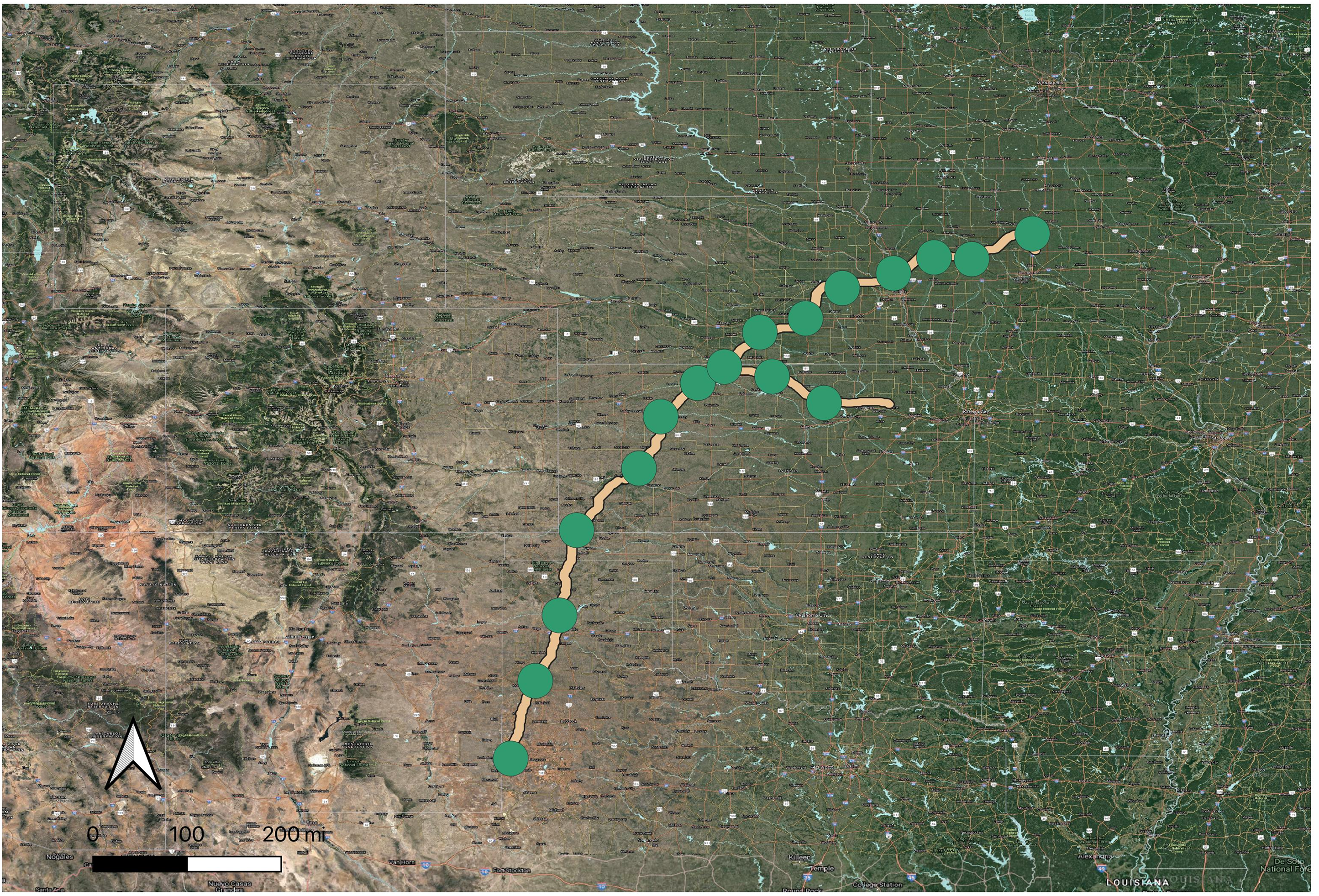
Map of interview sites.
Clearly a social transect such as this cannot “represent” concerns or ideas from publics in such a wide area; the aim here was to surface a diversity of perspectives that may not have been surfaced if the method was simply contacting pre-defined stakeholders. The method shares the limitations of rapid rural appraisal methods, in terms of not being representative, as well as the risks of quick appraisal — seeing things and activities but not relationships; catching a snapshot rather than a trend (Chambers, 1981). Further limitations of this particular experiment include that conversations were conducted only in English, and that studies conducted door-to-door are biased towards who tends to be at home and feels comfortable opening the door. However, the value of the approach is the ability to hear situated perspectives from inside the landscape which may not otherwise be heard. This can be a check against assuming who is an important “stakeholder”, as is often done in public engagement around new infrastructure. What follows represents initial points of departure and provocations on a topic that currently has very little empirical social science research. These conversations suggest at least three important observations that are currently missing from expert discussions on circular carbon.
Common-sense sustainability knowledge
The first is the widespread prevalence of what I’ll call “common-sense sustainability knowledge”, grounded in real-world experience. People who have been living with the rapid growth of renewables have acquired local knowledge about them. This knowledge may not be considered traditional or ecological, but rather a kind of settler techno-ecological knowledge that comes from farming, working, and living in the region. You don’t need to be a credentialed expert to spot sustainability problems with the status quo, or with new technological approaches. While not expressed with the language of “sustainability”, some of the sustainability concerns related to depletion, like the finitude of oil and gas; the sustainability of water resources was a key concern in the Texas panhandle and southwestern Kansas. As one respondent said, “I hope we have enough water to continue living here… I just keep saying, it will be six years until our kids are out of school, if the water will just last six years… I think we will eventually run out of water and we’ll foreclose on our home and be forced to move somewhere else” (R2). Another respondent in southwest Kansas stated, “Corn is an unsustainable crop. It's not meant to be grown out here. It takes a lot of water” (R7).
People also gauged new technologies on sustainability and life cycle criteria. Many people debated the efficiency of wind turbines. I spoke with a former railroad worker who used to run freight trains loaded with wind turbine parts that had been shipped from Vietnam; he questioned the carbon footprint of the supply chain. One respondent, who worked in an ethanol plant for two years, noted that it was zero waste, with all water re-used (R16). But ethanol was similarly debated: one farmer stated that “I’m not for ethanol – you lose energy. It's a net loss. From an efficiency standpoint, it's foolish” (R6). That same respondent lamented a cellulosic biorefinery that opened with much hype and closed without producing anything: “I told them that they shouldn’t have built it” (R6). Here, and also often with regards to companies introducing new methodologies for measuring soil carbon sequestration, respondents sometimes express ambivalent feelings about the expertise of outsiders and whether their technologies would do what they were sold as doing.
That people in working landscapes will have insights into the sustainability of green technologies may seem so obvious that reporting it could be conceived as elitist or insulting. But I note it here because these types of local knowledge are largely absent from CCUS expert discourse (as are the publics themselves, most of the time). These local knowledges seem to also be forgotten in the eyes of many climate advocates. Both climate champions and CCUS experts tend to render publics in the central, rural US as in need of education, or as obstacles to climate action. But the specific publics who live in these places may be far more literate in sustainability concepts than is assumed, and they may have transferable knowledge from domains in which they work. All of this suggests that life cycle analyses of circular carbon projects may meet both significant interest and critique when deployed, and not just from experts or activists in cities. Common sense sustainability expertise could improve project outcomes, and should be seen as a resource.
People also had a range of opinions about environmental action without “believing in” climate change. One respondent who suggested that volcanoes under the ocean were heating the climate was “all for alternative energy” such as solar panels (R6). Many respondents, though not all, expressed skepticism around anthropogenic global warming, and some of those who did were not sure how to personally address it. One respondent related seeing images on social media of climate change: “It's a little nerve wracking, a little scary, what the future holds. So, you’ll see something scary like the Amazon fires, for example, of how we didn’t know about them for three weeks. And then here, people are just, okay, what are we going to do about it? We can’t do anything” (R21). Both the sense of disconnection with climate action, as well as skepticism about anthropogenic causes of warming, suggests that climate math is not a useful starting point for talking about carbon removal. Again, this sounds obvious, but it is worth noting explicitly because climate math is almost always the starting point for expert discussions.
Circular carbon industries in the context of rural population decline
One overarching question hovering over the future of many of these communities is whether there will be a population base to sustain the social infrastructure, chiefly schools, but also investment in health care facilities, newspapers, etc. As one respondent said, “They talk about the brain drain. It's legit. It is a legit concern. We have fewer mom and pop farmers, farms and more corporate farms. We still have the same number of acres in agriculture, but we have fewer farmers farming those acres, because it's so difficult for a family if there's several kids and it's not enough to support several kids like it used to be. $3 corn is not a good income” (R13). Farmers go into debt, are affected by things like flooding and tariffs, go bankrupt, big corporations come to buy up the land, and the kids have to go find a job in more populated cities or states (R13). In at least one community, the concern was about lack of jobs with fossil fuel plant retirement – “without those [coal and gas plants] there would really be no jobs, we would lose the school and it’d kind of be a ghost town around here” (R2).
Points of optimism include new opportunities created by new internet infrastructure. In some areas, such as central Iowa, respondents were thinking of the land and tourism as an asset and future prospect. As one respondent said, “We had a seed corn processing plant here and when they left our community it left a void. So a lot of our community members feel like there should be some sort of a major employer return to our community. What do I want to see? I want to see more variety of businesses that would offer job opportunities to a broader audience” (R19). The kind of jobs that are available, and who they are for, matter — many spoke of jobs in IT that could be done from here. One respondent lamented that recent jobs, such as service / restaurant jobs, were for women and that there was a lack of jobs for men (R9).
Up until now, discussions of circular carbon or carbon removal have rarely been held in connection with concerns about rural depopulation. However, there is a new focus on jobs in the literature, so this may be changing: the Global CCS Institute now considers CCS in the context of a “just and sustainable transition for communities” (Townsend et al., 2020), philanthropists have been commissioning reports on jobs in direct air capture (Larsen et al., 2020), and new policy briefs are explaining carbon capture as a high wage job creator, with estimates of 70,000 to 100,000 construction jobs and 30,000–40,000 facility jobs by 2050 (CCC, 2020). Experience with renewables has set a precedent for a general welcome for projects having to do with clean energy, with some caveats. Many people I spoke with viewed wind farms as attractive options for community income — as one respondent said, “somebody is using their head” to bring in wind farms (R9). Ethanol has employed a lot of people, and has fairly good profits, though it “wasn’t an easy sell,” the respondent noted, and people were skeptical until they got used to it (R9). There are of course complaints about overreach or bloated subsidies for troubled projects, but on-balance positive experience with renewables and the widespread interest in new jobs to balance population declines may lead some communities to be interested circular carbon projects, depending on the conditions. This is something that requires much more research. But on the ground, communities may well see circular carbon as an extension of renewables, even while expert discussions often treat CCUS as a distinct pillar of climate response.
Pipelines: where do the benefits flow?
At the same time, there will likely be challenges for large-scale infrastructure that fails to offer community benefit, with the most striking example being CO2 transport infrastructure. Several respondents pointed out that pipelines don’t create a lot of jobs. One respondent involved in local job creation in Kansas pointed out that the state always says that road projects will stimulate the economy, but they don’t provide local jobs, because they bring in outsiders: “The stimulating of the economy comes when those people stay in the community” (R10). Another noted, “It would probably just depend on the people. If it went beside the existing pipeline, it probably won’t be as big of a deal, because it wouldn’t tear up as much” (R4). A third explained, “I think pipeline alone is just a scary word for people because whenever you hear about pipeline in the news or anything, it's always a bad thing. And you always hear about people protesting it. So I’m not quite sure … If it helped farmers, maybe then they would be more open to it. But, I think everyone would still be skeptical and a little reserved about that” (R21). There were also safety concerns about water and contamination of fields, because livelihoods rely on these.
People also posed questions about the overall goal of CO2 transport infrastructure, and CO2-EOR. “What problems are we fixing? Are we fixing the big oil industry?” one respondent asked, noting that “If we’re wanting to help the world, help the Earth, help the environment, I would tend to say let's do these things that are more natural… if the end result is going to the oil company to produce more oil, that doesn’t make sense to me” (R10). Whether people judge these projects more upon local impacts or on broader climate goals is an unresolved question in the social science literature; a recent study by Cox et al. (2020) found that focus group participants in the US and UK saw carbon dioxide removal as a “non-transition”, and reflected the idea that it does not represent people's vision for a sustainable future society.
One respondent who had experience with the Keystone XL pipeline explained that her concerns with the oil pipeline were initially sparked by a foreign corporation running a pipeline through the US to foreign markets, and that this was a starting point for thinking about a carbon pipeline, too (R13). At the same time, if the carbon pipeline was “275 feet from the side of my house, that would be a different breed of cat. That, I would really probably look into a little bit differently.” This respondent echoed very specific concerns with pipelines, including what happens at the end of the lifetime, monitoring and liability, etc., with the recommendation: “I would encourage anyone who's thinking about building a pipeline for something like this and touting it as green energy and helping with the environment and that kind of thing, so they would look at how oil pipelines do business and not do that. You know what I mean?” But this respondent was still open to the possibilities of “doing it green”, building green infrastructure, because of climate concerns: “We need to put the brakes on exactly what's happening in the world today. And if it could be done with someone … Just Tom Steyer as opposed to Donald Trump or Rex Tillerson. You know what I mean? If we could keep it green, that would be fabulous, if there's a choice. Is there a choice?” (R13).
Conclusion: Towards circular carbon systems that valorize grounded viewpoints
The insights offered in the latter part of this paper — that people have common-sense sustainability knowledge and environmental values, even if they’re not concerned about anthropogenic global warming; that rural population decline and livelihoods are widespread concerns; that pipelines may not be welcomed even in conservative-voting areas seeking economic growth — may seem obvious. Yet they offer critical starting points for thinking about the prospects of circular carbon industries and large-scale carbon removal infrastructure, which, as experts identify, require strong policy support — including from people living with and financing this infrastructure. Carbon professionals have not yet adequately put their roadmaps in conversation with what people are concerned about, in terms of language, epistemology, values, or policy choices. Whereas in other areas nongovernmental and climate advocacy organizations have done translational work between experts and laypeople, in the case of circular carbon, that rarely happens.
The disconnect between experts and laypeople means circular carbon will run into opposition that is likely to ultimately quash its development. First, there will be opposition to new infrastructure on the ground. Groups like the Nebraska chapter of the Sierra Club are organizing against newly proposed CO2 pipelines in Nebraska and Iowa (Hammel, 2021), and farmers and landowners are weighing in with concerns (Rossman, 2021). When it comes to actually building circular carbon infrastructure, in many places there will be resistance, unless something radically shifts from the status quo. Ironically, this may benefit fossil fuel companies, many of whom don’t want to actually go through the trouble of managing carbon and who can then point to these efforts and say, “Well, we tried.”
One might think that recent concern in the Trump and post-Trump era around rural decline and rural populism (Edelman, 2021), the politics of resentment around green sacrifice zones (Brock et al., 2021), and the deflation of expertise (Ialenti, 2020) would lead experts to engage more with publics who live and work in the areas expected to provide renewable energy and carbon sequestration. But perhaps this concern has led instead to disengagement? Perhaps there is something comforting about terra nullius technocratic visions of clean infrastructure or decarbonized fossil fuels when confronted with images of Q-Anon supporters. Yet one endpoint of evacuating the social is a concession that deep decarbonization is incompatible with democracy. How can the state deploy the capital and the land resources required for this scale of transformation if the people are not supportive? Is this scale of infrastructure — not just for carbon removal, or decarbonized fossil fuels, but merely for renewables — compatible with democracy? This is not clear. But it seems fair to say that democratic and climate-positive outcomes would be more likely if carbon professionals and publics understood each others’ visions.
To transcend this double unseeing, we should avoid thinking of it in a way that reinforces a binary between experts and people in working landscapes. The research here shows that there is an opportunity to better recognize the contributions that people on the ground could make. Kai Bosworth, in research on how opponents to oil pipelines have formed counterexpertise, suggests that “climate denial and postpolitical governance might be more effectively challenged if scientific and expert practices are not understood to be modes of depoliticization opposed to local experience”, and illustrates how “the split is not between elite knowledge and local or lay experience, but between a science in the interests of the state and capital and a minor science—what we might call a science for the people” (2019). In other words, applying his point towards this study, the potential fractures when it comes to circular carbon are not between “experts” who have technocratic visions and lay people who lack visions, but between particular forms of science mobilized for different interests. This points to the question of how to mobilize forms of circular carbon that aren’t narrowly in service of fossil capital and provide public benefit.
Paradoxically, the current conceptualizations of energy democracy may be a limitation to it. Energy democracy, as defined by scholars like Burke and Stephens (2017), is about advancing the renewable energy transition in a way that is linked with social justice and economic equity, with its roots in resisting fossil fuel infrastructure. Much of the scholarship is focused on ownership of control of energy generating technologies (van Veelen and van der Horst, 2018), centering on the electricity grid and decentralized renewables (Szulecki and Overland, 2020). Indeed, advancing small-scale, decentralized systems and renewables may be what the energy democracy movement is about in practice. However, does energy democracy as a concept have room for circular carbon, if that is what people decide they want?
Current discourse precludes the question of what sort of circular carbon system might be desired or beneficial, because right now, the actually-existing stand-in for energy democracy involves voting yes/no on particular configurations of circular carbon that fossil fuel companies or other powerful actors have already imagined. The energy democracy movement's roots in resistance are a source of mobilization, but also may be limiting in actualizing energy democracy, if time and attention is spent on resistance with no time left for creating alternatives. For example, in Iowa, public hearings in every county are a required part of applying for permits for CO2 pipelines from the Iowa Utilities Board. That's good, but weighing in on some company's pipeline plan is not the same thing as generating a locally appropriate vision of what a circular carbon system with real benefits would be like. For example, we can imagine community benefit agreements for circular carbon projects, community direction and planning of CO2 transport infrastructure, and public ownership of infrastructure. In other words, grassroots mobilization against these CO2 pipelines and showing up at public hearings is important, but may not necessarily give people more agency at the end of the day. It may prevent fossil fuel interests from promoting forms of lower-carbon fuels and greenwashing, but it may also preclude the development of technologies that could be an important part of cleaning up carbon dioxide in the atmosphere. There is no way to definitively assess the likelihoods of these possibilities except in retrospect. What we can say is that the act of resisting already-developed visions is a weak form of energy democracy compared to one in which communities actually develop and articulate their own visions for their energy and carbon futures.
There are a few actors and approaches that could make progress in forwarding alternative ideas of circular carbon. Labor unions are one — unions such as the International Brotherhood of Electrical Workers, the United Steel Workers and the Utility Workers Union of America are members of the Carbon Capture Coalition and have been active in shaping political roadmaps for CCUS, though this hasn’t been without controversy. Institutions that work on regional scales also have a critical role, as examples from California and other states point to. Experts need to learn to recognize common-sense sustainability expertise, and offer people access to tools so that communities in these working landscapes can establish alternative visions that are also grounded in what is feasible when it comes to geology, engineering, hydrology and so on, and better appraise tradeoffs when it comes to energy transition and climate change. If energy consumers are going to be “prosumers”, innovators, designers and analysts who are involved in decisions from production through use (Burke and Stephens, 2017; Szulecki and Overland, 2018), they will need technical expertise.
There's a paradox involving the role of government here. On one hand, the government is ideally suited to advance energy democracy, in terms of creating and funding forums and structures in which deliberation and collaborative decisions can happen. On the other hand, our current democracy, degraded by decades of neoliberalism, seems inadequate for the building and permitting of new infrastructure needed for the decarbonization challenge, as well as the social innovation needed to ameliorate double unseeing. This applies to circular carbon, but more importantly, to new renewable installations and the transmission lines needed to connect them. We won’t begin to approach decarbonization goals without increasing the involvement of communities in decarbonization and making sure the benefits flow to communities hosting new energy infrastructure. It is in the interest of both experts and governments to invest in forms of dissolving the double unseeing — whether those be fora for public deliberations, new platforms, or new institutions. The social infrastructure is as critical, if not more, than the physical infrastructure at this juncture.
Highlights
The oil and gas industry is dealing with pressure to decarbonize by conceptualizing a circular carbon economy.
Scaling circular carbon up to levels implied by climate targets hinges on cheap renewables and will require state intervention.
Interviews were conducted with experts and people living along a prospective carbon dioxide pipeline in the central US.
While experts have created roadmaps for circular carbon, people know little about these technologies and their implications.
Expertise from local people in working landscapes will be important in formulating alternative approaches to circular carbon.
Supplemental Material
sj-docx-1-ene-10.1177_25148486211061452 - Supplemental material for Mining the air: Political ecologies of the circular carbon economy
Supplemental material, sj-docx-1-ene-10.1177_25148486211061452 for Mining the air: Political ecologies of the circular carbon economy by Holly Jean Buck in Environment and Planning E: Nature and Space
Footnotes
Acknowledgement
Many thanks to the respondents who took time to speak with me.
Declaration of conflicting interests
The author(s) declared no potential conflicts of interest with respect to the research, authorship, and/or publication of this article.
Funding
The author(s) disclosed receipt of the following financial support for the research, authorship, and/or publication of this article: This work was supported by the Svenska Forskningsrådet Formas (grant number 2019-01953).

Supplemental material
Supplemental material for this article is available online.
References
Supplementary Material
Please find the following supplemental material available below.
For Open Access articles published under a Creative Commons License, all supplemental material carries the same license as the article it is associated with.
For non-Open Access articles published, all supplemental material carries a non-exclusive license, and permission requests for re-use of supplemental material or any part of supplemental material shall be sent directly to the copyright owner as specified in the copyright notice associated with the article.
