




Abstract
This paper seeks to answer the question: how does land become grabbable and local people relocatable? It focuses on the historical and current conditions of land tenure that enable land grabbing. While recognising the important contributions thus far made by the critical literature on land grabbing, this paper moves forward towards understanding specific processes that befall before land is grabbed and its original users relocated. Based on an empirical analysis of policy and practices of the Ngorongoro Conservation Area in Tanzania, the paper proposes that land grabbing, particularly in the context of conservation in rural Africa, is not an instantaneous phenomenon and does not happen in a vacuum. It is a result of long-term structural marginalisation of rural land users that produces scarcity and the deterioration of life conditions, which make people relocatable and land grabbing justifiable. Local people either relocate themselves because they could not make a living due to systematic disinvestments on basic social services or life is made unbearable through restrictions imposed on their production practices to make “voluntary” relocation possible. The paper highlights the need to focus on the stealthy dispossessions in addition to major events of grabbing as starting points of analysis. Insight from this study can be useful in analysing other cases of land grabbing where large swathes of ostensibly empty land are made available for investment.
Introduction
Tanzania is one of the countries with the highest proportion of land (currently over 40%) under protected areas. It has also a long history of evicting people for conservation (Neumann, 1992; Walsh, 2012). While many of the protected areas exclude local people and were created through evictions, the Ngorongoro Conservation Area (NCA) in Arusha region is a notable exception in which people have been allowed to remain within a protected area. The government and proponents of conservation claim that NCA which was established in 1959, is “one of Africa's longest experiments” (Thompson, 1997) where people have been allowed to continue to live within a protected area, under what is commonly known as a Multiple Land Use Model (MLUM). MLUM precedes the popular ‘community-based conservation models’ of the 1980s and 90s (Goldman, 2003; Turner, 2004). While it resembles the community-based conservation models in terms of allowing people to remain within a PA, the structure of its management and goals are different. 1
The NCA became a United Nations Educational, Scientific and Cultural Organization (UNESCO) World Heritage Site in 1979 for its unique combination of landscape, wealth of wildlife and cultural heritage. Sixty years after its establishment, UNESCO and conservation authorities in Tanzania now claim that this experiment has failed and that there is a need for relocating people. In its assessment reports in 2012 and 2019, the UNESCO World Heritage committee requested the Tanzanian authorities to ‘voluntarily’ relocate the residents by ‘increasing incentives to relocate’ (UNESCO, 2019; UNESCO, 2012). The 2019 report argued that the NCA is under threat from a “increasing human population” and “lack of enforcement of protection arrangements related regimes” among others (21). Similarly, a recent unpublished draft report by the Ngorongoro Conservation Area Authority (NCAA), the government enterprise the manages the NCA, indicates that the Tanzanian authorities also seem to agree with the UNESCO that majority of local people need to be “voluntarily” relocated from the area in order to address the conservation problems of the World Heritage Site. Plans are thus underway for the relocation of up to 70,000 people. 2
The 2019 report by NCAA states “…conditions of resident pastoralists are deteriorating, it is unlikely for the MLUM to bring the desired outcomes that will benefit conservation and indigenous residents” (URT, 2019: xii). While the Maasai residents of the Ngorongoro were allowed to remain within the protected area for decades, it now seems that authorities are planning for their relocation. The 2019 NCAA report indicates that there have already been attempts to relocate people out of the NCA in recent years.
The literature on land grabbing, which often refers to the transfer of land ownership largely by coercive means (Cochrane, 2016), presents a variety of ways of land appropriations as well as for different purposes. Land grabbing can take the form of a large-scale and abrupt forms of appropriations (White et al., 2012) or it can be more incremental (Benjaminsen and Bryceson, 2012). It can be for food production, mining, infrastructure and urban development, or it can be for environmental ends, which is often referred to as “green grabbing” (Benjaminsen and Bryceson, 2012; Fairhead et al., 2012). The focus in the existing literature is to a large degree on the moment of large-scale grabbing involving evictions (Constantin et al., 2017). However, land grabbing can be “in situ displacement” and it does not necessarily involve evictions (Ince, 2014). Land grabbing, particularly in the name of conservation, may take more subtle forms of expropriation (Napoletano and Clark, 2020).
Using Ngorongoro as an empirical case, I seek to explore the process by which land becomes grabbable and people relocatable. I examine the basic assumptions behind the multiple land use system using empirical material from a total of about 3-months long fieldwork that I carried out on four rounds between February 2017 and June 2019. The fieldwork involved in-depth interviews with 30 local people, 15 key informants including, representatives of conservation agencies, ministries, conservation and development non-governmental organisations as well as conservation experts. The analysis also includes review of documents such as legal acts, management plans, assessment reports, news articles and others.
In this article, I argue that Tanzanian conservation authorities involved in the management of the NCA both encourage and hinder the practice of traditional pastoralism at the same time. While local people can stay within the NCA, they can only do so if they practice pastoralism, as it is the only activity that is considered compatible with wildlife conservation. At the same time pastoral practices have been made difficult through the imposition of restrictions on access to grazing on important parts of the conservation area. At the same time, local people are not allowed to settle in fixed villages, but seasonal mobility is also curtailed. Locals argue that such contradictions in conservation policy and practice resulted in increasing poverty and dependence, which are again used by the state to legitimize resettlement. Ngorongoro is a unique case and the findings from this study are thus difficult to transfer to other cases where the context is likely different. Nonetheless, there are useful lessons that can give insight into how land generally becomes available for grabbing. First, land grabbing does not happen in vacuum. People are, through long processes of marginalisation, made relocatable. Local people either relocate themselves because the living conditions have deteriorated due to disinvestments on basic social services or life is made unbearable through impositions of restrictions that make voluntary relocation possible. The precedents to the transfer of large swathes of supposedly empty land for conservation and other uses should be carefully investigated considering such background contexts.
I will first briefly present a review of the literature on land grabbing in the name of conservation also known as green grabbing- i.e. ‘the appropriation of land and resources for environmental ends’ (Fairhead et al., 2012: 237) followed by a review of a historical background to the formation and nature of the MLUM in NCA. I will then present the analysis of the policy and practices of the MLUM, which may have paved the way to the current calls for the relocation of the pastoralists through analysis of empirical materials and draw some conclusions.
How does land become grabbable and people relocatable?
There is an increasing body of scholarly work on land grabbing and specifically on green grabbing. Research works on land grabbing in recent years particularly intensified following the ‘global land rush’ in relation to the 2007/8 global financial and food crisis (e.g. McMichael, 2012; Cotula, 2012; Hall, 2013; Fairhead et al., 2012; Li, 2014). While analysing land grabbing in relation to major events such as the 2008/9 financial and subsequent food crisis is in itself very important, there is another side of the story of how land becomes available for grabbing when it comes to rural areas in the “third world”.
Land grabbing can take the form of step-wise process of dispossession of land users in the name of conservation (Benjaminsen and Bryceson, 2012). Moreover, not all land grabbers always evict people as evictions may galvanise media attention and resistance (Li, 2014). In some cases, local people are enclaved within the appropriated land and left to continue their lives in smaller spaces- a tactic that Li (2014) argues, only postpones the problem of how people will survive on limited or no land, a problem that may become evident in next generations. In others, displacement can be an “in situ displacement” (Ince, 2014: 126) or “economic displacement” (Brockington and Wilkie, 2015) in which local people are not physically driven out of land, but find their lives made difficult due to restrictions placed on their production practices. It is a subtler form of relocation in which people are not displaced spatially but socioeconomically.
Kelly (2011) draws parallels between land grabbing in the name of conservation and Marx's concept of ‘primitive accumulation’- the enclosure of commons in favour of private property- but also warns us that there are limits to drawing such parallels. Primitive accumulation generally involves the enclosure of commons in favour of private property, whereas protected areas generally create public, not private property. For conservationists, the argument is that land allocated for conservation is converted to public and not private property and is thus for the greater good (e.g.Kopnina et al., 2018). However, Kelly (2011) argues, even though land under protected areas is converted into public property, benefits from conservation are appropriated by private tourism investors.
For critical social scientists, unlike the original primitive accumulation by Marx, dispossession in the name of conservation is not for the creation of labour reserve, but open spaces devoid of the original land users for conservation and tourism (Benjaminsen and Bryceson, 2012). The interest is in the land and not the people and in such cases land grabbing create surplus populations whose labour will never be needed (Li, 2010).
Levien (2015) argued that there are three basic means available for doing land dispossession: coercion, material compensation, and normative persuasion. Where open coercion is considered difficult to carry out because of fears of resistance, states turn towards using ideological and nationalistic justification to convince people to relocate. When ideological justifications and/or material compensations fall short in convincing people to relocate and resistance emerges, the ability of the state to dispossess gets decided by the balance of political forces (Levien, 2015: 149).
The relation between people and nature has always been a contested topic throughout conservation's history (Hutton et al., 2005). People have often been perceived as outsiders, invaders, or spoilers of the ‘original’, ‘pristine’ or ‘wild nature’ (Adams and Mcshane, 1996). Large numbers of local populations have as a result been relocated from or denied access to historical grazing and settlement spaces in the name of protecting nature (Adams and Mcshane, 1996; Neumann, 1992; Neumann, 2005). In other cases, communities have been enclaved within conservation areas (Nakamura and Hanazaki, 2017; Nelson, 2010). In such cases, land may be incrementally taken over through the impositions of restrictions on traditional land use practices that force the local population to choose wage labour over traditional production (Brockington and Duffy, 2010). This is, however, problematic given that conservation creates limited non-traditional wage labour opportunities (Li, 2010). In the absence of such opportunities, land users are left to live under circumstances that affect both their own lives and the ecosystem they live in, making eventual relocation justifiable (Dowie, 2009). So, what kind of processes make people relocatable and the land that they occupy available for grabbing, i.e. grabbable? In the rest of this section, I will discuss the roles that scarcity narratives and discourse on indigeneity play in making eventual relocation of local land users possible.
Scarcity narratives
Conservation policy making processes are often influenced by “scarcity narratives” in which discrepancy is assumed to exist between infinitely growing human needs and finite means to realise them (Mehta et al., 2019: 222). Neo-Malthusian conceptions about the relation between population growth, resource scarcity and environmental degradation play a central role in conservation debates, policy making and practice (Dean, 2015; Leach and Fairhead, 2000). Policies guided by such assumptions include proposals for reducing human population in wildlife rich landscapes; for example, through evictions and restrictions or other deleterious ways such as calculated neglect and impoverishment of local populations (Agrawal and Redford, 2009; Bergius et al., 2020).
Critics of neo-Malthusianism argue that population numbers are meaningless without the social-political conditions that shape the people-nature relations (Napoletano and Clark, 2020). Mehta et al. (2019) argue that scarcity is socially produced and used by powerful actors to justify the need for exclusive conservation spaces that limit local people's access to resources. Scarcity is an ideologically charged notion and shapes political possibilities (D'Souza, 2019). While it may be presented as neutral and absolute category and its deployment apolitical, scarcity arguments are often produced to fit certain interests (Scoones et al., 2019). Scarcity thinking has been widely challenged in the last decades of the 20th century. Widespread criticism of scarcity thinking helped forge new conservation models in which humans are viewed not as drivers of environmental decline: and thus, resulted in more participatory models to conservation.
Indigenising locals (as a discursive tool) for land grabbing
The central argument by proponents of conservation models that allow people to remain within conservation areas is that local communities, particularly indigenous groups can harmoniously coexist with their surrounding nature (Büscher and Fletcher, 2020). The implicit suggestion is that certain type of communities with a particular social and production practice can lead more wildlife friendly lives than others and are thus more suited to conservation. The impact of such conceptualizations is difficult to overstate.
In her article Articulating Indigenous Identity in Indonesia: Resource Politics and the Tribal Slot, Tania Li (2000) argues that defining a group as indigenous can facilitate appropriation of the group's resources as it may prevent the group from making claims beyond what is considered sufficient. Defining locals as indigenous is problematic as it obliges them to remain faithful to the kind of articulations in order to make claims over access to resources (Hall et al., 2011). The assumption that the lifestyles of indigenous groups are more harmonious with nature, Hall et al. (2011) noted, carries within itself the argument that ‘indigenous’/ traditional people have unique capacities for nature management and it obliges them to perform accordingly (173). It carries a “romantic baggage” (Adams, 2004). Even though the formation of such identity creates an opportunity to mobilise broad social movements to defend local peoples’ rights, there are also risks as such movements are based on simplifications of social boundaries and connections (Li, 2000).
A further risk of being defined as indigenous is that local communities may end up accepting the articulations because they see them as a defense line from encroachments into their resources by outsiders. Acceptance of such labels by locals can be due to three different reasons. First, defining themselves as indigenous can be due to what Harvey (2003) termed as ‘a politics of nostalgia’ towards a past that has been lost Second, accepting these labels provides them with global solidarities against state and capitalist aggressions against indigenous groups (Igoe, 2006). Global movement against the ‘fences and fines’ approaches in conservation in the 1970s and 80 s compelled states and conservation actors to recognise the presence of indigenous communities. Neumann (2005) argued that “…repressed and marginalised ethnic groups around the world are embracing the indigenous label as a means to defend and regain autonomous control of land and resources” (128). According to Salazar (2009), when human agents occupy a contested space that they are striving to legitimize control over, they reproduce their identity through the confirmation of cultural representations that speak to their conceptions of themselves and their interpretation of what they perceive to be others’ perceptions of them (p. 64). Third, tourism often plays important role in reconfiguring these images as it uses “indigenous” groups as its objects and leads to extreme form of assimilation in which indigenous people are integrated with the dominant society purely as objects of curiosity for the industry (Mowforth, 2014).
This eventually leads to ‘soft evictions’- less coercive, gentler and benign forms of displacements- caused by restrictions that make living within a protected area uneasy (Dowie, 2009). This is particularly common in places where eviction from ancestral homes is illegal or difficult to carry out and broad restrictive rules of human use and habitation are instead set and enforced. Displacement in such cases is carried under the veil of ‘voluntary relocation’ or ‘co-management’ arrangements that put restrictions on livelihoods of local populations (Dowie, 2009). The absence of freedom then facilitates dispossession. Essentialization of locals as ecological villains, heroes or as passive recipients of power is thus problematic and simplistic. It does not take into account how local people's relation with their non-human cohabitants is shaped by the capitalist system within which they interact (Napoletano and Clark, 2020).
Ngorongoro and the MLUM
The world-famous Serengeti National Park in Tanzania has undergone several stages of drawing and redrawing of boundaries both before and after its establishment as a National Park in 1951 (Sinclair et al., 2008; Århem, 1985b). A rather small area of 2286 km2 was established as a game reserve mainly for sport hunting in 1930. This land was later given a protected area status in 1940 and became a national park in 1951. The size of the protected area, which was initially limited to southern plains, also expanded throughout this upgrading process (Sinclair et al., 2008).
In 1956, a group of about 4000 Maasai living on the Serengeti plains were asked to resettle in the highlands of Ngorongoro and in the Loliondo area, outside the eastern borders of the then Serengeti National Park (Igoe, 2017). The colonial authorities made promises to locals that they will never be troubled again and that these areas will be their homes and signed a deal with some ‘representatives’ of the communities (Århem, 1985a; NCAA, 1996). However, in 1959, only three years later, authorities pressed by conservationist interest groups such as Frankfurt Zoological Society (FZS) returned to Ngorongoro now claiming that the highlands were too important to be left for communities (Århem, 1985a; Homewood and Rodgers, 1991; Igoe, 2017). The Ngorongoro highlands, conservation authorities argued, were vital for the whole Greater Serengeti-Mara ecosystem as the highlands make up an essential part of the annual wildlife migration route, as well as providing access to water and pasture during the dry seasons (Århem, 1985a).
At the same time, in the 1950s, there were fears of the spread anticolonial unrests in Kenya to the rest of the British colonies in East Africa making relocation of people for the second time problematic, as it may drive people to join the ongoing anticolonial struggles (Igoe, 2017). As a result, while the fundamental assumption in conservation around this period was that people and ‘nature’ should be kept apart (Igoe, 2017), authorities in Tanzania were not prepared to relocate people for the second time, as some of the residents of Ngorongoro had already been resettled there only three years earlier to its establishment. The establishment of the NCA in 1959 was thus based on claims that peaceful coexistence of people and wildlife could be possible. Under a MLUM, pastoralists were to coexist with vast number and diversity of wildlife and tourism activities that depend on both the wildlife and ‘authentic cultural experiences’ (Igoe, 2017), which the Maasai provide to tourists. The priority, according to the then governor of the Maasai District Council, quoted in Homewood and Rodgers (1991: 72), is; …to protect the game animals of the area, but should there be any conflict between the interests of the game and the human inhabitants, those of the latter must take precedence.
This may have seemed like a good deal for the locals given the violent evictions that were common elsewhere during the time. However, some conservation actors such as Bernhard Grzimek, the director of FZS at the time, bluntly opposed the idea of allowing the Maasai to graze their livestock in NCA from the beginning and worked behind the scene to undermine its founding principles (Adams and Mcshane, 1996). In his Serengeti Shall Not Die book, which he co-authored with Michael Grzimek, his son, Grzimek openly argued for the removal of the Maasai from Ngorongoro (Grzimek and Grzimek, 1959).
Thus, even though the initial promises seemed to prioritise the human residents’ interest, this started to change and particularly so after independence when the initial management structure that included local representatives, was replaced by an advisory board which excluded the Maasai (Homewood and Rodgers, 1991; Shivji and Kapinga, 1998). Furthermore, the NCA became the responsibility of the Ministry of Natural resources, whose main priority was the management and utilisation of natural resources, shifting from the initial promise to prioritise local peoples’ interests (Shivji and Kapinga, 1998). The interests of the residents of the NCA were thus relegated with the increasing focus of the authorities towards promoting tourism.
In 1975, the NCA authorities decided to ban cultivation, claiming that it was incompatible with conservation (McCabe, 2003). Even though the Maasai are traditionally pastoralists, historical evidence show that they have also in periods practiced small-scale subsistence cultivation to avert food shortages (Shivji and Kapinga, 1998).
In 1979, the same year the UNESCO inscribed the area into its World Heritage Sites list for its uniqueness of harmonious coexistence of people and wildlife, the authorities raised a concern regarding the “carrying capacity” of the area and the need for eventual relocation of people from it (Homewood and Rodgers, 1991). According to Homewood and Rodgers (1991), the conservation authorities requested UNESCO to commission a ‘planning study’, but the report from this study was later rejected by the authorities, as the results of the assessment did not support their plan and interest to relocate people. Despite the founding ordinance emphasising the need to balance between protecting natural resources and the rights of people, Homewood and Rodgers argued, the NCAA has for most of its history prioritised the first goal over the Maasai's interests (Homewood and Rodgers, 1991: 2).
More than sixty years after its establishment, Tanzanian authorities as well as international conservation organisations now claim that the conditions for people in Ngorongoro have worsened and that locals should be resettled. In 2012, a UNESCO World Heritage assessment committee urged the Tanzanian government to work towards relocating the residents of Ngorongoro ‘voluntarily’ by ‘increasing incentives to relocate’(UNESCO, 2012). There are ongoing preparations to relocate people to areas outside the NCA. Schools are being built outside the area to accept Maasai pupils who are willing to resettle. Moreover, some households have been relocated out of the NCA through a project known as Jema, named after a village outside the NCA where people were relocated to (URT, 2016).
As I stated in the introduction, in the 2019 NCA report Tanzanian authorities assert that even though the conditions for conservation of natural and cultural resources and tourism are improving it is unlikely for MLUM to bring the desired outcomes in terms of bringing benefit to ‘indigenous’ residents and that the situations of the local pastoralists are deteriorating (URT, 2019: 3). The alternative, authorities both during interviews and in the report seem to suggest is to relocate people out of the NCA.
Revisiting the discourses and practices of MLUM
Analysis of interviews with different actors as well as a review of documents reveal that multiple interlinked processes are paving the way for the relocation of people from the NCA. The first aspect is related to the shifts in the legal and institutional basis of the management of the NCAA. Even though the British administration in 1959, allowed the Maasai to stay within the NCA, the agreements made at the time did not provide a guarantee against the possibilities of land grabbing at a later stage. The legal and institutional arrangements have changed over time. A second, process is related to the weakening of the Maasai's position through conservation discourses about that focus on colonial imaginaries of local people and their practices as pristine and harmless to wildlife conservation. Such discourses discourage locals’ deviation from these ideal imaginaries. Tourism played a vital role in instituting these imaginaries, by presenting the Maasai as authentic objects of tourism.
Finally, a third and crucial process in paving the way for land grabbing is how the Maasai internalised and accepted their own place in relation to conservation, as Hodgson (1999) also argued. During colonial rule, the Maasai were presented as the “exotic other”, and a “nomad warrior race” by Europeans (Hodgson, 1999; Salazar, 2018). Pressured by the above discourses and as a result of continuous desocialization, locals, accepted and brought into existence a certain image of themselves as “indigenous”, “exotic” and whose social practices are harmonious with wildlife conservation, in the process of fighting back for land control. This self-image is then used by powerful actors, including the Tanzanian state, local elites, tourism sector and international conservation interest groups to impose restriction on social practices that deviate from the accepted imaginary. In the rest of this section, I will present empirical material demonstrating how these interlinked aspects made the human residents relocatable and their land grabbable.
Legal and institutional arrangements
A review of the legal acts since the 1959 reveals that authorities did not keep the promise of safeguarding the interests of local people. Nor did they provide the basic social services they promised to improve the living conditions of the people as the priorities shifted towards conservation and tourism over time (Århem, 1985b). Legal documents governing the NCA changed through time, reflecting dominant ways of thinking of different periods in Tanzania's conservation history (see Table 1 below).)
Summary of important documents pertaining to NCA and their definition of the local population who live within the protected area.
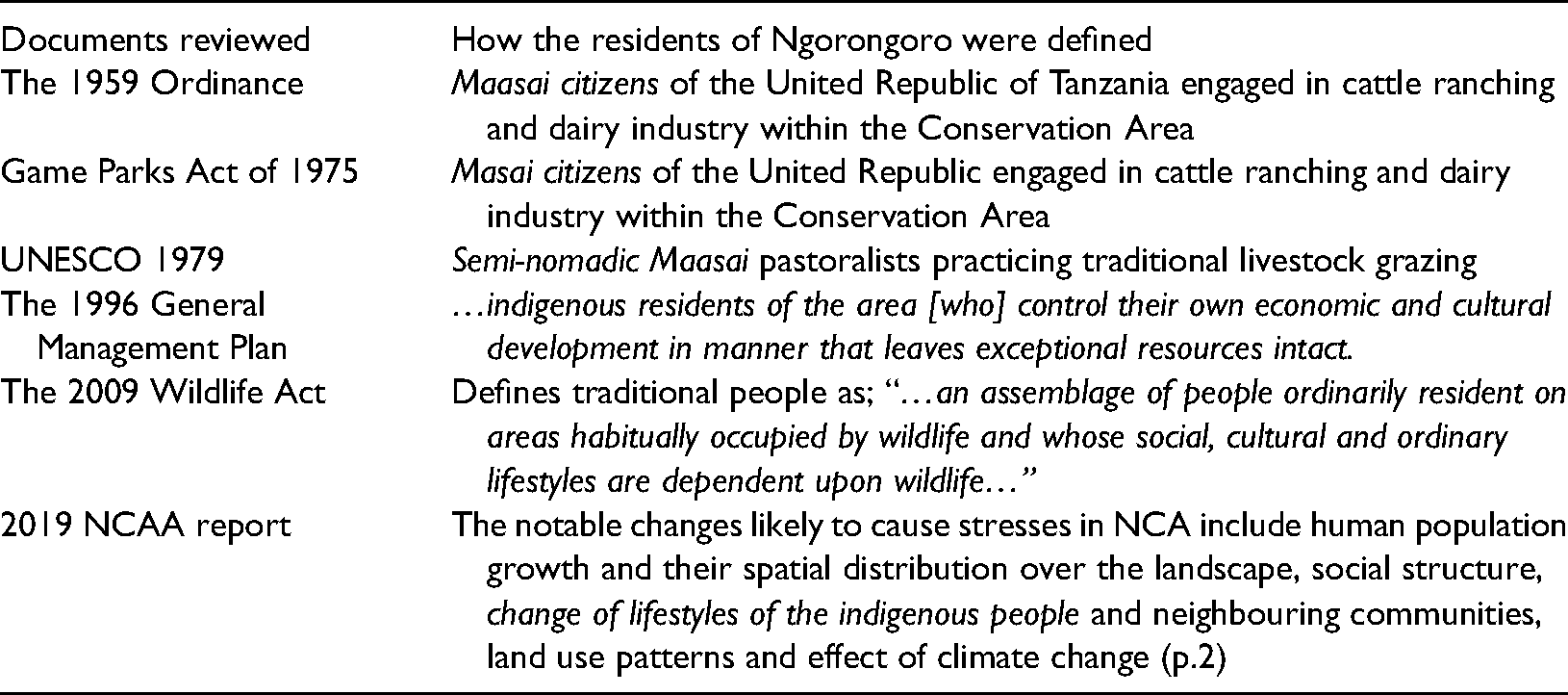
The various legal documents have over time gradually undermined the pastoralists’ rights by putting restrictions on local production practices. This is partly done through a gradual shift in the way the locals are defined in the documents- a main priority and partner in the early days to their eventual sidelining in recent years- and the gradual imposition of restrictions on their production practices. Table 1 below summarises how local people are defined in the different NCA related documents since 1959.
The 1959 ordinance makes no mention of the nature of the resident population. It only presents locals as ‘Maasai citizens of the United Republic of Tanzania engaged in cattle ranching and dairy industry within the Conservation Area’.
Similarly, the 1975 amended ordinance defines the residents as “Maasai citizens of the United Republic engaged in cattle ranching and dairy industry within the Conservation Area’. The residents are defined slightly differently when Ngorongoro was inscribed into the UNESCO World Heritage sites list in 1979 in which the UNESCO described Ngorongoro as a site where wildlife “[…coexist] with semi-nomadic Maasai pastoralists practicing traditional livestock grazing.” Whereas the earlier documents give more room for various expected production practices (cattle ranching and dairy industry), the UNESCO description of the Maasai as “semi-nomadic Maasai pastoralists practicing traditional livestock grazing” marks the new imaginary of “semi-nomadic” pastoralism as the accepted practice within the world heritage site.
In the 1996 General Management Plan (GMP), one of the aims of the NCAA is stated as ‘to safeguard and promote the rights of indigenous residents of the area to control their own economic and cultural development in manner that leaves exceptional resources intact.’(URT, 1996: 10), indicating a shift towards from defining locals as “citizens” and residents to “indigenous” and “traditional”. Similarly, the 2009 Wildlife Conservation Act (URT, 2009) solidifies this by defining traditional communities in Tanzania as an assemblage of ordinary people whose life depends on wildlife. By defining traditional communities in this way, authorities seem to exclude pastoralism, a production practice that is known to have historically been highly compatible with the conservation of wildlife.
Institutionally, the conditions for the residents worsened when the new independent government reformed the management system of the NCA. The NCA Ordinance (Amendment) Act, (Tanganyika, 1963), shifts the mandate over decisions on NCA matters from ‘members of the authority’, i.e. the NCAA that initially included local representatives, to the ‘conservator’, a single person appointed by the country's president and whose goal was ‘conserving and developing the natural resources in the conservation area’. This shifted focus towards wildlife conservation and tourism and away from protecting the interests of local people (Shivji and Kapinga, 1998; Homewood and Rodgers, 1991). Even though the term “authority” in the name of the organisation that manages the NCA was reconstituted through later amendments, the Maasai's representation in organisation was permanently erased. The 1963 act also put the NCA under the jurisdiction of the Minister of the Ministry of Natural Resources and Tourism instead of the regional government.
Moreover, while the Tanzanian Village Land Act, No. 5 of 1999 decentralised control over land to villages in order to guarantee tenure security, land within the NCA has been and still is categorised as ‘reserved land’, a category in which people are not allowed to settle. While few villages within the NCA are registered as villages, physical boundaries defining their ownership of land do not exist Most of the villages do not even have the registration numbers (URT, 2019). Thus, villages in the NCA are unique because they do not have any legal control over the land they live on. The NCA, which constitutes 59 percent of the area of Ngorongoro District, is managed by the NCAA- a special parastatal organisation that is responsible for the management of NCA. This means that the NCA is outside the jurisdictions of other lines of ministries and government structures responsible for the provision of social services and citizen political engagements.
Currently, the residents of NCA neither have representation within Tanzania's political structures nor in the NCAA. The board of the NCAA consists of a chairperson appointed by the country's President, the conservator (i.e. the director of the NCAA) and other six to eleven people, all appointed by the Minister of the Ministry of Natural Resources and Tourism. Locals are ‘represented’ by a single person who is directly appointed by the Ministry of Natural Resources and Tourism.
Even though the NCA was established with a triple mandate; i.e. protecting wildlife, safeguarding the interest of the local population and promoting tourism- studies in the 1980s and 90s revealed that life conditions of the Maasai residents of Ngorongoro were deteriorating(e.g. McCabe et al., 1992; Århem, 1985a; Shivji and Kapinga, 1998; Rogers, 2009).
In response to the widespread criticisms in the 1980s and 1990s, the NCAA established Pastoralist Council (PC), a separate management unit that exclusively deals with benefit sharing with communities in 1994. PC can to a large degree be seen as corporate social responsibility branch of the NCAA and receives its budget from the NCAA. In 2017/8 the PC's budget amounted to 4.8% of the annual tourism revenue of the NCAA (URT, 2019). According to interviews with members of the local communities, the establishment of PC did not really address the fundamental questions of the communities. While the locals hoped that PC would represent their interests in NCAA's decision makings, it ultimately became a body that merely distributes food handouts for the poor and pays small amount of school bursaries for selected students. Locals that I interviewed argued, by establishing PC, the authorities managed to divert the focus away from the real questions of political representation and benefit sharing. Furthermore, its establishment helped authorities to calm growing criticisms by communities, researchers and environmental justice advocates regarding benefit sharing and continual imposition of restrictions that further disadvantaged ‘traditional’ production practices. Following the establishment of PC, Shivji and Kapinga (1998) noted that they have seen circular letters from the Tanzanian National Parks Authority banning social science research in conservation areas, which may have made it difficult to access such areas for critical social science scholars.
The traditional-ness/indigenousness trap
Even though Tanzania does not officially recognise the presence of ‘indigenous’ communities (IWGIA, 2011), NCA legal documents as I stated earlier, make specific references to ‘traditional communities’ defined as those who practice mobile pastoralism and depend on wildlife/nature for their livelihoods. The ways that local Maasai are defined progressively shifted from one that considers them as ordinary citizens of the republic in the 1959 ordinance to ‘indigenous’ in the recent legal documents contrary to the fact that Tanzania does not legally recognise any group as indigenous but just as Tanzanian as (Igoe, 2006) also noted.
As a result of years of restrictions, many locals have been disconnected from pastoral practices while at the same time they have not been able to move on to other production practices. “We have nothing to look forward to when we wake up in the morning” said a Maasai woman from Oloirobi village near the Ngorongoro Crater whom I interviewed in August 2017, explaining the fact that they have neither livestock to care for nor other livelihood activities to replace it with. Many locals argued that lack of flexibility due to the many restrictions imposed by the NCAA, led to their impoverishment and dependence of on state support. As one young Maasai woman I interviewed in August 2017 explained. the problem with the current arrangement is that we are not allowed to interact with the outside world, with the assumption that we are nomads and we have to stay nomads, to be able to live with wildlife. But we are not nomads anymore because we have settled in permanent settlements without developing any skills for such lifestyle. This is because we have been systematically prevented from interacting with the outside world. Even the modern houses we build are not very much different from our traditional manyatta because we never got any experience from outside.
Local Maasai seems to have accepted the idea of identifying themselves as traditional/indigenous. In the 1990s, grass-root NGOs linked to global indigenous peoples’ movements, which focused on local land rights revived ethnic identities and territorial claims, countered longstanding efforts by the Tanzanian government to discourage ethnic based claims over land (Igoe, 2017). Local leaders and NGOs, Igoe noted, argued that the Maasai's transhumant lifestyle as well as their lack of interest in bushmeat makes them highly compatible and should thus be allowed to coexist with wildlife (42). Local Maasai present themselves as indigenous, in the hope that they could tap into benefits that tourism provides (Salazar, 2018). People have been persuaded that they will benefit from tourism that is based on the “pure” cultural experiences that the Maasai provide to tourists (Igoe, 2017). As Salazar (2009) rightly noted, Many Maasai themselves, like other indigenous groups, seem to be selling their own marginality. Were they not marginal to and different from the tourists, they would not have attracted the latter's attention. In order to sustain such commodity and to continue attracting customers, they have to maintain their difference.
The downside of the acceptance of such labels is that locals had to live up to expectations prescribed by not only the conservation authorities, to avert evictions- but also their own in response to tourist expectations of authenticity. This is dangerous as the uncritical deployment of the ‘indigenous lenses’ writes indigenousness into the communities’ mindset. That is to say, the process of making a tradition visible is also a process of creating it, as Ndlovu-Gatsheni (2018) noted.
While it is true that the Maasai have in the past lived in relative harmony with the nature, redundant focus on this idea alone leads to reinforcing of imaginaries created by tourist promotions that local people are part of the landscape just like the rest of the biota (Adams and Mcshane, 1996: 42). This contradictory position leaves the Maasai in dilemma, between securing their livelihoods and maintaining this reconstituted image handed to them, in order to secure access to land in Ngorongoro. A major actor in building these stereotypical imaginaries of the Maasai is the ecotourism sector. Some of the first things anyone who visits NCA may notice are the sight of groups of local people standing along roadsides and the small ‘cultural villages’ both of which are staged to show traditional dances and songs for the tourists. According to Salazar (2009), instead of providing an accurate representation of Maasai history and culture, the tourism industry “continued to present the colonial images and stereotypes concerning the Maasai as a backward community that provide additional anecdotes to western tourism lurking for exoticism and adventure in the African wilderness” (Salazar, 2009, p. 64).
The discursive production of scarcity and tradition
Two recurrent claims emerge from analysis of empirical material about the NCA. One is based on the notions of carrying capacity and resource scarcity, the idea that resources are limited and could only support a certain number of people. The second claim is related to changes in lifestyle- which involves an alleged deviation from what has been defined as traditional.
According to the first narrative, the NCA is being degraded because of increasing human population and rising number of livestock needed to sustain it. The authors of the 2019 assessment report, for example, argued that “with an average annual growth rate of 3.5%, human population will reach 200,000 people by 2038” (xiii). Population growth at this rate, they argue, implies declining of the well-being of the people as resources can hardly sustain the number of people. Maintaining the current status quo is therefore not a viable option. An official at the NCAA said the following explaining what will happen if they do not relocate people; I know Ngorongoro is going to change a lot. With the number of livestock, we are seeing today, if things are not taken seriously, we are going to lose quite a number of [wildlife]. Even the threatened species, we are going to lose them because they will be squeezed until when they cannot survive anymore. In that case, if we reach at that point maybe in 10 or 20 years to come and nothing has been done to rescue the situation, Ngorongoro Conservation Area will not be there anymore. A lot of changes will take place. A lot of changes have happened in the last few years alone. The temperature itself, Ngorongoro is not the way it used to be in the 1970s. It has changed. Rain pattern has changed, I don't know, maybe because of too much human impact or something. If you want things to remain as natural as possible, there should be very! very! minimum human disturbance because humans are destroyers of the environment.
With increasing numbers of people, authorities argue, they tend to settle near to key wildlife. When I argued that people have been here throughout history, he responded, Where they [stay] matters. People are settling near where the wildlife are, which was not the case before. The closer people are to wildlife, the more the conflicts are. That is the problem.
He further argued that the problem legal basis of the MLUM is that it did not clearly stipulate about the numbers of people who could be allowed to stay within NCAA. He said, From the very beginning, it was supposed to be stipulated directly like ‘if livestock reaches this number, no more livestock for you’. It has to be that way. If human beings increase to this number, no more people should stay inside, maybe they find somewhere else to stay. This is so as to maintain that carrying capacity, carrying capacity in terms of resource use, carrying capacity in terms of range land use, water, settlement and so forth. That is one. Another thing it [the MLUM] was supposed to say is, the types of settlements which would be allowed in the area. but, because this one was not much insisted, not that much said about, not that much documented, now people are building any house they want. But that is not proper. This shows that something is missing. It was supposed to be documented but also enforced. (key informant interview, August 2017)
Similarly, another NCAA official argued, When they [the authorities in 1950s] were shifting people from Serengeti, when they took them to Ngorongoro, they thought these people will run away after missing social services in Ngorongoro. The mistake they did is, they brought in the social services to the people in Ngorongoro. For instance, you bring people here, and you bring them the services such as hospitals, with schools, you give them water and the basic needs. What do you expect? They will reproduce… [laugh], from 8000 to 10,000 to 20,000 and so on. But, if they could have done like; they bring people to Ngorongoro and these people, they find out they do not get those basic needs, they will [would have] run away.
When NCA was established in 1959, there were about 8000 people residing in inside the new conservation area; about 4000 were original inhabitants of Ngorongoro and the other 4000 were relocated into it from the Serengeti plains in 1956. Currently, there are close to 100,000 inhabitants. NCA has some of the poorest households in Tanzania. A report from 2013 (URT, 2013) shows that more than 80% of the population lives under poverty line, nearly 74% of the population have no formal education and only 0.3% of the residents of NCA have attended higher education. The same report also shows that 89% of the population has no formal employment (URT, 2013).
However, interviews with locals and review of documents reveal that scarcity is an outcome of the restrictions imposed by the conservation authorities that led to lack of flexibility of the Maasai's production practices. The Tanzanian authorities had official consultations with UNESCO with regard to relocating the Maasai out of Ngorongoro since 1979. Even though results of the study commissioned to assess the carrying capacity of the area did not support the need for relocation, the authorities have since then been implementing measures to ostensibly reduce human impact on the ecosystem. Such measures among other include; the zoning of the NCA into human settlement, pastoralist development (grazing) and exclusive protected areas for wildlife in 1996, and restrictions on production practices such as small-scale cultivation since the early 1990s.
There is little evidence to support the claim that there has been increase in livestock despite the growth in population. Official reports show that the number of livestock remained almost constant ever since the conservation area was established. Tropical Livestock Units (TLUs) per capita declined from 11.6 in 1959 to 2.3 in 2017 (URT, 2019: xii), a number that is far below the estimated 8.0 TLU minimum needed to sustain pastoralist livelihoods (Haan, 2016).
Key government officials I interviewed argue that the Maasai are changing their ways of living; such as permanent settlements, new food habits and education among other changes. Such changes, authorities argue, affect the Maasai's relation with wildlife. Such views are also reflected in the August 2019 report by the NCA authorities. Transhumance mode of livestock production system, which indigenous residents practiced for many decades allowed pastoralists to move from one area to another within and outside NCA in search of pasture and water basing on seasonality. However, increase in human and livestock populations is disrupting traditional pastoral systems, which is detrimental to natural resources and leads to ecological changes. Thus, maintaining acceptable limits in livestock production is advocated. (URT, 2019: 13)
The Maasai have over generations developed a system of communal land use, where on seasonal rotation based grazing arrangements that enabled them to co-exist with abundant wildlife. However, such arrangements have over the last century been disrupted by interventions that prioritise the creation of exclusive protected areas and the conversion of communal pastoral land into permanent agriculture.
The conditions for pastoral practice in Ngorongoro particularly worsened when authorities introduced “zoning” in the 1996 GMP. Even though the MLUM initially put no restriction on livestock movements within the NCA, the 1996 GMP (URT, 1996) introduced ‘zoning’ in which human residents and their livestock were banned from accessing historical grazing spaces, water access points and other vital resources. Through the zoning process, pastoral mobilities were curtailed, and people were forced to gather around fixed settlements, i.e. in what is defined as the “Pastoralist Development Zone” (see Figure 2 below).
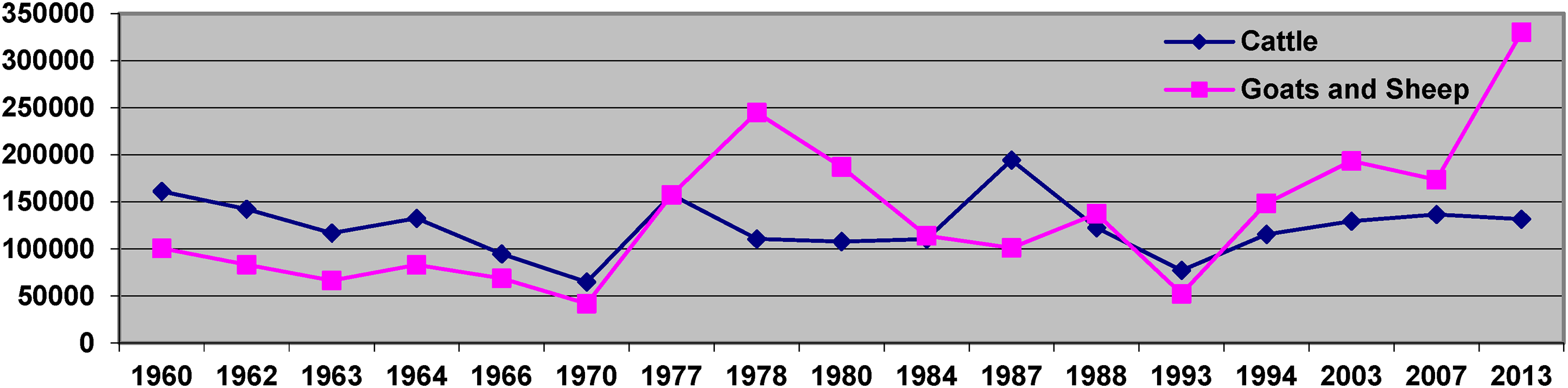
Number of livestock in NCA 1960 to 2013 (source: NCAA).
Official portrayals of local people as traditional pastoralists, many local interviewees argued, are problematic as the Maasai were required to stay traditional to be able to be able to live in in the NCA. First, such portrayals condescendingly elevate locals as guardians of wildlife while the benefits of conserving wildlife are only appropriated by the state and other local and non-local powerful actors. By defining the locals in such a way, the Maasai are othered from the rest of society in a way preventing them from interacting with the rest Despite official portrayals of local people as traditional pastoralists, many of the households in the NCA try to diversify their income sources, among others through seasonal migration for non-pastoralist jobs elsewhere.
Second, this view fails to consider the ongoing changes in areas surrounding the NCAA. According to an official3 from the NCAA, overall change in the communities surrounding the protected area greatly affects what is going on inside. The Maasai historically depended on nomadic practices, which are based on seasonal migration including to areas outside the Ngorongoro as Homewood and Rodgers (1991) also noted. This tradition, the interviewee argued, has been affected by changes in land use in areas adjacent to NCA, where farmers have converted most of the wildlife and livestock migration corridors into cultivation fields (as can also be seen in the Figure 2 below).
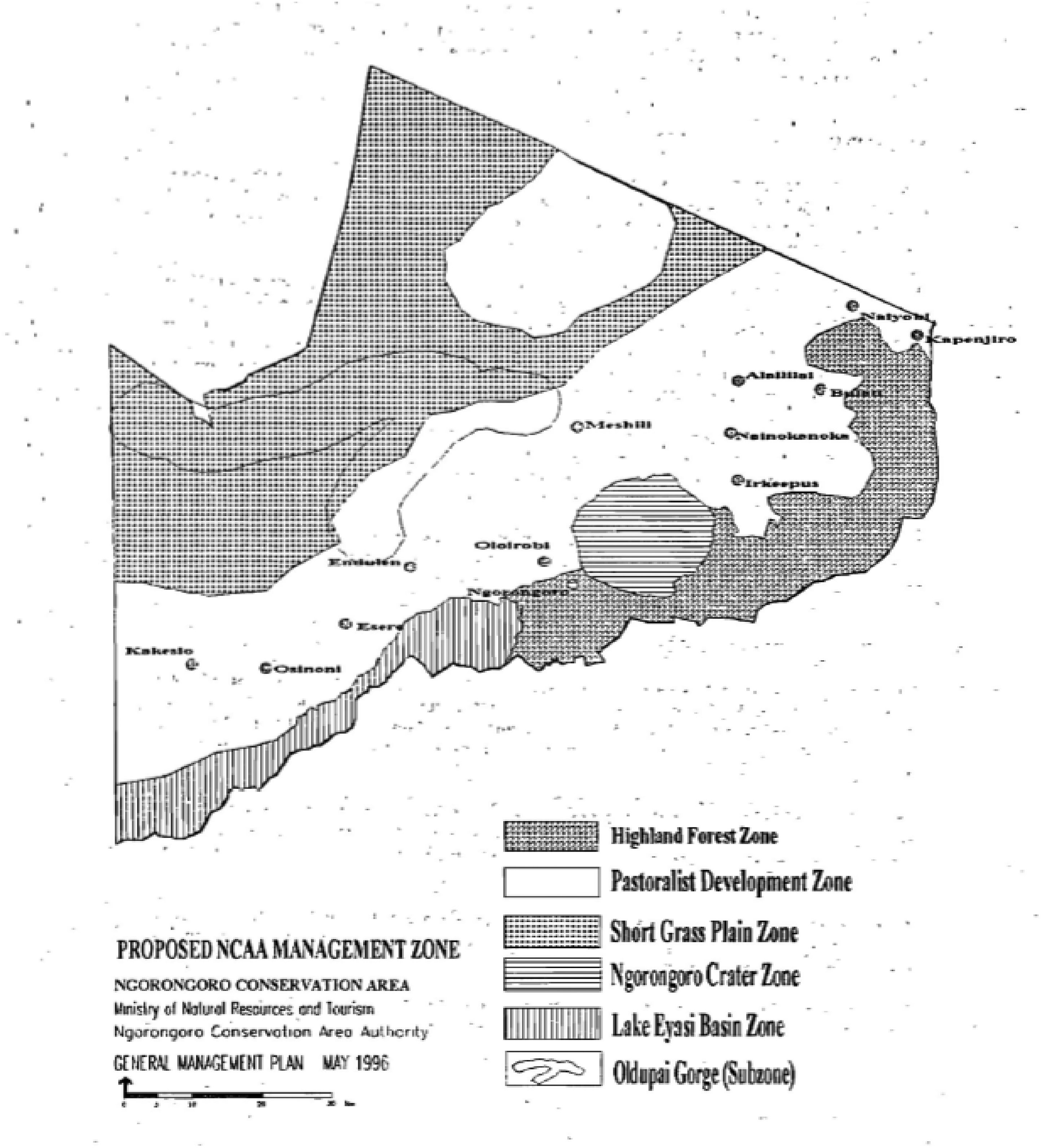
Zoning of the NCAA in the 1996 general management plan. Source: (NCAA, 1996).
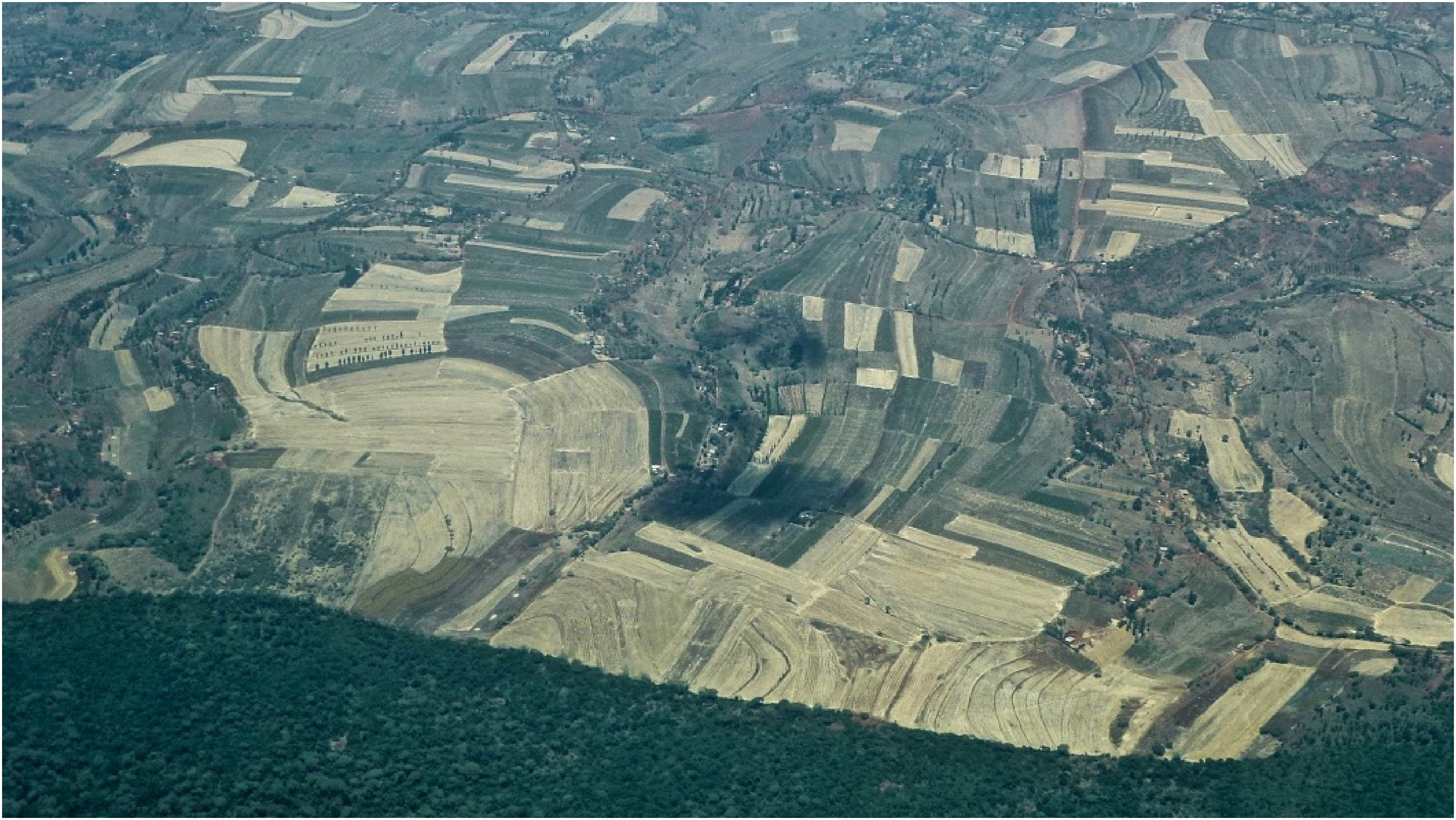
Farmlands adjacent to the borders of the NCA, the vegetated part at the bottom of the picture is within NCA. Photo: Haakon Lein.
Conservation authorities argue that changes in traditions among the residents of Ngorongoro is leading to degradation of the protected area. For people and communities to be able to stay in Ngorongoro, they must stay ‘traditional’, which means that they must practice pastoralism as they historically did i.e. should be nomadic and do seasonal migration, live in traditional homes and exclusively depend on livestock production as these supposedly traditional characteristics are presumed to have made the Maasai's ways of life compatible with wildlife. Based on this argument, people should stay culturally authentic to earn the right to live within the conservation area. A UNESCO report, for example, states; The shift from constructing “traditional houses” to modern styles and very large houses […] is not only impactful on the landscape, but also an erosion on the connection of the communities with their landscape. The bomas are a living testament of [a] harmony. (UNESCO, 2019)
Key informants from the NCAA also made similar arguments regarding the resource impacts of changes in Maasais’ ways of life. The quote below from an interview with a high-ranking official at the NCAA summarises the dilemma that the authorities face. […] if you improve the standard of living, indirectly you are also encouraging the usage of resources like water for example. When [the Maasai] are living in their Bomas [Maasai traditional homes], they do not need that much water, but if you improve their houses, they demand more water because they need to flush toilets, they need water for cattle, such kind of things. (Interview, August 2017)
Key authorities argue that many Maasai no longer practice pastoralism and should be relocated out of the NCA. One official at the NCAA argued; By law, the only people who are supposed to live within the NCAA are people who keep livestock. But, now there are poor people, people who do not own livestock. Once they do not have cattle, they are not supposed to be in there. (Interview, September 2018)
Similarly, a policy expert at the Ministry of Natural Resources and Tourism whom I interviewed argued Tanzania is a country which has a huge chunk of land. Through discussion with the communities concerned, we can devise a system to get them a good piece of land where they can do their socio-economic activities more freely. They have been constrained in Ngorongoro and this could easily drive people out of abject poverty. (Interview, September 2017)
The Maasai are thus expected to live a scripted lifestyle, which necessitates that they subsist their livelihoods in ways that the management authorities presume are compatible with wildlife conservation. The problem with this notion is that the script fails to take into account the fundamental nature of society and particularly society in a changing and globalising world where the script is supposed to change if it is to capture opportunities and cope with the challenges these changes bring about.
As Neumann (1995) noted, in Tanzania, what the Maasai could and could not do, have been and still is based on colonial stereotypes of the Maasai culture (p.138). The Maasai and their lands have been constituted to fit the colonial imaginaries of how Africa should look like (Igoe, 2017; Rogers, 2002). Maasai who deviate from the colonial imaginary and embrace change are often stigmatised and ostracised (Hodgson, 1999). As Igoe rightly argued, tourism in northern Tanzania recovers and perfects certain aspects of these colonial imaginaries and relations by infusing monetary value to such relations (Igoe, 2017: 56).
The management policies and in practice of the MLUM, which have their origins from colonial views of the Maasai are problematic. The Maasai were defined as traditional- which means that they must remain as nomadic livestock herders. However, in practice, the room for local peoples’ “traditional” livelihood practices have through time been increasingly limited and constrained. Moreover, the notion that communities should stay traditional when everything around them changes, led to a situation in which the basic means of livelihood for local people are endangered and where there is no alternative in place. The internalisation of these notions and acceptance of practices guided by such notions by the Maasai themselves left them under uncertainties. Such uncertainties resulted in lack of investment in basic social infrastructures by both the locals themselves and state or other development partners.
As presented in the background section, there were talks of moving the Maasai out of NCA since the late 1970s. A local interviewee summarises his frustrations in relation to this as follows. I do not know where to go. We don't have permanent things such as houses or we do not have plans like that. We build the houses like this you see now [mud houses] because we know we are not here permanently because this is a conservation area and we do not know when the government will push us out. Our life is based on indefinite temporariness. Our future is uncertain.
Authorities in Tanzania are now considering “voluntary resettlement” of locals into areas outside the NCAA. In so doing, they are using the Maasai's deteriorating life conditions to legitimatise resettlement. However, resettlements are often problematic due to the circumstances in which they are carried out. As Schmidt-Soltau and Brockington (2007) concluded, we should be cautious about resettlement as it is often difficult to distinguish voluntary from involuntary displacement (p. 2182). People who live within or adjacent to protected areas are in most cases under pressure from the social costs of the restrictions that PAs place on them. In such circumstances, Schmidt-Soltau and Brockington (Schmidt-Soltau and Brockington, 2007) argue, it is no surprise if people agree to move when they are asked to do so.
Conclusion
So, how does land become grabbable? How did the idea of relocating people out of NCA, which was not possible in 1959, become acceptable today? Ngorongoro is a unique case and the analysis results from this study are thus difficult to transfer to other cases where the context is likely different. However, there are important lessons to be taken from this case. First, land grabbing does not happen in vacuum. People are, through long processes of marginalisation, made relocatable. Local people either relocate themselves because they could not make a living due to systematic disinvestments on basic social services or life is made unbearable through restrictions imposed on local people to make voluntary relocation possible. Insight from this study can be used in other cases of land grabbing where large swathes of ostensibly empty land is made available for investment.
The MLUM upon which NCA is based was introduced to safeguard the interests of communities who were pushed out of their historical homes to establish the Serengeti National Park. Despite initial promises, Tanzanian conservation authorities diligently worked to disincentivize the Maasai from staying inside the Ngorongoro. Since the late 1970s conservation authorities openly argued for eventual relocation of people (Homewood and Rodgers (1991). While the legal documents and management plans recognise and promote the need for maintaining traditional social practices, in practice the authorities introduced restrictions that curtailed mobility and access to vital resources for locals. The NCAA continued to enforce restrictions on the social practices that historically enabled the pastoralist Maasai communities to lead a relatively harmonious life with the wildlife.
After years of deprivation of basic social services and opportunities for change, people have become poorer, deskilled and ended up in a weaker negotiating position. The Maasai residents, authorities I interviewed argue, should be discouraged from staying within the NCA and encouraged to relocate themselves to places with better opportunities outside, leaving Ngorongoro for wildlife conservation. However, this is not a new argument, as some powerful forces such as the FZS have since the beginning opposed the idea of allowing people within the NCA.
Locals have for the last 60 years struggled both to sustain livelihoods and maintain control over land under so much uncertainty. In so doing, they accepted narrowly defined labels such as traditional, indigenous in order to secure access to land, despite disadvantages associated with these labels. In other words, the Maasai were capitulated into the notions of traditional-ness, indigeneity and so on, in order to avoid forced relocation. This however sets a dangerous precedence as it leads to a situation where people have limited access to basic social infrastructures and services necessary for betterment of lives. Defining the Maasai as ‘traditional’, or ‘indigenous’, as Shivji and Kapinga (1998) also noted, set them apart from the ‘social and political mainstream of the country’. While the choice of what parts of tradition to keep and which ones to drop should be left to the communities, as Amartya Sen (1999) famously argued, in Ngorongoro these choices were and continue to be imposed from outside.
This is a stealthy process of dispossession where the state and conservation authorities did not have to impose coercive measure to relocate people as in the neighbouring sub-districts, such as Loliondo (Weldemichel, 2020), in order to grab the land. Here, the people are assumed to “voluntarily” leave the conservation area in search for better life outside. Even though, this has been the goal, for a long time, it is in recent years that authorities are openly pushing for the relocation of people from Ngorongoro. Pastoralist communities face increasing stigmatisation and disregard of their knowledge, their historic pastoral arrangements are dismantled, and they are left at the mercy of the state and the market (ecotourism) for living. Neither are people turned into labourers as there is no demand for their labour. The main employer in this case is tourism and very few locals secure jobs in the conservation-based tourism sector.
This historical precedents for the current push towards relocating the Maasai can be located in the different debates both before and throughout the period following the formation of the NCA. While the argument for allowing people to remain within a protected area is based on the notion that traditional communities can coexist in harmony with nature and wildlife, in practice the focus on traditional-ness facilitated the imposition of restrictions on local people's daily lives. The lack of freedom then contributed to the deterioration of the living conditions of the locals, which in turn is used to justify their relocation. Scarcity was thus discursively and materially produced. The material production of scarcity, as in the deteriorating living conditions of the locals, is in turn used to support arguments for relocation of the Maasai from their lands. Through the imposition of restrictions on their production practices and denying of access to necessary services, the government has tried to encourage exit of local population both from pastoral production and from the area and in order to render land in Ngorongoro grabbable.
Highlights
Current land grabbing-literature focuses on events
The literature does not address the specificities of the process that befall before land becomes grabbable in contexts where instant relocation of people from land is not possible.
Land grabbing in such contexts is incremental and involves the deployment of multiple discourses that make land grabbable.
The articulation of people as indigenous/traditional produces scarcity, which is then used to legitimize relocation
