




Abstract
Starting from Marcel Mauss’ observation that “one has no right to refuse a gift”, this paper explores the politics of refusal in the context of field trials with genetically modified organisms in Flanders (Belgium). Based on a decade of activist research, and focusing on the genetically modified organism field trials of the Flemish Institute for Biotechnology, we show that the business model of this strategic research center – with its triple mission of carrying biotechnology research, technology transfer, and the promotion of biotechnology through communication and lobby activities – fosters a climate in which innovations in the technosciences have to “be accepted”. The future is laid out without including the possibility of refusal. Consternation is great when this is exactly what happens. Irrational fears and lack of understanding or lack of familiarity are invoked to explain refusal. Language of precision, innovation, safety, and control are deployed to re-assure the public. Refusal is not considered a legitimate option. Yet, if farmers and grassroots initiatives would accept the gift of genetically modified organisms, it would mean the acceptance of their dispossession and the impossibility of diverse food sovereignties. Starting from theoretical work on “the gift” and “the politics of refusal”, we argue that recognizing innovation as the intrinsically plural and divergent process it is, entails including options to refuse particular pathways as a first step to open up others. As we will argue, saying no to genetically modified organisms is part of saying yes to peasant autonomy, agrobiodiversity, and peoples’ food sovereignties.
Keywords
Introduction
One has no right to refuse a gift. (Mauss 2002: 52)
To refuse is to say no. But, no, it is not just that. To refuse can be generative and strategic, a deliberate move toward one thing, belief, practice, or community and away from another. Refusals illuminate limits and possibilities … (McGranahan, 2016b: 319)
In the morning of 24 April 1987, about 70 journalists gathered in a field in California to document the first authorized release of a genetically engineered microbe into the environment. 1 The microbe, genetically modified to increase frost resistance of fruits, had already slalomed a number of obstacles in its trajectory towards commercial diffusion. After three years of legal battle, and 14 years after molecular biologists first spliced genetic material from one bacterium into another to create a recombinant bacterium, strawberries coated with ice minus pseudomonas (trademarked as Frostban) were now ready to confront the public eye. The night before the strawberries had to be sprayed, the Berkeley Greens uprooted a few thousands of the coated strawberry plants. 2
The mediatization and public contestation of the world’s first official field trial with genetically modified organisms (GMO) initiated a dialectic that would become a classic in the subsequent history of the agrifood technosciences. The mediatization of the installation of GMO field trials had to show the publics that the seclusion of scientist, bacteria and other organisms in laboratories had not been in vain. After years of hard work and longstanding public and private funding, the scientists had come back with a gift for society. They brought genetically modified plants and bacteria which were only waiting to be adapted and adopted for a variety of uses in agriculture and industry. Peasants and grassroots initiatives responded to the gift with public campaigns against GMOs, including legal battles and sometimes the destruction of field trials. Major points of opposition are GMOs’ key role in the growing privatization of life through patents and licensing agreements, as well as their broader role in the continuous encroachment on people’s food systems by a few transnational seed and agrochemical corporations (Howard, 2009; McAfee, 2003; Wright, 2005).
This paper thinks through the politics of refusal to explore how such actions resist and reframe the agrifood technosciences. It scrutinizes what happens when a product ridden with intellectual property rights and unequal power relations is imposed and normalized. It shows how refusal in the context of the genetic modification of plants is not a “negation of the need for dialogue” (Wright, 2018: 130) but a refusal to be drawn into politics that obstruct peasant autonomy and peoples’ food sovereignties.
GMO field trials – whether or not fenced off with anti-climbing material, carried out on roof tops, topped with barbed wires, under the watchful eye of security cameras or human guards – have clearly captured the collective imagination. In anglophone media, reports can be found of citizens’ interference with field trials in a wide variety of countries including the Philippines, France, the UK, Germany, Belgium, Sweden, Italy, the Netherlands, the US, and Brazil. Such interactions of peasant and grassroot groups with experimental field trials, reaching a peak in the 1990s and 2000s are significant. What is being “field tested” is more than just science, seed multiplication or even productivity. As we will argue in this article, field tests are also meant to provide insights into societies’ willingness to acquiesce to these new interventions (see also De Krom et al., 2014b). These experiments show that at least part of the population, in different places around the globe, are not willing to accept the unnegotiated use of GMOs in food and agriculture. Rachel Schurman and William Munro (2003) describe how in the mid-1990s, when GMOs “hit the ground running” a “proliferation of citizens’ voices challenging the biotechnology industry on economic, environmental, cultural, and moral grounds” emerged. As they comment, “long before transgenic crops made their way to the market, individuals and groups concerned about the dissemination of these new technologies were already questioning their safety, utility, and necessity” (p. 124). In the meantime, GMO scientists and science communicators appear to be surprised that people do not accept their gift. After all, in innovation language – much spoken in technoscience policy arenas and well documented in an imposing literature in the field of innovation studies – favored novelties are self-evidently to be spread, diffused, adopted, and “recombined” in follow-up inventions (Giuliani et al., 2011; Leary, 2019; Nelson and Winter, 1977; Stirling, 2014).
But why do certain technologies not diffuse? When it comes to the analysis and description of non-diffusion – the lack of adoption of perceived novelties – the language of innovation studies is much more impoverished. Obviously, an innovation can simply be unsuccessful in its aspired practical role, and it has long been well acknowledged that what is at stake here extends well beyond technical aspects alone (Bathelt et al., 2012). Yet whilst social and political aspects are comprehensively explored in interrogating positive processes of diffusion from invention to innovation (Genus, 2012), innovation studies is rather poor at recognizing the crucial social and political factors mediating the opposite process (Mahajan and Peterson, 1985). It is a matter of historical record, after all, that innovations can also be refused outright (Godin and Vinck, 2017). And the history of innovation likewise teaches that it is often only when this occurs, that it becomes possible to realize alternative pathways that would otherwise be foreclosed (Garud and Karnøe, 2003; Leach et al., 2010; Mortensen, 2018). 3 A role for refusal is thus an obvious implication of the widespread recognition in innovation studies that innovation in any given setting is an evolutionary branching process, not a one-track race (Stirling, 2018). Just like other socio-political dynamics, research and technological change involve societal choices among a diversity of possible pathways. Path-dependency and lock-in as well as multiple power-laden dynamics of entrenchment tend to reinforce those pathways favored by incumbent interests (Leach et al., 2010; Stirling, 2019). In plural societies, it follows that many contending interests will not be privileged in the same ways. Yet, refusal itself is oddly almost entirely ignored in this field as a social or political process.
In what follows, we will first zoom in on the logics underlying science, technology, and diffusion, showing how often this takes the form of an “obligation to accept” a supposed gift to society (Mauss, 2002). Drawing on a variety of scholarship on the politics of refusal, including the work of Black and Indigenous feminist scholars like Ruha Benjamin (2016) and Audra Simpson (2007, 2016), critical anthropologists and human geographers including Carole McGranahan (2016a, 2016b), Sarah Wright (2018), and David Graeber (2013), as well as autonomist Marxists like Silvia Federici (2012), Kathi Weeks (2005, 2011), and Michael Hardt and Antonio Negri (2000), this paper thinks through the politics of refusal to study the conscious and strategic obstruction of field trials that test genetically modified crops. As we will show, thinking through the conditions, meaning and possibilities of refusal sheds an interesting light on the contestation of GMO field trials as a political strategy of “talking back to scientific authority” (Benjamin, 2016: 969) as it rejects the normalization and neutralization of technical innovations. Empirically, our research is based on the study of the GMO field trials which the Flemish Institute for Biotechnology (VIB) organized in Belgium between 2007 and 2019 (see also Arora et al., 2020; Van Dyck and Arora, 2018), with a specific focus on a field trial with GMO-potatoes in 2011–2012, which has been crucial in shaping the GMO debate in Belgium. As we will argue, the business model of the VIB’s strategic research center with its triple mission of carrying out biotechnology research, technology transfer, and the promotion of biotechnology through communication and lobby activities fosters a climate in which it is normalized that innovations from the technosciences are to be accepted. Public–private partnerships, fiscal incentives, media campaigns, lobbying for deregulation, and public consultation procedures are designed in such a way as to create the impression that people need GMOs. The future is laid out without assessing those needs, including the possibility of refusal. The dismay is great, when the latter is exactly what happens.
This paper reclaims the imagined possibility – and the normative legitimacy – of GMO refusal as a generative, deliberately strategic, and politically positive move toward particular agricultural worlds and away from others. It argues that, similar to other interventions in pluralistic democratic politics, refusal should be recognized as unobjectionable an act as – typically massively better funded – countervailing pressure to accept.
Literature : gift-refusal
The gift of the technosciences
Do ut des – “I give so that you may give”. (Douglas, 2002: xii)
Michel Callon, Pierre Lascoumes, and Yannick Barthe argue in their essay on technical democracy that entrusted with the task of producing “sound forms of knowledge” and after having been “shut away in their laboratories”, technoscientists cannot come back to the outside world empty-handed. Taking their leave from the lay worlds within secluded research collectives, “researchers are accorded complete autonomy, with increasing budgets, but”, so they argue, “in return, and this is the object of delegation, they must come back with confirmed facts, as solid as the hardest granite” (Callon et al., 2009: 119). To measure these returns, systems of benchmarking and key performance indicators are put in place which evaluate scientists’ and research institutes’ performance. Through quasi-markets of publications, patents, spin-offs, research contracts, and standardized notions of “excellence”, public and private investors stimulate competition and control research orientations to make sure it is worth their investment (Deem et al., 2008; Benner and Ulf, 2000).
As part of new managerial strategies, publicly financed research centers have been set up to conduct research and facilitate its translation into industrial applications. In the field of biotechnology in particular, the close relationship between public-sector science and industry is prominent (Shohet and Prevezer, 1996). Technology transfer mechanisms – including university spin-offs, university consulting, research and development cooperation between universities and industries, incubators and science parks – are put in place to assure social uptake of novelties (Capron and Meeusen, 2000: Schurman and Munro, 2003). As research policy studies have shown, such forms of research regulation have the effect of emphasizing the commercial potential and societal impact of the research (Benner and Ulf, 2000). The social contract of research institutes thus comes with the prerequisite of applicability. As a matter of fact, Callon et al. (2009: 48) argue “it would be absurd” to finance researchers to bury themselves “in laboratories cut off from the world if something were not preserved in the course of this movement that enables one to turn back to the world with something extra that makes the difference”. Only “this extra” relieves the scientist from their debts towards their funders. In return, societies have the obligation to accept the “extra that makes the difference”.
It is in helping to understand what is at play here, that Marcel Mauss (2002) epic essay on “The Gift” is so useful. After mapping the transfers and obligations between members of a society, Mauss’ findings go firmly against the established idea that once gifts are given, no further claims are required from the recipient (Douglas, 2002). As he argues, “one has no right to refuse a gift […] But, by accepting it one knows that one is committing oneself” (Mauss, 2002: 52). Based on the study of archaic forms of contracts – including the potlach in Polynesia, Melanesia, and the American Northwest – Mauss shows how gifts engage persons in commitments through which social relations are established. This also shows the foundational character of the gift. As Mauss explains, refusing the gift has a vitally relational nature: “to refuse to accept is […] to reject the bond of alliance and commonality” (Mauss, 2002: 17). Furthermore, as Mauss points out, the gift is “a polite fiction […] when really there is obligation and economic self-interest” (Mauss, 2002: 4).
Mauss’ insightful analysis has been vastly influential, beyond his own fields, anthropology and sociology, such as in economy or international relations (Akerlof, 1982; Kowalski, 2011; Mallard, 2011). In this paper, we read the relation between science, technology, and society from this perspective, including both its “fictions” and its “economic self-interests (Mauss 2002 : 17) We will show how the gift logic – that ties the giver, the gift and the receiver – already starts at the moment when society and corporations fund the researchers. Refusal of this initial gift is rare. This is hardly surprising. Biotechnological research is depicted as a unique opportunity to engage in a highly relevant, interesting, and rewarding endeavor 4 and offers secure, well-rewarded job opportunities. Furthermore, the exceptional cases of “scientific dissent” (Delborne, 2008), where researchers challenge knowledge claims in (molecular) biology and the agricultural sciences have frequently been met with harsh repercussions for the scientists involved. 5 However, the acceptance of the funders’ gift, which allows researchers and research institutes to establish the material conditions of seclusion and scientific authority, includes the expectation to give back in the form of promising findings, patents, publications, spin-off companies, and marketable products. The observation that this subsequent gift, in this case the promise of GMOs, is not always accepted, forms the starting point of this paper.
Refusal as a political stance
The act of refusal has attracted interest of critical scholars as a way of resisting, reframing, and redirecting power imbalances and oppressive logics (Benjamin, 2016; Simpson, 2016; Wright, 2018). Anthropologists engaging with refusal have framed it as a form of dialogue in the face of power asymmetries and social hierarchies including class, race, and gender. Refusal, as they argue, constitutes both a political strategy and an assertion of other, diverse possible worlds. In theorizing ethnographic refusal, Audra Simpson (2007), for instance, shows how for First Nation people, politics of refusal are about a refusal to be drawn into logics and politics that enable colonialism. For them, refusal is a political and ethical stance, a way of engagement and assertion of sovereignty. Drawing on this literature, human geographer Sarah Wright (2018: 129) suggests that “refusal is more than stepping outside dialogue”. As she argues, “rather, refusal may be a way of reframing debate, refocusing the terms of engagement, and re-centering it in productive ways”.
Refusal has often been used as a conceptual tool to re-examine history, not starting from the viewpoint of power, but from the viewpoint of the people that do not accept the place in history that power attributes to them. Autonomous Marxists such as Kathi Weeks (2005, 2011), Michael Hardt, and Antonio Negri (2000) have theorized refusal as a way to not only think from “the ‘one-sided’ perspective of capital and its reproduction, but also from the perspective of the workers and their potential to subvert that power” (Weeks, 2005: 118). They show how capital continually has to invent new strategies to impose work and discipline against acts of refusal (Negri, 2005). Or, as Silvia Federici (2012) reminds us, feminist autonomists in the 1970s embraced refusal in the context of the women movement’s call for housework strikes aiming at making reproductive labor visible by refusing it. Anthropologists discuss subordinated groups’ resorting to refusal in a broader context including the rejection of authoritarian arrangements (Graeber, 2013), colonial citizenship (Simpson, 2016), medical interventions and screenings (Rapp, 1998) or biologically based citizenship (Benjamin, 2016). All show that refusal might have been much more important in explaining historical developments (or the lack of particular developments) than previously thought. In this context, Graeber (2013: 2) points to the fact that Mauss observed “dramatic examples of non-diffusion of even extremely practical technologies by neighboring peoples”, showing for instance how Algonkians refused to adopt Inuit kayaks, while Inuit, in their turn, refused to adopt Algonkian snowshoes. In his own work, Graeber studied amongst others the Malagasy origins and shows how through “rejecting forms of hierarchy and agriculture such societies can be seen as deliberate rejections of the governing principles of nearby states, or even as societies that had defined themselves against those states” (p. 2).
McGranahan (2016a: 334), for her part, sees refusal as an effort, at least minimally, to redefine or redirect certain outcomes or expectations or relationships […] maximally [as a way] to reject anticipated reactions or responses, and thus to challenge authority or structure or the rules of engagement in the first place.
Refusal thus illuminates limits and possibilities. On the one hand, it allows people to make “an intervention without having at hand a manifesto that fully articulates an alternative” (Erica Weiss quoted in McDonald, 2016). It allows one to say “‘no, not that’ without really knowing what the future holds, or even what she is holding out for”, only knowing “that there is something better”. On the other hand, refusal at least implicitly goes beyond merely “being and acting in the world”, as David Graeber (2013: 1) notes. Acts of refusal should be considered as “active political projects which often operate by the explicit rejection of other ones”. In that sense, refusal is both a point of possibility and the core of a political act. Or in the words of Kathi Weeks (2005: 110): it “is at once negative and positive; it encompasses both a rejection of the present regime […] and the project of imagining and constructing alternatives”. Refusal as both a “movement of exit and process of invention” is what can be observed in GMO activism as well. As we will argue in what follows, refusal in effect makes time and opens up spaces within which to construct alternatives.
Refusal as dialogue in the technosciences
Particularly relevant for the discussion of GMOs as a gift of the technosciences is Ruha Benjamin’s (2016) plea to consider the possibility of “informed refusal” as a necessary addition to “informed consent” whereby the giving of information is implicitly linked to the granting of permission.
As Benjamin (2016: 971) argues, refusal is a way to open-up the “spectrum of human agency vis-à-vis technoscience”. She grounds her observations in case studies where people resist biologically based citizenship in the context of structural violence against subordinated groups, including refugees who refuse to provide mouth swaps, hair and nail samples to the UK Border Agency. 6 Referring to dominant representations in the biosciences, Benjamin sees refusal as a form of “political and epistemological hacking” (p. 983); a way of “talking back to scientific authority [that] offers a prism on to a much larger terrain of action and negotiation” (p. 969).
Understanding public controversies around new technologies in this way, as we will demonstrate, points to a politics of possibility. This stands in stark contrast with framing people’s non-acceptance of these technologies as being based upon anti-scientism or anti-technology sentiments, a belief, fear, mixing up facts and values, or lack of understanding, that can be resolved through better science education and science communication (see Blancke et al., 2015, 2017 for examples of this approach). One of the assumptions underpinning such a framing is that people would drop their barriers if only they would understand that genetically engineered plants are not really different from plants that are the result of centuries of seed selection by farmers. Language of precision, innovation, safety, and control are deployed to present the former as merely faster and more efficient, modern breeding techniques and re-assure the public that no fundamentally new or different interventions in nature have taken place. Such framing of genetic modification, as just another step in a progressive line of increasing intervention, clashes with the patenting argument, which at the very same time argues in favor of property rights on the basis of the novelty of the invention. It also contrasts with views that show how GMOs bring in fundamentally different views on knowledge, farming, and ecology (Coolsaet, 2016).
As we will argue, the field trial being discussed in this paper can best be understood as a participation technology to help the transfer of GMOs from laboratory experiments to the outside world. Indeed, in response to public mistrust, procedures for science participation have been installed which are supposed to help with “framing the issues”, “defining the relevant expertise”, and “channeling dissent” (Levidow, 1998: 216). This is not without importance. The delegation of the production of knowledge and innovations to specialists requires the cooperation of those concerned whether this be farmers, food processing companies, distribution firms, or consumers (Delborne, 2011). Bringing journalists, politicians, or farmers to GMO field trials may thus help to smooth the return to the outside world by making tangible the contribution scientists “make to humanity”. Stuck in the deficit model of science communication, these modes of public engagement are supposed to orient people to discover and approve. Paraphrasing Gage Karahkwi (2019: 76), science communicators seem not to say “I want to talk with you about something,” but “I want you to listen to me while I talk about something”. In practice, these control-oriented modes of science engagement fail as people talk back in many ways, including through advocacy campaigning, asking inconvenient questions, launching court cases against field trial permits, and occasionally by physically intervening in field trials through techniques of reaping, trampling, or uprooting. While these practices are generally framed as reactionary by using terms such as “vandalism”, “violence”, or “ecoterrorism” (KGMB, 2013; Kuntz, 2012; McGrath, 2013; Normille, 2013), we will think with the politics of refusal to demonstrate their profoundly political and potentially radical progressive gesture. Through refusal, grassroots initiatives create spaces and times to pursue alternative agrifood practices and relationships. They change the context within which to explore agriculture and food futures. Rather than dealing with the problem of choosing one or another of the alternative solutions already on offer, people practicing refusal intervene in the very framing of who is setting the terms of the debate, questioning which and whose communication is allowed to enter the public sphere.
Method: Activist “field” work
This article is the result of over a decade of involvement in the anti-GMO movement in Belgium. Next to, and in relation to activist involvement, the research is based on the study of mainstream and alternative media coverage, parliamentary reports, biosafety documents, funding streams, advocacy campaigning material, as well as the organization of and participation in workshops, discussions and debates. Importantly, rather than us choosing the topic, the topic chose us. 7 Crucial in this context was a field liberation action, also calle “Big Potato Swap”, which took place in the Flemish town of Wetteren in May 2011. This event included a direct action, a farmers’ market and several workshops and debates in which two of us participated. The action triggered unprecedented political and academic outrage, which was intensely covered in the media and powerfully experienced at a personal level, after one of us got fired from her university position and was incriminated in court, and the other one was subjected to other tactics of (academic) intimidation.
The experience of this happening fostered a need to come to grips with the grounds for the intensity of the debate. By scrutinizing the political and economic interests involved, as well as the hegemonic understandings of technology and science which were at play, we came to understand how the scope for alternative views or opposing voices was being limited. On these grounds, we engaged in a profound analysis of the political economy of the VIB – scrutinizing its funding bodies and channels, relations with big business and political institutions, science communication, advertisement campaigns, public discourse and rhetoric, strategic choices – as well as the positioning of a large group of other actors (scientists, politicians, farmers, artists, activists, etc.) as they intervened in the highly mediatized political debate both immediately after the contested field liberation action and in the following years. In what follows, we will zoom in a field trial with potatoes that had been genetically modified to increase their resistance against blight, commonly referred to as the potato disease. We focus on the role of this field trial in mediating science-in-society interactions. In this endeavor, we explicitly take the side of those who are marginalized and at times even criminalized in the Flemish media coverage and wider public debate (see Maeseele, 2010; Maeseele et al., 2017 for an analysis of the media debate in this context). In other words, those who question, reject or even straightforwardly refuse a future laid out by GMOs.
In Flanders fields8
Invigorating GMO development in Flanders (Belgium)
In 1987, Yvonne Baskin (1987) wrote: No one knows what the real payoffs of genetically engineered organisms will be until the speculations have been tested in real world conditions. But with all the uncertainties clouding releases into the environment, even the most optimistic industry watchers don’t expect to see significant sales of recombinant plants or microbes before the 1990s.
Flanders has played a very specific position in the development and promotion of GMOs. In the 1980s, Flanders was one of the early regions to invest in this technology after, in the foregoing decade, Belgian researchers Jeff Schell and Marc Van Montagu had been amongst the first researchers worldwide to successfully figure out how to use Agrobacterium tumefaciens DNA transfer mechanisms to insert genes into plants. When Van Montagu and Schell set up Plant Genetic Systems (PGS) in 1982, probably the first plant biotech start-up company in Europe (Heimann, 2018), and submitted a patent application for the transmission of genes between bacteria and plants in 1983, they established the local foundations for the transformation of biotechnology research into an economic development opportunity. PGS, which was bought in 2002 by BayerCrop Science from Aventis CropScience, is today one of the five major plant biotech start-up companies around Ghent, Flanders’ second largest city and host of one of its most important universities. A second spin-off, Crop Design, established in 1988, became Plant science-BASF in 2006 and has partnerships with Dupont and Monsanto (now Bayer). In 2012, Syngenta (ChemChina now) bought the spin-off Devgen. 9 The newer VIB spin-offs Biotaly (2013) and Aphea. bio (2017) triggered new industrial partnerships with the intention of making disease and pest-resistant crops. The evolving panorama leads analysts to refer to the technology park in Zwijnaarde (Ghent) as a “green biotechnology cluster” (Segers, 2017) where government institutions, companies, and universities cooperate to increase Flanders economic competitiveness through investments in biotechnology.
The VIB research institute, established in 1995 with the explicit goal of applying and commercializing biotechnologies, plays a central role in this innovation strategy. The publicly funded research institute brings together researchers from the five Flemish universities, employed around 1450 researchers in 2019, and has its own communication and extension team. The institute is piloted by a board of directors composed by researchers and a number of business representatives including from Bayer/Monsanto, Syngenta, and Janssen Pharmaceutics. In addition to the 63-million-euro yearly donation from the Flemish government, co-financing comes mainly from the European Union (15 million) and from the industry (27 million in 2014). 10 As a return for this investment, the institute must undertake research that leads to excellence, measured in the number of scientific publications, citations and intellectual property patents. Next to that, it is also expected to facilitate public–private partnerships in biotechnology research, technology transfer through patents, license agreements with agro-biotech and pharmaceutical corporations, the launch of start-ups and the establishment of biotechnology incubators, accelerators, and a bio-hightech industrial network FlandersBio. 11 So much is clear: the researcher is not supposed to leave her laboratory empty-handed: many agents at the door expect tangible results (Callon, 2009).
The institute has taken this expectation very seriously. According to international benchmarking exercises, and against the standard of measuring excellence, the institute is doing remarkably well. Filing patents, preparing high-rank publications, grant writing, and the creation of spin-offs are all daily practice at the institute. As part of the effort of preparing for commercialization, the mission of VIB also includes the goal of “informing” people about GMOs and the broader field of biotechnology (“science communication”). 12 This includes the framing of their products as gifts to society – as means to reduce world hunger, adapt to climate change, or, in the Belgian potato case, to “reduce pesticide use, costs and work for farmers” whilst “assuring better yield and easier management” (Gheysen, 2011). Establishing the conditions for the uptake of GMOs furthermore requires efforts in terms of the (de)regulation and authorization of the commercialization of GMOs, an endeavor VIB is actively involved in. The institute does not only participate in the national biosafety evaluations for GMOs, on the European level, VIB actively lobbies for the deregulation of (the so-called new) GMOs. 13 A typical rhetorical strategy used to reinforce these lobby efforts is that of the “litany of delay”: fear is created that Europe would be lagging behind in terms of investment in new technologies in comparison to Asia or the United States. 14 The fact that Europe is a laggard in adopting new biotechnologies would be due to (over-)regulation and badly informed opposition to GMOs. This industry-type strategy is a logical consequence of the institute’s explicit goal and raison d’être of transforming knowledge into marketable products and economic growth, and to become part of what its directors refer to as the international top league of biotechnology institutes (Raeymaekers, 2012).
Field trials as action-communication
One of the instruments to facilitate the translation of GMO concepts into applications is the execution of field trials. VIB’s field trials, the first of which comprised the release of genetically engineered poplars in 2007, are not merely experiments with GMOs in real life conditions but are the outcome of “a strategic decision […] to break a de facto moratorium”, as stated in a booklet published by the institution (Raeymaekers, 2012: 74). While biotechnology companies had carried out a large number of field trials in Belgium in the late 1990s and early 2000s, they ceased the execution of test plots in 2003. A public industry statement details that it would not undertake any new field trials in Belgium until the government would be able to provide “a clear and secure environment for GMO field trials”. 15 In the preceding years, a number of field trials had been destroyed, resulting in negative promotion for GMOs. 16
The first series of earlier GMO field trials had a fundamentally different character compared to the new ones. According to the Belgian Biosafety monitor, only private companies executed GMO field trials between 1994 (the start of the registration of GMO field trials) and 2002. 17 While the first wave of field trials focused on the multiplication of genetically modified seeds (next to limited monitoring of environmental impact) and were thus “commercial cultures under the cover of experimental field trials” (Denys, 2005), the second wave of field trials were coordinated and executed by VIB, in partnership with public research institutes and biotechnology companies and were informed by another motive. In the institute’s own words, the field trials were in the first place important “in the development of a transparent framework that guarantees legal certainty” (Raeymaekers, 2012: 74). What this meant is that field trials became a way of “communication by doing”, which made it possible for politicians, farmers, and other publics to feel, smell, touch GMOs (De Krom et al., 2014a: 20).
This action-communication strategy was most apparent with respect to a field trial with GM potatoes in 2011 and 2012 in the Flemish town Wetteren. The field trial was carried out on land of a governmental research center situated next to a highway. Copying the shape, style, and size of public information campaigns for road safety, a billboard was placed next to the field trial, stating “Here Grow the Potatoes of the Future” (see Figure 1). The institute’s communication manager described the field trial as a way to communicate about GMOs in a way that is much more tangible than is possible through leaflets (De Krom et al., 2014a). A leading researcher of the field trial stressed in an interview with a local news site that “this is one of the most important and real GMO developments for Europe, which interested farmers must be able to see for themselves” . He explained that the field made it possible “to communicate about the advantages of the GMO potato for farmers and the environment” (Van Der Mensbrugghe, 2011). A government official, in his turn, claimed that field trials may contribute to the disappearance of resistance against GMOs as people would be able to see the benefits themselves. Grassroots collective of farmers and activists raised deep questions over who gets to say what, in what contexts and with what effects. The collective questioned how science communicators, speaking from a position of authority, engaged in a sort of non-conversation in which the latter retained all power to speak and foreclosed “the possibility of listening” (Karahkwi, 2019) to farmers and other people as true interlocutors.
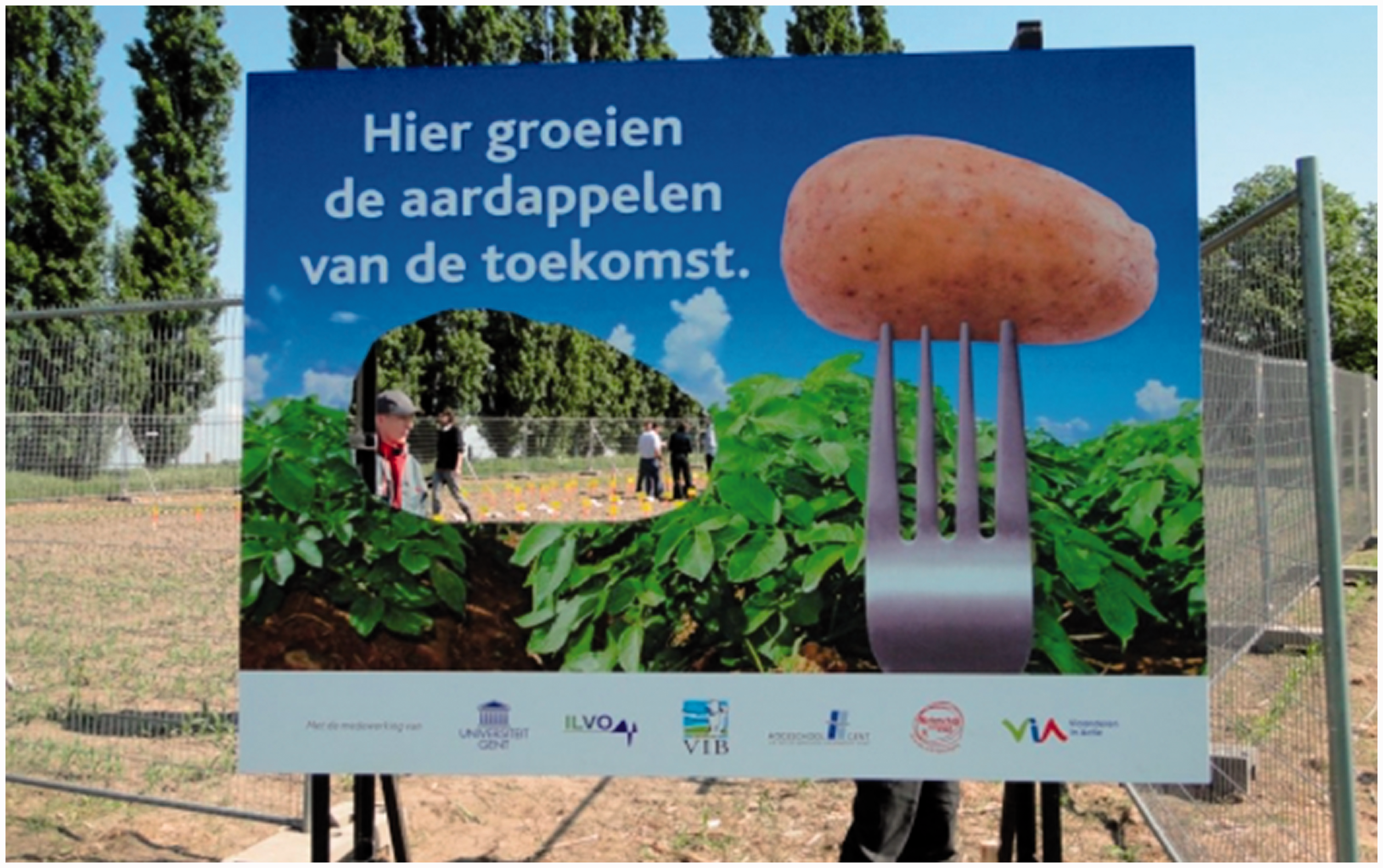
Billboard “Here Grow the Potatoes of the Future” (courtesy DeWereldMorgen).
The creativity, extent, and manner in which people took part, and especially transformed, the conversation must have exceeded the science communicators’ imagination. Even before the field trials’ materialization, farmers wrote a bold and self-aware open letter entitled “farmers do not want GMOs”, and a collective referred to as the Field Liberation Movement invited people to gather for a field liberation, more specifically a Big Potato Swap, symbolically replacing GMO potatoes by organic ones. Both the grassroots collective of farmers and activists raised deep questions over who gets to say what, in what contexts and with what effects. The collective questioned how science communicators, speaking from a position of authority, engaged in a sort of non-conversation in which the latter retained all power to speak and foreclosed “the possibility of listening” (Karahkwi, 2019) to farmers and other people as true interlocutors. The creativity, extent, and manner in which people took part, and especially transformed, the conversation must have exceeded the science communicators’ imagination. Even before the field trials’ materialization, farmers wrote a bold and self-aware open letter entitled “farmers do not want GMOs”, and a collective referred to as the Field Liberation Movement invited people to gather for a field liberation, more specifically a Big Potato Swap, symbolically replacing GMO potatoes by organic ones. Their acts of refusal is what we will turn to now.
Refusing the gift
On 16 February 2011, a group of 10 Flemish farmers reacted to the public announcement of the GMO potato field trial by publishing an open letter (D’Hulster et al., 2011) wherein they addressed scientists and regulators as follows: Scientists and regulators, we cannot accept your choice. We do not want your GMOs. […] Were it not for the fact that we, as farmers, on a daily basis are squeezed into a straitjacket by interference, regulations and provisions that affect the essence of our work. We often feel hurt. This even reaches such proportions that our survival is threatened in the near future, among other things by science and the short-sighted policy regarding genetically modified organisms (GMOs).
In this way, the mobilized farmers refuse to let themselves be put in the position of those who are “backwards”, those who would not have understood that history took a different direction a long time ago (Latour, 2018). No, they speak with a self-assured voice, situating themselves within a history of struggles against enclosures and the disappearance of the peasantry. By doing that they rewrite agrarian history. The disappearance of the peasantry, they argue, threatens society’s access to healthy and safe food “to fulfill everyone’s needs”. The farmers turn the argument of the technosciences upside down: technological progress does not necessarily improve access to healthy and safe food, quite the contrary. In fact, and drawing upon examples of failed science-based progress that turned living soils into dead substrates and seeds into patentable goods, the farmers challenge the very approach of producing agricultural knowledge in laboratories secluded from their fields (D’Hulster et al., 2011).
Crucially, as the farmers’ letter shows, the imposition of the gift of GMO’s goes further than the expectance of acceptance. It also requires reciprocity. The farmers are asked to subordinate themselves to – and implicate themselves in – the agricultural model presented by the gift. Participating now means accepting the limits that are set by the question (Stengers, 2015). It is exactly these hierarchies, these social and ecological relations that the farmers refuse with their answer. They insist on asking different – for some inconvenient – questions, by putting technoscience innovations in their broader context, and refuse to accept the mantra of progress that “if you refuse GMOs, you will have worse” (Stengers, 2015: 68).
Performing refusal
The second and more visible practice of refusal consisted in the attempt to physically replace the GMO potatoes of the field trial by organic ones. Science-communication by action was answered with grassroots-communication by action and the so-called “potatoes of the future” were swapped for what a grassroots collective referred to as Field Liberation Movement presented as being their potatoes of the future (see Figure 2). With their action, the activists took the main function of the field trial – to allow the public to smell, feel, and touch GMOs – very seriously. The normality of the future laid out in the research institute’s advertisement campaign was transformed into an open question and political choice.
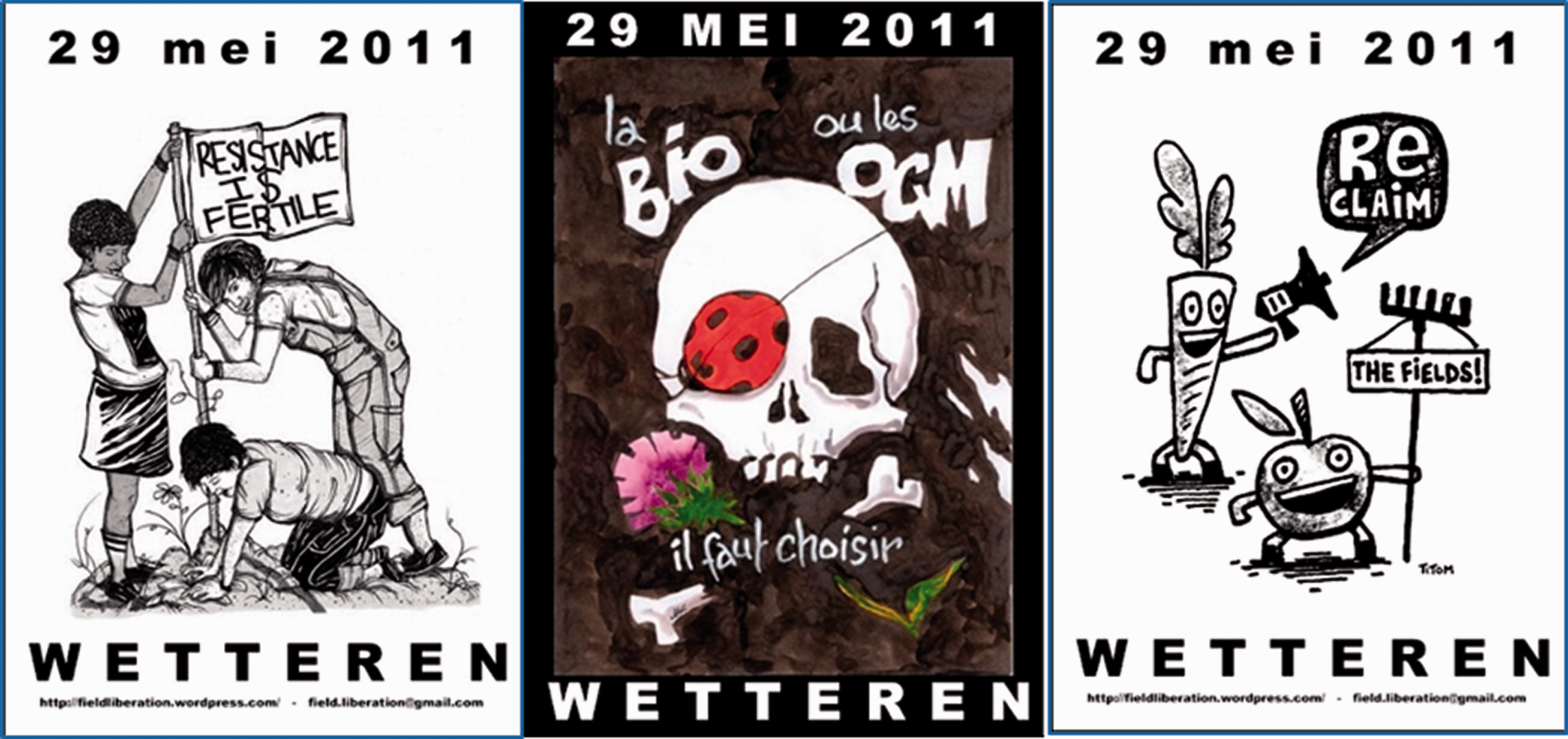
Leaflets to call out for potato swap action (courtesy Field Liberation Movement).
Giving information on the presumed social and ecological benefits of GM potatoes through a mediatized field trial did not lead to the manufactured consent or acceptance of what was presented as a gift to farmers and society. “Informed refusal” rather than “informed consent” was the answer. Through the publication of a public Potato Report, 19 media work, the organization of public debates and, finally, the Big Potato Swap, activists succeeded in reframing what was presented as a technical problem of the potato disease and widespread pesticide use into a complex societal debate about science, agriculture, and progress. 20 When the collective declined an invitation for an information meeting and instead organized a gene-spotting meeting, 21 they re-set the context for dialogue and asked the questions. 22
Through their actions, the collective countered the presumption that people would consent to the future that is being presented to them by a biotechnology state-industry-science alliance. They showed that this alliance acted prematurely on the expectation that all involved would be willing to consent with the choice for an agro-industrial agriculture whereby tax-funded investment strategies in public science serve private interests before others.
However, this refusal of the gift was itself not met with acceptance. The potato swap made it to the headlines of the television news and the front cover of the newspapers. Politicians, academics, and public figures were almost tripping over each other in their attempts to be the first to repudiate the action and the activists’ claims in dramatic terms. The message was clear: there are no legitimate grounds on which this gift can be refused. The overwhelming mood of the reaction underscores the intensity of the infraction: that a gift given by incumbent authority is never supposed to be refused, that refusing the gift is “tantamount to declaring war”, to use Mauss’s (2002) words. In not more than a few hours, the action was reframed from the ‘Big Potato Swap’ to ‘Potato War’. Fundamental values, like science, progress, and democracy itself seemed to be at stake. The national news channel headlines read “Black day for science” and the field trial’s leading scientist commented that it is “lamentable for the future of the country” if “scientific independent research to test a new technology [...] is no longer possible in a democracy”. 23 Irrational fears, lack of understanding, and lack of familiarity were put forward as the only valid diagnoses for this pathological transgression.
Considering that the grassroots collective had managed to transform a context that was carefully constructed to be biotechnology-friendly 24 into a hostile environment for biotechnology enterprises, every effort was made to discourage others from performing similar gestures of refusal as well. Activists were labeled “ecoterrorists”. Eleven people were summoned and in first instance convicted for belonging to a criminal gang. This included one of us, for whom university employment was terminated. Other university researchers who publicly defended the direct act of public refusal were punished in various forms. 25 As has been shown in other contexts (e.g. Benjamin, 2016; Delborne, 2008), the stigma and penalties placed on the people that choose to ‘opt out’ is big. This does not only show the difficulty, maybe even the impossibility, of GMO refusal in a region that seeks economic growth through biotechnology development, but also the foundational character of the gift logic.
Discussion: Opening up space for alternative futures
When asked whether illegal actions that involve trespassing and destruction, such as the Big Potato Swap, are legitimate, philosopher Isabelle Stengers answered a journalist of a major newspaper that “unfortunately”, such actions are needed in “the absence of political deliberation” while “imposing new products and technologies in the name of progress”, “necessity”, and “scientific rationality” (Boutte, 2011). Both the farmers’ and activists’ GMO-refusal triggers critical questions about the authority of the technosciences as the best guide for leading agricultural innovation. The farmers’ letter of refusal shows how the farmers perceived GMOs themselves as a rejection of their values, their way of living and knowing agriculture, and ultimately the existence of the peasantry. The letter expressed a conscious rejection of the agro-industrial values of the domination of nature and the privatization of life. These elements of refusal pinpoint the Belgian governments’ failure to facilitate proper conversations around technological developments and the future of agriculture, instead accelerating innovations through research funds and biotechnology infrastructure. This includes the investment in science communication campaigns, such as the field trial discussed here.
Furthermore, the farmers and activists ‘saying no’ to GMOs was not an act on itself, but part of saying ‘yes’ to peasant autonomy, agrobiodiversity and peoples’ food sovereignties. Through a press release, the grassroots collective of activists had framed the potato swap action as “National day of GMO field liberation. For sustainable agriculture and peasants’ autonomy”. 26 With the swapping of potatoes, the organization of a farmers’ market, public discussions, and skill sharing activities, the grassroots initiative not only rejected the dominant narrative of agricultural progress, it also did the work of imagining and constructing alternative “liberated” futures of agricultural modernization grounded in peasant autonomy and sustainability. In physically messing up a field trial, they denounced the imposition of innovation pathways that involve corporate control of science and agriculture and challenged the rules of engagement the state and scientists had laid out for them. An invitation from the field trial organizers for a round table, where the grassroots collective would receive information about GMO potatoes, was returned with a counter invitation to an activist-led discussion on the field inviting researchers, press, and neighbors. 27 By seeking actively to shape the form and terms of the conversation, activists built components of their desired future – one where technology is part of democratic decision-making – in the present. Collective research on the roots of the field trial, the research institute’s funding and industry partnerships, and discussions with farmers about growing potatoes and agroecological futures, all point to activists’ and farmers’ efforts to reappropriate and reconfigure research infrastructure and pathways for agricultural modernization. Solidarity actions with the incriminated activists were crucial in building alternative practices and relations as well. When more than 90 people, including citizens, scientists, farmers and politicians, presented themselves in court as “voluntary defendants” – a tactic of self-indictment (Doherty and Hayes, 2015) – to claim guilty of GMO refusal, they both challenged the courts and opened up new spaces for deliberation about the technosciences and agrifood futures. 28 , 29 In parallel, an initiative of researchers emerged to organize for the defense and promotion of “‘slow science’, that is, resisting the fast, competitive, benchmarked research, which is, seemingly unavoidably, becoming the norm” (Stengers, 2011, 2018). The field trial and the actions it triggered, thus shows that alongside the declared scientific aims, GMO field trials can hold a far more fundamental – and powerful – political purpose.
Using the lens of ‘the gift’, we have illuminated the ways field trials aim at preparing people for the arrival of new technologies in agriculture, even before the new products actually exist. For the case discussed here, the field trial was instrumental in science communication as it enabled scientists to deliberately enter into discussion with journalists, politicians, farmers, and other publics. In doing so, these kinds of actions become vehicles for science-based propaganda spreading the image of GMOs as inevitable for agricultural innovation and societal progress.
However, even more fundamentally, beyond the function of “science communication”, field trials harness the potent social semiotics around giving, which mobilizes, in favor of these very particular interests and values, “a gift that cannot be refused”. Discursively linking GMOs with large-scale global imperatives, like the reduction of pesticide use or farmers relieve, makes it even more difficult to refuse the gift. Cloistered in their laboratories and enjoying large flows of public and private money, the scientists cannot do otherwise than return to society heavy-handed with their own largesse. Great is the consternation if the gift is refused.
As the field trial interactions in Flanders show, people’s GMO refusal should be comprehended as the opening up of spaces for negotiation around agriculture’s futures in a context of corporatized public science “where the powers to object and propose are present, but under such conditions that in fact, the dice are loaded, the forces unequal” (Stengers, 2007 as cited in Farías, 2016: 54). The sabotage, trampling, or pirating of GMO field trials modifies the form and terms of dialogue by raising issues to the debate that were hitherto absent, as also other cases in France and Belgium have shown (Bonneuil et al., 2008; Denys, 2005; Levidow and Susan, 2007). Through grassroots interventions GMOs’ passage from laboratories to the outside world is transformed in ways that correspond with the complexity of real-life science, which has to recognize that it is co-produced by public scientists, corporations, managerial science governance, science communicators, and its publics.
By putting refusal forward as a viable – indeed a vital – political option, farmers and activists fundamentally question the assertion of technological progress in any field as a “single track race” (Stirling, 2007). If innovation is to be recognized as the intrinsically plural and divergent process it is, then options to refuse particular pathways – in this instance pathways obstructing farmers’ autonomy and peoples’ food sovereignties – become essential to the possibilities that new ones may be opened up. Therefore, the politics of refusal studied here may be seen not necessarily as the rejection of innovation per se (as a supposedly unitary category), but as a forced contestation over the meaning and orientation of the pathways for change that this entails (Stirling, 2014). That refusal is as stark as it is in such a case is a direct reflection of the overbearing power relations implicated in the presumed entitlement to steer a highly particular pathway as if this were the single possibility (Stirling, 2019). By failing to hear what decades of activist engagement with GMOs has said about food and agriculture, governments and innovation studies enable the prevailing of logics of dispossession.
Through acts of refusal, GMO field trials, often presented as objective instruments of science, may become spaces of dialogue around the socially and ecologically destructive nature of farming systems. In this way, grassroots engagement with science can contribute to disrupting the “allure of objectivity” (Benjamin, 2015) mobilized to support biotechnology field trials. Through activism, field trials are exposed as sources of complexity, ambiguity, and indeterminacy. It broadcasts complexity through showing that understandings of asserted beneficial consequences of GMOs are far less robust than is routinely claimed (O’Brien, 2000). It demonstrates the ambiguity of the idiosyncratically presumed futures towards which these actions lead, showing how they are far from clear in their implications – and in tension with many extant interests and values on the part of wider publics (Wynne, 1992). It shows indeterminacy in terms of the powerful positive-feedback loops, through which the successful enacting of the field trials themselves are – both through the performed confirmation of expectations and consent – a major driver in the self-reinforcement of this same idiosyncratic future (Levidow and Upham, 2016).
Conclusions
In this paper, we have shown how activists and farmers turn the story of the biotech-industry’s gift for sustainable agriculture upside down through the gesture of gift-refusal. Through gift-refusal, GMOs and the public laboratories developing them, become proxies for the problems related to industrial agriculture, ranging from monocultures to power concentrations, food safety, decline of biodiversity, expropriation of the peasantry, and biopiracy. With the destruction of GMO-field trials, activists challenge positionality, privilege, and power when technoscience innovations are presented as the normal next step in agricultural adaptions to deal with issues as broad as yield, climate change, plant diseases and pests or industrial efficiency.
Public actions against ‘the gift’, like the potato swap action, are deeply political indeed. They challenge “distributions of power, of effective and affective possibility” (Simpson, 2016: 326). They trigger “the imagination of how action will unfold to reach back to that distribution for a re-sort, but also for a push on what should be”. In this way, the refusal of new technologies can create spaces and times “in which we can pursue alternative practices and relationships” (Weeks, 2005: 122). These “can in turn give rise to collective subjects with different needs and desires, new capacities and powers”. GMO refusal may also have significant implications for wider processes shaping agriculture’s futures. The rejection of further investment in research that deepens the agro-industrial model is a first step towards the exploration of ‘convivial’ research approaches (Arora et al., 2020).
Then, why do certain technologies not diffuse? One answer may lay in the question. Innovation studies, overly preoccupied with diffusion, dissemination, and social acceptance, fail to pick up on refusal, as an undeniable social phenomenon, thereby overlooking its undoubtedly potent implications. As a crucial constituting dynamic in the social context of science and technology, this inconvenient counterpoint has been neglected. For too long, the focus has been on the study of one-sidedly casted technology transfer imperatives. “Listening to refusal”, as Gage Karahkwi (2019) proposes, might open possibilities here, as it may be a way forward for “dialogic encounter” where tools are developed to achieve reciprocal bases for listening (p. 76). While refusal does not guarantee any direct outcome, it would be a missed opportunity to classify it “as yet another roadblock” in the process of technology diffusion. Instead, the interruption of “a given script” can become an occasion to affirm alternatives to corporate control-based agricultural futures (p. 77). This is also what Simpson (2014) names as a possible “gain” of refusal: refusals allow the rise “of possibilities beyond the horizon of what we may think is a ‘good’ or a ‘gift’” (p. 193). In the case at hand, adopting the lens of gift-refusal reframes the active opposition by publics to new technologies as a political gesture that can open up questions about the conditions, forms, and shapes of science infrastructure in support of peasant autonomy and peoples’ food sovereignties.
Highlights
Alongside declared scientific aims, GMO field trials hold far more fundamental purposes: preparing people for the arrival of new agro-technologies. Mauss’ theories illuminate scientists-engineers increasingly operate in a gift logic whereby they cannot return from their laboratory empty-handed. A climate is fostered in which technoscientific innovations have to “be accepted”. Refusal is not considered a valid option. Farmers and activists fundamentally question the assertion of technological progress in any field as a “single track race”. Refusal should be comprehended as opening up spaces for negotiation around agriculture’s futures in a context of corporatized public science.
Footnotes
Acknowledgments
The authors would like to thank the farmers, activists, researchers, and others who taught us the importance of the politics of refusal in science and technology. Our gratitude goes to the peasant farmers and other persons we met through the field liberation movement for their efforts to open up crucial science in society debates. We also thank the anonymous reviewers for their constructive feedback.
Declaration of conflicting interests
The author(s) declared no potential conflicts of interest with respect to the research, authorship, and/or publication of this article.
Funding
The author(s) disclosed receipt of the following financial support for the research, authorship, and/or publication of this article: The work of the first author was supported by the European Union’s Horizon 2020 research and innovation program under the Marie Skłodowska-Curie grant agreement No. 707807. The work of the second author was supported by the Research Foundation Flanders (FWO).
