




Abstract
Research in political ecology and agrarian political economy has shown how commodity frontiers are constituted through the appropriation and transformation of nature. This work identifies two broad processes of socio-metabolism associated with commodity frontiers: the spatial extension of nature appropriation, via expanding territorial claims to the control and use of natural resources and associated acts of dispossession (commodity-widening); and the intensification of appropriation at existing sites, through socio-technical innovation and the growing capitalisation of production (commodity-deepening). While sympathetic, we have reservations about reducing frontier metabolism to either one or the other of these processes. We argue for more grounded examinations of how non-human nature is actively reconstituted at commodity frontiers, attuned to the diverse and specific ways in which socio-ecological processes are harnessed to dynamics of accumulation. To achieve this, we compare strategies of appropriation in three sectors often associated with the commodity frontier: gold mining, tree plantations and intensive aquaculture. In doing so, we bring research on capitalism as an ecological regime into conversation with work on the industrial dynamics of ‘nature-facing’ sectors. By harnessing the analytical categories of time, space and form adopted by research on industrial dynamics, we (i) show how strategies of commodity-widening and commodity-deepening are shaped in significant ways by the biophysical characteristics of these sectors; and (ii) identify a third strategy, beyond commodity-widening and commodity-deepening, that involves the active reconstitution of socio-ecological systems – we term this ‘commodity-transformation’.
Introduction
Research on the political ecologies of resource appropriation has boomed over the past decade, against the backdrop of a global commodity super-cycle. With uneven processes of industrialisation and urbanisation boosting demand for raw materials, international capital has sought out natural resource projects for their favourable financial returns, and states have increasingly turned national resource endowments and associated infrastructures into a means for generating rents. The renewed role of the primary sector as a vehicle for accumulation has materialised in the form of land grabs and investment booms across a wide range of commodities, from timber and fish to energy and metals. With it, the ‘commodity frontier’ has resurfaced as a concern of political ecology and agrarian political economy, consolidating these fields’ long-standing interest in the frontier as a space of dynamic socio-ecological relations (Bunker, 1989; Hecht and Cockburn, 2010; Peluso, 2017; Tsing, 2005). Recent work moves substantially beyond the (historic) association of the frontier as a peripheral ‘contact zone’ undergoing gradual incorporation, adopting relational and non-linear approaches that acknowledge multiple constitutive spatialities and temporalities (Fold and Hirsch, 2009; Peluso and Vandergeest, 2011; Rasmussen and Lund, 2018). Particularly important, we argue, are recent efforts to better understand the ‘socio-metabolism’ characteristic of frontier spaces – i.e. the appropriation and transformation of environments and raw materials as a consequence of their enrolment within processes of accumulation and/or strategies of geopolitical power.
Agriculture, mining and other forms of raw material commodity production have long provided a rich empirical environment for thinking about the ‘elasticity of nature’ (Saito, 2017: 87) and ‘the particular challenges of nature-centered production’ (Boyd et al., 2001: 555). Bunker’s seminal work on the historical succession of extractive frontiers in the Amazon Basin, for example, drew attention to how ‘time and space work differently’ in primary sector activities like rubber tapping, cattle ranching and mining (Bunker, 1989: 590). More recently, the political–ecological relations of the commodity frontier have been theorised in a more systemic fashion, with an eye to the structural role of the commodity frontier in the constitution of capitalism. Research on ecologically unequal exchange and the peripheralisation of environmental burdens at the world scale, for example, highlights processes of ecological simplification at work in the commodity frontier associated with the extraction and export of highly ordered forms of energy and materials (Hornborg, 2015; Marley, 2016; Muradian et al., 2012). The most thorough-going systemic treatment of the commodity frontier, however, is Moore’s work theorising capitalism as an ecological regime (Moore, 2010, 2015). Moore’s primary insight is that the political–ecological relations of the commodity frontier, manifested in the production of ‘cheap’ natures, play a critical role in the reproduction of capitalism. He shows how these relations are constituted through one of two strategies: commodity-widening, via the appropriation of new sources of ecological surplus; and commodity-deepening, via manipulating socio-ecological processes to increase productivity.
Our aim in this paper is to advance research on the relationship between capital accumulation and non-human natures as it is articulated at commodity frontiers. Specifically, we build on the valuable abstractions of commodity-widening and commodity-deepening by bringing this work into conversation with an older literature on the industrial dynamics of ‘nature-facing’ (i.e. primary) sectors. Our goal is to generate more grounded research on how non-human natures are actively reconstituted at commodity frontiers, attuned to the diverse and specific ways in which socio-ecological processes are harnessed to dynamics of accumulation. The paper seeks to do this in two ways. First, we compare how non-human natures are appropriated and reconstituted in three different sectors closely associated with the commodity frontier: mining, tree plantations and intensive aquaculture. 1 We apply the categories of time, space and form from research on industrial dynamics to show how strategies of commodity-widening and -deepening are shaped in significant ways by the biophysical characteristics of production. Second, through this comparative process, we identify a third category of strategy – not fully captured by commodity-widening and -deepening – that involves the active reconstitution of the socio-ecological processes and biophysical systems on which commodity production depends. We term this strategy ‘commodity-transformation’ since it aims to reconstitute the commodity form (and its underpinning biophysical systems) as a whole, rather than replicate existing approaches across space (commodity-widening) or intensify the productivity of existing commodity production systems via socio-technical innovation (commodity-deepening).
The three sectors we have chosen are at the centre of contemporary debates about the commodity frontier. Our analysis is informed by primary research we have conducted on these sectors as individual authors (see for example Banoub, 2018; Bridge, 2000; Bustos, 2015; de los Reyes, 2017; Ertör and Ortega‐Cerdà, 2019; González-Hidalgo and Zografos, 2017) and by a close reading of other sectoral studies in the field. While each sector is distinctive and internally heterogeneous, all involve the appropriation and transformation of materials which cannot be fully produced or replicated by capital. By thinking across these multiple natural resource sectors, we seek to provide an account of commodity frontiers attuned to differences in how socio-ecological processes are harnessed to the political–economic dynamics of accumulation. Here, work on industrial dynamics is analytically useful, we argue, because it is able to show quite precisely how commodity-widening and commodity-deepening strategies arise from a need to contend with the ‘variabilities’ and ‘surprises’ thrown up by the materiality of natural resources (Boyd et al., 2001: 557).
The paper has four further sections beyond this introduction. In the next section, we situate our argument in relation to the political ecology and agrarian political economy literatures on commodity frontiers and industrial dynamics. We identify the strengths and limitations of existing work on commodity frontiers and introduce the analytical categories of time, space and form from research on industrial dynamics. These categories, we argue, provide a way to parse the metabolic processes of appropriation and transformation at work on the commodity frontier. We then provide an empirically-based understanding of the ‘nature-facing’ character of commercial mining, tree plantations and intensive marine aquaculture, applying the categories of time, space and form to highlight important biophysical characteristics of each sector. The following section thinks across the cases to examine how time, space and form shape strategies of commodity-widening, -deepening and -transformation and explores the analytical promise of cross-commodity comparisons. The final section summarises the paper’s main argument and considers its capacity to disrupt narratives of the commodity frontier as a peripheral space of inevitable incorporation.
Theorising nature–capital relations at the commodity frontier
The distinctive political–ecological character of the frontier has been a long-term concern of geographical enquiry, not least for fields like political ecology and environmental history which acknowledge the expansionary dynamics of capitalism and empire (Beinart and Hughes, 2007; Moore, 2015; Ross, 2014). The frontier is classically defined in political–ecological terms – as a zone characterised by an abundance of land and resources relative to capital and labour and, therefore, as an important spatial ‘vent’ for surplus (see Barbier, 2007, 2010). Neo-Marxian accounts of enclosure and primitive accumulation similarly conceptualise the frontier as space of incorporation, although one produced by the historical dialectic of capitalism’s interior and exterior relations rather than a spatial disequilibrium of factors of production. Here, the frontier serves as capitalism’s ‘constitutive outside’, a space of original accumulation as lands and ecologies are plundered, turned into property and rendered in the form of commodities for exchange. To situate the paper’s argument, this section examines two neo-Marxian perspectives on the articulation of capital and nature at commodity frontiers: work on capitalism as an ecological regime (Moore, 2010); and research on the industrial dynamics of ‘nature-facing’ sectors (Boyd et al., 2001). Both perspectives focus on the political–ecological relations characteristic of the frontier, and both are broadly situated within the fields of political ecology and agrarian political economy. However, with only a few exceptions (which we describe below), these two perspectives have yet to be brought together. To that end, this section offers a sympathetic critique of recent work on capital as an ecological regime that acknowledges its useful abstraction of ‘commodity-widening’ and ‘commodity-deepening’ frontier strategies, but also highlights its limited engagement with biophysical and socio-ecological variation. This limitation can be addressed, we argue, via recourse to an older body of work on industrial dynamics and the ‘materiality of nature’ that centres on the ‘difference that nature makes’ (Boyd et al., 2001: 555) in structuring processes of resource appropriation. This work interrogates how the material properties (and, to a lesser extent, symbolic values) attributed to non-human natures condition possibilities for accumulation, including how they shape transformations in productive processes and the form and character of commodities themselves. Our aim, then, in bringing research on the industrial dynamics of ‘nature-facing’ sectors into conversation with recent work on capitalism as an ecological regime is to develop an analytical heuristic sensitive to material differences in the socio-ecological processes appropriated by capital, and that can further cross-commodity studies.
Widening and deepening on the commodity frontier: capital as an ecological regime
A growing body of work explores the metabolism of capital and nature characteristic of the commodity frontier. Informed by Marxian notions of social metabolism as the interaction of human and non-human nature via production, the commodity frontier in this work is a key site through which concentrated (i.e. socially useful) flows of energy and materials are secured and economic and political power reproduced (Foster, 2013; Swyngedouw, 2006). A core concern here is the role of the commodity frontier in wider social relations and the significance of the flows of raw materials to which it gives rise. Research on global social metabolism and socio-environmental conflicts, for example, explicitly connects commodity frontiers with industrial material demand in the global North in a way that highlights the socio-spatial distribution of environmental burdens of ‘growth’ and illuminates calls for environmental justice (Martinez-Alier and Walter, 2016; Muradian et al., 2012). Temper et al. (2015: 260), for example, argue that there are tight connections between metabolism, socio-ecological disruption and political resistance, observing that ‘the search for new materials and energy sources will continue leading the expansion of extraction frontiers in new locations, setting the conditions for new socio-environmental conflicts’.
An important consequence of this metabolic perspective, then, has been to understand the commodity frontier as a spatial expression of the forcible interiorisation of ecologies within capitalism. Contemporary political ecology neatly captures this combined process of spatial extension and internalisation via the metaphor of ‘grabbing’ – see, for example, work on land grabbing (Hall, 2013; Sassen, 2013), green grabbing (Fairhead et al., 2012), ocean grabbing (Barbesgaard, 2018), value grabbing (Andreucci et al., 2017) and on racialised patterns of resource grabbing (Coulthard, 2014). Indebted to Luxemburg’s (2003) reading of Marx in The Accumulation of Capital and Harvey’s (2003) account of ‘accumulation by dispossession’, this work highlights the continuing historical necessity of the incorporation of non-capitalist environments and societies into the circuits of capital (De Angelis, 2004; Glassman, 2006; Nichols, 2015). A key contribution of this work has been to highlight the social relations enabled by, and consequent to, the commodity super-cycle: as Silvia Federici (2004: 12) concludes, ‘a return of the most violent aspects of primitive accumulation has accompanied every phase of capitalist globalisation, including the present one’.
Work by Moore (2000, 2010, 2015) on capital as an ecological regime goes further than anyone else to position the commodity frontier as a primary crucible in the historical reproduction of capitalism. For Moore, capitalism is not simply an economic system that uses, or abuses, or exploits so-called ‘nature’. Fundamentally, he argues, capitalism ‘is a way of organizing nature’ (2015: 2). Moore rejects the strict Cartesian nature–society dualism to propose a ‘world-ecology’ paradigm that examines accumulation, social power and the co-production of nature as a relational unity. In this framework, the frontier is a configuration of space and nature through which capitalism is able to appropriate massive ecological surpluses (in the form of unpaid work/energy from outside the commodity system) to forestall crises of underproduction and sustain accumulation. The frontier is not only a space of plunder however; it can also be a site of managerial and technological innovation in which commodity production is simplified, rationalised and re-organised to secure cheap labour, food, energy and materials. In Moore’s terms, therefore, the processes at work on the frontier involve both commodity-widening and commodity-deepening. His historical approach shows how both strategies co-exist at commodity frontiers – ‘a dialectic of productivity and plunder, of accumulation by capitalisation and accumulation by appropriation’ (Moore, 2015: 137) – and reveals capitalism to be an ‘ecological regime’ through and through. The analytical value of this distinction between extensive and intensive modes of appropriation is increasingly recognised. Baglioni and Campling (2017: 7), for example, mobilise commodity-widening and -deepening as a ‘keystone’ within their proposed analytical framework for studying natural resource industries within global value chains. The commodity frontier, with its contending logics of extensification and intensification, allows them to ‘historicise natural resource industries’ and understand their specificities as ‘particular forms of industrial organisation rooted in the management and (always partial) control of labour and nature’ (p. 2).
The twin processes of appropriation and capitalisation identified by Moore are useful abstractions for understanding the frontier as an historical process internal to capitalism. On their own, however, they say relatively little about how capital confronts biophysical systems and the diverse ways in which it reconfigures them as it ‘works through nature’ (Moore, 2015: 12; italics in original). Work on social metabolism systematically underspecifies the political–ecological practices associated with the commodity frontier and, as a result, fails to capture the multiplicity of ways in which socio-ecological processes are appropriated and made internal to the dynamics of accumulation. We suggest this underspecification arises because of the way non-human nature in these accounts is reduced to a question of ecological surplus – i.e. concentrations of work/energy that are more or less easy to appropriate and which, over time, may be partially capitalised to sustain the flow of energy/work required by accumulation.
Much less present in accounts of capital as an ecological regime is a sense of the differential malleability of biophysical systems, and the degree to which their material and symbolic characteristics can be variably ‘flexed’ (temporally, spatially or in terms of product output) in response to changing political–economic conditions. The ‘confrontation’ with non-human nature – in the sense of the dynamic challenge of reconfiguring biophysical systems in ways that work for capitalism – is acknowledged but largely bracketed in favour of long-run historical process. 2 We suggest, however, that the concepts of commodity-widening and -deepening do not foreclose closer investigation of the way these articulate with socio-ecological processes under historically and geographically concrete conditions. They have untapped analytical potential, we argue, as tools for querying how specific socio-ecological processes are appropriated and the material and symbolic ‘elasticity’ of non-human nature in this regard. And to pursue this agenda, we find it fruitful to engage with earlier work on industrial dynamics, in order to unpack the ‘multiple, often conflicting, productions of nature as new frontiers are continually created’ (Saguin, 2016: 589). It is to that literature that we now briefly turn.
Industrial dynamics: the influence of time, space and form on the capitalisation of non-human nature
Research in critical resource geography has explored the political ecology of nature-based sectors, highlighting how strategy and accumulation in these sectors are shaped by their necessary and direct confrontation with biophysical systems that are, to a significant degree, external to capital. Significant parts of the production process in agriculture, forestry, seafood production and mining lie outside direct managerial control: accumulation depends, in part, on conditions and materials that are ‘produced not by capital but by ecological processes’ (Prudham, 2005: 8). Polanyi’s (1944: 72) observation that land ‘is only another name for nature, which is not produced by man’ – and his recognition of this distinguishing characteristic via the concept of a fictitious commodity – provides a touchstone for much of this work. The inability of the self-regulating market to produce and fully control this natural input, Polanyi argued, posed a challenge to its functioning: whereas one could find ‘the extension of the market organisation in respect to genuine commodities’, this process was ‘accompanied by its restriction in respect to fictitious ones’ (Polanyi, 1944: 79). In short, the accumulation process in nature-dependent sectors was fraught with difficulties and contradictions because of the way these sectors ‘confront nature directly’ (Bakker, 2004; Boyd et al., 2001: 556; Bridge, 2000; Huber, 2013; Kloppenburg, 2004; Labban, 2014; Mansfield, 2004).
In their important contribution, Boyd et al. (2001: 556) critically examined how capital comes to terms with ‘the problem of nature’: i.e. how the spatial, temporal and material characteristics of resources and environments ‘affect the capital accumulation process in unique and important ways’. Drawing on Marx’s analysis of the different logics through which human labour is subsumed in capitalist production, their work provides an initial way of thinking about how nature presents not only obstacles, but also surprises and opportunities in attempts by capital to subordinate biophysical processes to industrial production. It begins to flesh out analytically how nature-facing sectors are a more-than-capitalist undertaking, and how the confrontation with nature can take significantly different forms in industries based on extraction (where nature is hard to manipulate and is encountered ‘as it is’) vs cultivation (where biological and ecological processes can be adapted and intensified). Prudham (2005) subsequently developed the distinctions introduced by Boyd et al. (2001) into a tripartite framework – time, space and form – as a way to account for the ‘necessary discontinuity between capitalist production and biophysical nature’ in the context of Pacific coast forestry in North America. Carton et al. (2017: 791) have recently revisited the analysis of Boyd et al. (2001), emphasising its capacity for understanding how ‘the specificity of natural resources and environmental conditions helps us to understand characteristics of, and developments in, various economic sectors’. Like others (e.g. Banoub, 2018; Delgado, 2017; Labban, 2014; Smith, 2007), they move away from a hard distinction between cultivation and extraction, based on these sectors’ differential capacities to subsume biophysical processes into production; and they affirm the importance of empirical examination of the diverse strategies through which nature is subordinated to industrial processes, in the context of intensifying global material flows.
Our argument is that the tripartite schema of time–space–form introduced by Boyd et al. (2001) and elaborated by Prudham (2005) and Carton et al. (2017) has latent potential for thinking concretely about the question posed by Moore: i.e. how capital ‘works through nature’ on the commodity frontier. Specifically, it can illuminate the range of strategies through which industrial capital ‘takes hold of nature’ (Boyd and Prudham, 2017: 877) and the diverse spatial, temporal and material forms assumed by strategies of appropriation and capitalisation on the commodity frontier. By applying this schema it is possible to show, for example, how the spatial extension of commodity production (‘commodity-widening’) is achieved through socio-technical interventions that target the temporality and material form of commodity production (as well as its spatial structures) and to reveal the availability in some sectors of a third type of strategy that exceeds categorisation as either commodity-widening or -deepening – what we term ‘commodity-transformation’.
Industrial dynamics in gold mining, industrial tree plantations and intensive aquaculture
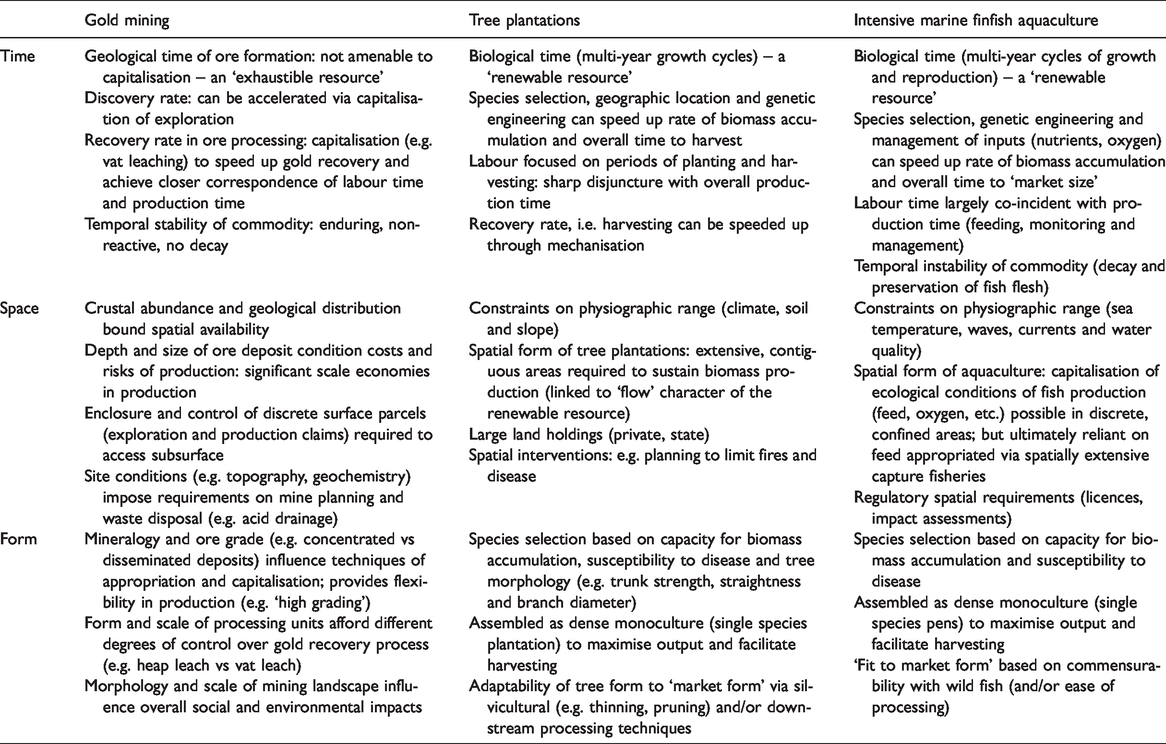
This section deploys the time–space–form framework to offer an empirically informed analysis of industrial dynamics across three sectors closely associated with the commodity frontier: gold mining, industrial tree plantations and intensive (marine) aquaculture. We acknowledge these sectors are internally heterogeneous but here, and in common with other cross-commodity analyses of political economy (e.g. Fine, 1994), we have sought to ‘read for difference’ across the sectors, attentive to the specific and diverse ways socio-ecological processes are harnessed for accumulation. In what follows, we identify significant time, space and form characteristics of gold mining, tree plantations and intensive aquaculture that influence the dynamics of capital accumulation in these sectors (summarised in Table 1), laying foundations for a conceptual analysis (next section) of how the appropriation of biophysical processes by capital shapes strategies on the commodity frontier.
Significant time, space and form characteristics of gold mining, industrial tree plantations and intensive marine aquaculture.
Gold mining
Valued as a symbol of wealth and store of value for millennia, global gold mining and exploration accelerated sharply during the 1980s as a result of technological change and significant structural shifts in international political economy. Gold production has continued to grow rapidly so that around a half of all the gold ever mined has been extracted in the last 35 years (United States Geological Survey, 2013). 3 Growing production has required mining firms replenish corporate gold reserves through exploration, and we show here how firms’ exploration and production strategies are heavily shaped by the material specificities of gold’s occurrence.
Time
An outcome of geological processes stretching over billions of years, gold is considered a non-renewable resource: its natural production is the result of time scales that cannot be replicated by capital (Boyd et al., 2001: 563). Mining firms are only able to work with the ‘stock of resources’ available so that the industry as a whole is ‘auto-consumptive’ and self-depleting: extraction today undermines the conditions for future accumulation (Bridge, 2000). While this is the case for minerals in general, gold’s physical attributes and manner of geological occurrence exert a very significant influence on the time it takes to successfully locate and define a resource. Unlike iron, bauxite or coal, for example, for which resource location is well known, gold ‘prospecting’ carries a strong element of speculation that is amplified by gold’s relative physical scarcity: with a crustal abundance of 0.0038 parts per million, gold is considered one of the scarcest metals on earth (Schoenberger, 2011). This quality of physical scarcity exerts an influence on exploration activity since the time required to make new discoveries and bring them into production entails sizeable risk, and the commercial viability of a deposit is highly uncertain. The uncertainty and hunt-like quality associated with gold exploration constructs the frontier in a cultural-moral register and not only an economic one, so that the frontier is ‘conjured’ as a space of possibility (the discovery of gold and spectacular financial return) through a ‘magic show of peculiar meanings, symbols and practices’ (Tsing, 2005: 57). Through her work on the Indonesian gold frontier, Tsing shows how the temporal and spatial characteristics of gold exploration – and specifically, the performance of spectacle these material characteristics enable – ‘became linked with migrant dreams of a regional frontier culture in which the rights of previous rural residents could be wiped out entirely to create a Wild West scene of rapid and lawless resource extraction: quick profits, quick exits’ (2005: 59).
More prosaically, the auto-consumptive nature of mining and the consequent threat of resource depletion mean exploration must remain a permanent strategy to prevent discontinuities in production. Beyond its exhaustibility as a resource, time also structures gold production in three other important ways. First, there is no discontinuity of production time and labour time in mineral extraction as a general rule (although there are specific exceptions where, for example, production relies on the seasonal availability of labour or water supplies, as in some cases of hydraulic mining). This means labour regimes in mining tend towards year-round work and efforts to shorten turn-over time centre on economies of scale in production which reduce labour time per unit of output. Second, the close correspondence between production time and labour time in mining means the rate at which labour is applied (often in the form of capital-intensive equipment) exerts a high degree of control over the pace of commodity production. In particular, the rate at which gold is separated from waste material – in both the mining and processing phase – is a key determinant of accumulation, and gold output can be flexed up and down (and labour applied selectively to heterogeneous materials e.g. high grading) in response to market conditions (de los Reyes, 2017). Finally, gold’s temporal stability – associated with both its chemical inertness and enduring symbolic power (reinforced time and again via cultural ceremony and through ‘flight to gold’ at moments of economic crisis) – underpins the metal’s social role as a store of value.
Space
Gold has a widespread geological distribution, notwithstanding its physical scarcity. Gold is mined in over a hundred countries and in diverse geophysical settings that include surface ‘placer’ mines, underground shafts that descend vertically for over four kilometres and high-altitude open pits. The distribution of minerals in the subsurface makes mining a complex undertaking: resource quality is variable, resources are hidden from view and physical conditions (temperature, humidity) can be inhospitable for the work of extraction. Gold occurrence can vary widely in shape, size, quality and consistency. These attributes largely determine the kind of processes and technologies employed to extract it and imply different capital requirements. For example, hard rock deep-level (underground) mining is associated with higher cost requirements than open pit extraction, along with greater logistical complexities, higher capital investment in specialised technologies and longer lead times between development and production (Mogotsi, 2005). Space is also important in other ways. The ultra-low concentrations of gold found in ore bodies mean that gold mining is primarily a waste-disposal business, and a significant space requirement concerns the disposal of the very high volume of extracted materials that have no marketable value. The process of waste disposal is not solely a matter of ‘raw’ space but also demands particular spatial qualities, because of the interactive effects between waste rock and the receiving environment. Finally, mining requires bringing ore body, labour, water, energy and transportation into a spatial configuration – a mining landscape – producing a range of spatial transformations that extend beyond the mine itself.
Form
Nowadays most gold is mined in the form of scattered, ‘invisible’ particles rather than nuggets, and the ease of recovery and processing depends on the geochemical context in which the element is found. As the least reactive metal, gold is generally easier to extract than metals like copper and aluminium which, being reactive, combine with other elements to create chemical compounds (Hammer and Norskov, 1995). Gold also tends to be found with fewer mineral impurities than other ore deposits (Norgate and Haque, 2012), it frequently liberates easily (being a native metal) and so can often be extracted through solely physical rather than chemical means. However, certain types of ores can be metallurgically complex: so-called ‘refractory’ gold deposits, for example – where the gold is bound up with or encased in other minerals – do not respond well to conventional methods of extraction, making the whole process longer and costlier. These variations in form can create large differences in gold recovery rates, although they can be addressed through further capitalisation of the production process to manipulate pH, temperature and pressure levels to maximise mineral recovery (CSIRO, 2015).
There are limited economies of scope in mining, but variations in quality across an ore body provide miners some flexibility in the grade of ore they extract. Grade refers to the amount of gold contained in a mass of ore and is one of the key factors that shape firms’ abilities to adjust production to market conditions. High-grade ores are desirable over low grade ones, everything else being equal, since they allow faster and more efficient recovery of gold. Lower-grade ores entail processing more waste material to get the same amount of gold, resulting in lower gold output by unit of material moved, and making them uneconomic to extract in a low-price environment. Mining firms can selectively target low-cost, higher grade mineralisation within a mine, or across a portfolio of properties, to speed up production time and increase profitability (de los Reyes, 2017). There are significant limits to the flexibility provided by form, however, and reserve grades overall tend to decline as mines reach maturity so that another round of appropriation to locate new reserves is ultimately required.
Industrial tree plantations
Planting a fast-growing species of tree in a monoculture plantation is a very efficient way to obtain uniform and cheap wood for the pulp, paper and timber industries. Although single species plantations have been practiced for centuries (see Aghalino, 2000), the global supply of plantation-grown forest commodities experienced an expansion and intensification in the 1960s. Industrial tree plantations are large-scale, intensively managed, even-aged monocultures of mostly exotic trees like fast-growing eucalyptus, pine and acacia species, destined for industrial processes that produce pulp, paper, timber, rubber and energy (Cossalter and Pye-Smith, 2003). Of the variety of uses for industrially grown trees, the pulp and paper industry is increasingly important and currently consumes over 40% of all industrial wood traded globally (WWF, 2020). Prudham’s (2005) innovative examination of the significance of industrial tree plantations expands on Marx’s early insight into the particularities of capitalist forestry: ‘The long production time … and the great length of the periods of turnover entailed make forestry an industry of little attraction to private and therefore capitalist enterprise’ (2005: 15). Tree plantations seek to solve the limits that ‘natural’ forests imply for extraction in terms of time (by selecting/breeding fast-growing species), space (ensuring access to and control over land) and form (adapting species and techniques to raw material demand).
Time
While ‘wild’ trees may require decades to reach sexual maturity (the family Araucariaceae, for example require more than 30 years (Tella et al., 2016)), trees grown under an industrial plantation regime usually stand for much shorter time scales before harvesting (for example, 5–15 years for Eucalyptus species (Cossalter and Pye-Smith, 2003)). Even so, tree plantations like other forms of agriculture exhibit a profound disjuncture between labour time and production time (Mann, 1990). The majority of production is given over to the biological process of tree growth, with labour inputs confined to concentrated periods associated with planting and harvesting. Mechanisation of planting, maintenance and harvesting processes has implied a general reduction of the labour force needed to extract and maintain plantations (Meneses and Guzmán, 2000). A related obstacle arising from the long period of time between planting and harvesting (during which few people are present within the plantation) is the difficulty and costs of monitoring and controlling access to a growing stock of trees. Many social and environmental conflicts surrounding industrial tree plantations centre on these issues of access and enclosure and are often heightened by the disjuncture between production time and labour time (Gerber, 2011). In short, the particularities of time in tree plantations demand that plantation owners commit resources to mitigate such risks, if they are to protect the future market value of growing trees by ensuring their continuity ‘in production’ (Hall, 2003).
Direct interventions into the biological growth of trees have been key to increasing the industry’s productivity. The use of biotechnology, for example, has helped with the creation of a desired phenotype in order to speed up the time for growing trees. Controlled species crossing, vegetative propagation, establishment and management of seedbeds, gene testing and development of clone banks allow for better control and modification of trees’ natural growth, although not without controversy (Häggman et al., 2013; Mathews and Campbell, 2000). Improvement of seeds via genetic engineering can increase the growth rate by as much as 20–40%, as trials in US, Brazil and China have shown on eucalypts, pines, poplars and fruit trees (Fenning and Gershenzon, 2002).
Space
Industrial rates of tree harvesting, dictated by the capital costs of sawmills and/or other processing facilities, require large areas of land to be dedicated to tree production. While conditions vary, profitability generally comes with plots bigger than 200 hectares (Meneses and Guzmán, 2000). However, optimal sizes can be considerably larger: in Indonesia, for example, the optimal area for an industrial tree plantation is considered to be 30,000–50,000 hectares (Hall, 2003). In many cases, these large extensions are achieved via land grabs (Borras et al., 2012; Gerber, 2011; Lyons and Westoby, 2014) led by private corporations with the support of the state. The adaptation of space for tree production frequently involves changes in land use that are symbolically mediated as, for example, when native forests, scrub and existing agriculture lands are classed as ‘unproductive’ or ‘unused’. The meanings attached to land, and to different land uses, are internal to the distinctive socio-metabolism that characterises the resource frontier. Understanding the specific historical and geographical conditions under which land appropriation for industrial tree production occurs (i.e. is made possible, acceptable and even desirable) requires, therefore, examining the interplay of both forest land’s economic and moral-symbolic elements (Mann, 2009).
Space is not only a matter of the land and soil where trees are planted but also includes conditions of water availability, organic matter composition and slope. Tree plantations are seldom irrigated as trees appropriate atmospheric and soil moisture directly (and without paying taxes) although, in doing so, they abstract water from local communities (González-Hidalgo, 2015). Slope also makes a difference, since mechanical work is easier on lands with a lower slope, and the value placed by the tree cultivation industry on flat plots is a driver of the transformation of agricultural land into tree plantations. The spatial constitution of plantations as tree monocultures creates challenges for the governance of tree plantations as forest fires and plagues can spread easily. The prevention and control of both, therefore, generate new opportunities for capital accumulation via new technologies and the outsourcing of workers and services (González-Hidalgo and Zografos, 2017). Wasps, moths, beetles and fungi can devastate hundreds of hectares causing large-scale economic damage. However, investments in phytosanitary controls can reduce risk, illustrating how capitalising the conditions of biological control can offer a window for expanding capital accumulation in the industrial forestry sector.
Form
Tree form in industrial tree plantations is adapted to demands of the market, with the nature of the anticipated product determining species selection and the subsequent application of different types of silvicultural work: for example, pruning creates small logs destined for pulp, while thinning practices enable the production of medium size logs for sawmills. The selection and application of these different techniques depends, to a large extent, on international raw material demand so that the malleability of tree form offers plantation owners a degree of flexibility in matching materials to markets (Kay, 2017; Meneses and Guzmán, 2000). Beyond species selection and the management of growing stock, biotechnology has also opened up opportunities to expand value by modifying quantitative (volume of material) and qualitative properties of timber, pulp and biomass (trunk straightness, branch diameter) (Tzfira et al., 1998) and identifying genotypes resistant to pests, diseases and extreme conditions (for example, Eucalyptus cladocalyx adapted to droughts or the Chinese GM-poplar, which is resistant to very damaging insect and plague losses, see Kröger, 2014). The growing use of biomass for industrial energy production has also motivated the selection of genotypes for this purpose (Harfouche et al., 2011). In the last years, and with diversification (flexibilisation) of the tree industry in the context of the ‘bioeconomy’, new tree species are being created to cater not only pulp and timber markets, but a diversity of markets that now need tree ‘products’, such as wood-based energy, carbon sinks and timber products replacing fossil fuels (see Kröger, 2016). This process of ‘flexing crops,’ as Borras et al. (2016) explain, implies that ‘crops and commodities have greater capacity as substitutes for both inputs and outputs, thus potentially stimulating greater changes in production systems and power relations’ (Borras et al., 2016: 95).
Intensive marine aquaculture
Aquaculture has been one of the fastest growing food producing sectors in the last decades, demonstrating remarkable growth especially in the 1980s and 1990s (Food and Agriculture Organization of the United Nations, 2016). It has surpassed capture fisheries to become the dominant type of seafood production and has played an important role at supplying the globally rising demand for fish. The perception that aquaculture enables production ‘beyond the natural capacity of environment’ (European Commission, 2012b: 7) has led to its promotion as a substitute for, or complement to, stagnating and declining wild fish stocks (Ertör and Ortega-Cerdà, 2017; Islam, 2014; Saguin, 2016). Nevertheless, the forms in which intensive marine aquaculture materialises on the commodity frontier reveals capital’s continuing sensitivity to the biophysical particularities of fish.
Time
One of the reasons for capital’s turn from capture fisheries and small-scale aquaculture towards intensive (marine) aquaculture is that it offers time-reduction possibilities that speed up the production process and the turnover of capital. Indeed, fish farming epitomises how the ‘life cycles of plants and animals are increasingly subjected to economic cycles of exchange’ (Longo et al., 2015: 169). Compared to their wild counterparts, many fish species can be produced faster in a fish cage when provided with the essential ingredients. Still, the nature-based character of fish production makes time a limiting factor. For many fish species, the necessary time to reach harvestable maturity cannot be shortened to days or weeks. It takes several months or usually more than a year, especially in large, high-value carnivorous species, i.e. around 1.5–2 years for sea bass, 2 years for cod and 3–4 years for Atlantic salmon (European Commission, 2012a). In order to overcome this challenge, the aquaculture industry has applied several methods including (i) intensified use of inputs like more efficient feed, (ii) drugs for growth promotion purposes and hormones, (iii) changing the temperature and/or lighting of pens and/or (iv) by directly producing GMO fish (Bailey et al., 2015; Bayarri et al., 2009; Longo et al., 2015; Salze and Davis, 2015; Seas At Risk, 2015; Yamazaki, 2011). Genetic engineering and genetic modification of animal feed have already been on the scene for some decades (Sanden et al., 2004). A further step has taken place, when in 2015 the US Food and Drug Administration controversially approved the production of GM salmon for human food, marking the first genetically modified animal approved for direct human consumption (Food and Drugs Administration, 2015; Grossman, 2016; New York Times, 2015; The Guardian, 2017). Finally, time is also a limiting factor for aquaculture production with regards to the decay and preservation of fish flesh. While the final product obtained can be processed and marketed in different ways (e.g. canned, salted, frozen and ready to cook), its processing or marketing have to occur relatively quickly to avoid spoilage or wastage.
Space
The spatial distribution of intensive fish farms is limited by two geographical factors. First, the geography of marine aquaculture production is shaped by the natural conditions of the sea. Locations are deemed suitable based on an evaluation of the winds, waves, currents and water quality, i.e. based on the impact of biophysical conditions on production. Second, fish farm location is regulated by national licensing legislation and environmental impact assessment procedures for each marine area, which increasingly take account of impacts of production on biochemical conditions of marine space. Although there are trials to place cages further offshore, fish farms are generally easier to manage, and thus more profitable, when they are closer to the coastline as they are shielded from tougher weather conditions and stronger ocean/offshore currents.
Form
Farmed fishes have a different biophysical form since, instead of being born in the sea, they are born in the tanks of a fish hatchery and spend their life in captivity. Compared to their wild counterparts, hatchery-raised juvenile fish cannot maintain their genetic fitness (and can hardly adapt to changing natural conditions) since they are protected from predators and fed pelleted feed at regular intervals. Moreover, farmed fish usually come from a narrower pool of broodstock which leads to a lack of genetic biodiversity and a greater vulnerability of the fish population to illnesses (Longo et al., 2015: 125–126). Aside from these genetic differences, an exponential rise in the production of fish flesh is not possible for two reasons. First, the final product still has to be produced in the bodily form of a fish. Its biophysical characteristics do not allow fish flesh to be produced in divided pieces, nor in laboratories totally isolated from ecological cycles. The ‘commodity’ remains, then, a biological one dependent on cycles of reproduction and maturation, in which gains in turn-over time require a high level of control over fish health and product quality, both during the fish’s lifetime and after being slaughtered. Second, although aquaculture is proposed as a techno-fix solution to overexploited fisheries (Saguin, 2016), fish fed in cages require a great quantity of fish meal and fish oil in their feed, especially in the case of carnivorous species. This feed is obtained from capture fisheries (Tacon and Metian, 2008). Biomass feed requirements can be 2.5–5 times as much as is produced, although fish-in/fish-out ratios change according to species and the aquaculture sector is always looking for ways to decrease their dependency on fish meat and fish oil (Naylor et al., 2000). Naylor et al. (2000: 1019) claim that ‘regardless of the exact efficiency ratio used … the growing aquaculture industry cannot continue to rely on finite stocks of wild-caught fish, a number of which are already classified as fully exploited, overexploited or depleted’. Aquaculture, then, does not provide an alternative to endangered marine stocks. Rather, it caters to the production of economically valuable, well-known and bigger species at the expense of exploiting – or overexploiting – smaller and less known varieties by shaping the form of the ‘commodity’ at stake.
To summarise, in this section, we have introduced three sectors associated with the commodity frontier and illustrated empirically how temporal, spatial and material qualities of the underlying biophysical processes condition the way non-human natures are reconstituted during commodity production. We have emphasised economic dimensions of this process, while also acknowledging how the socio-metabolic relations that characterise commodity frontiers are symbolically mediated (Andueza, 2020; Mann, 2009). In the next section, we discuss the strategies adopted by capital to access and control biophysical dynamics in these nature-based industries.
How time, space and form condition strategies on the commodity frontier
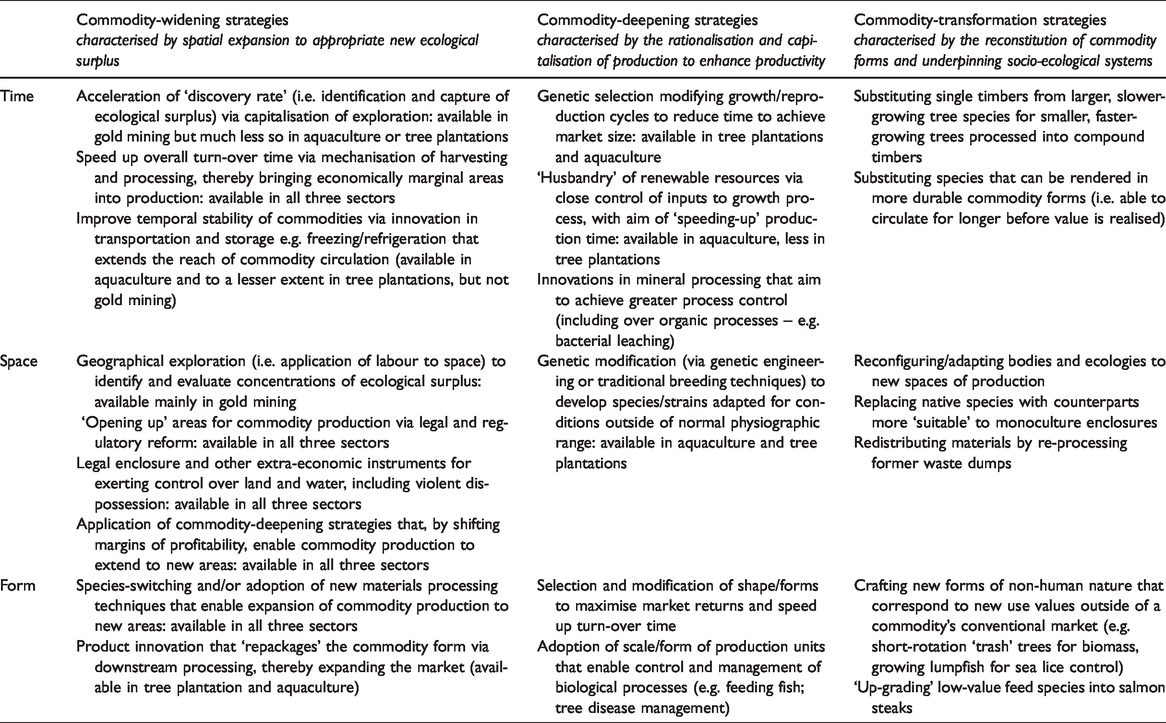
The production of ‘cheap natures’ (as Moore puts it) is far from straightforward. In this section, we examine how the temporal, spatial and material characteristics of gold, trees and fish influence strategies of appropriation and capitalisation on the commodity frontier; and how these strategies strive to reshape the times, spaces and forms of biophysical materials and environments in the image of capital. In doing so, we show concretely how capital ‘works through nature’ in these sectors on the commodity frontier and identify an alternative strategy (commodity-transformation) that is occluded by focusing only on commodity-widening and -deepening and which may be harnessed when these strategies are blocked or are otherwise unavailable. The analysis and discussion in this section is summarised in Table 2.
Examples of how strategies of commodity-widening, -deepening and -transformation harness time, space and form.
Commodity-widening
All three natural resource sectors present opportunities for capital accumulation through the replication or extension of commodity production techniques across space. This process of commodity-widening rests on the appropriation of material concentrations and/or biophysical conditions in the natural environment that can be ‘made to bear value’ via commodity production (Robertson, 2012). Commodity-widening in these sectors, then, is a classic form of primitive accumulation, as it centres on gaining control over materials and conditions of production that acquired their concentrated form through processes other than capitalist social relations.
The process of appropriation in the three sectors shares some important commonalities. First, in each case, opportunities for commodity-widening are spatially differentiated: geographical variation in the presence and quality of materials means some places present greater opportunities for the appropriation of ecological surplus than others. Second, in each case, ecological surplus is already territorially and culturally embedded: subject to competing claims, and enrolled into structures of meaning and economies of signification, the social entanglements of biophysical materials can be enabling or hostile to accumulation (Anthias, 2018; Baviskar, 2003; Pasternak and Dafnos, 2018). Third, accumulation via the appropriation of ecological surplus is constrained by the capacity of these surpluses to bear value in commodity production. Commodity-widening strategies in all three sectors rely, then, on configuring heterogenous materials in ways that allow them to qualify for commodity markets.
Beyond these shared conditions, opportunities to appropriate surplus present themselves in different ways across the sectors. When considered as a strategic action carried out by individual capitalists, commodity-widening is constituted through several specific practices. Of these, the identification (discovery), evaluation (selection) and control (exclusion) of new ground are the most significant. All three practices are central to accumulation in the mining sector, where they combine within the general term ‘exploration’. The non-renewable, ‘stock’ character of mining (time) and the physical occurrence of ore in multiple, dispersed underground locations (space) mean that exploration is a highly capitalised and structurally permanent part of the sector. The activity of exploration firms in identifying, evaluating and appropriating ecological surplus creates a vital ‘pipeline’ of projects for the sector as a whole. The fundamental uncertainties and risks associated with mining exploration – i.e. the possibility of a large discovery – also tie commodity-widening in this sector (and the ‘mining frontier’, more generally) to economies of speculation, in ways not seen with timber and fish. Research with communities experiencing intense periods of mineral exploration and claims-making activity point to uncertainty and speculation as key drivers of social conflict (Bebbington and Bury, 2013).
While some exploration-like practices are associated with timber plantations and fish, exploration in these sectors is not capitalised to the same extent. In general terms, ‘good’ areas for growing trees and raising fish are more easily identified so that strategy in these sectors is not directed towards discovering and evaluating new potential areas of production. Instead, strategy is directed either to controlling access to the best ground (land or ocean grabs) or managing conditions of production in ways that maximise the value of ecological surplus (i.e. commodity-deepening, see below). ‘Land grabbing’ – i.e. control and exclusion – is present in mining too, but it has additional significance in the case of fish and timber because of the limited opportunities in these sectors for discovery and because of the scale of the land units required to generate acceptable levels of return (which, as we show below, is linked to the ‘flow’ nature of fish and timber resources).
The ‘spatial instruments’ through which commodity-widening strategies unfold in each of the sectors are influenced by the material characteristics of the sector. Commodity-widening in timber materialises through the acquisition of extensive, contiguous areas over which commodity production can be generalised. Enclosure in timber takes the form of large-scale land parcels, with existing land use/land cover converted to monoculture plantations amenable to industrial planting and harvesting techniques; current land users are either dispossessed of access to land or experience very significant changes in use rights. Aquaculture and mining, by contrast, adopt less extensive and more ‘molecular’ forms of enclosure (Bridge, 2009). In gold mining, this reflects a need for access to the subsurface and the limited ‘flexibility’ of individual ore bodies for commodity-widening (i.e. constraints on being able to extend their horizontal and vertical reach); in intensive marine aquaculture, the spatial form of enclosure is influenced by technical capacities (e.g. exerting control over feeding and oxygenation regimes) and key ecosystem dynamics such as the circulation of water and transport of waste materials. As a result, commodity-widening in both these sectors occurs through the development of multiple non-contiguous sites, each of which is relatively small in comparison to timber.
Commodity-deepening
Commodity-deepening occurs when processes of appropriation become increasingly capitalised. Rationalisation and socio-technical innovation reorganise the process of commodity production in an effort to boost productivity and sustain the capture of ecological surplus. Like the commodity-widening strategies discussed above, these strategies are uneven across space and time and are shaped by material characteristics of timber, fish and ore.
Timber plantations and intensive marine aquaculture are classic examples of capitalisation. Both are practices of cultivation in which the ecological conditions that sustain biomass accumulation have been progressively capitalised, making them qualitatively different to the extractive activities of old growth logging and capture fisheries (Boyd et al., 2001). In intensive marine aquaculture, for example, genetic selection, nutrient supply and oxygenation are objects of capitalisation with the objective of steering the direction, pace and consistency of production processes in ways that enhance accumulation. Timber plantations have similar processes of species selection and growth management, although with less direct control over nutrient supply and other biophysical conditions of growth over the full life cycle (in part, because of the extensive spatial form adopted by plantations). In these sectors, capitalisation seeks to directly manipulate form, time and space. Socio-technical interventions in biologically based production systems, for example, frequently aim to speed up overall production time and, in particular, to reduce the period of time (e.g. germination, growth) in which commodity production ‘is handed over to the sway of natural processes, without being involved in the labour process’ (Marx, 1992/1885: 317). Interventions that shorten production time, then, not only introduce greater control over the process (by lessening the time commodity production is exposed to the vagaries of natural processes) but, importantly, are able to speed up the overall turn-over time of capital (Mann and Dickinson, 1978). This is a central strategy in industrial timber production, for example, where a goal of innovation has been to shorten the wood production cycle through species selection, genetic modification and enhanced land management. Genetically modified tree species have been shown to improve growth rates by as much as 20–40% in key industrial species, such as pines, eucalypts and poplars (Fenning and Gershenzon, 2002).
Mining may be the epitome of extraction/direct appropriation and seem an unlikely sector to experience commodity-deepening, particularly as the deep-time processes of gold formation lie outside human control and are not a viable target of capitalisation. However, methods for producing gold from sulphide ores rely on biochemical processes of oxidation that, over the past couple of decades, have become a key target of innovation aimed at achieving greater process control and accelerating the rate of gold recovery. The application of bacterial oxidation techniques which use ‘sulphide-eating’ bacteria to treat gold ores, and oxidation using high pressure autoclaves, both capitalise natural processes of sulphide oxidation with the goal of controlling their productivity and speeding up their yield of gold (Labban, 2014). Commodity-deepening, then, is a significant strategy in relation to these so-called ‘refractory’ gold ores that traditionally have released their gold content too slowly (or erratically) to be commercially viable.
While manipulating time and form are the primary targets of commodity-deepening, there are also instances where it occurs by transforming space. Plant and animal breeding techniques that enable species to be grown outside of their normal physiographic range have the effect of ‘stretching’ space. This is evident in both industrial tree plantations and intensive marine aquaculture, where the entry of new species to the same space can give rise to a series of environmental and social conflicts associated with inter-species competition, variable demands on the ecological conditions of production (water, nutrient cycling) and the social valuation of different species. In a similar way, breeding and feeding regimes in intensive marine aquaculture reproduce, in a highly compressed form, the vast spaces of ocean associated with the life cycle of migratory, anadromous fish species (such as the salmon). The dense accumulation of waste materials resulting from this ‘metabolic rift’ (Clausen and Clark, 2005) can become a widespread and long-term source of conflict over intensive marine aquaculture.
In summary, in this section, we have shown how commodity-widening and commodity-deepening strategies are present in all three sectors; how opportunities for adopting these strategies are shaped by the temporal, spatial and material-symbolic characteristics of underpinning biophysical systems; and how strategies of commodity-widening and -deepening on the commodity frontier are achieved by manipulating not only space but also time and form. We now go further to argue that a third strategy is available on the commodity frontier that is not captured by the literature’s focus on commodity-widening and commodity-deepening.
Commodity-transformation
Attempts to rework nature at the commodity frontier are not limited to strategies of commodity-widening or -deepening. Commodity-transformation, as we call it, refers to the active reconstitution of commodities (and the ecological systems on which they depend) in an effort to realise greater value in exchange. This can involve the crafting of forms of non-human nature that correspond to new use values outside of a given commodity’s conventional market. For example, lumpfish – once harvested as a source of caviar – is now farmed on an industrial scale as an ‘organic’ means to treat farmed salmon for sea lice instead of the use of pesticides (Imsland et al., 2018, 2019). As a strategy, commodity-transformation aims not simply to extend the geographies over which a given commodity is produced, or to enhance productive intensity at a given commodity frontier. Rather, it aims to alter the value-form, harnessing certain characteristics and muting others depending on shifts in their end-use and the markets through which their value as commodities can be realised. Commodity-transformation is thus a higher-order strategy that is analytically distinct from (although in practice related to) the strategies described above. When commodity-widening or commodity-deepening strategies encounter limits or challenges, production strategies can be diverted towards commodity-transformation – i.e. changing the time, space and form of commodities themselves (and the ecologies on which their production depends) in the interests of furthering accumulation.
In principle, commodity-transformation can be understood as an extension of the strategies of production control required for materials to qualify for markets (which are constituted, in part, through specifications on product quality). Commodity-transformation proceeds in multiple ways as an empirical practice but, in each case, it is focused on modifying the form of the commodity (enhancing or creating additional use values) to realise greater value through exchange. The re-purposing of local ecologies to produce commodity forms that attract a higher market value is an option in biologically based systems. Recent shifts in tree cultivation practices in favour of short-rotation ‘trash’ species of trees, for example, aim to expand their use as biomass for the energy market rather than for timber or pulp production. Trees cultivated for biomass are typically very fast growing (two to three years), densely planted and engineered to have high proportions of lignin instead of cellulose – the opposite characteristics sought in trees destined for wood and paper production (Couto et al., 2011; Overbeek, 2011). Commodity-transformation strategies mean that the industrial forestry frontier for pulp and paper, therefore, is qualitatively different to that for energy biomass. Similarly, in intensive aquaculture, commodity-transformation occurs when firms seek to re-purpose particular breeds/species or their by-products to capture value. For example, the expansion of Atlantic salmon aquaculture far beyond its native habitat has not occurred by simply replicating the same fish and farming techniques across space. Rather, it has been made possible by reconfiguring fish bodies and ecologies and articulating particular symbolical and cultural meanings of fish-as-protein. Thus, the industrial creation of novel aquaculture geographies has required adapting fish – via selecting stock – to the particular ecological and geochemical conditions of marine environments not previously used for commercial fish production; and strengthening the perception of fish as a commodifiable protein source rather than a food species embedded in a complex and interdependent social and ecological system (Levkoe et al., 2017). 4 The use of genetic modification in fish farms (and industrial tree plantations) further enhances the ability to tailor species to particular growing conditions, value-adding labour processes (e.g. fish processing, timber milling) and culturally mediated market demands, enabling market-ready fish (i.e. forms of fish that qualify for markets) to be produced at lower cost. The novel geographies of the commodity frontier, then, rest on engineering commodities (adapted fish bodies) and production systems (fish ecologies) that are qualitatively different. While these are, in general terms, instances of appropriation and capitalisation such designations are insufficiently specific about the ways capital ‘works through nature’ on the commodity frontier.
Industrial timber and intensive marine aquaculture production also present opportunities for commodity-transformation via a combination of species-switching and downstream materials processing. Both of these seek to ‘upgrade’ raw materials so that they qualify for existing commodity markets. In timber, for example, smaller species can be grown, harvested and processed into compound timbers to substitute for single timbers from larger, slower-growing species. In the case of fish, high-value species (like salmon, sea bass or sea bream) usually qualify for global markets (rather than small pelagic fish which also has a high nutritional value but a low exchange value). In this way, commodity-transformation strategies work through the bodies of these species: smaller species are ‘upgraded’ into salmon steaks through the feeding process. In contrast to the tendency to ‘fish down’ marine food chains in capture fisheries (Pauly et al., 1998), industrial interventions transform lower-grade species into forms that bear value in commodity markets through commodity-transformation strategies. A similar strategy of commodity-transformation via downstream processing is available in some mineral sectors, where the allocation of processed materials to the categories of ‘product’, ‘by-product’ and ‘waste’ can be adjusted to accommodate market shifts. This strategy characterises some poly-metallic mineral deposits (such as cobalt, historically a by-product of nickel and copper mining); the mining of brines from which a variety of commercial products (salt, iodine, lithium, magnesium and potassium) can potentially be recovered; and the re-working of dumped materials formerly regarded as wastes – a strategy used at some gold mining operations. The political–ecological significance of commodity-transformation here is that it changes the objectives and metrics by which production systems are optimised. Managed to yield one commodity rather than another, capital circulates through nature in a different way – with consequences for working conditions and environmental impacts.
Conclusion
The contemporary historical conjuncture is characterised by rapid socio-ecological transformation, and an intensification and diversification of strategies that seek to secure accumulation by circulating capital through nature. In this context, the ‘commodity frontier’ has emerged within political ecology and agrarian political economy as an important problem space, a complex spatio-temporal assemblage identified as central to the spiralling expansion of capitalist social relations. Metabolic perspectives on the commodity frontier focus on its association with historical processes of socio-ecological appropriation and transformation and isolate two distinct strategies at work on the commodity frontier: commodity-widening and commodity-deepening. We have argued, however, that this work underspecifies the practices by which capital works through nature on commodity frontiers, and that it does not adequately conceptualise how these practices are shaped by the biophysical specificities of the raw materials being commodified.
We have argued that research on the political ecology of the industrial dynamics of primary sectors, attuned to the biophysical specificities of activities like mining, tree plantations and intensive aquaculture, can make an important difference to understanding the practices at work on commodity frontiers. We have applied insights from this work, exploring similarities and differences in how three different extractive sectors encounter nature, and considering how the biophysical specificities of this encounter shape ‘industrial dynamics’ (i.e. accumulation strategies) in these sectors. We have provided a close and systematic reading of three sectors that deploys an analytical framework (time–space–form) drawn from work on industrial dynamics; in doing so, we have brought this framework into conversation with recent work on divergent strategies associated with the commodity frontier. Our paper shows how paying close attention to industrial dynamics can extend understanding of the socio-metabolic processes that characterise the commodity frontier in two ways. First, by rooting strategies of commodity-widening and commodity-deepening in the encounter with the material-symbolic properties of non-human natures, we have shown how the necessity to work with, around and through nature leads to a diversity of strategies of commodification. Second, we have highlighted a third strategy, not fully captured by previous work on commodity frontiers, which we dub commodity-transformation.
More broadly, the paper contributes to recent efforts to systematically consider the distinctiveness of nature-facing sectors and their implications for geographical analysis. We have demonstrated the utility of the ‘time–space–form’ schema (Boyd et al., 2001; Prudham, 2005) as an analytically precise and methodologically generative framework for examining commodity production in industries as diverse as gold, trees, and farmed fish. This framework shows how strategies of appropriation and transformation reflect and are adapted to, biophysical specificities while also sharing a fundamental similarity: strategy in each sector is profoundly shaped by the material properties of the resource in question. An implication of our argument is that paying close attention to the material-symbolic specificities of industrial dynamics in nature-facing sectors can productively disturb narratives of the commodity frontier as a space of inevitable incorporation, characterised by the transmission of industrial demands into commodity flows. This is an urgent task in an era of booming resource extraction, rapid urbanisation and globally uneven development.
Highlights
Compares strategies of appropriation in three sectors often associated with the commodity frontier: gold mining, tree plantations and intensive aquaculture Brings research on the industrial dynamics of ‘nature-facing’ sectors into conversation with recent work on capitalism as an ecological regime Analyses how capital works through nature on commodity frontiers and identifies a strategy of commodity-transformation alongside strategies of commodity-widening and commodity-deepening Argues for grounded examination of how non-human natures are reconstituted at commodity frontiers, attuned to the diverse and specific ways in which socio-ecological processes are harnessed to dynamics of accumulation
Footnotes
Acknowledgements
We gratefully acknowledge the insightful comments of reviewers who pushed us to clarify certain parts of the argument, and thank the Editor of Environment and Planning E for the opportunity to respond to their comments. The authors alone are responsible for the content of the paper. The views expressed in this paper are those of the authors and do not necessarily reflect the views of the European Commission.
Declaration of conflicting interests
The author(s) declared no potential conflicts of interest with respect to the research, authorship, and/or publication of this article.
Funding
The author(s) disclosed receipt of the following financial support for the research, authorship, and/or publication of this article: Research for this paper benefited from EC funding under the Marie Curie Actions - Initial Training Networks - FP7-PEOPLE-2011; contract No 289374 - ENTITLE (European Network of Political Ecology).
