




Abstract
Methodological advancement within more-than-human geography lags behind its theorization. As an intervention into the promise of visual methods for enlivening more-than-human geographies, I describe working with a photographic practice for exploring geographies of encounter between humans, the animals they care for, and wild animals. This is presented through discussing a collaborative project employing photovoice to explore wildlife conservation politics in a landscape where both humans and animals have the capacity to kill, and be killed, by one another. Through engaging with photographs and text produced over the course of six months by six individuals living in close proximity to Bandipur National Park in Karnataka, India, I explore entangled relations between humans and animals and the production of more-than-human hierarchies. I consider the potential of a visual method for practicing more-than-human geographies as an exploration of affective encounters. This paper contributes to on-going discussions and debates on decolonizing more-than-human geographies. More specifically, I suggest photovoice as one means by which more-than-human geographies can remain critically engaged with and speak out against enactments of injustice and violent legacies of colonialism that reach across species divides.
Keywords
Introduction
The sub-disciplinary field of more-than-human geography is now 20 years in the making. Whatmore and Thorne (1998, 2000) are credited with coining “more-than-human geographies,” later popularized in Whatmore’s (2002) book Hybrid Geographies. In it, and in related texts, Whatmore (2006) sets out a thesis that geographers need new modes of theorizing cohabitation in landscape to attend to the “livingness of the world” (602). Whatmore (2006: 602) argues for a more expansive approach to materiality concerned with “the intimate fabric of corporeality” and the intra-actions that produce subjects in relation to one another through their connections (Barad, 2003). These “more-than-human” ways of doing research interrogate landscape as co-produced bio-geo-graphies (Barua, 2014a)—what Tim Ingold (2000, 2005) calls landscapes of dwelling, full of lives with their own agential capacities for enacting social worlds (Whatmore, 2006: 604). Alongside these efforts to expand human geographies’ ontological and epistemological perspectives are embedded questions of practice. As Whatmore (2006) compelled over a decade ago: The experimental demands of “more-than-human” styles of working place an onus on actively redistributing expertise beyond engaging with other disciplines or research fields to engaging knowledge practices and vernaculars beyond the academy in experimental research/politics (607).
In this paper, I assess how a collaborative photography practice, photovoice, engages with two related questions emergent from themes assessed by Buller (2015) and later Hovorka (2017, 2019) in their respective progress reports on animal geographies: (1) what insights do modes of “redistributing expertise” hold for enquiring into power relations within more-than-human geographies; and (2) how can such approaches find purchase with critiques that more-than-human geography remains anemic to questions of interspecies justice, violence, dispossession, and inequality? My argument is that photovoice advances visual sensing as an affective methodology attuned to politics of dispossession, inequality, and power. Photovoice re-works researcher–subject distinctions and binaries, and as a result, the process of how directions of enquiry are pursued (Wang and Burris, 1997). At the same time, as an active method of creative practice, photovoice offers a visual means for exploring affective dimensions of human–animal entanglement, and as I will argue, opportunities to engage with animal presence.
In what follows, I draw on textual and visual materials produced in 2015–2016 in Karnataka, India, around Bandipur National Park. The motivation for the project was to document and publicly communicate about the everyday experiences of individuals and rural communities living with wildlife in a politically contested landscape. This resulted in a set of photoessays published as “The Book of Bandipur” in 2017 by the project participants archived through the People’s Archive of Rural India (https://ruralindiaonline.org/articles/book-of-bandipur). The project authors, Jayamma Belliah, Nagi Shiva, K Sunil, KN Mahesha, M Indra Kumar, and N Swamy Bassavanna, produced a series of photoessays offering insightful critiques and analyses of wildlife conservation management in India within a landscape fraught with deadly and destructive encounters between humans, their property and domestic animals, and a variety of wild animals. The photoessays speak to conservation in Bandipur as a practice of territorialization rooted in colonial histories of dispossession. They reveal means by which the spatial ordering of conservation space in Bandipur reshuffles hierarchies of human and animal life whose effects are differently felt across axes of gender, race, caste, class, species, and animal breed. They also demonstrate how becoming attuned to animal presence, the ways in which human life is always affecting and affected by other animal lives, can be approached through absence and uncertainty as modes of relating.
I have written this paper from my vantage point as project facilitator. In reflecting on the project’s outcomes and process over a year after its completion, I found resonances with discussions about experimentation with visual methods within more-than-human geographies (Dowling et al., 2017, 2018; Hodgetts and Lorimer, 2015; Lorimer, 2010; Pitt, 2015). In particular, I became interested in how these methodological discussions intersect with questions about power, social difference, and inequality in crafting more-than-human geographies that feature nonhuman animals and their territories as central subjects (Hovorka, 2017, 2019; Margulies and Bersaglio, 2018). I therefore draw on the project’s approach and results as a means to reflect on the sticky intersections of these methodological and political questions. Engaging with photovoice as more-than-human practice advances debates about whose voices emerge through more-than-human scholarship, what are the means by which they do so, and the stakes involved in furthering decolonizing efforts within more-than-human geographies.
In the next section, I review recent engagements with experiments in crafting and visually sensing more-than-human geographies before describing the particular methods employed in this project. This is followed by a brief introduction to Bandipur’s conservation geography followed by the paper’s main analysis, advanced through discussing “The Book of Bandipur” and the particular advantages of photovoice for engaging with the affective, embodied capacities of human–animal entanglements.
Visual matters
A variety of geographers have noted that application of novel methods in more-than-human geographies lags behind the field’s more developed theorization (Barua, 2014a; Bastian et al., 2016; Bell et al., 2018; Buller, 2015; Dowling et al., 2017, 2018; Hodgetts and Lorimer, 2015; Hovorka, 2017; Lorimer, 2010; Pacini-Ketchabaw et al., 2016). This gap between theory and practice is especially striking in the context of research focused on human–wildlife encounters often marked by injury, death, and destruction (Collard, 2012; Dowling et al., 2017). In the instances where critical geographers have incorporated more-than-human perspectives into analyses of violent encounters between different human actors and nonhuman animals, such as cougars (Collard, 2012), small felines (Sundberg, 2011), elephants (Barua, 2014b; de Silva and Srinivasan, 2019), lions (Barua, 2017), tigers (Doubleday, 2018; Margulies, 2019), and bears (Jampel, 2016), the data collection and analytical methods employed in these studies remain primarily textual in their approach (but see Barua, 2014a; Evans and Adams, 2018). The contributions of these papers to the field are meritorious and many, but in summary, more-than-human geography remains open for creative experimentation, especially in the context of studying the political ambit of spatial contestations with a host of lively actors.
Affecting
While incorporating visual materials into geographic analyses is nothing new (Gregory, 1994), geographers have historically relied on visual materials as representational objects rather than considering what working with visual materials as an active process might do (Dowling et al., 2018; Oldrup and Carstensen, 2012; Pink, 2001; Rose, 2016). Approached in this way, photographs, among other visual formats such as motion picture film and drawing, do more than merely represent space and place. Instead, they can be used to capture that which evades textual description, the affective and haptic dimensions of human relations with other kinds of life (Johnsen et al., 2008; Lombard, 2013; Lorimer, 2010; Oldrup and Carstensen, 2012; Pitt, 2015; Schwartz, 1989). Affect names the intensities of relations between beings and their capacities “to act and be acted upon” (Gregg and Seigworth, 2010: 1; Massumi, 2002). Distinct from emotion, affect is not an experience internal to the subject but something constituted between beings (Gregg and Seigworth, 2010). As Juno Salazar Parreñas (2012) writes, “…it is between bodies that we come to feel affect” (682). While the field of affect theory is immense and varied, much of the research within more-than-human geography and related fields draw on the canon of scholarship inspired by Spinoza’s (1996 [1677]) original writings on affect, Deleuze’s (1988) writings on Spinoza, as well as their more contemporary interlocutors (Bennett, 2009; Massumi, 2002; Stengers, 2010). In reviewing methodological approaches to more-than-human geographies, Lorimer (2010: 239) highlights the importance of new modes of doing research that engage with processes of “learning to be affected,” and creative sensory techniques for appreciating the corporeal existence of others. Learning to approach affect in images therefore demands looking beyond a picture’s capacity to represent, to instead consider what images reveal about the ebbs and flows of relations emergent between bodies, rendered momentarily still.
A variety of geographers, drawing on works from visual studies such as Bergson (1988), Nancy (2005), and Rancière (2007), have explored approaches to the meaning of images and image-making beyond their representational form (Crang, 2003, 2009; Dowling et al., 2018; Latham, 2003; Latham and McCormack, 2009; Oldrup and Cartensen, 2012). Writing about nonrepresentational approaches to images within geography drawing on the work of Henri Bergson (1988), Latham and McCormack (2009) clarify that “an image is never just a representational snapshot; nor is it a material thing reducible to brute object-ness. Rather, images can be understood as resonant blocks of space-time: they have duration, even if they appear still” (253). There are a variety of mediums beyond the still image through which geographers might approach “more-than-representational” visual methodologies to explore their less certain, affective qualities (Lorimer, 2005). One such method, as Lorimer (2010, 2013) explores, is moving image or motion picture methodologies. Motion pictures are immersive, evocative, multisensory experiences. Creating and analyzing film remains a promising method to explore more-than-human geographies (Amir, 2019; Fijn, 2012; Richardson-Ngwenya, 2014; Vannini, 2017), particularly given the prominence of motion picture media in contemporary life. Other, more experimental visual methods include engaging with time-lapse photography (Simpson, 2012), drawing (Brice, 2018), ethological video surveillance technologies and body sensors (see discussion by Hodgetts and Lorimer, 2015; Lorimer et al., 2019), and performative creative practices, including collaborations with artists or creatively interrogating the poetics of visual archives (Dwyer and Davies, 2010; Hawkins, 2015; Vannini, 2015; Veal, 2016).
While there are innumerable opportunities to experiment with these various forms of sensing and visualization, I became interested in exploring the potentials of still photography in part for practical reasons. With the rise of digital photography, high-quality images can be produced using affordable and simple to use technologies, making practicing photography an easily transferable skill even for those with little to no experience with digital technologies or photography as a creative medium. As Lorimer (2013) notes in writing about the practicalities and pitfalls of working with moving image methodologies, the tools and skills required for making high-quality films can demand greater technical expertise and significantly greater costs compared to still image photography, though this is also changing (see Amir, 2019).
Collaborating
Aside from some of the practical advantages of photography over other visual methods, I became interested in photovoice for its political potential. In their recent progress report on more-than-human methodologies, Dowling et al. (2017) call for “challenging, and moving away from, the privileging of the speaking, rationally reflective human agent/research that continues, implicitly at least, to frame knowledge production in the social sciences and humanities” (827). In line with these aims, I pursued facilitating this project as a practice of solidarity with indigenous and non-indigenous communities marginalized and economically impacted by exclusionary conservation planning and broader political economic forces, people who are often perversely cast as the enemies of wildlife conservation within lands of their own historical dispossession (Bawa et al., 2011). Across many parts of the world, the voices of those people most impacted by wildlife conservation continue to be marginalized within conservation debates (Bawa et al., 2011; Brockington and Duffy, 2010; Duffy, 2010; Duffy et al., 2019). In selecting photovoice as a framework of practice, I sought a more collaborative approach for speaking directly to the political stakes of conservation and injustices enacted through the management of contested environments by those experiencing the impact of these politics in their everyday lives. In a recent special issue on the subject of affective ecologies and conservation, Singh (2018) notes that while the turn towards affect theory in geography and related disciplines has grown exponentially in the past two decades, a concern remains that “the affective turn can lead to an apolitical focus on biophysical processes or on proximate attachments that neglect the complex histories, cultures, and issues of conflict and incompatibility” (2). Approaching photovoice as a means of attuning to conservation’s affects also becomes a means of responding to criticisms that more-than-human and posthuman-inflected research ignores pressing questions of politics and justice in favor of attention to the affects of individual beings and the “liveliness” of things (for a review of these debates, see Braun, 2015; Fraser, 1997; Panelli, 2010; Ruddick, 2010, 2017; Singh, 2018).
There are a variety of means by which geographers have incorporated photography into research methods with participants. Auto-photography refers to the method of working with research participants who capture images based on agreed-upon prompts, questions, or themes to visually communicate about their experiences and perspectives (Alam et al., 2017; Aitken and Wingate, 1993; Dodman, 2003; Lombard, 2013; Noland, 2006). Photo-elicitation is another visual-based method, in which photographs are used as visual prompts during qualitative interviews to facilitate discussions surrounding particular research subjects (Blinn and Harrist, 1991; Harper, 2002; Oldrup and Carstensen, 2012; Schoepfer, 2014). An important distinction, therefore, between photo-response research techniques such as these and photovoice relates to the researcher–subject relationship and the privileging of expertise. Within photovoice, participants take up the traditional research position in developing their own photoessay narratives and decide who, what, or through what lens they wish to focus their photographic efforts as a means to share their stories on a particular theme with a wider public (Wang and Burris, 1997).
Photovoice was developed as a photographic empowerment tool to engage with marginalized communities and individuals to communicate with the wider public about social inequalities and injustices that affect participants’ well-being (Wang and Buris, 1997). Grounded in the pedagogy of critical education studies (Freire, 1970, 1973), photovoice is defined as “a process by which people can identify, represent, and enhance their community through a specific photographic technique” (Wang and Burris, 1997: 369). Researchers have worked with photovoice and modified photovoice techniques to highlight and communicate about issues of importance to various groups of people—including (but not limited to) people experiencing homelessness (Wang et al., 2000); youth in urban environments (Delgado, 2015); neighborhoods experiencing violence (Wang et al., 2004); communities living in postindustrial landscapes (Loopmans et al., 2012)—and to explore gendered experiences of place (McIntyre, 2003). To date, however, there has been very limited engagement with photovoice in studies of rural socioenvironmental relations inclusive of nonhuman life (but see Alam et al., 2017; Beh et al., 2013).
Photovoice in Bandipur
This project took place over six months between December and May 2015–2016. The project authors came from diverse socioeconomic, cultural, and class backgrounds, including two different indigenous (adivasi) communities, and held a diversity of past and present occupations (and often multiple roles at once) including agricultural day-labor, household work, livestock rearing, and commercial and subsistence farming. 1 The authors included two women and four men. After an initial project orientation meeting and group discussion, the group settled on framing the project through the theme of “living with wildlife,” to be interpreted by individuals as broadly as they saw fit. At this time all authors received a digital camera (Fujifilm FinePix S8630) to use for the duration of the project.
The authors and I met as a group about twice per month over the course of six months (though more frequently at the start of the project), beginning with an introduction to basic digital photography, as several of the group members had never used a camera before. During the next phase of the project, project authors began taking photographs at their convenience. At meetings we held group discussions and they shared photographs with one another. Throughout the duration of the project, I was aided by a tri-lingual research assistant (English, Tamil, and Kannada). The continuity of working with the same assistant was invaluable for developing trust and rapport between group members, the assistant, and myself. After several months, I began facilitating individual sessions with the authors to help them curate a final set of photographs, which they then narrated with text.
After early group discussions, group members decided a local exhibition of the final work would not reach the relevant conservation stakeholders and general public whom they wished to communicate to. The group decided they were most interested in communicating to urban-dwelling Indian citizens and foreigners who travel to Bandipur for wildlife tourism, whom they felt did not appreciate the perspectives of rural people whose lives are most impacted by conservation. For these reasons, I contacted the People’s Archive of Rural India (PARI), a noncommercial online archive, to become the permanent repository for the project’s outcomes. Founded in 2014, the mission of PARI is to document “the everyday lives of everyday people” in every administrative district of rural India, accessible in a growing number of languages (www.ruralindiaonline.net). 2 Several of the photoessay authors also presented their photoessays in 2016 in Bangalore, Karnataka, at a major national wildlife photography festival at the invitation of the festival organizers. As a result, their presentations and photoessays were also highlighted in several national and regional Indian newspapers and in online news outlets.
Because the rights to use the photoessays remain with the authors in accordance with PARI’s Creative Commons licensing, they are not reproduced here. Rather, readers are encouraged to read this paper alongside engaging with the online archive itself as an alternative form of research communication and visual archival engagement: https://ruralindiaonline.org/articles/book-of-bandipur. In what follows, I reflect on the practice of working with photovoice for examining more-than-human geographies, at times referencing particular images or stories that are found through the web link to the archive. My suggestion is for readers to first explore the archive, then read what follows, referring back to individual photoessays as they are discussed in the text. In the next section, I briefly describe the geographic context of the project, before turning to the photoessay authors’ materials.
The conservation geography of Bandipur
This work was situated within a geographic region of great importance for Indian biodiversity conservation, home to the largest breeding populations of Asian elephants and tigers in the world (Jathanna et al., 2015; Karanth et al., 2011). This region is also the site of on-going political contestation in response to exclusionary conservation practices and “accumulation by conservation,” as wildlife tourism has become a valuable revenue stream for Indian National Parks at the expense of communities either dispossessed of lands in the name of conservation or under new forms of governmental regimes controlling access to natural resources and land use (Büscher and Fletcher, 2014; Rai et al., 2019). Local debates about who or what benefits from wildlife conservation in the region continues to result in violent altercations between members of the public and elements of the state (Margulies, 2018), alongside forms of everyday resistance to undemocratic forest governance regimes, such as setting fire to Bandipur’s forests.
The project participants lived within the buffer zone of Bandipur National Park in Gundlupet Taluk of Chamarajanagar District at the southernmost end of Karnataka State (Figure 1). There are 123 villages that fall within the buffer zone along Bandipur’s northern border (597.45 km
2
), though the photoessays primarily focus on the Eastern portion of the buffer zone abutting Bandipur’s Kundakere Range. Economically, most inhabitants of this area earn income through a combination of seasonal crop cultivation, livestock rearing (for dung or milk), and/or manual casual labor. Many residents, especially adivasis, work as casual laborers for the Forest Department on a temporary basis and without permanent work contracts. Chamarajanagar is the third poorest of Karnataka’s 30 districts, with 76% of rural residents earning less than 5000 rupees per calendar month (77 USD). Half of rural households in Chamarajanagar own agricultural land (Socio-Economic and Caste Census of India (SECC), 2011). The buffer zone region surrounding Bandipur is home to a large population of Government Scheduled Tribes (adivasis)—including significant populations of Soliga and Jenu Kuruba adivasis (SECC, 2011).
Study region along the fringes of the Eastern range of Bandipur National Park within Gundlupet Taluk of Chamarajanagar District in Karnataka State, India (white-shaded area). Study region within broader geographic context of Southern India shown in the inset map (bottom left). Shading depicts general area of geographic concentration where participants took photographs during the six-month study, but does not represent an explicitly bounded space in the study. Major (dark gray) and minor roads (light gray) are displayed for illustrative purposes only.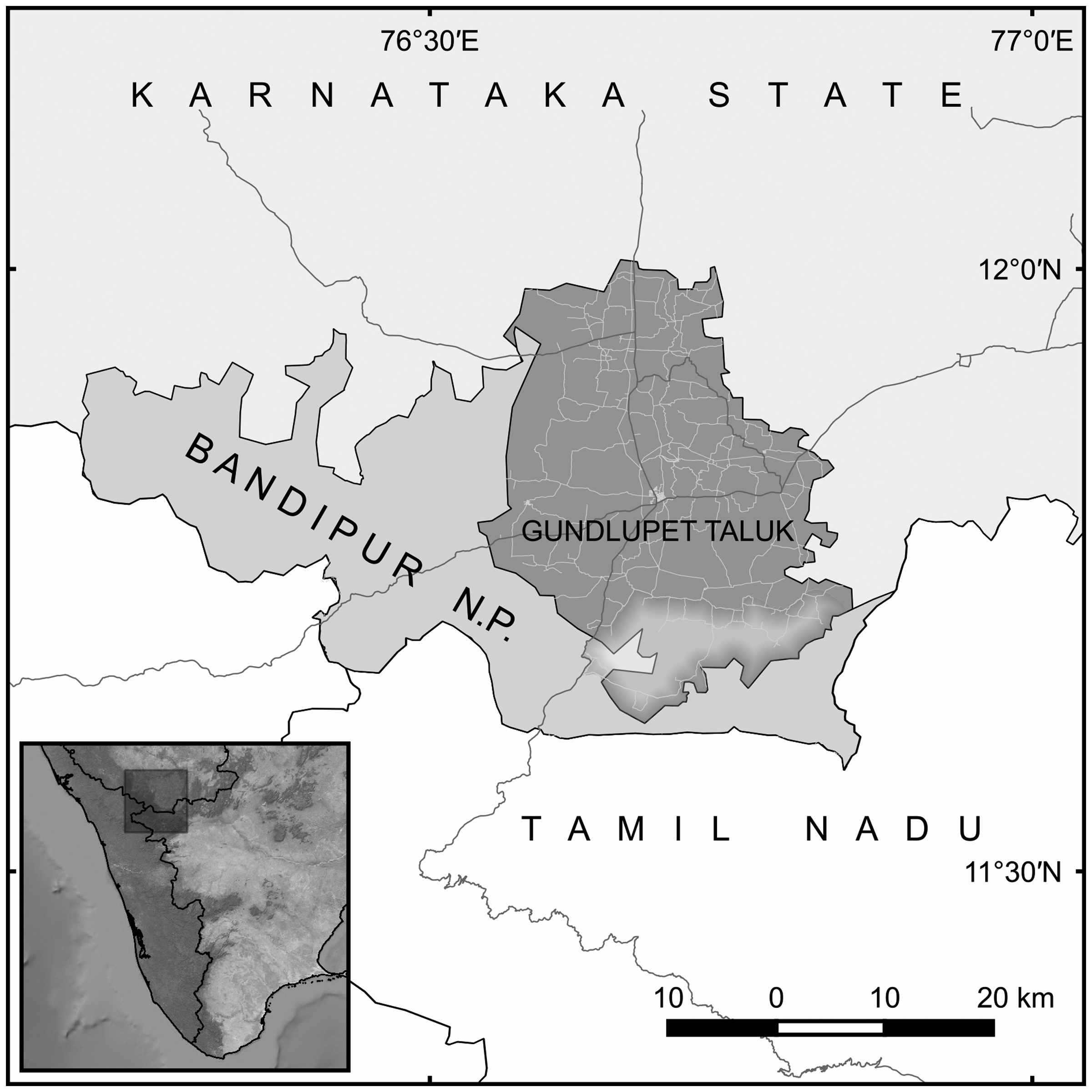
Bandipur was designated as a National Park in 1974 and at the same time was notified as one of India’s original Tiger Reserves through a significant expansion of the 90 km 2 Venugopala Wildlife Park, which had been the exclusive hunting grounds of the erstwhile Mysore Maharajah (Hosmath, 2015: 12). 3 Several of the region’s adivasi communities formerly inhabited or relied on resources from the land now designated as Bandipur (Narayanan et al., 2012). 4 During the British Raj era following the death of Tipu Sultan in 1799, Bandipur’s forests were managed for timber production, primarily teak. The ecological memory of Bandipur as a timber plantation turned “inviolate” space for wildlife is imprinted across the landscape (Hosmath, 2015: 9). Today, swaths of Bandipur remain essentially monoculture timber plantations reclassified as wilderness. 5 Despite the transformative ecological changes of the Bandipur forest for capital-intensive timber production, Bandipur remains a culturally significant landscape—local inhabitants as well as pilgrims are permitted to enter the park to visit several temples now found within its confines, while other sites within Bandipur of cultural and religious significance to the region’s adivasi communities, such as particular caves and hilltops, are not.
Bandipur is a popular wildlife tourism destination, with bus and jeep safari rides available in the park’s tourism zone. With the exception of paying tourists, human populations are excluded from entering Bandipur. Damage and destruction of agricultural crops by wildlife, especially elephants and wild boar, is pervasive around Bandipur, and attacks on livestock by leopards and tigers is common in the region (Karanth and Ranganathan, 2018; Karanth et al., 2013). While policies are in place for local communities to file for compensation following incidents of crop and livestock loss, or human injury and death following encounters with wild animals, communities complain that the compensation system is deeply inadequate. Forest Department response times are slow, compensation often never materializes, and the cost of customary “fees” paid to park staff to ensure claims are appropriately filed often means the monetary amount of compensation claimants receive is negligible compared to the financial losses they incur in filing for compensation (Karanth and Nepal, 2012; Margulies and Karanth, 2018).
Visualizing more-than-human contact zones, enclosures
In what follows, I draw on the “Book of Bandipur” as an affective archive, highlighting the ways in which the photoessays offer a variety of critiques of Bandipur’s management whose effects are most viscerally and economically experienced by rural communities living at Bandupr’s edge. I wish to make clear that the analysis I present below, drawing on “The Book of Bandipur,” is my own, and I make every effort to distinguish between where I am presenting the authors’ photoessay text or interview materials from that of my own interpretations of their materials. My own analysis is informed by my conversations, interviews, and experience collaborating with the photoessay authors, as well as from the vantage point of concurrently conducting 10 months of qualitative research in the region on wildlife conservation politics and human–wildlife relations.
Enclosure’s more-than-human hierarchies
KN Mahesha (Mahesh) is passionate about wildlife, and his knowledge and skills in identifying animals, especially birds, is extensive. During the project, Mahesh told me he was most proud of the photographs he took of wild animals, in particular his images of Prince, an iconic tiger in the Bandipur landscape and a favorite photography subject for Bandipur’s many tourists (Prince died in 2017). Mahesh manages agricultural land that he maintains with his father in Kunagahalli village. He also works with a local conservation nonprofit organization working to remove the invasive weed Lantana camara from the Bandipur landscape. Like many people living near Bandipur, he relies on a variety of occupations in addition to farming for his livelihood. But while Mahesh most enjoyed taking photographs of wildlife, he also chose to use his photographs to describe shifting dynamics in the agrarian economy surrounding Bandipur through his photographs of agricultural activities and changes in livestock rearing practices in the region. In his photoessay, Mahesh visualized two distinct forms of cattle rearing practices in the Bandipur landscape, and in doing so captured a dynamic political economy of cattle, and cattle–carnivore relations in flux.
This story begins with Mahesh’s photograph “Fighting bulls.” We see two bulls butting heads along a roadside, a deep thicket of Lantana camara behind them, their hoofs kicking up a cloud of dust. He explains the significance of this breed of cattle in Bandipur: These are scrub bulls. People used to have many more scrub cows than they do now. They were sent for grazing in the forest, but this isn’t permitted anymore. Now more people have a few hybrid cows, they are much more expensive and sensitive, but produce more milk than scrub cows. The scrub cows are mostly kept for their dung. People from Kerala come and buy the dung, but there are fewer cows now. The woman in the picture is a Jenu Kuruba adivasi grazing her cows in the forest. I see them every day. She probably has about 100–150 [native, or “scrub”] cows with her. They complained to me that two cows and one calf were recently killed by wild animals. So they go in groups to graze their livestock. They live at the fringes of the forest—it is illegal to graze inside the forest, but they say that they don’t have much grazing land so they go into the forest with their animals.
“Cowherd” is contrasted with his subsequent photograph, “Cows feeding under shed,” and its accompanying description of some of the particular rearing practices of “hybrid” dairy cattle in the region: This is my neighbor, he owns three hybrid cattle [native Indian cows cross-bred with European dairy cows]. He stores large amounts of fodder to feed his cows for a year… During summer, when there won’t be grass, he can feed all this to his animals. Hybrid cows can’t bear much heat, that’s why he has built a shed for them; they are very sensitive. Water, millet cake and other items are supplied directly under the shed for them.
I approach these photographs as comparative imagery about the political ecology of human-cattle care. In “Cowherd,” we see an expansive view of a forest following a significant drought, contrasted with the enclosed space of Mahesh’s neighbor’s shed. Dozens of “scrub” cattle bred for resilience, extensively grazing out into the horizon on the one hand, and just a few hybrid cows surrounded by stockpiles of fodder and feed, protected by barbed-wire fencing with stone supports, on the other. As the text accompanying “Cowherd” reveals, by taking her cattle into the forest, it is within the forest that the woman’s cattle were attacked. Because grazing is illegal inside Bandipur, she will not receive compensation from the Forest Department for the economic losses she accrues, as her presence there is not permitted. Nevertheless, she is dependent on the forest as grazing land for her livelihood.
In contrast, farmers with access to capital and the capacity to take on debt (for irrigation systems to ensure hybrid dairy cattle have access to feed year-round) have switched from owning larger numbers of scrub cattle to a fewer number of hybrid cattle. This is partly in response to increasing enforcement against grazing cattle in Bandipur. As the photograph depicts, owners of hybrid cows typically keep them in stalls and graze them close to their homes in fallow fields they own. While this affords them a certain degree of protection from carnivores, the economic losses incurred when this breed of cattle is killed or injured is proportionally much greater than when a scrub cow is killed, as the concentration of capital is embodied in fewer cattle compared to being spread out across a larger herd of animals. At the same time, if a hybrid cow is killed by a leopard or tiger on a person’s property, the owner can file for compensation from the state to cover at least some of this economic loss. As a diptych, Mahesh captures a stark disparity between security and the capacity to make secure—access to land, to capital—with the precarity produced through the transformation of traditional grazing land into an “inviolate” space of wildlife enclosure. His photoessay illuminates how, as lively commodities (Collard and Dempsy, 2013), the concentration of capital within bovine bodies intersects with conservation as a spatial reordering of animal geographies mediating the predation risk cattle experience. Ultimately, these photographs and text remain centered on the relation between humans and cattle, rather than directly focused on cattle as subject. Nevertheless, they point towards ways in which photovoice can shed light on the lifeworlds of cattle via the risks—corporeal and economic—that domestic cattle and human caretaker share.
While Mahesh’s photoessay is analytically powerful for its representation of a complex political ecology of human–cattle–carnivore relations, the images also resonate with affective capacities. The precarity of life in “Cowherd” is focused and amplified through its opposite in “Cows feeding under a shed.” As Latham and McCormack (2009) write, “images are also blocks of sensation with an affective intensity: they make sense not just because we take time to figure out what they signify, but also because their pre-signifying affective materiality is felt in bodies” (253). Despite conducting my own in-depth study of the changing political economy of cattle rearing around Bandipur during this same time period, Mahesh’s photographs do more than charts and figures about changing cattle populations and dung economies are capable. Mahesh captures anxiety-in-landscape, a circulating atmosphere of care and concern between caretaker and animal. His images visualize social inequalities with more-than-human consequences. These inequalities extend to the animals themselves and the risky geographies cattle breeds differentially experience. The images reverberate with the tensions of people whose lives are bound up with lives of other animals.
The photoessays of individual authors also speak to one another. M Indra Kumar depicts the vital consequences of where wildlife encounters occur. As he describes in his photograph “Leopard attack”: This is the hybrid cow that was attacked by a leopard. The man led the cows to graze in the fallow land while he was working in his field close by. Then he saw all the cows running out of fear. By the time he reached the spot, his cow had been killed. He was working here [the field in “Harvesting”], and then this leopard came out and attacked. His cows are grazing there [pointing to the treeline behind the man], less than one kilometer away. He can see them all grazing there, working from here, so he can watch them. This picture is at 12 o’ clock. I took this photo and left, and then he called me after the leopard attack and I came. This is the same man, same day. This can happen at any time (Interview, May 19, 2016).
Uncertain encounters: Attuning to animal presence
Uncertainty and absence also emerged as themes in participants’ photoessays. I draw on these themes here to argue for thinking more about animal presence in practicing and writing more-than-human geographies. I engage with the idea of presence inspired by Urusla Le Guin’s (1990) invitation to come into animal presence. Coming into presence is to acknowledge human–animal kinship and difference through attention to our shared dwelling, or as Kenneth Shapiro (1990) writes, “the bodily experiencing that we have in common that is the basis of our access to each other” (184). I am drawn to presence to consider the connectivity between presence and absence (Hinchcliffe, 2008), and how visual methodologies are particularly sensitive to these relationships. I employ presence here not in reference to the immediate, physical appearance of nonhuman animals observed through human registers, but how their affective presences are felt—the sense in which animals prowl, track, inhabit, and territorialize hybrid spaces. Animal presence signals not only our human awareness of individual animals “gazing back” (Berger, 1980) but also our awareness of their presence experienced in where they are not.
N Swamy Bassavanna, a farmer from Mangala village, focused his photoessay on the farming practices in his home village, and the difficulties of surviving in the contemporary rural agricultural economy in India. In our conversations, he repeatedly spoke of his frustration that urban city dwellers did not respect farmers or their arduous way of life, while also criticizing members of his own community for giving up traditional, nonmechanized farming practices, which he felt were better for the land and community. His photoessay also pays close attention to the damage and losses inflicted by wildlife in Mangala on his crops and his animals. As a variety of authors have shown drawing on more-than-human scholarship, many relations between humans and other animals are not mutually beneficial ones. While some human–animal relations are detached (Ginn, 2014) or ambivalent (Münster, 2016), many, such as those highlighted in this paper, are marked by mutual threat (Barua, 2014a; Collard, 2012; Jampel, 2016). For instance, in the photograph, “Calf and boy,” we see an image of Swamy’s son tending to a calf he is very fond of. Swamy’s written description specifies the relationship between the calf and the boy: This calf went missing not long after I took this photo. We leave them to graze, but this one didn’t return. Indra [Swamy’s friend] and I went searching for it everywhere, but we couldn’t find it. The boy is very fond of cows and he was taking care of the calf that went missing. He is feeding water to it. It was probably eaten by a tiger or a leopard, but we can’t say for sure, we never found it.
The work of Jayamma Belliah, a Jenu Kuruba adivasi whose village is situated just meters from the border of Bandipur, carries this thematic of uncertainty to its most painful conclusion, detailing the sometimes mortal consequences when humans encounter wild animals with deadly capacities. Describing her image, “The leopard tree,” Jayamma writes: I walk to work every day this way, and my nieces walk to school along with me in the morning. Three months ago, an old woman went to graze her goats in the morning in the forest. Later, I was going back home after work when I saw many people had gathered at this tree. Her goats had all gone back home earlier, none of them were injured or attacked. So others went looking for her when she did not come home and found her lying near this tree. She wasn’t eaten by the animal, there were only two bite marks on either side of her forehead. I don’t know if it was a leopard or a tiger. After being taken to hospital, the woman died the next day. She was my aunt. I walk along the same route every day. We are frightened to walk, but we can’t do much about it. We can’t sit at home fearing this. I am scared while walking here every day, going to work and going home, but there isn’t anything to do about it, we just have to live with it. It can be evening or night and I still have to walk. There is no public transport here for the children, there is nothing to do about this (Interview, April 7, 2016).
Decolonizing more-than-human contact zones
The photoessays of Jaymma, Mahesh, Indra, and Swamy share a common engagement and concern with violent encounters between people and animals, and how uncomfortable, painful, and deadly animal encounters intersect with forms of social difference. In the context of Bandipur, therefore, coming into animal presence demands attention to fraught entanglements between animals and people in shared yet politically contested landscapes. In her photograph, “The Leopard,” Jayamma depicts a wary encounter between herself and a leopard: The leopard was sitting on the rock on the slope of the hill behind the place where I work. I was going back home in the evening when I spotted it. It was very close to me, maybe a distance of 4–5 meters. My husband had come to pick me up, so I wasn’t very scared. If the leopard comes close, we cannot do much. I took this photo because I wanted to take a picture of the leopard. I would have taken it even if my husband wasn’t there. I am scared of the leopards and tigers. When I took the picture, the leopard saw us and lowered its head slowly behind the rock.
My argument for reading “The Leopard” in this way is situated in the momentary connection between Jayamma and the leopard caught in their reciprocal gaze, the claim they both make to Bandipur as home. Coming into animal presence in “The Leopard” means acknowledging the photographer as an active participant and presence in the image while recognizing with equal measure the dwelt presence of the animal. The image makes visible the capacities of both human and animal alike to assert their presence and affect one another. 6 “The Leopard” also speaks to how participatory visual methods bring questions both about social difference and attuning to more-than-human actors into the same frame through the connection of the photographer to animal subject. Unlike the omniscient, “western” gaze of traditional photographic methods in ethnographic studies (Edwards, 2011), photovoice enables the relationship between the image and the photographer to emerge as a central subject, or their intra-action (Barad, 2003). Jayamma’s use of a technology adept at reproducing the colonial imaginary of wilderness absent of human presence through selective visual curation becomes a critique of this very practice and its attendant spatial delineations of wilderness at the exclusion of people who call Bandipur home.
I approach Jayamma’s photograph “The Leopard” and accompanying text as an expression of a dwelt political ecology (Barua, 2014a; Ingold, 2005). Her visual representation of encounter with the leopard brings matters of indigeneity, gender, and politics to bear on the more-than-human frictions felt where conceptualizations of “animal spaces” and “beastly places” meet (Philo and Wilbert, 2000). Her photoessay contests a reading of the Bandipur landscape as territorialized wildlife space without human presence (“animal spaces”), while offering a deeply affective vision of Bandipur as a “beastly place” through her experiences of loss, trauma, and anxiety which cut across human and animal lives. In this way, Jayamma’s work resonates with Cindi Katz’ (1996) urging for a continued engagement with minor theory in geography, one which “attends to the differentiated concrete realms in which gendered racial capitalism is encountered, known, and felt” (Katz, 2017: 599). 7 Just as “the minor” begins from the place of expression rather than conceptualization (Deleuze and Guattari, 1986), Jayamma’s critique of Bandipur is an embodied one, visually expressed through her close engagement with the animal other.
Contemporary and diverse debates about decolonizing knowledge and research practices (e.g. Bhambra et al. 2018; Kuokkanen, 2007; Wane, 2006; Tallbear, 2011; Tuhiwai Smith, 1999) build on decades of foundational texts on decolonization and decolonizing struggles (e.g. Achebe, 1958; Fanon, 1963; Said, 1978; Tuck and Yang, 2012; Wa Thiong'o, 1986). Despite this immense intellectual history, researchers across animal, posthumanist, and more-than-human geographies have only more recently begun to grapple with critical questions about what decolonizing this scholarship might actually involve doing as a means of supporting struggles for sovereignty by colonized peoples on colonized lands (e.g. Sundberg, 2014). In her second of three progress reports on animal geographies, Alice Hovorka (2017) calls for further engagement with the globalizing and decolonizing potentials of animal and more-than-human geographies. Hovorka (2017) reviews efforts to date in actively resisting universalizing tendencies by Anglo-European knowledge practices in more-than-human geographies, and the need to embrace onto-epistemological plurality in research on human-animal relations (Gillespie and Collard, 2015; Howitt and Suchet-Pearson, 2006; Sundberg, 2014). In the third installment of her series, Hovorka (2018) considers relations of power within animal geographies, and, “invokes difference and inequality as central tenants of animal geographies to recognize how power relations operate to shape opportunities and constraints between and within nonhuman animal groups” (1). In the case of postcolonial wildlife conservation landscapes such as Bandipur, these power relations between human and nonhuman animals cannot be separated from the politics at the heart of decolonizing more-than-human geographies. Questions of how to practice more-than-human geography as a means to support struggles for indigenous freedom demand, as she writes, “opportunities for expanding our ways of knowing, embracing subaltern perspectives, and allowing those silenced human and nonhuman voices to speak” (Hovorka, 2017: 383). Certainly there are many modes of sensing with potential for probing the lifeworlds of animals, as renewed engagement with ethology in human geography has productively demonstrated (Barua and Sinha, 2017; Bear, 2011; Evans and Adams, 2018). But photovoice seems especially suited to inquiring into the relational lines connecting bodies and geographies of dwelling attendant to critical matters of human social difference and liberatory struggles. Photovoice draws attention to questions of politics that speak to environmental inequalities, political economy, and decolonizing as an active process towards indigenous sovereignty in places of dispossession (Tuck and Yang, 2012).
Returning to Lorimer’s (2010) treatment of visual methodologies, “learning to be affected,” I would argue, is another means to become aware of different paths of sensing, knowing, and being, open to indigenous and non-Western ontologies and epistemologies. Sundberg (2014) suggests geographers work to locate “our body-knowledge in relation to the existing paths we know and walk” as a means of decolonizing more-than-human geographical scholarship and the politics such work attempts to intervene in. In reflecting on Sundberg’s prompt, I have returned to Jaymma’s photograph, “The Leopard Tree” many times. I walked the path in this image a dozen or more times in the course of my own research, and Jayamma’s photograph is a prescient reminder of the ignorance of my own body-knowledge within the Bandipur landscape. The afternoon after Jayamma told me the story of her aunt’s deadly encounter with a leopard, Rajeev (my research assistant) and I asked if we could accompany her on her walk home later that day. She agreed, and as the sun was beginning to fade, we set off on the walk to Jaya’s hamlet at the forest’s edge. Along the way she pointed out where she had taken the photograph of the leopard, the rock where the animal lay, basking in the sun. She showed us the tree where her aunt had been killed, and she took us down a short side path, just beyond the trench marking Bandipur’s border, where behind the lantana brush there was a small shrine. As we approached, Jayamma asked us to remove our chappals before approaching this sacred site. As Sundberg (2014: 40) suggests, drawing on the Zapatista tradition of walking with and Rauna Kuokkanen’s (2014: 117–118) scholarship on participatory reciprocity, learning is “an engagement with the other.” Tracing Jayamma’s experience of walking in landscape became a means of learning to be affected by animal presence in an altogether unfamiliar register.
Conclusion
While we may acknowledge that dwelling is a way of being at home in the world, home is not necessarily a comfortable or pleasant place to be, nor are we alone there.
—Tim Ingold (2005: 503)
Photovoice is a promising method for attuning to the affective relations between humans and animals while also reconfiguring power relations within research practices. The photoessays comprising “The Book of Bandipur” demonstrate how pursuing research open to entanglement’s affective qualities is vital for appreciating how the production of environmental inequalities resonates across species divides and is felt in bodily, visceral terms. As a mode of practice, the use of photovoice to interrogate human–animal relations also engages criticism that more-than-human geography and related scholarship remain politically anemic and averse to interrogations of conflict. I see such engagement as vital for more-than-human research approaches to gain traction among scholars expressly concerned with processes of marginalization and enactments of injustice over and through natural resources and access to space (Menon and Karthik, 2017).
In considering limitations of this paper, the first is that I did not set out to write about the creation of “The Book of Bandipur” as an academic practice at the time of the project. It therefore does not feature the analytical contributions of the photovoice participants as co-authors. I am inspired by works of collaborative writing as decolonizing practice, for instance, by Bawaka Country et al. (2015, 2016), which from the outset engage with new ways of writing, researching, and collaborating with a variety of people, places, and beings. In future work, I would like to reflect on the possibilities that this approach to collaborative writing alongside visually-driven projects might hold. A second limitation speaks to broader questions about the meaning of “participation” (Hall, 1981; Hayward et al., 2004; McIntyre, 2000, 2003; Minkler, 2004). While the authors of the photoessays participated with free prior and informed consent, this language obfuscates the larger power dynamics embedded in my relationships with all of the project’s authors as a non-Indian researcher from the United States, working across significant social, cultural, and linguistic boundaries. As one of the participants told me during an interview after the project concluded: I wanted to [participate in the project] because you asked, and outside people [researchers] never ask us what we really think about these issues. I see now why it is good we tell our own stories and why this is important. But when we started I wanted to say yes because you asked.
The transportability of photovoice as a more-than-human method to other geographies where questions of sensing and power converge are many. To date, researchers working with photovoice in geography have tended to focus on subjects in urban and peri-urban landscapes, but this bias is more likely to do with the additional challenges posed by working with visual technologies in rural landscapes (e.g. additional time training individuals less familiar with cameras, practical considerations of electrical power supply and costs) than with the inappropriateness of these methods for research in rural environments. With few exceptions, participatory visual methods have also not engaged with questions pertinent to animal geographies or considerations of the nonhuman in contested environments (but see Alam et al. 2017; Amir, 2019; Bastian et al., 2016). I would encourage researchers interested in photovoice to consider how it can complement and work alongside other participatory action research methods, activist projects, or collaborative learning engagements that extend beyond the academy. For instance, I see exciting possibilities for combining photovoice efforts with counter-mapping projects (Peluso, 1995; Wainwright and Bryan, 2009) and the creation of alternative archives and counterpublic histories (Gilliland and McKemmish, 2014; Stephenson, 2002).
Beyond methodological contributions, the empirical material produced by the “The Book of Bandipur” creators speaks directly to the now substantial body of scholarship on the political ecology of conservation, and how this field of research is strengthened through grappling with questions about participation, voice, and researching with (Bawaka Country, 2015; Kuokkanen, 2007). These photoessays reveals ways in which absence and distance emerge as important themes in coming into animal presence: how spaces of deadly encounter are not just configured through conservation’s territoriality, but also broader political economic forces operating in and through landscape; and how analyzing the risk of deadly and violent entanglements between humans and animals necessitates engagement with matters of indigeneity, gender, race, caste, and class inequalities. “The Book of Bandipur” contributes to contemporary debates in geography and political ecology on the politics embedded in research practice. As a permanent archive documenting life along the borders of a National Park rife with deadly and destructive human–animal encounters, these photoessays demonstrate in visceral, material, and political terms the critical value of “redistributing expertise” in more-than-human geographical research.
Highlights
Photovoice is employed as method to explore human–animal relations and hierarchies in Bandipur National Park, India. Photovoice contributes to methodological advancement of more-than-human geographies. Photovoice is well-suited to explore affective and political dimensions of human–wildlife relations. Coming into animal presence demands attention to absence and uncertainty in more-than-human encounters.
Footnotes
Acknowledgements
This article was only possible because of the enthusiasm, creative efforts and talent of the creators of “The Book of Bandipur”: Jayamma Belliah, Nagi Shiva, K Sunil, KN Mahesha, M Indra Kumar, and N Swamy Bassavanna. I would like to thank P Sainath and Sharmila Joshi of The People’s Archive of Rural India for their careful hand in editing the final materials for the PARI archive, and I thank Maan Barua for making me aware of the PARI project. I am indebted to my friend BR Rajeev for his tireless efforts as research assistant, translator, and collaborator. I thank my friend Sunita Dhairyam of the Mariamma Charitable Trust for graciously and generously offering logical support and space for pursuing this project for much longer than was originally planned. I owe much to Casey McKeel for encouragement and intellectual engagement throughout the duration of this project in India. This paper benefited from the feedback of audiences at a number of conferences and workshops, including the Sheffield Animal Studies Research Centre in May 2018 and at the ‘Social Difference and Nature’ workshop held at the University of Edinburgh in June 2018. Finally, I wish to thank editor Rosemary-Claire Collard and four anonymous reviewers and Brock Bersaglio for their extensive and thoughtful comments and suggestions on previous iterations of this paper. This research was made possible with the financial support of the US Fulbright Program through a 2015-2016 Fulbright-Nehru Student Research Grant and a grant from the Graduate Student Association of the University of Maryland Baltimore County. The usual disclaimers apply.
Declaration of conflicting interests
The author(s) declared no potential conflicts of interest with respect to the research, authorship, and/or publication of this article.
Funding
The author(s) disclosed receipt of the following financial support for the research, authorship, and/or publication of this article: Support for writing this article was funded by the European Research Council, grant number 694995, BIOSEC: Biodiversity and Security, Understanding Environmental Crime, Illegal Wildlife Trade and Threat Finance.