




Abstract
Prospective memory (PM) is the ability to remember to carry out intentions within a certain delay. PM tasks require a large degree of self-initiated retrieval, and in the absence of a prompt to recall, people must ‘remember to remember’ by their own volition. Thus, PM is a challenge – especially in old age with increasing health-related PM demands. Surprisingly, older adults show less pronounced impairment in naturalistic PM tasks (e.g. call the experimenter twice a day) than in the laboratory (e.g. press button × when a specific word appears). In fact, the age-PM paradox states that older individuals regularly outperform younger participants in naturalistic PM approaches. In these tasks, older individuals might experience better time management, better planning abilities, or a more efficient use of PM cues. Alternatively, elderly people might be more motivated when performing naturalistic tasks rather than abstract tasks. Here, we review the literature on the impact of motivation on the age-PM paradox by highlighting different methods used to manipulate motivation. We applied a systematic literature search on the Medline/PubMed database and reference lists of articles. Main findings suggest that depending on the type of modulation and the task setting, motivation enhances PM performance in older adults: Increasing importance (either by the experimenter or personally) boosted PM performance in older adults both in the laboratory and in naturalistic settings, while offering a monetary reward did not. Conversely, providing a social motive enhanced PM performance in the laboratory but not in naturalistic approaches. Although these results are encouraging, they also highlight the need for additional research on the impact of motivation on PM performance. Future studies should particularly focus on investigating the effect of non-financial reward on PM performance and elucidate the role of personality traits in the relation between motivation and PM.
Introduction
Prospective memory (PM) refers to the ability to remember to carry out future intentions at a certain time (i.e. time-based PM) or following an event (i.e. a specific external cue; event-based PM). 1 Both types of PM tasks are common in everyday life, they are particularly important in aging (e.g. for remembering to take medication) and have been shown to be of key relevance for maintaining functional independence and well-being. 2,3
PM comprises multiple phases that rely on different cognitive processes. First, a person needs to form an intention (e.g. call a friend at six o’clock in the evening). During this intention-encoding phase, the person plans when (i.e. at six o’clock) and how (i.e. by phone) the intention will be performed. Then, the intention is stored in retrospective memory, while the person is engaged in other activities and might monitor for the PM target cue or target time, respectively. When the moment for completing the intention arises, the person has to retrieve the intended action, inhibit other ongoing activities, and switch to the intention as well as perform it as planned. 4
Initially, research on PM was mostly conducted in naturalistic settings by asking participants to return postcards or call the experimenter on specified days. 5 Beside these naturalistic tasks in which externally provided intentions have to be completed, there are also more ecological valid approaches (i.e. tasks in which participants try to fulfil personally relevant intentions). 6 Einstein and McDaniel then developed event-based PM tasks for the laboratory 7 : They engaged participants in an ongoing task (e.g. a lexical decision task) and, coincidently, gave them an intended action to perform at some point in the context of that task (e.g. press button A, whenever you see a specific word in the ongoing task). There are also time-based laboratory PM tasks in which the appropriate moment for performing an action is a period of time (e.g. press button B in 2 min). 8 Contrary to retrospective memory tasks in the laboratory, where the experimenter typically initiates retrieval, PM tasks require the participant to perform self-initiated retrieval. Thus, PM tasks place high demands on self-initiated processes and offer low environmental support.
Since the ability to recruit self-initiated processes declines with advancing age, PM was suggested to be particularly sensitive to effects of aging. 9 Indeed, in laboratory settings, younger participants often outperform older participants on tests of both time- and event-based PM. 10 However, in naturalistic settings, older participants perform substantially better than younger participants do. This contradictory finding (i.e. an age advantage across naturalistic tasks and an age deficit in laboratory tasks) has been introduced as the age-PM paradox. 11 The superior performance of older adults in naturalistic settings might reflect more experience with time management, fewer distractions, better planning on how they will remember to execute the tasks, or more efficient use of PM cues. 12 Yet, motivation among older adults may also be an important factor. Motivation can be divided into intrinsic and extrinsic motivation. 13 In experimental approaches, intrinsic motivation refers to an inherent interest in performing a task (e.g. due to providing a social motive). In contrast, extrinsic motivation refers to a means-end orientation in executing a task (e.g. due to a monetary reward). According to the goal-based motivational-cognitive model, the motivation to realize a PM intention increases whenever the intention becomes relevant or important for personal goals. 14 The model further suggests that goal-relevant intentions will become better accessible in memory and/or encourage the use of better intention-encoding strategies. Additionally, important intentions induce a stronger engagement in effortful attentional monitoring for PM cues when it is time to realize the intention. 14 Thus, it could be that the increased performance of elderly people in naturalistic settings is a result of higher personal relevance. Yet, very little experimental research has set out to test this hypothesis and, in general, only few studies have investigated the influence of motivation on the age-PM paradox.
Currently, there is only one review which summarizes one specific aspect of motivation on PM performance (i.e. intention importance) but it did not particularly focus on the elderly population or the age-PM paradox. 15 Manipulating importance in experimental research includes offering a reward, instructing relative importance (i.e. highlighting the PM task relative to other ongoing activities), instructing absolute importance (i.e. emphasizing the PM task per se), or providing social motives (i.e. underlining that the PM task is important to somebody else). 15 The first two manipulation methods are thought to enhance extrinsic motivation, while the latter two might influence intrinsic motivation. 15 Assessing self-imposed importance of intentions (i.e. personal relevance) is another way to investigate the effect of motivation on PM performance. The authors of the previous review focused on manipulating motivation by the experimenter and mentioned studies in elderly adults only for instructing relative importance and providing social motives. For relative task importance, they reported a comparable enhancing effect of importance on PM performance across age groups (i.e. both younger and elderly individuals improved performance by enhancing importance). 15 For social motives, they found that older adults’ PM performance improved by stressing social importance of the PM task (but see Niedźwieńska and Barzykowski 16 ), while the PM performance of younger adults did not change. 15
In the present review, we set out to evaluate the literature on the influence of motivation on PM performance with a focus on the age-PM paradox. The topic is particularly important for the development of interventions to improve PM in the elderly, and it would be crucial to find out which motivational aspects can enhance PM performance (and if these aspects only hold for laboratory tasks or also for naturalistic approaches). With the help of this review, we will foster our understanding of motivational influences on PM (or the age-PM paradox, respectively), and we can then provide recommendations for future research based on our findings.
Methods
Search strategy
We started a literature search with no date restriction using the search terms (((motivation OR importance) AND (‘prospective memory’) AND (‘aging’ OR ‘age’ OR ‘elderly’ OR ‘older’)) NOT children NOT review NOT Alzheimer NOT animal NOT intervention) in the PubMed database in May 2018. We found additional articles through scanning the reference list of articles. Only studies focusing on motivation and PM in older participants (>60 years) were included. The search resulted in n = 13 publications (Figure 1); these studies will be reported in the following and are summarized in Table 1. Please note that three of these publications 17–19 were already included in a previous review by Walter and Meier. 15

Flow chart of the identification of studies included in the current review.
Overview of reviewed studies: Sample size, employed prospective memory task and motivation manipulation, main results, and conclusions.
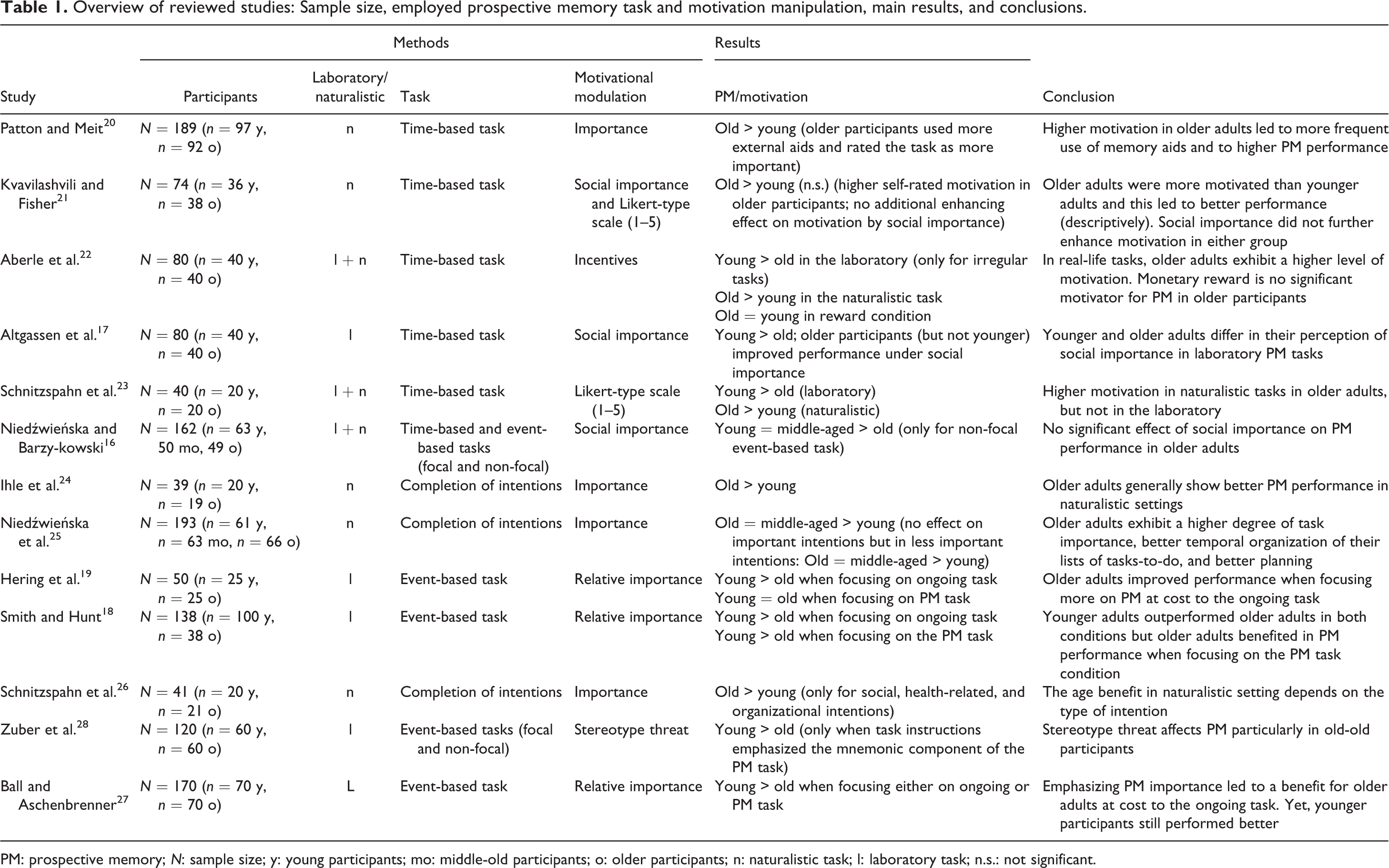
PM: prospective memory; N: sample size; y: young participants; mo: middle-old participants; o: older participants; n: naturalistic task; l: laboratory task; n.s.: not significant.
Results
From the 13 studies reported here, 7 evidenced improvement of PM performance in elderly participants under experimental manipulation of motivation – but mainly in naturalistic settings (Figures 2 and 3). In the following, we will describe the reviewed studies in more detail.

Summary of methods to manipulate motivation in experimental settings and the effect of those manipulations on PM performance in older adults as well as in older adults compared to younger participants. Note: Blue colour indicates experimentally induced motivation, while orange colour indicates self-perceived motivation. For absolute importance, we found no studies in elderly people. For other manipulation methods, arrows indicate increase, decrease, or no change in performance in naturalistic (n) or laboratory (l) approaches. PM: prospective memory.

Summary of the findings regarding the manipulation of motivation and the consequences on prospective memory performance in naturalistic or laboratory approaches.
Patton and Meit 20 conducted two experiments to test the effect of aging and motivation on PM in a time-based naturalistic approach (i.e. send postcards back to the experimenter). In the first experiment (n = 24 young, n = 17 elderly participants), they provided external memory aids to half of the participants (i.e. a telephone reminder that the task has to be performed the following day). They found that older participants with access to external memory aids significantly improved PM performance. In the second (n = 51 young, n = 55 elderly participants) and third (n = 22 young, n = 20 elderly participants) experiments, further elucidated if the improvement in PM performance was due to facilitated memory processes or higher motivation (i.e. higher self-imposed importance) to complete the task. They concluded that older participants, who displayed higher PM accuracy, indicated higher task importance, while facilitated memory did not add significantly to aided PM performance (Figure 2). Thus, higher motivation to solve the task led to a more effective use of external memory aids and thus better PM in older participants.
Kvavilashvili and Fisher 21 investigated the effect of self-rated intrinsic motivation on PM performance in a time-based naturalistic setting (i.e. calling the experimenter on the phone; n = 36 young, n = 38 older participants). Additionally, they modulated motivation by providing a social motive. Comparable to Patton and Meit, they found that older participants reported higher levels of self-perceived motivation to complete the PM task and better PM performance (although not significantly so). However, they found no additional enhancing effect on PM performance by social importance in either group (Figure 2). Thus, motivation to solve task seems to be one influencing factor to enhance PM performance in naturalistic settings while providing a social motive seems not (Figure 3).
Aberle et al. 22 examined the effect of task setting (laboratory vs. naturalistic) as well as extrinsic motivation (i.e. incentives) on PM performance in two experiments (n = 40 young, n = 40 elderly participants). In their first experiment, they additionally manipulated task-regularity in a virtual-week paradigm by providing both regular and irregular tasks. Regular tasks were repeated tasks within each day of the virtual week (e.g. take medication at breakfast), while irregular tasks were on–off tasks (e.g. returning a library book when being next to the library). In this laboratory approach, they found age deficits only in irregular tasks but not in regular tasks. They concluded that a regular presentation of PM cues led to more automatic and less cognitively demanding processing, thereby resulting in reduced age deficits. For the naturalistic setting (i.e. send text messages to the experimenter), they provided incentives, which affected younger – but not older – participants’ performance. Comparable to Kvavilashvili and Fisher, they suggested that older adults might exhibit higher intrinsic motivation to solve naturalistic PM tasks (Figure 2). In any case, monetary reward seems no significant motivator for PM in older adults – at least in naturalistic task settings (Figure 3).
Schnitzspahn et al. 23 also tested PM in both naturalistic and laboratory settings (n = 20 young, n = 20 elderly participants). Comparable to Kvavilashvili and Fisher, they did not manipulate motivation directly but instead assessed the current motivation to solve the task with a five-point Likert-type scale to compute the contribution of the current motivation to the age-PM paradox. Older adults exhibited higher motivation only in the naturalistic task (i.e. send text messages to the experimenter) but not in the laboratory (i.e. press button ‘a’ at specific time points), and higher motivation was associated with an age benefit in the naturalistic PM task (Figure 2). This provides further evidence that higher motivation to solve PM tasks is limited to naturalistic settings in older adults.
Altgassen et al. 17 explored the influence of social motives on PM task performance in the laboratory (n = 40 young, n = 40 elderly participants). According to the literature, providing a social motive should increase intrinsic motivation 15 (see Figure 2 for an overview on different experimental manipulations of motivation). They found that younger adults outperformed older adults in the PM task. Contrary to young adults, older adults’ PM performance significantly increased in the social importance condition compared to the standard condition. However, Niedźwieńska and Barzykowski 16 failed to find a similar effect in their study (n = 63 young, 50 middle-old and 49 older participants), in which they applied both laboratory and naturalistic tasks. Here, older adults did not increase PM performance through social importance in the laboratory, but performed at comparable levels in both the social and non-social condition. However, older adults were more motivated to solve naturalistic PM tasks and higher motivation was associated with PM performance (Figure 3). This, again, illustrates that older adults show higher motivation only in naturalistic PM approaches although the exact reasons behind this finding are unclear.
In a diary study, Ihle et al. 24 explored the role of personal task importance in a naturalistic, everyday setting. The participants had to generate a list of intended activities for the following week and to rate the importance of each listed intention. One week later, the participants had to mark the tasks they had effectively executed. The authors found superior PM performance of older adults also for this ecologically valid naturalistic approach. In addition, self-perceived task importance moderated age-related PM performance in a way that older adults outperformed younger participants only in tasks with medium and low importance while both groups performed on similar levels for very important tasks.
Niedźwieńska et al. 25 used a similar approach but included also middle-old participants (n = 61 young, n = 63 middle-old and n = 66 older participants). They also found that older participants attributed a higher degree of importance to their intentions and, above that, showed better planning abilities. Comparable to Ihle et al., older participants outperformed younger ones only in tasks of less importance (Figure 2). Furthermore, in well-planned tasks, the age benefit disappeared, too.
Schnitzspahn et al. 26 further elucidated the enhancing effect of self-imposed task importance on PM performance, again in a diary approach (n = 20 younger participants, n = 21 older participants). They divided the intentions by intention type (i.e. social, work, health, organization and leisure) and found that the age-related benefit in PM performance strongly depended on the type of intention. Older adults rated only social intentions as significantly more important and they outperformed younger participants only in social, health-related and organizational PM intentions (Figure 2). Taken together, these three diary studies indicate that the enhanced PM performance of older adults in naturalistic tasks is limited to certain types of intentions as well as to low and medium important intentions.
The effect of relative task importance in a laboratory task was explored by Hering et al. (n = 25 young, n = 25 older adults) 19 by either stressing the ongoing task or the PM task to be important. They found equal levels of PM performance in both groups if the PM task component was instructed to be more important than the ongoing task. Ball and Aschenbrenner 27 found comparable results (n = 70 young, n = 70 older participants) and further stated that the improvement in older participants was not due to allocating attention away from the ongoing task, but rather because of increased PM response thresholds (e.g. to allow more time for target checking). This means that older adults can perform similar to younger participants in the laboratory when the importance of the PM task is stressed (but see a contradictory finding in a study by Smith and Hunt 18 ).
Zuber et al. followed a different line of research on the age-PM paradox. 28 In an event-based setting, they manipulated the amount of stereotype threat by either telling the participants that they will test if their memory is still normal (i.e. high stereotype threat) or that their reading ability will be examined (i.e. low stereotype thread). They found that younger participants outperformed older ones only when task instructions emphasized the mnemonic component of the PM task (i.e. if there was a high stereotype threat for older people). Furthermore, stereotypes affected PM particularly in participants >71 years of age. These participants exhibited fear of memory loss and this fear hinders them to concentrate on the task, possibly due to the production of irrelevant, intruding thoughts but this assumption needs to be confirmed by future studies.
Discussion and perspective
In line with the previous research, all the studies in this review found improved (or at least comparable 22 ) PM performance in older participants in naturalistic PM approaches, while younger participants mostly outperformed elderly people in laboratory settings (Figure 3). Despite the small number of reviewed studies, there is evidence for an enhancing effect of motivation on PM performance in the laboratory and in naturalistic approaches, but the effect strongly depends on the type of motivation (Figure 2). All of the included studies had group sizes that allowed robust conclusions (all N ≥ 40).
For manipulating PM with different aspects of motivation, this review revealed a few important findings. First, manipulating motivation by monetary reward had no significant effect on PM performance in elderly participants (but in younger ones 23 ), although this needs to be replicated in a few more studies.
Second, older participants showed higher motivation in naturalistic settings. 23,24 Previous studies suggested that older people perform better than younger ones in naturalistic settings because they use external reminders more efficiently or they rehearse the task more frequently. The studies in this review instead showed that when actively discouraging elderly people from using external mnemonic aids or when holding constant the amount of thinking about the task, elderly individuals still performed on the level of younger ones (or better). 21 One explanation might be that elderly people are typically involved in relatively automatic habitual activities in their daily live (representing naturalistic PM approaches) even though they may find some of these fairly demanding. Therefore, the combination of high motivation and relatively undemanding and familiar ongoing tasks may result in PM performance that is comparable or even better than that of younger adults. In the laboratory, however, older participants may still be motivated but they have to perform tasks that are unfamiliar and cognitively demanding. Thus, the performance levels of older adults may drop and higher motivation cannot overcome this drop in performance. Engaging participants in fairly undemanding and familiar activities should eliminate age effects in the laboratory. One of the reviewed studies supports this assumption since elderly people were able to perform on a comparable PM performance level in the laboratory, depending on task regularity: Age deficits emerged in irregular tasks but disappeared in regular tasks. 23 In irregular tasks (as in most laboratory studies), PM cues show no consistent pattern and occur somewhat arbitrarily. On contrary, regular tasks present cues more consistently, making them more predictable and leading to a lower monitoring load.
A third key finding is that importance of an intention is one of the main factors affecting PM performance in the healthy elderly. Manipulating importance experimentally in a naturalistic setting led to better PM performance in older participants. 22 Manipulating importance non-experimentally (i.e. self-imposed importance), older adults also outperformed younger adults in PM tasks but only for tasks with lower and medium levels of importance, whereas in PM tasks with the highest level of importance, both age groups showed comparable PM performance. Thus, the age benefit in naturalistic PM settings goes beyond experimenter given/artificial naturalistic tasks. However, the benefit of higher importance on the completion of PM intentions depends on the type of intentions as well as age benefits were only observed for specific intention categories such as health and social intentions. 26
Manipulating (relative) importance in the laboratory improved PM abilities in older adults although they still performed worse than younger participants (but see Hering et al. 19 ). It has been suggested that older adults might not respond to external incentives in general 18,22,24 ; however, our review rather indicates that aspects of extrinsic motivation apparently seem to influence PM performance in older age even when older participants do not respond to monetary reward.
Only few studies have systematically attempted to examine the effect of motivational manipulation on PM performance. Thus, more studies should systematically manipulate aspects of motivation and evaluate the effect on PM performance in the elderly population. So far, most of the reviewed studies concentrated on task importance, leaving aside almost completely the manipulation of social motives and monetary reward. Only one study investigated the influence of monetary reward on PM performance in a naturalistic setting. Given that motivation in older adults is thought to be higher in naturalistic than in laboratory settings, it would be interesting to investigate if monetary reward (or different levels of reward) might improve motivation (and thereby PM performance) in the laboratory. Personality traits might also play a role in the relation between motivation and PM, since personality traits influence motivation and thereby may influence PM. Another area of interest might be the underlying neural correlates of PM in aging, with a special emphasis on motivational aspects. Especially neuroimaging studies, applying structural and functional magnetic resonance imaging or positron emission tomography would foster our understanding of PM changes in aging, although it might be difficult to transfer naturalistic tasks to the MR scanner. For the development of interventions to improve PM performance in older individuals, motivation might also be essential both for the outcome of the intervention (see Peter et al., for an example of the influence of motivation on intervention outcome 29 ) and for the implementation of the intervention in the everyday life of the participants once the intervention is completed. Thus, the influence of motivation on the outcome of intervention studies in PM should be another factor to investigate in the future.
Footnotes
Declaration of conflicting interests
The author(s) declared no potential conflicts of interest with respect to the research, authorship, and/or publication of this article.
Funding
The author(s) disclosed receipt of the following financial support for the research, authorship, and/or publication of this article: JP received funding from the University of Bern’s Initiator Grant. MK acknowledges funding from the Swiss National Science Foundation (SNSF).
