Keywords: Bunion, Minimally Invasive, Biomechanics of the Foot and Ankle
Introduction/Purpose: Hallux Valgus deformity is one of the most frequent pathologies evaluated by foot and ankle surgeons. Minimally Invasive surgery (MIS) has increased in popularity in recent years as a reliable procedure to correct deformity and preserve metatarsophalangeal joint motion. Although MIS has achieved good results, no information is available about the intrinsic muscle activity related to surgery. Our objective is to identify biomechanical muscle activation in the foot intrinsic muscles before and after MIS surgery.
Methods: Prospective case-control study. Cases include patients with MIS bunion surgery. The control group contains volunteers without bunion deformity or symptoms. All measurements were performed with surface electromyography in four intrinsic muscles (Extensor Digitorum Brevis [EDB], first Dorsal Interosseous [DI], Flexor Hallucis Brevis [FHB], and Abductor Hallucis [AH]). Results were expressed as median and interquartile range in percentages of normalized muscle activity at its maximum value for each muscle. Case subjects were evaluated twice (preoperative and six months after surgery), meanwhile the control group received a one-time evaluation. All measurements were recorded during gait over a treadmill with specific sensors. A Kruskal-Wallis test was done to compare results, with a statistical difference set at p<0.05.
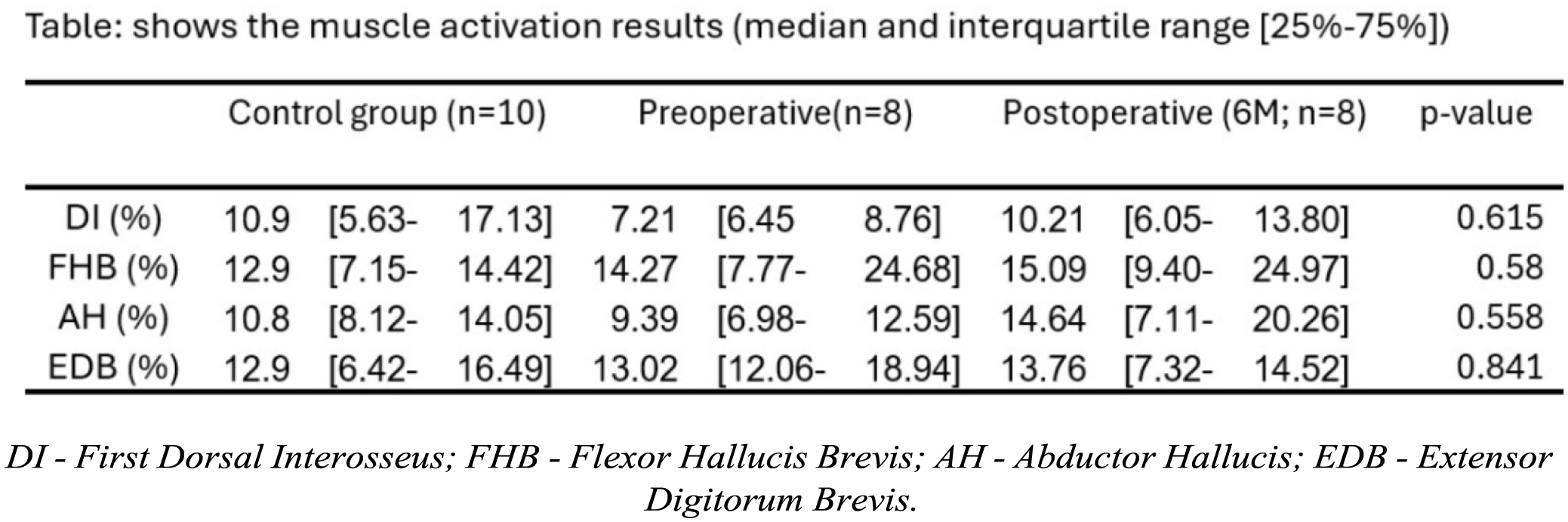
Results: Eight cases and ten control subjects were included. Muscle activation porcentages values (control, preoperative and postoperative, respectively) were: DI 10.9 [5.63-17.13], 7.21 [6.45-8.76], 10.21 [6.05-13.80], FHB 12.9 [7.15-14.05], 14.27 [7.77-24.68], 15.09 [9.40-24.97], AH 10.8 [8.12-14.05], 9.39 [6.98-12.59], 14.64 [7.11-20.26], EDB 12.9 [6.42-16.49], 13.02 [12.06-18.94], 13.76 [7.32-14.52]. No statistical difference was found between groups (p-values 0.615, 0.58, 0.58, 0.841, for DI, FHB, AH, and EDB, respectively).
Conclusion: No intrinsic muscle biomechanical differences between the control and case groups were found. Control and postoperative groups have similar values in all muscles, meanwhile, DI and AH activation improved between preoperative and postoperative evaluation, without statistical differences. These results increased the benefits associated with MIS surgery reported in the literature, adding relevant information about hallux function after surgery.






 AbstractFirst published online January, 2026