Keywords: Ankle Arthrodesis, Ankle Arthritis, Total Ankle Arthroplasty
Introduction/Purpose: End-stage ankle arthritis remains a challenging problem, with ankle fusion providing reliable pain relief at the cost of motion loss and total ankle replacement (TAR) emerging as a motion- preserving alternative. Although TAR utilization has increased with improved implant design and surgical technique, comparative studies remain limited and often rely on legacy outcome measures. The purpose of this study was to compare postoperative outcomes, complications, and recovery profiles between TAR and ankle fusion using validated Patient-Reported Outcomes Measurement Information System (PROMIS) instruments.
Methods: We conducted a retrospective review of patients who underwent total ankle replacement (TAR) or ankle fusion for end-stage ankle arthritis at a single academic institution between January 2022 and May 2025. Eligibility was restricted to patients with a minimum of 12 months of clinical follow-up and complete pre- and postoperative Patient-Reported Outcomes Measurement Information System (PROMIS) scores. The primary outcomes were changes in PROMIS Pain Interference, Physical Function, and Mobility domains. A threshold of 5 points was applied to define the minimum clinically important difference (MCID) for clinically meaningful improvement. Secondary outcomes included overall complication rates, stratified as major or minor according to established criteria, as well as specific complication profiles, with particular attention to nonunion and revision surgery. Demographic and comorbidity data were collected to assess for potential differences between cohorts.
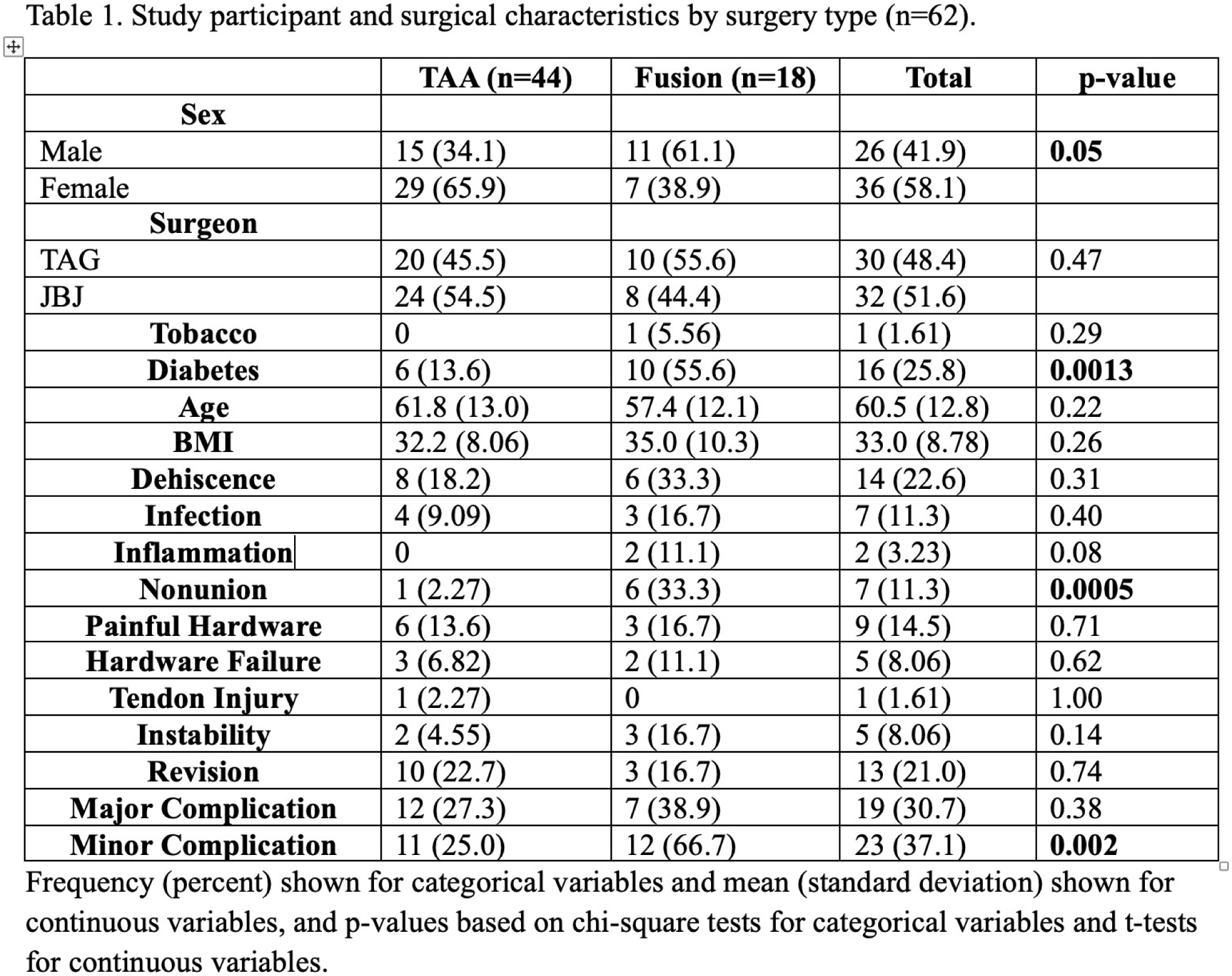
Results: Sixty-two patients met inclusion criteria (44 total ankle replacement [TAR], 18 fusion). Fusion patients had a higher prevalence of diabetes (55.6% vs 13.6%, p=0.0013). Both groups demonstrated significant postoperative improvement in PROMIS Pain Interference (TAR mean change 8.99, p<0.0001, fusion 7.23, p=0.017). TAR patients achieved additional significant improvements in Physical Function (6.18, p<0.0001) and Mobility (5.95, p<0.0001), while corresponding improvements in the fusion cohort did not reach significance. Regarding secondary outcomes, nonunion occurred more frequently following fusion (33.3% vs 2.3%, p=0.0005), and minor complications were more common in the fusion group (66.7% vs 25.0%, p=0.002). Major complication rates were similar (38.9% vs 27.3%, p=0.38), as were revision procedures (16.7% vs 22.7%, p=0.74).
Conclusion: Both total ankle replacement and ankle fusion resulted in meaningful pain reduction at one year. Only TAR, however, achieved clinically significant improvements in physical function and mobility, highlighting its potential advantage as a motion-preserving procedure. Fusion patients, who more frequently had diabetes, experienced higher rates of nonunion and minor complications, while revision rates were comparable between groups. These findings suggest that patient comorbidity profiles may strongly influence both procedure selection and postoperative outcomes. Although limited by the smaller fusion cohort, our results support TAR as a valuable option for appropriately selected patients and underscore the need for larger, multi-center validation.
Demographics and complication comparisons between groups







 AbstractFirst published online January, 2026