Introduction/Purpose: Complex foot deformities in skeletally mature patients, whether idiopathic or acquired, remain a challenge for foot and ankle and pediatric orthopedic surgeons. In low- and middle-income countries, approximately 78% of infants with clubfoot remain untreated due to barriers in healthcare access, resulting in rigid, multiplanar deformities that persist into adolescence or adulthood. These deformities often exhibit tense skin, hypertrophied tendon–ligament complexes, and muscle imbalance, making correction difficult. Standard reconstruction frequently requires extensive soft-tissue release, osteotomy, arthrodesis, or external fixation, all associated with morbidity and demanding rehabilitation. The Ponseti method is a cost- effective, minimally invasive standard for infants, however, its applicability in skeletally mature CFD remains unclear. This study evaluated a modified Ponseti-based serial casting protocol as a presurgical correction strategy for adolescent and adult CFD.
Methods: A retrospective cohort study encompassing fifty-eight skeletally mature patients (78 feet) with idiopathic or acquired CFD treated with a modified PM between 2020 and 2024 was conducted. Patients were analyzed by etiology group, and deformity severity in cavus, varus, adductus, and equinus were recorded at baseline, after casting, and postoperatively. Repeated-measures analysis of variance and Tukey honestly significant difference testing compared changes across time points. Postoperative and casting complications, relapsed deformity, and the Foot and Ankle Outcome Score (FAOS) were reported at final follow-up.
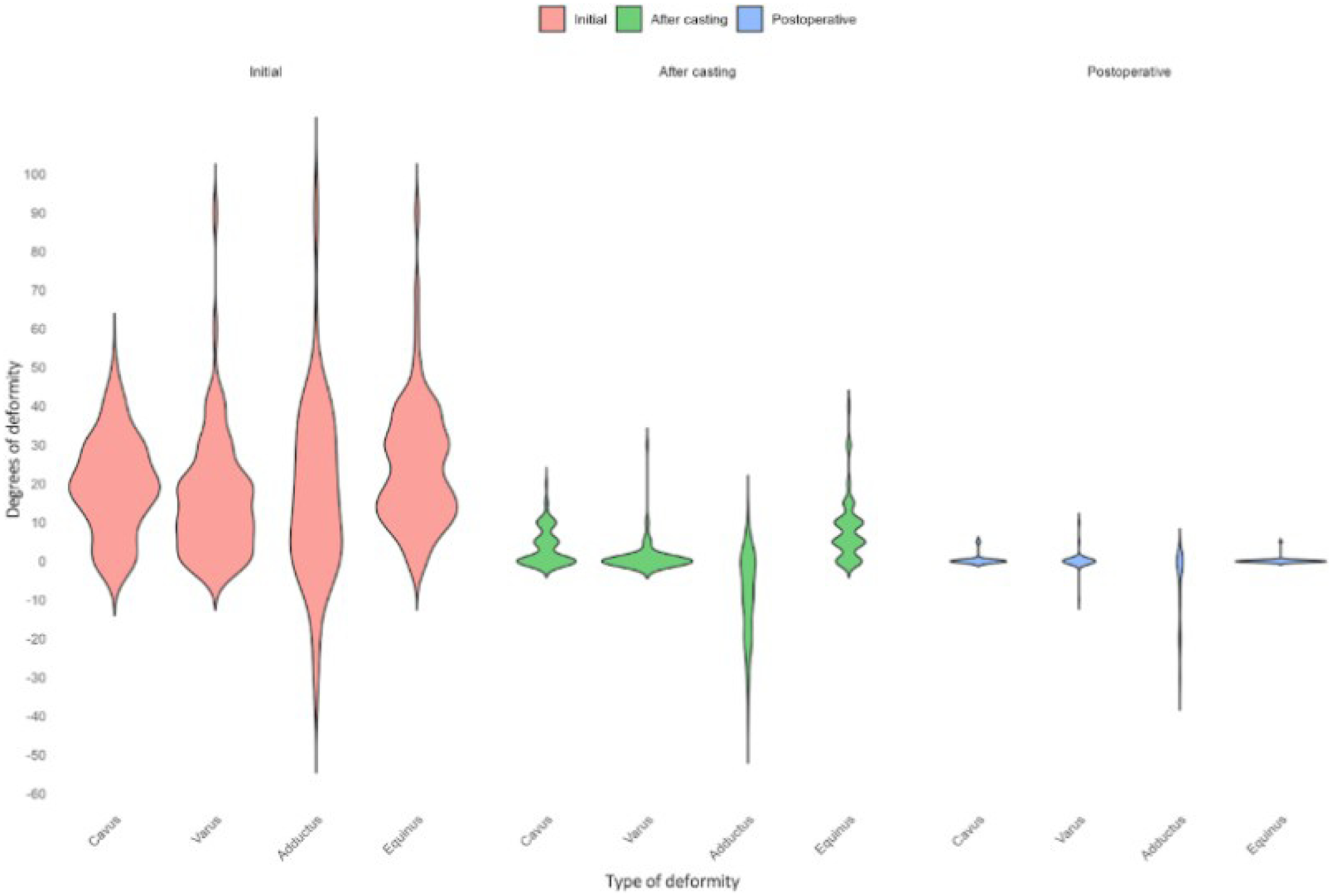
Results: Following casting, 55/58 (94.8%) of patients required adjunctive procedures. A plantigrade, shoable foot was achieved in 69/78 (88.5%) feet. Improvements in all deformity planes were primarily attributable to serial casting (p < 0.001), and, postoperatively, equinus improved significantly (p < 0.04 and p < 0.01) in both groups. Casting-related skin pressure injuries requiring wound care occurred in 9/78 feet (8.9%). After a median follow-up of 17 months, 10/78 feet (12.8%) relapsed. Postoperative complications included one wound dehiscence and one postoperative stiffness. Mean FAOS was 82.9 among respondents.
Conclusion: A modification of the PM, using serial leg casting as a preoperative correction strategy for idiopathic and acquired CFD, reduces the need for, or the complexity of, major reconstructive foot surgery, achieving high rates of plantigrade feet with low rates of arthrodesis. This could redefine treatment paradigms in resource-constrained settings and for multiplanar correction of foot deformity.
Flowchart of patient selection and study cohort derivation.
Violin plot demonstrating the distributions of feet and magnitude of deformity across three time points.
A 16-year-old female patient with bilateral congenital clubfoot. The right foot had previously undergone posteromedial release and external fixation. The left foot underwent Ponseti serial casting; after 10 casts, a neutral hindfoot and correction of cavus and forefoot adduction were achieved, followed by percutaneous Achilles tenotomy and tibialis anterior transfer to the lateral cuneiform with 6 weeks of immobilization. a,: pre-treatment clinical appearance of left foot and postoperative clinical appearance of fixator-treated right foot; b,c: after 10 casts; d: postoperative clinical appearance; e,g: clinical view after casting and after surgery; f,h: weight-bearing lateral X-rays showing better anatomic restoration of joint relationships after serial casting compared with the external fixator approach
Subject #17: A 30-year-old patient with hemophilia and secondary ankle ankylosis presented to the Ponseti clinic with a CFD of the right foot. The patient was managed with 10 serial casts, achieving correction of the forefoot adduction, hindfoot varus, and cavus components. Residual equinus was addressed with tibiotalar arthrodesis. a,b: pre-casting clinical appearance; c: preoperative ankle radiograph; d: postoperative lateral radiograph; e: immediate postoperative clinical appearance; f,g: follow-up clinical appearance demonstrating correction of the deformity.
A 67-year-old patient with bilateral congenital clubfeet previously treated with posteromedial release presented to our clinic with relapse. Initial management consisted of 16 serial casts followed by percutaneous Achilles tenotomy, TATT, and plantar fasciotomy. a,b: Initial position of feet; c.d: Initial lateral X-rays; e,f: Postoperative clinical appearance; g,h: weight-bearing lateral X-rays showing adequate joint relationship.