Abstract
Research Type:
Level 3 - Retrospective cohort study, Case-control study, Meta-analysis of Level 3 studies
Introduction/Purpose:
Acute hindfoot nailing or tibio-talo-calcaneal (TTC) fusion has become an increasingly utilized surgical option for comminuted pilon fractures, particularly in elderly patients. Compared to open reduction internal fixation (ORIF), acute hindfoot nailing is less invasive, allowing for earlier weightbearing and preventing requirement of secondary procedures.Despite its potential advantages, acute hindfoot nailing violates the subtalar joint which is of concern given the loss of the subtalar motion segment. While the development of ankle arthrosis after pilon fracture has been well documented in the literature, the prevalence of post- traumatic subtalar arthritis has not been defined. The aim of this study was to define the severity of subtalar arthritis following pilon fracture to better understand the implications of acute hindfoot nailing as an emerging treatment strategy.
Methods:
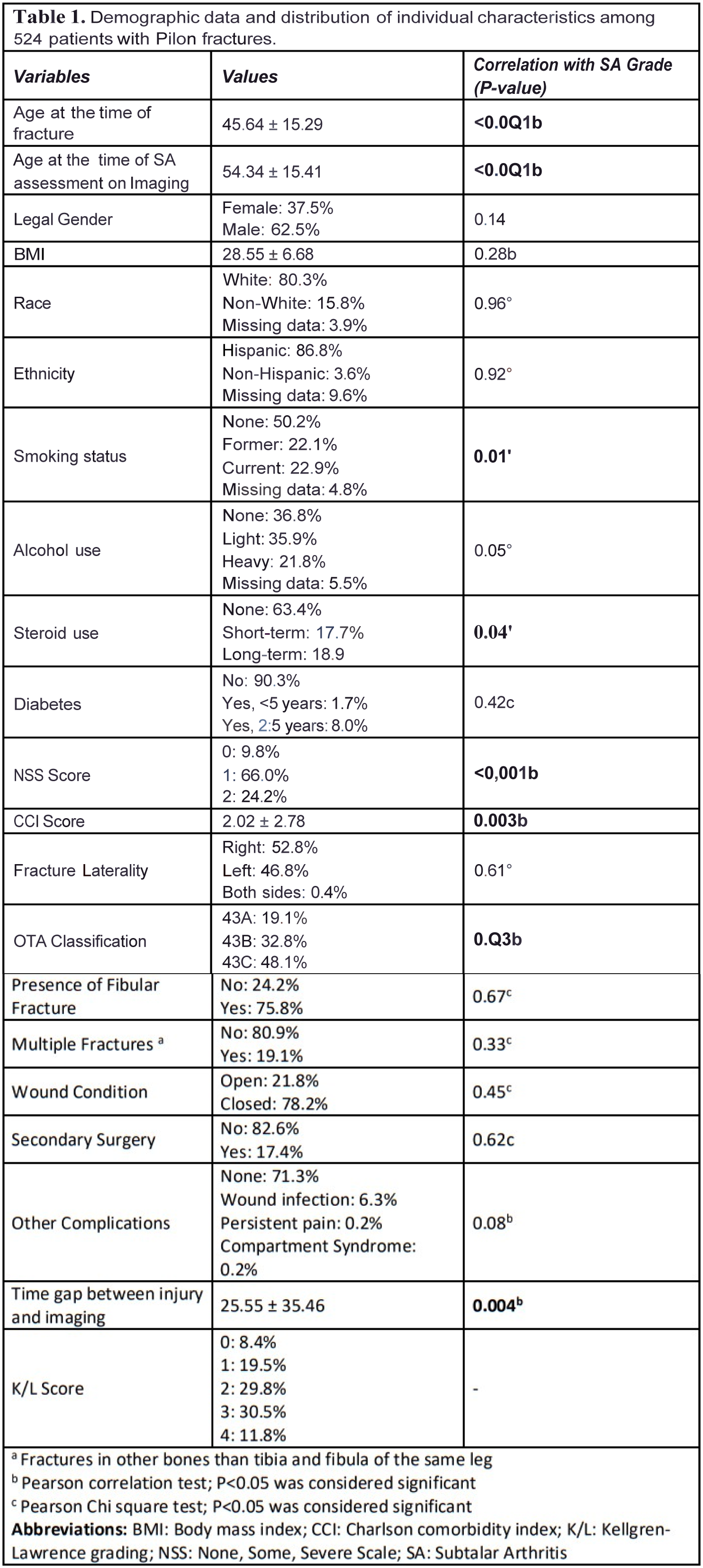
Adult patients who sustained a pilon fracture undergoing ORIF at a level one trauma center between November 2000 and June 2022 were retrospectively queried. Patients who sustained concurrent talus or calcaneus fractures and/or were treated by means of procedures other than ORIF were excluded. 473 patients, with a total of 474 pilon fractures, were included in the final analysis. Patients were placed into four groups corresponding respectively to < 12 months, 12 –24 months, 25 – 48 months, and > 48 months between the date of injury and the latest available imaging. The Kellgren-Lawrence (K/L) score and the None, Some, Severe (NSS) score were used to quantify the degree of subtalar arthritis on plain radiographs at various timepoints postoperatively. We assessed the correlation of the individual factors amongst our patient population and the severity of subtalar arthritis using Pearson correlation and Chi-Square analysis. P < 0.05 was considered significant.
Results:
Patient initial age (P <.001), age at time of imaging (P <.001), smoking status (P=.01), steroid use (P=.04), NSS score (P <.001), CCI score (P=.003), OTA classification (P=.03), and time interval between injury and final imaging (P=.004) were all significant factors Patients in Group 3 were found to have a significantly higher average K/L score than those in Group 1 (mean difference (MD) 0.34, 95% confidence interval (CI) 0.03 to 0.66, p = 0.04) and Group 2 respectively (MD 0.39, 95% CI 0.05 to 0.73, p = 0.02). Patients in Group 4 had a significantly higher average K-L score than those in Group 1 (MD 0.37, 95% CI 0.08 to 0.66, p = 0.01) and Group 2 respectively (MD 0.42, 95% CI 0.11 to 0.73, p = 0.009).
Conclusion:
Multiple patient-based factors including age, smoking status, steroid use, NSS score, CCI score, OTA classification, and time interval between injury and final imaging were significantly associated with the development of subtalar arthritis after pilon fracture. While further longitudinal studies are required, acute hindfoot nailing as an index treatment option for pilon fractures may have less clinical ramifications than previously thought given the natural history of the development of subtalar arthritis after pilon fracture.