Abstract
Research Type:
Level 4 – Case series
Introduction/Purpose:
The strain on the Achilles tendon plays a crucial role in both pathology and foot biomechanics. Heel lift is commonly utilized to alleviate symptoms in cases of Achilles tendinopathy and to reduce tension on the Achilles tendon during the healing period after surgery. Clinically, decreasing tendon strain through heel lift is important for minimizing the risk of rupture and ensuring a safer rehabilitation process. Current imaging techniques have limitations in measuring dynamic strain. Digital Image Correlation (DIC), a non-contact optical measurement technique, offers a novel approach to quantify tendon strain changes. This study hypothesizes that Achilles tendon strain changes exponentially according to heel lift height after mid-substance tenorrhaphy. The aim is to investigate strain variations in repaired Achilles tendons under different heel lift conditions.
Methods:
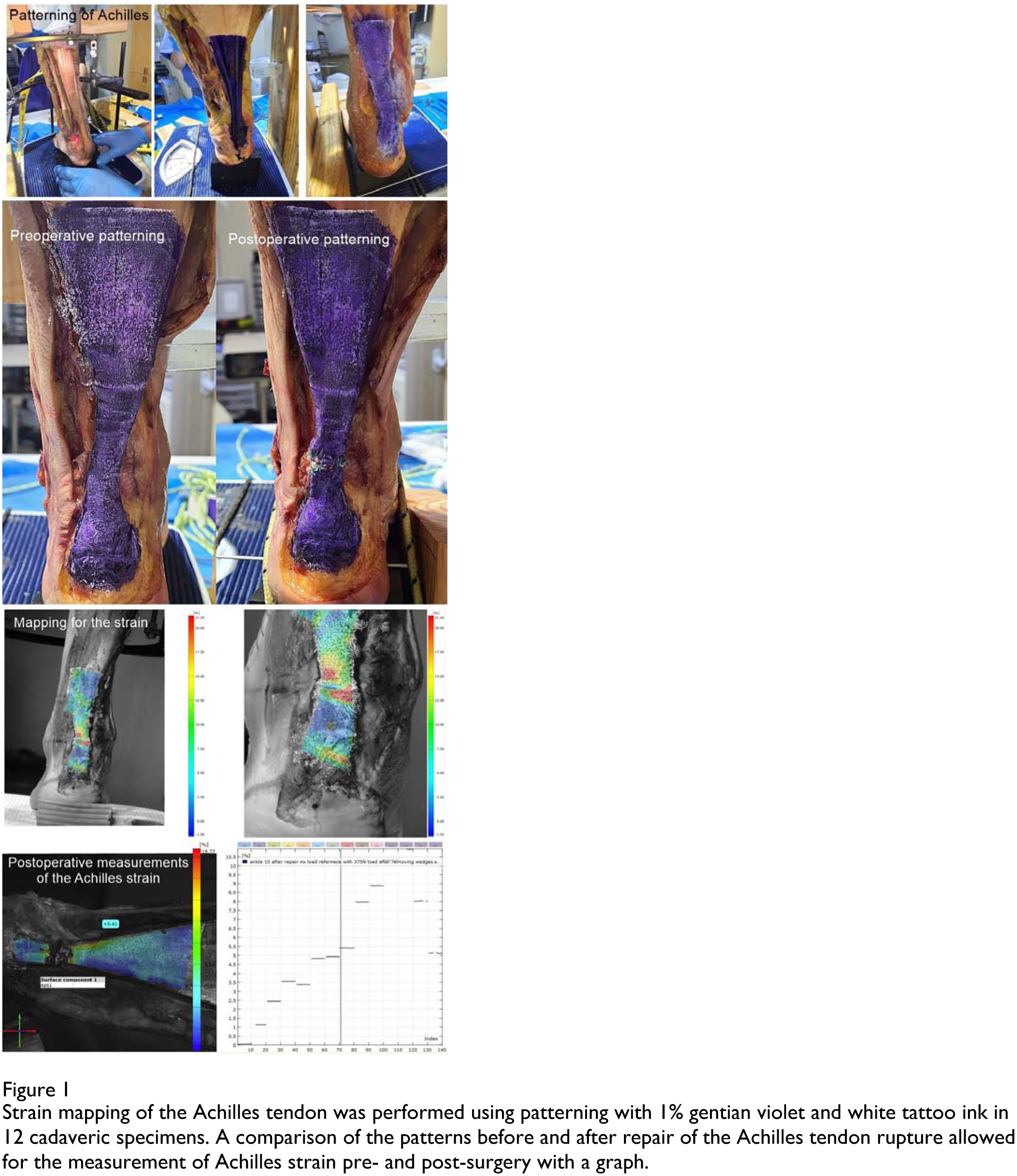
Twelve freshly frozen lower extremity cadaveric specimens were used to simulate Achilles tendon rupture and repair. Baseline weight-bearing radiographs were obtained before creating a mid-substance Achilles tendon rupture 4.5 cm above the calcaneal insertion under confirmation of C-arm images. The Krackow technique with non-absorbable sutures was employed for tenorrhaphy. Heel lifts ranging from 6 to 0 cm, in 0.5 cm decrements, were applied using 3D-printed wedges. Strain measurements were conducted using the ARAMIS® Digital Image Correlation (DIC) system. The Achilles tendon was patterned with a speckled contrast to facilitate strain analysis. High-resolution images captured strain distribution under axial loading (650 N/cm²). Data were analyzed to assess mean strain (%), and relative strain change at varying heel lift heights. The experiment was terminated if rupture at the tenorrhaphy site was observed.
Results:
Under non-weight-bearing conditions, Achilles tendon strain exhibited an exponential increase with decreasing heel lift. Under weight-bearing conditions, the mean strain percentage showed a significant drop at a median of 50 mm (IQR, 40–50) before Achilles tendon repair. After Achilles tendon repair, the mean strain percentage also demonstrated a significant drop at a median of 40 mm (IQR, 40–50) under weight-bearing conditions. Under weight-bearing conditions, both before and after Achilles tendon repair, the mean strain percentage showed a sudden inflection point with a sharp increase at a median of 25 mm (IQR, 25–30).
Conclusion:
Changes in Achilles tendon tension with decreasing heel lift exhibited an exponential pattern under non-weight-bearing conditions. Under weight-bearing conditions, strain percentage dropped at a median heel lift of 50 mm before repair and 40 mm after repair, followed by a gradual increase. In both pre- and post-repair conditions, a pronounced inflection point occurred at a median heel lift of 25 mm. Therefore, heel lifts of 40 mm and 25 mm may be considered ideal for postoperative rehabilitation.