Abstract
Research Type:
Level 3 - Retrospective cohort study, Case-control study, Meta-analysis of Level 3 studies
Introduction/Purpose:
Inferior fascicle of anterior talofibular ligament (ATFL) is linked to calcaneofibular ligament (CFL). Consequently, significant distal migration of ruptured ligament complex is less likely when CFL is completely ruptured at its fibular attachment. Unlike fibular-side CFL ruptures, complete CFL rupture at calcaneal attachment is rare but can lead to substantial proximal migration, which is challenging to repair. When proximal migration is severely advanced, stump of torn calcaneal-side CFL can be displaced superficially over peroneal tendons, similar to Stener’s lesion in a skier’s thumb. Thus, anatomical restoration of ruptured CFL stump through conservative treatment becomes challenging, increasing the risk of developing chronic ankle instability. This study aimed to compare clinical and radiographic outcomes between conservative and surgical treatments for complete calcaneal-side CFL ruptures.
Methods:
Forty-six patients diagnosed with acute ankle sprain accompanied by complete ruptures of ATFL and calcaneal-side CFL were consecutively treated by a single surgeon between January 2016 and December 2019. After applying the inclusion and exclusion criteria, 36 patients remained eligible for the study. The first 14 patients were treated conservatively (group C), and the remaining 22 underwent surgery (group S). The demographic characteristics of the two groups are listed in Table 1. Clinical results between the two groups were compared regarding their scores on the Cumberland Ankle Instability Tool (CAIT) and patient satisfaction with the treatment. Radiographic results were evaluated for the rupture status of the CFL on preoperative magnetic resonance imaging and stability of the ankle joint using a stress radiographs with Telos and manual anterior drawer test.
Results:
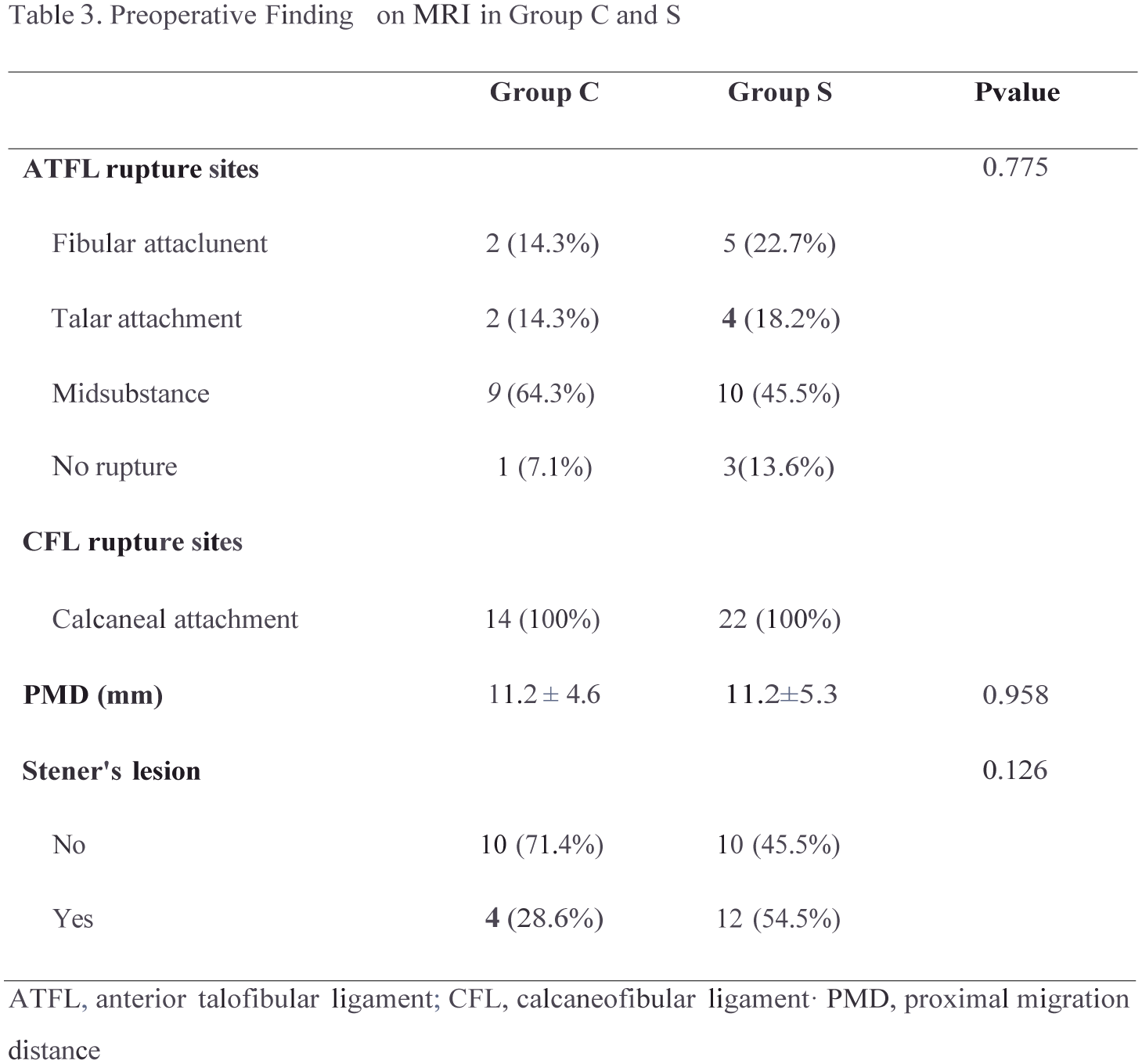
At last follow-up, mean CAIT score was significantly higher in group S than in group C (P < 0.001) (Table 2). Treatment dissatisfaction rate was significantly higher in group C (P=0.003). On preoperative MRI, ATFL rupture site, PMD of CFL, and incidence of Stener’s-like lesions did not differ between the groups (Table 3). In all cases, proximal migration distance of ruptured CFL significantly correlated with incidence of Stener’s-like lesions, in which distal stump of CFL was displaced over peroneal tendons (R=0.721, P< 0.001). Stress radiographs showed no significant difference in postoperative instability between the groups. In manual anterior drawer test at the last follow-up, proportion of stable ankles was significantly higher in group S than in group C (P=0.02) (Table 4).
Conclusion:
Surgical treatment could improve clinical results and satisfaction in patients with acute ankle sprains and complete calcaneal-side CFL rupture.