



Abstract
Research Type:
Level 3 - Retrospective cohort study, Case-control study, Meta-analysis of Level 3 studies
Introduction/Purpose:
The aging population presents unique surgical challenges, particularly in ankle fracture management. We investigated whether the Modified 5-Item Frailty Index (mFI-5) accurately predicts adverse outcomes after geriatric ankle fracture open reduction internal fixation (ORIF), potentially providing an objective tool to guide operative versus non-operative treatment decisions in this high-risk population.
Methods:
Using the ACS-NSQIP database (2011-2023), we identified patients aged ≥65 years who underwent ankle fracture ORIF (CPT 27766, 27769, 27792, 27814, 27822, 27823). Patients were stratified by mFI-5 (based on functional dependence, diabetes, COPD, CHF, hypertension) into non-frail (NF; mFI=0), mildly frail (mFI=1), moderately frail (mFI=2), and severely frail (SF; mFI≥3). Multivariate logistic regression was used to analyze 30-day outcomes, adjusting for age, BMI, sex, and ASA class. Primary outcomes included complications, readmissions, return to OR, mortality, and discharge disposition.
Results:
Of 60,625 rotational ankle fractures, 14,400 geriatric patients met inclusion criteria: NF (28.7%), mildly frail (42.0%), moderately frail (23.6%), and SF (5.8%). Mean age was 73.7±6.9 years and BMI 30.15±7.34 kg/m2; 72.3% were female. Overall complications increased from NF (4.0%) to SF (20.5%). Major complications rose from 0.5% (NF) to 3.9% (SF), readmissions from 1.7% (NF) to 9.8% (SF), and mortality from 0.3% (NF) to 4.1% (SF). Length of stay doubled (2.05 vs. 4.61 days) and non-home discharge quadrupled (8.3% vs. 30.5%) in SF patients (all p< 0.001).
Conclusion:
The mFI-5 effectively stratifies risk in geriatric ankle fracture patients, with severe frailty independently predicting a four-fold increase in mortality and three-fold increase in major complications after ORIF. These findings suggest that severely frail patients may benefit from careful preoperative optimization or consideration of non-operative management strategies. The mFI-5, a simple five-item assessment, provides surgeons with an objective tool to guide shared decision-making and enhance perioperative risk counseling in this vulnerable population.
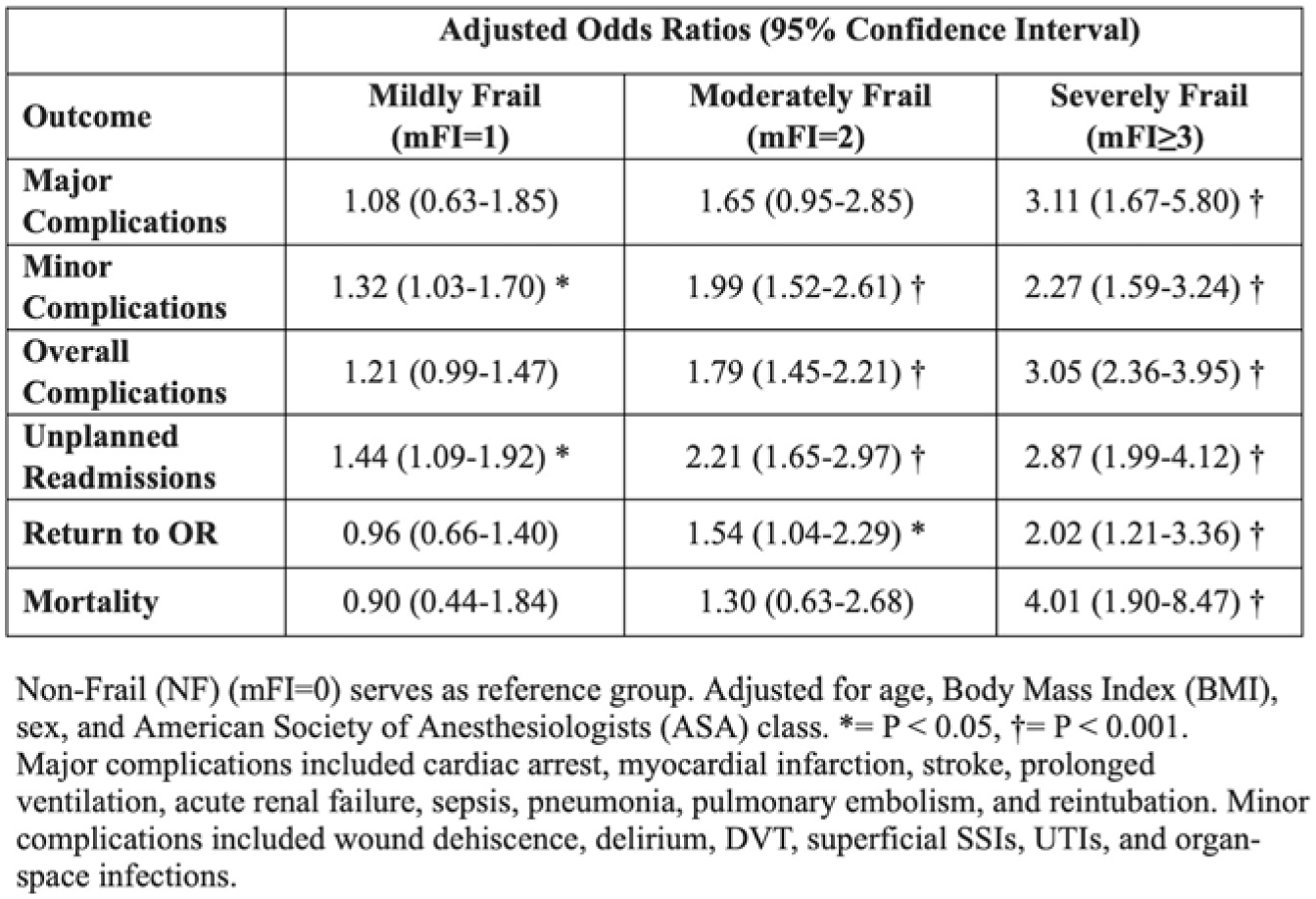
Multivariate Analysis of Adverse Outcomes by Frailty Status