Abstract
Research Type:
Level 3 - Retrospective cohort study, Case-control study, Meta-analysis of Level 3 studies
Introduction/Purpose:
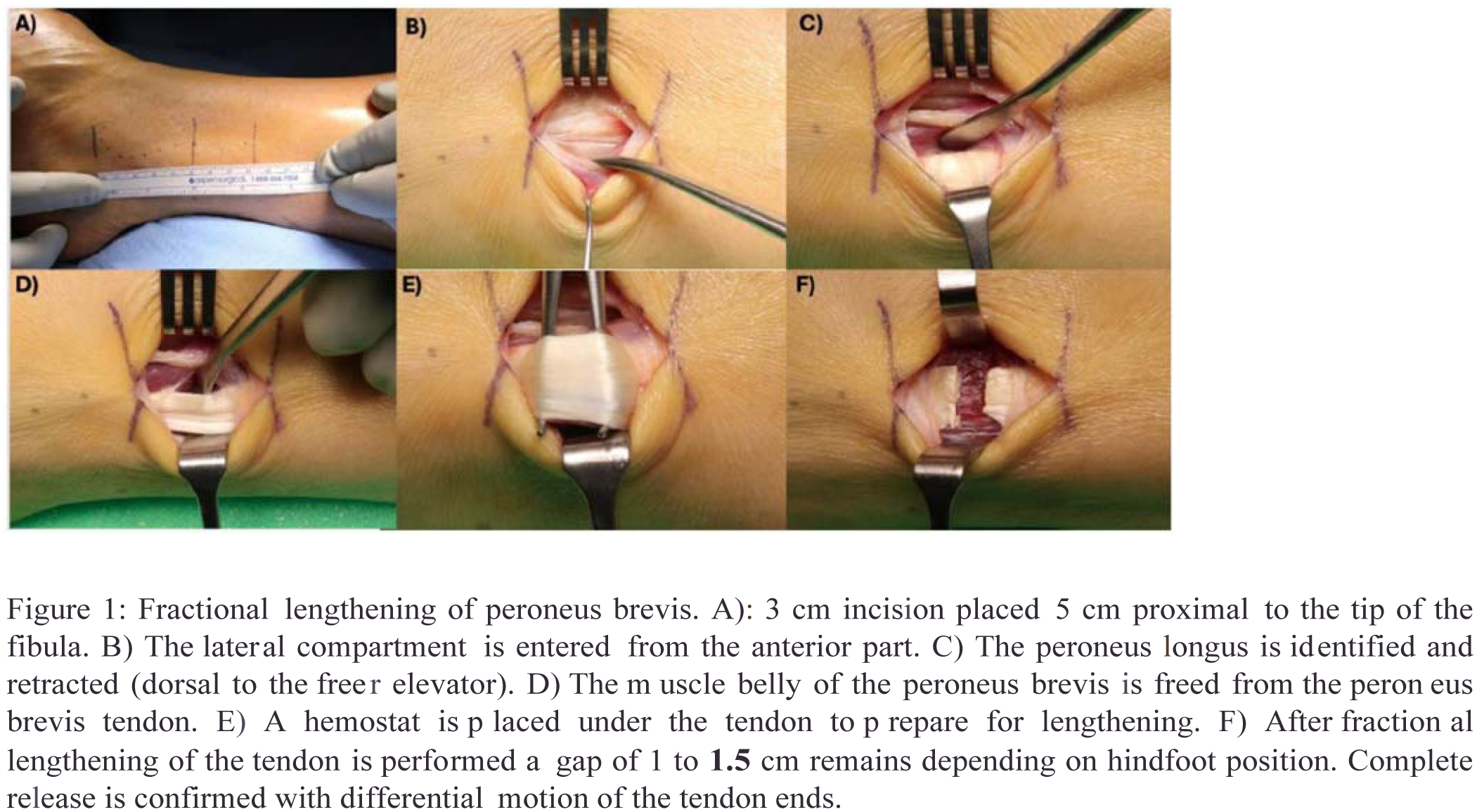
Progressive collapsing foot deformity (PCFD), is typically characterized as flexible or rigid. Rigid PCFD is often treated with hindfoot arthrodesis, causing stiffness and risks future ankle arthritis. The peroneus brevis (PB) is the primary opponent of the posterior tibialis (PT) and can become contracted as the PT weakens with collapse. This restricts inversion and the hindfoot would appear rigid. PB to peroneus longus (PL) transfer has been suggested. PB±PL z-lengthening with lateral column lengthening (LCL) has been used as a joint/motion sparing alternative to avoid arthrodesis. LCL can cause lateral column pain and PB±PL lengthening may help mitigate by decreasing joint reaction forces. This study evaluates the clinical and radiographic outcomes of PB+/-PL lengthening as an adjunct to joint sparing reconstructive procedures using LCL for patients with rigid PCFD.
Methods:
This IRB-approved retrospective cohort study evaluated patients with rigid PCFD who underwent peroneal tendon lengthening as part of flatfoot reconstruction between 2012 and 2021 Inclusion required weight-bearing radiographs pre-operatively and at follow-up visits post-operatively. Exclusions included flexible PCFD, ankle fusion or replacement, cavovarus/equinovarus deformities, or Charcot arthropathy. Radiographic measurements—Meary’s angle, calcaneal pitch, talonavicular coverage angle (TNCA), talar head uncoverage, AP talus-first metatarsal angle (TFMA), hindfoot moment arm (HMA), and plantar fascia distance (PFD)—were manually obtained pre-operatively, at 6 months, and at the last follow-up. Complications were classified as minor (e.g., superficial infection, delayed healing, hardware removal) or major (e.g., revision surgery, arthrodesis). Pre- and post-operative lateral foot, sinus tarsi, and subfibular pain were recorded. Descriptive statistics summarized demographics and complications, while intra-class correlation coefficients assessed measurement reliability. Radiographic comparisons between time points used estimated marginal means, with p-values < 0.05 considered significant.
Results:
A total of 32 patients (34 feet; 18M, 16F) with mean age of 48.4 years(range 13-70) and BMI of 31.9 were analyzed. Mean follow-up was 38.0 ± 3.5 months. Two patients(5.8%) developed superficial infections, one(3.1%) delayed wound healing, and seven(20.6%) hardware pain requiring removal, all with satisfactory pain relief. Post-operatively, the incidence of sinus tarsi and subfibular pain decreased(Figure 1d). One patient with persistent sinus tarsi pain later required subtalar fusion. No patients(0/34 feet) had post-operative lateral column pain at the CC joint, cuboid, lateral Tarsometatarsal joints, or 5th metatarsal. Radiographic analysis showed significant improvements at 6 months, including Meary’s angle(-5.9°), calcaneal pitch(+4.5°), TNCA(+21.8°), talar head uncoverage(+24.3%), AP TFMA(-12.1°), HMA(-8.0 mm), and PFD(-6.3 mm)(p < 0.001). Improvements were maintained at final follow-up without loss of correction.
Conclusion:
In this retrospective cohort study of 32 patients undergoing PB(+/-PL) lengthening together with LCL for rigid PCFD, as a joint-sparing alternative to arthrodesis, we observed a low complication rate with no cases of post-operative lateral column pain. Additionally, there was a reduced incidence of subfibular and sinus tarsi pain after surgery. Significant improvements were observed in all radiographic measurements at 6 months post-operatively compared to pre-operative imaging, with corrections maintained at the most recent follow-up. These findings underscore the effectiveness of PB(+/-PL) with LCL as an alternative to arthrodesis in reconstruction of rigid PCFD.