Abstract
Research Type:
Level 3 - Retrospective cohort study, Case-control study, Meta-analysis of Level 3 studies
Introduction/Purpose:
There has been increased interest in the role of non-autogenous bone graft adjuncts to augment union rates during foot and ankle fusion surgery. However, mid- and long-term union rates were not widely explored. We aimed to determine the rates of nonunion and time to union between patients who received a synthetic graft supplement (Augment®, Stryker, [rhPDGF-BB and beta-Tricalcium Phosphate]) and those with no graft supplementation in ankle and subtalar arthrodesis. We hypothesized that the group with graft supplementation had a higher union rate in a shorter period of time.
Methods:
A retrospective chart review was conducted using the Research Patient Data Registry (RPDR) including data from three referral centers in Boston, MA. A total of 113 patients who underwent ankle and subtalar arthrodesis were identified and included. The cohort was divided into cases and controls. Cases were defined as patients who received synthetic graft supplementation and controls were patients who received no graft supplementation of any kind. Postoperative radiographs and computed tomography (CT) scans were evaluated for time to union and nonunion rates. Statistical analyses, including time-to-event and categorical comparisons, were performed using SPSS software with P< 0.05 as significant.
Results:
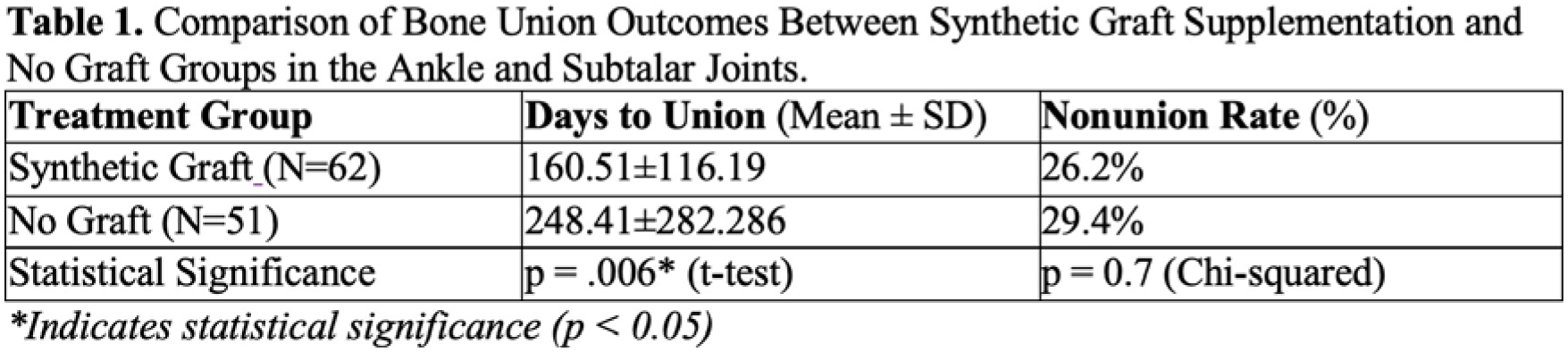
Fifty-eight percent of our patients had postoperative CT data to interpret time to union and nonunion, whereas radiographs represented 42% of patient data. The case group achieved union in less days (160.51±116.19) compared to the control group (248.41±282.28) (p=0.01). Regardless of time to union, the difference between the union rate of the case and control groups was not statically significant (73.8% vs 70.6%) (p = 0.7).
Conclusion:
Despites no significant difference between the two groups regarding the union rate, Synthetic graft supplementation in ankle and subtalar arthrodesis led to faster union times. Clinically, this represents a better quality of life in our patients by returning to regular activities faster while saving costs for longer rehabilitation time. Further studies assessing the role of synthetic graft supplementation in patients undergoing multiple joint arthrodesis and their patient-reported outcomes may help to validate the role of biologics in foot and ankle arthrodesis.