Abstract
Research Type:
Level 3 - Retrospective cohort study, Case-control study, Meta-analysis of Level 3 studies
Introduction/Purpose:
Recently, research has demonstrated an association between the subtalar middle facet uncoverage percentage (MFUP) and Progressive Collapsing Foot Deformity (PCFD). Additionally, a threshold of 17.9% has been suggested to provide 100% specificity and 96.7% sensitivity for the symptomatic, flexible flatfoot. However, it is still unknown how MFUP improves after surgery, correlates with outcomes or others conventional radiographic flatfoot parameters, and how it influences decision-making in the surgical treatment of PCFD. The objective of our study was to analyze postoperative correction of the MFUP. We also sought to assess the correlation between radiographic 2D measurements and changes in MFUP The second goal was to investigate how the MFUP correlates with minimum 2 years patient reported outcomes scores (PROMs).
Methods:
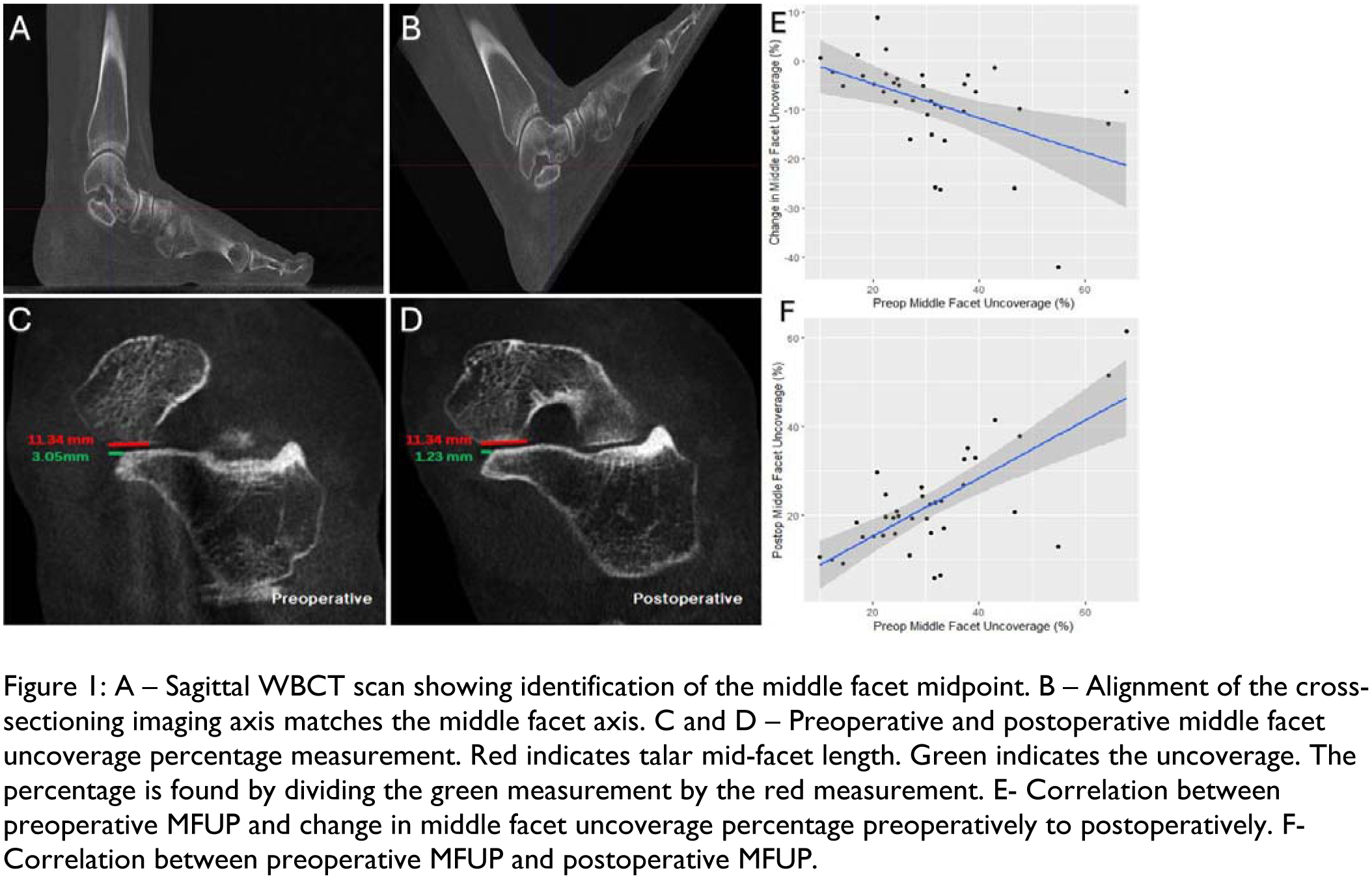
This study is a single-institution retrospective review of prospectively collected data from patients undergoing flexible PCFD reconstructions with preoperative and postoperative (minimum 3 months postoperatively) WBCT scans and with baseline and minimum 2 years follow-up PROMs. Patients that underwent hindfoot fusions were excluded. In all, 36 patients met the inclusion and exclusion criteria. The MFUP (Figure 1) and the foot and ankle offset (FAO) were collected from the WBCT scans. The hindfoot moment arm (HMA) and talar lateral incongruency angle (TLIA) were measured on conventional weightbearing hindfoot alignment and lateral foot radiographs, respectively. PROMs were measured using two-year PROMIS Physical Function, Pain Intensity, and Pain Interference scales. Spearman correlation with 95% bootstrapped percentile confidence intervals was used to study the correlation between the parameters. Independent two-sample t-test was used to compare the preoperative and postoperative MFUP values. A p-value < 0.05 was considered statistically significant.
Results:
The mean MFUP decreased from 31.1% preoperatively to and 22.5% postoperatively (p=0.005) . Preoperative MFUP demonstrated a moderate correlation with postoperative uncoverage (rho 0.56, 95% CI). Patients with greater preoperative MFUP had the greatest improvement in this parameter preoperatively to postoperatively (rho -0.58, 95% CI). We did not find any association between the middle facet uncoverage and FAO, HMA, or TLIA (all rho < 0.20). There was no correlation between middle facet uncoverage and two-year PROMs (all rho < 0.20).
When using 17.9% as a postoperative threshold, patients who were corrected back to this “normal” MFUP did not have better postoperative PROMs than those who were left uncorrected.
Conclusion:
Our study shows that surgery can successfully improve the MFUP and that postoperative MFUP is driven primarily by preoperative uncoverage percentage. Greater changes from preoperatively-to-postoperatively are expected in patients with higher MFUP, although this improvement did not seem to impact outcomes. MFUP improvement was not associated with improvements in other imaging parameters. Although our study was underpowered to detect differences in patient report outcomes, our results suggest that significant improvement in middle facet uncoverage percentage is not associated with improvement in patient-reported outcomes. Studies with a larger cohort are needed to confirm our findings.