Abstract
Research Type:
Level 3 - Retrospective cohort study, Case-control study, Meta-analysis of Level 3 studies
Introduction/Purpose:
Tobacco use is the leading cause of preventable death worldwide and in the United States. It has a well-established relationship to increased post-surgical complications. Non-tobacco nicotine products, such as vaping and e-cigarettes, are marketed as safer alternatives but have been associated with poor wound healing and immune dysregulation. While various studies have examined the relationship between either tobacco nicotine dependence (TND) or non-tobacco nicotine dependence (NTND) and postoperative outcomes in orthopaedic surgery, comparative analyses of both nicotine sources within the same study remain limited in the context of ankle surgery. This study aims to evaluate the impact of NTND compared to TND on postoperative outcomes following ankle fracture open reduction and internal fixation (ORIF).
Methods:
This retrospective study used the TriNetX database (2005–2025) to examine patients undergoing ankle fracture ORIF. Patients with preoperative nicotine use (NTND, n=19,289; TND, n=12,698) were compared to a control cohort without nicotine use (n=81,607). Propensity score matching, at a 1:1 ratio, controlled for preoperative demographics and comorbidities, resulting in 18,658 patients per cohort for NTND and 11,505 per cohort for TND. After matching, the NTND cohort (46.3% female) had a mean age of 45.4 years, mean BMI of 30.1 kg/m², and a mean follow-up of 672.35 days. The control cohort had a follow-up of 662.29 days and similar demographics. The matched TND cohort (45.3% female) had a mean age of 45.8 years, BMI of 30.1 kg/m², and a mean follow-up of 608.78 days.
The control group had a follow-up of 661.49 days with similar demographics. BMIs ranged from 18.5 to 40, and follow-up ranged from 730.5 to 1095.75 days.
Results:
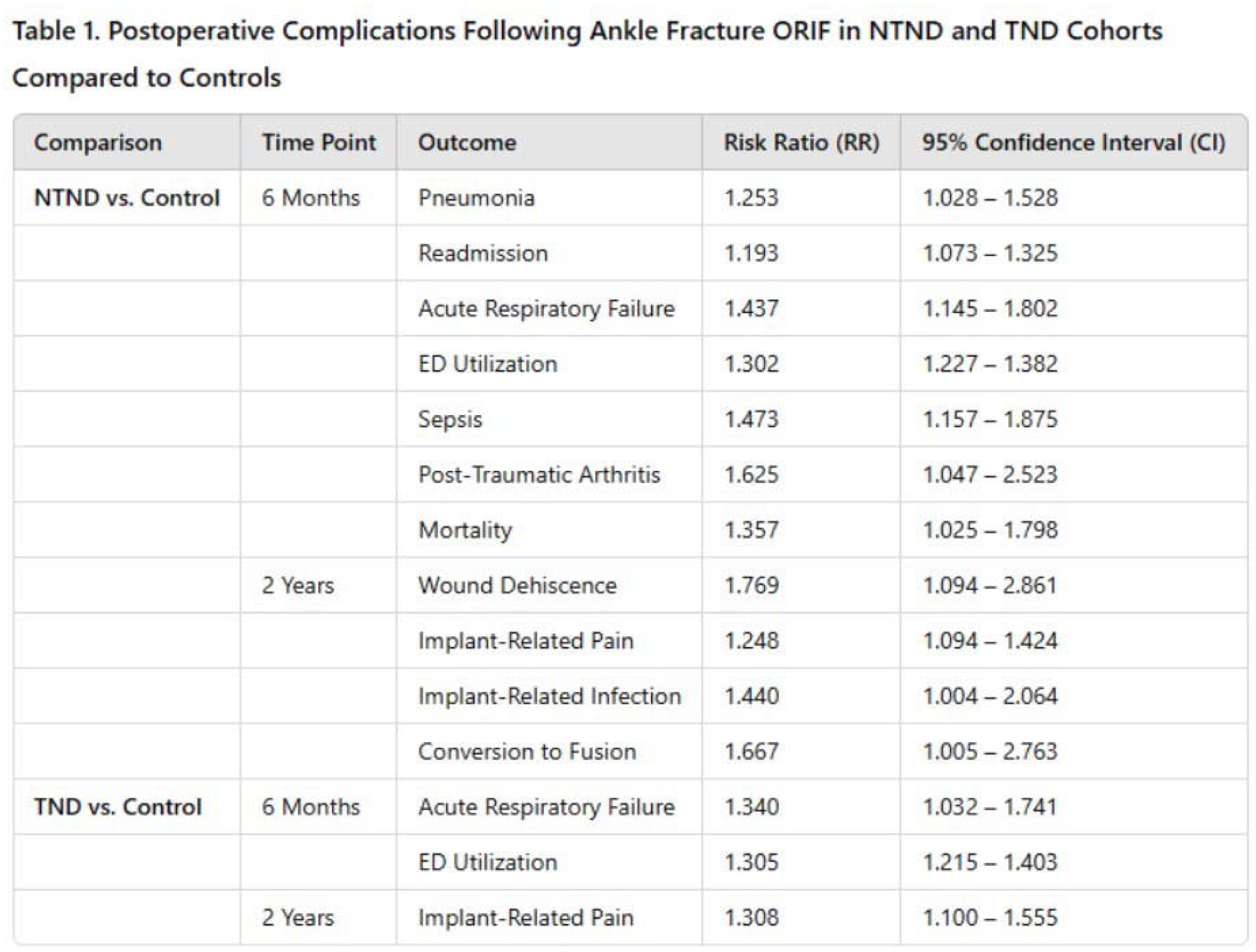
NTND patients had a significantly increased risk of readmission (risk ratio [RR]: 1.193, 95% CI: 1.073–1.325), acute respiratory failure (RR: 1.437, 95% CI: 1.145–1.802), emergency department visits (RR: 1.302, 95% CI: 1.227– 1.382), post-traumatic arthritis (RR: 1.625, 95% CI: 1.047–2.523), and mortality (RR: 1.357, 95% CI: 1.025–1.798) at 6-months and higher risk of wound dehiscence (RR: 1.769, 95% CI: 1.094–2.861), implant-related pain (RR: 1.248, 95% CI: 1.094–1.424), implant infection (RR: 1.440, 95% CI: 1.004–2.064), and fusion conversion (RR: 1.667, 95% CI: 1.005–2.763) at 2 years. TND patients had increased risk of acute respiratory failure (RR: 1.340, 95% CI: 1.032–1.741) and emergency department visits (RR: 1.305, 95% CI: 1.215–1.403) at 6 months and implant-related pain (RR: 1.308, 95% CI: 1.100–1.555) at 2 years.
Conclusion:
Patients with NTND undergoing ankle fracture ORIF had a higher risk of both short-term and long-term complications, including wound complications, infection, and implant-related failure, whereas TND was primarily associated with acute respiratory failure and ED utilization. These findings suggest that NTND may pose a greater risk for postoperative complications, challenging the perception that non-tobacco nicotine products are a safer alternative. Further research is needed to better understand these differences.