



Abstract
Research Type:
Level 3 - Retrospective cohort study, Case-control study, Meta-analysis of Level 3 studies
Introduction/Purpose:
Foot Ankle Offset (FAO) is a semi-automatic Weight-Bearing CT (WBCT) measurement assessing the relationship between the ankle joint's center and the WB foot tripod. While FAO provides a measurement of global Hindfoot Alignment (HA), it does not specifically isolate subtalar joint (SJ) involvement.
Previous research has shown that the SJ center of rotation is located within the SJ middle facet (MF). This study’s aim was to introduce and evaluate a new 3D biometric that focuses on quantifying the SJ offet in relation to the foot tripod, allowing for 3D HA assessment that isolates SJ alignment from the ankle offset. Our hypothesis was that this new measurement could help differentiate SJ from ankle deformities in patients with valgus, neutral, and varus HA.
Methods:
We conducted a retrospective-comparative study with 182 patients (235 feet, 83 males, 99 females, average age and BMI respectively 54.5±15.9 years and 31.4Kg/m2±6.8) that underwent WBCT, with overall normal (n=40), valgus (n=157), or varus (n=38) HA, based on FAO measurements (-0.6%< neutral < 5.2%). A new measurement, Subtalar Joint Offset (SJO), was calculated by identifying the center of the SJ middle calcaneal facet and assessing its relative position to the WB foot tripod. Two independent and blinded fellowship trained observers measured FAO, SJO and Middle facet subluxation (MFS) using Cubevue software (CurvebeamAI, Hatfield PA, USA). We then calculated the difference between SJO and FAO in the three different alignment groups (SJO-FAO), to assess the relative distance between center of rotation of the SJ and ankle and isolate the contribution of the SJ in the overall deformity. Measurements were compared between different HA alignments groups. Statistical significance was set at p< 0.05.
Results:
Mean FAO was found to be significantly different between the groups (p < 0.0001), when comparing neutral (3.1%±2), valgus (9.5%±4.4) and varus groups (-13.9%±6.2). The SJO was also found to be significantly different between the groups (p < 0.0001): neutral (15.6%±2), valgus (19.9%±3) and varus alignment groups (8.8%±5.4). A strong correlation was observed between FAO and SJO measurements (R2=0.75). The formula of the regression line was SJO=15.1+0.48*(FAO). When assessing the difference between SJO and FAO, valgus alignment was found to have the smallest relative distance between the two offsets (10.4%±2.9), followed by neutral (12.55%±1.8) and varus alignments (22.7%±5.9) (p < 0.0001), revealing decreased amounts of isolated SJ deformity in valgus alignment. Findings were consistent with lower capability of the SJ to accommodate to overall valgus deformities when compared to varus deformities.
Conclusion:
The Subtalar Joint Offset (SJO) is a novel WBCT measurement that evaluates the contribution of the SJ to hindfoot deformity. It uses the middle calcaneal facet as a reference point, providing a comprehensive assessment of hindfoot alignment. The SJO correlates well with the FAO and can effectively distinguish between valgus, varus, and neutral HA. Comparing overall HA (FAO) with isolated SJ alignment (SJO), we found that the subtalar joint component is less pronounced in valgus compared to varus. This could help tailor surgical treatment and understand when specific hindfoot procedures may be required in addition to ankle realignment.
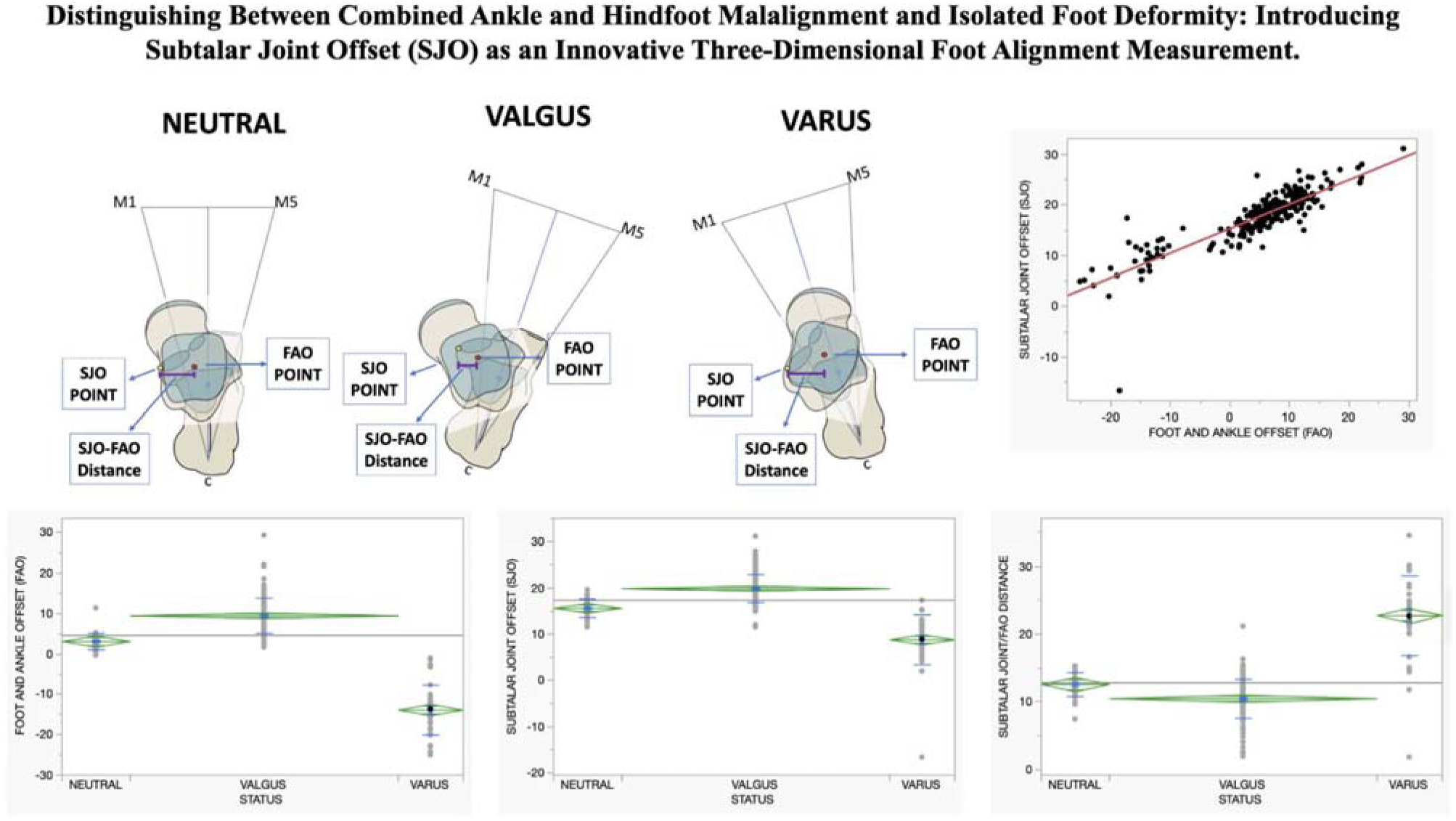
Illustration of the variation in SJO and distance between SJO / FAO for different alignments (neutral, valgus and varus) The illustrations show the ratio of the talus to the calcaneus, highlighting the change in distance between the FAO and the SJO as a function of alignment (neutral, valgus and varus). The three graphs at the bottom of the image show a greater SJO and SJO-FAO difference in the varus group compared with the neutral and valgus groups, illustrating the lower adaptability of the Subtalar joint in the valgus group compared with the varus group. The graph at top right shows a good correlation between the FAO and the SJO.