Abstract
Research Type:
Level 3 - Retrospective cohort study, Case-control study, Meta-analysis of Level 3 studies
Introduction/Purpose:
Hallux valgus (HV) is a common foot deformity that can cause pain and functional impairment, often requiring surgical correction. Minimally invasive techniques (MITO) have gained popularity due to reduced soft tissue trauma and faster recovery. Tourniquets are widely used in lower limb surgeries but may cause complications such as skin injury, nerve palsy, and deep vein thrombosis (DVT). While their effectiveness has been studied in other orthopedic procedures, evidence in MITO remains limited. This study evaluates the impact of intraoperative tourniquet use on postoperative foot circumference, as well as radiological and clinical outcomes, in MITO performed by a single surgeon for HV correction. The findings provide valuable insights into the risks and benefits of tourniquet use in minimally invasive HV surgery.
Methods:
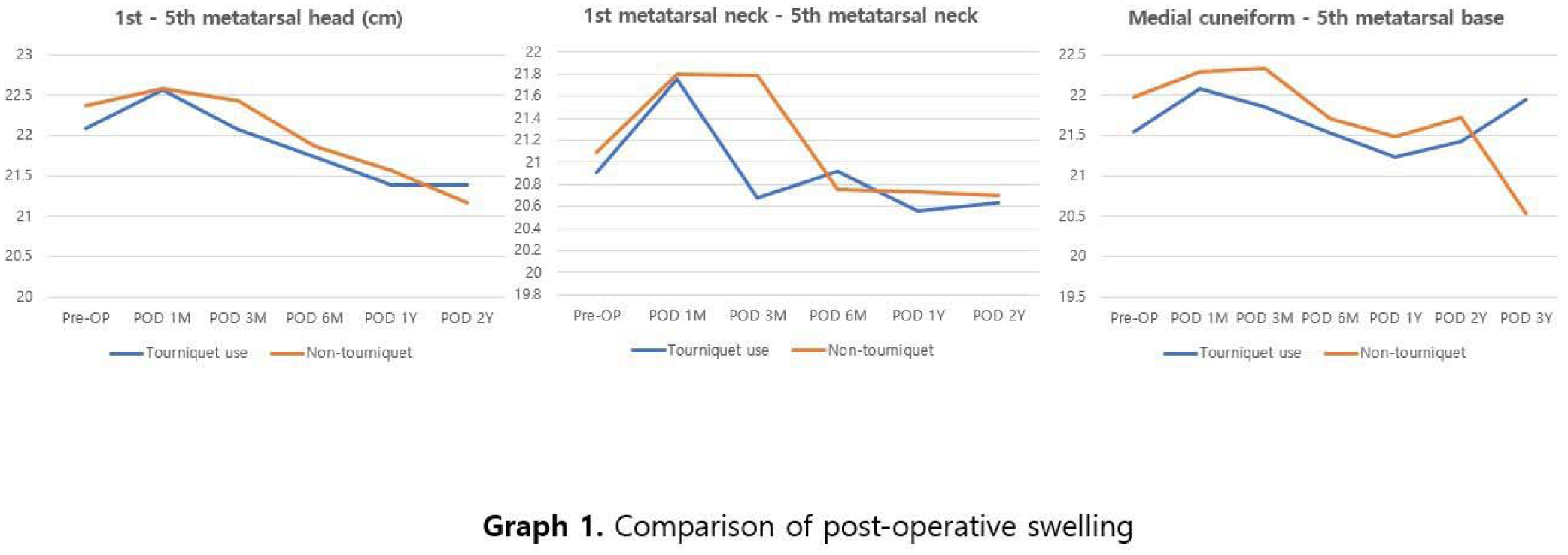
Fifty - four patients who underwent MITO between June 2020 and April 2022 were recruited and followed for a minimum of 1 year. (median follow-up period of 15.45 months). Of these, 18 patients underwent surgery on both feet. Subsequently, 43 feet used a tourniquet, and 39 feet did not use a tourniquet. To compare the swelling before and after surgery, foot circumference was measured before surgery, 4 weeks, 3 months, 6 months, 1 year, 2 year, and 3 years after surgery. Foot circumference was measured at three locations; Distance between the 1st and 5th metatarsal head, 1st metatarsal neck and 5th metatarsal neck, medial cuneiform and 5th metatarsal base.
Results:
A total of 82 feet were included in this study and median follow-up period of 15.45 months (range, 12-36 months). It was confirmed that the use of a tourniquet did not have much of an impact on blood loss or the amount of postoperative pain medication used. Additionally, radiological parameters (Hallux valgus angle, 1-2 intermetatarsal angle, Distal metatarsal articular angle) improved in both groups before and after surgery, but there were no significant differences between the two groups. Functional outcomes (VAS score, FAOS score, SF-36 PCS) were also not affected by the use of a tourniquet. Regarding postoperative foot swelling, there were no significant differences between the two groups at all three measured locations. Both groups showed a reduction in swelling after three months post-surgery.
Conclusion:
Through this study, it was confirmed that the use of a tourniquet in MITO surgery for hallux valgus correction does not provide any benefits in terms of blood loss, postoperative pain, postoperative swelling, or functional and radiologic outcomes. It is known that the use of a tourniquet during surgery can increase the possibility of complications such as postoperative infection, deep vein thrombosis, postoperative tourniquet pain and skin injury. Because tourniquet application does not affect postoperative swelling and other outcomes, it is necessary to reconsider the routine use of tourniquets during minimally invasive foot surgery.