Abstract
Research Type:
Level 5 - Case report, Expert opinion, Personal observation
Introduction/Purpose:
Lateral ankle instability is a common condition, particularly among athletes, with 70% of affected individuals experiencing residual disability. This instability usually results from chronic laxity of the lateral ankle ligaments, primarily the anterior talofibular ligament (ATFL) and calcaneofibular ligament (CFL). While the Broström procedure remains the standard treatment, additional reinforcement may be necessary to restore native ligament strength and enhance early postoperative stability. This study aims to assess the effect of augmentation after Broström using a novel bio-inductive implant.
Methods:
Eight fresh-frozen human lower extremity specimens (aged ≥18 years) with no documented history of foot or ankle injury were included. Each specimen was tested under three conditions based on the status of the ATFL and CFL: (1) Intact, (2) Broström Suture Repair, and (3) Bio-inductive Implant Augmentation (Bio-Aug) (BioBrace®, ConMed Co, FL). Following Intact testing, the ligaments were resected at mid-substance. The order of Broström and Bio-Aug conditions was then randomized to minimize potential bias from soft tissue changes during testing. Surgical procedures were performed by four orthopedic surgeons following a standardized study protocol. Biomechanical testing was conducted using a mechanical testing machine (Instron®, Model 5944 2kN) under a 500 cyclic loading protocol. Outcomes included creep (viscoelastic deformation under sustained loading), primary stiffness (measured before steady-state deformation), and final stiffness (measured at the last cycle). Data are reported as median (IQR), with statistical significance set at p < 0.05.
Results:
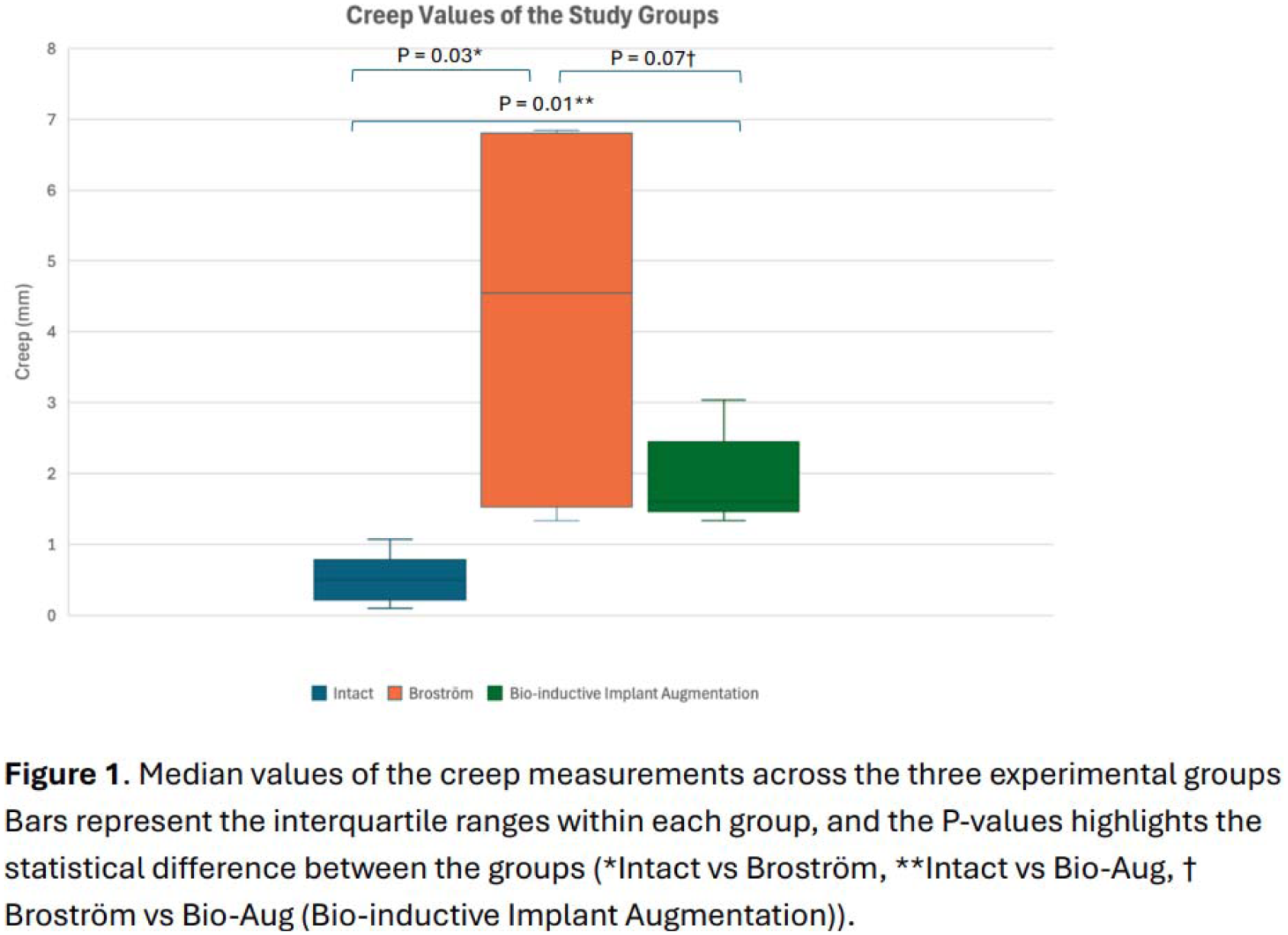
The Broström specimens completed 32% (1.5%, 100%) of the total loading cycles, with only three specimens successfully completing all 500 cycles. In contrast, all specimens in the Intact and Bio-Aug groups successfully completed the cyclic loading protocol (P = 0.04). Bio-Aug testing showed results comparable to the Intact group (Table 1). The Suture Repair group exhibited lower primary stiffness than the Intact group and lower final stiffness than the Bio-Aug group (P = 0.049 for both comparisons). The Intact group demonstrated less creep than the other groups, although the Broström group displayed considerable variability in creep measurements (Figure 1).
Conclusion:
This study underscores the potential benefits of augmentation after Broström using bio-inductive implant in the treatment of lateral ankle instability. Bio-inductive implant appears to reinforce Broström and provides stiffness comparable to native ligaments. Since these implants degrade over time, they will allow the natural tissue to appear without any side effects of the current non-absorbable implants such as stiffness and infections. We also suggest future clinical studies to further investigate our outcomes.