Abstract
Research Type:
Level 3 - Retrospective cohort study, Case-control study, Meta-analysis of Level 3 studies
Introduction/Purpose:
The fee-for-service model in the United States healthcare system relies on work Relative Value Units (wRVUs), established by the Centers for Medicare and Medicaid Services (CMS). wRVUs are assigned to various clinical activities, including procedures and office visits, serving as a key metric for physician reimbursement and procedural valuation. While the number of wRVUs is reflective of multiple factors, physicians’ work such as effort, time, and technical expertise remain the primary determinants. Many orthopaedic foot and ankle (FA) procedures require substantial technical expertise, yet the adequacy of their compensation remains largely unexplored. This study evaluates whether orthopaedic FA surgeries are fairly compensated compared to other orthopaedic procedures.
Methods:
The National Surgical Quality Improvement Program (NSQIP) database from 2020 to 2022 was utilized for this study. Orthopaedic procedures performed by orthopaedic surgeons were identified using Current Procedural Terminology (CPT) codes. The CMS RVU dollar conversion factor was obtained from the 2025 CMS fee schedule.
Identified procedures were categorized into orthopaedic FA group and non-FA group based on CPT codes. Compensation adequacy for FA procedures was assessed by comparing wRVUs, operative time, wRVU per hour (wRVU/h), and reimbursement rates ($/hour). We also analyzed the relationship between operative time and wRVU/h in FA procedures through polynomial regression analysis. Since a nonlinear relationship was identified in the linear regression analysis, polynomial regression analysis was performed. Additionally, perioperative complications, including mortality, readmission, and reoperation, were analyzed, along with secondary complications such as infections, thromboembolic events, respiratory complications, renal failure, transfusion, cardiac events, and sepsis, to compare procedural risk profiles between the two groups.
Results:
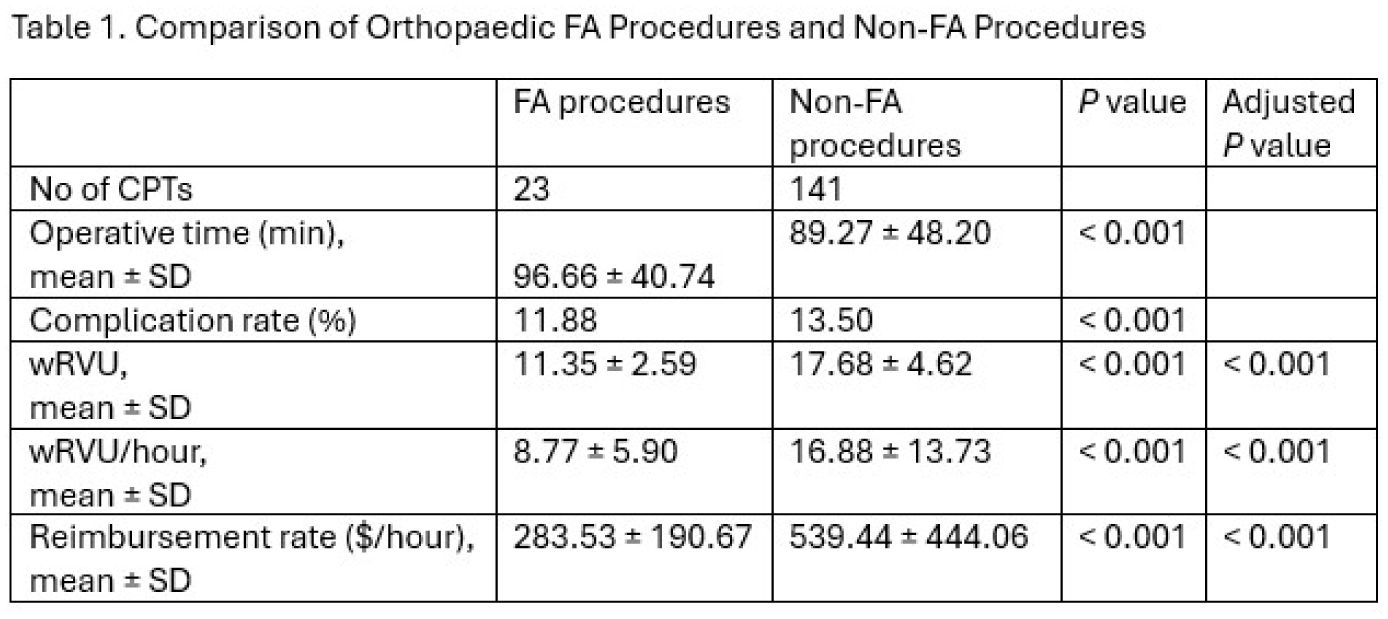
Twenty-three CPT codes for orthopaedic FA procedures accounting 8,684 cases were identified from 164 orthopaedic CPT codes. Compared to non-FA procedures, FA procedures demonstrated longer operative time (96.66 minutes Vs. 89.27 minutes, P<.001), and lower mean wRVU number (11.35 Vs. 17.68, P<.001). The mean wRVU/h and the reimbursement ($/h) were significantly lower in FA procedure group (8.77 Vs. 16.88, P<.001 and 283.53 Vs.539.44, P<.001, respectively). After adjusting for the effect of perioperative complication, the mean wRVU/h remained significantly (P <.001). Further, there is a tendency for wRVU/h to decrease as operative time increases in orthopaedic FA procedures: P<.001, R2=0.69, wRVU/h = 29.25 – 0.32*(operative time) + 0.000096*(operative time)2. The perioperative complication rate was higher in non-FA procedure group (11.88% Vs. 13.50%, P<.001).
Conclusion:
The current wRVU scale may not adequately compensate for orthopaedic FA procedures. Compared to non-FA orthopaedic procedures, FA procedures have lower wRVU/h despite longer operative times. Furthermore, a significant trend shows a decline in mean wRVU/h as operative time increases in orthopaedic FA procedures. These findings suggest a potential undercompensating of FA procedures.
Are Orthopaedic Foot and Ankle Surgeries Undercompensated? Assessment of Work Relative Value Units in Orthopaedic Foot and Ankle Procedures Compared to Other Orthopaedic Procedures