Abstract
Research Type:
Level 3 - Retrospective cohort study, Case-control study, Meta-analysis of Level 3 studies
Introduction/Purpose:
Achilles tendinopathy (AT) is a common injury in runners and biokinetic factors contribute significantly to its development. The specific influence of strength and flexibility on running biokinetics in individuals with AT needs to be investigated. Several biomechanical factors, such as gastrocnemius-soleus weakness with impaired peak ankle plantarflexion torque, increased rearfoot range of motion (ROM), and coronal plane velocity, have been associated with AT. The purpose of this study was to evaluate the relationship between ankle plantarflexion strength and ankle dorsiflexion flexibility with foot and ankle kinematics during running in rearfoot strike runners with AT.
Methods:
A cross-sectional study was conducted using retrospective data collected in a motion analysis laboratory between 2020 and 2024. Forty-five participants diagnosed with AT (33 men,12 women; mean age 46.4±9.25 years) were assessed while running on a treadmill (at 2.3 to 3.9m/s) for two minutes. Foot and ankle kinematics were recorded in the sagittal and coronal planes using a motion capture system with four high-speed cameras through anatomical landmarks and reflective markers. Foot and ankle angles were calculated relative to the laboratory coordinate system and between the tibia and the foot in the sagittal and coronal planes. Isometric plantarflexion strength was assessed using a handheld dynamometer with the knee extended and flexed, and open and closed ankle dorsiflexion ROM were also measured. Spearman's correlation and regression analysis were used to assess the relationships between kinematics and strength and flexibility metrics and if the strength and ROM tests may explain the kinematics.
Results:
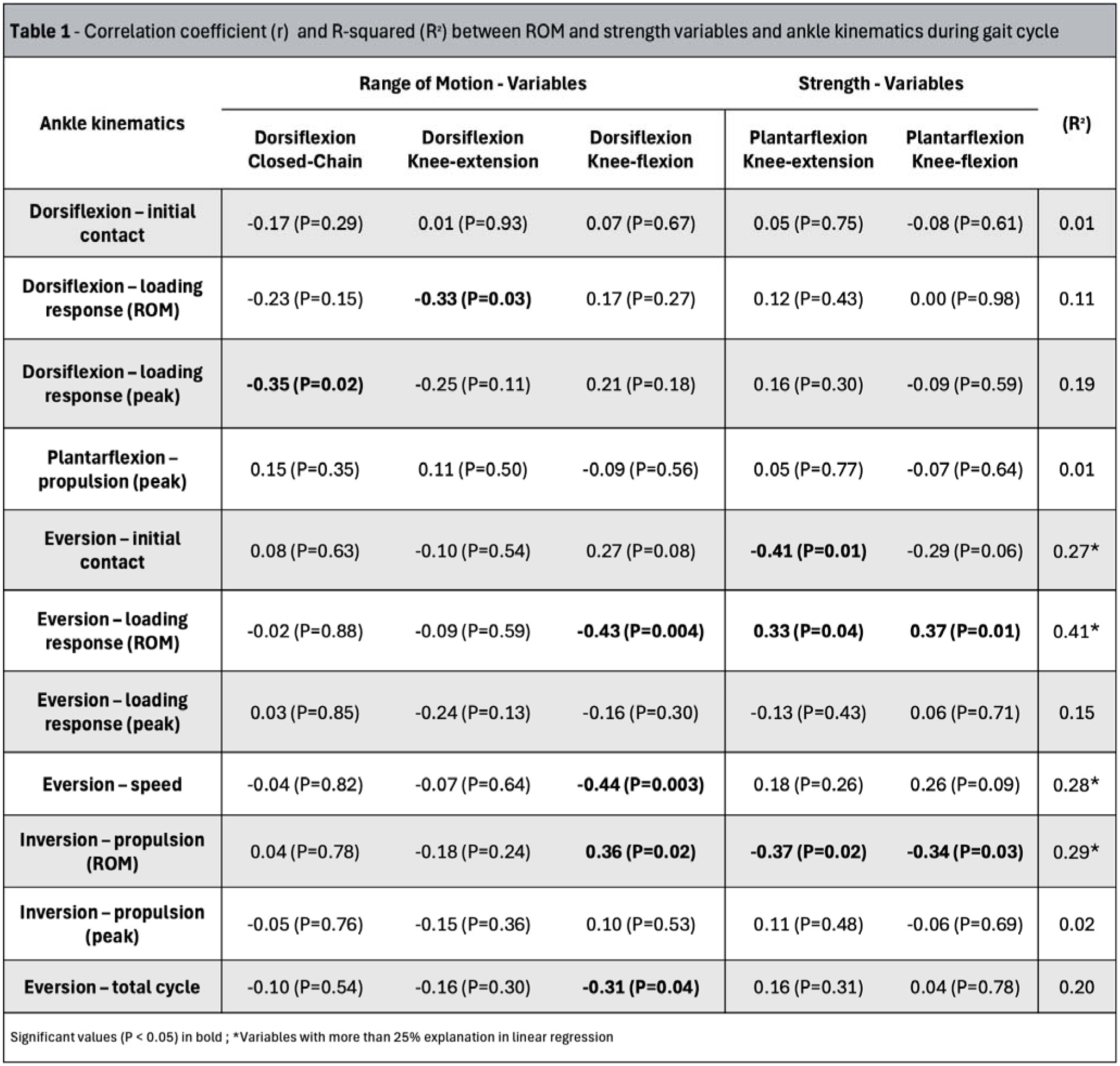
Plantarflexor strength (knee-extension) was negatively correlated with ankle eversion at initial contact (r = - 0.41, P=0.01), explaining 27% of the variability (R2=0.27). During loading response, greater plantarflexor strength (knee-extension: r = 0.33, P=0.04; knee-flexion: r = 0.37, P=0.01) was positively correlated with eversion ROM, while dorsiflexion ROM (knee-flexion) was negatively correlated (r = -0.43, P=0.004). Together, these variables explained 41% of eversion ROM variability (R2 =0.41). During propulsion, plantarflexor strength (knee-extension: r = -0.37, P=0.02; knee-flexion: r = -0.34, P=0.03) was negatively correlated with inversion ROM, while dorsiflexion ROM (knee-flexion) was positively correlated (r = 0.36, P=0.02), explaining 29% of variability (R2 =0.29). Dorsiflexion ROM (knee-flexion) was also negatively correlated with eversion speed (r = -0.44, P=0.003), explaining 28% of variability (R2=0.28).
Conclusion:
The main finding of this study is that passive ankle dorsiflexion with knee flexion in open kinetic chain and triceps surae strength influence running mechanics in both the coronal and sagittal planes, with compensatory movements occurring across planes. Higher plantarflexor strength and limited dorsiflexion are associated with increased hindfoot eversion and compensatory forefoot pronation during the stance phase, increasing the risk of Achilles tendinopathy. The findings highlight the importance of dorsiflexion in open kinetic chain and the role of additional muscles in propulsion. Increasing strength beyond the triceps surae may improve force distribution and ankle mobility through force sharing.