



Abstract
Research Type:
Level 2 - Prospective comparative study, Meta-analysis of Level 2 studies or Level 1 studies with inconsistent results
Introduction/Purpose:
***This is an ongoing study. 21 of 40 patients have completed the protocol and were included in this preliminary data. This will be completed before the 2025 Annual AOFAS Conference. *** For patients with insertional Achilles tendinopathy (IAT) who require surgical management, the open midline Achilles tendon splitting Haglund’s resection (OH) has been considered to be the gold standard intervention. Recently, the percutaneous Zadek osteotomy (ZO) has been reported to provide equivalent resolution of patient symptoms, with fewer complications than the open procedure. Currently, there remains limited data to compare gait mechanics following either of the aforementioned interventions for IAT. Accordingly, the current prospective study sought comparisons of the gait mechanics > 1 year following OH vs. ZO.
Methods:
Patients who underwent unilateral ZO or OH for IAT were included in this prospective study. All patients were > 18 years of age at the time of surgery; all patients were followed for > 12 months following their procedure. Exclusion criteria for the current study included: prior midfoot or hindfoot surgery, recent ( < 6 months) lower extremity surgery, or diagnosis with any neuromuscular condition. All study personnel were blinded to patients’ operative side and their surgical procedure. A 3D motion capture system provided spatiotemporal gait metrics for each included patient. Gait metrics included: cadence, stride-length, stride-time, step-length, step-width, step-time, and single and double support time. For each measurement, the mean difference between a patients’ operative and non-operative limbs was calculated separately. All continuous data was compared on t-test; all p < 0.05 were considered to be significant.
Results:
Twenty-one patients were included in these preliminary results. Eight patients underwent percutaneous ZO, and 13 patients underwent OH. Patients had a mean age of 55.4 +/-10.5 years and mean weight of 219.9 +/- 55.0 lbs. In patients who underwent OH, a statistically significant increase in stride time between the operative vs. nonoperative limb was observed (p=0.004). Meanwhile, in patients who underwent ZO, no difference in gait was observed between the operative and nonoperative limb.
Conclusion:
A statistically significant increase in stride time was observed in the operative limb, in comparison to the nonoperative limb, following open Haglund’s resection. Meanwhile, no changes in gait patterns were observed following intervention with the percutaneous ZO. While both procedures are safe and effective surgical options for managing IAT, these preliminary findings suggest the percutaneous ZO may allow for preserved gait mechanics relative to the open Haglund’s resection. Additional investigation is required to expand upon these findings.

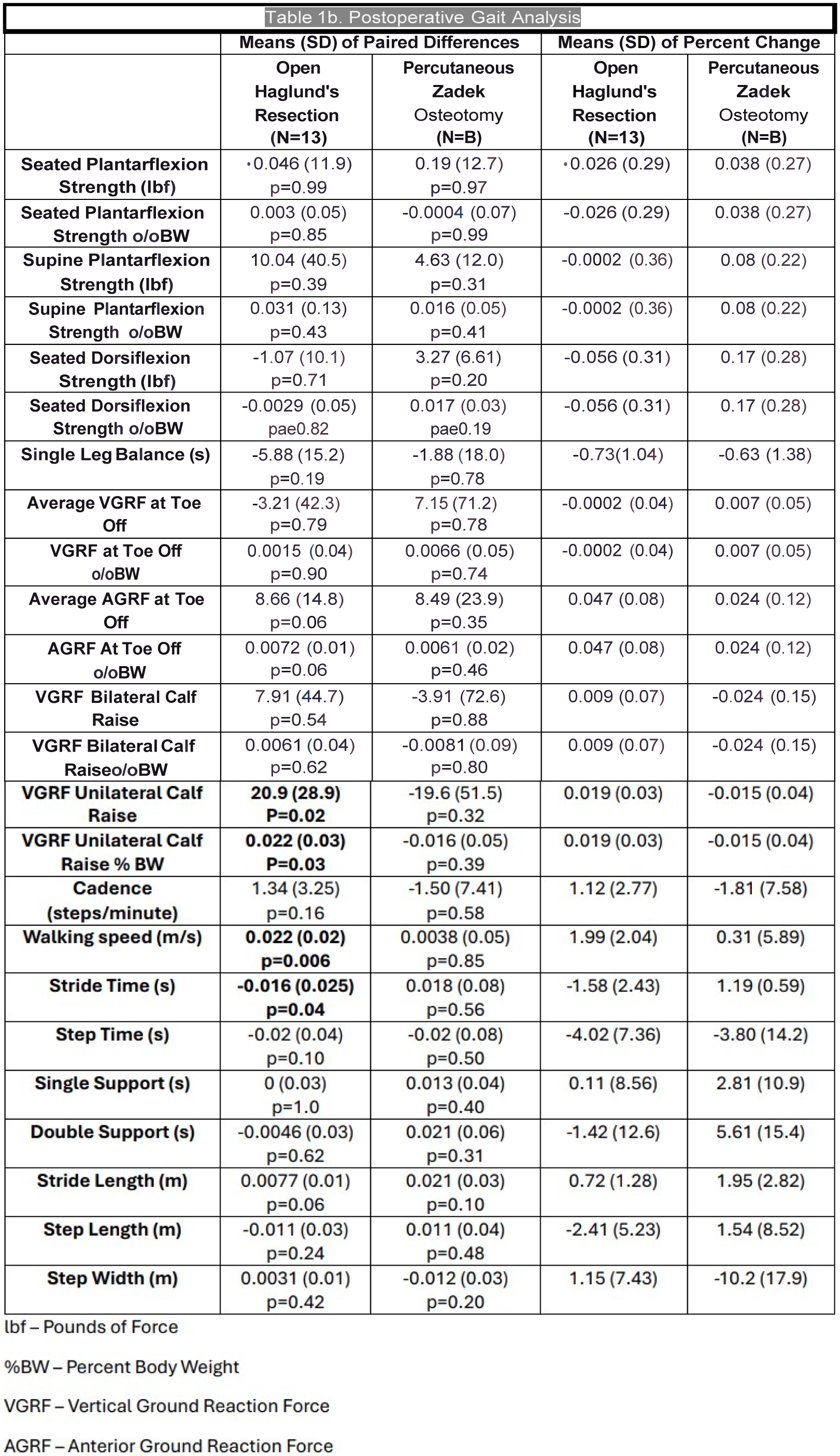
Table 1A. Patient demographics B. Mean (SD) of paired differences (non-surgical side – surgical side) stratified by surgery and means of percent change by surgery comparing non-surgical and surgical sides. Bold indicates significant difference. A negative value indicates that the treatment leg had a higher mean than the control leg.