



Abstract
Background:
Extensor tendon injuries of the foot and ankle are common, and less literature is available regarding its outcome. Ours is an observational study that aims to evaluate the functional outcome of surgical repair of all extensor tendons of the foot and ankle.
Methods:
The study was conducted over a period of 1½ years with extensor tendon injury that was repaired within 24 hours of injury. The patients were followed up for a minimum period of 6 months and the functional outcome was evaluated using the American Orthopaedic Foot & Ankle Society (AOFAS) ankle-hindfoot score.
Results:
A total of 30 patients were enrolled, and that included 15 patients in a prospective study and another 15 patients in a retrospective study. A total of 22 cases were followed up. The major tendons involved were extensor digitorum longus (60%) followed by a combination of 2 or more tendons (30%). Extensor hallucis longus and tibialis anterior were involved in 6.7% and 3.35% of cases, respectively. The mean follow-up was 16 ± 7.8 months, and the mean AOFAS score was 99.36 ± 2.1, with a range of 90-100. The mean pain score was 39.2 ± 9, with a range of 30-40. The mean functional score was 49.36 ± 2.17, whereas the mean alignment score was 10.
Conclusion:
Extensor tendon injuries of the foot and ankle are common injuries that require active surgical intervention. Early repair with a good physiotherapy protocol was associated with excellent AOFAS score and a pain-free limb without deformities in the 22 of 30 patients who were followed up.
Level of Evidence:
Level IV, ambispective observational study.

Keywords
Balance is essential to human existence. Feet aid in maintaining balance and coordination while walking or engaging in other activities. Extensor tendons of the foot are a kind of tendon found in the dorsum of the foot that aid in lifting the toes and the front of the foot off the ground. An injury to the extensor tendon results in dysfunctional ankle movement or toe movement, thereby affecting the individual's daily activities and quality of life.10,14
Extensor tendon injuries in the foot and ankle are not uncommon but are misdiagnosed or neglected. These tendons, especially the tibialis anterior (TA) and other extensors of the foot and toes, are the third most frequent tendon rupture in the lower leg, after the Achilles and patellar tendon ruptures.3 -5 An injury may occur with lacerations sustained over the dorsum of the foot or ankle or in the form of closed injury, leading to ankle or toe movement dysfunction and in the long term may cause various deformities.6,9,10,13
Common mechanisms of injury include direct trauma or closed indirect trauma, such as inadvertently applied plantarflexion force and spontaneous rupture. However, despite its proneness to injury, no definite guidelines are recommended for its repair and the outcome of repair. The common surgical management for extensor tendon injuries is end-to-end repair and reconstruction.
A thorough clinical examination is important, as neglected partial injuries to the extensor tendons of the foot and ankle can lead to complete rupture on full weightbearing, thus leading to foot drop gait and permanent disability. 10 Despite being common injuries, less literature is available to document the outcome.
The present study focuses on evaluating the efficacy of available surgical management for acute extensor tendon injuries of the foot and ankle to evaluate the functional outcome of surgical intervention. The primary objective of the study was to assess the functional outcome of surgical intervention for acute extensor tendon injuries of the foot and ankle, and the secondary objectives were to find the epidemiology of foot extensor tendon injury and to find the association between tendon repair, rehabilitation, and outcome.
Material and Methods
This was an ambispective study that included a retrospective analysis of data of patients from May 2021 to November 2021 and a prospective study from November 2021 to November 2022.
All patients in the age range 10-65 years who presented to our trauma center or in our outpatient department with extensor tendon injuries of the foot and ankle within 24 hours of injury were included. Patients with known diabetes mellitus, wounds associated with soft tissue loss, wounds with a gap between the 2 cut ends of tendon, wounds with associated fractures of leg and foot bones, chronic tendinitis, psychiatric patients, and neurovascular injuries were excluded.
All such patients admitted to our trauma center and in which plastic surgery consultation was sought were screened and informed consent was taken.
All details of the patients such as age, gender, occupation, education, duration of injury, type of injury, type of wound, mode of injury, type of rupture, tendon involved, investigations, associated neurovascular injury, surgical method used, procedure details, complications, and tendon rehabilitation exercises were noted and documented in the pro forma and corresponding Excel sheet. The retrospective data were retrieved from our computerized patient record system and the medical records department, whereas prospective data were evaluated after enrollment and subsequent follow-up with the patients.
Preoperation
All the patients were operated on under local, spinal, or general anesthesia. After debridement of the wound margin, the incision was extended at the border of injury for better exposure of the cut tendon ends. The cut ends of the tendon were debrided and repair was done using a modified Kessler technique using 1-0 (for TA) or 3-0 (for extensor hallucis longus [EHL] and extensor digitorum longus [EDL]). The repair was further reinforced by epitenon sutures using a 5-0 Prolene suture (Figures 1-7). The skin wound was closed with a 3-0 nylon suture followed by dressing. The limb was immobilized in the below-knee slab with the ankle in slight dorsiflexion in the TA tendon injury and with the big toe and other toes’ support in EHL or EDL tendon injury.

Preoperative picture of cut tendons of extensor hallucis longus (EHL) of the left foot.
Postoperative follow-up of extensor hallucis longus (EHL) tendon repair after 11 months showing good extension of the great toe of the left foot.

Preoperative photograph of the cut tendon of tibialis anterior with foot drop as presented in the emergency department.

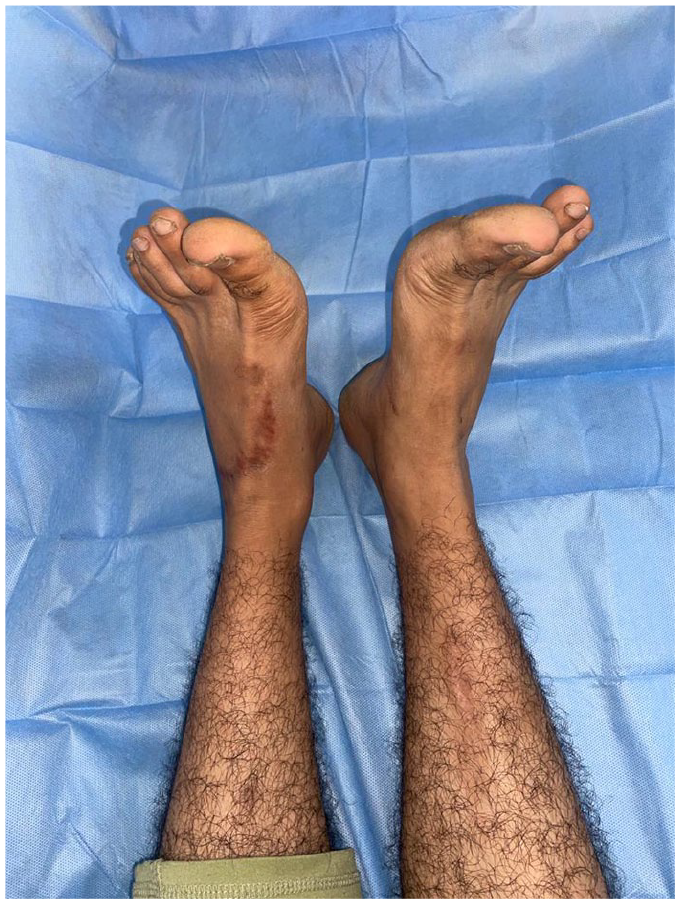
Postoperative follow-up after 1½ years with good dorsiflexion of the foot.

Preoperative photograph of the cut ends of the extensor digitorum longus (EDL) tendon of the right foot.

Intraoperative picture of repaired tendons of the extensor digitorum longus (EDL).

Postoperative follow-up after 2 years; good dorsiflexion movement was achieved in the toes.
The patient was discharged with analgesics and antibiotics and immobilized using a knee slab. Patients were advised to follow nonweightbearing mobilization. Each patient was reviewed for first dressing after 2 days, and sutures were removed after 2 weeks postoperatively. All patients were assessed for measuring the final functional outcome using the AOFAS ankle-hindfoot scale at the minimum sixth month of surgery and follow-up.
Data Analysis
All data were entered into an Excel sheet, and statistical analysis was done using the Statistical Package for Social Sciences (SPSS version 26.0, IBM Corp) for MS Windows. The data on categorical variables are shown as n (% of cases), and the data on continuous variables are presented as mean and SD.
Results
The present ambispective observational study included a total of 30 patients who fit into the inclusion criteria per the study protocol.
Of the 30 patients enrolled in the study, 15 were in the retrospective group and 15 in the prospective group. However, we could follow 22 cases only (Table 1). Five patients in the retrospective study and 3 in the prospective study were lost to follow-up.
Demographic prifile of patients sutained extensor tendons injury of foot & ankle and type of tendons injury in different zones.

Abbreviations: EDL, extensor digitorum longus; EHL, extensor hallucis longus; RTA, road traffic accident; TA, tibialis anterior.
The mean age of the patients was 27.77 ± 9.8 years and within the age range of 11-51 years. In our study, the majority of the acute extensor tendon injuries of the foot and ankle patients were in the age group of 18-35 years (70%), followed by >35 years (23.3%) and <18 years (6.7%).
Male patients (96.7%) were predominantly involved with acute extensor tendon injuries of the foot and ankle compared with female patients (3.3%).
Most of our patients were manual laborers (33.3%), followed by businessmen and students (23.3% each), skilled workers (16.75), and professionals (office-related work) (3.3%), respectively. The educational qualifications of the patients were as follows: 46.7% had completed or were attending high school, 20% had primary education, 13.3% had 12th-grade education, 13.3% had degree education, and 6.7% were illiterate.
Most of the acute extensor tendon injuries of the foot and ankle cases were reported from sharp injuries (91%), followed by crush injuries (10%), and most of these cases were caused by road traffic accidents (50%) and trauma (50%).
Most of our patients presented with complete rupture extensor tendon injuries of the foot and ankle, and the remaining 10% were incomplete rupture.
The majority of the patients presented with EDL tendon injuries of the foot and ankle (60%) followed by a combination of 2 or more tendons (30%), EHL (6.7%), and TA (3.35).
The mean period of follow-up was 16.4 ± 7.8 months with a range of 7-31 months (Table 2).
Outcome of Repair of Extensor Tendons of the Foot With Follow-up.

Abbreviations: AOFAS, American Orthopaedic Foot & Ankle Society ankle-hindfoot score; NA, not applicable.
The mean AOFAS score of acute extensor tendon injuries in foot and ankle patients was 99.36 ± 2.1 with a range of 90 to 100. The mean pain scores were 39 ± 2.9, with a range of 30 to 40. The mean functional score of acute extensor tendon injuries of the foot and ankle patients was 49.36 ± 2.17 with a range of 40 to 50. The mean alignment score was 10 (Table 3).
Descriptive Analysis of the Functional Outcome of Repair Tendons by AOFAS Score.

Abbreviation: AOFAS, American Orthopaedic Foot & Ankle Society ankle-hindfoot score.
Complications
Among the total of 22 patients followed up, 2 patients had marginal suture line necrosis, which was treated with dressings. One patient had suture granuloma, which was treated with the removal of a protruding suture.
Discussion
In our study, males (96.7%) were more likely to sustain acute extensor tendon injuries of the foot and ankle than females probably because of their involvement in more outdoor activities of males in the society like labor work and running small businesses and shops. Al-Qattan 1 also found that EHL tendon injuries were more prevalent in men.
In our series, 90% of extensor tendon injuries of the foot and ankle were complete laceration, whereas 10% were incomplete lacerations. Al Qattan 1 also analyzed in his study about EHL lacerations and found that tendon rupture was complete in 15 patients and partial in the remaining 2 patients.
Cases of acute extensor tendon injuries of the foot and ankle caused by road traffic accidents (50%) and non–road traffic accident-related trauma (50%), which included trauma at the workplace or home, were reported in equal numbers. Al-Qattan 1 also found that most of the injuries were related to industrial accidents. Floyd et al 5 observed in their study that most patients sustained injuries via accidental trauma with sharp objects at home or their workplace, and the remaining were due to road traffic accidents. According to the study by Wong et al, 14 the mechanism of injury in nearly all patients was due to a laceration to the dorsum of the foot or ankle with a pointed or weighty object (glass, knife, mirror, metal object).
There is indeed a lack of literature to support the treatment protocol for surgical repair of all extensor tendons. However, we recommend repairing all tendons for the following reasons. The neglected partial injuries to the extensor tendons of the foot and ankle can lead to complete rupture on full weightbearing, thus leading to foot drop gait and permanent disability. 10 The initial recommendation of nonsurgical treatment of extensor tendons with some good recovery was based on a few cases reports only. The 2 cases of recovery with nonsurgical treatment are often cited as evidence and references that incomplete repair should not be performed. In the same period, other authors mentioned that complete rupture may occur because of previous injury or degeneration of tendons and is often caused by trivial trauma. 10
Many authors now recommend exploring all lacerations over the dorsum of the ankle and foot if there is suspicion of partial or complete lacerations of tendons and should be repaired to avoid any dysfunctions.2,12
Most patients in our study presented with EDL tendon injuries of the foot and ankle (60%), followed by injuries to 2 or more tendons (30%), EHL (6.7%), and TA (3.35%). In a study of different kinds of literature, Floyd et al 5 reported 80 lacerations and found multiple tendon injuries, with a combination of 2 or more tendons in 44% of cases. However, they included all the tendons, including flexors and extensor tendons around the foot. Most of the series included only EHL tendon injuries and did not differentiate EHL injuries from the extensor to the toes. 7
The mean follow-up of all 22 patients of acute extensor tendon injuries of the foot and ankle patients was 16.4 ± 7.8 months, with a range of 7-31 months. In the study by Wong et al, 14 23 patients who had undergone EHL tendon repair or reconstruction were reviewed telephonically after an average follow-up of 5 years (range: 1-10.4 years). Most of the studies available are retrospective in nature, whereas ours is a prospective as well as retrospective study and direct examiner dependent.
Although several scoring systems are available to assess the functional outcome after injury of the ankle and foot, the American Orthopaedic Foot & Ankle Society previously proposed the AOFAS score, which is one of the standard measurement scores to evaluate the outcome around the ankle and foot. This clinical rating system developed by Kitaoka et al 8 combines subjective scores of pain and function provided by patients and objective scores based on a physician’s physical examination.
Another scoring system described by Cöster et al 4 described validity, reliability, and responsiveness of the Self-reported Foot and Ankle Score in the forefoot, hindfoot, and ankle disorders and found acceptable validity. Self-reported outcome has disadvantages in that it is more subjective and patient dependent, which may vary with the patient’s level of understanding and response. However, patient-reported outcomes are well regarded because they frame the level of improvement in the eyes of the patient rather than the medical team, which may have some bias.
In contrast, the AOFAS ankle-hindfoot score is both subjective and objective according to patients and examiners.
The AOFAS score for acute extensor tendon injuries in foot and ankle patients in our study ranged from 90 to 100, with a mean of 99.3 ± 62.1. Wong et al 14 studied EHL injury in 14 of their 20 patients evaluated by AOFAS score and found a total hallux score of 91.7. Our result was slightly better than other studies.
The mean pain score in our patients was 39 ± 2.9 with a range of 30 to 40 pain scores Al-Qattan 1 found that according to the AOFAS Hallux scale, all patients were pain-free (pain score of 40), which is comparable to our study. Wong et al 14 found the average Hallux pain score for their patients to be 34.3. Our patients showed better results compared with other studies, and almost all of them were pain-free.
The functional score of patients with acute extensor tendon injuries of the foot and ankle was 49.3 ± 62.17, with a range of 40 to 50. Wong et al 14 also evaluated the average hallux function score, which was 42.9 (range: 33-45), whereas Al-Qattan 1 showed a mean functional score of 42.1 (range: 40-45). The mean alignment in our patients was 10. Wong et al 14 had an average alignment score for the hallux of 14.5 (range: 8-15) in their patients.
Pedrazzini et al 11 reported on traumatic injury of the TA, EHL, and EDL in a 5-year-old child and concluded that primary repair yielded active dorsiflexion without limitation of range of movement and a painless limb.
However, various studies have reported complications like a painful scar (38%), foot paresthesia (15%), hallux stiffness (10%), persistent hallux droop (5%), and wound complications (5%). 13 We had only 2 patients with marginal suture line necrosis, which was managed with dressing, and another patient required removal of protruding sutures because of stitch granuloma.
There is a lack of data on acute extensor tendon injuries of the foot and ankle, even though they account for a significant proportion of the total number of foot and ankle injuries. Our study reveals the various patterns of acute extensor tendon injuries of the foot and ankle that are broadly distributed by age, gender, injury mechanism, and other parameters. Being retrospective as well as prospective in nature, our study gives more evidence that early repair of extensor tendons of the foot will help in the early restoration of function of the foot and provide early ambulating and pain-free foot.
Wicks et al 13 studied tendon injuries around the foot and ankle in children retrospectively and recommended early exploration of tendons; however, they proposed that EHL and long flexors and extensors are not required to repair. Contrary to his conclusion, we believe that all tendons around the ankle and foot with lacerations should be repaired to provide better functional and aesthetic outcome.
Limitations
Our study includes both retrospective and prospective data, with retrospective data presenting interpretive challenges. A single-center study cannot be extrapolated to predict the disease burden in the general population, whereas a multicenter study will provide additional information and more accurate data. The retrospective cases that were followed up were among those cases operated during the COVID-19 pandemic period, which may not accurately reflect the incidence of injuries during that period. Our study was limited by the small sample size and the short-term follow-up of an average 16 months with a 27% dropout rate. The cases lost to follow-up were not included as it could affect the outcome—what we must assume is the dropouts approximately did as well as the included subjects, but it they did not, the estimates of outcomes would be different.
Also, the type of laceration was not uniform (4 cases of partial laceration) in our study. We tried to evaluate the ankle and foot functions with one scoring system of AOFAS; however, AOFAS great toe or lesser toes would be more accurate for individual tendon injury. Finally, the AOFAS scales have been found to be invalid and may lend to misleading observations.
Conclusion
Extensor tendon injuries of the foot and ankle are common. All patients presented with acute injury over the foot and ankle should be evaluated for tendon injury, which should be repaired accordingly. Most of the patients in our ambispective study found that each of them had a mean AOFAS score of 99.3 after undergoing direct end-to-end repair of the tendons. They become pain-free with a mean score of 39.09 ± 2.942 and mean functional score of 49.36 ± 2.172 based on AOFAS subscales and alignment of 10. Therefore, we believe that carefully performed early repair of extensor tendon injuries of the foot and ankle can lead to good functional outcomes.
Supplemental Material
sj-pdf-1-fao-10.1177_24730114251337450 – Supplemental material for Evaluation of the Short-term Functional Outcome of Repair of Acute Extensor Tendon Injuries of Foot and Ankle
Supplemental material, sj-pdf-1-fao-10.1177_24730114251337450 for Evaluation of the Short-term Functional Outcome of Repair of Acute Extensor Tendon Injuries of Foot and Ankle by Anwar Shareef KK and Raj Kumar Manas in Foot & Ankle Orthopaedics
Footnotes
Ethical Approval
The study was approved for ethical clearance by the AIIMS Institutional Ethical Committee with the approval number IECPG-583/28.10.2021, RT-19/25.11.2021.
Declaration of Conflicting Interests
The author(s) declared no potential conflicts of interest with respect to the research, authorship, and/or publication of this article. Disclosure forms for all authors are available online.
Funding
The author(s) received no financial support for the research, authorship, and/or publication of this article.

References
Supplementary Material
Please find the following supplemental material available below.
For Open Access articles published under a Creative Commons License, all supplemental material carries the same license as the article it is associated with.
For non-Open Access articles published, all supplemental material carries a non-exclusive license, and permission requests for re-use of supplemental material or any part of supplemental material shall be sent directly to the copyright owner as specified in the copyright notice associated with the article.
