Abstract
Category:
Hindfoot; Trauma
Introduction/Purpose:
Calcaneal fractures, commonly caused by high-energy trauma, present significant challenges for orthopedic surgeons. Open reduction internal fixation (ORIF) is a widely used surgical technique for managing these fractures; it can lead to subtalar joint arthritis and pain, requiring subtalar fusion when conservative treatments prove ineffective. Understanding the risk factors associated with subtalar fusion (STF) after calcaneal ORIF is crucial for optimizing patient outcomes and treatment strategies. In this study, we aimed to comprehensively evaluate these risk factors, including patient demographics, medical comorbidities, same day and 90-day reimbursement data.
Methods:
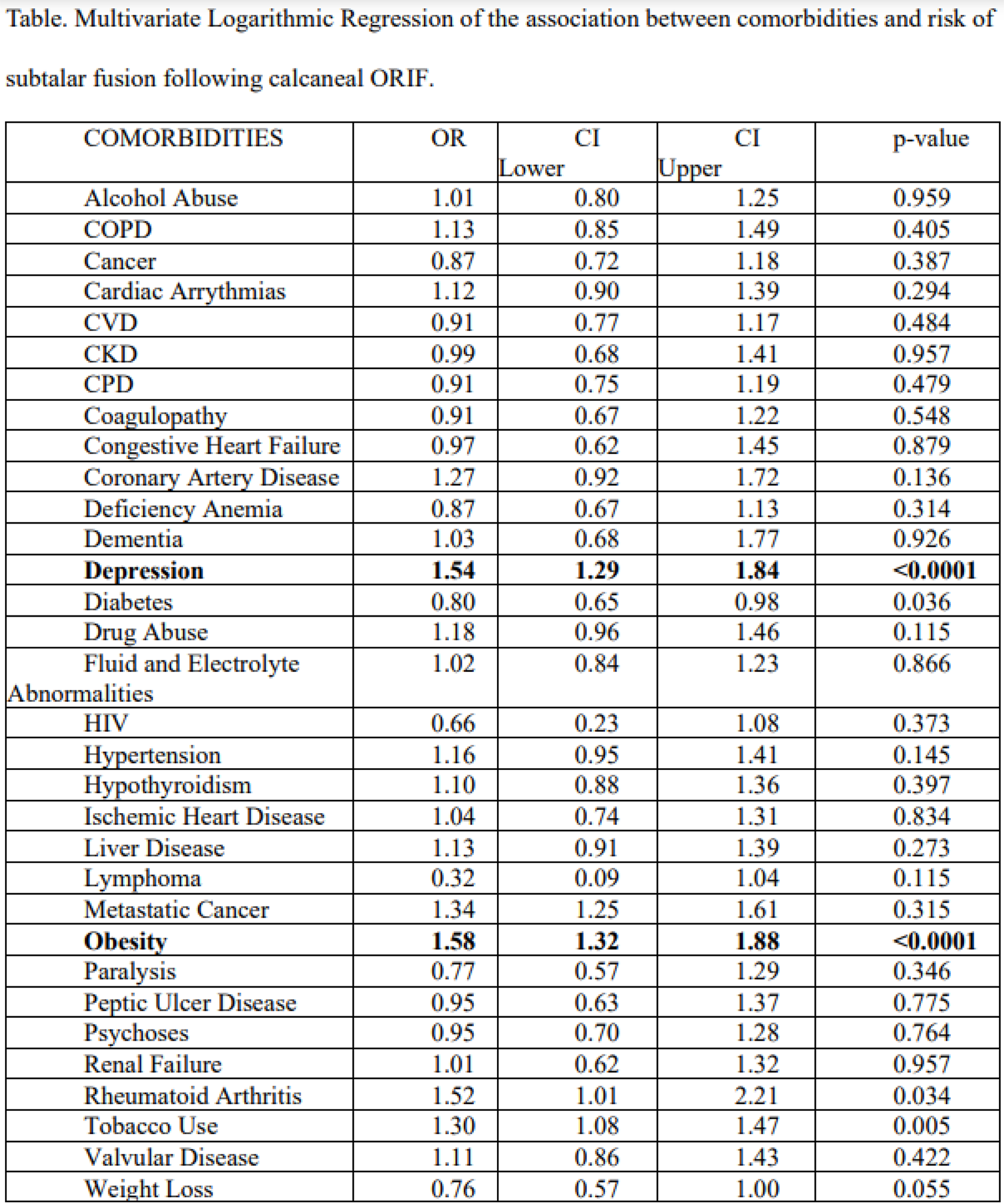
A retrospective analysis was performed using the PearlDiver Mariner 157 national claims database from January 1st, 2010 to October 31st, 2021. Patients who underwent calcaneal ORIF, identified using Current Procedural Terminology (CPT) and International Classification of Diseases (ICD-9, ICD-10) codes, were queried for 5-year rates of STF and reimbursement data. Patient demographics and comorbidities were recorded, and multivariate logistic regression was employed to determine the association of risk factors with STF. A p-value of less than 0.001 was considered significant after performing a Bonferroni correction.
Results:
Patients with STF had a higher proportion of alcohol abuse (21.3% vs. 16.2%), depression (58.1% vs. 43.1%), drug abuse (29.1% vs. 19.7%), obesity (40.3% vs. 28%) and tobacco use (62.2% vs. 50.3%), all exhibiting a p-value of less than 0.001. Those with depression (OR: 1.54; 99% CI:1.29-1.84; p< 0.001) and obesity (OR:1.58; 99% CI: 1.32-1.88; p< 0.001) as comorbidities had a higher odds ratio of association ith STF within 5 years following calcaneal ORIF.
Conclusion:
Our study demonstrates that patients who ultimately required STF within 5 years of calcaneal ORIF had higher rates of alcohol abuse, tobacco use, drug use, obesity, and depression prior to ORIF. In addition, there was no significant difference observed between those with and without STF in average same-day and 90-day reimbursements and demographics. Future patients with a calcaneal fracture along with multiple risk factors listed above should be in consideration for primary surgical fusion over calcaneal ORIF, with additional studies needed to aid orthopaedic surgeons in this decision making.