Abstract
Category:
Sports; Ankle
Introduction/Purpose:
Previous studies still have conflicting views on the size of the ossicle during ligament repair after ossicle removal. However, there is no standard for measuring the size of the ossicle. Furthermore, ossicle has various sizes, shapes, and positions. This study aimed to investigate the subfibular ossicles' morphologic characteristics and correlations with variables and to determine the clinical outcomes of ossicle removal and ligament repair.
Methods:
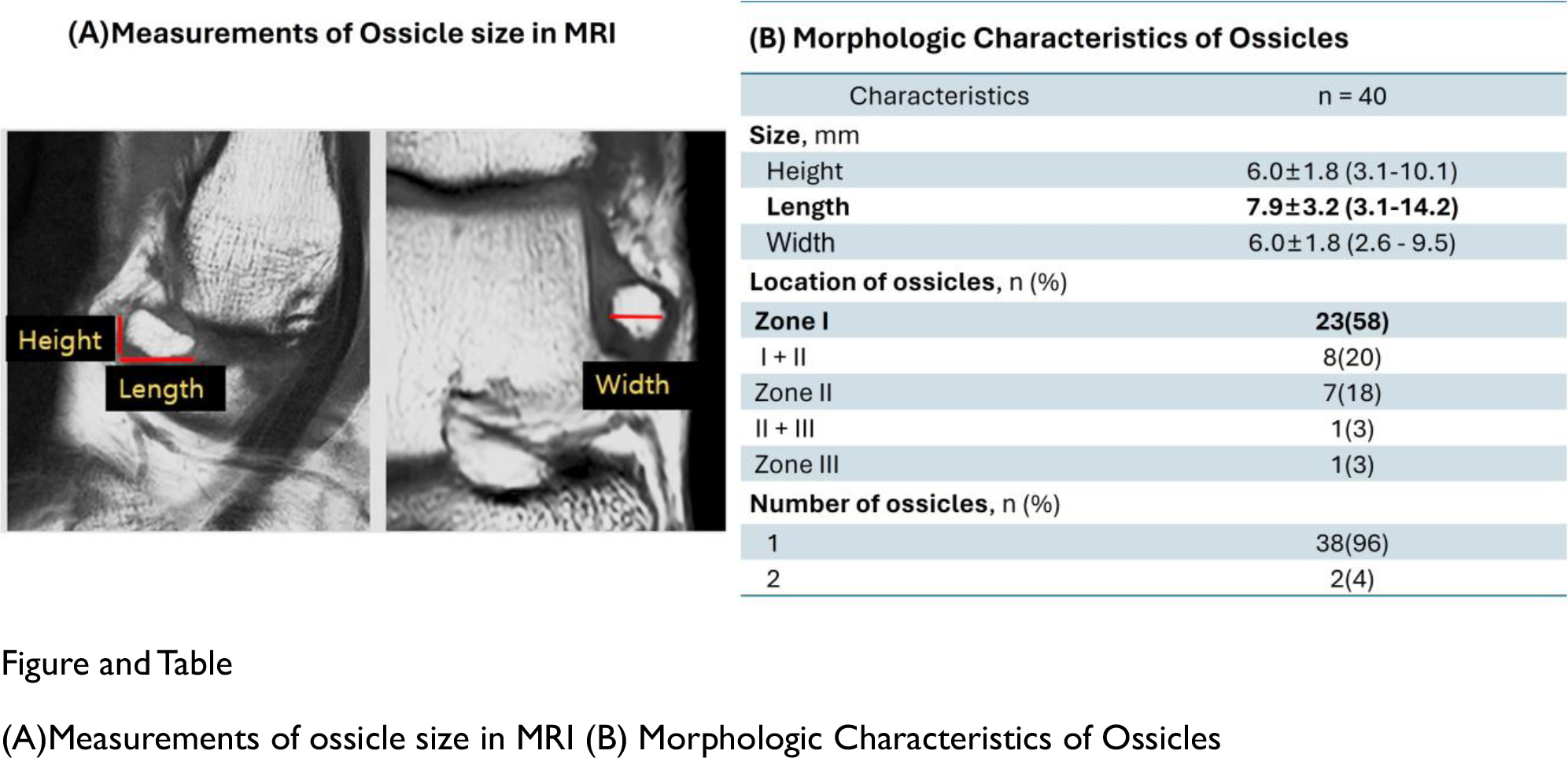
From February 2012 to December 2022, we retrospectively studied patients who underwent ossicle removal and MBO for chronic lateral ankle instability. Patients with degenerative arthritis, a history of previous ankle ligament surgery, or bilateral subfibular ossicles were excluded. The ankle stress radiographs were taken, and anterior drawer distance and talar tilt angle were obtained. The size, location, and number of ossicles were evaluated on MRI and radiographs. The location of the ossicle was classified into three zones according to the insertion of the ankle ligaments. Ossicle size measurements in MRI were as follows: length: anterior-posterior distance, height: superior-inferior distance, width: medial-lateral distance. The greatest distance among the coronal and sagittal images was measured, respectively. Clinical results were assessed using the Karlsson-Peterson (KP) ankle score and Foot and ankle outcome score (FAOS).
Results:
Forty ankles out of 477 patients were included. As for the location of ossicles, the ATFL attachment site was the most common with 57.5% (23/40), the CFL attachment site was 17.5% (7/40), and the case that spanned both ATFL and CFL was 20% (8/40). Most showed one ossicle, but 5% (2/40) of ankles showed two. Ossicles with a length greater than 10 mm in the sagittal view were 30% (12/40). At the last follow-up, all clinical scores improved significantly. There were no significant differences in preoperative radiographic instability, ossicle size, and clinical outcomes according to ossicle location. Ossicle width showed a significant correlation with anterior drawer distance (Pearson coefficient=0.437, p=0.033). Ossicle size showed no significant correlation with clinical scores at the last follow-up.
Conclusion:
For chronic ankle lateral instability with ossicle, ossicle removal and Brostrom ligament repair can achieve good clinical results. The size and location of ossicles had no significant correlation with post-operative clinical outcomes. Depending on the width of the ossicles, instability is thought to be related to which anatomical ligaments are involved and how much.